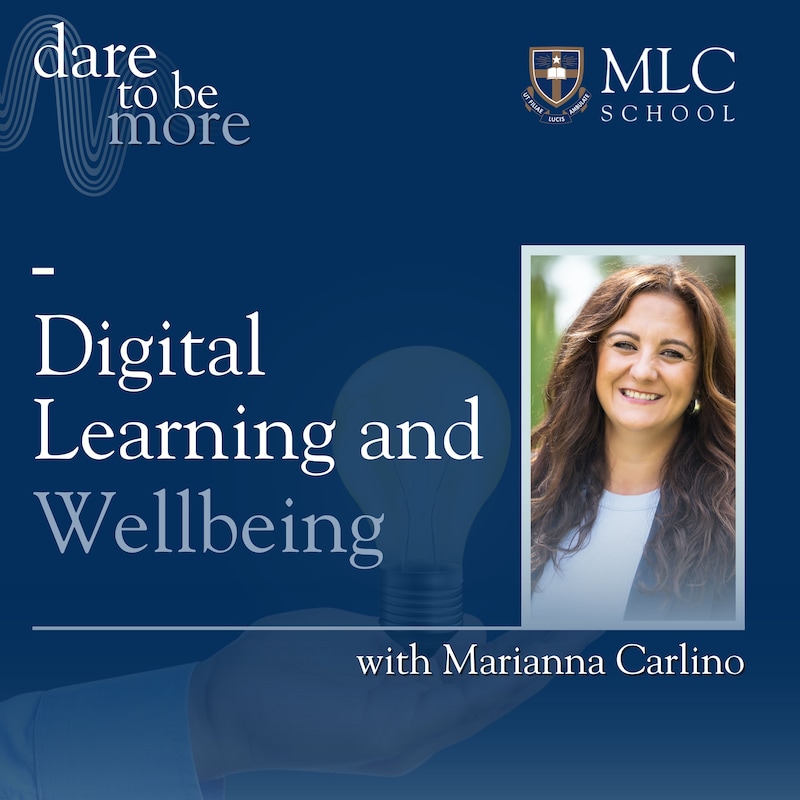
Shownotes
In this forward-thinking episode of "Dare to Be More," host Anthony Perl speaks with Marianna Carlino, Director of e-Learning at MLC School, about how technology is woven into every aspect of school life — and how MLC is leading the way in preparing girls to use it responsibly, creatively, and confidently.
Marianna covers everything from touch typing in Year 2 to AI ethics in Year 12, and shares how MLC's triangular approach — connecting students, staff, and parents — ensures everyone is on the same page when it comes to digital citizenship.
Featured Guest: Marianna Carlino, Director of e-Learning at MLC School
In This Episode, You'll Discover:
- How MLC integrates technology from Pre-K through to Year 12 in age-appropriate ways
- Why MLC is one of the first independent schools in NSW to hold a full Microsoft Copilot licence
- How the school teaches AI ethics, academic integrity, and responsible use of technology
- Practical strategies for parents to set healthy device boundaries at home
- The importance of balancing screen time with human connection and social interaction
Key Topics Discussed:
- Technology integration across all year levels and faculties
- AI in education — opportunities, ethics, and academic integrity
- Cyber safety, digital footprint, and online reputation
- Social media, the new age restrictions, and their impact on students
- The school-home partnership in managing device use
- Mitigating teacher burnout through smart use of technology
About MLC School: MLC School is a leading independent girls' school in Sydney, committed to empowering young women through academic excellence, character development, and innovative education. Our mission is to inspire girls to dare to be more.
Connect With Us:
- Website: mlcsyd.nsw.edu.au
- Instagram: @mlcsydney
- Facebook: @MLCSchoolSydney
- LinkedIn: MLC School
Co-host: Anthony Perl
- Produced by: 'Podcasts Done for You'
Hashtags: #DigitalLearning #CyberSafety #MLCSchool #AIinEducation #GirlsEducation #DigitalCitizenship #DareToBeMore
Transcripts
How do we prepare girls to thrive in a digital world and
2
:keep them safe while doing it?
3
:Today I am joined by Mariana Carlino,
director of E-Learning at MLC School.
4
:In this episode, we explore technology and
education, including how MLC integrates
5
:digital learning from pre-K to year
12, the school's approach to AI and
6
:academic integrity, navigating social
media and cyber safety, and how parents
7
:can support healthy tech habits at home.
8
:I'm your host, Anthony Pearl.
9
:Let's begin today's conversation.
10
:Well, hello everyone and welcome to
another episode of Dare to Be More,
11
:and I have Marianna with me today
and we have a very interesting topic.
12
:As we were just saying before
we kick things off, there's
13
:multi-layers to this one.
14
:So let me firstly welcome
you to the program.
15
:Marianna: Thank you so much for having me.
16
:It's so exciting to have the
opportunity to talk about everything
17
:e-learning, especially in our
beautiful community, MLC School.
18
:Anthony: Fantastic.
19
:Well, before we get into all of that, why
don't you introduce yourself to everybody?
20
:Marianna: So, I'm Mariana Carlino.
21
:I'm the Director of
e-Learning at MLC School.
22
:Essentially what that means is
I help and support staff and
23
:students in using pedagogy and.
24
:Learning acquisition, using technology
in that space, all across all faculties
25
:and all year levels, including wellbeing.
26
:I also support staff as well as
any kind of principal support or
27
:anything that needs to happen.
28
:I'm in that space as well, and I run
a lot of webinars for parents as well.
29
:In that space, I look after not just
digital skills, how to use tech, but also
30
:the cyber safety component for students.
31
:And I cover a lot of different
areas dependent on the year
32
:group that I am addressing.
33
:Anthony: It's a really important area
and it's one that is changing at such
34
:a rapid rate and many parents will
remember a time when digital wasn't
35
:even really a thing in school and now
it's interwoven so much into kids from
36
:really from a very early age, isn't it?
37
:Marianna: Yes, absolutely.
38
:We have the use of technology from
the very start, from pre-K, in
39
:fact, all the way through to year
12 different levels, obviously, of
40
:integration of tech in that space.
41
:For different purposes, I guess.
42
:But yes, there is always some sort of
constant use of text throughout the week.
43
:Not necessarily every day for
the younger year groups, but
44
:definitely a couple of times a week.
45
:But as they get older, it's more and
more within their reach of learning.
46
:Anthony: That within itself is
an interesting approach because.
47
:I guess there are many schools
where technology, particularly the
48
:use of computers and whether it
be an iPad or an actual laptop,
49
:doesn't come in until later on.
50
:And the problem with that is, is that
you're assuming a level of knowledge
51
:of how to use things that you are
educating really from very early phases.
52
:Of what to do and how to do it.
53
:Marianna: Yeah, absolutely.
54
:So we currently have a one to two
ratio for K to two students of iPads.
55
:So in junior school's, iPad,
in senior school it's laptops.
56
:And then from year three, all the
way to year 12, it's one to one.
57
:Some of them are BYOD and some are.
58
:Provided by the school
community, uh, in junior school.
59
:So far, we are sort of in control of the K
to four devices, and that will continually
60
:roll out throughout all the years.
61
:And we do spend, I do spend some time,
for example, just recently I've spent
62
:some time with year two on touch typing.
63
:I've spent some time with year
seven on how to use word in
64
:the basic kind of fashion.
65
:I've spent some time with year five on
how to use PowerPoint and animations.
66
:I cover all of those simple skills that
we assume they know how to do, but not
67
:necessarily really know how to do it.
68
:I break it down in little bite-sized
chunks that can kind of digest quite
69
:easily and create a whole lot of
resources, whether it's videos that
70
:supports them in an instructional
fashion or steps that they can choose
71
:to follow instead of watching a video
and they can refer back to that.
72
:Then that's across the
board all the way through.
73
:I probably starting year two with
that space, sometimes in year one
74
:and go all the way up to year 12.
75
:Anthony: And we tend to
gloss over it these days.
76
:But you touched on it there, typing.
77
:Marianna: Yes.
78
:Anthony: Uh, you know, it used to
be a skill that you, certain people
79
:went outside and learned that, and it
was a thing on your resume about how
80
:many words a minute you could type.
81
:Mm-hmm.
82
:Nowadays we just kind of
expect that it can happen.
83
:Marianna: Yes.
84
:Anthony: But it's so important, isn't it?
85
:Because you get to the point where
they might be taking notes and
86
:doing things and AB being able
to type at a speed is important.
87
:Marianna: Absolutely.
88
:So at in our community, at MLC School,
we have a subscription from year two,
89
:right through year six for touch typing.
90
:So girls that move in from junior school
into senior school have quite a high
91
:level of ability to to touch type.
92
:The students that come in year
seven, we spend some time on
93
:focusing and helping them out.
94
:A lot of them come knowing obviously
how to type because it's just part
95
:of their makeup of their society.
96
:It's just about being efficient in
typing and knowing how to embed a
97
:certain speed, because if they do
choose to take notes on their laptop,
98
:then they need to keep up obviously
with what's happening in the classroom.
99
:Although in the young years, we do
tend to suggest the standard exercise
100
:book and writing notes down there is
still quite a lot of work on their
101
:laptop in seven, eight, and nine
that do require some typing skills.
102
:So we work on that and we work on
making sure we support the students
103
:in that growth, particularly from
junior school into year seven.
104
:Anthony: I think it's interesting too,
that balance between typing and writing.
105
:Because you certainly writing can
help you memorize things and I don't
106
:know whether typing does has the
same impact in your learning process.
107
:So there is something to be said
for that touch field that you have
108
:when you are putting pen to paper
and finding that balance everywhere
109
:and with the use of technology.
110
:And I imagine that's
difficult thing to navigate.
111
:Marianna: But you know, there's
different learning styles.
112
:Every student, every individual, every
human has a different way to learn.
113
:Some people like to have
tactile, some people need audio.
114
:Some people need visual stimulation.
115
:It really is dependent on that
individual's learning style, and
116
:sometimes it's a couple of different
ways that they can learn based on the
117
:subject that they're trying to acquire.
118
:It is definitely a balance.
119
:I always say every time I'm
running any workshops, whether
120
:it's with staff or students or even
parents, it is about a balance.
121
:That technology is a tool.
122
:It's not a hindrance.
123
:It's meant to be something that's added
upon, you know, your toolkit for learning.
124
:And we have to make sure that we educate
our students on the best way to use
125
:that to better their acquisition of
knowledge, and not to just replace
126
:learning, but to aid learning.
127
:Anthony: Yeah, and I think that's
such an important idea in of itself,
128
:particularly the way technology is
going with the use of AI in particular.
129
:And you know, things like note taking
apps and there's a lot out there that can
130
:assist, but it doesn't necessarily mean
that you're not going to be learning you.
131
:You still have to do that
132
:Marianna: part.
133
:Absolutely.
134
:So we at MLC School, I believe, are
ahead of the game in the AI space.
135
:We have an AI task force that has been
developed since last year, and we are
136
:one of the first independent schools in
New South Wales to have the full license
137
:of copilot, which is the AI component of
Microsoft through all the different apps.
138
:Now, the students don't have
access to that just yet.
139
:There is tool that they are gonna
drop that age limit to 13 plus in
140
:September, and that will be something
that we'll be navigating and exploring.
141
:Down the track, so obviously to
allow students to use it as a tool
142
:fashion, but we have had opportunities,
well, I have had opportunities
143
:in the task force committee.
144
:I've had opportunities to talk to
students about the importance of using.
145
:AI in a ethical way, in an efficient
way with academic integrity
146
:and what steps that looks like.
147
:So we're currently developing flow
charts for students to follow.
148
:We're currently developing little videos
of how to best practice in use of ai.
149
:We've done that all with teachers and
we've done that for the last 12 months.
150
:And our teacher body art,
incredible at the use of.
151
:Efficiency in that space.
152
:And it's not about saving time, it's
about, you know, the efficiency of their
153
:time in the use of AI and how that has
allowed rich development of resources and
154
:the opportunity to really connect in a
deep fashion with their students or peers.
155
:And we would like that
for our students as well.
156
:We'll be running little workshops for
year 12 in preparation to help them in
157
:towards their IB or HSC exams that are
coming up shortly, um, before we know it.
158
:And also we have.
159
:You know, supporting year 10, going
into stage six and everything else.
160
:We've got some plans that will occur
in the rest of the year where we will
161
:support students learning in the use of
AI in an ethical fashion, which is key.
162
:Anthony: Absolutely it is, isn't it?
163
:Because it's like any technology,
there's so much opportunity for it to
164
:be misused and there's the ethics of it,
but there's also the fact that you're
165
:doing it yourself a disservice as well.
166
:Marianna: Absolutely.
167
:It's a tool, and that's
the key thing, right?
168
:So learning.
169
:The benefit of the students that we have
nowadays is that they have a plethora
170
:of tools that can aid their learning.
171
:They have so much at their fingertips
that I wish I had when I was going
172
:through school, or maybe not,
maybe because I didn't have them.
173
:I've got certain skills that they really
have to work at developing, but they
174
:had everything at their fingertips,
and it was our duty as educators
175
:to teach them how to use it best.
176
:Whether it's actual skill sets on
how to use Word or PowerPoint or
177
:Outlook or anything like that in time
management, organizational skills in
178
:development and production of work.
179
:Or whether it's how to use tools
to help that if they're stuck.
180
:How can you use AI to help
you if you need support?
181
:How can AI step in to help you out?
182
:If you still need a little bit
more feedback on something and
183
:you want a different perspective,
how can AI help you in that space?
184
:So it's about educating.
185
:It's not about putting our head
under the sand and ignoring what's
186
:happening because they're using
it whether we like it or not.
187
:They're gonna use it.
188
:And so it's about redesigning assessments,
for example, thinking about how PE
189
:pedagogy is gonna work, thinking
about flipped learning, for example.
190
:There's a lot of ways that we as
educators can adapt and mold to allow
191
:AI to be exactly what we need it to
be, a supporting tool for our students.
192
:Anthony: Yeah, and I think what's
important about all of this as well is
193
:that there's an expectation when they
advance from school and perhaps beyond
194
:university and get a job, that there's
an expectation that you know how to
195
:use all of these things these days.
196
:And so being able to learn it
from a very early age is important
197
:and to a degree expected.
198
:Marianna: Yeah, it's absolutely our duty.
199
:And at MLC School, we are about.
200
:The student where we all are about what
the girl needs and the inner light.
201
:And part of that is our
society is very future focused.
202
:We don't know what jobs are going to
exist in five years, yet 10 years.
203
:But we do have the role in being able
to develop our graduates to deal with
204
:whatever may come their way in society
and you know, be great humans with
205
:kindness and know how to act accordingly
in situations that are online.
206
:And that's a lot of conversations
that I have with 10, 11, and 12.
207
:About the ability of having respectful
relationships and consent and
208
:understanding the pros and cons of
social media, for example, and how that
209
:can affect your dig reputation, your
digital footprint, how then can have
210
:ripple effects to your future self.
211
:And these are all things that, you
know, if you don't know, you dunno.
212
:So it, it is absolutely in my vision to
ensure that I know that our graduates.
213
:Covered are covered in all that
aspect and that they are safe and
214
:that they know how to be great
lights in community moving forward.
215
:Anthony: I did wanna touch on as
well that I imagine that for many
216
:students when they go home, they're
already well in advance of perhaps
217
:what their parents and probably their
grandparents might have the knowledge
218
:in as far as technology is concerned.
219
:So it is important that they have a grasp.
220
:On it in a way that is going to
be used in a sensible fashion and
221
:perhaps even that understanding that
when they go home, people at home
222
:may not know as much as they know.
223
:Marianna: Yeah.
224
:And we work really hard to have that
triangular kind of relationships.
225
:Right.
226
:So we have the, the student at one end,
we have ourselves on one point, and then
227
:we have the parents on the other point.
228
:And so those webinars that I run are
purely to inform parents, well, this
229
:is where we're at, this is what your
daughter's exposed to here at MLC School.
230
:This is what could happen
outside of MLCC school.
231
:This is what we've told her.
232
:The steps and strategies we, we've
taught her to deal with maybe
233
:challenges that might come across.
234
:And we've exposed her to say like the
eSafety Commissioner in different areas
235
:that they can go to if they need support.
236
:And it's about communicating with the
parents exactly what we've done for
237
:their daughter and what we're asking
them to do, which is basically have open
238
:communication, ensure that there's really
clear boundaries about device use at
239
:home, ensuring that they are aware of what
their daughter's doing online because.
240
:We're not with them.
241
:We're only with them at a certain
amount of time, and we wanna make sure
242
:that everyone is on the same page and
understanding that it's about life
243
:journey, academic rigor in a tech world
that is only gonna be more and more
244
:technology driven, and we need to make
sure that they have the right skills
245
:and the right equipment to succeed.
246
:Anthony: It wasn't that long ago that
when you went home from school, you were
247
:away from all friends and everybody else,
but now they're there at your fingertips.
248
:And so, you know, there's positives
and obviously there are negatives,
249
:particularly when you think about,
you know, online bullying and
250
:things that can happen as well.
251
:Marianna: Yeah.
252
:Anthony: You know, and being educated
on that must be, you know, it's
253
:incredibly important for that to happen.
254
:You know, how do the girls cope with that
whole idea of drawing those boundaries and
255
:knowing, knowing what is the right thing
to do and what's the wrong thing to do?
256
:Marianna: Gosh, we definitely have a
mixed bag of reactions and realities
257
:in our community like you would expect.
258
:I mean, removing tech aside, there is
always those nuances of high school
259
:in general when it comes to a whole
lot of different personalities.
260
:Being almost forced to be in one
journey together and learning how to
261
:navigate that is complex in itself.
262
:And then you add the layer of
tech, which is almost, has a bit of
263
:anonymity because you can kind of
hide a little bit behind your screen.
264
:Right?
265
:So we talk really significantly about
the importance of respecting boundaries,
266
:that there are different rules in
different homes, and to accept that.
267
:So for example, one of the best.
268
:Examples that I give is that I have a
daughter in year nine and our family
269
:rule around device is that after
nine o'clock, she's not to have it.
270
:It comes upstairs, it's nowhere near her.
271
:She goes in her room.
272
:It might not be, she might not go to bed
at nine, it might be nine 30 or 10, but
273
:she's not to have her device after nine.
274
:And at first her friends thought
that she was ghosting them.
275
:After nine, as they say, you know, teen
talk, but in reality that's not the case.
276
:Obviously she would love to be on that
device all the time, 24 7, no problem.
277
:But it is our ju as parents
to say, no, no, that's it.
278
:Cut off time.
279
:You need a bit of downtime or
some family time or whatnot.
280
:Um, and so her friends have had to learn
to navigate that and understand that
281
:if they message her after nine, they're
not gonna get a response until they
282
:see her again at school the next day.
283
:And she's in year nine, she's 15.
284
:And there's different levels of that.
285
:Some families have, and the flip
side for me, the challenges are
286
:that some of their friends have
full, full scope to everything.
287
:All the time.
288
:At any time.
289
:And I have that conversation
with, well, they get to have it.
290
:Why can't I?
291
:Well, it's not really about that.
292
:We need to respect both
sides of what's happening.
293
:But the reality is that we as parents
need to, and I say this to our
294
:parent body, we need to be able to
set boundaries to ensure that we.
295
:Teach them balance and that is
hard in, in the school community.
296
:We talk about that.
297
:We talk about tech balance, right?
298
:We don't want them when they're
tech at recess, recess and lunch.
299
:We want them to socialize
with their mates.
300
:We don't want the particularly
year 11 and 12 that are allowed
301
:to have their mobile phones.
302
:We have suggested don't
have them out at all.
303
:At recess.
304
:Recess and lunch, seven to 10.
305
:They're not allowed to have them,
but they do have their laptops and
306
:so we did see sometimes students on
their laptops at recess and lunch.
307
:So we presented a whole different
presentation assembly, as well
308
:as luminaries, talking about the
importance of human connection and the
309
:importance of balance in our classes.
310
:We're not always on our laptops.
311
:It is a combination of a series
of different tools for learning.
312
:Yes, we do get our timetable on our
laptops, and yes, we communicate
313
:through Outlook and yes, our LMS
is on our laptops, but it's not.
314
:The only way that we teach, and
it's not the only way that we
315
:expect them to learn as well.
316
:So we talk about that quite largely.
317
:Not just me, but every
staff member does that.
318
:The luminaries do that.
319
:The year coordinators do that.
320
:The faculty hos we're all on
the same page and we are just,
321
:you know, data time bit by bit.
322
:And if we encounter issues that maybe a
cohort maybe is like navigating a pathway
323
:where they're a little bit uncertain on.
324
:They're using too much tech.
325
:Then we hone into that home cohort and
help them understand how to rebalance.
326
:It's just about learning.
327
:It's about trial and error and learning
what we can and can't do with tech.
328
:And if we don't tell them and
we don't educate them, then
329
:how can we expect them to know
330
:Anthony: what absolute, absolutely.
331
:I, I did just wanna touch on briefly
as well, social media, because Yeah.
332
:We're, we're in a situation
where those laws are changing.
333
:You've been involved with kids
and obviously you've got your own.
334
:Marianna: Yes.
335
:Anthony: Social media has been
a part of kids up until now.
336
:Yes.
337
:Those things are about to change it.
338
:How do you find that
balance in social media?
339
:Because it can be a positive, but
there are a heck of a lot of negatives.
340
:Hence the reason why
the laws are changing.
341
:Marianna: Yeah, absolutely.
342
:Look, that is such a complex question.
343
:There are so many layers to consider.
344
:There's, you know, the age that,
that students jump on social media.
345
:There's the communica, the
community aspect of social media.
346
:There's also the learning aspect.
347
:There's a lot of things on, for
example, Instagram that are great
348
:for learning as well, that students
do search for to help them with say,
349
:mathematical equations or whatnot.
350
:Or maybe English quotes or whatever it
is, and it does support them, but it's
351
:about being able to learn how to use
that in a way where it doesn't hinder
352
:your wellbeing in a way where it's not
affecting your self image in any way.
353
:And that's really complex
in a girl school as well.
354
:It is widely known that you know
students between the ages of 13 and 16.
355
:Struggle a little bit with self-image,
particularly girls and Instagram has
356
:not helped that with everything that's
happening with AI and deep fakes as well.
357
:So we talk heavily about the importance
of being safe online and ensuring
358
:that their profiles are private and
things have changed legally, that
359
:they do not have access to that.
360
:And there's a different level
of reaction from students.
361
:Some are absolutely gobsmacked, and
then others are like, oh, that's okay.
362
:I see them at school.
363
:I can always call them, I'll cope.
364
:So it, there's different levels of
reactions and that really base is based
365
:on, you know, personality and family
direction when it comes to device use and
366
:just a general outlook on their, on how
it's going to affect their personal world.
367
:Not necessarily bigger picture,
but just their little silo will.
368
:How is that going to affect them?
369
:Look, they'll navigate it and it'll be
adapting that it'll be very interesting
370
:in the educational space how that's
gonna look for us educators, both
371
:for a wellbeing perspective as well
as a pedagogical aspect as well.
372
:So, but, you know, look,
we, educators are tough.
373
:We get through everything
and we'll figure it out.
374
:Um, and it's always with, with the main
focus on the best possible outcome for
375
:our students and support for staff,
because teacher burnout is so real.
376
:For me, the use of technology, my whole
thing, my whole vision, my whole focus is
377
:mitigating teacher burnout and how tech
can support teachers to allow that moment
378
:of breathing that really has not occurred
for a while, especially after COVID.
379
:It just seems to be constant and all the
way sprinting to the end of every term.
380
:Anthony: Yeah, I can imagine
it is a difficult world to
381
:navigate with all of this stuff.
382
:There is so much more that we could
potentially explore with this, but I
383
:think you've given us some great insights.
384
:Just before we wrap up, I wanted to
ask you a question that I'm asking
385
:everyone that's coming on the program
dare to be more in the context of
386
:what you do in the digital space.
387
:What does dare to be more mean?
388
:Marianna: I think Dare to be more
in e-learning or in a tech space is.
389
:How can you be a light that shares
love and laughter and kindness
390
:and community through tech?
391
:How can tech allow you to flourish
to the best that you can in whatever
392
:career path that you choose to have?
393
:How can I dare to be more and support
my peers and ensure that they have
394
:everything they need to be the best
possible educators, but also feel
395
:supported and feel like they're safe?
396
:How can we dare we want just to connect,
not just online, but even offline.
397
:How can that help that space as well?
398
:Anthony: Fantastic.
399
:Thank you so much for
being part of the program.
400
:No
401
:Marianna: problem.
402
:Anthony: I've really enjoyed that
very deep discussion and there's
403
:a lot for parents to be thinking
about and thanks for sharing.
404
:Marianna: Thank
405
:Anthony: you so much.
406
:Thank you for joining
us on Dare to Be More.
407
:If you enjoyed this episode, please
subscribe wherever you get your
408
:podcast so you never miss an episode.
409
:Your likes and comments also
help more families discover
410
:these valuable conversations.
411
:For more information about MLC School
and their approach to girls' education.
412
:Visit their [email protected].
413
:Check out the show notes
for more information.
414
:The Dare To Be More Podcast is
produced by podcast done for you.
415
:I'm your host, Anthony Pearl,
and we invite you to join us next
416
:time as we continue to explore
what it means to dare to be more.
