Artificial intelligence promises faster delivery, lower costs and extraordinary productivity. But what happens when the people expected to use it do not trust it, do not understand it or believe it could ultimately replace them?
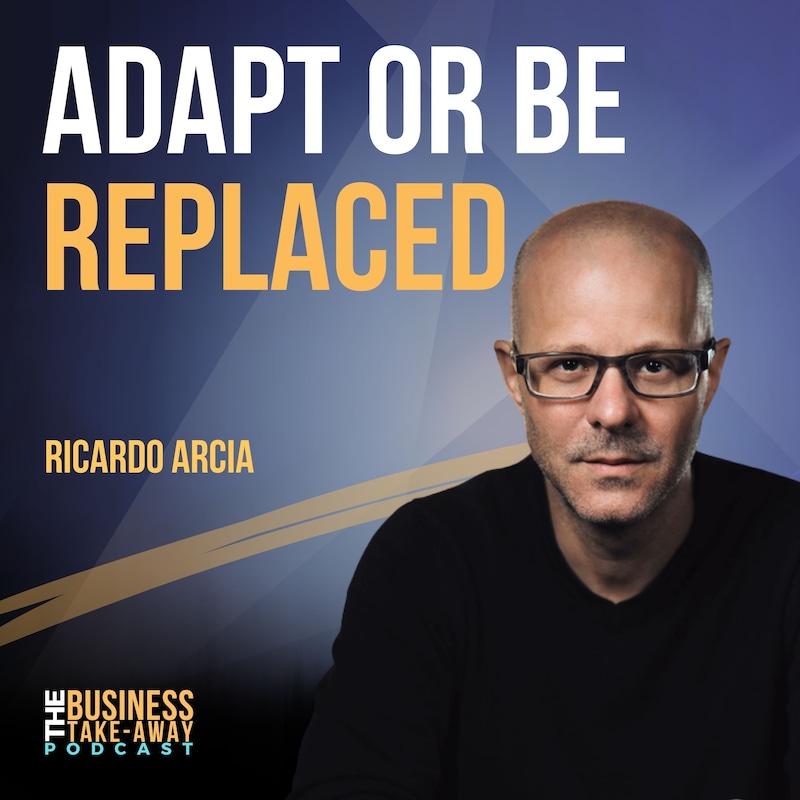
In this episode of The Business Takeaway Podcast, Ben sits down with Ricardo Arcia, founder and CEO of Teravision Technologies and author of The Cognitive Leader.
Ricardo founded Teravision more than 20 years ago and has grown the organisation into an international software business. Over the past two years, he has led an extensive AI transformation involving real engineering teams, live client projects and repeated experimentation.
The results challenged some of the biggest assumptions surrounding AI adoption.
Ricardo explains why isolated AI tools do not automatically create organisation-wide productivity, why experienced employees can be among the most resistant to change and why successful AI transformation depends more on leadership than technology.
They also explore how software teams are becoming smaller, why leaders must give employees permission to become temporarily slower and why every technology leader Ricardo interviewed believed their organisation was already behind.
This episode is essential listening for CEOs, CTOs, engineering leaders and business owners trying to understand how artificial intelligence will change teams, skills and organisational structures.
IN THIS EPISODE
• Why Ricardo began investigating AI-driven software development
• What happened when three engineering teams were challenged to compress a seven-month project into eight weeks
• Why junior engineers embraced AI but initially produced weaker results
• Why experienced engineers were more sceptical
• The difference between isolated acceleration and compound productivity
• Why AI transformation is a people and leadership challenge
• What Ricardo means by “cognitive leadership”
• Why established companies should not expect instant 10x productivity
• Whether AI will reduce the number of software engineering jobs
• Why adaptability can become more valuable than existing technical expertise
• How leaders can provide psychological safety during AI transformation
• Why Ricardo gave engineers permission to introduce technical debt
• Why teams need permission to become slower before becoming faster
• How AI is changing the structure of software development teams
• What Ricardo discovered after interviewing more than 150 technology leaders
• Why every CTO believes they are behind
• How companies can move beyond using ChatGPT for emails
• Why AI implementation should be managed through 90-day loops
• The role of a “Team Zero” in testing and transferring AI practices
• Why coaching is essential to sustainable adoption
• Which software roles could become more valuable
• How AI could dramatically accelerate global innovation
KEY TAKEAWAYS
AI transformation is a leadership challenge
The technology may be new, but the greatest barriers are human. Leaders must manage fear, uncertainty, professional identity and resistance—not simply distribute new software.
Tools do not create transformation
Individual employees may complete certain tasks more quickly, but those gains will remain isolated unless the entire process is redesigned around them.
Productivity may fall before it rises
Teams need time to learn, experiment and develop confidence. Expecting immediate gains can cause people to return to familiar working methods before new behaviours take hold.
Adaptability is becoming a core hiring criterion
Technical expertise remains important, but an employee who refuses to engage with new technology risks becoming less valuable than somebody with fewer existing skills and a stronger capacity to learn.
Leaders must become comfortable with uncertainty
AI systems and capabilities are developing too quickly for leaders to wait until every answer is known. The role of leadership is increasingly to create systems for experimentation, measurement and adaptation.
Think in 90-day loops
Rather than attempting to produce a fixed multi-year AI strategy, organisations should establish measurable 90-day objectives, test them, capture the learning and update their approach.
TIMECODES
00:16 — Ricardo’s background and the creation of Teravision Technologies
02:05 — The experiment that began Teravision’s AI transformation
03:00 — Junior enthusiasm versus senior engineering experience
04:20 — Why isolated productivity improvements failed to compound
05:07 — The AI tools that started the journey
06:31 — Guardrails, risk and fears surrounding autonomous AI
08:45 — What it means to become a cognitive leader
09:50 — Why AI transformation is a people problem
11:39 — The biggest misconception CEOs have about AI productivity
13:10 — Will AI replace software engineers?
15:00 — Helping employees work through fear and uncertainty
16:30 — “AI will not replace you, but somebody using it might”
17:15 — How a ten-person software team could become a four-person team
19:16 — Why coaching is essential during AI adoption
20:30 — Giving engineers permission to introduce technical debt
21:20 — Why teams need permission to become temporarily slower
23:13 — How Ricardo’s own leadership had to change
24:20 — Making peace with permanent discomfort
27:55 — What Ricardo learned from interviewing 150 technology leaders
28:13 — Why every technology leader believes they are late
29:25 — How early we really are in the AI adoption cycle
31:31 — Moving beyond using ChatGPT to write emails
32:41 — Why AI transformation should happen in 90-day loops
34:57 — AI accuracy, architecture and the importance of context
38:00 — Why product definition is becoming the new bottleneck
39:10 — How software engineering roles are changing
40:48 — Brilliant traditional engineer versus adaptable AI engineer
42:50 — How a company should begin its AI transformation
44:00 — Training teams to use a shared AI language
45:00 — The “Team Zero” operating model
47:00 — Coaching teams through continuous behavioural change
48:18 — Which software roles could become more valuable
50:30 — How AI could accelerate global innovation
52:24 — Ricardo’s rapid-fire answers
ABOUT RICARDO ARCIA
Ricardo Arcia is the founder and CEO of Teravision Technologies, a software development organisation working with businesses on digital products and AI-driven software transformation.
He is also the author of The Cognitive Leader: How to Drive Strategic AI Transformation in Software Development, informed by hands-on experimentation inside Teravision and more than 150 interviews with CTOs, VPs of Engineering and technology leaders.
Teravision Technologies
TheCognitiveLeader.com
The Cognitive Leader newsletter
The Cognitive Leader: How to Drive Strategic AI Transformation in Software Development will be published on September 29, 2026
ABOUT THE BUSINESS TAKEAWAY PODCAST
The Business Takeaway Podcast goes beyond polished success stories to uncover the decisions, failures, leadership lessons and practical takeaways behind real businesses.
Each episode gives founders, leaders and business owners ideas they can apply inside their own organisations.
Subscribe on YouTube, Spotify and Apple Podcasts so you never miss an episode.
Similar episodes which might be of interest:
Episode 10 - Marcel Fairbairn, the CEO and founder of GearNet Holdings, discussing the evolution of the entertainment industry, the importance of data analytics, business strategy, CEO Insights and the role of AI in transforming business practices.