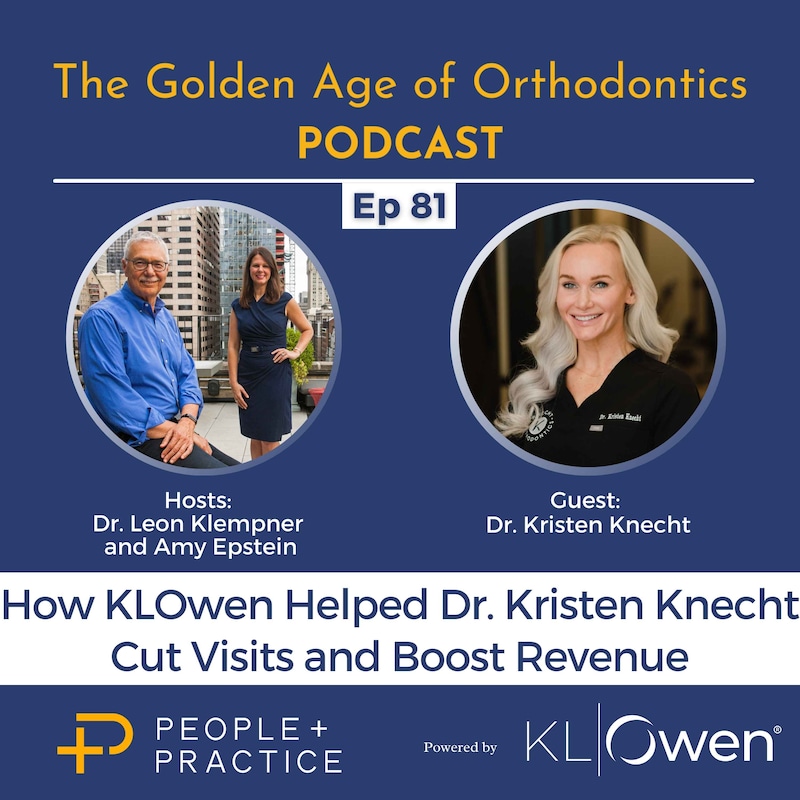
Shownotes
On the Golden Age of Orthodontics, hosts Dr. Leon Klempner and Amy Epstein welcome Dr. Kristen Knecht to discuss how to revolutionize practice efficiency through indirect bonding. Dr. Knecht shares how her Houston startup practice grew 40-50% annually, forcing critical decisions about patient care delivery. Rather than hiring more staff, she redesigned her clinical orthodontics workflow with KLOwen custom brackets. The results were dramatic: reduced appointment scheduling burdens, eliminated bracket placement bottlenecks, and cut average case length by 40%. Learn her strategies for successful staff training, managing lab fees, and why partial technology adoption fails.
What you will Learn in this Episode:
- How implementing indirect bonding completely transformed Dr. Knecht’s practice efficiency by freeing up hours of doctor time and reducing emergency appointments through superior bracket placement accuracy and isolation protocols.
- Why partial adoption of custom bracket systems fails and how Dr. Knecht's all-in approach with KLOwen enabled her team to master bonding technique, eliminate pan and repo appointments, and achieve consistent results across all cases.
- Strategic timing for practice management changes, including how Dr. Knecht planned her technology rollout during slower seasons to ensure successful staff training and avoid the common pitfalls that derail orthodontic practice growth.
Subscribe to the Golden Age of Orthodontics and our sister podcast, Practice Talk, hosted by Lacie Ellis, wherever you listen to stay updated on orthodontic innovation and real-world practice strategies. Visit People in Practice for more insights and to connect with our team for practice growth solutions.
TIMESTAMPS:
- 00:00 Dr. Kristen Knecht discusses practice growth challenges and schedule management struggles
- 08:50 Discovery of indirect bonding through a colleague's experience with KLOwen custom brackets
- 12:08 Strategic implementation timing and preparing staff training for technology transition
- 16:16 Measurable results: reducing visits from 21 to 12.5 and improving revenue per visit
- 22:01 Why full commitment to the custom bracket system matters more than partial adoption
- 27:03 Advice for startup practice owners on adopting orthodontic technology early
KEY TAKEAWAYS:
- Indirect bonding requires complete commitment to realize benefits. Dr. Knecht emphasizes that dabbling with one case per week prevents staff from achieving proficiency in the bonding technique and fails to demonstrate the system's true time-saving potential.
- Strategic fee adjustments offset lab fees while delivering superior value. By raising fees by $200-250 and eliminating one visit through improved treatment planning and digital setup, practices can justify the investment while improving the patient experience.
- Early technology adoption in a startup practice prevents staffing challenges. Mastering systems like KLOwen, when schedules allow, enables easier clinical orthodontics workflow changes and reduces dependency on expanding teams as practice growth accelerates.
ABOUT THE GUEST:
Dr. Kristen Knecht, a Baton Rouge native, has always been passionate about creating beautiful, healthy smiles. As a board-certified orthodontist, she combines meticulous attention to detail with a deep commitment to improving her patients’ lives. She completed her orthodontic specialty training at the renowned University of Connecticut, where she worked with world-renowned faculty and developed expertise in advanced orthodontic techniques.
Education
Louisiana State University – Bachelor of Science in Biology
LSU Health Science Center – Doctor of Dental Surgery
University of Connecticut Health Science Center – Orthodontic Specialty Certification and Master of Dental Science
A Holistic Approach to Orthodontics
Dr. Knecht believes orthodontics is about much more than creating straight teeth — it’s about improving lives. Her approach focuses on identifying and addressing the root causes of malocclusions, with a strong emphasis on the connection between jaw development, airway health, and overall well-being. Her passion for this approach was inspired by her sister’s struggles with mouth breathing and airway issues as an adult, challenges that could have been addressed during her critical growth years.
Transcripts
[00:00:20] Welcome to the Golden Age of Orthodontics.
[:[00:00:57] You can get more information as well as a special [00:01:00] offer on our website. Just go to ppl practice.com and click our partner tab. Welcome to the Golden Age of Orthodontics. I'm Leon Klempner, retired board certified orthodontist. I am the director of orthodontics at Mount Sinai Hospital here in New York, part-time faculty at both Harvard and Montefiore Ortho programs.
[:[00:01:43] Amy Epstein: Thank you. Great to be here. As always, my background's marketing and public relations, and we got together to be able to bring those high level strategies and tactics to the business of orthodontics where it works really well. Uh, about 15 years ago, we [00:02:00] started the business and it's been going.
[:[00:02:22] Dr. Leon Klempner: Yeah. Yeah. So, um. You know, I have a faculty position at the medical school, Mount Sinai, uh, medical school here in, uh, in Manhattan.
[:[00:02:57] In any event, uh, I got a lot [00:03:00] of stuff on my plate and a lot of projects going on, and so I use a project manager. To help me manage it. I'm using OmniFocus basically, but mm-hmm. I think without that I'd be lost.
[:[00:03:27] And we can see that in the kids that the project that you're working on or the grant that you're writing, um, for the study that you're looking to do, we can see that in the kids that come and they, they will often ha, will often have to raise funds to get these kids emergency. Dental treatment, um, you know, to, because they have to go to the OR and, um, it's all preventable.
[:[00:04:12] I don't know how many years ago I used Fantastic Health to like integrate all my calendars and all that stuff, but you are always looking at, uh, systems and tools so that you can do the things that you actually wanna do, which is a great segue to today's conversation. Because like you mentioned in the, uh, open, we're, we're unpacking how one orthodontist redesigned her care delivery to make her practice more manageable.
[:[00:05:03] She's completed more than 500 KLOwen and custom cases and brings, uh, a lot of real world data on how customization improves not only, uh, the treatment for the patient, but also the practice performance. So thank you for being here. Kristen. Welcome to the show.
[:[00:05:22] I.
[:[00:05:48] You know, the tough students in their pocket. We had maybe a, maybe a pen with our ID and maybe a ruler. The Yukon students had like gauges to measure, you know, [00:06:00] ounces and they, they had like data that was like, you know, beyond, we, we didn't know what was going on. When Charlie. Was speaking, to be honest with you.
[:[00:06:36] Tell us, you know what, what were the most challenging things that you had to deal with about running your practice?
[:[00:06:57] Can I afford to put all these chairs and [00:07:00] you know, am I gonna start to fill them in a reasonable amount of time? So I kind of settled on like a middle number. I put five treatment chairs and two consult room chairs in the office. And it just started to grow much faster than I expected. And so, you know, as that happened, I was, especially with a startup, you're used to like this really slow build.
[:[00:07:58] I thought that I was more efficient than I [00:08:00] actually am, and it's not until you really start to analyze your own data. That I think that you start to see all of the, the issues that are arising. And for me, the biggest thing was like, how do I continue to grow but provide the same level of care if I'm seeing 60 patients or I'm seeing 20 patients, and I wanted to make sure that as I grew, that that level of care and attention to detail didn't falter at all.
[:[00:08:50] Dr. Kristen Knecht: Yeah, so I knew, um, I mean, one of the things that. That I saw firsthand is I had a friend that we went to residency together.
[:[00:09:17] And I was kind of helping him in the research part because I knew that I was just like a few years behind pretty much. Right. And so watching him do that and see that he was able to ultimately phase out his partner, not hire someone else, and what he was spending on a lab bill. And a huge practice was still much less than what he would pay an associate was really impressive.
[:[00:10:04] So if it's, if a case is just a simple class one crowding case, like of course I'm gonna put braces on right then and there, I have no one else in the clinic. But as the office gets busier, your staff wants to kill you when you do that. Mm-hmm. So being able to just do a scan and send that off. To Kayla Owen to do my digital setup and schedule the bondings.
[:[00:10:50] It frees up tons of time. Mm-hmm. I could have, I've done mornings where I just went in and did like six or eight KLOwen and bonds, and I [00:11:00] have not gotten that much admin stuff done, you know, on any other day because they didn't need me. I just went over at the end and checked everything.
[:[00:11:10] Yeah, so, so Kristen. Talking about staff wanting to kill you. I've been there many, many times and, um, you know, I'll come back from a meeting, you know, with an idea about integrating some tool or making some change, and I'd always get like some pushback because staff typically, mm-hmm. In my experience, they're in a routine.
[:[00:11:57] Bringing your staff on [00:12:00] board and, and how is, how did they adapt and adjust to it in terms of, of how you moved forward?
[:[00:12:25] So we don't need to hire new staff. We don't need to even start considering hiring someone else to help me in the practice. So everything gets to stay the same way that it is, and then it gives you more autonomy Instead of having to wait for me to come over, the parents are awkwardly staring at you like, when is she coming to check these brackets?
[:[00:13:08] I said, this is what we're gonna do so that we can continue to provide the best care possible for our patients. It's more accurate, it's more efficient. This is what we're doing, you know? And I did tell them like, don't get frustrated. It's something new. Of course there's gonna be a learning curve, but I promise once you get the hang of it, you're all gonna thank me and be thrilled with this.
[:[00:13:42] Dr. Leon Klempner: Yeah. So. Let me ask, let me rewind for a second. And you were, you know, in your storyline where you're evaluating ways to enhance efficiency and you're, um, you know, there's somebody that, that is a friend who's kind of ahead of you [00:14:00] and you're seeing his decision making.
[:[00:14:20] Dr. Kristen Knecht: Yeah, so I, the first year and a half, I wasn't full-time in my practice. I was splitting my time. Between my corporate job and my private office, and so the amount of growth I saw in my first full year of being there was a little bit, I mean, it was beyond exciting, but also a little bit alarming in the sense that I was like, okay, if this happened in one year, if.
[:[00:15:08] So I, I kind of found a sweet spot where I waited until the summer. Went past the summer went by because I didn't think implementing a new system in like the heart of the summer when it was super busy, was gonna set my team up for success. So I waited until the fall of 23. So I plan, I mean I did plan it.
[:[00:15:51] And that would be a better time to implement something new.
[:[00:16:11] Right? So what were some of the benefits that you saw in the practice?
[:[00:16:42] And what was interesting is. I wasn't even utilizing the system to the full extent at this point. I was still doing like a mix of what I was doing with my traditional brackets, and by that I mean I wasn't spacing out the appointment intervals quite how I should have been. [00:17:00] And I was still just noticing so much more time in the schedule.
[:[00:17:30] And, you know, so we were seeing less broken brackets. Um, the adjustment schedule was improving a ton, and then just the time in my schedule was changing substantially. I was having more time to spend with the consults, which was important to me to make sure that I was making a thorough diagnosis and connecting with my patients without having to feel like I had to run out of the clinic to go check brackets.
[:[00:18:28] Number two is. A lab fee here compared to just putting brackets on. That's a significant impact on my p and l. So, um, could you share with us, I mean, know you saved some time in the clinic, you're saying that it freed up some time. Is there any data that you could share with those orthodontists at, at, are, are considering moving towards a indirect bonding system like KLOwenN.
[:[00:19:26] But then when you pull the numbers, they don't lie. So I went from, you know, 20 to 21 appointments to about 12 and a half. And I mean, that to me is a huge savings. So I've more than covered my lap bill. And you know, that was a huge thing, or like a mental thing that I told myself going in because I knew that it was gonna be more expensive, right?
[:[00:19:51] Dr. Leon Klempner: mm-hmm.
[:[00:20:15] But I think anyone that's contemplating it, like if you approach it that way, like I'm just gonna. Increase my fees a tiny bit and then all I have to do is shave off one visit. And it's now we're, it's very easy to justify. Um, the other thing that was pretty huge for me is, um, repos. So I would repo, you know, three or four brackets per case.
[:[00:21:04] Especially even it's going down even more the more that I've used, um, CBCT root integration because it's so accurate. But I mean, that's a huge time savings, you know, to not have those pan and repo appointments. We used to only allow those to get scheduled in a certain column because they required more doctor time.
[:[00:21:49] Dr. Leon Klempner: Yeah. Yeah, I was gonna mention that, you know, for those data-driven orthos out there that are measuring, you know, profit, you know, per visit, that that, that, that's a [00:22:00] significant change. But, you know, I, I talk to orthos all the time about, um, incorporating, uh, indirect bonding into their, uh, system. And, and many of them have told me that, yeah, you know, I tried it on a couple of cases, but I didn't see, you know, how that was really.
[:[00:22:32] Dr. Kristen Knecht: 100%. Um, I dabbled in light force and my experience wasn't great because it's not, I didn't do enough cases to get over the learning curve and like over the hump of the bonding, like just the bonding technique for my staff.
[:[00:23:10] Um, and then the other aspect of it is. It takes time, I think, as an orthodontist to kind of rewire your brain and trust that this system is very accurate and it is more accurate than you putting the brackets on there. So you know, you should space out the intervals, you, the appointment intervals. You need to let the wires work and kind of not try to overdo things.
[:[00:23:57] I saw the biggest change when [00:24:00] most of my traditional cases, you know, had been deep bonded, and I could really just work on honing in all of the systems and efficiencies for an indirect bonding system.
[:[00:24:18] I'm just curious, like, why, what is it about KLOwenN that, you know, uh, attracted you in the first place, or, or keeps you a client?
[:[00:24:46] Don't feel like you need that. There's ways that they make it, I think just as custom with like changing the angle at the base of the bracket with glue and you know, more details than we need to go into. But, um, you also [00:25:00] have all options. So I'm thinking for me, the next step to really hone in my efficiencies is switching to self ligating.
[:[00:25:30] Um, so that was a huge deciding factor for me. I knew that even when I was trying light force, that it was never gonna be something that I put like every teenager in. I was thinking more of like, let me test this out for my ceramic cases, but I just wasn't happy enough with. The support and then the bonding that I was having a lot of like breakages of the actual brackets.
[:[00:26:13] How do you explain that to the parents that had one kid that started and you were like, oh yeah, we don't offer that one anymore. Now we're back to the medal. But to all the parents and patients, it's a twin bracket, so. They couldn't tell the difference and I wasn't, I didn't give people options either.
[:[00:26:50] Dr. Leon Klempner: So as we close up, I wanted to ask you, I mean, you, um. Out of startup mode, you know, on the [00:27:00] tail end of, of, uh, the hump of startup mode. What, do you have any advice for, um, orthodontists who are just starting out and, you know, whether they're buying a practice or specifically if they're starting from scratch and get to spec their own, uh, technologies and, um, vendors and everything themselves, what would you say to them?
[:[00:27:46] To continue to grow but meet a lot less staff. And as I think most practicing orthodontists will tell you that staffing is one of the biggest challenges. So if you can find a way to rely on humans [00:28:00] less, there's, that's a huge benefit. So if by mastering an indirect bonding system, you could, you know, keep one assistant for substantially longer and not have to keep adding staff.
[:[00:28:29] Dr. Leon Klempner: Mm-hmm.
[:[00:28:41] Mm-hmm.
[:[00:28:57] Dr. Kristen Knecht: Yes, they can definitely email me. Um, my [00:29:00] personal email is kette, so K-K-N-E-C-H t87@gmail.com.
[:[00:29:30] Kristen, thank you. Much luck to you moving forward as you grow your practice. We'll keep our eye on you. We appreciate you being here today and sharing your story.
[:[00:29:43] Dr. Leon Klempner: Yep. Thanks, Kristen. You can subscribe or download other episodes of the Golden Age of Orthodontics on Apple Podcasts, Spotify, SoundCloud, YouTube, or wherever you get your podcasts.
[:[00:30:21] This is a big issue, giving them back their time. So we're moving to a point where this will be the standard of care. So, you know, you hear me talk about the digital practice you hear. Chris Benson talking about it. You hear most people that are in the know are telling you that the, the profession will be moving in this and those practices that are incorporating these types of technologies that are of benefit to the patients are going to grow.
[:[00:31:10] Bye.
[:

