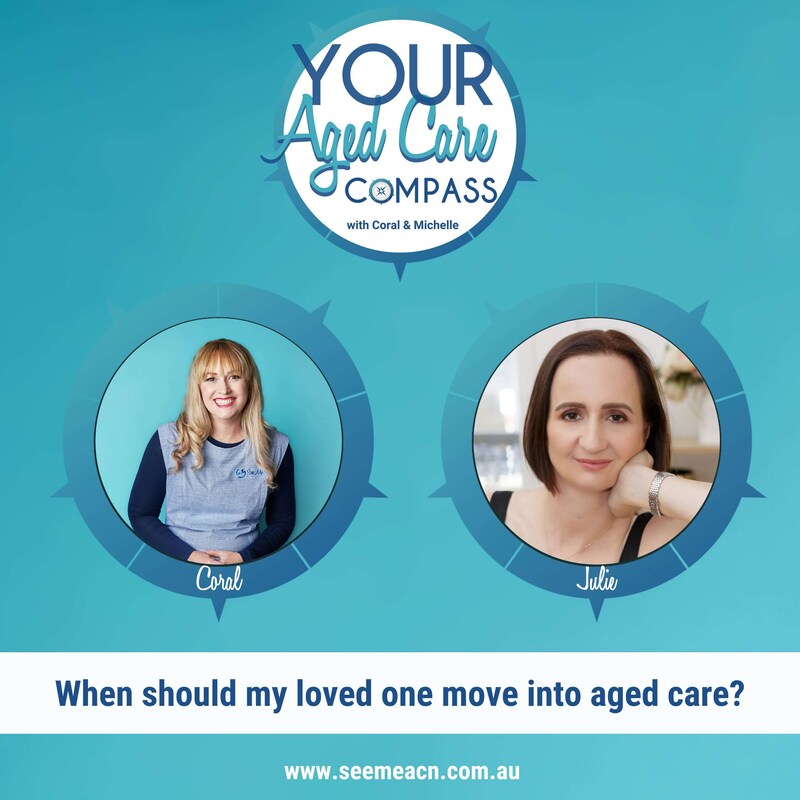
Shownotes
Supporting an older loved one to move from their own home into residential accommodation is a task that often takes an emotional toll on all family members involved.
Sometimes the move can be planned, when the older person acknowledges it’s time to make the move. But more often this significant life change happens during a crisis, when there’s been a massive decline in the older person’s health, often after a hospital admission.
In a perfect world, we’d all be having these conversations with our older loved ones, well in advance of this situation arising, but it doesn’t happen like that for many families. Today’s guest, registered psychologist Dr Julie Bajic-Smith, helps us understand the impact on everyone when the time comes for a loved on to move into residential aged care. She discusses how to approach these conversations and how frame the move more positively.
In this episode:
- Only a small percentage of older people move into aged care
- Independence vs risk
- When might a person need to move into aged care?
- How much informal support is provided?
- How to start a conversation about a move to residential care
- The significance of losing independence
- Moving a loved one into care doesn’t always reduce stress
- Moving an older person into care can enhance family relationships
- Frame things positively
- Loss of insight in the older person and how to deal with this
- Have gentle and compassionate conversations earlier and regularly
- Improving mental health for older people in residential care
Resources mentioned:
- Julie's Book: Beyond the reluctant move
- Julie’s podcast: So you work in aged care
- Downloadable: 5 facts about me
- Let’s Talk Consultation
Connect with Dr Julie Bajic-Smith:
Connect with Coral Wilkinson:
Follow See Me Aged Care Navigators:
More about Your Aged Care Compass podcast:
Do you support an older loved one at home and you're ready to give up because it’s just too hard? Your Aged Care Compass is for you.
We're Coral and Michelle, the sisters behind our business, See Me Aged Care Navigators.
Coral is a registered nurse with over 30 years’ experience in both health and aged care. A former assessor with the aged care assessment team, an advocate and author, there’s not much Coral doesn’t know about Australia’s aged care system.
Michelle is a former pharmacist with over 30 years in the public health and private sectors of pharmacy. Michelle is the client care manager for our business.
Our story started as one of supporting our parents to remain in their own home, to be as independent as possible and remain connected to their community. When we eventually needed extra support, we achieved this because we know Australia’s aged care system so well. We knew what programs could assist us and our parents.
Your Aged Care Compass podcast brings together not only our personal experience in supporting our parents but also our vast professional experience in supporting other families to keep their loved ones at home.
We'll help you makes sense of Australia’s aged care system and bring you topics related to ageing as well. Legal, financial, health, forward planning and more.
Your Aged Care Compass will guide you clearly and compassionately to the right support at the right time for your ageing parents and loved ones.
Like what you hear? Please leave us a rating and review. We’d love you to share this podcast with any friends or family who have older loved ones.
Transcripts
Welcome back listeners.
2
:How to initiate that difficult
conversation about moving an older
3
:loved one into residential care.
4
:It's a question we're
asked from time to time.
5
:It's not my area of expertise.
6
:So I reached out to our guest speaker, Dr.
7
:Julie Badgick Smith to join us
on the podcast today to guide us
8
:on how to approach this topic.
9
:Julie is a registered psychologist
and has 15 years plus years in aged
10
:care as a clinician and researcher.
11
:Her work focuses on the well
being of home care workers and
12
:decision making in dementia.
13
:Julie's book, Beyond the
Reluctant Move, enhances
14
:emotional well being in aged care.
15
:As a board approved supervisor,
she guides intern psychologists
16
:and mental health professionals.
17
:Julie's award winning programs
significantly impact older adults
18
:and their carers, providing crucial
support and practical solutions.
19
:Julie, my mum still lives in her own
home, and we're doing everything we
20
:can to support her to remain in her
own home for as long as possible.
21
:But she's had a few significant health
issues over the past three years,
22
:and I wondered each time if her care
would be too high to remain at home.
23
:She was able to return home each time
after those hospital admissions and
24
:is doing well now, but I realize her
care may one day become too high for
25
:us to continue to support her at home.
26
:I'd feel sad and guilty that I wasn't able
to keep her at home if it came to this.
27
:Is this a situation you find
many families grappling with?
28
:Julie: Hi Carol, thank you so much
for having me on your podcast.
29
:This is a very common issue and dilemma
that a lot of people encounter as they,
30
:as their loved one gets older and starts
to experience challenges in late life.
31
:So the situation that you're finding
yourself in with your mum is not uncommon.
32
:Coral: Yeah, that's right.
33
:And, that's what we consistently hear as
well from our followers and listeners.
34
:Julie: We must keep in mind that
most people actually remain living
35
:in their homes, that it's only a
very small population of adults who.
36
:move into care, we're talking
about six, 6 percent or so.
37
:So vast majority of people do
remain living independently.
38
:I think sometimes a lot of people
tend to have this fear that
39
:they'll end up in nursing homes.
40
:And the people who end up in care,
the ones whose health declines
41
:significantly and whose risk of
being or remaining independent in
42
:the community is just too high.
43
:So the challenge for families.
44
:And loved ones is determining what
level of risk they are prepared to
45
:maintain independence at what risk.
46
:Coral: That's a really
interesting comment from you.
47
:you know, the, in the media, the
stories that we often hear are those
48
:crisis kind of, situations where
people have to make this really big
49
:decision and it's very traumatic and
it's about moving mum into aged care.
50
:So that you said, it's actually
quite a small, or a smaller number
51
:of people compared to the people
who are still living at home that
52
:really got my interest there because.
53
:From where I'm sitting, and I
deal in the home care space, not
54
:in residential accommodation.
55
:To me, I would have assumed that that
number would have been, much larger.
56
:Julie: Yeah.
57
:See, that's assumption often.
58
:And having been to a number of nursing
homes here in New South Wales over
59
:the years, many people who move into
care, the ones that don't have the
60
:family support, the ones that don't
have no one to support them, in their
61
:own homes, or maybe they've had a fall.
62
:and they used to live on the
second, story unit block.
63
:There's no lift.
64
:They can't navigate the stairs anymore.
65
:And it's not just about the stairs.
66
:It's also then, well, actually,
even if I lived on the ground floor,
67
:no one would be able to assist me.
68
:So we don't hear often stories
from people whose voices are, not
69
:represented in our population because
maybe they don't have family members.
70
:Maybe they've, never
married, never had spouses.
71
:Maybe there's only a niece or nephew who
have their own aging parents to deal with.
72
:So we don't hear the true representation.
73
:And I believe that a lot of your
listeners who are so committed and
74
:dedicated towards supporting their.
75
:And all the people themselves have
this fear, but also, that they're
76
:so blessed to be surrounded by
people who are supporting them.
77
:Coral: Absolutely.
78
:Yeah, look, the other thing you
just touched on was about risk.
79
:So the question I wanted to ask you
now is, in your experience, what are
80
:the indicators that make family members
supporting an older loved one at home
81
:consider that it's time for mum and dad?
82
:To move into more supported accommodation.
83
:Julie: So it comes down to the activities
of daily living, their physical health,
84
:but also their emotional wellbeing.
85
:Some people might have the physical health
in, reasonably good, but perhaps they are.
86
:not motivated to attempt to
activities of daily living.
87
:So maybe they are not showering and
just making sure the floor is wet so
88
:that family will think that they've had
a shower, perhaps they're not eating
89
:properly and feeding themselves properly.
90
:And look, Coral, there could
be a whole range of reasons
91
:as to why that might happen.
92
:So it could be because they might
be having mild cognitive changes.
93
:Maybe they are, experiencing Some
neurological changes, or it could
94
:be because of their mental health.
95
:And it's really hard to jump to
conclusions as to what is going on.
96
:We know that with older population
and older generations, we don't, talk
97
:about mental health so comfortably.
98
:And a lot of older people might
be in denial that they might
99
:have a mental health condition.
100
:So what would be happening
is like, no, no, no, I'm not
101
:depressed, I'm not anxious.
102
:Not recognize that actually
that, is what might be going on.
103
:So.
104
:A very important note is that
Although we know that, we can't
105
:reverse the impact of dementia, we
know that, we can slow it down, but
106
:we can't cure people from dementia.
107
:We can cure people from
mental health conditions.
108
:We can cure people who might
have experienced grief and loss
109
:because they've experienced
significant loss of their loved one.
110
:And, and, maybe that manifested
into depression, but we know that
111
:regardless of a person's age,
that they can actually improve.
112
:So when, when the family thinks about,
what risk and what, factors they would
113
:need to see where their loved one, might
be, requiring additional help and support
114
:is obviously, making sure that everyone's
on the same page, but also making sure
115
:that, are they eligible for service?
116
:No good talking to mom and dad about
additional support and service if they're
117
:not eligible for residential care.
118
:and so what, tends to happen is that
sometimes people do become eligible.
119
:They do not want to move.
120
:I can understand.
121
:That's why my book is called
Beyond the Reluctant Move, because
122
:people don't want to move there.
123
:In, in, in many cases, I, I've met a
handful of people who are keen and willing
124
:to do that, to stay out of trouble.
125
:family's way and not impact their
family's, activities and lifestyles
126
:and feel like they're a burden.
127
:I think that the main challenge, Coral,
is in people who might have additional
128
:needs, support needs, or they may have
a diagnosis of a degenerative disease.
129
:And if it's impacting them
neurologically and cognitively, what
130
:tends to happen is that these people
lose the insight into their ability.
131
:And so they are under the impression
that they can do things independently.
132
:Yes, my daughter will come and top up the
fridge and cook, but they can downplay the
133
:level of support that they are getting.
134
:And so what happens is that,
offspring, goes on holidays or
135
:becomes unavailable suddenly.
136
:And then it comes to light, wow, actually
there's a lot of help That they're
137
:giving me, and it becomes unsustainable
at one stage where it's like, well,
138
:no, if, if they're not helping me do
this, I can't stay living independently.
139
:I'm not going to feed myself properly.
140
:I'm not going to chuck food
that's off, that's been sitting
141
:in the fridge for weeks and weeks.
142
:I'm not going to go and get, new supply
and no, it's not okay for Meals on Wheels
143
:meal to last you for three meals in a day.
144
:It's supposed to be one meal,
it's not to be split up.
145
:So it is about.
146
:Really determining what risk there is.
147
:And for some people who have cognitive
changes, who have very little insight
148
:into what is going on for them, they
might be like, Oh yes, I can do lots of
149
:things independently, but it's like you
leave the stove on and your house goes
150
:on fire, your front door is unlocked,
you, go wandering on the streets.
151
:So it's about mitigating that risk.
152
:And it's really hard because
it can be quite subjective.
153
:And some families can be prepared to deal
with a higher level of risk than others.
154
:So I think that a lot of that comes into
play and it really depends on individual
155
:circumstance and their support unit
and their own insight and, willingness
156
:to explore additional support needs.
157
:Coral: Really, really interesting
that you just spoke about insight
158
:and the level of care because this is
something I often speak about as well.
159
:And when I'm presenting to a group, I
say it's a really difficult conversation.
160
:And sometimes, like you said,
that lack of insight, the older
161
:person will say, I'm okay.
162
:I don't need any help and I'll
say, okay, let's talk about that.
163
:And then I'll say, well, my daughter
prepares all my meals for me.
164
:So I just have to reheat them
and I pay a private cleaner.
165
:And when I go to my bridge club on Monday,
Marge, the neighbor takes me because
166
:I'm and, There isn't that insight, that
recognition that they are actually getting
167
:a significant amount of support already.
168
:and I always suggest to them, all
right, we need to remove, just let's,
169
:let's just take all that support away.
170
:How, would you cope at home?
171
:And that's when it can be, it can
reveal itself to the person that in
172
:fact they are getting quite a lot of
support already, but that it's informal
173
:doesn't seem like support to them.
174
:Julie: absolutely.
175
:And then when you peel the layers of
onion, when you realize, wow, it's amazing
176
:that this person has been able to keep
doing for what they've been doing for
177
:so long and just the level of support
that they might downplay and think, oh,
178
:it's no big deal, but really it is a big
179
:Coral: Yes, absolutely.
180
:Yeah.
181
:So look on that point, Julie, how would
a family member approach that perhaps
182
:initial conversation with an older
loved one about, Hey, mom or dad, you're
183
:needing quite a little bit of support.
184
:And, I, as the son or the daughter,
it's really hard for me, mom,
185
:I'm working, I'm exhausted.
186
:Perhaps it's time to consider
moving into residential care.
187
:That's a really difficult conversation for
people to have with their older loved ones
188
:or and certainly what, in our experience,
that's what people always report to us.
189
:So how would someone initiate
that kind of conversation, Julie?
190
:Julie: I think that you're spot on Coral.
191
:I think it's really, it is
a hard conversation to have.
192
:It is very difficult for family
members to, accept that their
193
:loved one needs additional support.
194
:And it's hard to get that message across,
without, touching on many emotions.
195
:it's not a brief conversation to have.
196
:I think that it's something that,
It's likely to get people upset.
197
:We can't, just assume, look, it's going
to be a happy brief chat, but I think
198
:it's something that probably evolves over
time and being clear in the communication,
199
:even when, you are able to do things.
200
:To highlight that you are doing those
things, I think it's really helpful for
201
:the person to realize just about the level
of support that goes into helping out.
202
:Not, not to say, look, I'm so burdened
by what I'm doing for you, but just
203
:to say, look, mum, at the moment
where things are like, I'm probably
204
:helping, five to 10 hours a week.
205
:To maintain living at home.
206
:And yes, I can do this, but can we
reevaluate this in six months time and
207
:see how that's going, with my availability
and my commitments and also for you.
208
:And, if mom also has home care packages
or, supports in place just to Track
209
:along and see how that's going, as
opposed to what I find choral happens
210
:sometimes is that it's the, it's the non
spoken, word for so long that goes on
211
:and then the family gets to a breaking
point and they're like, I can't keep
212
:doing this and then, the family member
like, it was like, Oh wow, I had no
213
:idea what impact this was having on
you, or we didn't really talk about it.
214
:And then it's like, well, no,
you need to move into care.
215
:and so sometimes, there's
really, I'll take a step back.
216
:There's, two types of
people that move into care.
217
:There's one, Where they've had significant
change, like they've sort of had
218
:overnight events that have happened.
219
:And they may have had a stroke,
they may have had a fall, they ended
220
:up in hospital or they, they had
some sort of event that from being
221
:completely independent to, requiring
a lot of support happened overnight.
222
:And usually for those people, it's
really hard because they haven't had
223
:any time to adjust to that transition.
224
:But you know, if they end up in a
hospital setting and it's like, the
225
:doctors say, look, you can't go home,
you can't mobilize or they've had
226
:something happen quite traumatic.
227
:So those people don't really have
a lot of say as to what they want.
228
:And they end up in an aged care facility
because, they, can't have a hoist at home.
229
:They can't, return to
that environment at all.
230
:The other type of people
is the ones that have.
231
:They're called slow growers or the
changes happen slowly over prolonged a
232
:period of time, and it's really hard,
because technically it doesn't matter
233
:if mom moves into home today or next
week or a month ago, and that can be
234
:really harder to know where do you
reach that point when you go, yes.
235
:yes, this is where we're getting and
that's really hard because then that
236
:older person is hanging on to the
independence the family member is
237
:like, well, what are you waiting for?
238
:There's room in this facility for you now.
239
:Why don't you go in?
240
:And I think that because
that move signifies so much.
241
:It signifies so much for the older person,
it signifies so much for the loved one.
242
:And we know that research shows
that even when an older person moves
243
:into care, the immediate caregiver,
their level of stress remains the
244
:same until the person passes away.
245
:So putting a loved one into care doesn't
necessarily mean that, your life is over.
246
:It's all going to be easier
because then you'll just have
247
:different concerns and worries.
248
:But I think it needs to be a collaborative
approach and collaborative discussion
249
:and looking at different, facilities, if
time allows it, if there is vacancies,
250
:and having all parties on board.
251
:So I think, having medical
team on board, speaking to the
252
:GP about the support needs.
253
:Talking to facilities and families makes
it more of a team effort as opposed to
254
:a daughter wanting to have mom moved
into care and also communicating about
255
:the rights and responsibilities of
all the people in care as well, that
256
:it will become their home, that they
can personalize their rooms and how.
257
:The care delivery will look like,
and it doesn't mean the end of that
258
:relationship between a child and
the parent, but they can focus on
259
:more fun stuff because someone else
is going to be providing the care.
260
:And so that moving to care can
actually enhance their relationship and
261
:their time together because of that.
262
:They now have this additional time
that's available, that's free because
263
:mom doesn't need to cook anymore and
mom doesn't need to clean and you
264
:don't need to clean all this, you can
really have nice fun outings and enjoy
265
:this later stage of your mom's life.
266
:Coral: Yeah.
267
:Yeah.
268
:Fantastic way that you've reframed
approaching this situation.
269
:And in fact I was listening to some
of your own podcast episodes and
270
:noted, noticed how you talked about
reframing this kind of discussion
271
:suggesting a more positive approach.
272
:you know, The guilt associated with moving
mom or dad into care could be reframed
273
:to be supportive, rather than reactive.
274
:you've touched on some of those points.
275
:Are there more, are there other ways
or things that people should be perhaps
276
:considering that they could introduce
into that kind of conversation that
277
:would be, more positive and supportive
rather than reactive and reactive.
278
:Negative.
279
:Julie: Yeah, Look, I think that
it's really important to look
280
:at the positive side of things.
281
:And I think that often families can feel
quite overwhelmed about that process.
282
:And so, I have a really handy tool,
which I actually started off with
283
:just like a blank piece of paper.
284
:And when I just started working in
aged care, one of my, Mentors, Dr.
285
:Nancy Bahano was saying about
this, just write down, just get
286
:family to write down what's very
positive about their loved one.
287
:And so I actually designed this resource
that I'm sure you can link to your
288
:listeners from my website, Five Facts
About Me, and actually writing down
289
:what are the five things about mum
or dad that the facility should know?
290
:and putting it in a positive
way, like mum, is a modest lady.
291
:She loves to have her cardigan over
her shoulders, or it's really important
292
:that, she has her cup of tea from
her cup and you'll find it here.
293
:Or mum loves to talk about horses,
just putting it on positive things and,
294
:your mum or your dad, they're not just
their diagnosis, they are a person.
295
:So when we think about more
like a systematic approach.
296
:to care and support needs framing
what, you know, you might feel really
297
:overwhelmed at that point of time going,
Oh my God, there's so much I can say.
298
:But if you think about what's the five
most important things that we need
299
:to know about, your loved one, it can
really help and you can update it, you
300
:can update it, monthly, quarterly, six
monthly, whatever might be relevant,
301
:but just focusing on those positive
aspects initially can really help
302
:the older person adjust them finding
things that are, in common with other
303
:residents and making those connections
based on all the people's strengths and
304
:abilities rather than their weaknesses.
305
:Coral: Fantastic.
306
:So, if a family member or spouse or an
adult child is, is You know, pursuing this
307
:kind of conversation, with mum or dad, and
yet they're still very resistant if they
308
:are completely lacking that insight that
we've touched on, what does a person do?
309
:What does this, what does the spouse,
typically from our experience,
310
:what, can the adult child do?
311
:What can they sort of say to,
perhaps they can say nothing.
312
:I'm not really sure, but
what is your experience?
313
:And what would you suggest if, Mom
or dad, or perhaps both of them are
314
:completely resistant to going into
supported care residential accommodation
315
:and you can actually see that that
big crisis is about to happen.
316
:Julie: yeah, absolutely.
317
:Look, I think that, it reminds me
of this case, like years ago, I
318
:met this lady who was in retirement
village and she absolutely refused
319
:to go into residential care.
320
:Interestingly, the facility
was actually on site.
321
:She lived in a retirement village.
322
:The facility was on site.
323
:On site where she lived and her two
daughters were beside themselves
324
:and they were like, mom needs
to go up the road to a hostel.
325
:She doesn't want to go.
326
:And this lady presented beautifully
and she was very kind, generous.
327
:I'd come over.
328
:She's like, I'll make you a cup of tea.
329
:On surface, it all looked amazing,
but Coral, like, then I realized
330
:she was making a cup of tea and
the milk expired two weeks ago and
331
:the, the mugs were dirty and, like
I allowed her to make a cup of tea.
332
:I didn't drink it, but she wanted to
show me how hospital she was and I could
333
:really see that there was problems.
334
:And in hindsight, actually, her
dementia was quite advanced.
335
:So that insight was really impaired
because she couldn't actually.
336
:see how how much she deteriorated.
337
:So then I realized that her
conversations were actually all the same.
338
:And she couldn't tell me that,
she couldn't tell me what she
339
:had for dinner last night.
340
:She couldn't tell me when
she last saw the doctor.
341
:She couldn't tell me what
she was doing next week.
342
:And I actually think that That
if those daughters spoke with mum
343
:six months prior, her admission
would have gone a lot better.
344
:So what happened was this lady was
moved into hostel without her agreeance
345
:to it the daughters were power of
attorney, they could do all that and
346
:mum would, run out of the facility
because it was not locked facility.
347
:And so she was putting herself in
more risks because she was trying to
348
:go back into her hostel and she was
like, not packing her bags, leaving.
349
:It was really stressful.
350
:And the daughters would
be beside themselves.
351
:Mom was really upset.
352
:And so, Unfortunately, in that
case, this person missed out on an
353
:opportunity to live in a hostel and
assimilate with other residents and
354
:ended up moving into a secure unit.
355
:So I think that sometimes when things
get too far and too complicated, it's
356
:more stressful for all parties and not
having everyone on the same page can
357
:result and look, I'm not trying to get
your listeners upset but it can result
358
:in the older person then deciding that.
359
:The only way they can, assert themselves
is by refusing to eat, refusing
360
:to shower, feeling that that's the
only thing that they can control.
361
:And this is why I think it's great that
we're doing this episode and I'm hoping
362
:that your listeners, that they're not
quite at that stage, whether it's early
363
:or on, and that they can communicate
with their loved one about, no, these
364
:are the risks, with you being at home.
365
:Involving the medical team, as
I said, like talking to GPs,
366
:making appointments, getting more.
367
:team approach to this.
368
:So it's not just about, Hey,
I'm the daughter who wants to
369
:move my mom into care, that the
concerns are across the board.
370
:And so that the older person can
see that the safest option for them
371
:and their health at that point of
time is supported accommodation.
372
:And I think that more we can preempt
those discussions and involvement.
373
:The better outcome it can be for,
for all parties, but it's so hard if
374
:we just ignore it for so long ago.
375
:Oh, we're not going to talk about it.
376
:And the older person's health declines,
then, they don't want to go, they
377
:don't realize, and they can't see
that actually that there are any
378
:benefits for them moving into care.
379
:Coral: it's so interesting.
380
:What you've just said is kind of
like what I say when I'm talking to
381
:people about accepting in home care.
382
:And I always say preparation is key, and
don't leave it until the crisis happens.
383
:So, uh, what I'm hearing
loud and clear is.
384
:have those conversations earlier
and it's not just one conversation.
385
:It's a number of, gentle and
compassionate kind of conversations
386
:that, that will lead you.
387
:And when that point, when that
situation makes itself clear, it's
388
:not a surprise, to the older person.
389
:And it's like, Hey mom, I think we
might, might've reached this point.
390
:We've talked about this for the last
six months for the last year, not
391
:dissimilar to advanced care planning
or, having an AHD and advanced health
392
:directive is, talking about it and,
understanding what the person wants.
393
:And then when you reach that point, it's,
I think it's probably an easier step.
394
:But look, even if you, like looking
upon my own situation with my mum,
395
:and we kept dad at home, with his
dementia and, he died at home.
396
:And for me, I would love to keep mum
at home, but I still acknowledge that,
397
:my mum's getting a lot of support
right now and, my sisters and I are
398
:at the point where we actually can't.
399
:give any more support.
400
:We have a private carer coming on top of
her home care package, support workers.
401
:And I know that at that point where, and
again, I'm, I'm very positive and I, I
402
:look at the positive aspects of whatever.
403
:That, I would feel some guilt and some
sadness about helping mum make that
404
:transition into residential accommodation.
405
:So is there, people ask,
ask us this as well.
406
:Is there, and I know you work
in this space and certainly your
407
:website titled Wise Care will be,
in the show notes of this episode.
408
:But is there support out there for.
409
:Family spouses, adult children to debrief
to talk about this to help them, kind of
410
:come to terms or accept that it's okay
that, mom or dad have reached this point
411
:need to go into residential accommodation.
412
:Julie: there is a lot
of support out there.
413
:And I think that sometimes it's
hard for people to know where to go
414
:and where to find help and support.
415
:And.
416
:Sometimes people might think that
they don't have time for support,
417
:they don't have money for support,
they don't have energy for support,
418
:that they don't want to unpack it.
419
:Sometimes there could be issues, from
earlier on in their life and that
420
:they feel maybe mum or dad helped
them so much earlier on and that,
421
:that, they just can't process that
emotionally at that point of time.
422
:There are associations.
423
:Relevant to different diseases like
Parkinson's Association, Alzheimer's
424
:Australia, or Dementia Australia, or
there's, Dementia Support Services.
425
:There's different agencies, but I
think, Coral, what's really important
426
:is for the family member to take
a step back and just to think what
427
:is their gut feeling telling them.
428
:at that point of time that
would help them the most.
429
:I think that, and I've been talking
about this so much this year, just
430
:to go, what would help me right now?
431
:And sometimes it might not be
connecting with other people who
432
:have a loved one, who has dementia.
433
:Sometimes it might not be
necessarily about talking to
434
:others, who moved into aged care.
435
:Sometimes it's just, I just want to
be seen and heard and understood.
436
:And it could be about, reaching out
to a counsellor and, and having some
437
:counselling sessions to debrief.
438
:Sometimes it could be like,
you know what, I, I really,
439
:just need to look after myself.
440
:I'm going to pick up swimming
again and I'll start doing my 10,
441
:000 steps a day, but just seeing
what actually works for you.
442
:Cause not everyone needs to
necessarily reach out for help.
443
:for psychological support.
444
:Some family members might be experiencing
burnout and maybe they're not
445
:sleeping well, they've got insomnia.
446
:And so once we fix those issues,
they can actually feel better.
447
:So there's different supports available.
448
:I know that Flinders
University offers free support.
449
:I know that also there's support through
I will put Swinburne University down
450
:in Victoria, they offer telehealth
for residents of aged care, but
451
:also for families and for workers.
452
:So that's free confidential counseling.
453
:A lot of families can also just go to
the GP, get a mental health care plan
454
:and connect with a local psychologist.
455
:Doesn't mean that you have to
have anxiety or depression.
456
:Carer burnout is real.
457
:And if you want to talk to
someone, you can do it that way.
458
:There's lots of Facebook
groups that you can join.
459
:If you want to connect with
another, it's not going to.
460
:Fix your personal problem.
461
:So I think it really depends on
what is the person struggling with
462
:most at that point of time and
approaching it from that point of
463
:view, like what would help you most?
464
:What outcome would you love most?
465
:Is it about, Connecting with others,
is it about finding time for yourself?
466
:Is it about, treating, if you have
sleep disorder, if you have you know,
467
:if you're feeling really stressed
and overwhelmed, how can you create a
468
:healthy pathway for your own wellbeing?
469
:It's just, teasing apart what's going on.
470
:I don't want everyone to think,
Oh, I need to see a psychologist
471
:or I need to speak to someone.
472
:It really is so individualized.
473
:Couple of nursing homes that I've
visited in Sydney, they did have monthly
474
:meetings for the families as well.
475
:And they found that quite
beneficial and useful.
476
:It might work in some cases,
but in some, it might not.
477
:So it really depends on what's
going on for the individual.
478
:Yeah.
479
:Sorry.
480
:I hope that's helpful.
481
:I guess it really depends.
482
:Coral: Yeah, it does.
483
:Look, it's, it's obviously individual
and case by case and what works for
484
:one person or what one person is
seeking is not going to be what the
485
:next person needs or wants as well.
486
:So certainly a tough situation, but
I think, I agree with you there, I
487
:guess you have to reflect on what
it is you're seeking and, source
488
:what's going to be most appropriate
to your personal situation.
489
:Julie: Yes,
490
:Coral: what about thee?
491
:older person themselves?
492
:Like, that's, a huge life change.
493
:Well, for some people, if, they've
been talking it through and the
494
:older person acknowledges its time
and makes the move, that's probably
495
:going to be positive experience.
496
:but, people who have been resistant
to that, perhaps they've been in that
497
:crisis and they've gone from hospital
to residential care is very traumatic.
498
:Uh, and you know, It's a space I've
mentioned this that we don't work in,
499
:but what we hear from people is, anxiety
and then mood disorders, depression,
500
:what could be available to an older
person to help them, adjust or accept.
501
:That big situation because I just
can't think of anything more, kind of
502
:traumatic, I use that word, but you
know, from, having an event, perhaps
503
:it's been a significant fall and going
to hospital and then going from hospital
504
:into residential care, like, so big.
505
:What, could support the older
person in that situation?
506
:Julie: Look, we know that people in
residential care are at higher risk
507
:of developing poor mental health.
508
:And research indicates that up to 50
percent or one in two would experience,
509
:symptoms of depression and anxiety.
510
:Anxiety is a lot more
common than depression.
511
:And we know that physical health can
definitely impact how a person is feeling.
512
:So, What can help all the people when
they move into care is really connecting
513
:with others, not isolating themselves in
rooms, organizing, for family when they
514
:come to see their loved one, to take
them out of the room, do the visit on
515
:the balcony, go out in nature, look for,
what's on the program for the day, can
516
:family help and facilitate that so that
the older person is not spending prolonged
517
:times in isolation, By themselves.
518
:What we know is that the more
the person is isolated, the worse
519
:their mental health will be.
520
:Antidepressants alone are not
going to fix, how a person
521
:feels if they remain isolated.
522
:We've learned through
COVID just how deadly.
523
:The impact of isolation and with is
an older people and all age groups,
524
:how much we all struggled being
physically removed from others.
525
:So I think that just looking for
opportunities, what would help an older
526
:person have meals out of their room,
connect with others, join activities.
527
:Go on outings would definitely
improve their well being.
528
:And I know even last week when I
was in an aged care facility, an
529
:elder said to me, Oh, but you know,
like I'm so comfortable in my room.
530
:And I said, I know, but I want you
to be a little bit uncomfortable.
531
:I want you to feel something a
bit different because, you know,
532
:her son visits her every every
week and they always sit in that
533
:room and, they just chat away.
534
:And it's like, well, yes, I know
that, you're really comfortable with
535
:it, but you know, there's horses in
a paddock next door to the facility.
536
:Go and look at that.
537
:It's spring.
538
:So many trees are flowering right now.
539
:Come and experience that.
540
:There's not so much you can do
in air conditioned room, and I
541
:think that physically moving to,
Uh, looking at nature is good for
542
:her health because she's moving.
543
:She, blood is flowing through her body.
544
:She's got something new to talk about.
545
:She's got, come across staff and
other residents to say hello to.
546
:and I think that the more we help.
547
:Older person assimilating that
environment, the better outcome
548
:that will be for them as well.
549
:Coral: They're fantastic tips.
550
:So simple, hey,
551
:Julie: Yeah.
552
:Coral: and achievable.
553
:Julie: Over, we overthink them and we
think we don't have time, we don't have
554
:money, but I think that, yeah, like
the more we come to attention of stuff
555
:and go, Oh yeah, this is what we like.
556
:Yes.
557
:I'd love to do it.
558
:Do bingo, do exercise or
something like, that we can do it.
559
:And the family knows their loved
ones so much and they know what,
560
:their worries and anxieties are,
maybe there'll be like, Oh, initially
561
:I don't want to join dining room.
562
:It's too noisy.
563
:There's too many people.
564
:But if they form friendships with
people at their table next time,
565
:they'll invite them, come on,
time to come to the dining room.
566
:So just looking for little things like
that and having family support and
567
:guide that process can help so much.
568
:Coral: Julie, I'm a person that,
has a very positive and encouraging
569
:kind of approach to aging and aging.
570
:Well, and I'd love to
conclude this episode.
571
:On that positive note, can you recall
perhaps a family, a situation where
572
:there was some resistance and it was
difficult for the family supporting mum
573
:to move into residential accommodation
and then actually, it turned out okay
574
:and it became a positive experience
for the older person in the family.
575
:Julie: Oh, I have so many
positive stories, Coral, and
576
:not just moving, in dad as well.
577
:There's been.
578
:I can think of several cases.
579
:I can, one specific one where, this lady
was a little bit hesitant about coming in
580
:and if, she would be okay with food and
if she'd be comfortable with her room.
581
:And I really encouraged the daughters
to come in and look at the, program
582
:of what was going on in facility, help
mom, join those activities, even though
583
:there was a little bit of resistance.
584
:And that lady just.
585
:adjusted so well because it was
done so well and collaboratively.
586
:She was reassured by staff.
587
:And so she took great pride in how
she dressed and what she did each day
588
:and she made really great friendships.
589
:And I know that when I was writing
my, first book, I referenced her a
590
:lot in the book because it was really
helpful to see just, from someone who
591
:was getting so upset and disappointed
about the move to actually making
592
:some amazing friendships in that.
593
:Facility connecting with others because
the reality for this lady was when she
594
:was living at home, she was becoming more
and more isolated and she didn't have any,
595
:friends that she could see and talk to.
596
:And she just got a completely new
lease on life and she started making
597
:beautiful cards and then she actually
became part of the welcoming committee.
598
:So when other residents moved
into care, she was the one who was
599
:actually helping them adjust as well.
600
:And I think that that's really,
a great example of how that
601
:collaboration and working together.
602
:Not only help that family,
but help so many families, as
603
:Coral: That's a fantastic story.
604
:I love that.
605
:Julie: There you go.
606
:Maybe your mom could, become
part of the welcoming committee
607
:if she ends up in care.
608
:Coral: know, you've all, you've already
made me feel a little lighter, actually,
609
:about, should this time come for my mum
and should, we all realize we're at that
610
:point just in, in that case that you
said, I do actually feel, better about it.
611
:So thank you.
612
:So supporting an older loved one
move from their own home into
613
:residential accommodation is a task
that often takes an emotional toll
614
:on all family members involved.
615
:Sometimes the move can be planned when
the older person themselves acknowledges
616
:it's time to make the move, but more
often this significant life change is
617
:done during a crisis when there's been a
big change in the older person's health.
618
:Such as a series of falls
resulting in a hospital admission.
619
:In a perfect world, we'd all be
having these conversations with
620
:our older loved ones well in
advance of the situation arising.
621
:But it doesn't happen like
that for many families.
622
:Mum and Dad can be very resistant
to leaving the family home and
623
:moving into supported accommodation.
624
:Julie, you've given our listeners
some fantastic advice about how to
625
:approach this kind of conversation.
626
:If anyone wants to follow
up with you, is this okay?
627
:Julie: Absolutely.
628
:No problem.
629
:More than happy to be
connected with your listeners.
630
:Coral: Wonderful.
631
:Well, look, we will have, your
contact details in the show notes.
632
:and certainly, I imagine, I think
your book is on your website as well,
633
:Julie: Yes.
634
:So I'm just finishing with the
editor is my second book beyond
635
:unexpected changes in late life.
636
:So that covers residential
and community care.
637
:My first book about residential
care is on my website.
638
:So if you just share the link to wisecare.
639
:com.
640
:au, that would be much appreciated.
641
:Coral: Absolutely.
642
:And congratulations.
643
:it's such a big task, publishing a book.
644
:And here you are about to
publish your second one.
645
:So congratulations on that, Julie.
646
:Julie: Thank You.
647
:Coral: thank you for joining us today.
648
:It's been an absolute pleasure
having you on the show
649
:Julie: Thank you, Coral, for having me.
650
:Coral: listeners until next week.
651
:Take care.

