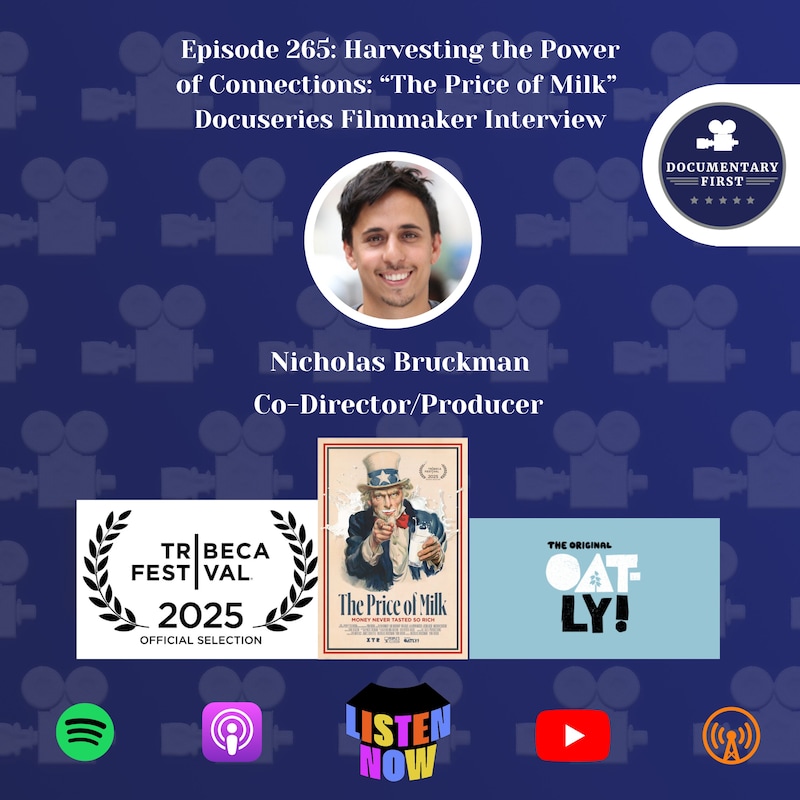
Shownotes
In this episode of Documentary First, host Christian Taylor welcomes back Emmy-nominated director and producer Nicholas (Nick) Bruckman for his third visit to the show. Together, they pull back the curtain on the real world of documentary filmmaking—from getting into top festivals like Sundance and Tribeca, to navigating labs and markets, to landing a doc on Netflix.
Nick shares how his early narrative feature Valley of Saints got into Sundance off a “cold” submission, and how he’s since used programs like Gotham Week, Film Independent’s labs, and Tribeca’s Creators Market to build meaningful relationships with programmers and industry partners. He breaks down his rough-cut screening process (including Google forms and phone-watching “tells”) and explains why being radically open to feedback is one of the most powerful tools a filmmaker has.
Christian and Nick also dive into Minted: The Rise and Fall of the NFT, exploring why that film became Netflix’s “definitive” NFT documentary—and what that reveals about marketplace demands, cultural buzz, and why some critically acclaimed films (Not Going Quietly) still don’t land on major streamers.
The conversation then turns to Nick’s latest four-part docuseries, The Price of Milk, which premiered at Tribeca. Christian shares her strong personal reaction to the series, especially its portrayal of small family dairy farmers and the government “checkoff” program that was supposed to support them. Nick unpacks the hidden story behind the “Got Milk?” campaign, how money flows from farmers to industry groups, and why transparency, policy, and political engagement matter more than simply switching what’s in your grocery cart.
Finally, Nick reveals how Oatly helped fund The Price of Milk while still allowing full editorial independence—and offers practical advice for filmmakers on working with brands, nonprofits, and mission-aligned partners to get ambitious projects made and seen. He closes with a DocuView Déjà Vu recommendation: Secret Mall Apartment, a doc that not only tells a wild story but also models what’s possible with clever, independent distribution outside traditional gatekeepers.
Links:
Minted - on Netflix & Prime Video, IMDB: https://www.imdb.com/title/tt27548035/?ref_=fn_all_ttl_1
Valley of Saints - on Prime Video, IMDB: https://www.imdb.com/title/tt2088967/?ref_=fn_all_ttl_3
Catapult Film Find: Catapult Film Fund
Gotham Week: Gotham Week
TriBeca X: Tribeca X
Peoples TV: People's Television
DocuView Déjà Vu
Secret Mall Apartment, 2024, 91 mins, Watch on Prime Video, IMDB Link: https://www.imdb.com/title/tt21221386/?ref_=nv_sr_srsg_0_tt_8_nm_0_in_0_q_secret%2520mal
Time Codes
00:00 Introduction to Documentary Filmmaking
03:31 Navigating Film Festivals
09:50 The Importance of Feedback in Filmmaking
16:04 Getting Projects on Netflix
21:58 Understanding Market Demands in Documentary Filmmaking
27:47 Exploring 'The Price of Milk'
34:13 The Role of Government in Dairy Industry
42:05 Funding Documentaries: A New Approach
47:13 Collaborating with Brands for Storytelling
54:06 Conclusion and Recommendations
Sponsor: Virgil Films http://www.virgilfilms.com/
Support us by buying merch or watching our films: https://documentaryfirst.com/
Transcripts
Welcome to Documentary First, everybody.
2
:My name is Christian Taylor and I am the host of Documentary First, also a documentary
filmmaker.
3
:This podcast is an inside look at documentary filmmaking and I am really excited today to
have another documentary filmmaker with me here, Nicholas Bruckman.
4
:We call him Nick.
5
:This is the third time he's been on our show.
6
:Nick, we're super happy to have you here today.
7
:Thanks for being here.
8
:Thank you so much, Christian, glad to be back.
9
:Yeah, he's talking about a new project.
10
:We're also going to talk about another project that he spoke about before called minted,
which is now you can find on Netflix.
11
:We're going to talk about how it got there.
12
:We're going to talk about a new project that he just came out with his, or, you know, it's
going to be on the film festival circuit.
13
:It is called the price of milk.
14
:I just finished watching it and boy, let me tell you, I got some really strong feelings
about that.
15
:I can't wait to talk about.
16
:But first, let me read his bio.
17
:Nick Bruckman is an Emmy nominated director and founder of People's Television in New York
City and DC based creative studio producing award winning films and storytelling campaigns
18
:for the world's leading brands, foundations and social movements.
19
:His feature documentary, Not Going Quietly, which is phenomenal and everybody should see
that.
20
:about healthcare activist, Addie Barkin won both the audience and jury awards at South by
Southwest and was a release to critical acclaim in theaters nationwide and on Hulu.
21
:Is it still there?
22
:No, it's not on Hulu, but it is still on Amazon and Apple TV.
23
:Good.
24
:His follow-up minted the rise and fall question mark of the NFT premiered at the Tribeca
Film Festival.
25
:And I absolutely love that film and was released by Netflix earlier this year.
26
:And I'm assuming it is still there.
27
:Yep.
28
:Most recently the docu-series, The Price of Milk, which we're going to talk about today,
which uncovers the hidden story behind the iconic Got Milk campaign had its world premiere
29
:at Tribeca in June.
30
:So
31
:That's just a small introduction of who Nick is.
32
:uh Nick, thank you so much for all of those projects and for your experience.
33
:I um really want to look under the hood and figure out about how you were able to make all
this happen, particularly about how the heck you get into Tribeca and how in the world you
34
:get your stuff on Netflix.
35
:And...
36
:how you get things funded like the price of milk because I just finished watching it.
37
:was an excellent production.
38
:You used all sorts of things from amazing graphics to a lot of archival stuff.
39
:You had interviews all over the place.
40
:So I know there was a lot of travel uh and just talking heads and just different people
that you interviewed.
41
:So it looked like it was a big uh undertaking.
42
:So lot of questions for you.
43
:Thank you.
44
:Yeah, I appreciate all the run through and there's different themes that emerge.
45
:And I know a lot of your audiences, filmmakers themselves who are trying to make their
first or maybe second or third or fourth project and things are changing very fast in the
46
:documentary landscape.
47
:so I'm happy both to talk about the stories but also the behind the scenes under the hood.
48
:I'm super happy that you're here because you're one of the filmmakers that I feel like I
can talk to is sort of on my level.
49
:You're not, you're ahead of me, but you are an everyman in a sense where you are an
independent filmmaker.
50
:You're trying to get your stuff out there, but you have been super successful with getting
your things in the high profile film festivals and now, you know, getting your shows on uh
51
:streaming services like Netflix.
52
:So let's start with how you're getting your things into Tribeca.
53
:That's really hard to do.
54
:How have you made that happen?
55
:Thanks, yeah, that's a great question.
56
:I mean, I should caveat by starting to say that film festivals are important, but they're
not everything.
57
:um Of course, they're really important launch pads for films.
58
:um And I know that a lot of filmmakers can put a lot of emphasis on them.
59
:And I think that's right.
60
:I include myself in those filmmakers that emphasize them.
61
:So I don't want to diminish it anyway, but I do want to make sure that we button this talk
about Tribeca and how to get in with the fact that
62
:you can still make a great film and you can still get it out to the world without those
laurels.
63
:uh But it is really important to think about how you're gonna present your film to the
world for the first time.
64
:That's where all the buzz and attention will begin.
65
:um so, at bare minimum, like one piece of advice that most filmmakers um will learn on
their first film is to really try to reserve that first screening for the right fit.
66
:And that can be a really challenging process because
67
:Everybody, you send your film to Sundance and it doesn't get in as not all some of my
projects have, but many have not.
68
:And then you say, okay, well, what now?
69
:Do I try to go to South by Southwest?
70
:Do I go to Tribeca?
71
:What if one of them says no?
72
:What's the next best thing?
73
:So there's a couple of things that I've done.
74
:um One is just to, and this is uh important, is to really try to develop the pedigree of
your project through different labs and markets.
75
:So we're talking about the price of milk, which is our...
76
:four part documentary series about the absurd history of milk in America.
77
:And we actually um had that project developed at the Tribeca Creators Market in 2024,
which is something that we submitted to.
78
:And through that, we're able to make some connections to the Tribeca programming team.
79
:I also have had projects in Tribeca in the past, but there are markets like that which
help to
80
:um cultivate some type of relationship with a festival.
81
:That way you're not just writing to submissions at sundance.org, but instead hopefully
writing to a programmer there that you have some connection to.
82
:Now, that can help because you can put it on their radar early, you can get more attention
from them.
83
:um And a lot of filmmakers will say, well, how do I get those relationships in the first
place?
84
:And there really are ways to do it.
85
:You can attend.
86
:The programmers often speak at events, speak at panels.
87
:They do these labs and markets.
88
:But I've done these different kinds of labs and markets with most of my projects from Not
Going Quietly to The Price of Milk.
89
:Not Going Quietly was in a program called Gotham Week, which is here in New York, which is
also a project development uh marketplace.
90
:There's also one that we participated in called Fast Track, which is run by Film
Independent in Los Angeles.
91
:They have a documentary lab as well and a producing
92
:a workshop and a rough cut workshop.
93
:And the reason why these things are, I encourage people to apply to these things.
94
:It can be a bit burdensome to do that is not only to make those connections to
programmers, but also to evaluate the strength of the material in the first place.
95
:uh Even those, course, like film festivals are very competitive to get in, but it's a
place where you can really show the work to a lot of peers and also to industry and get
96
:feedback.
97
:And I think that brings me to the
98
:Last thing I just want to mention besides kind of making relationships, applying to labs
is it really comes down to, I don't think it's that political.
99
:My first ever film that I produced, we made it with a crew of three.
100
:I was 25 years old.
101
:We submitted it cold.
102
:I didn't have any program relationship at the time to the Sundance Film Festival.
103
:uh And I got the call on Thanksgiving weekend.
104
:Congratulations.
105
:I wasn't, know, everything I'd heard before that was, you have to, you know,
106
:be the studio head, Harvey Weinstein can make the call or that at the time.
107
:I don't know, you've got to be head of Netflix.
108
:We'll pick up the phone for you or CAA or whatever.
109
:And so we didn't need that.
110
:Of course, those things do help.
111
:But fundamentally, it comes down to making something that is unique, that's competitive in
the marketplace, that has a distinct point of view.
112
:And the way that I approach it as a storyteller, this is not about business or
connections.
113
:is really back to this idea of getting feedback and getting feedback from peers, from
people you trust.
114
:And every project that I've done has probably had, you know, going on five, 10, 15 rough
cut screenings where I've sent them, sent the links to friends.
115
:We've had screenings at the office.
116
:We have this technique where everybody gets a little form, a Google form, and they all
have to,
117
:movie ends, the rough cut ends, and everybody has to silently take out their laptops or go
on one of the computers and put in their raw, unvarnished, unfiltered thoughts before
118
:anybody says anything.
119
:That way you hear what people thought individually.
120
:And of course you can do this online.
121
:But I recommend making an actual form.
122
:Don't just say, can you look at this and tell me what you think.
123
:Try to actually put radio buttons in there that say,
124
:on a one to five, would you recommend this to a friend?
125
:And where were you bored?
126
:One thing that I um really notice when I'm in these rough cut screenings is not just what
people click there, but when I see people reach for their phones in their pocket, if it's
127
:a live screening.
128
:And when you watch people do that, you got to cut that scene or shorten it.
129
:And so I say all this because I think fundamentally, this is the best way to improve as a
filmmaker.
130
:You can also go to film school.
131
:great, great collaborators, all of the stuff that, you know, is obviously fundamental
storytelling, but being open to critical feedback and continuing to iterate on your
132
:project until that stuff starts to improve.
133
:If you were getting threes and fours in the reviews of your film from your friends and
family, keep working on it until you start to get fives.
134
:Because if it's not, if your friends and family don't think it's incredible, now you have
to compete with
135
:the other 10,000 people submitting to Tribeca.
136
:So this is not foolproof.
137
:It's just to say that, you know, focus on being open, being vulnerable, you know, listen
to what people tell you about your work.
138
:Cause it can be really hard to get that perspective from the outside.
139
:So true.
140
:What was that first film that you submitted to Sunday?
141
:Valley of Saints.
142
:the producer on the film and it was at Sundance in 2012.
143
:That's also on VOD now so you can download to rent or buy it on Amazon or Apple.
144
:It was very formative project for me.
145
:It was directed by an amazing filmmaker named Musa Saeed who I still collaborate with
today and we filmed it in Kashmir on the Indian Pakistani border.
146
:uh And it's a narrative film, a love story, but shot in a very documentary style.
147
:And I was the producer and the sound recordist because we only had a crew of three to make
the movie.
148
:and that was a scary time to be there, actually.
149
:My son was in Afghanistan at the time, right on the, in the Pakiya province, right near
the Pakistan border.
150
:So I know that was not a easy time to be over there.
151
:It was not, and we um actually included the story is around some of the conflict that is
happening there.
152
:And we actually included kind of some of the real protests and real um strikes and things
that were going, even though it was a scripted film, we sort of incorporated some of those
153
:um elements into the story, which I think made it really unique.
154
:And not a lot of films have been made in that part of the world with that perspective.
155
:Yeah, I'm sure that's why you got into Sundance.
156
:So congrats on that.
157
:So let me just ask you about these creators markets and these labs.
158
:Just talk to me about exactly what that is.
159
:So I mean, I've seen that when I've gone to Sundance's website or when I've gone to the
Tribeca's website and I really have been intimidated uh because they seem very onerous to
160
:get in.
161
:uh I feel like, gosh, I'll never get in.
162
:They're expensive or they're time consuming.
163
:Just explain a little bit more about what your experience is, you know, to get in and what
it's like when you get in there.
164
:Yeah, I mean, similarly to the festivals, they are very competitive and we all just have
to acknowledge that being a filmmaker, being a storyteller is a very privileged position
165
:and there's always gonna be, as well as any kind of artist, there's going to be more
creators than there are uh room for in the market, especially when you're you know, kind
166
:of socially oriented documentaries.
167
:People wanna kick back and watch reality.
168
:And if you definitely want to work, you can definitely get into other parts of the
industry that are not as competitive.
169
:But all of us in this field are really motivated.
170
:We're really passionate about the stories.
171
:We know that nobody else is going to tell them if we don't.
172
:And so we don't let a little rejection slow us down.
173
:And I've experienced plenty of it.
174
:For every project you just described, there's others that I couldn't get off the ground at
all.
175
:ah There's films that...
176
:I was, uh, gotten pretty far and never got out.
177
:there's films of friends that I've helped support that never got into any film festivals
and, know, had to be self distributed and all of those things have found their way.
178
:having thick skin for all of that is important, but I do think applying for the labs can
help because it can show you the promise of the project early on.
179
:And there's different kinds.
180
:There's some that really look at projects very early on at a sort of development stage.
181
:And there's some that.
182
:you're sending the rough cut of your film to.
183
:And for documentaries, really, it's all about getting the story right in post.
184
:um All of my projects have taken, all three of the main kind of documentary projects you
mentioned were in post-production for almost a year.
185
:um And all of that was finding the story, refining it, making sure it works, having it
resonate, doing those rough cut screenings.
186
:So the labs that do that are great.
187
:There's a uh rough cut retreat.
188
:that I haven't participated in held by an organization called Catapult Films.
189
:um although I've heard great things about it, but I would really encourage, a lot of film
festivals have um pitch sessions where you can pitch your idea or show your preview of it.
190
:But I can speak particularly to Gotham, which is kind of New York's main film nonprofit
and Film Independent, which is LA's main film nonprofit.
191
:as being very welcoming of new and diverse voices.
192
:um And ah both of those programs were great.
193
:So they consist of kind of two different tracks.
194
:One is the kind of story workshops or labs where you really hone your craft.
195
:There's a directing lab at Film Independent, a producing lab, an editing lab, et cetera.
196
:Those are great.
197
:And then there's also with both of these organizations kind of uh networking markets.
198
:And those are really not about
199
:being a better filmmaker, those are about connecting your project to industry.
200
:And that's really critically important.
201
:One tip I will say is that those, as we talk more about the business side of how do you
find money, how do you find the programmers, how do you find the festivals, et cetera, at
202
:a lot of those labs, they do publish the names of the people who attended.
203
:And the people who attended are generally,
204
:the people who are looking for projects in some capacity and You can email those people
and try to get to those people even if you're not in the lab So I recommend staying up to
205
:speed on who's attending these things you can also just go as an attendee if you don't get
in to many of these things like Gotham week here in New York and uh You know buy buy a day
206
:pass or a conference pass and really try to network and if you're a you know ambitious
207
:independent filmmaker, I know you'll have no problem kind of going up to somebody, shaking
their hand, pitching your project, just getting their email and being persistent.
208
:And I, as any good producer, have a big spreadsheet of anybody who I think might possibly
support a project from a traditional investor to a donor, to a foundation, to a brand, to
209
:a journalist, um and trying to manage those relationships.
210
:at scale, you can be honest about being a first time filmmaker or being up and coming and
really trying to get your first project off the ground.
211
:And people are receptive to that kind of honesty and helping you out.
212
:um yeah, developing and managing relationships is important.
213
:And that's what those market side of those um programs do.
214
:And there's a few more that are escaping me right now besides those two.
215
:And a lot of individual and local film festivals also have um workshops and markets.
216
:Well, that's what Google and ChatGPT are for.
217
:I think you've given us a good list and I really appreciate it.
218
:say AI in any of my answers today, just as a a drinking game to see if I can get through
the whole interview without saying it.
219
:No, no, you're good.
220
:But actually, thank you so much for those inside tips.
221
:I think that is uh the stuff that filmmakers are looking for.
222
:So thank you.
223
:Let's move on now to talk about Minted because Minted is, we were talking about this last
time.
224
:We talked about what was going on.
225
:You couldn't talk to us about it.
226
:I had a sneaky suspicion.
227
:You were talking to Netflix and.
228
:I was hoping that that would go through for you.
229
:It clearly did.
230
:I want to know how it happened because my film was not accepted by Netflix.
231
:And so how'd you make it happen?
232
:Yeah, well, don't, like I said about any kind of rejection, just to make you feel better.
233
:uh My other films, including Not Going Quietly, which got sort of many, many industry
accolades uh and attention, uh also was not acquired by Netflix.
234
:every project has its own path and journey.
235
:um And I am hopeful that some of the tips that I'm giving here will help you with your
next film getting on there.
236
:And just like I said, with film festivals, like getting on the Netflix isn't everything.
237
:It was a really big milestone for me.
238
:I'm obviously excited to talk to you about it.
239
:And it was great to have a lot of the accessibility of it for a lot of my friends.
240
:And most of our friends have it and therefore it makes it easier to see.
241
:Nobody wants the friction of paying $2.99 to rent a movie, although they should, because
it helps support these kinds of projects get out into the world.
242
:uh And in the case of uh
243
:minted the rise and fall of the NFT.
244
:We were lucky enough in April of this year to uh have the film uh licensed by Netflix in
about hundred countries, uh not everywhere.
245
:uh And it was uh a deal that was done uh by our agents.
246
:So the project has a sales rep and this is another part of the whole process that
documentaries can uh have somebody that helps you navigate the marketplace.
247
:And um they're um not difficult to get a good sales rep necessarily because it's their job
to sell films.
248
:And it kind of again goes back to the first principles of having a great story.
249
:Getting into a film festival will help you get a sales rep.
250
:And in our case, the project was represented by Range Media Partners headed by Jessica
Lacey, who I don't know if she wants to share this, but is Susan Lacey's daughter who you.
251
:mentioned and I really um love that Jessica is both a industry executive selling
documentaries, but also comes from a family of legendary documentary filmmakers.
252
:So she really knows and loves and cares about the craft as you know, not just a Hollywood
studio type.
253
:um And um they um made the deal happen.
254
:And I'll mention that the deal was done in conjunction with PBS.
255
:um the film broadcast on PBS Independent Lens and they were able to do a joint deal where
after the PBS broadcast, the film um then went onto the Netflix platform, uh which was
256
:great that they were willing to work together.
257
:um I'll mention a couple other things that are important.
258
:uh From the perspective of the story, the reason I think that that film was acquired was
because not just about all the quality,
259
:stuff that we've been talking about, about great stories, but it's also kind of the
definitive film about this one cultural flash point.
260
:And Netflix, they send these mandates about what they're interested in to industry.
261
:I'll send you one.
262
:They send them like once every few months to the sales agents and they're very informal.
263
:They're like, buzzy, true crime.
264
:We're looking for the next,
265
:greatest big scams and cults.
266
:They're not necessarily looking for some of the more mission-driven docs, which is why the
industry has been having such a hard time.
267
:And I'm sure your other guests have talked about that.
268
:the case of Minted, they really want projects that kind of drive like water cooler
conversation, right?
269
:What kinds of films are people gonna be like going into the office and saying, hey, did
you see that new Netflix doc?
270
:That's what...
271
:Tiger King is or the big celebrity thing is, right?
272
:You just have to subscribe to Netflix because then the reason for their business logic, in
my opinion, I'm not a streaming exec either, but their logic is they want people talking
273
:about the movies so that anybody not subscribing in that what friend group needs to
subscribe or they're missing out.
274
:And so I think having kind of like the definitive NFT.
275
:Doc helped because everybody was like, what was that whole thing?
276
:And yeah, and I don't know that it was strictly.
277
:So I think it's important when selecting your projects to think about, you you don't want
to cater to the marketplace.
278
:You have to do what you care about and what what story is you're passionate about.
279
:But I do think having something that has a little bit of that buzz and it's recent and
it's like a cultural phenomenon, all of those, I think, are the reasons that Netflix took
280
:it, even though, like I said, they did not.
281
:take my previous film before that, which was, you know, in some ways a more elevated, more
accoladed, won many more awards, but it was about a really difficult subject about
282
:somebody with ALS.
283
:It was very political and unfortunately there hasn't been as much acquisition of political
docs.
284
:And so, you know, I don't know that I want to tell people like, do what the marketplace
says.
285
:Like you should make the best story you can.
286
:But let's just talk about that for one second.
287
:And then I want to come back to, we're going to have to clarify what Minted is about in
case people did not listen to our other podcasts, which you should.
288
:It is on YouTube and it is on your other podcast streaming platforms.
289
:uh But we do need to talk about what Minted is about.
290
:let's do talk about this concept of making docs that the market wants, because we are in a
situation where we can...
291
:I have always said on this podcast, you must think about the end result.
292
:As a filmmaker, you can't just say, oh, I'm going to go and make whatever I want to make
and spend my money on all these things and then try to go and sell it.
293
:And I just think that's folly these days because that's not the way our industry works
anymore.
294
:It's narrowed so much and it's changed so much.
295
:that if you're not thinking about what the buyers are buying, then you are throwing away
your time and your money.
296
:You're right.
297
:It's a balance of making sure that you are doing the project for the right reasons and
your passion about the topic and the story are driving you forward while also being
298
:realistic that there is an audience for this.
299
:It's a story that needs to be told by you, the storyteller, but it's also a story that
needs to be heard.
300
:And there's an audience that wants to hear it.
301
:I agree, you know, going back to Chat GPT, I mean, I do think that the first thing when
you find, you know, I met this amazing person and he's got this great story and he
302
:overcame this thing and it's going to be an amazing film.
303
:I, you know, would that there I would encourage people to go into Chat GPT and, and I
know, I know, and ask it to list out every film.
304
:about this topic and there always will be, including for NFTs, including about Milk,
including even about um Adi, there was other things going on, he's the subject of not
305
:going quietly.
306
:And I wouldn't say to let any of that deter you, but watch those movies and think about
how did they perform, what works about them, what didn't, and what is your unique
307
:perspective on this?
308
:And of course, you know, the Fyre Festival had two documentaries made about it at the same
time.
309
:It doesn't mean you can't do something.
310
:It just means you have to have a unique take, a perspective, and you have to have, it has
to have an audience as a subject.
311
:So you're right about that.
312
:And, you know, I just don't want that to mean that everybody's just chasing the same buzzy
feeling projects, because if everybody followed that, there would only be true crime
313
:documentaries, which is 90 % of what's out there.
314
:true.
315
:So true crime and horror, some sort of horror thing, because that's what sells, sadly.
316
:um
317
:fictional crime or real crime.
318
:That's what people wanna watch.
319
:And I think there's a lot of reasons for that.
320
:And this is beyond the scope of this conversation, but I think having more media literacy,
more cinema studies in school, more documentary introduction earlier on, that I think can
321
:really help cultivate more of an audience for it.
322
:I think it starts.
323
:when people are young, but I'll just mention this one anecdote.
324
:Maybe I told you this before, but I was at the Copenhagen Documentary Film Festival, CPH
Docs with Minted last year, and um all the screenings were packed and much more full than
325
:any festival I'd been to in the U.S.
326
:mean, just regular Danish people just walking in wanting to see every documentary.
327
:And I was asking somebody at a reception, like, why are the Danish people so into
documentaries?
328
:And he said, that's easy.
329
:It's because we're happy.
330
:We have great health care.
331
:We have good child care.
332
:ah And we have good employment here.
333
:And so when we have free time, we want to know what's going on with the rest of the world.
334
:And so we like to watch documentaries to learn more about that.
335
:And I think that's an interesting just take because here a lot of people, for whatever
reason, whatever your political beliefs are on why that's the case, people
336
:you have to ask yourself, why are people so gravitated towards watching this kind of like,
you know, I don't want to say empty because true crime is great is a great medium.
337
:But why is it that people want to watch that and don't have the energy on a Friday night
to watch something really hard hitting about veterans or about health care or about, uh
338
:you know, food, the food industry.
339
:uh And so it's like a societal thing that I don't have any answers for, but it's just
something.
340
:that we need to think about because that's where all the pressure for the Netflix's of the
world to buy documentaries is going to come from.
341
:People have to demand them.
342
:Why do you think it is the case in the US?
343
:What's your theory?
344
:I mean, it comes down to, like I said, outside of the scope of this conversation, because
I think it comes into the political questions of why are, why, if you take that anecdote I
345
:used about the Danish guy and its word, that people here feel a greater sense of struggle
in their own lives.
346
:And so that makes them less inclined to watch cinema that
347
:has people struggling.
348
:yeah, yeah, so that it's as simple as that.
349
:that's, that's why sports it's growing.
350
:So if you look at the sports industry, especially sports and streaming, it's where the
money always is.
351
:Like you could true crime or the sports industry or the betting industry, know, the kind
of gaming industry, those are.
352
:It's blowing up.
353
:media component to this, right, which is attention spans are going down.
354
:And I think great stories can be told on social.
355
:We make, as our production company, People's TV, we make a lot of social forward content.
356
:I'm not a purist about only make documentaries for the big screen.
357
:We do.
358
:for Asia.
359
:my goodness.
360
:I've heard about these.
361
:the vertical stories.
362
:No, no, no, I know about those, the soap dramas.
363
:Yeah, no, we haven't made any of those.
364
:Yeah, so it's a big, like I said, it's a bigger topic than we can deal with here, but my,
to leave it on a hopeful note, I think, you know, the best thing people can do, filmmakers
365
:and audiences, is just engage more with great stories.
366
:Pay that, if it's not on Netflix, pay that $3.99 to rent.
367
:the Girl Who Wore Freedom or Now I'm Not Going Quietly or any other project that's harder
to see on the bigger streamers and show that there's a demand.
368
:Yeah, well, I will say that when I talk to people who do watch documentaries or take the
time to, they always say, I love them.
369
:I love watching docs.
370
:If they just make the choice to do that, they learn something new.
371
:And then people are like, I love learning new things if they just need to make that step.
372
:All right, so let's talk about minted real quick.
373
:Talk about what an NFT is.
374
:Talk about why it was the, you know, uh the, what'd you say?
375
:What'd you say it was the?
376
:In the zeitgeist, a cultural moment.
377
:Yeah, but the like admit that what did you say it was the film was like the.
378
:There you go, that's the word I'm looking for the definitive one.
379
:Yeah, so minted the rise and fall of the NFT was my previous film before the price of milk
that we chatted about on a past episode.
380
:So for more details, your audience can go back to that one.
381
:But the um film tells the story of the sudden and explosive rise of the non-fungible
token, which is when a cryptocurrency like a Bitcoin
382
:is attached typically to a piece of art or something else that gives it value.
383
:And in 2021, when we started filming that project, a single NFT by an artist known as
Beeple was sold for $69 million.
384
:And it shook up the entire art world.
385
:It made him the third highest selling living artist.
386
:And it created this phenomenon where artists around the world
387
:and collectors started cashing in on this meteoric rise of the value of these ephemeral
digital tokens.
388
:And for people who are now familiar with Bitcoin, they'll know how these cycles can come
up and rise and crash.
389
:And the story follows over the course of the two years, artists around the world whose
fortunes rise and then dramatically fall through that market phenomenon.
390
:uh And it's now on Netflix.
391
:Yeah, and it's definitely worth a watch.
392
:So make sure you do that.
393
:Now, let's move on to this new film that I watched.
394
:well, it's actually a four-part series called The Price of Milk.
395
:And I have to say, extremely well done.
396
:uh Visually a beautiful film about a very dirty subject, if you want my opinion.
397
:um I was not at all um expecting where it went.
398
:I don't know why.
399
:think...
400
:I shouldn't have known you.
401
:should have known it was going to go in that direction.
402
:anyway, talk to me.
403
:My first question was, how the heck did you get excited about this subject matter?
404
:What made you want to tell this story?
405
:And give us the log line about it first.
406
:So The Price of Milk is a four part investigative documentary series that follows the
money behind the iconic:
407
:America, the government and the milk and dairy industry.
408
:And it's a fun and wild ride, also exposes, I hope you felt that way, but also exposes uh
bigger issues with how industries can capture our government and our politics and our um
409
:economy um in ways that may not be at the best interests of everyday people.
410
:And that could apply to almost anything.
411
:And all my projects, I think, explore that to some degree.
412
:But this one looks at it through a very
413
:kind of uh simple and unusually deceptive thing, which is a simple glass of white milk.
414
:Yeah, and I will say I did not read the log line before I jumped in.
415
:you you mentioned before, Susan Lacey, Jessica Lacey and her mom, Susan Lacey, I thought I
was interviewing her today.
416
:I will be interviewing her tomorrow.
417
:And so I had to quickly watch your film and I just jumped in without reading any prep,
which actually I kind of liked.
418
:I liked just not knowing what it was about and discovering it as I walked in.
419
:And one of the things that I will say is I was in...
420
:incredibly impressed by the organization of the story.
421
:So I felt the story was super clear and told really well because it was divided into these
four parts that were easily digestible.
422
:thought that, what'd you say?
423
:Yes, no pun intended.
424
:it was, um it highlighted, you know, it slowly took me, I felt like I was a frog in water.
425
:Because it slowly developed until I fully understood at the end how bad the problem was.
426
:So you gave me this education very slowly throughout the series.
427
:um And then I fully understood at the end, holy cow, this is ginormous.
428
:That's again the right expression that you keep using for the project.
429
:Holy cow.
430
:um yes.
431
:Well, thank you.
432
:I'm really glad it resonated with you.
433
:And it was my first time doing a series.
434
:um And I'll mention that it began as a feature, like most of my other projects that we've
talked about.
435
:um going back to those rough cut screenings, when we were trying to put it together as a
feature,
436
:It just wasn't really working as a story.
437
:It was too sprawling.
438
:It was too complex.
439
:um It didn't have the kind of traditional arc that you'd want in the three act structure
of a movie.
440
:And so we decided to break it up and turn it into an episodic series that is what you see.
441
:Yeah, well that makes sense completely.
442
:What I did love is I thought it was brilliant that you did have this, you start with this
one couple um and Joe and Brenda Cochran and they are small family farmers.
443
:And it was very easy to follow their story and kind of their experience all the way
through the movie.
444
:I kind of, you kind of see yourself as them um going through this process.
445
:That was easy for me to get my head around.
446
:And I really,
447
:appreciated that.
448
:And then you see their kind of plight um because really that's what this whole thing is
about.
449
:You see it's the small farmer versus the corporate farmer.
450
:That's kind of the beginning.
451
:And I didn't really even begin to think about um how that happened in the United States
that I knew because I had actually done a voicing for this project where
452
:we were talking about how we were losing these small farms to big real estate people that
were buying up the farms because the younger generations couldn't make a living farming
453
:and they were turning them into developments.
454
:And so we were just losing large swaths of America.
455
:uh So I knew we were losing these small farms.
456
:I didn't understand it was also happening to these corporations.
457
:So that was a highlight for me.
458
:Yeah, that's great that you had some connection to it.
459
:And I think when a lot of people read the log line or even hear the title, The Price of
Milk, they might think that the story is about milk being bad or bad for you um or that
460
:farmers, dairy farmers are bad.
461
:And it's really quite the opposite.
462
:As you pointed out, the heroes of the story are small dairy farmers.
463
:And the price that we talked about is kind of the price that um we all pay for um
464
:the collusion between big dairy, industrial dairy, and the government, which is what the
series explores.
465
:So episode one is about the Got Milk campaign, which is actually a USDA, that's the United
States Department of Agriculture, checkoff program.
466
:So it's a federal program.
467
:Yeah.
468
:I thought it was the playwright checkoff.
469
:was like, did they take that name and make it mean somewhere else?
470
:But it's check, C H E K O F F check off.
471
:And that was a hard concept to understand.
472
:Why don't you explain that real quick?
473
:I'll do my best.
474
:um And it's a very obscure word.
475
:It's a program for the USDA.
476
:It means to check off a box for a farmer to, ah you know, take their pen and check a box.
477
:And um the reason that um people will know about checkoff programs is because they've
heard of all of the advertising.
478
:At least if you grew up in America in the 90s, as I did, you will have heard of Got Milk.
479
:as well as beef, it's what's for dinner, perhaps pork, the other white meat, maybe the
touch, the feel of cotton, the fabric of our lives, the incredible edible egg.
480
:These are all generic advertising programs, which I don't think people have thought too
much about, kind of think of them as regular, I don't know, PSAs, like eat your
481
:vegetables, but actually they're a US government program that all of the producers of that
product are forced to pay into.
482
:And what we explore is whether that mandatory tax on America's farmers to advertise these
kind of generic products, A, whether the advertising works at all and B, whether it's
483
:worth it for the small farmers.
484
:And this is, as you pointed out, Christian, all set against the backdrop of small and
family farms closing across America.
485
:And what we discovered through our research and following the reporters in the series is
that these programs are actually
486
:basically robbing America's small farmers blind and transferring that money to big
industrial farms.
487
:And they're sort of doing it with the pretense of helping America's farmers, but really
they're helping these kinds of, um you know, executive dairy industry moguls who we
488
:uncovered in the series.
489
:Well, and this is going to shock you because it shocked me, but I have another touch point
to this story because you say these advertisements were in the nineties and they were, but
490
:they started actually in the eighties um when Reagan was elected and you had milk does a
body good in the early eighties, right?
491
:But somewhere in there, correct me if I'm wrong.
492
:they realized that there was this huge surplus of cheese and butter and all of these
things.
493
:And they tried to get rid of that surplus by giving it away to, you know, um the poor
populations in the U S barely made a dent.
494
:And they had to find some other way to um subsidize these farms so that they wouldn't go
under sort of like holding up the banks.
495
:And so
496
:the USDA under the Reagan administration decided to create this check off program.
497
:And so they decided that they were going to tax the farmers 12 cents on every dollar or
whatever.
498
:They were going to tax them and then use that money to pay advertisers to create these
campaigns to encourage us to buy more milk.
499
:or buy more cotton or clothes or buy more whatever in order to help these farmers so that
they would, the small town farmers so that they would not go under.
500
:That was the premise.
501
:You got it, yeah.
502
:Yeah, you did it better than me.
503
:A little bit, you know, some of this began under Carter, so it's, you know, difficult to
pinpoint, you know, exactly where the checkoffs went wrong.
504
:But I will say that it's actually a program, like many things in our government, that had
some good intentions.
505
:The idea of increasing demand to support farmers is not necessarily a bad idea.
506
:but what we explore in this series is how it kind of goes off the rails and how the
project is taken advantage of by the lobbyists who have their uh arms wrapped around our
507
:government.
508
:And this is where I want to explain my connection.
509
:My father was the deputy undersecretary of agriculture from 1980 to 1984 under Ronald
Reagan.
510
:Is he still with us, may I ask?
511
:I'd love to get his take on the show.
512
:Yeah.
513
:I haven't been able to talk to him yet.
514
:I remember him saying to me and talking to me at the time, because I worked in Washington
on Capitol Hill in radio and television production.
515
:It's how I got my start actually in this industry.
516
:But I remember him talking to me about these huge surpluses of dairy and how they needed
to subsidize the farmers.
517
:And I remembered.
518
:them trying to figure out a way.
519
:I even actually found some papers as I was going.
520
:had to move my father into an assisted living.
521
:I was going through all those papers.
522
:I found paperwork.
523
:I should show you this.
524
:I found paperwork on this stuff that he was working on this.
525
:And so my father's a good man.
526
:He was the undersecretary under Jack Block who was from Illinois.
527
:I knew these people.
528
:So I knew that they had good intentions to help these farmers.
529
:Jack Block was a farmer.
530
:So like you said,
531
:Yeah, there were good people trying to do good things with good intentions.
532
:But then my father became a lobbyist after he left.
533
:And this is this rotating door, right?
534
:So my father became a lobbyist who had a good relationship with Trent Lott, who at the
time was the majority leader in the Senate.
535
:His job was to lobby the senator about, you know, these how to vote on certain bills.
536
:My father then
537
:was reliant on clients to pay him to pressure the Senator to vote certain ways.
538
:And so he now is reliant, his salary is reliant on clients to pressure the Senator to do
certain things.
539
:And there you have this untoward relationship, right?
540
:It's not really pure anymore.
541
:Yeah, that's right.
542
:There's a total revolving door between private industry and government.
543
:I mean, it's an interesting personal take on it.
544
:I really want him to see the series and see whether he thinks we got it right, because we
do try to cover that time period.
545
:uh And it's important to say that, you know, we look at milk as this kind of like it's
it's almost comical, like to think about making our two hours of television about a glass
546
:of milk.
547
:But you could apply a lot of these issues with
548
:money in politics to almost any other, first of all, any other food, but also to any other
industry, to the weapons industry, to the defense, you know, many other ways in which our
549
:uh representatives are not always acting in our interest.
550
:But because everybody's got a relationship with milk and everybody remembers the Got Milk
campaign, we thought this was a fun entry point and not a too, you know, talking about
551
:movies that people want to engage with, a way to explore these issues without hitting you
so much on the head.
552
:I want to mention that one of the things that excited me about the project is the Got Milk
campaign itself is actually like incredible advertising.
553
:Some of the ads are totally iconic.
554
:The first Got Milk campaign was actually directed by Michael Bay of Transformers fame.
555
:Yeah, the one about Aaron Burr and the contest.
556
:Yeah, you'll have to see the series or look up that ad on YouTube.
557
:So there's a lot of, you know, it's a way that you can kind of use pop culture, all the
celebrities who did the mustache.
558
:Mm-hmm.
559
:to look at these bigger problems in our food industry and in our political industry.
560
:And hopefully to get people to think a little more critically about where their message is
and where they're advertising and where their food comes from.
561
:Yeah, well, I'll tell you that Got Milk campaign was incredibly popular, but what you
showed us in this film was that it didn't benefit the farmers at all.
562
:That's what we didn't get to.
563
:So the farmers paid for this and then the small farmers didn't benefit from it at all.
564
:They paid for it and yet they're still not helped and they're continuing to lose their
farm.
565
:And what's interesting is then you contrast that with a corporate farmer masquerading as a
small town farmer who actually I pass constantly
566
:no way.
567
:Yeah.
568
:kids, is another touch point, to see my kids at Wabash College.
569
:I drive by Fair Oaks Farm.
570
:I've actually eaten there and I actually thought, wow, this is such a cool place.
571
:And guess what?
572
:I buy Fair Life Milk.
573
:I stopped for a while when I heard about the abuse of animals, but then, you know, I heard
about how they had reformed and changed things.
574
:So I started buying Fair Life Milk again, but after this, I will never buy Fair Life Milk
again.
575
:because now we have learned that they're not small town farmers, they're masquerading and
they're actually penalizing the small town farmers by what they're doing.
576
:Yeah, episode two explores an example of a dairy baron, Mike McCloskey, who runs Fair Oaks
Farms.
577
:there's, explore the animal abuse scandal that happened at his farm that you mentioned in
:
578
:And, you know, it's important to kind of back up and mention here that the series is not
telling people not to drink milk.
579
:We're not telling people
580
:um you should switch to, uh yeah, switch to oat milk or plant milk.
581
:Well, that's why, yeah, that's why um we do it because what we're gonna get to in this
conversation is how this series came to be and where some of our money came from to
582
:finance it.
583
:So I'll go ahead and go there now, which is,
584
:Before we go there now, before we go there, let me just say, if it's not to tell people,
don't drink milk, what is the purpose of it?
585
:Yes, great.
586
:I spoke a little bit about this before, um which is that one, it's really to look at how
policy is shaped and how laws and how our collective rules around food are written.
587
:If you go all the way back, I uh reference Upton Sinclair's The Jungle, which was an
investigative
588
:book written in 1910, I believe, about the meat industry.
589
:And the book was such a powerful expose that it led to the creation of the Food and Drug
Administration, because we realized that we needed collective rules to regulate industries
590
:that otherwise are just incentivized to maximize profit at everyone's expense.
591
:And so when I think about great reporting
592
:on food and this series in particular, sure, it's good to change your consumption habits.
593
:And I applaud not buying Fair Life.
594
:And if you watch the Price of Milk episode two, you'll see exactly why not to buy it.
595
:But it's not a problem that I think as a storyteller and advocate around this issue that
it can be solved at the supermarket.
596
:It's a political problem.
597
:And we need to make sure that our
598
:leaders, our representatives are advocating for our best interests and are creating rules
around these industries that protect us.
599
:And the only way we can do that is if we're informed about what these industries are doing
in the first place.
600
:And one of the big problems with the Chekhov program is that it's totally opaque.
601
:There's no transparency about how the money is spent.
602
:You see the journalists trying to submit requests that are blocked out by the government.
603
:And it's the U.S.
604
:government trying to keep journalists from getting information.
605
:about how its own programs are run.
606
:so, you know, starting with transparency, education, political engagement, those are what
the series is about.
607
:And of course, supporting your local farmer is great and can be part of that.
608
:But it's also about how we work together as a society.
609
:Yeah, and ultimately how we vote because uh being engaged politically is more important
now than ever.
610
:And we must, we must be engaged in our cities, in our states, you know, and, and, you
know, nationally, we just must.
611
:That's our uh responsibility and our duties.
612
:People died so that we have the right to vote.
613
:That's my little pitch.
614
:So please be, uh please be engaged.
615
:Okay.
616
:So now let's go to how you funded this film.
617
:Yes, so this is the most important thing.
618
:And actually, usually I start with this in our Q &A, and it's included in the series as a
title card.
619
:But uh I was fascinated with milk for all the reasons that we talked about and grew up
with those Got Milk commercials.
620
:But it wasn't until I heard that a plant milk company was looking to partner with a
filmmaker and a production company to tell a story of some kind.
621
:that I got interested and actually developed the story.
622
:And I got with my producing team in touch with Jeff Goodby, who came up with the Got Milk
campaign and talked to him about this project and learned about all of this stuff.
623
:And then I went to the plant milk company, they're called Oatly, and they're disclosed in
ah the credits.
624
:again, we show this in the film, in the series.
625
:oh
626
:pitch them on this idea of what if we explored the story from this perspective?
627
:What if we looked at the Got Milk campaign?
628
:And everything we just said about not telling people not to drink milk, not telling people
to drink plant milk, that was kind of rule number one for the collaboration because what
629
:we talked about is if this series in any way feels like it's promoting plant milk or
telling people what to drink, it'll be advertising.
630
:And what Oatley wanted to do was actually fund an independent documentary.
631
:And they were amazing partners because they allowed my co-director, Yoni Brook, and our
producers, Jen Malak and James Doolittle, who are absolutely critical to this whole
632
:project, even though I'm here talking to you, they deserve all of the limelight.
633
:ah They ah gave us the freedom to tell the story that we wanted.
634
:um And that was very unusual and really exciting.
635
:what I think it speaks to is that now there's opportunities like this where brands are
realizing that they can support great storytelling and they can fill a gap in the
636
:marketplace because I don't think any traditional funder or documentary investor would
have supported a project this ambitious.
637
:yeah, so that's, that's, and it's an important caveat because we want to make sure that
audiences everywhere know that we have this connection because again,
638
:all of this, everything I just told you is about transparency.
639
:And so when you edit this together, you might want to consider moving this part earlier
into the edit.
640
:It's up to you, at least, you know, knowing that I...
641
:We can put that in the show notes.
642
:We don't edit it.
643
:We just put it up there as it is.
644
:So we'll put it in the show notes.
645
:a lot of our presentations around the film, we have the Oatly logo on there.
646
:um The disclosure is important um and it's kind of ambitious and it's a new way of
partnering with brands to get documentaries made and seen.
647
:So I'm very excited.
648
:We had a great premiere at Tribeca.
649
:We brought the farmers to come.
650
:It was their first time in New York City and they came down to the Red Carpet and they had
a great time and they got to share their message with an audience.
651
:That's awesome.
652
:subversive and it really showed our independence.
653
:I don't think anybody would imagine that a plant milk company would support a documentary
about dairy farmers and bringing the dairy farmers to share their message with the world.
654
:We really wanted to make something that was universal and inclusive and was the story that
Yoni and I wanted to tell.
655
:Yeah, mean, hats off to Oatley for sure.
656
:I'm so thankful that they um funded you.
657
:I think that's such a creative way to find funding.
658
:I'm glad you've brought this kind of to light.
659
:um How can other people look for similar opportunities?
660
:Yeah, that's a great question.
661
:So I run a production company called People's TV.
662
:We've talked a little bit about the work that we do.
663
:And that includes doing some storytelling with um brands.
664
:And I think that as somebody in a career in independent film, making work that's
commissioned or brought by brands is a great um avenue towards making a sustainable
665
:living.
666
:There's different ways of doing it.
667
:Some people teach, some people...
668
:run podcasts, some people write, some people, um you know, work in restaurants so that
they can do their storytelling.
669
:And for me, um I've engaged with this a lot.
670
:And I think there's like a couple of key things to think about is like one, where is there
some type of um alignment between your story and a brand partner?
671
:So if you do work around veterans, are there nonprofits or other organizations that might
want to support you with?
672
:not just money, but possibly exposure via screening partner or maybe a donor to that
nonprofit wants to also do a collaboration between you and them, where you'll have a
673
:screening there and there's resources that can be shared.
674
:And I think it's really important to think for any of those types of collaborations, like
what you can offer them as a storyteller.
675
:So can you have a panel at their office?
676
:Can you bring more attention?
677
:to their cause.
678
:Oh, they have a lot of sustainability initiatives about climate change.
679
:And so we've screened this series in that context.
680
:just did one in New York with a large climate group that they support.
681
:so trying to think about what you, not just like, hey, I need money for my film, but here.
682
:Yeah.
683
:pitching what you can do um really to support what they're already doing or what they're
passionate about?
684
:exactly.
685
:And that can be with your story that's really developed already.
686
:That can be with something very early that you just have an idea for.
687
:um And it's not a, um you know, I'm not the only person to do this.
688
:If you, uh you know, look at, for example, at Tribeca and Sundance Festivals we talked
about, they now have brand sections in them.
689
:There's an event called Tribeca X, which is all about brand storytelling.
690
:We work with a lot of technology companies to do stories, some of which are more, um you
know, feel more like traditional marketing or commercials, and some which are like this,
691
:which are really independent stories that they support.
692
:And so, um you know, I wish we lived in a world, to be honest with you, where going back
to all the stuff happening in the industry, where you have a great idea, the streamer buys
693
:it, and you go to the festival, and you get your big fee, and you make your art.
694
:But I think, again, this is a very dynamic time and you have to be resourceful and go
different places.
695
:And that can be, you know, trying to go to high net worth individuals and finding the
subjects that they care about and partnering with you.
696
:If you're working on animal rights, there's people that are working on that.
697
:How can your story help advance them?
698
:you uh know, we talked, filmmaking is very collaborative in all of the artistic senses.
699
:but it's also collaborative in the greater business, cultural, financial context.
700
:And I think it can also be additive to your distribution plan to have a nonprofit or a
brand or a company or a small business behind you.
701
:And it can be great exposure for them as well.
702
:Absolutely.
703
:Well, this has been super enlightening.
704
:Thank you so much for your time, for sharing your information.
705
:I know that it's hard one, and it's just such a gift that you are willing to share that
with me and with the other filmmakers that are listening.
706
:So that's incredibly generous.
707
:And I thank you from the bottom of my heart.
708
:I wondered if you would share one more thing, which is we always like to ask our
filmmakers to bring something to everyone's favorite section, D'acuVu Deja Vu.
709
:So.
710
:Did you bring a documentary that you could share with our listeners that you might think
they would enjoy?
711
:I did, and today I'm going to recommend Secret Mall Apartment by Jeremy Workman.
712
:It is a documentary about a group of artists who build a secret apartment inside the
Providence Mall in Rhode Island and live there for nearly a decade without the mall ever
713
:finding out.
714
:yeah, and the reason I recommend it is not because Jeremy's an amazing
715
:filmmaker, he was also the editor of our trailer um for The Price of Milk, but also
because it did not get traditional distribution.
716
:And instead, Jeremy ran an independent theatrical campaign around the country.
717
:And I think the film has grossed over a million dollars without, after being turned down
by every distributor.
718
:So um I don't think it's in theaters anymore.
719
:You'll have to catch it on digital, um but it's a great example, not only of a really
720
:awesome story about kind of artists and gentrification and radical self-expression, but
it's also a great example of how you can get your movie out into the world despite the
721
:gatekeepers saying no.
722
:Can he come on our podcast too?
723
:I would love to have him on.
724
:That would be amazing.
725
:Thank you so much for recommending.
726
:do it.
727
:send me a note, check out the movie and I'll send you guys an intro.
728
:He's a close collaborator and a really talented artist.
729
:Fantastic.
730
:Well, this has been amazing.
731
:Thank you so much for your time and we really appreciate having you on.
732
:Totally, and just thank you, Christian.
733
:I mean, the background of everything we talked about is there's just not enough exposure
for these films and for us as storytellers.
734
:So I'm just like always happy to talk to you about my projects because you're doing a
really important service to that community.
735
:Thank you, I appreciate it.
736
:All right, everybody, thank you so much for listening to Documentary First, where we
believe everybody has a story to tell, and you can be the one to tell it.
737
:Bye, everybody.






