Shownotes
If you had told Jan a year ago she would bring a member of Congress onto this show, she would have said you were crazy.
But this isn’t about politics.
It’s about survival.
It’s about supply chains, tariffs, China, semiconductors, and the reality that policy decisions now move faster than most production lines.
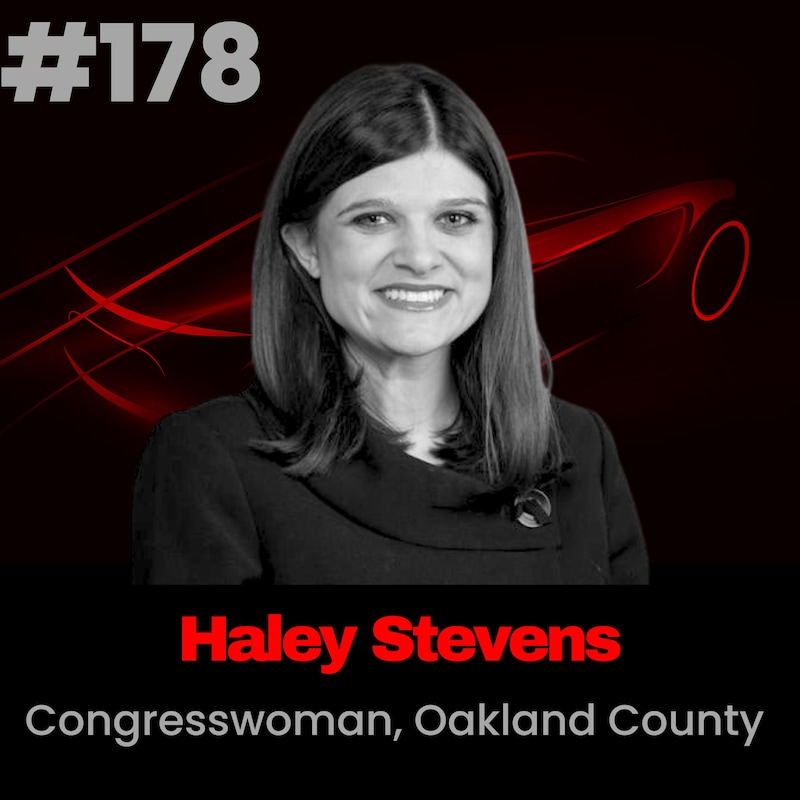
In this episode of the Automotive Leaders Podcast, Jan Griffiths sits down with Congresswoman Haley Stevens, often called the “manufacturing geek,” for a direct conversation about industrial policy, public-private partnership, national security, and what automotive leaders should expect from Washington.
Whether we like it or not, policy volatility is now a leadership variable.
Themes Discussed in this Episode
- Why Manufacturing Mondays keep policymakers grounded in shop-floor reality
- Lessons from the 2008–2009 auto rescue and bipartisan public-private partnership
- The Chips and Science Act and reshoring semiconductor production
- China’s 95% dominance in rare earth processing and why it matters
- Critical minerals, battery recycling, and national competitiveness
- Tariff volatility and the cost of policy uncertainty
- USMCA review, Canada relationships, and North American stability
- The Chinese OEM threat and rule-based trade enforcement
- What automotive leaders can expect from policymakers moving forward
🎥 Watch the full episode on YouTube:
https://www.youtube.com/@jangriffithsautomotiveleaders
This episode is sponsored by Lockton, click here to learn more
Featured Guest: Congresswoman Haley Stevens
Congresswoman Haley Stevens is a Michigan native who served as Chief of Staff on President Obama’s auto rescue team, helping save 200,000 Michigan jobs. Elected to Congress in 2018, she flipped a Republican-held seat and has since championed Michigan’s manufacturing and auto industries. She has introduced legislation to strengthen domestic supply chains, counter China’s influence in critical minerals and auto production, and push back against tariffs impacting Michigan families. Stevens has been recognized as one of the most effective Democrats in Congress, particularly on science and technology issues, and is currently running to be Michigan’s next U.S. Senator.
About Your Host – Jan Griffiths
Jan Griffiths is the champion for culture change and the host of the Automotive Leaders Podcast. A former automotive executive with a rebellious spirit, Jan is known for challenging outdated norms and inspiring leaders to ditch command and control. She brings honesty, energy, and courage to every conversation, proving that authentic, human-centered leadership is the future of the automotive industry.
Mentioned in this episode
Episode Highlights
[01:26] Why Jan Brought a Policymaker Onto the Show: Policy now shapes daily decisions in automotive. Jan explains why Washington can no longer be ignored.
[04:09] Nearly 200 Manufacturing Mondays Visits: Haley Stevens shares how nearly 200 shop floor visits keep her grounded in real manufacturing issues.
[07:03] Inside the Auto Task Force During GM’s Bankruptcy: A firsthand look at the bipartisan effort to stabilize GM and protect American jobs during the crisis.
[10:03] Chips and Reshoring Strategy: From pandemic shortages to the CHIPS Act, rebuilding semiconductor strength became a national priority.
[11:14] China’s 95% Control of Critical Minerals: China dominates processing and refining. Stevens calls it a supply chain and national security risk.
[14:17] USMCA and Canada Trade Tensions: Uncertainty around trade agreements creates instability for manufacturers across North America.
[15:20] 55 Tariff Announcements in 100 Days: Volatility is the real problem. Constant tariff changes leave suppliers scrambling.
[16:57] The Chinese OEM Threat: Chinese automakers are expanding globally. The competitive pressure is real, even if we do not see it yet.
[18:26] What Leaders Should Expect from Policymakers: Leaders need steady voices who understand the supply chain and fight for fair competition.
Top Quotes
[07:53] Haley Stevens: “We were caught holding the bag and we needed to act.”
[10:03] Haley Stevens: “They're doing 95% of that processing and refining, we've seeded an industry to them.”
[00:15:20] Haley Stevens: “When you mention the White House tab that's open, 55 tariffs announcements in the first a hundred days, and then many more from that. I mean, manufacturers didn't know which way is up.”
[00:18:37] Haley Stevens: “Well, look, I think we need reasonable policy makers who actually have an understanding of the industries and the jobs that they are lawmaking around.”
[00:19:20] Jan Griffiths: “I would agree. It's the volatility that kills us. Tariffs are here. They're a reality, whether we like it or not, it's part of the administration moving forward. They're here, but it's the way that they're administered that we have a problem with.”
The automotive industry does not operate in a vacuum.
Trade policy, tariffs, semiconductor access, critical minerals, and global competition now shape execution decisions daily.
You cannot lead at speed if you ignore the forces shaping your environment.
If this episode resonated, share it with a fellow automotive leader and subscribe to The Automotive Leaders Podcast, where we’re shaping the future of authentic leadership in the automotive industry.
This podcast episode is also available on YouTube. Check out our YouTube channel at Jangriffithsautomotiveleaders
Send us your feedback or questions — email Jan at [email protected].
Transcripts
[Transcript]
[:Stay true to yourself, be you and lead with gravitas, the hallmark of authentic leadership. Let's dive in.
This episode is brought to you by Lockton. Rising benefit costs aren't inevitable for you or your employees when you break through the status quo. Independence matters, it means Lockton can bring you creative, tailored solutions that truly serve your business and your people. At Lockton, clients, associates, and communities come first, not margins and not mediocrity. Meet the moment with Lockton. If you had told me a year ago that I would have a politician on this show, I would've said that you are crazy. And yet here we are, all of us in the auto industry, all leaders in the auto industry, we're constantly looking and checking policy decisions, executive orders. I've even got the White House tab, internet tab open on my browser at all times.
Never before have we had to be so involved and aware of what's happening. In Washington than we are right now. And so it gives me great pleasure to bring on the show today. A woman who cares deeply about manufacturing. In fact, she's otherwise known as the manufacturing geek. She's none other than Congresswoman Haley Stevens.
Congresswoman, welcome to the show.
[:I'M geeked to be here.
[:[00:02:32] Haley Stevens: You know, look, I was born here in Michigan and my parents had a small business. It was a landscaping business. And so I grew up around a lot of that heavy equipment, the grit, the grease, the grime. I had family members in the auto industry and as someone who's had a career in public service. Looking around our state and recognizing Michigan for what we are one of a handful of states in the country whose central economy drives through the manufacturing sector and the industry is not what people think it is.
It's not just a few original equipment manufacturing, manufacturers, slapping door panels on cars. It's this integrated web of suppliers and global supply chains and access to materials, and it's tied to innovation.
You go out to Silicon Valley particularly, you look at the turn of the entry into not the point we're at now. Ones and zeros, fiber optics, everything right at your fingertips. And yet, capital intensive industries are still what makes the world go round. We have to access goods and products.
We have to continue to improve how our automobiles are made and the safety and the quality components. And so, yeah, I've had a career focused on manufacturing policy, industrial policy at a kind of a brief stint outside of direct government work, but it was still a public-private partnership. And I've got a lot done for Michigan, and it's because I just spend the time visiting with the manufacturers.
[:[00:04:09] Haley Stevens: So look, when I got elected to Congress, eight years ago, I decided I didn't wanna lose touch and I wanted to keep my finger on the pulse of the economic drivers of our state. And so I came up with this initiative for deep and regular engagement with the small to mid-size manufacturers.
Just going and spending time with them, not bringing a whole road show, but just really forming relationships. I've done just shy of 200 unique visits to manufacturers. Small, mid-size, sometimes training centers. A lot of times I hear folks say, oh my gosh, similar to what you just said, Jan.
We've never had a politician here, and yet that's really enabled some great policymaking for me. I think, part of the reason why they said I was the most effective democrat in the Congress for Michigan. But I've been right there at the lawmaking table advocating for fair tax code, the R&D tax credit, pushing back on some of these erratic tariffs. Helping us get a Chips and Signs Act passed and signed in the law, legislation that I'm working on to secure our supply chain and on. And sometimes it's not as big as just one bill that a company can point to.
It's maybe a series of policy considerations or. Untangling something from the federal government and then for me as a policymaker man, does this just keep you rooted, right? It's like the come down to earth moment. People see Washington as a lot of partisan infighting. Well, that's not what it's like on a manufacturing shop floor.
Also, the equipment, oh my gosh, I just love seeing the equipment. The equipment's so cool. And then a lot of times I go and visit a supplier and they're doing the equipment that then I see on the factory floor. So I've just made a lot of great relationships. I've learned a lot, and it makes me better at my job for the state of Michigan.
[:[00:06:02] Haley Stevens: Yeah. You need to see some of these CNCs I've seen. It's pretty great stuff, and then I always ask a shop floor. I'm like, okay, so what's your oldest piece of equipment? Not to ding them, but to look at, what's been around for decades and decades and decades.
And that quality that was made, and that's who we are here in Michigan. We've got a broaching manufacturer. You know, here in Oakland County, I mean, it's unreal. I love it. I love it, and it's then the tie in with autos to defense to aerospace. They call us the arsenal of democracy. We still are. These are national security assets, and that's another thing that really fires me up as well.
[:Now, let's go back to the 2008, 2009 timeframe.
[:[00:07:03] Jan Griffiths: You were chief of staff for the Auto Task Force. It's a very important time, I think, in our history where the administration and the industry had to work together. What did you learn about working together between industry and the administration from that experience?
[:I mean, what was going on with the financial sector, the housing crisis, that was so palpable. I mean, we exemplified a lot of that here in, in Michigan. And then very unfathomably hearing the words, General Motors and bankruptcy in a sentence.
[:[00:07:53] Haley Stevens: I mean, Jan, I was the person from Michigan on the team and I just remember feeling that and how nerve wracking that was and.
Look, this was good government action at play and one of the mantras was we're making an investment in our auto industry, in the US auto industry, particularly General Motors and Chrysler. And the goal was not to control the day-to-day management of the companies and that was a real ethos.
It was that there're still private entities. GM did leave the stock market. I was there for the entrance onto the stock market too. I was thought my life, I'd be working on a General Motors IPO, and yet, where are we today? There is this incredible moonshot coming out of this place that we call home.
There are these hyper competitive, innovated companies really trying to keep up with where the cheese is moving, so to speak but also very importantly, to go back to the great recession period is that it was a large cash infusion of federal taxpayer money that came from the Troubled Asset Relief Program.
Again, bipartisan. The government was repaid, the government was repaid on interest. And what that enabled was the creation of NewCo, which we, you know, the new General Motors, the new Chrysler, and the shedding of the assets from Old Co, which then turned into Brownfields and Economic Development, Environmental Remediation Projects.
You and I are here at M1 Studios, right? And yet we've got M1 concourse at down Woodward the other way. That was part of the auto rescue, that's part of the racer trust. And that's something that I've now written legislation to keep that kind of approach going to taking old sites, and being able to redevelop them.
Obviously we wanna see, if you talk to my friends at the UAW, we wanna see these plants stay busy, stay full. We wanna see the jobs, come back. But look, we were caught holding the bag and we needed to act. And that was such a great example of good public-private partnership and a tough moment.
[:[00:09:55] Haley Stevens: And now that's led to other things like the Chips and Science Act and the work that I'm eager to do on critical minerals as well.
[:[00:10:03] Haley Stevens: Yeah, so look, during the auto rescue time period, it was very clear to us that China was dominating in the spaces of microchips, the semiconductor chips. A lot of us here in Michigan, I know you certainly do, Jan, remember that, time period where we had COVID hit and we had the chips. Just hung in the balance and you had all these cars sitting on lots that weren't completely manufactured because they didn't have the microchips. So I'm proud to have helped pass legislation to regrow our chip manufacturing industry here in the United States.
Again, public-private partnership. People can look at a federal price tag of precious taxpayer dollars that were put out into the marketplace. That puppy paid for itself four times over, within a quarter of being signed. Private industry rush to invest, rush to invest and to meet that moment. And now our country's gonna be very uniquely positioned to be the only nation in the world that from soup to nuts, is designing, producing, shipping, the wrapping of those chips and what goes on in that space.
Similarly, when we were on the auto rescue, another topic, critical minerals, rare earth elements, the critical materials that come from those minerals get processed and refined in China. Wake up moment, right? The siren is blaring. They're doing 95% of that processing and refining, we've seeded an industry to them.
So I wanna take a similar approach to incentive loan guarantees. Tax credits, an R&D Center of Excellence. This is all around us here in Michigan. It's not that folks aren't doing it, but we wanna be an overdrive in terms of supporting these American jobs, lowering costs, and bringing jobs back here.
And that's gonna be through the sustainability, the synthesizing of Minerals, there's a company called Cirba Solutions. It's got a location here in Michigan, in Western Oakland County. It's remarkable. They love my bill, though. They love my bill because it's just gonna allow them to recycle the, you know, they have batteries there, for instance, and they bring it back down to their original lithium form and then can go and make a new product.
I mean, when we look at chemistry, chemicals in our manufacturing sector and this segment of our supply chain where we're just waiting on China. We're waiting on their delivery. Our allies are saying we're at the mercy of the Chinese Communist Party. We need to be playing in the rules-based industrial world order.
We need to be in overdrive with our allies and our industry partners here. So I'm really excited about this bill that I wrote, it's called Unearth America's Future Act. Alright. It's got a lot of support. I've got an election coming up this year. I'm running to be Michigan's next United States Senator.
That is something I wanna take to the Senate that is worthy of a senator, that is worthy of bipartisan support, and it's gonna enable us to win the future, not just as the United States of America, but from the place that we call home here in Michigan.
[:Did you know suppliers now spend 157 hours on an average RFQ and still face the same roadblocks as 20 years ago? UHY and the Center for Automotive Research, break it all down in their new white paper. Get the insights and see what's really changed in 2025.
Download your copy. There's a link in the show notes.
I love that. Now you say that we need to be on overdrive with our allies.
Two very important allies to us in the auto industry, Canada and Mexico. U-S-M-C-A is coming up mid-year. There's a lot of fear in the air as to what could happen with U-S-M-C-A. Is it just gonna be abolished? Are we gonna have individual agreements with each country. Where's your head at on U-S-M-C-A?
[:Small businesses are feeling the pinch. Our manufacturing sector has certainly felt the uncertainty and the upending. The threats to not open the Gordie howe bridge.
I mean, just such a slap in the face. And then there's also the labor component here. How do we do enforcement? How do we make sure that the good jobs that we have here in Michigan are protected and supported?
And some of that has to do, south of our border and what's gone on in, in Mexico. And so I was actually just recently with the UAW, they were in Washington, DC for their Annual CAP Conference. And this was a topic of conversation I'm really gonna be looking to what they say, as well during this process.
I think those voices are gonna be very important and I'm also very eager to hold the administration accountable for these erratic tariffs. When you mention the White House tab that's open, 55 tariffs announcements in the first a hundred days, and then many more from that. I mean, manufacturers didn't know which way is up.
And then you have, for instance, my friends at Alpha USA almost 70 years in business, parts component supplier at Union shop, and they're paying hundreds of thousands of dollars a month. Just to manage these tariffs. And I think where's the handholding? Where's that implementation?
And so that's really what voice I wanna bring always to the lawmaking table. The policymaking table, and certainly this U-S-M-C-A review process. I'll tell you, if we don't have certainty. And that was one of the reasons why NAFTA got upended in addition to some of its frustrations and failures is, we wanted to make improvements.
Throwing it out, I don't know if that's gonna get us the results that folks want. We've gotta make up with Canada. We really do.
And I'm concerned because of course some of that relationship is in the diplomatic hands of our President and, as a lawmaker again, you go back to the auto rescue time.
Canada was a part of it. They were friends during that process. So, let's stop the tariff threats and the erraticness and the chaos. Let's listen to our manufacturers. Let's listen to our small and midsize enterprises. Our big three, who we want to be able to compete and win on the world stage.
This is also Jan, why I've written legislation called the No Chinese Cars Act.
[:[00:16:57] Haley Stevens: As well.
[:We don't see those cars. They're in Mexico, they're all over Europe, they're in South America, but we don't see them. We talk about the Chinese OEM threat, but we don't see those vehicles. And yes, the quality has improved and yes, they have good cost, but the price of the Chinese vehicles would have to improve if they came into this country, if that day ever happens.
But do you see that as the quoted existential threat that people talk about?
[:I'm deeply frustrated because their cars are subsidized, they're not playing by the same rules, and we can't allow all this innovation, all this R&D, I mean a billion dollars of R&D going into any vehicle. Get upended because of the Chinese Communist Party. So I really wanna see something like my legislation, which closes any loophole with Canada and Mexico come into place when we do and review on U-S-M-C-A.
[:[00:18:37] Haley Stevens: Well, look, I think we need reasonable policy makers who actually have an understanding of the industries and the jobs that they are lawmaking around.
And we need champions. I'll tell you that when I get a chance. I like to explain, the supply chain, the suppliers who I have relationships with, the unions that I have relationships with. I like to explain their stories to my colleagues.
That's what being a champion really is.
And we do, we need plans, to push back on China, to level the playing field. For us as well. And look, I have supported strategic terrorists in the past. The problem with erratic tariffs has been we paid a price.
[:They're here, but it's the way that they're administered that we have a problem with. And like you say, we need a strong voice right in the middle of it, and I couldn't think of a stronger voice and somebody who cares more passionately about manufacturing than Congresswoman Haley Stevens.
Thank you so much for joining us today.
[:[00:19:49] Jan Griffiths: Thank you for listening to the Automotive Leaders Podcast. Click the listen link in the show notes to subscribe for free on your platform of choice, and don't forget to download the 21 Traits of Authentic Leadership PDF by clicking on the link below and remember. Stay true to yourself, be you, and lead with gravitas, the hallmark of authentic leadership.



