Shownotes
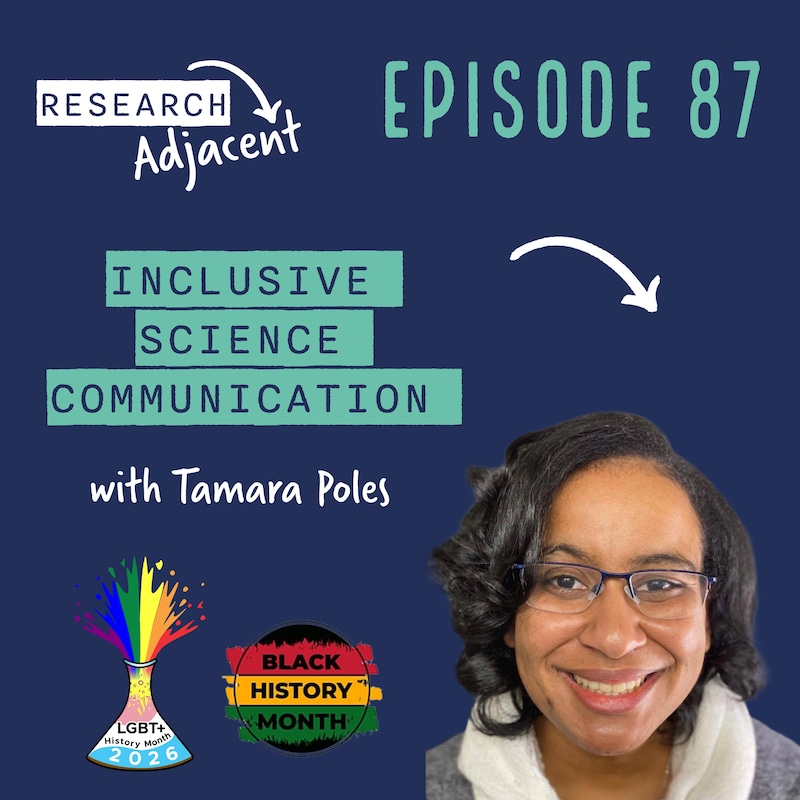
Tamara Poles is the founder and CEO of Universal SciCom based in North Carolina, USA, and working remotely across the world.
Sarah and Tamara talk about
- Why representation and inclusion in science communication matters
- Sharing science and building community through unconventional formats including the Scirens drag and burlesque show and adults-only ‘Uncensored Science’
- Helping researchers connect to audiences through their own personal story, not just their science
- Navigating funding cuts and the anti-science narrative in current US politics
Find out more
- Visit the episode webpage
- Connect with Tamara on LinkedIn
- Find out more about Universal SciCom via their website, Instagram, Facebook or LinkedIn pages
- Sign up for the Universal SciCom newsletter
- This episode was first released in February 2026 which was both LGBT+ History Month in the UK, and Black History Month in the USA.
About Research Adjacent
- Follow Research Adjacent on LinkedIn or Instagram
- Email a comment, question or suggestion
- Leave a voice note
- Post a review on Podchaser
- Sign up to the Research Adjacent newsletter
Mentioned in this episode:
Member of the Month: Duncan Yellowlees, DY Training
Let’s put rubbish presentations in the bin – where they belong. Get in touch with Duncan for specialist research presentation skills training www.duncanyellowlees.com
Come along to our Manchester networking event
Join host Sarah McLusky and fellow research-adjacent professionals on Thursday 12 March 2026 at 5.30pm. Find out more and register here https://researchadjacent.circle.so/c/open-events/manchester-research-adjacent-community-networking
Transcripts
if you study something that's so abstract that
Tamara Poles:people can't connect with, then how are you connecting with it?
Tamara Poles:What is your personal story and why are you doing this?
Tamara Poles:What I do is I try to give people the tools to bring them their full
Tamara Poles:selves to when they're doing their research or when they're doing their
Tamara Poles:outreach because I didn't see myself in science or science communication
Tamara Poles:as a lesbian black woman in STEM.
Tamara Poles:I didn't see that.
Tamara Poles:I created a program called Sirens where it's a science
Tamara Poles:themed drag and burlesque show.
Tamara Poles:And it's a way to show that scientists can be anybody and you can
Tamara Poles:communicate science in more than just reading and writing and speaking.
Tamara Poles:You can perform it.
Tamara Poles:You can't fight passion with data.
Tamara Poles:You have to fight passion with humanity
Sarah McLusky:Hello there.
Sarah McLusky:I'm Sarah McLusky and this is Research Adjacent.
Sarah McLusky:Each episode I talk to amazing research adjacent professionals about what
Sarah McLusky:they do and why it makes a difference.
Sarah McLusky:Keep listening to find out why we think the research adjacent space
Sarah McLusky:is where the real magic happens.
Sarah McLusky:Hello and welcome to another episode of Research Adjacent.
Sarah McLusky:I am as always your host, Sarah McLusky.
Sarah McLusky:Today I'm delighted to introduce you to our first North
Sarah McLusky:American guest, Tamara Poles.
Sarah McLusky:Tamara runs Universal SciCom, a company based in North Carolina, which helps
Sarah McLusky:people learn, do, and experience excellent science communication.
Sarah McLusky:We met through previous guest Kath Burton and immediately hit it off,
Sarah McLusky:and when I realized that February was both LGBT+ history month in the UK
Sarah McLusky:and Black History Month in the USA, I knew that it was the right time
Sarah McLusky:to share Tamara's story with you.
Sarah McLusky:Tamara was planning to do a PhD but realized that she was
Sarah McLusky:much better at talking about science than actually doing it.
Sarah McLusky:Motivated by the fact she couldn't find role models who looked like her.
Sarah McLusky:She trained as an educator and science communicator, and that drive to increased
Sarah McLusky:diversity and representation in science and science communication has led
Sarah McLusky:to programs covering everything from making field work more inclusive to
Sarah McLusky:science themed drag and burlesque shows.
Sarah McLusky:We also talk about what it's like doing science communication in the US
Sarah McLusky:right now where funding cuts and an anti-science public narrative have made
Sarah McLusky:her work extremely challenging at times.
Sarah McLusky:Her solution is community humanity and improving education around mental health.
Sarah McLusky:All things which I think will resonate here in the UK too.
Sarah McLusky:Before we get onto the conversation, I have to apologize that the sound
Sarah McLusky:quality isn't as good as usual.
Sarah McLusky:This is entirely my fault.
Sarah McLusky:For the first time in over three years doing this podcast, I
Sarah McLusky:recorded the wrong microphone.
Sarah McLusky:Tamara generously offered to re-record our episode, but in the spirit of
Sarah McLusky:showing what really goes on behind the scenes and owning up to my failures,
Sarah McLusky:I've cleaned it up as best I can, but otherwise, I've left it as it is.
Sarah McLusky:So with that, listen on to hear Tamara's story.
Sarah McLusky:Welcome along to the podcast, Tamara.
Sarah McLusky:It is fantastic to have you joining us all the way from the USA.
Sarah McLusky:First of all, can you tell us a bit about who you are and what you do?
Tamara Poles:Hello.
Tamara Poles:Hello.
Tamara Poles:Thank you so much, Sarah, for inviting me on the podcast.
Tamara Poles:I really appreciate it.
Tamara Poles:My name's Tamara Poles, I'm founder and CEO of Universal SciCom, but my
Tamara Poles:official government name is SciCom Consulting, as you can see behind me.
Tamara Poles:But we, you can Google us as Universal SciCom.
Tamara Poles:That's my doing business as, my DBA.
Tamara Poles:And what we do is we are the home for a lot of researchers and STEM
Tamara Poles:professionals where we, they can learn how to, do science communication.
Tamara Poles:We do science communication trainings and workshops and also bootcamps.
Tamara Poles:So if you want multiple days of it, we conduct those.
Tamara Poles:We also do outreach opportunities.
Tamara Poles:So it's a place where scientists and science educators can learn
Tamara Poles:how to communicate their science effectively, and also a place where
Tamara Poles:they can practice and hone their skills in science communication.
Sarah McLusky:Yeah.
Sarah McLusky:So do you do really, is it like any aspect of science that you work on or do you have
Sarah McLusky:particular things that you specialize in?
Tamara Poles:Yeah, excellent question.
Tamara Poles:So it's all science.
Tamara Poles:So the, that's the reason why we actually changed the name from SciCom
Tamara Poles:Consulting to Universal SciCom 'cause I wanna make sure people know that
Tamara Poles:it's all forms of STEM and science and you're learning these universal skills
Tamara Poles:that you can literally apply anywhere.
Tamara Poles:So it's for all scientists and STEM professionals.
Tamara Poles:The audience is for everyone.
Tamara Poles:And the skills that you learn, you can apply everywhere.
Tamara Poles:So that's why it's like a universal remote.
Tamara Poles:You can apply it anywhere.
Tamara Poles:So that's why we changed our name to Universal SciCom.
Sarah McLusky:Fantastic.
Sarah McLusky:Point and click.
Sarah McLusky:I love it.
Sarah McLusky:And so you're working, you've said they're with researchers, STEM
Sarah McLusky:professionals, are these people who are working in universities and
Sarah McLusky:companies where whereabouts are.
Tamara Poles:Yeah.
Tamara Poles:Yeah.
Tamara Poles:So we have clients from all over yes.
Tamara Poles:A lot of our clients are labs at universities that want to learn science
Tamara Poles:communication so they can conduct outreach in their own communities.
Tamara Poles:There's a lot of like nonprofits that will hire me so they can learn how to,
Tamara Poles:and it's researchers still or scientists still that do lab work that want to be
Tamara Poles:able to write for different audiences or present or communicate to like their
Tamara Poles:churches or their they wanna go into a school group, things like that.
Tamara Poles:Pretty much anybody can use us.
Tamara Poles:And also, so my background is biology in environmental science,
Tamara Poles:but I went back to school and got my higher ed degree in education.
Tamara Poles:So what I also do is I create curricula for universities or schools or nonprofit
Tamara Poles:organizations so they can help teach others how to communicate their
Tamara Poles:research or get across their point.
Tamara Poles:Recently I worked with this organization called Field Inclusive,
Tamara Poles:where they train other scientists how to be more inclusive when they're
Tamara Poles:doing their field work because not everybody's created and treated the
Tamara Poles:same when they're out in the field.
Tamara Poles:So they want to bring awareness of that.
Tamara Poles:So they hired me to develop their curriculum and we can put it online.
Tamara Poles:So there's gonna be an online curriculum, and that's all done by me
Tamara Poles:and the folks at Universal SciCom.
Tamara Poles:So we do a lot of different things to help researchers and STEM professionals
Tamara Poles:get their outreach out there.
Sarah McLusky:Yeah.
Sarah McLusky:Fantastic.
Sarah McLusky:I imagine that's so valuable.
Sarah McLusky:So you said there, you've done some work specifically on inclusivity,
Sarah McLusky:and I know that's something that's a really big, is interest for you.
Sarah McLusky:And so when it comes to making this science communication more inclusive, what
Sarah McLusky:sorts of things have you found help there?
Tamara Poles:Oh, that's so good.
Tamara Poles:That's an excellent question.
Tamara Poles:So one of my most popular workshops is actually called Power of Authenticity
Tamara Poles:and Science Communication, how to bring your whole self to a group or when you are
Tamara Poles:writing or when you're speaking about your research or when you're even conducting
Tamara Poles:research, where are you reflected in this?
Tamara Poles:And a lot of times it's representation matters.
Tamara Poles:So that's why we have these shirts that say this is what
Tamara Poles:science communication looks like.
Tamara Poles:And it's because a lot of people think that in order to be a researcher or a STEM
Tamara Poles:professional or a science communicator, you have to look like it's usually what
Tamara Poles:old white guys with crazy white hair.
Tamara Poles:They always think that those are the scientists.
Tamara Poles:But no, you could be a a black scientist, you could be a woman scientist.
Tamara Poles:I'm a scientist and a science communicator.
Tamara Poles:What I do is I try to give people the tools to bring them their full selves
Tamara Poles:to when they're doing their research or when they're doing their outreach.
Tamara Poles:So in that workshop that I do, I ask them.
Tamara Poles:Where are you in your research?
Tamara Poles:Why are you doing this research?
Tamara Poles:And we talk about that and we actually start brainstorming ways
Tamara Poles:that they can add themselves to their research or their outreach.
Tamara Poles:Maybe they're queer scientists.
Tamara Poles:Are you doing something that targets queer professionals?
Tamara Poles:Let's see how you can do that.
Tamara Poles:And I have examples of me personally doing that
Tamara Poles:because I didn't see myself in science or science communication
Tamara Poles:as a lesbian black woman in STEM.
Tamara Poles:I didn't see that.
Tamara Poles:So I created a program called Sirens where it's a science
Tamara Poles:themed drag and burlesque show.
Tamara Poles:And by no means am I the first person to come up with that idea.
Tamara Poles:But the niche that I'm fulfilling is, it's a science
Tamara Poles:themed drag and burlesque show.
Tamara Poles:So it's for everybody.
Tamara Poles:So if they do not identify if they identify as them or they, they're welcome.
Tamara Poles:If they're trans, they're welcome.
Tamara Poles:Past two shows that we've done, we've had every color in the rainbow,
Tamara Poles:every orientation, everything.
Tamara Poles:And they're there.
Tamara Poles:And it's a way to show that scientists can be anybody and you can
Tamara Poles:communicate science in more than just reading and writing and speaking.
Tamara Poles:You can perform it.
Tamara Poles:So what they do is they're in their performances, they're actually performing
Tamara Poles:scientific content and relating it to the audience and it's so much fun.
Tamara Poles:Strongly recommend everybody looking it up or checking us out.
Tamara Poles:But yeah, those are just some ways that I try to show up for my community and
Tamara Poles:that the people at Universal Sitcom tries to show up for their community as well.
Tamara Poles:So try being as inclusive as possible and creating more opportunities
Tamara Poles:to let everybody be at the table.
Sarah McLusky:Yeah, I love, that's one of the things when we were talking about
Sarah McLusky:before the call and you showed me some of the pictures and things from this
Sarah McLusky:drag and burlesque show that you do.
Sarah McLusky:And I think definitely we need to get some pictures of that and put
Sarah McLusky:them in the show notes so that people can go and check it out.
Sarah McLusky:And it is it's wonderful to be creating spaces like that, that feel inclusive,
Sarah McLusky:and I think that is especially.
Sarah McLusky:You know, things like when you are working with schools or when you're
Sarah McLusky:in an environment, we, you know, with the, the science and all about
Sarah McLusky:publishing and this assumption that you have to be a certain way to be
Sarah McLusky:taken seriously as a scientist, right?
Sarah McLusky:And so the fact that you're doing some things which really
Sarah McLusky:challenge that and create some safe spaces, I think is fantastic.
Tamara Poles:Thanks that's my main goal 'cause once we start doing that and once
Tamara Poles:people start seeing us as people I think people will start seeing themselves as a
Tamara Poles:scientist, especially people coming up.
Tamara Poles:The kids coming up, they'll see themselves as a scientist and be like, oh, she
Tamara Poles:looks like me, or they look like me.
Tamara Poles:They identify as they, this is cool.
Tamara Poles:I can be a scientist too.
Tamara Poles:And that was something that I didn't see a lot of until I got
Tamara Poles:I've graduated that I started seeing black female scientists that were
Tamara Poles:doing outreach and I was like, oh.
Tamara Poles:I could do that too.
Tamara Poles:Yeah.
Tamara Poles:So yeah, it was a journey for me and I'm trying to make that journey a
Tamara Poles:little bit easier for everybody else.
Sarah McLusky:Yeah.
Sarah McLusky:Oh, fantastic.
Sarah McLusky:You've said there that this has been a bit of a journey for you, and you said that
Sarah McLusky:you originally came through doing biology.
Sarah McLusky:Tell us a bit about what you've done and how you've ended up where you are now.
Tamara Poles:Oh, how much time do you have?
Tamara Poles:Yeah.
Tamara Poles:My undergrad biology and environmental science, and I realized that when
Tamara Poles:I was working in labs, 'cause I worked in a bunch of labs in
Tamara Poles:undergrad, I kept contaminating my Petri dishes with my own DNA.
Tamara Poles:And so that was a clue that I talked too much.
Tamara Poles:And so when I but I went to my advisor.
Tamara Poles:I was like, Hey, is there a way that we can I could be like a liaison between
Tamara Poles:scientists and general public because I realized we were doing some really cool
Tamara Poles:research at the school I went to, but the community around us had no idea.
Tamara Poles:We were doing some really cool stuff and my advisor told me, you might as well
Tamara Poles:just become a teacher like it was a bad thing, and that seems to be really
Tamara Poles:systemic within the research world, at least here, is that a publish or perish.
Tamara Poles:You don't want to become a teacher even though the professors
Tamara Poles:are technically teachers.
Tamara Poles:But it
Sarah McLusky:seems that it's a really strange thing, isn't it?
Sarah McLusky:Is that, yeah.
Sarah McLusky:If of the fact that it's like if you become a teacher, you've
Sarah McLusky:somehow like given up, even though, as you say university
Sarah McLusky:staff or teachers by definition.
Sarah McLusky:Yeah.
Tamara Poles:And it, that actually took me eight years to overcome though.
Tamara Poles:So I kept that in the back of my head and was like, okay, I've
Tamara Poles:gotta do research somehow.
Tamara Poles:But then I took a year off 'cause I was supposed to go get, because
Tamara Poles:my PhD and evolutionary ecology.
Tamara Poles:But I took a year off and went into museums and science
Tamara Poles:centers and absolutely loved it.
Tamara Poles:I worked at the Virginia Museum of Natural History, then I worked at at
Tamara Poles:the North Carolina Museum of Natural Sciences, but at VMNH, that was where
Tamara Poles:I learned I wanted to bridge that gap and bring researchers to some of the
Tamara Poles:outreach that I was doing as an educator.
Tamara Poles:Because my job was to provide nature and outdoors education
Tamara Poles:opportunities for the community.
Tamara Poles:And I was like, why don't I bring the researchers out here and I
Tamara Poles:was like, first, you know what?
Tamara Poles:That first one didn't really work out well, let me train them up first.
Tamara Poles:And then I took them out.
Tamara Poles:And then I worked at the North Carolina Museum of Natural Sciences where I
Tamara Poles:was coordinator of virtual education.
Tamara Poles:So my job was to provide a museum experience for people that were
Tamara Poles:unable to attend the museum.
Tamara Poles:And it started really fun program.
Tamara Poles:So essentially, I was doing this before this was cool.
Tamara Poles:So I had my props, I had my animals that I would show, I would did pre pediatric
Tamara Poles:hospital programs, things like that.
Tamara Poles:But one of my programs that I did start was called The Smarts Program, which
Tamara Poles:stood for scientists making answers relevant for teachers and students.
Tamara Poles:That was an all-nighter, just letting you know.
Tamara Poles:Okay.
Tamara Poles:Coming up with that acronym.
Tamara Poles:And what I did there was I trained scientists how to communicate their
Tamara Poles:research using digital technology, because this was back in 2016.
Tamara Poles:This was from 2016 no, 2012 to 2016.
Tamara Poles:Yeah, this was definitely something that wasn't being used.
Tamara Poles:So when I did that, I started training scientists how to do that, and I
Tamara Poles:really started really liking that and I thought, this is actually
Tamara Poles:what I wanna do for a living.
Tamara Poles:This is fantastic.
Tamara Poles:And then getting to see the kids' eyes and aha moments when they would see
Tamara Poles:like a woman scientist presenting from their lab like to their classroom.
Tamara Poles:And that was really cool.
Tamara Poles:And I really liked that and I learned so much from that program.
Tamara Poles:And then Morehead Planetarium and Science Center that they host the
Tamara Poles:North Carolina Science Festival, which is one of the largest
Tamara Poles:celebrations of science in the world.
Tamara Poles:And they received a grant to start a statewide science
Tamara Poles:communication training program.
Tamara Poles:And I got hired to do that.
Tamara Poles:So I got to actually do Universal SciCom in this like smaller protected
Tamara Poles:environment where I created this curriculum, went around the state and
Tamara Poles:prepared the scientists to do outreach.
Tamara Poles:And it was a very fun program.
Tamara Poles:And then I was like, alright.
Tamara Poles:This is something I definitely need to do.
Tamara Poles:So after, after I left Morehead, start at Universal SciCom and
Tamara Poles:have not turned back since.
Tamara Poles:So that is essentially my journey and the most straight of a line that you can make.
Tamara Poles:But just know there were so many other hundred things.
Sarah McLusky:So many squiggles along the way.
Tamara Poles:It's so true.
Tamara Poles:And whenever I do like a keynote address and they want me to talk
Tamara Poles:about my life, I always have a Super Mario themed PowerPoint where it's
Tamara Poles:like going through like the tubes.
Tamara Poles:And this is where I played for the US International Softball team.
Tamara Poles:And I did this for a little while.
Tamara Poles:And then like I just talk about all of my little like side quests, because as
Tamara Poles:an ADHD person, I have a lot of those.
Tamara Poles:So
Sarah McLusky:I love it, side quest.
Sarah McLusky:That's a fantastic way to fantastic way to describe it.
Sarah McLusky:But as you say, you've got this kind of central channel running through now the
Sarah McLusky:central theme of science communication and it, it sounds like you've been
Sarah McLusky:able to, to really get into lots of different kinds of communities and
Sarah McLusky:different ways of delivering information and different kinds of scientists.
Sarah McLusky:What are things that have made the biggest difference to how people share
Sarah McLusky:their research, share their science?
Tamara Poles:First of all, like all, there isn't a difference when I'm training
Tamara Poles:scientists in different fields because we all have, first off imposter syndrome.
Tamara Poles:We always think that we're not the one that should be doing this, but who better?
Tamara Poles:So please remember, if you're a scientist or a STEM professional
Tamara Poles:listening to this, you are the person that should be doing this.
Tamara Poles:'Cause who better to do it than you?
Tamara Poles:' And also I think what's really important is getting the scientists to learn
Tamara Poles:how to share their personal stories and connecting their personal stories
Tamara Poles:with either their research or the community that they're speaking with.
Tamara Poles:And that is part of my intro workshop.
Tamara Poles:And then we delve deeper into it and the full storytelling workshop,
Tamara Poles:because there's so much power in storytelling and sharing your
Tamara Poles:personal stories with the public.
Tamara Poles:So I think those two things are crucial for scientists to learn.
Sarah McLusky:That's really interesting that's your go-to is
Sarah McLusky:helping them to share and make connections through their personal
Sarah McLusky:story, because I think a lot of people.
Sarah McLusky:When you ask for advice about science communication, it's all about,
Sarah McLusky:oh, you need to not use jargon and you need to, simplify it for
Sarah McLusky:your audience and stuff like that.
Sarah McLusky:And.
Sarah McLusky:And actually in many cases, that isn't really what connects with people.
Sarah McLusky:We're
Tamara Poles:Right.
Sarah McLusky:Humans connect human to human.
Sarah McLusky:And when actually when you're actually trying to make a difference to somebody.
Sarah McLusky:That human to human connection I think is often more important
Sarah McLusky:than the content of what you're
Tamara Poles:a hundred percent
Sarah McLusky:sharing.
Tamara Poles:Yep.
Sarah McLusky:Yeah, so I love that that's your approach.
Tamara Poles:Yeah, and you're absolutely right, and that's the first
Tamara Poles:thing I teach my scientists and all of my workshops is why do I care?
Tamara Poles:Why?
Tamara Poles:Why do I care that you are studying this gene on this loci?
Tamara Poles:And then that's where we start.
Tamara Poles:And because a lot of times the scientist cares about this like
Tamara Poles:small thing that they're researching.
Tamara Poles:And I'm like, why?
Tamara Poles:But, and they'll say, they'll essentially go like this.
Tamara Poles:And then I'm like, why?
Tamara Poles:And then they go like this.
Tamara Poles:And then I say, why?
Tamara Poles:And then they sometimes go back to this.
Tamara Poles:But that's where the personal story comes in.
Tamara Poles:Because if you study something that's so abstract that people can't connect with,
Tamara Poles:then how are you connecting with it?
Tamara Poles:What is your personal story and why are you doing this?
Tamara Poles:And all of my workshops I constantly am saying, why do I care?
Tamara Poles:And I'm constantly saying, how does this relate to you and
Tamara Poles:why do you care about this?
Tamara Poles:And
Sarah McLusky:That's really interesting as well, because we have got this
Sarah McLusky:culture at the moment of people being almost anti-science, anti evidence,
Sarah McLusky:whatever kind of language they're using for in the US in the UK it's like
Sarah McLusky:people are, it is like we've had enough of experts and sometimes I feel that
Sarah McLusky:it's because we think facts are gonna change somebody's mind about something.
Sarah McLusky:When they rarely do, but maybe tell us a bit about what that culture's
Sarah McLusky:like in the US at the moment.
Tamara Poles:Like a lot of times, especially scientists and researchers,
Tamara Poles:they want to throw data at people.
Tamara Poles:Look at this graph, look at this data.
Tamara Poles:But if you can't tell me why I should care, is that gonna make me sick?
Tamara Poles:Is that gonna harm someone's kids?
Tamara Poles:Is that gonna make me money?
Tamara Poles:Is that gonna help me eat?
Tamara Poles:If you can't boil it down to that or boil it down to where we are as humans
Tamara Poles:and make it make it human focused.
Tamara Poles:So intertwining your experience and helping them with their experience.
Tamara Poles:It might make your daily lives a little bit easier if you knew this.
Tamara Poles:If you can't connect it with that, you're not gonna get people, because
Tamara Poles:the people that are thinking scientists are all liars and blah, blah, blah.
Tamara Poles:If those people are very passionate about those things and
Tamara Poles:you can't fight passion with data.
Tamara Poles:You have to fight passion with humanity
Tamara Poles:again.
Tamara Poles:And say Hey, like I understand that you think that scientists don't
Tamara Poles:exist, but I'm a scientist and I've been your neighbor for this long,
Tamara Poles:and have you had a problem with me?
Tamara Poles:Have I steered you in the wrong way?
Tamara Poles:Developing, redeveloping that trust is what we need to do, and we can't do
Tamara Poles:that by throwing a lot of data at stuff.
Sarah McLusky:No, I think people often ask me things like, they'll say,
Sarah McLusky:oh, what would you say to somebody to convince them of climate change or
Sarah McLusky:convince them that vaccines are safe?
Sarah McLusky:And I am.
Sarah McLusky:I just, I think if they're that determined, I'm not sure that there
Sarah McLusky:is much I can say except from me saying my daughter's vaccinated.
Sarah McLusky:That's
Tamara Poles:right.
Sarah McLusky:I think it's safe for my family.
Sarah McLusky:And again, it's that connection with the emotional part, the human part of things.
Sarah McLusky:Yeah.
Sarah McLusky:Yeah.
Sarah McLusky:I imagine that things in the US though when it comes to science communication are
Sarah McLusky:really challenging at the moment because, here over in the UK we've heard about
Sarah McLusky:cuts to research funding and programs being shut down and that sort of thing.
Sarah McLusky:How is that affecting science communication I guess?
Tamara Poles:It is impacting scicom a whole lot.
Tamara Poles:It's even hit Universal SciCom quite a bit because since grants are, have been
Tamara Poles:taken away from research facilities, like for instance, certain grants, that
Tamara Poles:researchers were receiving some portion of that grant was to conduct outreach,
Tamara Poles:or publish or like some type of outreach portion or broader impacts portion is
Tamara Poles:attached to a lot of the grants here.
Tamara Poles:And when those grants were taken away, that means the labs are focusing
Tamara Poles:on just their research' cause they barely have funding to support that.
Tamara Poles:So they're not doing these professional development opportunities in which
Tamara Poles:I provide, or these outreach opportunities, which I also provide and
Tamara Poles:help connect research labs with the communities that they wanna engage with.
Tamara Poles:There a lot of them aren't doing that, so scientists and science communicators that
Tamara Poles:do want to do the outreach, we're actually doing it on our own and trying our best to
Tamara Poles:get to social media and things like that.
Tamara Poles:Me personally, part of the pivot, because so much of our funding has been taken
Tamara Poles:away because people research facilities don't have the money anymore to do
Tamara Poles:this type of professional development.
Tamara Poles:My pivot is to start with my community because that's the best place to
Tamara Poles:start, and that's what we really need to start building community again.
Tamara Poles:So what I've been doing is a lot of community events.
Tamara Poles:So like Sirens science themed, drag and burlesque show.
Tamara Poles:That's one of one of the examples.
Tamara Poles:Another example actually is starting in March.
Tamara Poles:And I'm gonna be doing this at a coffee shop and also at a brewery,
Tamara Poles:and it's called Uncensored Science.
Tamara Poles:I'm getting researchers and STEM professionals to come in and talk
Tamara Poles:about what they can't normally share with you know, audiences under 18.
Tamara Poles:And it's gonna be at a coffee shop or a bar, and it's gonna be a lot of fun.
Tamara Poles:Like one of the, one of my presenters that will be presenting is trans, and
Tamara Poles:they are transitioning and they wanted to present on, and their background
Tamara Poles:by the way, is physics and chemistry.
Tamara Poles:Those are like the two hardest things in my mind.
Tamara Poles:But they're, and and they're transitioning and what they wanna
Tamara Poles:talk about is where all the boobs go.
Tamara Poles:And I was like, that is fantastic, but just know we are gonna be
Tamara Poles:in spaces where you get this opportunity to raise awareness.
Tamara Poles:So what they're gonna do is they're gonna talk about trans in other
Tamara Poles:populations like, oh like for instance, zebrafish, they tend to
Tamara Poles:transition based on their population.
Tamara Poles:I'm sure other biologists can come up with a thousand other examples,
Tamara Poles:and that's what they're gonna do.
Tamara Poles:And then they're gonna talk about themselves and their transition,
Tamara Poles:and then talk about the fun topic of yeah, where do all the boobs go?
Tamara Poles:So different things like that.
Tamara Poles:See
Sarah McLusky:my daughter would love that, so she.
Sarah McLusky:She's under 18, so she would love that.
Tamara Poles:I am certain if they're accompanied by a parent, especially at
Tamara Poles:the coffee shop, you might be okay.
Tamara Poles:There is we do have a disclaimer.
Tamara Poles:Not all of it's gonna be like that, but there are, it's just a time to
Tamara Poles:where we get to share what's fun and exciting and or funny about our research
Tamara Poles:and our research experience that, we can't just go to a K 12 event and
Tamara Poles:say it or a family event and say it.
Tamara Poles:So yeah, it's a opportunity for us to learn and laugh
Tamara Poles:and engage with scientists.
Tamara Poles:And so trying to create these unique opportunities throughout my
Tamara Poles:community to do that, and a lot of this I'm doing for a very low cost.
Tamara Poles:Because I want people to be able to attend these events for free.
Tamara Poles:Yeah.
Tamara Poles:And if it's not for free, it's next to free because I don't want to have
Tamara Poles:any barriers to access knowledge.
Tamara Poles:Like education should be free for everybody.
Tamara Poles:When these opportunities happen, especially the Uncensored Science,
Tamara Poles:that's not a ticketed event.
Tamara Poles:You just have to be 18 or over to go in.
Tamara Poles:Sirens because I want to pay the performers.
Tamara Poles:That is a ticketed event.
Tamara Poles:But doing things like that.
Tamara Poles:There's also trips that I take people on that are local that want to tag sharks.
Tamara Poles:And I work with Dr. David Schiffman to do that really cool program.
Tamara Poles:So that's how I've been pivoting and it's still part of Universal SciCom
Tamara Poles:'cause Universal SciCom is learn it, so learning scicom with the workshops.
Tamara Poles:And things like that I do.
Tamara Poles:And then there's do scicom, so like the people that I've trained get to
Tamara Poles:go out and conduct this outreach.
Tamara Poles:And then there's experience scicom.
Tamara Poles:So the experience scicom are like Sirens and things like that we are
Tamara Poles:hosting that are trained scientists or people that i've already vetted
Tamara Poles:to go to these outreach events.
Tamara Poles:So yes, we focused a lot on learning scicom, which we still are doing.
Tamara Poles:So if anybody wants a workshop, let me know.
Tamara Poles:Yeah.
Tamara Poles:But we have pivoted to the experience scicom part because I want to focus
Tamara Poles:more on community building and letting people meet their neighbors and see them
Tamara Poles:as research professionals and educators.
Sarah McLusky:Yeah.
Sarah McLusky:I think that's so important for me as well.
Sarah McLusky:I think we just, the way we solve a lot of the problems of the world at the moment, I
Sarah McLusky:think is actually being in rooms together.
Tamara Poles:Right.
Sarah McLusky:With other human needs, right?
Sarah McLusky:Yeah.
Sarah McLusky:Yeah,
Tamara Poles:exactly.
Tamara Poles:And then that's so true.
Tamara Poles:The value of just getting to know someone.
Tamara Poles:Yeah.
Sarah McLusky:Yeah.
Sarah McLusky:It is, it's amazing what difference it makes.
Sarah McLusky:I am I, this may be related.
Sarah McLusky:Your answers, I don't know.
Sarah McLusky:I like to ask all my guests.
Sarah McLusky:Okay.
Sarah McLusky:If they had a magic wand, what would they change about the world that they work in?
Sarah McLusky:So money and time are no object.
Sarah McLusky:What would you do differently?
Tamara Poles:Okay.
Tamara Poles:So if I could do some do the hard work, I think, and I don't know if this is
Tamara Poles:the same in overseas, in the UK or not.
Tamara Poles:I'm not sure if it's the same, but I know in the US.
Tamara Poles:I would, and mind you, this is coming from an athlete.
Tamara Poles:So my background is I was a competitive softball player for over half my life.
Tamara Poles:And I played in college and then I played for the US international team and went
Tamara Poles:overseas and played in the Netherlands.
Tamara Poles:So this is coming from an athlete's perspective as well, but I genuinely
Tamara Poles:think we should treat like athleticism and athletics, we should use that as
Tamara Poles:a model to uplift like mental health.
Tamara Poles:So we're all really focused on especially in schools.
Tamara Poles:In schools we're like, oh, we have PE and you get to play this sport.
Tamara Poles:And like everybody, when they're five, they play soccer.
Tamara Poles:And so it's a thing, but why not?
Tamara Poles:When we turn five, we still like focus on physical health, but then we start also.
Tamara Poles:Putting in mental health and being emotionally savvy and dealing with our
Tamara Poles:own thoughts and emotions in a proper way.
Tamara Poles:Because I feel like if we put as much stress on that I think we would have
Tamara Poles:more compassion and empathy and it will play more into how we treat each other.
Tamara Poles:So we wouldn't have to do all of this like extra heavy lifting to make sure
Tamara Poles:black and brown people have the same resources or people that have special
Tamara Poles:needs have these resources as well.
Tamara Poles:Like we would already think that, we would already realize, oh,
Tamara Poles:we should listen to these folks.
Tamara Poles:We need to make sure we have a transcript for this, or we need
Tamara Poles:to make sure this is in braille.
Tamara Poles:We think of these things a lot more tactfully and inclusively
Tamara Poles:instead of looking at it as a pie, if I have this, you can't have it.
Tamara Poles:So I think if we had more emotional intelligence and we were able to
Tamara Poles:process our feelings and like we realized, oh, the reason why I feel
Tamara Poles:like that is because I'm scared.
Tamara Poles:Alright, let's figure out how we deal with fear.
Tamara Poles:Like I think a lot of our problems would be solved.
Tamara Poles:And like right now, you even know if you go outside and you trip and fall
Tamara Poles:and you skin your knee, guess what?
Tamara Poles:You know exactly what to do.
Tamara Poles:That's something physical, we could fix that.
Tamara Poles:It's the same for mental health, but sadly, we don't have those tools.
Tamara Poles:And I will say like in the curriculum in the US, that is becoming a little bit
Tamara Poles:more prevalent, but it's not like huge.
Tamara Poles:I think New York is the only one that has it built in to
Tamara Poles:their curriculum from K to 12.
Tamara Poles:But I, like you just, I know for me, I didn't see it and even in fifth
Tamara Poles:grade, I played like the recorder.
Tamara Poles:So I'm like, how can we do these things?
Tamara Poles:But for mental health?
Sarah McLusky:Yeah.
Tamara Poles:Throughout, I don't know.
Tamara Poles:Hopefully that made sense.
Sarah McLusky:But yeah.
Sarah McLusky:No, I think more empathy and compassion.
Sarah McLusky:It just, again it fits with everything that you've been talking about science
Sarah McLusky:communication and the way that we connect to each other as human beings
Sarah McLusky:and almost the way that, that you've said throughout that it's almost like
Sarah McLusky:the subject matter is less important than this kind of shared humanity.
Sarah McLusky:And and I think yeah, and if we, I think you're right, we do
Sarah McLusky:spend too much time teaching.
Sarah McLusky:Yeah, I've mentioned my daughter before.
Sarah McLusky:She's about to do her like, what in the UK are called GCSEs, it's
Sarah McLusky:exams that you do when you're 16.
Sarah McLusky:So she's about to do her like school exams at 16 and some of the stuff
Sarah McLusky:she's learning, like quotes from Shakespeare and weird mathematical
Sarah McLusky:formulas and stuff, and you think you're never gonna use that ever again.
Sarah McLusky:Whereas some of this emotional intelligence stuff, you
Sarah McLusky:would use it every day.
Tamara Poles:Yeah, you use it every day.
Tamara Poles:And then the emotional intelligence, when you start like delving into
Tamara Poles:it, it also becomes problem solving.
Tamara Poles:It also becomes critical thinking.
Tamara Poles:And then guess what?
Tamara Poles:Here's your science stuff.
Tamara Poles:We snuck that in there.
Sarah McLusky:Always gotta sneak it in there somewhere.
Tamara Poles:Sneak it there.
Tamara Poles:But yeah, just like me being a part of athletics, literally all my life, I
Tamara Poles:learned a lot of problem solving skills.
Tamara Poles:I learned teamwork.
Tamara Poles:I learned all of these cool skills that you don't learn in school
Tamara Poles:because I was put in sports.
Tamara Poles:You could do the same if you did something similar.
Tamara Poles:If you did something relating to emotional health and mental
Tamara Poles:health, and you prioritize that as well as you do physical health.
Tamara Poles:Like we have physical fitness testing.
Tamara Poles:Why not mental health testing?
Tamara Poles:Yeah, like that.
Tamara Poles:That sounds a little weird, but I think people got what I said.
Tamara Poles:Exactly.
Tamara Poles:It sounded weird, but as in holding it to such a level of respect and
Tamara Poles:appreciation 'cause right now it's always seemed as like an other or,
Tamara Poles:oh, you're just being too whatever.
Tamara Poles:Yeah.
Tamara Poles:Whereas somebody that's an athlete, if you're being too whatever.
Tamara Poles:That's awesome.
Tamara Poles:That sounds,
Sarah McLusky:Yeah.
Sarah McLusky:Considered a good thing in certain situations.
Sarah McLusky:Yeah.
Sarah McLusky:Oh, fantastic.
Sarah McLusky:If I think we should think about wrapping up our conversation, so
Sarah McLusky:if people want to get in touch with you, what's the best way?
Sarah McLusky:Where do you hang out?
Sarah McLusky:Where's the best places to find you?
Tamara Poles:I am always online so I am, you can find my website at
Tamara Poles:universalscicom.com, and that's with one m. You can find us on Instagram, you can
Tamara Poles:find us on Facebook, you can find me on LinkedIn and you can even send me a DM
Tamara Poles:or an email via any of those platforms, and it'll get to either me or my staff.
Tamara Poles:Because I 'cause I don't do this alone.
Tamara Poles:I have volunteers that volunteer their time and help out
Tamara Poles:greatly, and they're amazing.
Tamara Poles:And I also have consultants.
Tamara Poles:So if you are a scientist or a STEM professional that is very specific and
Tamara Poles:you have very specific needs, I do have a, an entire bench of scientists and stem
Tamara Poles:professionals that do align or will likely align with your questions or your field.
Tamara Poles:So I can even pair you up 'cause we do consultations, we do
Tamara Poles:workshops, we do all kinds of stuff.
Tamara Poles:So you can find me anywhere.
Tamara Poles:But yeah, your first guess is universalscicom.com.
Sarah McLusky:Fantastic.
Sarah McLusky:We'll make sure we get those links and put them in the show
Sarah McLusky:notes if they can find them.
Tamara Poles:Awesome.
Tamara Poles:That'll be great.
Sarah McLusky:Thank you so much, Tamara, for joining us.
Tamara Poles:Thank you so much for having me.
Sarah McLusky:Thanks for listening to Research Adjacent.
Sarah McLusky:If you're listening in a podcast app, please check you're subscribed and then
Sarah McLusky:use the links in the episode description to find full show notes and to follow
Sarah McLusky:the podcast on LinkedIn or Instagram.
Sarah McLusky:You can also find all the links and other episodes at www.researchadjacent.com.
Sarah McLusky:Research Adjacent is presented and produced by Sarah McLusky, and the
Sarah McLusky:theme music is by Lemon Music Studios on Pixabay and you, yes you, get a big
Sarah McLusky:gold star for listening right to the end.
Sarah McLusky:See you next time.
