Transcripts
Sonia Kampshoff
Welcome to Working with Languages, the podcast for language speakers ready to explore the range of opportunities involving languages. My name is Sonia Kampshoff. I'm a translator-turned Google Arts specialist and a lifelong language enthusiast. Join me and my guests as we explore how they embraced languages in their careers and what working with languages looks like in the age of AI. Because finding the right inspiration can help you build or shift your career.
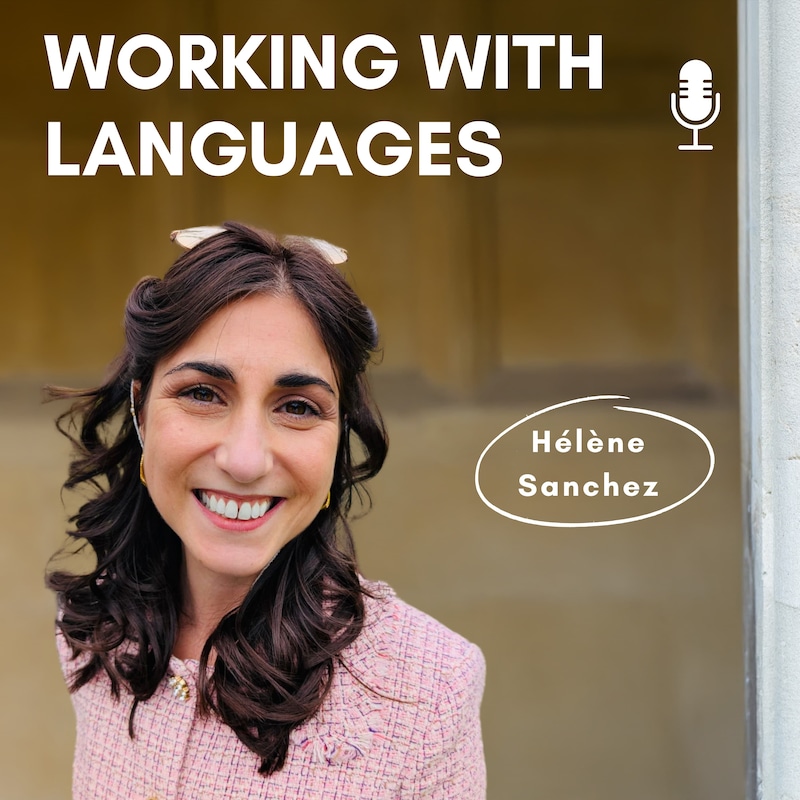
Today's guest on Working with Languages is Hélène, who works in product management, shaping software products. I've been looking forward to talking to Hélène because of her multilingual and multicultural background, and also because I wanted to dive deeper into product management. This job type can feel a bit distant and very technical, but she gives us a good overview of what is behind it, the skills needed, and how languages and communication fit into the mix. Let's dive in.
Welcome back to Working with Languages. My guest today is Helene Sarkchets, who works as a product manager in tech and has a very multilingual and multicultural background. First of all, hello, Helen. It's wonderful to have you on the podcast. Thank you for coming.
Hélène Sanchez
Hi Sonia. I'm very excited. I've never done this before. So I'm like obviously a little bit anxious, but also super excited to be here.
Sonia Kampshoff
Great. So as you know, I normally s ask the same question to everyone at the beginning. What is your favourite word or phrase in a language that you speak?
Hélène Sanchez
So it's a bit of a weird one because it's taken from a poem of Giuseppe Ungaretti and it's something that stuck with me while I was in secondary school, college maybe. I don't know the translation in in English, but it's this sentence that says Licenzio Lazzurro Vertiginose Ave Maria and it be it it means I fire off an Ave Maria into the vertiginous blue sky.
I just really love it. It's just stuck with me. I don't know why. So thanks to this opportunity I looked into the meaning of it a little bit more. And it's basically the the this collage of words are fantastic and wonderful because you have this sort of like balance or dichotomy between firing off something that is so ephemeral, like a prayer into the sky, which you can't really touch. But the way that is described with these like a dizziness and l having verticals, it feels like, you know, you can really touch it in a sense.
And and it's a representation of how of beauty of of the beauty of languages really. I'm sure poems that do the same in so many other languages. So I just think is yeah, it's really fascinating to be able to work with these words with words together and create these very contrasting effects.
Sonia Kampshoff
I like that very much. And I also like, you know, it's from a a poem from an Italian writer. And it kind of also capture captures the the fact that in Italy kind of religion is everywhere. It's felt much more strongly. You know, there's kind of churches everywhere and there's cross with Jesus on it, you know, al almost everywhere. There's a little Madonna statue, you know, when you go to little villages and so on. And there's a much more visible presence of the church kind of everywhere in Italy much more than in the UK, for example. So whether you're religious or not, or whether you're very religious or only a little bit, it kind of reflects this idea that the church has it's just more prominent in Italy in a way.
Sonia Kampshoff
So you're originally from Italy. Can you tell us a little bit more about your upbringing and background?
Hélène Sanchez
Yes. So I am I'm actually half French, half Italian. hence why my my name is Hélène. And my surname is Spanish, but I was born in Italy. I was and my father is French and my mother is Italian, hence why the draw nationality. I spent I s did my my primary and secondary school in Italy.
And I did my first my bachelor's degree in philosophy in Italy. And then I moved to the UK just after that. It's been always in our family, being half French, half Italian, we spoke French and Italian like all the time. Actually, we spoke French when my parents were angry at us, my sister and I. So they would tell us off in French. So you'd know that something was wrong because you were called off in French and and then the rest, like yes, was was Italian.
But we used to spend our summer holidays with my grandparents. So we'd go and stay a bit with my French grandparents and stay a bit with my Italian grandparents. And yes, that's how like it feels really weird to speak Italian to my French grandparents, although they've lived in Italy for like forty five years. So yeah, that's that's how I sort of like grew up in in in that sense.
Sonia Kampshoff
Where does your Spanish surname come from? Is there a Spanish connection as well?
Hélène Sanchez
Yes, through through many generation before So we're looking at the the the great grandparents of my grandparents. They would come from Spain and from the Basque region, and that's why they've through emigration they've ended up settling in Algeria, Oran, where my grandparents met.
And when Algeria was France and the civil war happened, so they had to escape and they decided to move to to Italy at the time. Obviously they weren't welcome in France and and that's how they they basically settled there. So I don't speak Spanish unfortunately. My grandfather speaks Spanish and some words of Arabic as well because they they were born there and my grandmother was a teacher in school. So it had to like she was teaching French, but obviously like she had to give s some instructions like normally to all the families, to all the Algeria families that that were sending their schools, their their kids to to my grandmother's school.
Sonia Kampshoff
So very fascinating background, very international. And then after your bachelor in philosophy you moved to u to the UK. I think it's it you first moved to London, is that right?
Hélène Sanchez
Yes. So I I gradu I graduated in December, the eleventh of December I remember. And the third of January was my birthday and the fifth of January I was already in London. I was like, I'm out of here. I don't know why, but I've decided to move to London and and canonical taking a an English course because at the time you had to have a you had to have a specific qualification to be able to study, in the UK. And that's what I've I've focused on and I did at the beginning 'cause I was like, I don't know.
I left without a return ticket 'cause I thought, let's see. I was like, I I don't know. I'm I've always been one hour one one year sorry, one year earlier than everyone else at school 'cause I was born in January so they decided to send me to school one year before the others. So I didn't feel really like the pressure of I've got to I've got to do something like this year. So it was good to understand like the education system in the UK, completely different from what we have what we have in Italy and also the cadence of like what you want to do. So I moved to London and I was yeah, I was studying, meeting people, met friends.
And after six months, I've applied to to do masters, got rejected in in a few places, and and then I got into the University of Edinburgh to do a master in management. So packed a van and I moved to Edinburgh and I lived in Edinburgh for four years. So I did my masters there, I worked, it was great. I've I've travelled a bit through Scotland and it's beautiful beautiful country.
And then after that I I moved briefly back to Italy for a few months. But it was great because I got a really interesting job in Italy that then allowed me to sort of well, not specifically that job, but I always wanted to go back to the UK. It was just like a brief I've started like applying for jobs, and even that was like a huge learning curve. I applied for the BBC.
And I got an interview. So I've jumped on a plane at 7 AM in the morning, went to the BBC Studios in central London, did my interview, and flew back on the same night, same day. And I remember my bot my what would have been my boss at the time later, sorry. He said, So where you yeah, where where are you from? And I'm like, I'm from Italy. Right, but where do you live? In London. No, I live in Italy. I'm going back today. He said, I don't think n anyone has travelled so far for an interview in the entire life. So Yeah, got the trouble to BBC apparently.
Sonia Kampshoff
That's amazing. What was your job at the BBC?
Hélène Sanchez
So yeah. At the BBC I at the time I kind of started as a delivery manager and scrum master.
Sonia Kampshoff
What does that mean actually?
Hélène Sanchez
Yes. So it means i in software development in that period, well, I've started to to to learn about this when I worked for the BBC is how you produce a software. So there's some agile methodologies and there there was a position specifically to work in a team that was developing products and facilitate and teach the team on how to be high perform performing and also making sure that things got done. Like the BBC had some like ways of working that perhaps were a bit antiquated. So they were trying to they were trying to improve just the whole like system of developing products, getting feedback from users, just self organizing around around what needed to be done.
And my job so I I worked on BBC I Player for one year and I worked on the transition from BBC I player radio to BBC Sounds, what is now BBC Sounds. And I really loved it, to be honest. That's what got me into really wanting to be part of developing products because my role at the BBC was more of a delivery, delivery, yeah, delivery manager.
So delivery role, whereas what I'm doing now is being in charge of what the product is. So taking responsi taking decisions, responsibilities on what are we doing, why are we doing it. There's a lot of like storytelling and context that need to be passed on the on the team. So on the people that actually do the work and in this case, because I work in tech is about writing writing software, creating software.
Sonia Kampshoff
In case someone doesn't know what product management is, when you talk when you talk about product, can you tell us a little bit more in very simple terms, you know, what the product is and what product management actually is?
Hélène Sanchez
Sure. Product management is a role that has a lot of soft skills. We as product manager, you don't you don't do any of the executive work. So I have a team of developers, designers, testers, and they they build. I create context and the story of what something needs to be done and why we're doing it. So I need to be I need to understand if there's a gap in the market. I need to understand what that gap is, what is the user base, what is our total addressable market, why do we need this product? I need to think about a go-to-market strategy. I'm responsible for the team. So I'm it's like being an entrepreneur, right?
So you're you've got an idea or you've got a problem that you want to solve that you need to solve, perhaps it's a mandate from the business or and you tap into all the resources that you have to solve that problem. So it's a bit of a there isn't like one definition, I would say, about what a product manager does or is. It really depends on the company and the context.
That is about solving being a problem solver, is about empathizing with your users, with any with an opportunity that you see, is empathizing with your team, because obviously you you have to have a team. And it's about really like loving these waves that it's about loving an opportunity and seeing a process from start to end and enabling that process and those people to be successful.
Sonia Kampshoff
It sounds really interesting but also very wide ranging. So you you develop technology products, the software or something similar. And then you also have a lot of teams and stakeholders that you communicate with, a lot of responsibility and also a lot of sort of touch points and people to talk to. So would you say it's it sounds like a very technical and a role full of responsibility because you produce a software or t a different technology product and you deal with a lot of teams, different kind of teams, and a lot of people and a lot of stakeholders. So what would you say the skills are that you need to be a successful product manager?
Hélène Sanchez
Patience, ability to listen without judgment, definitely emotional intelligence, those soft skills that I think are becoming even more important now that we have like AI tools that do all the executive work in a sense. And it's about negotiation.
It definitely is about negotiation. It's about empowering the success of and the strength well, empowering other people to to be the best that they can because they are actually building things. And never get tired to repeat the same story all over again to different audiences so that you can create alignment. So that there are no surprises or there are very little surprises when things get out in the wild and they reach millions of users, for instance. I guess because I work in technology that like the kind of impact and the the relationships and the stakeholders I deal with may be perhaps different if you're developing a a concrete so a physical product. Okay. A physical product, it might be a bit different.
But the the the sort of like fil rouge is is this is being able to be the glue between different groups, between different stakeholders. They will all everyone will have their own agenda and you need to be excellent at aligning all these agendas together and make them make your audience, your stakeholders see why it's important that we're all on the same page about something.
I know it may sound like wishy washy, but really these are like life skills, really. And in a sense, people need direction, like they really need the direction. Not a lot of people are proactive and they perhaps n they're not the best to judge of of themselves as well. So one of the aspects of being a good product manager is is also not being afraid of having difficult conversations, of operating in the unknown where you don't have all the answers at all. And you won you will never have them. But the people but some people you work with need all the answers or need to be certain about a lot of things. And there's that kind of like nurturing that needs to be done to build trust.
Sonia Kampshoff
I understand you work for a British and French company, or at least you have offices in the UK and in France. do you get to trouble a lot and do you get to use your languages? I mean, I guess your working language is English, but you get to speak other languages as well, or how do you use your language skills and communication skills?
Hélène Sanchez
I actually this particular role and company that I'm at at the moment made me use my languages a lot more than I thought. So my role has changed a little bit because of a pivoting that the company has done. but I started a year ago with the with the mission of helping the acquisition of a French company.
So there's an English company is the mother company that has acquired the businesses in France, in Portugal. And this particular French company has been acquired, but always felt quite like distant in a sense from a product perspective as well. So the the objective was how do you take, you know, a company, a product that is lived as a standalone entity.
And you integrate it in the context of where this is going to be sold as you know, they as a capability of a platform rather than just like a standalone product. And this was like what was written on paper. However, what they really needed was what I started doing was being that cultural bridge between the French office and
and the rest of the stakeholders in in England because they've never really communicated. And also let's remember that French is a beautiful language but is quite hard to learn. English is the language that everyone speaks and should speak. There's not many people in front that speak English to a standard level.
So there's been a lot of translation. There's been a lot of of you know, kind of like listening to one side, translating the complexity into it's yeah, translating a message from, you know, one culture to another. And it's not just about it was literally about how do we work together. Like how do we how do we make sure that what we see in the French market is heard and understood and how do we cater for that with the tools and with with
Hélène Sanchez
the product suite that the mother company has. So finding how to align what we were building that could serve two different markets.
Sonia Kampshoff
find it really interesting because the role that you have as a product manager, I understand did not require any languages, but then the fact that you spoke not only English but also French has actually turned into an advantage. So something that, you know, ha was an add on that you offered to the to your employer was clearly an advantage and it probably put you in a very favorable position within the company. Yeah.
Hélène Sanchez
Yeah. I'm I didn't realise at the time, 'cause obviously I've applied as a a product manager. I s mm there's there's this opportunity on how you know to to solve this like market gap and then I've I've acquired the skill that skills that I didn't even know I had, to be honest. So it's been really eye opening to literally be that bridge and to create like a an integration between two different w worlds, really.
Sonia Kampshoff
Yes, that's wonderful. That is all that I really wanted to ask you. Is there anything else that you would like to add?
Hélène Sanchez
there is one thing, yes, which actually having the opportunity to to use languages at work made me realize, first of all, that speaking different languages is a skill. I've always thought I'm taking this for granted because I grew up like this, because I grew up being able to switch mental model in a millisecond. You are a different person when you speak a language your character changes, the way you s you you move your tongue, where your saliva goes. It is fascinating and I love etymology. I get so much satisfaction understanding like why something is called some is called that way.
And it reminds me that we use words to create a reality. It's not that like we interpret the world through the language that we speak. So speaking different languages is like you're seeing context and situations in in different ways. And I think you're really fortunate that we can do this. And I wouldn't it's speaking different languages whenever you bump into someone or, how many languages did you speak? I speak this and this. Wow, you're so lucky. Yes. Yes, we are. Like we are really, really lucky. So just an acknowledgement of have by by taking, you know, by by w it's just yeah, it's really good.
Sonia Kampshoff
Yeah, I agree. I I agree that we change in a way when we speak a different language because we consciously or inconscious unconsciously we adapt to the culture of that language. But I also think it makes us it allows us to think in a broader context and to understand nuances better and to understand different people better. And that just makes us really good communicators. And I think that's definitely an advantage both in our private lives and at work. Brilliant. Well, thank you so much for coming. It's been a great conversation.
Hélène Sanchez
Yes, thank you so much, Sonia.
Sonia Kampshoff
What strikes me about this conversation is that Alain focused on her technical skills to progress her career. But languages turned out to be an additional skill that placed her in a favorable position after her British employer merged with a French company. She was able to help build bridges thanks to her French language, cultural awareness, and her communication. If you enjoyed this episode, please subscribe to the podcast on your favorite platform.
And if you think a friend might be interested, do share this episode or the podcast with them. You can also subscribe to my newsletter. The link is in the show notes.

