Shownotes
Summary
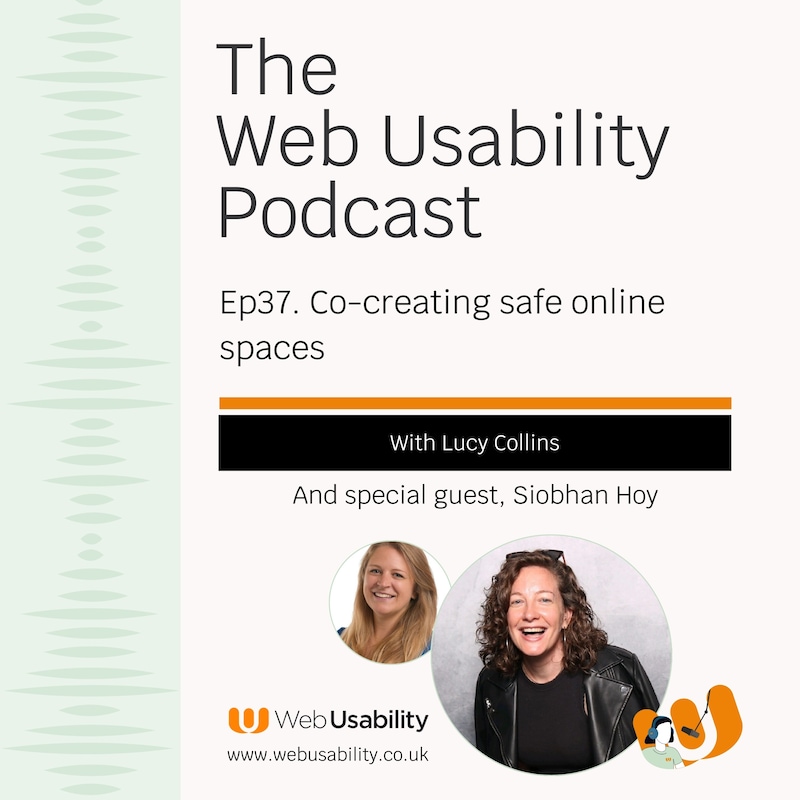
In this episode of the Web Usability podcast, Lucy Collins and Siobhan Hoy discuss the importance of creating safe online spaces, particularly for vulnerable users. They explore key principles such as user-centered design, the necessity of engaging users from the beginning, and the balance between accessibility and design. The conversation also touches on essential features for crisis support, the role of emerging technologies, and the challenges organizations face in co-creating these spaces. Siobhan shares success stories from her projects, emphasizing the importance of continuous user feedback and the need for organizations to prioritize user safety and accessibility.
Takeaways
- Creating safe online spaces is crucial for vulnerable users.
- User-centered design should be prioritized in online spaces.
- Engaging users from the beginning helps avoid assumptions.
- Payment for participation shows respect for lived experiences.
- Balancing accessibility with design aesthetics is essential.
- Crisis signposting is a critical feature for support.
- Dynamic signposting can enhance user experience based on behavior.
- Reducing content overwhelm improves user engagement.
- Emerging technologies like AI require careful risk assessment.
- Co-creation with users leads to more successful outcomes.
Titles
- Creating Safe Online Spaces: A Guide
- The Importance of User-Centered Design
Sound Bites
- "How do we create safe online spaces?"
- "Understanding audience needs is crucial."
- "AI brings both value and risk."
Transcripts
Lucy Collins
Welcome to the Web Usability podcast, where we explore what it takes to make the web a more accessible and enjoyable place for everyone. Whether you're a website owner, developer, or just a curious mind, we're here to share insights, tips, and stories that can help you improve the user experience of your digital world. I'm Lucy Collins, Director of Web Usability and your guide on this journey to better usability. If you need a transcript of this podcast, just visit our website at www.webusability.co.uk.
Now, let's dive in!
Lucy Collins
So my guest today is Siobhan Hoy, hailing all the way from very snowy Toronto, Canada. Siobhan is founder of Strategy by Siobhan and has had the pleasure of working with a really impressive roll call of organisations, including the NHS, Children's Society, and most recently Canada Post. Today, Siobhan and I are going to be exploring a topic that is of great interest to me, how do we create safe online spaces? It's so important because they very much provide the foundation of trust and security for everyone particularly those in vulnerable positions or managing mental health conditions. In these spaces, individuals should be able to engage without fear or harassment or judgment or exposure to harmful content, promoting psychological safety and enabling open dialogue and ultimately helping people when they need it the most. But what's the best way to approach the creation of such spaces and how can we ensure that they have the intended impact? It is this and much more that we will be delving into today but first let me say a big hello to Siobhan. Welcome to the podcast.
Siobhan Hoy
Hi, thank you for having me.
Lucy Collins
No problem at all. We probably ought to say, because people have heard that you're from Toronto, but then you come in with this northern accent. So perhaps we ought to say kind of where you're originally from and how you've ended up over there in Toronto.
Siobhan Hoy
and I relocated to Toronto in:Lucy Collins
Amazing. And you're just telling me that you've had a lot of snow there overnight, so 10 centimetres or more, which would have the UK in an absolute flurry, I'm sure. But no doubt the Canadians are surviving.
Siobhan Hoy
Yeah, they're doing OK. But there was a day off school for the kids yesterday, I think. brilliant.
Lucy Collins
So let's talk about some safe spaces or safe online spaces. I mean, what for you makes an online space safe, do you think?
Siobhan Hoy
Yeah, I think when I think about the bigger picture, I think there's a few different factors that come into play. And I think from a technical perspective, when we're trying to create safe online spaces, things like security, privacy, anonymized data, secure online accounts is really important. From a content perspective, think expert-led content that can be reliable and can be trusted is important. From a design perspective, that reassurance and guidance coming into the experience is important. And then a couple of other things like risk mitigation and brand credibility and trust, think, as well. So really communicating that brand credibility to build trust with users is important.
Lucy Collins
Yeah, absolutely. So if we think about creating a safe online space, where would we start? What are the key values or principles you find it's important to embed right from the very beginning when we're thinking about these spaces?
Siobhan Hoy
Yeah, so it's something that should be considered, I guess, for any spaces that are created online. But really taking a user-centered approach is crucial in this kind of thing. Understanding which are the audience segments that are going to be engaging with the platform, what their needs are, and building from there upwards so that everything is centered on how we can create a safe space based on what the users need. Because sometimes we might have assumptions about what that could look like, and it's quite different from what the end user would feel. And then accessibility, think, building in the accessibility standards from the start that you're trying to achieve is really important as well.
Lucy Collins
Yeah, absolutely. I think that point around there's a lot of unknown unknowns possibly when you're building safe spaces. There's a lot of danger of that assumed knowledge as well. When you think that you know what someone with a different lived experience to you might need. And when we think about safe spaces, and I guess in this context, we're perhaps talking about places where people might go for mental health support, where people might go when they're in crisis, where people might be going for support for specific and critical need. If we are either designing from a place of ignorance, we might unintentionally not have the right information or even worse actually unintentionally cause harm. And so I completely agree that involving people right from the very beginning is so important. How do you do that? I think this is something that a lot of organisations struggle with, particularly when we're thinking about working with marginalized groups or people with additional needs. There's almost like a fear or reticence around approaching these groups sometimes or knowing where to go to find people. And the number of times I work with organisations, obviously we specialise in digital accessibility and I'm like, well, we don't know how to speak to disabled people. But like a quarter of the UK population has a registered disability. It's not like they're a small group of people. yeah, how do you go about kind of involving users? Where do you go about to find them? But then also actually how are you kind of managing sessions or managing, engaging with these people to avoid overwhelming them and avoid causing them unintended harm or stress as part of that co-creation process?
Siobhan Hoy
If you are working with an organisation who has frontline staff, service providers who have a rapport and a relationship with end users or prospective end users, then leveraging, working closely with those people to leverage that relationship is really important because coming in cold might be more of a challenge, but if somebody already kind of has that relationship with service users and can introduce you and tell this person more about the project and that can help to drive engagement from a participant perspective. There's other things that are important in the process as well. I think with any research engagement it's important to be clear from the start about what the process is going to look like but with more vulnerable groups this is even more important especially if they have never been involved in a research engagement before. There is no reason they would know what's going to happen next or have an idea about that.
So really communicating that clearly early on. Also, incentivisation is important and making sure that people are where relevant compensated for the contributions that they're making to the solution that you're building. There are other things that should be considered as well, particularly if you're working with younger people. The safeguarding aspects, such as having people involved in the process who have the necessary background checks, like CRB checks and things like that.
And then right down to the discussion guides and testing plans that are being used, think keeping those as simple as possible while still enabling you to capture the insights that you need to build the platform is going to help bring people along the process as smoothly as possible before any sessions that people participate in, understanding if there are any accessibility needs, is there anything that we can do to accommodate to make sure that everybody can participate and contribute their perspectives in the right way and safely and easily.
And then also trying where possible to have a panel. If you are conducting a longer engagement, can we have the same people participating? Because it does add value to the process. But understanding that, particularly for vulnerable groups, there's going to be things that arise potentially that mean that they can no longer take part in a long-term project. So having flex to accommodate if that does happen, but also seeking to have some kind of ongoing panel that you can work with to validate things as you go through.
Lucy Collins
Yeah, yeah, so much good stuff in there. mean, I think that expectation management piece is so important, isn't it? It's being really transparent and upfront about what it is that you need from these people, that setting out the process. And we do that for any recruitment. But you're so right that when you're working with people that perhaps have additional needs, you can almost never be too transparent and too forthright with what it is that those sessions are going to be like, because so much of the prep happens before that session begins. And if they're already you know, feeling confident, feeling safe in that environment. Yes, the role of the researcher is to build rapport quickly and to make people feel comfortable and put in those adaptations and adjustments in the moment. But actually, like so much of the work happens beforehand, doesn't it? And, you know, we find that a lot where people have been well taken care of prior to a research session. You then get so much more from them because you can much more quickly kind of get into the meat of things because they already trust you and they trust the process, which is which is really nice.
Your point around payment as well, I just wanted to pick up on that as well, again, because it's amazing how much people want people to do for free. When you are involving anyone in any form of research, some form of incentivization is important because it shows value for their time, right? But when you are actually asking for people's lived experience, I mean, that is invaluable. You really can't actually probably put a price on it, but putting some financial incentive there to compensate them for sharing that lived experience is so important and it always shocks me when I hear of any stories where people are trying to get anyone to take part in research for free. just, I don't know, it fills me with dread slightly.
Siobhan Hoy
Definitely and I think that kind of ties into UX advocacy on the other side. where we as a UX team feel that there should be an incentive against sometimes there's internal budget constraints and that kind of thing but we really have to advocate for the value of people will contribute to the project and that incentivisation should be built into the project budget.
Lucy Collins
So when we think about building safe, accessible experiences, I think there's often a feeling that it butts head with also sleek and minimal design and UI. So I know that you kind of span both sides of the research and design spectrum. You've had kind of experience in all sorts of different areas of the sort of digital development life cycle. How would you address that? How do you find that balance between inclusive, accessible features? And it'd be great to pick up on some specific examples, like crisis signposting, quick exit buttons, and then also make that an attractive and nice experience for people to use online.
Siobhan Hoy
Yeah, definitely. Those two features that you've mentioned there have been quite key to a couple of the projects that I've worked on in the past when working with vulnerable audiences who may become unwell or that they're browsing privately and they may need to exit the site quickly and with ease. I think understanding, the first point is kind of understanding what those features are because from the start of a project we might not have a clear idea of what users need to do but working with clinical practitioners or subject matter experts, even the frontline staff, they might have an idea. So any type of kind of subject matter expert that you can connect with early in the project is going to help guide what those essential features are that kind of mission critical that needs to be included in the platform and once we've got a good idea of that I think it's important to map out the flow so understanding what the different user flows are that exist within the platform and where these different features should live. Another thing that's important is considering what other information is being presented in those flows so we definitely want to reduce visual overwhelm and information overwhelm so if we can make sure that we're not pushing too much information at the user through a flow as well as these other CTAs to help them navigate the site. It can help, like an optimal user flow and user experience.
Lucy Collins
Some of these features that are perhaps a bit more specific to environments where people are coming, if they are in crisis or they are, you you wouldn't necessarily expect a quick exit button on your Sainsbury shopping, for example. But if you are coming to I know. I'm wondering if there's some particular examples where these sorts of like additional features, you know, are important. mean, it's crisis signposting, posting, you know, certainly if you are in any kind of mental health support service, then there needs to be very clear and obvious signposting for people who are in acute crisis at any one moment. I'm just wondering where, like, if they've got examples of where a kind of quick exit button is appropriate. And again, like what that might look like on the screen itself. Yeah.
Siobhan Hoy
So from the quick exit perspective, it can be relevant for a lot of different domain spaces. So mental health is one that we've touched on. Non-profits offering support to victims of domestic abuse, that's another area where this type of feature might be. So it can be used in any platform where there's potentially a vulnerable audience. And how it is typically handled would be floating sticky CTA button. So it's not actually disrupting the remaining content on the page, but it's placed in a standardised global way across the site so that it builds that expectation for the user as to where they can go if they need to exit rather than having to think, I need to quickly exit this page, but I don't remember where that button was to do that. There is obviously the shut browser button, but if it's sticky, if they're midway through a page, it's a quicker move for them to get to it. So that's why that format is typically used. In terms of crisis signposting and that safeguarding perspective. Again, having it somewhere in the global navigation is useful so that it's prominent and it's easy to access, but it's also possible to use conditional logic based on a user's behavior to present it in a more dynamic way. So it should be accessible as a standard feature, but if they're moving through the platform and they've entered certain information or their behaviour is a certain way, then it could be dynamically pop up modal to dynamically present the signpost and then bring them over to that information so that they know that the support that they're going to access is not actually offered within this platform, but we are offering links to get to it.
Lucy Collins
That's really interesting, the idea of the dynamic signposting. And guess you must need to be quite careful there because you don't want to suddenly signpost someone to a crisis thing just based on some behaviors if actually that's then going to trigger them themselves. I mean, how do you find that balance as well because certain inputs, certain behaviors might not necessarily signal crisis and actually seeing the crisis stuff might have the unintended consequence of, I don't know, of somehow being triggering. Is that something that you came up against at all as part of your work?
Siobhan Hoy
That's a really good point. think working with the users is essential to work out how we can best present this information. One of the examples that I'm thinking of, we were actually capturing how the user was feeling which meant that we could then, based on how they've self-reported, we could then present something if necessary because from a safeguarding perspective, we couldn't necessarily have someone enter a very extreme feeling and not have something signposted because ultimately the platform was more geared towards providing support, resources and helping them to manage their wellbeing, but it wasn't a crisis resource. So that distinction needed to be clear.
Lucy Collins
So I guess it's a balance between the user need but also the organizational safeguarding requirements and being very clear presumably on what those are. yeah, it's tricky balance though. I can kind of see where you that again, you might butt against friction, but actually like you have to know that those safeguarding requirements are there for a reason. And I have to be honest, I don't know a huge amount about kind of how safeguarding requirements have been developed and you know, how I assume that they're quite evidence-based and come out of a lot of research. Yeah, it's an interesting moral dilemma and interesting ethical discussion to be had. I wanted to go back to something you said earlier, which was about kind of reducing that overwhelm as well and thinking about the content that you're presenting to people and ensuring that that's done in a way that is minimal. Can you give me some examples of that in terms of, you know, how do you ensure you're giving enough but not too much? How can you feel confident when you've got the balance right?
Siobhan Hoy
Yeah, I think again, a lot of the work that I have done is through validation with with end users and the research to understand is the way that we've positioned this, is this viable for you? And oftentimes when the first review is done, maybe it's not, maybe there's a little bit, especially with younger groups, maybe there's a bit too much text. It's reported as being too text heavy. And then that feedback allows us to iterate and condense the text that we've included and maybe introduce new formats. You can probably imagine, but I think most of us like short form video content, even more so with the younger audiences, the feedback that we received was they're so used to engaging on social media apps that a resource that's purely text-based can be challenge or can be off-putting. So trying to introduce different formats of content where it's possible. It's not always possible if we need to use existing resources, but also introducing tagging so that they can see this is a blog post, this is a video, this is an audio clip so that they can kind of filter the content to what they're looking for, the type of format that they're looking for.
Lucy Collins
It's really about ensuring that information meets their needs, giving them a variety of different content formats. And then it's these additional features, the signposting, the exit buttons, that sort of help to create these safe spaces. Is there anything else that we haven't touched on that you think is important when we think about safe online spaces?
Siobhan Hoy
One thing that should be considered thoroughly before introduced to safe online spaces is emerging technology and any forum or peer-to-peer type environment within the space. in terms of emerging technology, I'm specifically at the moment thinking about AI.
Lucy Collins
I mean, how can you not in:Siobhan Hoy
We know that it brings a lot of value and it can introduce efficiencies and bring resources to people more quickly and this kind of thing. But I think when you're working with vulnerable audiences, the proper risk analysis needs to be done because you can see from the safeguarding that already needs to be in the site, you can't then introduce more risk necessarily. So that area in general with this type of space needs to be really thought through. I saw a recent example shared on LinkedIn where an AI note taker had been used in a medical appointment and it had gotten something wrong. And then it had advised that a gentleman, an elderly gentleman had his pacemaker removed when that actually wasn't the recommendation in the appointment. So that was just a kind of an anecdote or online but that just shows that the risk is there so we need to be mindful of how we implement emerging technology and then from the kind of forum perspective we know that there's benefit of people connecting with other people who have similar lived experiences but the caveat there is can the space be moderated. If you don't have the resource or the means to moderate some kind of peer-to-peer aspect in a platform that potentially brings risk to vulnerable users. So yeah, I think in a couple of projects, we've stayed away from that purely from that perspective is that again, we need to safeguard our users.
Lucy Collins
It's a slightly depressing though, isn't it? That we can't have a free online platform without fear that it's going to descend into trolling and all the awful behaviour that we do see online. But yeah, it's such a valid point. And I guess that then often comes down to organisational resourcing is moderator, something that is feasible for the organization that's delivering those things. And while it might be a nice to have feature, you're so right, let's take it back to the safeguarding. What are the potential what is from this situation and the harm that could be done. I think that point on AI is so interesting though, because it does, everybody's jumping on the bandwagon at the moment. We all want to be using this technology, but you can see how quickly and easily, how many examples do you see every day? The one about the pacemaker example is a terrible, but also a great one. you just, know, the stuff that's in the news right now about Brock and everything that's going on with the indecent images, you just think, God, if this is the underlying technology that's potentially being used with people who are vulnerable and in spaces that are supposed to be safe, the unintended harmful consequences are potentially quite scary. Not to say that this isn't technology that should be used. You I do think that there is a lot of AI for good out there. But with all these things, I think that there's this need to slow down slightly with it. think the problem is that everything has to be done yesterday and for no money. And when we operate in that kind of environment, inevitably mistakes are going to happen. But if we allow ourselves to just take a bit more time, open up the conversation with more people, take the time to really listen to them, then you are going to much more deeply understand their needs and understand which technologies are potentially going to be suitable to support those needs. But so often it feels like we don't give ourselves the time.
do that and I think that's probably one of the biggest challenges that organisations face with doing this sort of work is making the time for it. Would you agree are there other kind of challenges that you see organizations facing when they co-create these places?
Siobhan Hoy
Yeah I think there's a few definitely timing and the pressure to deliver solutions within fixed time frames and budget constraints especially within the public sector that that is a factor. There's other challenges that arise sometimes recruitment of participants can be a challenge And then that ties back into timelines because sometimes timelines slip when maybe we're ready to move ahead with some research but there isn't the necessary participants as of yet. That can be a challenge as well. I've mentioned it previously but that internal advocacy for UX and user research to inform solutions can be a challenge, especially if you're working with stakeholders who are a little bit removed from the ins and outs of what needs to take place.
what looks like a feasible timeline for someone who's less involved. Maybe we know that's going to be a bit tricky to deliver on based on the timeline, the time we need to build the report, bring them in to manage their expectations, all of the stuff that we've mentioned earlier. I think that there are different challenges within the space of co-creation, even working with people who aren't used to co-creating. I've led workshops before where there's been a little bit of hesitancy to do the co-creation exercises when we run.
design sprints and that kind of thing because participants feel they don't have the necessary skills. So I think it's important to again create a supportive relationship and manage expectations early of what they might need to do and that they don't need to be an artist to be able to help bring their vision to life. It's more about just trying to illustrate what they're thinking in their minds and bringing that to life on paper and that kind of thing. yeah, a few different challenges.
Lucy Collins
Going back to kind of finding the participants, as you mentioned this earlier on, it is often a barrier to people to access people who might have additional needs or whatever else it might be. And I think you said something about working with customer facing staff briefly, which I just wanted to go back to because I think often customer facing staff are really underutilized resource within an organization. Is that something that you found and have they been a useful channel into the communities that you've been needing to work with?
Siobhan Hoy
Yeah, definitely. think it's the barrier to recruitment of participants we can see across lots of industries and verticals. So it's interesting that it doesn't just apply to people who are building safe spaces, it can apply to enterprise organisations who are selling commercial services. Sometimes it's hard to get hold of these people but definitely building a relationship with the people who are working with end users or customers, whoever they might be, and even capturing insights from those people.
I think sometimes while we try to drive recruitment and there's maybe a little bit of time while we're doing that, analysing customer feedback logs that the customer service team have captured or running workshops with the sales team, whoever that might be. I'm thinking more of an enterprise organisation there, but again for Safe Spaces, it's those frontline service providers who might be working with young people on a regular basis. They pick up on things, they have insights, so anecdotally they can share things that can kind of start to stir the solution early on.
Lucy Collins
Yeah, definitely. I wanted to just wrap up by thinking about some of the projects that you have worked on. Is there anything that you have done or anything that's kind of come out of the projects you've done, both the kind of the research and the design pieces, where it's like it's really worked and you're like, that's been such a success. Is there any kind of like real moments like that that you can share. I appreciate we can anonymise it, but any anecdotes from the work that you've done where things have really worked and why as well, I guess?
Siobhan Hoy
In terms of the safe spaces and creating these online, the key thing that's led to success, and I've touched on it a little bit earlier, but it's the bridge between reaching the end users but also working in conjunction with clinical practitioners. I feel like that intersection means that you're not only supporting the end user, but you're doing it in a way that clinically sound and safe. So that approach and also co-creating and co-designing with the end user, that is what typically has led to success on the project. Working across multiple phases, so kind of building things in an agile way, which ties back into the topic of timelines and budget constraints, is that if we can work more agile, we can get to an MVP state that is still clinically sound and safe, but it maybe doesn't have all the bells and whistles, and then we can release that to pilot groups, gather feedback and iterate on it on an ongoing basis. And that can also help to drive buy-in from external parties that might be involved, whether that's commissioners or the stakeholder groups. Because once you have a platform or a solution, even if it's in its MVP state, it comes to life and people who are more removed from the project can see, okay, this is a real thing that's serving the needs of vulnerable users. And that's the kind of key thing. And what I've seen in the past with a couple of projects is sometimes through that agile approach, we've introduced new features or we've enhanced features. a good example is kind of for young people to manage their well-being, introducing a of a mood journal or a mood tracker and enabling them to reflect back on trends and see kind of the past data themselves. That's not how it looked in the first MVP. It was more of a strip back mechanism where they could enter data. over time with their feedback, we were able to iterate and enhance that.
At the same time, sometimes pulling back features, so scaling them back. Maybe we've introduced a feature that we thought maybe could bring value early on, but then when we look at the usage data and we speak to the end users, they're not actually using that area that much. So, is it bringing value to keep it or should we remove it and keep the platform as streamlined as possible? yeah, I think just continually capturing ongoing feedback from users, whether that's through more engagement or through site, feedback mechanisms, content feedback mechanisms, did you like this piece of content, different ways, but just to make sure that we're iterating and continually enhancing the solution. Yeah, brilliant.
Lucy Collins
My final question, I feel you perhaps already answered it, but I'm going to ask it anyway, because why not? It was really, what would be the first step for people that haven't necessarily considered, they haven't had a need to, or they perhaps just hasn't been on their radar, that there's something about creating a safe space online, what would be the first step that you'd recommend people taking to get into this area?
Siobhan Hoy
Yeah, there's probably a few. So I think it's quite common for design staff to have completed accessibility training as well as obviously accessibility staff. They will have the highest level of training, but anybody else that's worked within product team that's maybe a little bit removed, there are some basic online courses around accessibility that could give everybody on the team like a foundational awareness of what is best practice and what are the standards and what is required. That's one area that, you know, if people aren't designers, they can still upskill. If they're a product manager or a product owner, they can upskill in that area. Another thing is just initially thinking about the problem space and what problem are you trying to solve for. That's best practice for any UX or product team. But I think just really aligning on what that looks like early on in the process. And then I think there's lots of resources out there and even looking at
who's already offering something in the space that you are planning to build a solution in and how are they doing it? And maybe they're doing it differently, they have a different problem they're trying to solve, but if they're working in an adjacent area, can you take inspiration from what they've done or think about how you can differentiate your product but still kind of maintain that safety and accessibility to it?
Lucy Collins
Yeah, brilliant. So I think a bit of personal self-development as well as obviously setting some kind of organisational intention around, yeah, what is the problem to be solved here? Sean, I think that's probably a lovely point to end on. if there are any of those online courses or resources that you found particularly helpful, it'd be lovely to share those. We can always pop them in the show notes.
But thank you so much for a fascinating discussion. mean, I think it goes right back to involve your users, understand their needs, co-create with them, and ensuring that the design itself minimizes overwhelm, but also provides those mechanisms that can support people in those moments of crisis or with those quick exit buttons.
Thank you so much. This has been really interesting. Do you want to kind of listen and where they might connect with you or learn more about what you are up to? Anywhere we can signpost people.
Siobhan Hoy
Yeah, sure. I'm on LinkedIn as we most of us are. So yeah, feel free to connect with me on LinkedIn. It's Siobhan Hoy or my website is strategy by Siobhan. But you do need an access code to get into the detail of that. So, feel free to. A private website. That makes it quite like, I don't know. Makes me want to go in weirdly. I can share that to anybody that's interested. Fantastic. Brilliant. Well, we will share your LinkedIn details within the show notes that anyone can reach out to then. But otherwise, thank you so much for listening and we hope to see you at the next episode. Thank you for tuning in to the Web Usability podcast. We really hope you enjoyed this episode. If you have any questions, comments or topics you'd like us to cover, reach out to me on Lucy at webusability.co.uk or connect with us on LinkedIn.
Please don't forget to like and subscribe so you never miss an episode. Until next time, keep making the web a better place, one user at a time.
