Subscribe/Follow and click here for further information and the eBook of resources:
https://www.criticalfewactions.com.au/podcast/
Please let me know if I’m on the right track with the podcast. It means the world to me to know I’m adding value.
Are you stepping back from your business but still find everyone waiting for you to make the final call?
Has your organisation outgrown instinctive, founder-led decision-making?
Are you trying to empower a CEO but feel the pull of old habits and legacy systems?
If you are trying to transition from founder-led operations to a CEO–Chair model without creating friction or confusion, this episode is for you.
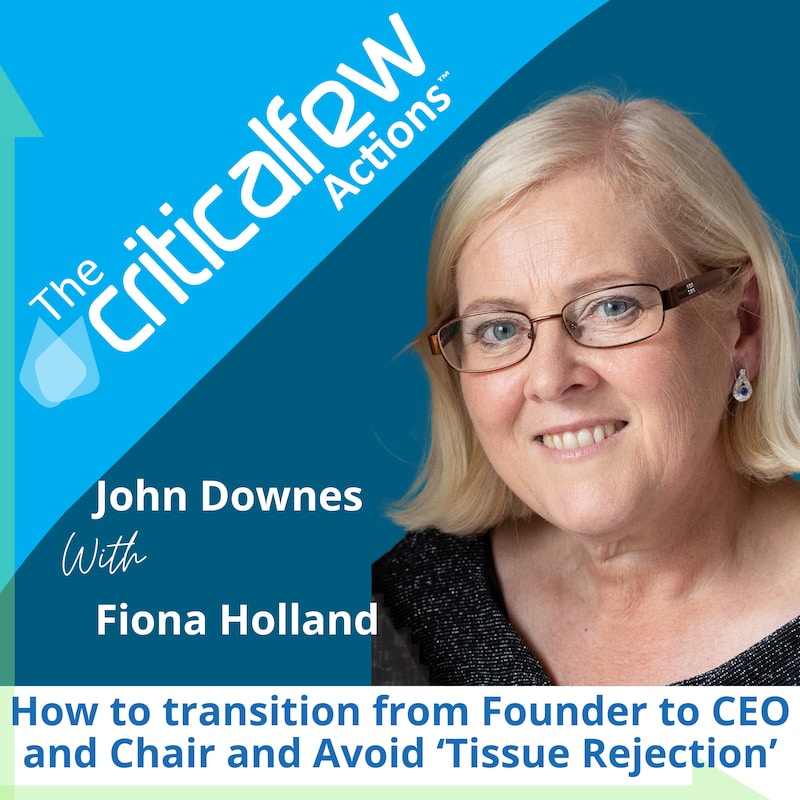
In this conversation with Fiona Holland, CEO of Tri-Tech Chemicals, we explore the real-world challenges founders face when they hand over control. You’ll hear how Fiona navigated authority, governance, gut-feel decision-making, and the risk of organisational “tissue rejection” when a new CEO steps in.
What You’ll Learn
== Why founders struggle to let go of authority even after stepping out of operations
== How CEOs can build legitimacy when long-term staff still default to the founder
== How a new CEO stepped up significantly her skills and network
== Why missing governance and Delegation of Authority creates risk as you grow
== How to reset your strategic plan with your leadership team and board
== Practical steps to avoid “tissue rejection” when bringing in a CEO
Highlights
00:00 Fiona's Early Career and Education
05:28 Joining Tri-Tech and Initial Challenges
10:43 Transitioning to CEO and Establishing Authority
21:50 Implementing Strategic Changes
27:27 Navigating Founder-CEO Dynamics
37:08 Facilitating a Smooth Transition
37:22 Mutual Respect and Open Communication
38:29 Implementing Systems and Processes
40:13 Educating the Board and Governance
40:59 Advice for Retiring Founders
44:35 Navigating Founder-CEO Relationships
54:46 How to Develop as a CEO and build a network
58:57 The Power of Knowing Your OPV
01:04:09 Future of the Chemical Industry and Tri-Tech
01:06:25 Advice for Aspiring CEOs
01:08:21 #CriticalFewActions™ for Founders and CEOs
The #CriticalFewActions™ You Can Do Today
When I work with successful business leaders, I often see founders stepping back from operations without changing the structures that once held everything together. This leaves CEOs responsible but not fully empowered, and teams confused about where decisions truly sit.
Here are the three key insights I took from the conversation:
Insight 1: Clarify authority early
Many founders still speak with the authority of the past, which unintentionally overrides the CEO.
So, what can you do?
• Agree which decisions belong to the CEO and which remain with the founder–Chair.
• Communicate these boundaries clearly and reinforce them consistently.
Insight 2: Put governance and structure in place
Mid-sized businesses often rely on habit and history, not defined systems or Delegation of Authority.
So, what can you do?
• Create a simple Delegation of Authority so staff know who approves what.
• Establish a predictable governance rhythm with reporting and defined decision pathways.
Insight 3: Rebuild the strategic plan together
If the strategy lives only in the founder’s head, the CEO cannot lead effectively.
So, what can you do?
• Develop the strategic plan with your CEO, board, and leadership team together.
• Link KPIs and roles to the plan so accountability is shared and transparent.
Final Thought
If your organisation is entering a founder-to-CEO transition, the risks are real but manageable. Clarity, structure, and a shared strategic plan remove friction and protect both the business and the founder’s legacy.
This episode gives you practical steps to ensure your business grows beyond gut-feel and into sustainable, scalable leadership.