Shownotes
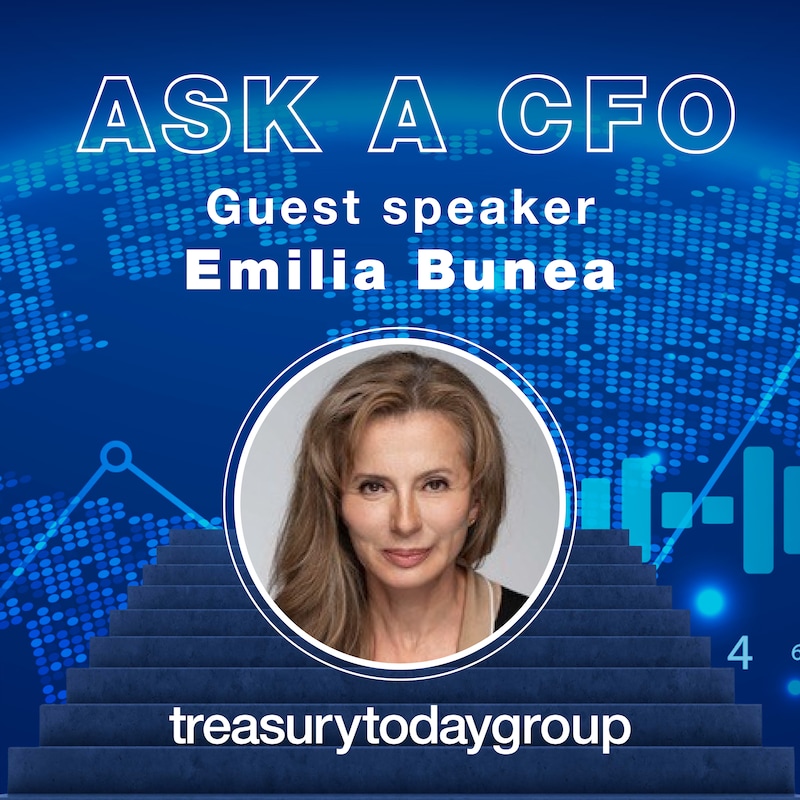
In this episode, Sophie Jackson speaks with Emilia Bunea, a former CFO turned accomplished academic and author. They discuss key insights from Emilia’s new book, Leadership for the CFO, a must-read for anyone aspiring to become a CFO or excel in a finance career. They also explore Emilia’s career journey, experiences and advice for finance professionals.
---
- Leadership for the CFO: Influence. Motivate. Inspire. - Emilia's book Leadership for the CFO is available to buy online.
Transcripts
Hi and welcome to Ask A CFO, the podcast series that shines a light on the different paths taken to become Chief Financial Officer and showcases the personal stories of those that have made the journey.
Sophie:I'm Sophie Jackson, and in today's episode, I'm joined by Emelia Bunea, former CFO turned accomplished academic and author whose psychological analysis and insights on leadership in finance are spot on.
Sophie:We'll be together discussing some of the perspectives from Emelia's new book, Leadership for the CFO, which was released in November 2025 and is a must-read for CFOs, aspiring finance executives and anyone looking to a career in finance.
Sophie:We'll also be taking a look at Emelia's own career journey her experiences and her advice for all of us.
Sophie:Oh, hi.
Emilia:Hi.
Sophie:I love this amazing set of bookshelves behind you. So first of all, can I ask you just to introduce yourself?
Emilia:Yeah, sure. So I am Emilia Bunea. I've been a corporate creature for most of my professional life, followed by a change to academia and leadership. I've been researching and teaching and speaking about leadership for about seven years, eight years now, and I keep learning every day.
Sophie:Amazing. I've never heard the expression corporate creature before, but I love that. So I will be borrowing that. Thank you.
Sophie:Before we run through your path to CFO and your journey afterwards, I'd love to explore your origin story. So tell us, where did you grow up? What shaped your early education? And what ultimately sparked your interest in the world of finance?
Emilia:Well, there's a lot there. So let me try to keep that brief.
Emilia:I grew up in communist Romania. The good parts of that for the finance career were that Romania was and still is very strong in maths and math educations from earlier on. And luckily enough, I had a bit of a talent that way.
Emilia:The other good parts, I guess, looking back, are that it was very difficult times, of course, which I guess does something to one's resilience and appreciation of everything that we otherwise might take for granted in a Western, comfortable life.
Emilia:I did, I went as a math talent, unless you wanted to become a teacher, which I didn't, you'd become a, an engineer and there was this hierarchy where at the top level you had either aeronautics or software engineering. So I did software engineering and then the revolution came and things changed.
Emilia:So things changed like those movies that move from black and white to colour in the middle of the movie. It feels a bit like that.
Emilia:My mother is a very strong, very special person. She was a single mom who raised the two of us. We didn't have much, especially because she was a priest's daughter, so she was not allowed to go to university.
Emilia:But still, we didn't have much, but we had private French tutoring and private piano lessons. So we got this appreciation and respect for culture and literature and philosophy also from very early on. And this actually came incredibly handy when the doors opened, when the Iron Curtain fell, because it allowed me very quickly to connect both language-wise and, if you want, culture-wise with the Western world.
Emilia:So I started working for a small real estate development company, got an MBA, an executive MBA from University of Washington at about the same time. And then I was headhunted by an investment bank that was owned by the European Bank for Reconstruction and Development.
Emilia:And the boutique investment bank in New York, Wasserstein Perella. That to me sounded very exciting because it played a role in a book I had just read, Barbarians at the Gate. I don't know if you've heard it.
Emilia:So this was again right from the movies, right? I was being headhunted by this investment bank that I had read about. So obviously it didn't take much pondering. So I started working in investment banking.
Sophie:Wow, so it sounds like, although obviously very challenging, that you had a very rich upbringing and you were able to put it into practice very quickly. So that's brilliant.
Sophie:You began your career in investment banking, as you well said, before transitioning into CFO roles. Can you tell me a little bit about what prompted that shift and how did you navigate the different demands of moving into a different space?
Emilia:Yeah, so it seemed like it was a natural step at the time, first because the investments bit was rather slow. This was the late 1990s.
Emilia:Russia had just defaulted, so everything, you know, the phones went silent on everything related to the higher risk markets. We were not even an emerging market at the same time, but just below. So things were slow.
Emilia:And at the same time, the EBRD had this minority stake in this insurance company. And I guess, not that they put it like that, only later did I realise that they probably wanted their man, their woman in this case, at their finance controls there. So yeah, so that's how I was offered the CFO job by that company. And I took it.
Emilia:It's interesting because you'd think, yeah, I was just not even 30 when the change happened, very young CFO. And you'd think it would have been a big shock, the demands being very different. But actually, it wasn't.
Emilia:And I think, you know, after speaking with many CFOs for my book as well, I think it's not a very rare situation where finance executives can actually progress quite a bit in their career, sometimes even as CFOs of smaller, or smaller, not necessarily in numbers, but in scope, simpler, if you wish, organisations. And it goes relatively okay without them having to fundamentally change something in how they behave, in how they lead, in what they do. And the shock comes later when complexity grows unexpectedly.
Emilia:So yeah, so in this first CFO job, I still brought with me this, well, first the investment banking long hours working ethos, but also this sort of impatience with anybody who couldn't keep up, right?
Emilia:So if I had smart people in my teams, I would definitely take their interests to heart and develop them and work with them. And I think inspired them. Some of them still tell me, you told me that, which is a good sign that I did do something good there.
Emilia:But at the same time, I completely ignored everyone who wasn't like me looking back. So I just dismissed them as too slow to keep up. And of course, that probably cost me something then, not very much at that time, again, because the market was growing so and we had a very good brand as a company.
Emilia:So if I fired someone, I knew they would find good jobs somewhere. It wasn't, you know, a life destroying decision. And it was also relatively easy to hire new talent.
Emilia:So, you know, there would have been some turnaround and some mistakes there, but they in the end didn't cost very much luckily.
Sophie:That's interesting. And you mentioned there your young age. So you became a CFO, I believe at the age of 30 or perhaps just before from what you're saying.
Sophie:I hate to presume that it's a challenge because I feel like we're always particularly judgmental of women who are young for roles. And sometimes that's self-imposed, sometimes it’s imposed externally. I've never been a CFO, but when I was younger, I was always considered too young for my jobs, whatever that means. And I think it's wrong to presume that people struggle.
Sophie:But I'd love to know what was it like to carry such significant responsibility so early in your career? And were there any challenges that shaped your development during that time? You've just touched on a couple.
Emilia:Yes, so again, I don't think I, which is probably, you know, an advantage of youth, I don't think I appreciate, really appreciated the responsibility on my on my shoulders. I just took it on.
Emilia:In the CFO role, I did get what you're describing, actually, as a consultant in my previous roles, I got that quite a bit, you know, being too young, not looking experienced enough.
Emilia:In the CFO role, funnily enough, I didn't. I realised, looking back, I had a very strong expert power, which sort of shielded me from politics. There was quite a lot of politics in the company, but somehow, I didn't need to engage in it at all because I had this very powerful, expert, independent aura, if you wish.
Emilia:I had the trust of the CEO, so I could afford, again, this luxury of not having to manage stakeholders and politics and interpersonal dynamics, much which I wouldn't have known how to deal with at all.
Emilia:And I might, as I said, I made some mistakes. I made many mistakes, you know, looking back.
Emilia:There's a lot of mistakes we make just with inexperience. And obviously, some of them have informed how I write about it for leaders later.
Emilia:I think, I mean, the one that still weighs on me is I promoted someone too quickly, a young woman, a young talent. I had to let our chief accountant go and I promoted this young woman and she wasn't ready for it, especially because I was not an accountant. I didn't have an accounting background. So I was relying on her completely. There was little supervision and she burned out. So she left at some point.
Emilia:I mean, we didn't know what burnout was back then. But now, you know, looking back, I realise that this must have been it.
Sophie:But it's interesting that we're speaking about mistakes because it's something I've been talking about this week.
Sophie:And I think if you can have bravery and separate a collapsing ego from mistakes, then they can be such points of galvanising in some ways as well, because you're able to take them as learning opportunities and take everyone with you.
Sophie:And it's something I really try to instil in our team is sometimes we ruminate too much and we self-blame, and that is so unhelpful. It's good to acknowledge responsibility, but it's not good to become I don't know to feel like that's symptomatic of who you are or what you're capable of.
Sophie:Is that something that you've dealt with. Do you have any advice for anybody who's struggling with it? Because I think particularly especially conscientious people, which is the people you don't want to be hurt the most, but you do need to show when there has been a mistake and move forward. So what are some advice you'd have?
Emilia:Yeah, I think you've summarised it perfectly. There's a difference between not taking responsibility and placing everything on your shoulders and even worst seeing it as a reflection of who you are rather than what you do at this particular, and what you know at this particular moment in time. So, I think if you can separate those two, you're already half there.
Emilia:It's also important to, first of all, to recognise a mistake. And in leadership, sometimes, again, if those don't immediately come back to haunt you, might not, like in this case I've just described, you might not recognise them until much later.
Emilia:Yeah. So then it's not about rumination. It's actually the opposite of that. So it would have been very useful to have, I guess, a mentor, maybe not a, maybe even a coach, yeah, who could help me unpack what was going on and make the most of it, like you say.
Emilia:Yes. But I did have, so later on when I went to, there were several steps, but at some point there was this very marked transition to a much more complex, more stakeholder management reach, more influence dependent role as a CFO.
Emilia:And there I immediately had what you're describing, maybe not as much in terms of mistakes, but in terms of feeling like I don't know how to lead. I don't know anything. Everything I pull or push, you know, I'm left with the button or with the lever in my hand. There's no, there's no right connection.
Emilia:And there, I think what you're saying is very valuable, right? Realising that you should take what's happening as a learning, unpack what's happening, and not blame everything because there was a lot of context around it, not blame everything on your inability to do that job.
Sophie:Yeah, because I think one of the things I've noticed is that when we are very hard on ourselves and that shame gets activated, it often actually means we're destined to repeat the mistake because you're not having enough distance from what's happened. And that's something that I've definitely noticed.
Sophie:So it's ironic that the people who take it the hardest sometimes end up being the most likely to repeat it because they're lost in not changing a whole system and changing how everybody works.
Sophie:I want to come now to think about your journey. So you have spent more than a decade in senior CFO and CEO roles, but then you moved, as you mentioned at the beginning, into academia to pursue your PhD.
Sophie:I'm sure there are many people that would love the idea of being able to do that at some point, but knowing when and how and what that will mean for us can be challenging to navigate. So I love your story.
Sophie:Tell me how you came to choose to make that transition.
Emilia:Well it's actually, it was almost two decades, enough time to stratify what I had done, what I had achieved so far. I have to say, I've always also been a bit of a bookish person. I always studied for something. I mean, there was college and then there was the MBA and then the CFA charter, and then I got a non-executive diploma from the Financial Times.
Emilia:And then I actually started an online masters in organisation of psychology programme at Birkbeck in, I think in about 2002, 2003 it would have been. I never finished that one. It was a bit too much.
Emilia:But, you know, so I always had this curiosity and maybe again, coming from my communist background when to read a good book, you had often to find a zero copy, bad copy of it and read it. So I've always had this thirst for learning everything there is to learn because it used to be so hard to access.
Emilia:So this was one, the temptation was always there. And then I had this moment when obviously, I'm also making sense of it now. Probably, I'm sure there wasn't just a moment, but I see it as an important contribution when I had a mid-term mid-year performance evaluation with my boss.
Emilia:I was CEO, country CEO back then, so with the regional CEO. And I realised while we were talking about it, I mean, I found myself asking myself, do I want his job?
Emilia:And it's not that he was offering it or that he was even close to offering it. It would have been, for many reasons, many of them not connected to my performance. It would have been difficult actually to get his job. But if it had been possible did I even want it, and I realised I didn't.
Emilia:And I think that was, you know, a light bulb moment that it's time to change something, to discover something new and do something else with the second half of my life.
Sophie:Amazing. And then how we came to know one another is you wrote a book called Leadership for the CFO, which brings together insights that you've derived from speaking with 200 finance professionals. I believe that's correct.
Emilia:Yes.
Sophie:So tell me what inspired you to write it. And obviously for our audience, it's very resonant. So what are some of the core messages or aims that you'd like to highlight for our audience from the book?
Emilia:So, in terms of what inspired me to write it, I think what we've talked about already gives an idea of that, right? My experience with it. So that was part of it.
Emilia:There are several, it's always hard to summarise one's book in a few messages, but I would say, first of all, that particularly for CFOs, and my story exemplifies it, but again, in those, after speaking with so many, I have heard various versions of the same story.
Emilia:In finance, unlike maybe in other areas, such as maybe operations or sales, we can afford, if you wish, to sail on the strength of our experience and expert strength power alone for longer in our career trajectory.
Emilia:So obviously, this varies, but sometimes, and for some people, like in my case, you could spend, even be CFO in not one, but two positions, progressing once, before you reach a level where all of a sudden, politics, influence, stakeholder management, team dynamics, culture, all hit you in the face.
Emilia:And it's a sudden transition. This is the interesting bit. It's not a gradual one.
Emilia:And many have described it like this. There's a CFO I spoke with who described it as the congratulations, you are a relationship manager now moment. Which is a shock because we are numbers people and we tend to be to like deterministic, if difficult problems to solve. So these fuzzy set problems are much harder to address.
Emilia:So my first, again, my first message is, if possible, try to get some of the knowledge, such as by reading this book before they hit you in the face.
Emilia:And my second message, it's more general, not only for CFOs, but again, CFOs, I think, might be particularly susceptible to this fallacy.
Emilia:We tend to have, many of us, this romantic view of leadership, which is, I call it the children's book view of leadership. And I think I may have mentioned before, like, you know, as if you gave an extraterrestrial who is going to live among us and look like us, and you gave them a children's book and said, this is how a city, a town functions. This is the mayor, and this is the policeman, and this is the baker, and here they are going about their business. And, you know, it's not wrong, but it's just so oversimplifying and also quite moralising.
Emilia:So there's a lot in popular leadership literature that sets these very high standards, you know, you have to be all about the team. You have to never think about yourself. You have to have the purest aims and values.
Emilia:And we are humans. So most of the times those standards are going to be, you know, impossible to reach. And that's not good. It's not like it's fine because it makes us stretch for the ideal. It's more like we often give up and they think that's simple.
Sophie:It's sets you up for failure.
Emilia:Yeah, yeah, exactly. So that's my second message.
Emilia:Understand, again, from reading my book, but also maybe some research, not popular literature, that leadership is more complex, that it's okay to have mixed motivations, as long as you can see a trend.
Emilia:Many of us start with this, if you want, selfish motivation to lead, which is mostly, you know, we dream of ourselves on sort of a figurative stage, inspiring others and changing their lives.
Emilia:So it's not that we actually want to lead. We don't have a mission to begin with, right? It's not like from the beginning we want to bring this team to enormous success. It's more about, I want to be this great leader.
Emilia:And again, that's normal, especially when you're younger and especially because of this romantic view of leadership. It's not surprising that it starts that way.
Emilia:What you have to see, and it's a process, it won't happen instantly. To see some progress towards starting to, there's this good spiral where you are getting more attached to your team, to your company, and you're starting to care more about what you can do together. And then your leadership goes from, it's about me to it's about us and then it's about this broader aim, right? This broader mission that we can have this vision.
Sophie:Amazing. You also mentioned that there's no single universal leadership style, but if we can, what are some of the core qualities or behaviours that consistently show up as defining effective leadership, particularly when we think about the finance functions?
Emilia:So maybe very briefly before going there, I should say that obviously I'm in no way original in that everybody says there is no one single leadership style. Everybody understands that you should flex your leadership.
Emilia:But usually what they understand by that is that it's still the leader who is this central rock with their values and their true self, as the North Star. And yes, they behave a bit differently, they take more time with this follower and develop this one more or, see this motivation in this context. But they are still this entity, right, that leads.
Emilia:And I'm taking the concept of there's no single leadership style further in the book by showing how followers and cultures and business environments and the business contexts, are you losing money or you're making money, all of that changes leaders too.
Emilia:And we should be aware of that, first of all, and take the best parts out of it. So not confuse authenticity and staying true to yourself, to your values with stagnation. And then with staying the same.
Emilia:So, yeah, qualities for a leader. There are qualities that research shows are better for leaders, but we can't do anything about height, symmetrical facial features, right? Intelligence, actually, up to a certain point, interestingly, there's a curve there.
Emilia:Optimism. This is also universal. And this we can do something about.
Emilia:Yes, optimism energy, we have about 60% of that, that's determined from nature and nurture. But then about 40% we can actually manage and cultivate and grow. So, and we should, as leaders. But leadership feeds on energy and optimism. So we have to have a source to continuously replenish that.
Emilia:Then extroversion. I mean, I know there's been quite a bit of popular literature lately on the introvert advantage. There's actually very little support for that. And I'm an introvert myself. I'm sorry for my fellow introverts, extroversion is a leadership advantage.
Emilia:And the good news is that as an introvert, you can absolutely do it when needed. So this would be maybe more in terms of traits. And then behaviours.
Emilia:In the book, I underline the sixteen behaviours that together make what is called transformational leadership. And those will support you in most situations because they are still sort of together making what you could call a proto style, a basis.
Emilia:So you can be a transformational leader and have an authoritarian style or what they call a paternalistic style, you know, more parent-like, more taking care of others, knowing what's good for them. Or on the contrary, it could be more delegating and empowering style and still use those behaviours.
Emilia:So, I'm not going to go for the sixteen behaviours, but I would say probably a few of the most important would be demonstrating values that are aligned with those of your team, your followers.
Emilia:And of course, the question comes, well, wait a moment, what if I want to change the values of my followers? Yes, you can and you should do that as a leader if that's what you think is the right direction, but you always start from common ground. You never start by saying your values are wrong, mine are right, come. You're starting by finding whatever the common ground is and draw on those, call on those while inspiring them to move to your points of view.
Emilia:Putting the team before self, we always want our leaders to do this. Having and communicating a vivid vision of what you want to do together.
Emilia:And it's funny, I speak with finance and non-finance middle managers. And, you know, I'm asking them, what's your vision for your team? And it's usually a variation of supporting the company vision, which is good, but it's just not vivid, not specific enough.
Emilia:So what do you actually want for this team, both in terms of the what and the how? What is your vision, an image you can paint in your head of how they behave, how they interact, how they are seen by others, what they achieve together in five years, maybe five years too long nowadays, but two years from now.
Emilia:So that's another behaviour. Minding the individual beyond the team role, right? They have their own specificities, ambitions, development needs.
Emilia:And last, something we tend to forget, challenging them intellectually. So leadership absolutely needs to push others to think differently, to broaden horizon, to open up.
Emilia:Now, one important thing about these behaviours, one important note, is they all have to be as perceived by your followers. So this is another counter-children book argument. You can't be the anonymous hero, the unknown hero, you know, the one that they had monuments for in the parks.
Emilia:If you do something that's absolutely selfless and the best thing for the team or for the organisation, maybe advancing your vision, but nobody else knows about it. It might still be very good, self-sacrificing might still be very good for your organisation short-term, but it's not getting you followership.
Emilia:And if you don't have followership, you don't have that average effect, you don't lead through others, you can't achieve through others, so you fail, ultimately. So perception is central in our leadership.
Sophie:That's so interesting. You mentioned earlier this moment when you are becoming the relationship manager. And I think particularly for lots of the audience that I've worked with, which is those in treasury that move up they tend to be more introverted naturally, I'd say, in the treasury function.
Sophie:And so sometimes the interpersonal skills and the communication and presentation may not necessarily have come as naturally to people, but I've seen people with all sorts of styles, you know, more reserved, more bombastic, let everyone be able to thrive if they really want it, and that it can be something you can work on.
Sophie:So I'd love to explore with you the shift that happens as you go up in leadership from technical actions to really strong interpersonal skills. Why does that happen? I mean, it's fairly obvious, but perhaps we can talk that through more bit by bit.
Sophie:And also think about how can we intentionally build those skills, especially if we're not someone who's naturally, as you say, very extrovert and life and soul of the party.
Emilia:Yeah, it's interesting. You know, why that happens, it's actually a question I don't think we've asked ourselves enough. It's a very interesting question, why do we need more interpersonal capability as our area of responsibility grows?
Emilia:And I'd guess, part of it is that because, the bigger the area, again, of responsibility, meaning there's more people, more systems. So the more you have of those, the more complexity, all right?
Emilia:And the more complexity, the less you can rely, again, as I said, on deterministic, even if complicated, but not complex, mathematical problem solving, which is what we are educated to do. And more on these unpredictable complexity processes, phenomena that arise from, again, themes and personalities and psychology and power balance. So yeah, I guess that's why it happens.
Emilia:And of course, again, it can vary by culture and the type of organisation. You might have some can be quite large in terms of revenue structure but still have a clear enough remit and scope that it's more or less clear to everybody where they fall and what they have to do. And then maybe interpersonal, at least stakeholder management is needed a bit less. But at any rate, you will need it. You will need it more at some point in your career.
Emilia:Now, what you can do about it, besides obviously everything that's in the book and in many other books about interpersonal skills, I think it's, first of all, if you ask yourself that question already, you've won half the battle because many finance leaders don't ask themselves that question until it hits them.
Emilia:And second, I think it's like with changing any habit. The pattern that gets you to change habits is, doing something that making the new habit as easy as possible, which means in our terms, that you would abstain from what feels not so uncomfortable first, right? So you don't jump into the deep water from the beginning. You start with the smaller things you feel like you could maybe engage with.
Emilia:Then mark the small wins you get, right, the quick wins mark that because that's a reward mechanism reward yourself explicitly. You've made a little progress here. You had three meetings outside your area this week, wonderful.
Emilia:You never had this before, you know, progress. This is time to reward yourself, whatever reward means to you, something that tells the brain, hey, I've done a good thing. I want to do it again.
Emilia:So I think it's, again, it's like changing habits towards exercising regularly. It's hard, but it's possible step by step.
Sophie:Excellent. And then one of the things that I've noticed from speaking, but also which comes across in your work, is that CFOs can be expected to embody personality traits that at times can seem to be at odds with each other. And certainly, I think it would be a rare person who had all of them instinctively.
Sophie:So what do you think this tension looks like in practice? And how do you observe this?
Emilia:Yeah, I think actually this is fascinating and it's fascinating specifically for CFOs this time, because there's quite a bit, mostly newer research that shows that investors, boards, even many CEOs explicitly prefer their CFO to be, you know, a bit of the mood spoiler, the balloon popper, right?
Emilia:To be a rather pessimistic, numbers first, definitely very cautious, right? Very risk adverse person to take that approach. And sure, actually, they are not going to say this is the personality we want they would say this is the behaviour we want.
Emilia:But then, you know, if these are the behaviours one looks for in a CFO, this tends to attract and select and retain and promote people with the personality traits that match those behaviours, because it's much easier to enact the behaviour when you actually have the personality for it. So that's one, right?
Emilia:You have the attraction, selection, socialisation, attrition process that gives you certain personality traits that might be more along those lines I've just mentioned.
Emilia:But at the same time, the CFO, and again, like we talked before, this could be a sudden change. But at some point, the CFO job becomes this leadership job as well, much more than the senior finance levels that are right under it.
Emilia:And as I mentioned before, what we want from leaders universally is optimism, to be people first, not numbers first individuals, to be extroverted, to reach for ambitious goals reaching for ambitious goals means risk taking, right?
Emilia:Yeah, and this is not even before considering that as a CFO, you might have your eye on the CEO role, which requires those twice as much. So there's a big contrast there, so, you know, how do you address it?
Emilia:Well, finance managers tend to be more introverted than the average. CFOs don't, CFOs are actually slightly extroverted, according to studies.
Emilia:And this is where the question arises. Are they really, did they somehow, coming from those finance managers, change personality? Or is it more likely that they are playing an extroversion role?
Emilia:And this is, again, fascinating. It's absolutely possible. And there's quite a bit of research that shows counterintuitively, because, you know, we are very, everybody is very vocal about authenticity. That if you are an introvert, provided that you're not a very strong introvert, if you're a very strong introvert, that would be hard, but you wouldn't make it to management if you are very strongly introverted to begin with.
Emilia:So if you're not, if you're an introvert, not very strongly, and you are asked to play an extroverted role, to behave extroverted, again, several studies, right? What happens is not only that you can absolutely do it, but that you feel, actually feel more, not less authentic when you do it.
Emilia:Because there's this, there's psychology behind, we do feel authentic when we enact roles that are, that we feel are good, right? The socially desirable, the good way to behave.
Emilia:So it's absolutely possible to play extroverted. Is it easy? no, it takes energy we know that. And of course, you don't want to go overboard and look completely fake. But you can select and play different roles to the different audiences you have.
Emilia:And what is important here is to recognise that this does not mean you're not authentic. And the example I give CFOs is, look, if you think of yourself, we all play different roles in our lives, and that doesn't mean we are less authentic in some of them.
Emilia:For instance, many of them, many of us are parents. If you have, say, younger children under and or teenage age, if you think of yourself, how you behave as a parent, probably more responsibly, maybe a bit boring given, you know, a bit less risk-taking, more controlled compared to how you would behave with your college friends when you meet on Friday evening for drinks, those are two very different roles and you're behaving very differently, doesn't mean that you're less authentic in any of those. So it's absolutely possible to play different roles to different audiences and to be equally authentic in both.
Emilia:Something else that CFOs, this is indirect, so it doesn't help them, but it does help the CFO profession. We have a responsibility to recruit potential leaders. And we often don't do it, especially again, maybe not as much as the CFO, but the management level under the CFO, they are going to tend to recruit and promote people like themselves.
Emilia:And this may also often mean hardworking, put your nose down and do the job, people, which is great, but it doesn't emphasise the people's skills. They reach out and speak to the team at the other end of the corridor's skills. Many of them, and again, it comes from the discussions I've had, the managers see those as, you know, distractions. I mean, you're not paying attention to your job, you're, why are you away from your computer so much? you know, where's the Excel I've asked for?
Emilia:And of course, there's a balance there, but I think as CFO, you have a very strong responsibility to recruit and help select and protect, because it will be hard for them to thrive for a while, people who have this, if not the skills, at least the desire to develop those interpersonal skills.
Sophie:Okay, I understand. And then if we think about the future, because there's so much change going on, especially for those in finance. So the CFO role, I often spend time speaking with people about how it's going to evolve in time because of so much change in the technology they need to use and the complexity of problems and everything that's going on.
Sophie:How do you think that will, how do you see it from your perspective? Because you are probably the most informed of anyone that I would speak with on multiple people rather than just your own experience.
Emilia:Yeah, I mean, look, I think any prediction that anyone tries to make probably makes us look very silly in a year from now. But there seems to be some convergence in current thinking that if anything, interpersonal skills and leadership skills will be more needed, right, in a AI technology-dominated future.
Emilia:There's also, I think, a more immediate need for this, if you wish, transition period that I see practically when speaking to CFOs and to other executives, which is that there's an enormous range of difference in speeds of adoption of technology I'm not going to say AI necessarily, but new technologies.
Emilia:And this difference in speed is when you speak to the leaders, is very, well obviously they are not exactly independent, but it doesn't seem to be so much because they don't understand the importance of it or because they don't have the strategic thinking right for the complexities that it involves.
Emilia:What seems to be the case much more often is that they find it very hard to mobilise their whole finance organisation towards the change and or, mostly and, they find it hard to find the support in their broader system, right? The top support to enact those changes, and these are both leadership skills, right?
Emilia:Leadership abilities, being able to, you know, stakeholder management, again, influencing others, advancing your agenda, and change leadership within your organisation, getting people in the mindset and in open to adopting these new technologies. So it's a very pro domo answer I think leadership is the answer to everything, basically.
Sophie:Amazing. And one of the things that I found interesting that coming to that point is that I've been interviewing a fair few more CFOs who have more humanities backgrounds academically recently.
Sophie:And I remember I'm that way inclined and when I started my career, I felt the technical skillsets would be a weakness and as time goes on, I think the value of having a humanities background for any role becomes really important. So I'm delighted to see a sector of academia that I thought would struggle so much in the future and that has had, you know, much more challenges, certainly of British institutions.
Sophie:For everyone that listens to this, I should imagine, is listening because they want to get ahead and get to where they want to go, whether they're an eighteen year-old thinking about a career in finance or they're someone in their mid fifties who wants to get to that next level. What's some advice you would like to offer to everybody who's listening?
Emilia:Yeah, it sums up what we've talked about, actually, what you very nicely summarised which is that, you should make an effort to lead a bit better every day, but not beat yourself up if you fail.
Sophie:Yeah, be kind to ourselves. I have loved speaking with you. I have loved meeting you. And I want to thank you for all the work that you've done to draw light on things that are often hard to navigate and people are trying to figure out often alone.
Sophie:So thank you so much and thank you for taking the time to speak with me and to share so openly. I really appreciate it.
Emilia:Thank you, Sophie. A pleasure here too.
Sophie:A very big thank you again to Emelia for taking part in our Ask A CFO series. Please do subscribe and share and stay tuned for the next episode as we continue to bring you the human stories of CFOs across the world.
