Transcripts
Sonia Kampshoff
Welcome to Working with Languages, the podcast for language speakers ready to explore the range of opportunities involving languages. My name is Sonia Kampshoff. I'm a translator turned Google Ads specialist and a lifelong language enthusiast. Join me and my guests as we explore how they embraced languages in their careers and what working with languages looks like in the age of AI. Because finding the right inspiration can help you build or shift your career.
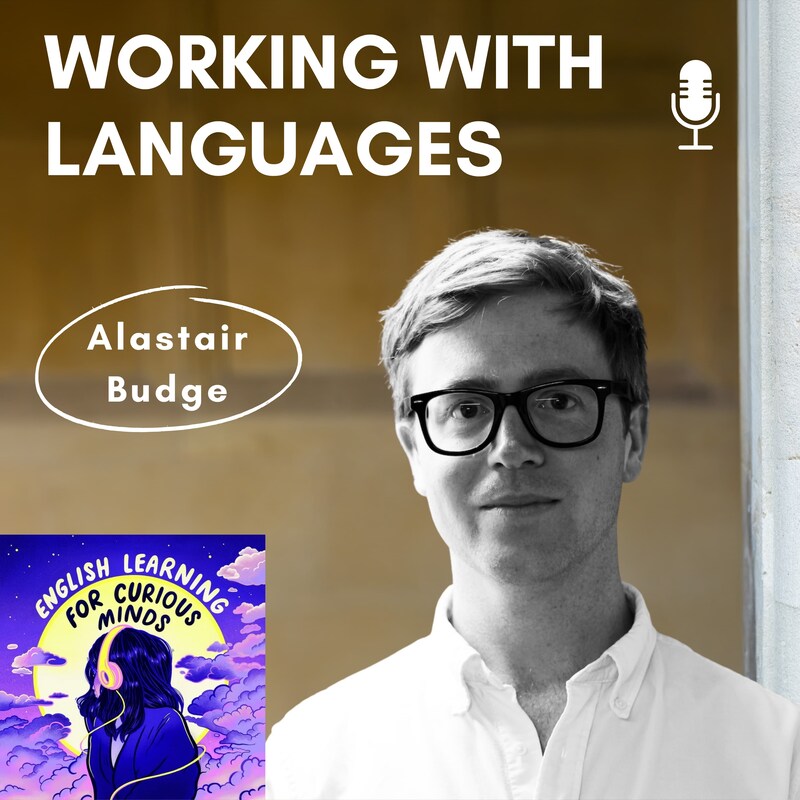
In today's conversation, I talked to Alistair Badge, who went from learning languages to now teaching English through his podcast, English Learning for Curious Minds. As he says himself, he never thought he would be working with languages. In only a few years, he built a community mostly of people coming back to the language who want to refine it and be able to speak it without starting again from the grammar books. They can learn through listening to his podcast and he also built tools that allow people to improve their English and receive feedback on it. Let's dive in.
Welcome back to the Working With Languages podcast. Today my guest is Alistair Butch. Hello, Alistair.
Alastair Budge
Hello, Sonia. I am thrilled to be here.
Sonia Kampshoff
It's great to have you here. I'm already looking forward to this conversation. Your background is so interesting. But first of all, as you know, my first question is always the same for all guests. What's your favorite word or phrase in a language that you speak?
Alastair Budge
So this is kind of a cheating answer, because I remember you told me to prepare this, and I'd forgotten a bit about the language that I speak, because I do have a favorite phrase in a language that I kind of speak. And that would be a phrase in Triestino, in the dialect from Trieste, which is, dito lo zotto lo.
Sonia Kampshoff
Okay, I went to university in 3S, but I don't know that. What does it mean?
Alastair Budge
I can imagine it's the kind of thing that you probably wouldn't need to know if you're a university student. And it is, it's what we call it in English, a seesaw, the toy that you have in playgrounds where one person sits on one end and the other person sits on the other end and you go up and down like that.
Sonia Kampshoff
And there's a word specifically for that in Cestino.
Alastair Budge
there is, which I, the reason that I mention it is because my wife's family comes from Tristina and they, you know, they speak obviously Italian, but slip into some Tristina words occasionally. And quite often I, I don't necessarily know which words are Tristina, which words are Italian if they are slightly more unusual pieces of vocabulary like that.
And I think I asked someone, another Italian friend who's not from Trieste, something about the Zittarozottola and they had absolutely no idea what I was talking about because literally like you, they didn't know what it was. it's, firstly, I think it's just a really nice, like onomatopoeic word. So it kind of has that idea of going up and down, Zittarozottola. And I think it's just a quite a fun thing that makes me think.
back to Trieste and the richness of the languages that are spoken in Italy, languages and dialects that are spoken in Italy.
Sonia Kampshoff
Yeah, I think it's also probably one of those words that maybe you're not necessarily aware of before you have children because, know, it's like a swing. Everybody knows the swing, but any other playground tool or equipment, you know, you get just you just get more familiar with it once you have children yourself. Brilliant. So you speak a little bit of Italian. You speak of
Alastair Budge
Indeed.
Sonia Kampshoff
a few languages. So can you tell us more where you come from first of all?
Alastair Budge
and and lived in the UK until:experience with learning different languages, some to relatively high levels, others, so dipping my toe in. So I studied languages at university. studied French and Italian first, and then I did a master's in Chinese studies and both of both French and Italian, I thought would never be particularly useful to me. was
far more interested in Mandarin. And it turns out that Italian has become more useful to me on a personal, not necessarily professional level, because I now have a sort of adopted family, I guess, from Italy via my wife. French is in the category of sort of, I can still read in French, watch films in French and so on, but I don't use it at all, really.
because I moved to Sweden in:Sonia Kampshoff
Very interesting. So a couple of questions on language learning here first. So you studied French and Italian and Chinese at university a few years ago. Did you find that when learning Chinese, which is such a different language when you come from a European language, did you find it, it was easier for you to learn it having learned other languages as well? And do you also find
Now that a few years have passed and you're learning a new language again, do you find it comparably easy or difficult?
Alastair Budge
So in terms of your first question, yes, I think it was slightly easier given that I had learned other languages before and also experimented with Russian and Latin and Greek as well. So it was easier once you have your own sort of slight rhythm and you understand that things take time and you have a kind of better idea that this is not impossible. I should also add a little caveat that my, you know, my Mandarin was never better than a sort of intermediate style, intermediate level, but you have this huge confidence boost when, when you go to China as, as a, um, like as a European or anyone who is non Chinese and you speak possible Mandarin, they sort of tell you that your Mandarin is fantastic and you're doing an amazing job.
Um, so that is a big, that's a big confidence booster. I think for me with learning Mandarin, I just found it far more interesting and easier to be excited about because I'd firstly, it was completely different. you and I'm sure anyone listening to this knows, whereas compared to French or Italian or most European languages.
Most people kind of look at the text and they won't understand it, but they'll probably be able to understand some words. They will be able to have some kind of a stab at pronouncing it. They will probably won't pronounce it particularly well, but it's not so completely inaccessible. Whereas to someone who has never learned any Mandarin, if they are presented with a text of Mandarin, they literally don't, they'd have no idea.
what it was about. They'd have no idea how to say any of it. It would be completely locked. And so I really enjoyed the kind of challenge of trying to unlock that myself. And we're not talking about translating, you know, Qing dynasty texts or whatever, but it's more like just being able to do something that other people were not able to do, or that most people were not able to do. That was a really fun thing for me to
Alastair Budge
get excited about, and I found myself being able to be far more excited about learning Mandarin than I ever was with French and Italian. So in terms of your question, yes, I found it easier, but I think I was, there was also more motivation, more intrinsic motivation to learn. And especially when you're at a lower level, I think it's, it's often easier to motivate yourself because you can see progress on a
almost daily basis, whereas once you get to a higher level of any kind of language, it's, it feels like the progress is slower because you're not mailing, you're not making those almost kind of daily breakthroughs. And it feels like you're sort of treading water. Sometimes it's been probably 15 years since I tried to learn a new language with any sort of regularity and.
I don't know if it's more difficult now. It's sort of hard for me to think about, about trying to recall vocabulary and stuff when I was, when I was, you know, but in my early twenties, I think now the difficulty is mainly time, which I know everyone says it's hard to find time to do these kinds of things, but it's probably only as a, as an adult, as a parent, someone
running their own business that you perhaps appreciate how much time you used to have when you were 20 years old and how much easier it was to, to, to find time to, to do the kind of things that you need to do when you're learning a language. So I have to try, I have to be a bit more methodical in terms of what I'm doing. And I guess also working now with languages, I have
got a bit better in terms of my own routines and stuff like that. So I don't necessarily feel like there is something that is wrong with my, you know, deeply wrong neurologically in terms of my ability to learn a language now versus, versus 20 years ago, but it is probably a little bit harder because of my other life commitments.
Sonia Kampshoff
Do you find that it's also different based on why you're learning a language, whether it's for professional reasons or personal reasons, whether you think you're going to use it in a professional settings, you know, for example, you with Swedish, you know that you will use it in your everyday life. Do you think that makes a difference?
Alastair Budge
Yes, I think it's, certainly makes a difference. If you have that kind of clear payoff of why you're doing it for me, there is really little reasons for me to do it professionally. the reason is purely from a personal point of view for being able to talk to the parents of my kids, friends, being able to go about my
daily life without asking people, you know, is it okay to speak English? Because there are, there must be tens of thousands of people in, in Sweden who do that and life is sort of perfectly okay for them. But I think integrating properly is, very hard if you do that. And it's something I don't want to do from a personal level. And I feel like there would be a great irony also on a
professional level if I was talking to people about learning languages and I wasn't actively practicing what I preach. So I think it would be harder if I was someone thinking, I like the idea of Swedish culture or I don't know, I like K-pop or whatever. And that's why I'm going to spend a bit of time learning Swedish on Duolingo or Babbel or whatever it was or watching Korean documentaries. I think it certainly helps to have that motive.
Sonia Kampshoff
Yes, can from the way you speak, I can tell that you do help people in a language in your case, English, and we'll get to that later on. But I think I can tell and I think the listeners will be able to tell that you spend a lot of time thinking about how do you help people learn English. And that is great. So you haven't always
I English though. So what was your first career out of university?
Alastair Budge
So I had quite a few different jobs, I guess. In my last year of university, I worked for a Chinese pharmaceutical company. Then I always sort of thought I was going to move to China and do something, do something there. I ended up working for a startup that was then acquired by a larger American company and then, then Avis, the car rental company.
So I started doing that in:But I got, I guess, a different, different type of bug or interest. And that was in the world of, yeah, the world of startups, entrepreneurialism and so on. And this was 2011. So joining a startup or small company like that was still a slightly unusual thing to do. I know that now it is, it is not, but back then, I think I was one of the
hat I started doing. That was:Then, yeah, I've now, I've been technically unemployed by someone who is not me since 2016. I think so 10 years, first doing a mixture of kind of consulting, contracting projects in marketing, and then also along the way experimenting with different entrepreneurial projects.
Alastair Budge
e of which did not. And since:Sonia Kampshoff
And is how I found you through your podcast. And I must say, it's brilliant. It's really, really good. It's the range of topic that you cover all about, well, mostly, you know, I think mostly about life in Britain and English overall. But the range of topics is amazing. And the details you give are very interesting. And you also speak with a of course, a very nice accent, also slow enough that non-English speakers can easily understand you. Yeah, I was listening to the podcast and I thought this could be a very interesting guest on my podcast. I'm very happy to have you here. Can you tell us a little bit more who your students are?
Alastair Budge
Yeah. So I think it's a real, it's a real mixture. I started this podcast. It's called English learning for curious minds. Really to scratch my own itch, really to try to solve a problem that I had had as a language learner, which is that once you get to a particular level, I think there's a lack of
interesting and authentic materials, especially in an audio format. I always liked listening to podcasts and kind of audio based learning. I always found that helpful to me. And I didn't see, I never found that in, French or Italian. And I looked for similar kinds of things in English because I thought these things must exist. But I couldn't see anything that
I thought was exactly the kind of thing that I would like. So I, I thought I would just make it and see if anyone listens. And if, if no, nobody listens, no one decides to kind of pay for the premium version, which I has. Then after three months, I will say, right, that's, that was fun. And that's a good experiment. And now I can take that off my list, but it's,
hasn't worked as I expected. And sure enough, people started to listen, people started to pay for it. And they're kind of, I guess there are various different reasons for people to listen. There are those people who are listening for more professional reasons. So people who want to improve their English primarily for, you know, better job prospects, whether that's
of switching careers or getting promotions or just generally feeling more confident at work and not necessarily talking about, you know, business English in the classic sense, but rather feeling the confidence to engage in small talk with colleagues about stuff that's slightly deeper than, you know, how was your weekend? Do you want to go for coffee? That kind of thing. So
Alastair Budge
That is, that is quite a large part of the people I see listening and the people I help. Another really interesting sort of category, I guess you'd call it of people who get value from, from listening to the podcast, people who are what I say, returning to English, perhaps in their
40s, 50s, 60s, 70s, we even have 80s and people in their 90s. And often there is some kind of life event that has meant that someone has thought, ah, actually, would be quite a useful thing to feel like I'm more comfortable in. And they are typically not particularly satisfied with the English education that they got at school and, you know, think back to their days in an English classroom and think, firstly, my teacher wasn't particularly good. Secondly, I didn't really pay much attention. And as a result, my English is not at a level that I'm happy with. And then they have often had, you know, a child who has
got married to someone who doesn't speak their language and suddenly they are forced to, you know, speak to them in what would otherwise be, I don't want to say broken English, but English that they feel unhappy with. Sometimes it's people who've retired and they want to do more traveling and they've realized that they want to, you know, that they want to go to places where their language isn't spoken.
And not being able to speak decent English is, is making their life hard. So that is another, is a really interesting sort of, I think, category of people, because often people like that don't necessarily want to go to a traditional English school. They don't want to be treated, treated, not necessarily like children, but kind of to go through that.
Alastair Budge
traditional system again. And they are, they have that intrinsic motivation to study. So they'll sit down and they'll listen to the podcast, they'll take notes, they'll follow the transcript, they'll go through all the vocabulary and so on. And I see lots of those people making fantastic progress. So it really is a variety of people. And I don't want to necessarily kind of pigeonhole people into one particular cat, one particular category, because I've seen, you know,
12 year olds signing up. I've seen people in their nineties signing up. think the, the one thread that unifies them all is that they, they have this innate sense of curiosity and they are sort of bored with traditional like English learning contents. They don't want to watch a video about, you know, grammar or like here are 10 expressions you need to know when you're
going on holiday, that kind of stuff. They want to be treated with the kind of intellectual respect that they deserve. And hopefully that's what they get through the podcast.
Sonia Kampshoff
Very interesting. Yeah, I was thinking also, know, when you especially when you come back to learning a language that you have learned before, you don't necessarily want to go back down on all the grammar stuff. But it's more about being able to speak really, and having an understanding of topics and subjects that may come up in any conversation. That's true. So you mentioned the podcast. Do you have anything else that helps?
People learn English, any other programs or...
Alastair Budge
Yeah, so I have a few like story based courses where people listen to stories over the course of 30 days and there in each chapter of the story comes with a lesson. We also do challenges in that have kind of paid subscription and people can join various different challenges throughout the year. At the moment, there is one going on called the learn English with AI challenge, which is quite fun.
So it's all about using tools like chat GPT to help you learn English, to help you create systems and, and so on for the purposes of learning English. And I really enjoy doing these kinds of things because it's through these things that I, that I get, like I get a sense of the, of what people are really struggling with. So for someone in in my position, perhaps it's very easy to assume that lots of people are using ChatGBT all the time and they are familiar with how to do things that I might think are relatively obvious. But for lots of people, don't have that level of familiarity.
So it's been fantastic to see how appreciative lots of people are when they are taught something in kind of clear, but not sort of in a clear way, but without someone talking down to them. think that's what I always, what I try to do is just explain things clearly and treat adults as adults, of course. And I think people appreciate that. And one other thing that I've I'm sort of, I've half launched, kind of launched is this new feedback and corrections tool.
Which is called fix my English. So I, I, I'm always asked for feedback on people's written English and people want corrections, which is completely understandable. Everyone wants to know how they're doing. They want to get a score. They want to understand what they did wrong. And in my experience, tools like, you know, Grammarly or spell checkers, things like that. They.
Alastair Budge
get clearly very good at fixing your mistakes. So you can put a grammatically incorrect piece of text into Grammarly, it fixes it fine. But the missing part, I think, for the purposes of learning is that you don't really get explanations about what you did wrong. You can't really track your frequent mistakes and so on. So why I tried to do with this tool is
recreate the experience that you might have if you had a really patient tutor who would mark your work and kind of cross out bits and say, you know, Sonya, the reason you keep on using this, this proposition is because of like L1 interference, whatever, and suggests to you that it helps you categorize your mistakes, helps you understand them so that you don't make them in the future. So that tool is still kind of under development, but it's live to the public and the feedback has been really good so far. There's like hundreds of people using it every day, which is great. So I'm quite excited about where that might go.
Sonia Kampshoff
Amazing. And this is a tool that you developed yourself or your company. Did you develop it with AI?
Alastair Budge
Yeah, not completely with AI, but AI assisted, I guess.
Sonia Kampshoff
Very interesting. That makes so much sense, not only correcting, but explaining the correction. And going back to the challenge, you mentioned you're doing a challenge at the moment. Can you walk us through it? What are you asking people to do?
Alastair Budge
So I've done quite a few different challenges and we offer around five different challenges, five or six. It'll be this year, every year. And they all tend to focus on different things. So there are some when they're, for example, those challenge we did last year where it was all about learning English through kind of great speeches from history. The one that is going on now is
This one mobile focusing on learning English with the help of AI. So it's going on for four weeks. There are eight different sort of lessons to it. So every week on a Monday and a Thursday, there is a new lesson that is released. And the idea is it's, it's a kind of course really, I guess they were originally called challenge challenges, because the idea was you challenge yourself to do something.
You could call it a course, I guess. But over the, these four weeks and eight different lessons, I essentially taught people through different functionalities and different ways that you can use chat GBT in this case, to help with your English learning. Of course, any of the stuff that I talk about could also be applied to, to any other language. But in this case, everyone is learning English. So that's what we're talking about.
And it's like, like any course, it sort of builds on each lesson. And so there's stuff about, you know, creating your own corrections log documents, using AI to help you rephrase, not rewrite your, your text and so on. So with that, I essentially, what I do is I record a lesson. So it's 20 minutes or so of me explaining what we're going to talk about, walking people through showing my screen often showing the, you know, the, the iterative process of chat GPT giving you something you're not quite happy about. And so how do you, how do you move forward with that? And yeah, that only started this week actually. So we're, we are early into it, but I ran it one time before last year, it was super popular and, I'm doing it again. Of course I had to.
Alastair Budge
remake all of the content because AI is very different now to how it was 12 months ago. So there's a lot of people who took the challenge last year, came back to do it again. And I think finding it very useful because it's updating people on what they might've missed over the past 12 months. And it's been great to see because already people are like, getting a lot of value out of it.
They're talking about how they are starting to use it. And I got a few messages from people who took it last year and I've come back to take it again this year, talking about how they basically continued doing what I had taught them to do last year. They continued doing it for a year and what they done. So what I'm trying to do with these is not necessarily to hold people's hands and to give them, you know, give them very detailed lessons and to sort of talk them through everything they need to be doing to try. I'm doing instead is trying to kind of explain how I think about it, how they can use it as well, and sort of show them the power of what can be done. And then they, they take it from there.
Sonia Kampshoff
Brilliant. That sounds really good. And how do you come up with ideas for topics for the podcast or challenges and so on?
Alastair Budge
So in terms of ideas for the podcast, I mean, I've got a massive list of, I'm just going to look now. Let's see how many I have, but I have a big backlog of stuff. I've got 548 ideas in my backlog of episodes that I have not got around to making yet. Really, if there's anything that I think is kind of interesting.
that I am, I've read about something or I have kind of gone down some kind of rabbit hole on Wikipedia or whatever. I would just add it to that list. And it's often in the research for one episode that I will stumble across something else that I think could be interesting. you know, researching one episode might lead to three new ideas.
And I also get quite a lot of requests from people for ideas for episodes. Some of them I will do almost immediately because they're just great ideas that are perhaps timeless. Often I get requests from people that want sort of almost like immediate commentary on current events, which I don't do because I want, firstly, I don't feel qualified to be able to give that kind of commentary about whatever kind of topic you might imagine that is currently going on in the world. I don't feel like I'm qualified to provide some kind of opinion on that.
Plus, my idea behind the episodes is to make them as timeless as possible so someone can go to the list of our episodes and they can find an episode about Henry the eighth and that is as relevant now as it was five years ago. You know, not much has changed in terms of our understanding of his life. Whereas, uh, if I was to do stuff about current events, that would very quickly become outdated. And a few times, actually, I have done episodes that I've had to rewrite and rerecord because
Alastair Budge
in the time between when I've recorded them and they've been edited and stuff and the time that I was planning to publish them, something important has changed about the subject matter, which is really annoying. So I try to avoid choosing subjects where that might be the case.
Sonia Kampshoff
Yeah, that's the downside of current events. They keep on evolving as opposed to history where new findings about historical events are fairly rare. Indeed. And how many episodes do you have now on your podcast?
Alastair Budge
This morning I was writing, I think the 607th. So currently available, I think as of now it's going to be 590 something. But there are quite a lot.
Sonia Kampshoff
Wow.
And it's one episode a week, isn't it?
Alastair Budge
So yeah, I have a kind of freemium model, I guess, where there is one episode that is released every two weeks on things like Spotify, Apple podcasts, and YouTube. And I have a membership which allows people to get an extra one. So there's an extra one every week, or rather, sorry, one a week. So an extra one every two weeks.
Plus also gives them access to stuff like interactive transcripts where you can hover over harder words and get definitions. You can also translate the transcripts into your language, study packs, challenges, and so on.
Sonia Kampshoff
Brilliant. Yeah, I remember looking at your transcripts and thinking it makes so much sense for someone who is learning a language to be able to follow in writing what is being spoken. That's a brilliant idea. Do you have of the people who listen to your podcasts and are part of your memberships, do you have any geography or language that is most dominant?
Alastair Budge
So Southern Europe, think is the most dominant area. So Spain, Italy, France, I guess doesn't really count as Southern Europe, but France. And then it's also very popular in Germany and Poland, China, Brazil, Japan, Saudi Arabia, some of the other main countries and Turkey.
Sonia Kampshoff
Okay, very nice. So with Europe, but not only.
Alastair Budge
Yeah, I think to anyone, anyone working in, in like English tuition, the English language industry, that probably won't be much of a surprise to hear those countries. But yeah, those are the those are main ones.
Sonia Kampshoff
are the plans for your company, your English learning company for the future? Do you think you will continue with the courses and challenges and the podcast or do you envision something different, something in addition to that?
Alastair Budge
Do know what I'm just going to say? I don't know because I, I've, I've been in companies that have very large plans and ambitious things for the future. And sometimes those work and sometimes they don't. And I think there's always a lot of room for disappointment when they don't, when things don't quite happen as you, as you plan. And I've also been in that position myself in terms of trying to figure out like, what's the best thing to do for, for my company.
At the moment, I'm just concentrating on making the best episodes that I can in terms of spending much more time researching and writing and trying to just produce things that people will tell their friends about, that English teachers will recommend to their students because it's one of the main things that I'm told that my teacher recommended me or I heard about you from a friend or so on.
So I think that's, I think I underestimated the power of that, of just creating something that was as good as I possibly could make it. And I'm also very interested in building more kind of tools to help people with their English journey. Like I've, I've had enough experience now, I think.
Talking to people from all over the world and understanding the kind of problems that people have with improving their English and understanding the kind of tools that people like to use that I think I'm in a better position than most people in terms of being able to build things that will be helpful. So this fixmyenglish.ai is one of them. And I've got quite a few ideas for other things that could help.
So I mean, my, business at the moment is, yeah, it's tiny in the grand scale of things in the grand scheme of things. Sorry. And I'm not under any illusions that I'm trying to build the Duolingo or whatever, but if I can build something that is helping tens or hundreds of thousands of people across the world, and it changes their life in.
Alastair Budge
even a very small way, then that is something that makes me happy.
Sonia Kampshoff
Brilliant. Has there been anything that surprised you positively or also negatively as you developed your business and your products?
Alastair Budge
I guess lots of surprises. So in terms of positive surprise, I, um, I'm always just kind of blown away by how motivated some people can be. It makes me feel like I am not doing a good enough job sometimes with my own language learning, but when people will send me details of what they're doing and how they're using the podcasts and so on, I think it's, it's absolutely brilliant. I'll tell you one.
One thing that I found really surprising, actually, this is going to be my surprising thing because this is a better, better answer to the question. A few weeks ago, I got an email by a, an email from a Spanish teacher living in Germany. I think it was in Berlin. And he said that he listened to the podcast. I'd been listening for a while and he thought, do you know what I could do the same thing for Spanish?
And I used to get lots of emails from people saying, you know, Alistair, I'd like to this for Spanish or French or German or Mandarin or whatever. Like, can you, can you help me do it? Or can you give me some advice on what to do? And I would always, I'd respond and be as helpful as I could possibly be. But my general conclusion was just start, and then you'll see if you want to continue with it.
It's no use me giving you the kind of perfect blueprint or plan. Firstly, I don't have it. And secondly, even if I did, then there's still a lot of work for you to, to build something that is meaningful. And this, this man had actually just on his own had just gone and created this really good Spanish podcasts. And I'm sure you're going to ask me the name and I've forgotten the name. So I'm going to look at, look up the name now so I can tell you what it is. And anyway, he emailed me to say, can I thank you for this inspiration? And he also suggested a little collaboration. So a fun thing that is going to be released in early April, I think, is that I've taken one of his episodes that he, he made an episode about the, that flights, the Uruguayan flight that crashed in the Andes.
Alastair Budge
And so I basically taken his episode, rewritten it a little bit and published it as an episode of English learning for curious minds. And he has done the same thing for his posts, for his podcast about an episode I made on the disappearance of Lord Lucan. So that's quite a fun thing. And it was a really nice surprise to, to receive that email. So his name is Javier and his podcast is called Radio Ele. So if you want to improve your Spanish, then go to Radio Ele.
Sonia Kampshoff
So nice. I was actually thinking that maybe you could find a way of doing it for Italian or find someone Italian to do it for Italian. But yeah, Spanish, you know, mean, any language really. That's amazing. Really good.
Alastair Budge
Yeah. Yeah. And in terms of your question about what has negatively surprised me, I think I didn't really appreciate how difficult it was to continue to grow a podcast. so it's, it's a kind of, it's an unusual medium and compared to a YouTube channel or traditional
website-based businesses, apps, and so on. think it's a lot harder to sort of measure what is working and what is not. So I didn't quite appreciate that at the start. And on one level, it's a little bit frustrating because with my, you know, with my marketing hat on, it would be nice to be able to think that there were more things you could do to grow a podcast.
And kind of better ways that you could figure out what was working and what wasn't. But the flip side of this is that it gives you, I think more sort of flexibility just to focus on making the best possible podcast that you can make without worrying all the time about what your downloads were or how many new paying members you've got because
You sort of know that if you continue, you know, pushing the ball in the right direction and that you continue to make good episodes that people like to listen to, then it will, but it will continue to grow. But that growth will probably not be as linear as it might be if you were doing something else.
Sonia Kampshoff
Brilliant. Do you have a team that helps you doing things that maybe you're happy outsourcing or that you feel you are less good at or not the best use of your time?
Alastair Budge
Yeah. So I have a editor who edits episodes and also have a teacher who creates the all of our vocabulary and study packs. I've experimented with various other people doing other things for me, but now that's the, yeah, that that's the only two people I have currently working with me. And I also tried to find people who could help write episodes but have completely gone back on that because it was something that I just never found anyone who I thought was able to write in a kind of tone and style that I thought was true to me. And I think what I've realized now is that that is the of core of what people want. And if they used to my, my writing style, my way of presenting and so on, then trying to change that would be a silly thing to do. And also I found myself trying like constantly going back and forth over people's corrections. And it was actually taking much more time to correct someone's work or correct is probably the wrong word because I'm not saying that what they were doing was wrong, but rather that
I didn't feel it was true to my style. to change what they had written to fit how I thought it would sound, would take longer for me to do that than it would for me just to do it from scratch. So now I am back to writing, reviewing, editing everything myself.
Sonia Kampshoff
Is there anything else that you would like to add that I haven't asked you?
Alastair Budge
I don't think so. mean, the main, I think my main takeaway in terms of the title of your podcast, you know, working with languages is that I never thought I would be working with languages at all. And for many years of my career, I didn't, or didn't in any kind of meaningful way. I think languages will always be something that
people can come back to and that can be useful for people in the future. think there's lots of things that learning a language teaches you that are probably harder to measure. And especially if there are lots of native English speakers listening to this, I think it's increasingly rare that there are people in your position who also speak foreign languages.
because there's this assumption that everyone will speak English as I'm sure any, anyone living in France or something, he's used to loud English people coming up and demanding, you know, a pint of beer or whatever that they'll be all too used to. So my, my thing to leave people with, I guess, is that languages can be very useful, even if it feels like they might not be useful to you now.
Sonia Kampshoff
That is brilliant that you say it because that is exactly what I'm aiming to do with a podcast is to give really a the widest possible array of work and jobs that people have and can have with languages and to make people understand that there's very different ways of using language in the work that you do. And yeah, thank you. I couldn't have said it better than this.
Alastair Budge
Well, thank you very much for inviting me on and giving me the chance to tell my language story.
Sonia Kampshoff Yeah, thanks for coming. Thanks a lot. And I will put all the links to podcast website and so on in the show notes.
Alastair Budge
Thank you so much, Sonia.
Sonia Kampshoff
You can tell that Alistair understands how to learn a language and also how to teach it. More than a teacher, he comes across as a guide, helping people enjoy language learning with intellectual respect for his students. And his personality comes across all of his materials, showing how one can build a successful business around languages.
If you enjoyed this episode, please give it a five-star rating on Spotify, Apple Podcasts or any other platform where you listen to your podcasts. And if you have a question, do let me know in the comments below.

