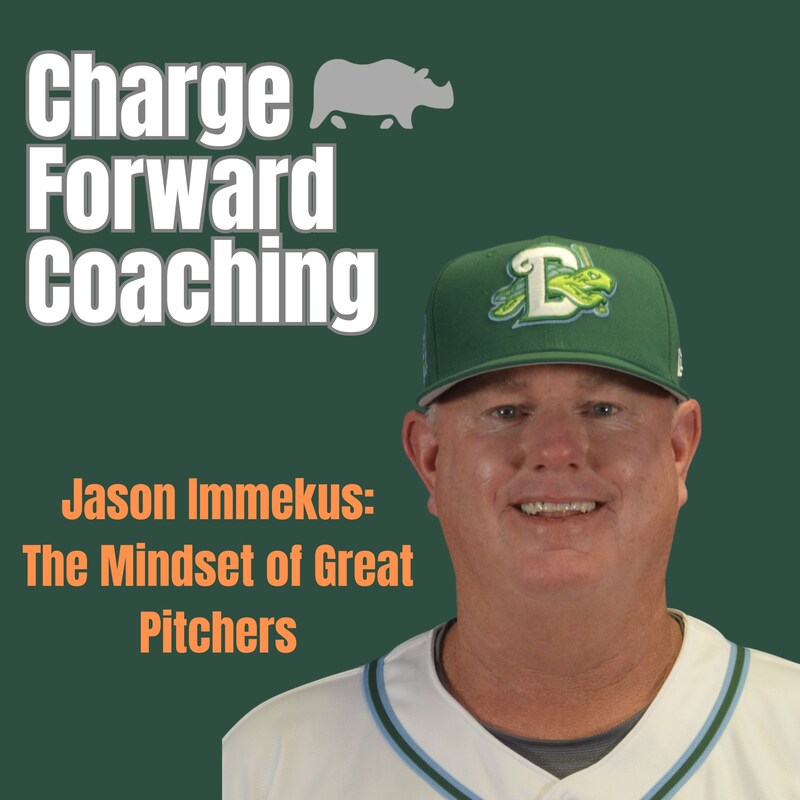
Shownotes
In this episode of the Charge Forward Coaching Podcast, host James Blasco interviews Jason Immekus, a minor league pitching coach with the Cincinnati Reds. They discuss the mindset of great pitchers, the importance of mental toughness, and how routines and rituals contribute to performance. Jason shares insights on coaching young athletes, preparing for big moments, and the sacrifices required to achieve success in baseball. The conversation emphasizes the need for a supportive environment that fosters growth and resilience in athletes.
Takeaways
Mental toughness is about staying focused on the next pitch.
Coaches must show they care to build trust with players.
Young athletes face more distractions than previous generations.
Mental toughness can be developed and sharpened over time.
Routines and rituals are crucial for performance but must be adaptable.
Creating a safe environment allows athletes to learn from failure.
Handling conflict positively is essential for growth.
Parents should model consistent behavior for young athletes.
Success in baseball comes in many forms and styles.
Aspiring pitchers must be willing to sacrifice for their goals.
Chapters
(00:00) Introduction to Mental Toughness in Pitching
(06:29) Understanding the Mindset of Great Pitchers
(11:41) The Role of Routines and Rituals in Performance
(17:29) Building Mental Toughness in Young Athletes
(23:46) The Importance of Adaptability in Pitching
(29:22) Advice for Aspiring Pitchers
About the Guest:
Jason Immekus is a veteran pitching coach and consultant with over 19 years of experience developing athletes at the collegiate and professional levels. He is currently a Minor League Pitching Coach for the Cincinnati Reds, (Daytona Tortugas) where he works with emerging talent to refine mechanics, build confidence, and prepare pitchers for the big leagues.
Before joining the Reds, Immekus built a distinguished coaching career across multiple programs:
Crowder College (2018–2021): Guided pitchers and contributed to team success in the NJCAA ranks.
Pittsburg State University (2016–2018): Helped lead the pitching staff to its best statistical performance since 1997, contributing to postseason qualification.
Missouri Southern State University (2010–2015): Coached an MIAA Pitcher of the Year, six All-MIAA pitchers, and advanced to two NCAA Regionals.
Jefferson College (2006–2009): Served as pitching coach and recruiting coordinator.
Immekus has also worked extensively in collegiate summer leagues such as the Coastal Plain League, Northwoods League, and Mink League, where he mentored players who went on to professional careers. Over his career, he has helped develop more than 60 pitchers who signed professionally, including seven who reached Major League Baseball.
In addition to his coaching roles, Jason has served as an Associate Scout for both the St. Louis Cardinals and Tampa Bay Rays, bringing his expertise in player evaluation to MLB organizations. He also contributes as a Pitching Coordinator and Consultant for Premier Pitching Performance, where he designs individualized throwing programs and connects advanced data analysis to on-field success.
A native of Carthage, Missouri, Immekus began his playing career at Independence Community College before transferring to Washburn University, where he was an all-conference pitcher. He later signed a free-agent contract in the Frontier League, playing for the Richmond Roosters and Kalamazoo Kings.
About the Host:
James Blasco is a CTA Certified Coach, and a Certified Functional Mental Toughness and Resilience coach, and a Certified Neuroscience Coach based in Ormond Beach, Florida, with a rich background in sales, media, and entrepreneurship. Throughout his career, James has excelled in sales and sales coaching for some of the largest media companies, owned three successful businesses, and worked in media relations in the NFL. His diverse experiences have equipped him with a deep understanding of leadership, communication, and the drive needed to achieve success. James is also trained specifically to coach to all aspects of mental toughness and resilience.
Having received coaching and mentoring throughout his personal and professional life, James recognizes the profound impact of genuine, constructive, and meaningful guidance. He understands the passion required to pursue a goal, as well as the challenges of doubt, fear, and the need for perseverance.
Resources:
Website: www.chargeforwardcoaching.com
LinkedIn: https://www.linkedin.com/company/chargeforwardcoaching/
Facebook: https://www.facebook.com/ChargeForwardCoaching/
Instagram: https://www.instagram.com/chargeforwardcoaching
YouTube: https://www.youtube.com/@ChargeForwardCoaching
Spotify: https://open.spotify.com/show/ChargeForwardCoaching
Apple Podcasts: https://podcasts.apple.com/ChargeForwardCoaching
Cincinnati Red: www.mlb.com/reds
Daytona Tortugas: www.milb.com/daytona
Transcripts
Hello and welcome to another episode of the Charge Forward Coaching Podcast. I'm your host, James Blasco Today we have a great episode. You know, the World Series just ended and it was a heck of a World Series. One of the best in a long time. And you know, any baseball game, especially World Series and big games, the most important person on the field typically is the pitcher. And I've always been so curious as to what is the mindset of a great pitcher in the biggest moments on the biggest stage? Well, today we have a minor league.
pitching coach with the Cincinnati Reds and he is here to tell us how the mind works for these great pitchers. Welcome to this show Jason.
Jason Immekus (:Thank you, thanks for having me.
James Blasco (:Absolutely. So before we get into ⁓ understanding the mindset of great pitchers, why don't you give us a little bit of your background and what you're doing these days.
Jason Immekus (:Yeah, so I just completed my first year with the Cincinnati Reds. ⁓ Before that, I worked at a private facility ⁓ in the biomech realm where we did assessments, full body assessments on pitchers from the high school to professional level. ⁓ Before that, spent 16 years ⁓ or so coaching at the college level at some Division II schools and also two junior colleges. So been very fortunate to be in the game as low as I have. Grew up in Carthage, Missouri. ⁓
down in the southwest corner, very proud of where I'm from. And from there, I went to junior college in Southeast Kansas and then Division II school, University of Washburn in Topeka, Kansas. And that kind of led me into independent baseball for a couple of years and led me into getting involved in the scouting side as an associate scout, which is more of a support role for the area scout. And then that's kind of very fortunate to have been a part of the game as long as I have.
James Blasco (:Yeah, absolutely. And one of the things when I was doing some research and looking up your background, I know you've helped send several pitchers to the major leagues and you've just seen the best and maybe the worst in some pitchers and obviously have coached them through that. What would you say, we'll start with this, this episode and this podcast is always about mental toughness in some way, or form. What would you...
Jason Immekus (:Mm-hmm.
James Blasco (:How would you define mental toughness in a great pitcher?
Jason Immekus (:I think it's the ability to stay on task or complete the task at hand, which is the next pitch we talk about. And we're not the only ones. Like a lot of people through time have talked about that next pitch mentality, right? Like, regardless of what happens, if it's a great pitch, hey, good job, you did your job. Now let's make the next great pitch. If it doesn't go right or doesn't go your way, you can't let that influence. ⁓
simply can't let that influence what happens on the next pitch regardless of the prior outcome. So it becomes more of a pitch to pitch, but very small events, controlling the things that you can control and having the ability when the game speeds up and it gets loud, the crowd gets going, the opposing dugout gets going, having the ability to continue to do your job.
James Blasco (:Yeah, and just so know, you may not know that you're talking to a great little league pitcher here. I was a sidearm pitcher. I was pretty good. I think that's as far as I got little league all-star team, but I loved it. I did enjoy being a pitcher, although it could stress you out. So when you start working with a pitcher, say for the first time, what are some of the things you see right off the bat? Typically that you go, okay, we, is something we need to work on.
Jason Immekus (:Yeah, baby. Yeah.
Well, I think ⁓ it's important to kind of see and you could tell a lot by how a guy gets ready to go about his business. ⁓ Say you're in a setting where you're like you mentioned the first time watching the guy throw it under that being a bullpen ⁓ setting or an indoor setting, whatever the case may be. ⁓ You know, watch how he gets ready. Is he, is he very attentive to detail? Is he, you know, kind of like locked in like,
You know, just like quiet headphones and music rolling. Is he kind of like joking around with guys? ⁓ is he talking through his warmup? You know, ⁓ different, different things, get different guys going and it's about finding what maybe gets you to that point to perform at your peak. So, just kind of pay attention to those things. And then like how it goes about his business and that, that pre-pitch set up. then, ⁓ as he begins to throw up, it's a.
If it's a good picture, a bad pitch, how does he respond? Is he displaying negative body language, positive body language, too emotional, too up and down pitch to pitch? then obviously that's when you're working with somebody, I'm a firm believer in they have to know that you care before they care what you know. And I know that's a very cliche thing to say, but
The longer that I'm in the game, the more important I realize. And also, you know, one thing we're missing is these kids, by the time, ⁓ you know, they get to a college or professional level where I have worked with a lot of guys, like they've had a lot of coaches, you know, they've been coached up, coached down, coached sideways, you know, whatever, like they've been through a lot of coaches, ⁓ which can lead to a whole nother set of issues. But ultimately, like, I'm not going to start.
chirping in on, you need to do this or you need to try this. It's more about like watching that pre-pitch routine, the pre-game routine, how they get themselves ready. And if it's a good bullpen kind of make a mental note to myself, like, Hey, that's the guy that like can kind of talk and laugh and joke through it. Or that's the guy that needs to, you know, be listening to music as they get going to get them in that state of mind where they're ready to compete as well as they can. If they, if they are doing their pre-pitch, you know, pregame warmup, what have you.
and it doesn't necessarily match up with the results we want, then through time that becomes a discussion about preparation and setting yourself up for success.
James Blasco (:Yeah, that's so interesting, you're right. They have to understand that you do care, that you have a genuine interest in helping them in their career and pursuing the goals that they have, so that's perfect.
Absolutely, and I know you did some work ⁓ with a lot of analytics, metrics, things like that. I found that really interesting. You wrote a brief article on that. We'll get to that in just one second.
So to that point where these players, have a lot of different coaches and you have to work them through the good and the bad of where they're at right now when you start working with them. The younger kids, and I know you work with lot of them, do you see a difference now in their mindset in terms of they're actually stronger, they have a little bit more mental toughness than maybe in the past where these kids weren't getting any kind of performance coaching or feedback in that way?
Jason Immekus (:Yeah, I think to lump everybody into the same category would not be good. I think that there is good and bad. you know, face it, kids today, and when I say kids, you're talking, you know, 10, 11, 12, 13, 14, know, through early high school, what have you. Those guys have it tougher than we did growing up, you know, with all the things, all the distractions in the world. So some of the things that they have to deal with are things that we didn't have to deal with quite frankly growing up.
So you see, you see both. don't think kids have changed overall when you really get to know a kid. I think they're very similar to I was growing up. I'm sure you were growing up and our fathers and grandfathers, et cetera, you know, they still have the desire to please people and they still want to be successful in whatever it is they're trying to do. I think what has changed are all those distractions, like I mentioned, and sometimes that gets to be a little bit tougher and we need to be understanding.
I think at times we get mental toughness mistaken for just toughness. Like we're not trying to fight a guy in the parking lot after the game tough. We're like trying to handle our business tough, so to speak. ⁓ you know, I think it's, I think there are kids that do a really good job with it. And I think there are guys that could definitely use a lot of help and it doesn't matter if you're 12 or 22. I think both cases show up in those age groups.
James Blasco (:Yeah, you nailed it. It isn't about being that macho tough. It's really a spectrum of mental toughness, mental sensitivity in a lot of areas for folks who have tuned in before to the podcast or have been on my website or worked with me. know I really zero in on the four C's of mental toughness that are commitment, control, challenge, and confidence. And confidence is one of the big ones. when I think of Yamamoto in a world series,
Jason Immekus (:Mm-hmm.
James Blasco (:and how dominant he was, like crazy dominant. Do a lot of these pitchers have that type of confidence coming into whatever stage they're at or is that something that has to be built?
Jason Immekus (:Yeah, I think mental toughness is very similar to like the overall body, right? Like if we want to stay in good shape, ⁓ we work out, we do things that allow our body to get challenged and maintain a level of fitness, whether that be like a throwing fitness off the mound or it's a weight room type fitness, full body fitness for a different type of athlete. ⁓ I think mental toughness is something that always can continue to be sharpened and should be something that is discussed.
⁓ and talked about daily. ⁓ I think that everybody at a certain level is pretty good, right? So then what becomes that separating factor? And oftentimes it's the guys that can really execute ⁓ when it gets loud around them. Like we mentioned earlier, ⁓ when there's traffic on the bases, when the crowd's getting loud, when everybody in the ballpark doubts you, have to have the wherewithal to slow down.
catch your breath, refocus and execute that task at hand. And the guys that have the ability to do that are the ones that show up in those bright lights, right? When everybody wants it. There's a lot of very talented pitchers. I think now more than ever, the game is better than it has been. I think guys are bigger, faster, stronger. I think with the evolution of all the technology that we have in our game now, it allows guys to get better earlier. So they're more dialed in on the mound.
So then at some point you have to separate yourself and from what I have seen through my experiences as the guys that are mentally tough ⁓ are guys that work on those things and challenge themselves. So as leadership, whether it be coaching ⁓ per se, player development, ⁓ parents, I think it's important as us as leaders of helping ⁓ shape and create mental toughness and.
you know, those skills of mental toughness in. I think it's important to create an environment that allows those kids some freedom of vulnerability, like they can screw stuff up and not just get pummeled for it, ⁓ you know, then becomes a learning point. And to my point on that, I think one of the biggest factors that that I was always able to maintain some mental toughness through my days of playing and coaching, and even in my personal life was I knew growing up like, you know, hey, if I went out
As a player and it doesn't matter if it's high school college You know, let's talk about Little League specifically here when I was young if I had a great game say I went two for two three for three and struck out a bunch of guys when I was pitching like I went home and did chores and we had supper if I had a horrible game It was go home eat supper do my chores, right? There was no there was no I never felt loved or I never felt like oh man I better do good or I'm gonna get screamed at like
When you create that kind of environment, it just becomes pleasing people and making somebody not yell at you. And so with that split focus, that becomes a little too much for most people to handle regardless of age. So creating that environment of vulnerability and allowing kids to fail and challenging them, to have the opportunity to fail and then go back and learn from that and understand the big picture of everything.
James Blasco (:You're so right and working with athletes and for a long time I've worked with professional salespeople, sometimes other folks that are leaders or coaches or whatever, they don't want to allow that failure and they want to use it in a negative sense thinking it's going to inspire or drive somebody but you're right. You got to use it as a learning experience and you got to develop your skills from there. I tell people all the time, hey fail as fast as you freaking can please.
so you can learn and get even better faster. So yeah, real fast. So I'm a big believer in routines and even rituals. And since I was young, I always have a routine, my daily life, my work life, and even ritual, I have some rituals, I'll bring them up here, some things I do that I believe in. But when you were a player and now as a coach working with a player, how important are routines and rituals in top performance?
Jason Immekus (:Felt fast. Yep.
Yeah, think two things. I think they are very important. ⁓ And we all know baseball seems to be a superstitious or very ritualistic sport. ⁓ I do believe ⁓ it is important to know what your routine is, right? Like to know what I need to do to set myself up for success ⁓ as a player goes into pitch, right? Like, and kind of like be aware of that. And we encourage guys and have for a long time to journal. Like, hey, this is what I did pregame. This is what time.
And then, you know, kind of mark that date and then, you know, go back and see ⁓ if you can start like, hey, I didn't do this that day and I wasn't very good that day. ⁓ You know, and start drawing on some of their own experiences because as soon as you can, you know, personalize it and make it customized to what that person really needs, because everybody's a little bit different, right? Like, like some guys need that, that headbanger, you know, music to rah rah rah. And some guys just, you know, need to.
to chill out and kind of be relaxed. it's like the old saying, you know, got to be at peace with yourself before you go to war. understanding what you need to do one, but here's the other side of that, that, that I believe also you need to be mentally tough enough to know that like, if, especially in baseball in Florida and Daytona, it rains every day, right? So you might have your normal ritual. I'm going to do this, this, and this at this, this, and this time. Well, guess what? We're in a two hour rain away. So.
⁓ That doesn't give you the built-in excuse to not be successful and not go compete at your highest level It's you have to adapt and adjust and I think that's also a big part of ⁓ mental toughness is the ability to have to You know change course quickly and still be able to perform at your highest So what what we like to do with guys? Regardless of level I've been at is hey, what's my best routine? and then what are the essentials that I need to do if my time constraints or
You know, hey, the bus broke down on the way to this game or I don't have everything I need necessarily. Maybe, maybe forgot something that I normally like, you know, one of the plow balls that I throw before a game. I don't have that one. Well, that doesn't give you the excuse to not be successful because then it's all of a sudden, well, I didn't do good because I didn't do this or this. That's not necessarily the case. It's more of a state of mind that you're getting yourself into. So having that ability to be mentally tough, to adjust that routine if need be.
But I do like the consistency of a good solid routine.
James Blasco (:And I have sat through my share of rain delays ⁓ here in Daytona. That has happened a lot in the summertime down here. ⁓ So I'm glad they're expanding. They have all the food and beer stands, plenty. ⁓ So we talked a little bit about Little League, touched on parents and things. I know every Little League, or at least most of them, they have a dream, you know, get into the major leagues and stuff. And we know that's a really challenging thing to do, but it's a great goal.
Jason Immekus (:Yeah, I have as well.
Yeah.
Yeah, for sure.
James Blasco (:For a parent who has someone in Little League and maybe they're one of the best kids out there, how should they be working and coaching and dealing with those kids at such a young age when they know they see the talent in them, but they also know that every level is going to get tougher?
Jason Immekus (:For sure. I think it's ⁓ kind of the summation of this whole podcast in a sense, right? Like it's creating that environment of being mentally tough and understanding that it's not going to always go your way. And that environment of vulnerability where like, if you don't go out there and have the best game ever, like you're going to hear about it in the car ride home. know, I think there's something to be said for, you know, we talk about consistency and behavior and routines like
I think that us as leaders, rather that be a parent of a little leaguer or somebody in player development, college coach, whatever, I think that our behavior needs to be the model of consistency. Our behavior needs to be the one that kind of shows them by example, like, hey, you can go out and like two of your three innings were really good and one of them wasn't. I'm not going to crush you over the bad inning. I think you let that, you know, player, especially a younger player.
have the freedom to understand like it's okay. Like if it was that easy, we'd all be doing it, you know? And I think, you know, one thing we can do, and this is a little bit of a broader topic, but I also think it's a very big piece of this discussion is like, you know, we have this generation where you see these guys that have played on five different travel teams or they're doing all these, you know, ⁓ well, we're not happy with, we're not getting enough innings. We need to...
We're going to jump teams. we didn't like this here. Somebody's parent made us math. You know, what are you really teaching somebody other than to run from any kind of engagement where it might not be like the most peaceful environment, right? You're not teaching them to in the way that I would say that you're not teaching them to handle their business, right? Like you've got to deal with, with conflict in a positive way and not just continue to avoid because at some point you're going to get to a spot where if you want to continue.
you're going to have to struggle through something. And I think what a better platform to do that than rather it be travel baseball, little league baseball, ⁓ a high school situation where you're not getting your playing time that you deserve. You know, it doesn't need to be a parent phone call. needs to be a player walking in and respectfully, hey, what do I need to do to get better? And I think when you do that as a parent, you're teaching your child to handle those conflicts and come to some kind of, you know, resolution.
Now, they might not like what they hear, but you know what? We all got problems, right? So we all have to work through those things. And you're just building a skill set, whether it be baseball or business down the road of how to handle it instead of just running and hiding from everything. And that's something that as a recruiter, ⁓ people are looking at that like, this guy played on seven different travel teams. ⁓ Maybe that's a red flag for some, right?
James Blasco (:the effort.
Little League World Series in:in that World Series game watching them say, how did they look like they're having fun? They played hard. How in the world did you get young kids to do that? And he said, man, he goes, we practice so hard. I challenged him so much that when the game was there, it was going to be fun. And I told him that and it was fun. So when you're working with a pitcher and you know, some big moments are coming up. you, how do you practice for that? How do you prepare for that?
Jason Immekus (:Mm-hmm.
I think it's a, again, a kind of a continuous day to day. The nice thing about baseball is it's every day, right? Like if you have a good day, ⁓ you get a chance to have another one tomorrow, all right? And stack up some good days. If you're not running right on a given day, hopefully you have the opportunity to go right back out there the next day. So I think the way that you build that is create that sense of like, don't, don't let the good or bad influence your ability to do your job.
Right. I think it's very important to kind of have that poker face, right? Like if you look at a pitcher during a game, is he up 10, down 10, you know, those types of things. think that when you continuously have those discussions and different, you know, ways of expressing basically that same concept, I think it allows, you know, inside like, okay, I know I need to catch my breath, you know, remember what I need to do to get refocused rather than be.
look in your glove, look down at the rubber, remember a Bible verse, remember a verse of your favorite song, think about a cheeseburger, but what do I have to do to kind of get myself re-centered? And I think the guys that have the ability to do that and that are willing to do those things are the ones that we see doing the things in the game that most aspire to do when they're pitching.
James Blasco (:So this next question might be kind of a dumb question, but I'm going to throw it out there anyway. So when you're working with a pitcher or pitchers, you know, working on their game and they're working on different types of pitches, know, curve ball, slider, split, or all these things. ⁓ is there a different kind of mindset for each pitch? I mean, how does that work? Because when you're there, especially in the big moments and you might have to throw a pitch that's, it's not your, your best pitch or your favorite pitch.
How do you work with pitchers on that, how to develop that?
Jason Immekus (:think when you're introducing something new, again, that's the importance of the process, right? Like, hey, this is going to take a little while. So it's not going to be perfect every time. But we're going to work at this thing until we get so comfortable with it that it becomes second nature. So the mindset for each pitch doesn't change. We should always be throwing with our best stuff through the strike zone, staying in attack mode. ⁓
You know, it'd be the aggressor. You know, I think it's at times where guys get themselves in trouble as they become very tentative, right? Like they're like kind of trying to baby a pitch or manipulate a pitch ⁓ just to land it in the strike zone. Well, if we do things right as coaches, we're allowing them to practice, practice like at full speed or like, you know, like a max effort rep, right? So they really get a feel for what their body's doing through the delivery, but also
where the ball's going and maybe what I need to adjust to get it to where I want it to go. you know, we've done things in the past, ⁓ you know, at some of the schools I've worked at where we kind of have, we call it like an open rag session where everybody stands around and they can kind of have their fun with the guy on the mound. And the whole concept of that is to make sure that that pitcher staying focused on what he's doing. and I just had a conversation with a former pitcher the other day he said he always loved that day in the fall because really,
You could see like the younger guys that were very uncomfortable in that situation that maybe hadn't been, you know, maybe that level at the time was their big leagues. And a guy that was pretty good when things were going good, a younger guy, all of a sudden they start, you know, saying this, that and the other in pretty loud. They don't have the ability to execute anymore and they get that split focus. So, and then it's always fun as a coach.
to be able to watch those guys grow through time and then kind of go back and laugh and say, hey, remember the first time you did this, you were like, you know, at about a 40 % strike clip where you're normally at about an 80 % strike clip in a bullpen. Now all of a sudden, you know, as you got older, it didn't influence you, didn't affect you.
James Blasco (:And in a similar regard, so you have the different pitchers, have your starter, the guy who comes in middle innings and then someone to wrap the game up. Do you find those are different personalities, different traits in those three types of pitchers or is it the same across the board? Because they've all at some point been in one of those roles.
Jason Immekus (:Yeah, I think that's a great question. I do think that ⁓ at times the guys that get those last three outs for you, ⁓ you know, tend to be a little bit more of that bulldog mentality like we would used to say, or like kind of stomp around on the mound. ⁓ But in that same breath, I've also seen guys that are kind of like the old gunfighter, cool comic collector, right? So ⁓ I think overall it's just...
It's just a mindset of needing to stay like on task, unfocused, be aggressive in the strike zone. Here's my best stuff. I'm going to let all the line. ⁓ I think where guys do get into trouble is like a starting pitcher that maybe tries to pace themselves or maybe not ⁓ throw their best stuff. Like I'm going to save some bullets for later, which is an awful idea, right? So I think it's a, how many outs do I need to get today?
And here's my best stuff as long as I can go. So it's like one of those go as hard as you can, as long as you can, or whatever the team is asking out of you that.
James Blasco (:So who all time puts you on the spot? Who all time is your favorite pitcher? And who all time do you think is the best pitcher?
Jason Immekus (:man, there's a lot of guys. ⁓ Probably, for sure without a question, growing up, knowing Ryan, I grew up in a very rural area ⁓ and was able to watch him. ⁓ He was kind of the big thing going. You talk about like knowing Ryan's Roger Clemens, like big guys, big fast balls, kind of the old school cowboy attitude, right? Like not super flashy or...
You know, they were very confident and you didn't mess with them. You know, they're kind of like Marshall Dillon, right? And Gunsmoke, they just, they just kind of had that big presence on the mound and they had big fastballs to match it. and it was a don't mess with me. I'm the guy. ⁓ and I'm not going to show you up, but if you try to do something to me, we're coming at you. I like that mentality. and what was the next one?
James Blasco (:⁓ who do you think is the best pitcher? So your favorite pitchers and then the person that you think was the best pitcher of all time.
Jason Immekus (:Yeah, the person that I think is best. I mean, gosh, how far you want to go back? I think it kind of my my simple short answer ⁓ is probably Bob Gibson. Like he had a year so good to actually change the rules, right? They lowered the mound. ⁓ So it's kind of hard to argue if if you're so good that they change the rules like probably pretty peak performance right there. So ⁓ and again, he was another type guy before my time, but was able to, you know, through family stories and all that.
James Blasco (:You're right.
Jason Immekus (:hear about that and you hear about guys that were around to watch him talk about him and you watch the video. He was a very different guy than Nolan Ryan and Roger Clemens in the sense that he was intimidating. He was talking to you. He was challenging you verbally. He wasn't afraid to do those things. So ⁓ I would say Bob Gibson.
James Blasco (:Yeah, that's interesting. You could be right there. That's a good person to pick all time. As a kid, I went to a lot of Phillies games. up north of Philadelphia. Steve Carlton was big back then for the Phillies. I thought he was ⁓ pretty darn good as well.
Jason Immekus (:I was going to say that's one of the great things about our game as you look at a guy like Steve Carlton, he got his outs in a very different way, right? So you could be successful in this game ⁓ in all sorts of ways of getting to be successful, right? Like you don't have to be a yell or screamer. You don't have to be the quiet poker face guy all the time. But I think as long as that behavior is authentic, you're going to have a chance. And as long as you know how you get your outs and what you need to do to get them.
and behave in an authentic way, think that's the recipe for success.
James Blasco (:Yeah, no doubt you could skin a cat a lot of different ways, as they say. ⁓ So we'll wrap it up here. I'll just ⁓ throw the ball in your court and ask if you had one bit of advice you could share with a young pitcher who wants to, has big goals, to play college or go to the major leagues. ⁓ What advice would that be?
Jason Immekus (:Absolutely.
⁓ Don't be afraid. It's actually a lane frost quote. Well, famous ⁓ late bull rider, ⁓ which is you kind of get a theme of where I'm from, where I grew up and kind of the mindset. But but don't be afraid to go after what you want, but don't be afraid or unwilling to sacrifice what it takes to get there. So like you can talk about it or be about it right. Like if you if you want to truly give yourself the opportunity to be the best that you can be, you're going to have people.
that are going to make it tough on you, you're going to be challenged and you have to be willing to not let that supersede that desire or the will to be the best that you can be. So kind of stay the course, right? Like, understand that it's a very rare thing to be a champion. It's a very rare thing to be the top of.
The pile right like those guys make sacrifices and do things that others quite frankly aren't willing to do
James Blasco (:Yeah, what a great answer. And it's so very, very true. So Jason, thank you so much for joining us. We wish you the best of luck next season and your entire career. We'll be keeping an eye out for all that you do for the rest of you out there. Thanks for tuning in. Don't forget, you could go to chargeforwardcoaching.com, learn a little bit more about mental toughness. You can listen to other podcasts, things like that. And if you want, you can even call me and we'll do a free discovery call. Maybe you'll find the coaching is
something that could work for you and you learn a little bit more about me and we could go from there. But in the meantime, just keep charging forward.