Shownotes
Episode Summary
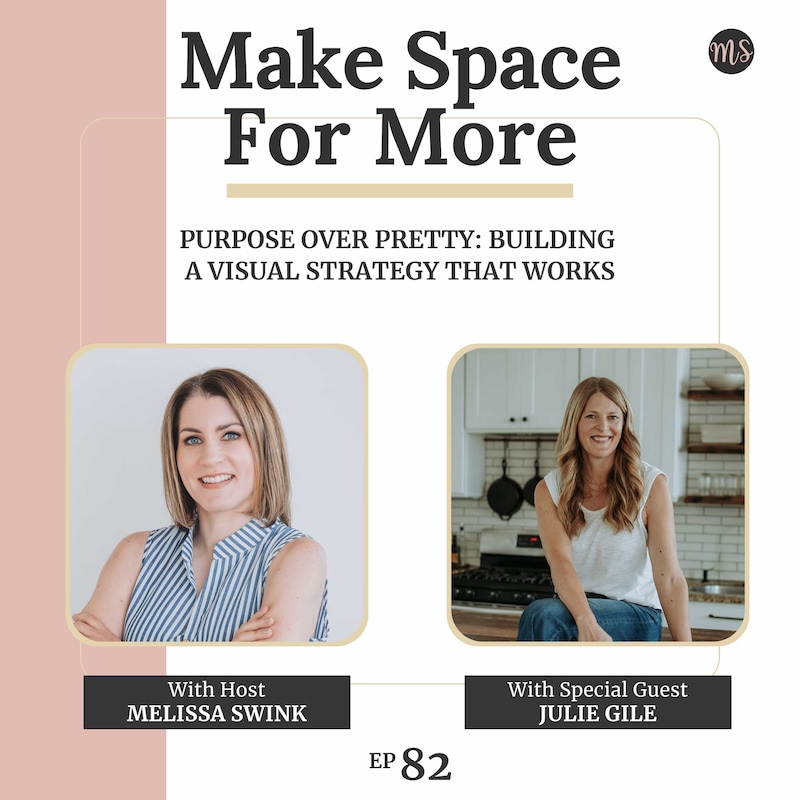
Tune into Make Space for More as host Melissa Swink interviews brand photographer Julie Gile, who shares her journey from personal tragedy to professional success. Julie discusses the importance of storytelling in brand photography – especially the need for strategy and intentionality in capturing visuals that resonate with clients.
You’ll learn tips and tricks for working with clients, the difference between headshots and lifestyle branding, and the significance of investing in growth through coaching and team building. Julie also provides valuable insights into preparing for a brand photo shoot and how to use your visuals for effective marketing.
Key Highlights:
- Brand photography is not just about taking pretty pictures. Intentional brand photos help you tell your unique story and connect with your audience.
- It’s OK to let your personality shine! Lifestyle branding photos capture the real you, helping ideal clients feel like they already know and trust you.
- When your visuals match your business goals, magic happens. Smart visual storytelling can transform your marketing strategy.
- Great brand photos start with understanding what makes your clients tick: What are their dreams, values, and target audience?
- Growing a successful business is a journey. Get tips for investing in professional development and how Julie has surrounded herself with the right team.
- Want to feel amazing in front of the camera? Tune in for advice about preparing yourself and your mindset for your next photoshoot, so your brand photos will capture the authentic essence of your business.
About Our Guest:
Meet Julie of Julie M Gile Photography: a brand- and commercial-photographer who’s boosted over 500 businesses by turning visuals into emotional connection. Her studio kicks off with expert strategy and ends with images that feel authentic, alive, and unmistakably human. She builds not just pretty but profitable images that connect your story. Let’s dive in. Julie offers a free 30 min Brand Strategy Session to clarify your brand’s top goals, and give you smart, actionable ways to implement these. Contact Julie here for more information: https://www.juliemgilephotography.com/let-s-connect
About Melissa:
Melissa Swink, Founder & CEO of Melissa Swink & Co., has a team of virtual assistants who provide administrative and marketing support for small businesses and non-profits.
Since 2012, Melissa and her team have helped more than 100 businesses grow through the services they offer, and she is dedicated to helping entrepreneurs create profitable, scalable businesses they love.
Her work is all about doing what works (and eliminating what doesn’t) and driving real, measurable results. Visit www.melissaswink.com to learn more!
Thanks for listening!
If you enjoyed this episode and think that others could benefit from listening, please share it using the social media buttons on this page. Do you have some feedback or questions about this episode? Leave a comment in the section below!
Subscribe to the podcast
If you would like to get automatic updates of new podcast episodes, you can subscribe to the podcast on Apple Podcasts or Stitcher. You can also subscribe in your favorite podcast app.
Leave us an Apple Podcast review
Ratings and reviews from our listeners are really valuable and greatly appreciated. They help our podcast rank higher on Apple Podcasts, which exposes our show to more awesome listeners like you. If you have a minute, please leave an honest review.
Transcripts
Hi everyone, welcome to the Make Space for More podcast where we talk strategies for growing and scaling your business in a way that's authentic and aligned for you. I'm your host, Melissa Swink, and in today's episode, I feel like I always say this, but I have a very special guest joining me today and I know you are all going to love her and you're gonna learn a lot through today's episode. So I am joined by my friend and brand photographer, Julie Guile.
Julie is the owner of JM Guile Photography, a brand and commercial photographer who's boosted over 500 businesses by turning visuals into emotional connection. Her studio kicks off with expert strategy and ends with images that feel authentic, alive, and unmistakably human. She builds not just pretty, but profitable images that connect your story.
Julie, I am so excited to dive into everything today. We have been chatting, you guys, before we started recording. We've just been chatting for the last like 20 minutes. There's so much that we can talk about and share about, so I'm excited to see where this conversation goes. But Julie, why don't you share it with our audience? Just tell us a little bit about yourself before we dive into the business and all the aspects of brand photography and visualization.
Julie Gile (:Yeah.
Julie Gile (:Thank you for the dynamic intro. I'm really excited about this. Yes, so I think it was about nine years ago, my mom, it was just an awful time in my life. My mom was dying of colon cancer. She was living in our house. So I was caretaking for her. had a three year old. I was also pregnant and obviously a wife as well. So I was just feeling like I was literally drowning because I did not know how
Melissa Swink (:you
Julie Gile (:to hold on to the memories of my mom. knowing my three year old would never remember her, my unborn child would never meet her, it was just a very, very hard time for me. And I didn't know how to exist in that time. So I picked up a dusty old camera that we had in our house and I started taking photos. I signed up for an online class and I started creating photos because I I realized I could save stories.
of my mom hiding my three-year-old under the covers and coloring with him. Because she couldn't get out of bed, but she was trying to find ways to interact with him. I could savor the joy that she had on her face. She called my son her medicine because it always made her happy when he was around. I could keep those memories in photos and savor the stories forever. That's how photography started for me. Then I just fell in love with
Melissa Swink (:Right.
Julie Gile (:businesses that also have that personal connection. A lot of people start businesses out of, you know, traumatic stories and the need and the want to serve and the need and the want to solve problems in people's lives. And I think traditional marketing ignores that, that passion and that drive to really serve people and to heal from a place that was maybe troublesome for people.
where a lot of businesses start from, but yet people ignore that in their marketing. So what if we take story and really infuse it into marketing in a way that is aligned and authentic and then all of a sudden there's a personal connection that wasn't there before. And I believe that's what marketing should be.
Melissa Swink (:my gosh, there's so much that I want to impact in your story. And every time you talk about your mom in that time, my heart just goes out to you and everybody who's been through that. But I love the way that you have learned this art form of photography. That passion was born out of that time. So taking a step back, I want to talk about all the marketing and the storytelling as well. So you picked up this camera, you're capturing memories.
And then how did you end up in business then? Like, people start noticing your talent and start asking you to take their photos? Did you always do brand photography? Like, has that evolved over time? Like, how did things kind of unfold from there?
Julie Gile (:Well, the funny story is I was taking that online class at the time and then I started really sinking into it and trying to be better at the photography and taking more photos and just tactically. And then I invested in a one-on-one mentor who is incredible support in my life and just really helped me with that professional aspect of it. And then I had a client. So I was asked, I...
went into a juicery and asked if I could do some photos for them because I was like, your two sisters, you own the only organic healthy food and for miles and miles and miles miles I said, I don't want you to fail. Can I help you with your marketing? And this is what I can provide. And they said, yeah, absolutely. And that was my very first client. And then a couple down the line, I had a client and what they did is they took all of the pictures that I gave them.
Melissa Swink (:out.
Julie Gile (:Like I delivered I think a gallery of 60 images and they released them all in a week.
Melissa Swink (:I remember you telling me that story.
Julie Gile (:And I was like, holy cow, because how, why would they ever call me back again? If everything I did for them was released in a week and like essentially they missed, they missed the point. So that's when I just stopped and I pulled back and I said, I have to help people with strategy. I have to, because I see it when I plan it on my end, but if you don't receive it and know how to implement moving forward, then everything we've done is a waste.
Melissa Swink (:Mm-hmm.
Yes.
Melissa Swink (:That's really interesting. And I feel like there is, and I don't know anything about this client that released all those photos, but I think in my personal feed, I'll see people, know, photo dump from our vacation or photo dump from the summer. And then they upload, you know, like 80 images from, you know, their family trip out West and business does not work the same way. You can just be like, look at our new photo shoot and then drop it.
Julie Gile (:No, my gosh.
Melissa Swink (:every single image in one post. But you know, I can see where that could be an innocent mistake or somebody's really excited. They love all the photos and they want to release them all. But you're like, whoa, whoa, whoa, whoa, let's put some intentionality behind it.
Julie Gile (:Yeah.
Julie Gile (:Right, that was the missing piece for me was the intentionality and how do I create a business that offers not just the visuals but the intention and the implementation behind it. And really story is the shortcut to connection. That's what you're trying to make in business is connection and the story is what's the driving piece for that.
Melissa Swink (:Yes, and talking about storytelling and you do this beautifully through visuals. And when I think about storytelling and me who I do not have the talents that you have, I think, I need to write out a long story. Like here's how I started my business or here was this client and here's how we help them. And you have this idea of the words behind it and you can get help with that with, you know, a copywriter and, you know, other talented people as well.
But at the end of the day, not everybody's gonna take the time to read a lengthy story about your company or your client's success story, where have you. We have, think, in general, kind of a short attention span, or at least we need to capture somebody's attention to get them to want to learn more. So that's where the visuals come in, especially through those photos. So I love the way that you talk about storytelling through an image.
Julie Gile (:Right and for yours specifically, the one that is so crystal clear in my mind, can I tease it out there or are waiting? gosh.
Melissa Swink (:Absolutely, absolutely. And I didn't even mention this at the beginning of the podcast, which I should have. Julie has done the last, let's see, I've done three photo shoots with you in the last couple of years. So all of the beautiful images on our website and all of our marketing were taken by Julie. yes. Yes. So feel free to leak whatever you want. We're an open book around here.
Julie Gile (:Well, it's such an honor. So one that I love that just sticks out in my head when you talk about that, a story, it's not like a novel. A great example of that is the yarn ball. So what your organization does, Melissa, and what you do in particular, looking at the books behind you as an example, is you take chaos and you make it orderly. So we took.
Melissa Swink (:Mm-hmm.
Julie Gile (:So how do you show that in an image? We did it several different ways, but one was we had a ball of yarn that was just absolute disaster chaos in one hand, flopping all over the place, hanging pieces everywhere. It was just an absolute disaster dumpster fire. And then the other hand is like a neat, tiny, orderly ball of yarn, all wrapped up perfect in the palm of your hand. And we had the two next to each other. Like before is the chaos ball, and after is the orderly ball. And like...
That's to me a crystal clear way that you can communicate in a heartbeat of a second because we're all so busy, right? We scroll past stuff. It's like, why is Melissa holding these balls of yarn? Chaos to calm. Boom.
Melissa Swink (:Yep, I love that. Okay, and a side note, and I promise we won't go down this rabbit hole. My cat found that neat little ball of yarn and stole it out of my desk the other day and had it all over the house. It was fine. It's a ball of yarn, right? So that's no longer neat and tidy anymore. good thing we captured that in a photo. For those who have pets are probably smiling here. But Julie, I want to talk about
Julie Gile (:Julie Gile (09:39.115)
So darn.
Yes.
Melissa Swink (:the process of working with you. And I wanna share this more from a learning experience and a learning perspective for our audience as well, because now certainly I've been in business for 12 years and I've had headshots before, plenty of times, even in my corporate job I've had headshots. And then I did a couple of smaller photo shoots and I found that there's a striking difference between
really the brand strategy that you bring and just having photos taken. Because I know in the past when I've had other photo shoots, it's been like, what do you want? The photographer's asking me, well, what do you want us to capture? Or what do you want to share? And what do you want to wear? That's the number one question I know that you get, like, what do I wear? Because you want to be happy with the way that something looks on camera. But you really came in, you took a look at
Julie Gile (:Yeah.
Julie Gile (:Yeah. Yeah.
Melissa Swink (:the problem that we solve for our clients. You took a look at all of our marketing, as it had been to that point, and made some recommendations. Here's what I think that we need to show. And you really brought in that expertise. So then the work and the planning of the photo shoot wasn't relying on me. Can you speak to how you work with clients?
Julie Gile (:Yeah, that is huge and I myself, when I book my own brand photo shoot, they'll ask me, like, what do you want to do? And I'm like, like I really want somebody, what I really want is someone to step outside my business to say, hey, if I'm looking at you, these are the questions that I have about your business. These are the things that I would want to know and this would make it easier for me to make a decision or feel more comfortable with you. So basically what I do is we have a brand strategy session.
Melissa Swink (:Mm-hmm.
Julie Gile (:We talk a lot in advance about what are the common questions that you get? What are people's driving decision-making factors and all that good stuff? But my favorite question to ask is what's your favorite client story? Because that's when people smile and their face lights up just like you, and they're able to articulate like.
Melissa Swink (:Yeah.
Julie Gile (:Oh, I shot a cookbook for this wellness company and it was just an amazing experience, blah, blah, blah. Well, when was the last time you marketed that you shot cookbooks? Well, I don't know. I mean, I thought it was just like a one-off thing or whatever. it's like, okay, so here's the juice. Tell me why you love that project. And then all of a sudden, this dream comes out and they're like, well, my dream is to only shoot cookbooks. I never want to shoot another newborn session again. And you're like, okay, well now.
Melissa Swink (:Yes.
Julie Gile (:If your visuals aren't tied to your bigger goals, then you're wasting your money. So the point in that session is for me to figure out what is your bigger goal and actually not ask you that direct question because not everyone knows that. But I can hear it by the way you talk about how you're lit up by your client work. So I need to figure out what is your bigger goal and then how do we create the visuals to feed into that. So I'll ask questions like where do you see yourself in five years? Like where do you want to be in five years?
Melissa Swink (:Right.
Melissa Swink (:Mm-hmm. Mm-hmm.
Julie Gile (:Sometimes people don't know that. So again, that favorite client story is usually a really good one. And then from there, I create a couple different scenes that will illustrate what that looks like to your next best client. And then what's the story behind it. And then from there, we create the wardrobe guidelines. We create the shot list. We create the prop list of the things that we're gonna be bringing to the shoot. And then we'll create the location. And sometimes it's multiple locations. Sometimes it's.
indoor and outdoor, sometimes it's a studio, sometimes it's a house, sometimes it's a public place, like an atrium or something like that. And then who needs to be there? So are we bringing clients, are we bringing family, are we bringing models, all that kind of stuff, and then we'll have an itinerary of how that day is gonna go. So basically, you just take your prep list and then you have it in your hand and you can get all your things together for that.
Melissa Swink (:Yeah.
Melissa Swink (:Yes, for sure. And I will even add to that. And that makes that takes so much of the guesswork out for, you know, those on the receiving end like myself when we're doing a brand shoot where I can pull up that sheet and like, OK, I need these outfits. I need these items. And it makes it really easy to pack up and prepare for the day. And it's far less stressful when we have that in place. And again, it's not reliant on me to give direction to have something done that I don't know how to do for myself. So I love that.
Julie Gile (:Right.
Melissa Swink (:The other thing too that you and I did this time around for my marketing team, again, we're just super open book and transparent about what's working is I took that shot list and I uploaded it with the photos to our Google Drive for our team and told them, a look through that. Let me know if you have questions. So then that way it's translated from your strategy into them and implementing and rolling out these photos in a meaningful way.
Julie Gile (:That is the goal. The goal is to be able to, and we meet and go over the photos together, so I can also say, like, okay, do remember when you were talking about client pain points? Well, that's why we have these pictures. Remember when you wanted that really wide angle shot to add the graphics on the left-hand side? Like, that's where you have these photos. So we talk through the intention of each photo and how it relates to your strategy, and then you get a takeaway that says, okay, whoever is in my team is implementing this stuff, or...
Maybe I can't get to it for six months and then I can pick up that paper and start right where we left off. So it's an investment that stays with you. So they're not just pretty pictures, but they're profitable.
Melissa Swink (:Right.
Melissa Swink (:Yes, I love that. And the other thing, Julie, that you and I talk about pretty often, and I certainly see this again on behalf of my team when we start working with clients is they might hire us to do some of their marketing. Maybe we're writing blogs, we're writing email newsletters, we're doing social media content, and visuals are super important. it's the clients who have...
brand photos like what you do or something similar are in the minority when they start working with us. A lot of clients are relying on headshots and stock photos to get them through. And so when we start talking about branding with those new clients, they'll say, I have a logo and maybe along with that logo, they might, if we're lucky, they might have the brand colors and their brand fonts. So we have something that we can use in order to create some
maybe like graphic templates for client testimonials and let's see, Google reviews and quotes and things like that. And then if we're lucky, they might even have something along the lines of their mission, their values, their vision. They have some of those pieces, especially if they've done some work with a marketing team before. But the one thing that they rarely have are actual photos, brand photos, fully customized.
based on their brand overall look and feel and vibe. And so that's something that you and I talk about at length because there seems to be a gap between branding and the actual visuals that get rolled out with it.
Julie Gile (:There, yeah, there's a very large gap there and I can't figure that out myself. I've actually sat down and talked with several marketing firms and said, you know, you're putting these great strategy packages together for people with all, like you said, you gotta have the fonts and all the things. And I think that's all really, really valuable and consistent. But I've asked like, why would you, are you creating visuals? And usually the answer is our clients don't have the budget for that. But if you're a marketing company and you're creating the package,
Melissa Swink (:Okay.
Julie Gile (:you were in charge of how the money gets spent. it's really, sometimes seems like either the market, it's not in the comfort zone of the marketing company or they want to not allocate money for visuals, but visuals tell the story. don't, font does not tell the story. Font keeps the story consistent, but it doesn't tell the story.
Melissa Swink (:Yes. Yes, absolutely. So, for those who have invested in the branding aspects and they've worked with marketing team, I think that's fantastic. That's a great starting point. But then, yeah, when you start trying to do blog posts or you're trying to do social media posts or you're creating your website, you don't want a bunch of stock photos either. You want something that's actually faces because we know that
pictures of people and faces, especially people that you know, not just, you know, models in a stock photo necessarily, but that's what really creates that connection. having brand photography is just a game changer when it comes to telling your story.
Julie Gile (:Yes, and then like you said, having materials to work with when you are building emails and when you're building social media strategy and when you're trying to connect on LinkedIn and all those good things. We're doing some photography for online courses and things like that too because stock imagery is only gonna get you so far if you're trying to convey a specific scenario.
Melissa Swink (:Yes, absolutely. And the other thing too that I was thinking about preparing for our most recent shoot was at our marketing call with our marketing team, I asked what are some of the things when you think about when you're pulling photos to match up with some of the content we're creating, what are some things that you would like us to be able to show or be great if we had a photo that showed somebody who looks overwhelmed like some of the befores, you know, that was one of the requests that came through recently. So
Julie Gile (:Yes.
Melissa Swink (:getting their feedback, the people who are actually creating the content, like what do need photos of is another great, that was another great help for our last photo shoot as well.
Julie Gile (:Yes.
Julie Gile (:Yes, yes, that was huge. And a lot of it is getting people in the trenches. Like you said, what does it look like to be overwhelmed? What does it look like to have a desk full of chaos next to a desk that's clean? Right one thing next to the other. mean, that tells a story right there.
Melissa Swink (:Yes. Absolutely. And also I know we're talking a lot about like people and kind of related to that more services and solving problems for clients and stuff, but you also take photos of products as well. You work with a lot of product based businesses as well. How does that vary a little bit when you were talking about products versus people and professionals?
Julie Gile (:Yeah, the product is interesting because people from all over the country will ship me their products. And then we have conversations on the phone or online about same thing, pain points, favorite subjects, topics, things like that, why people are buying their products, why they wouldn't. And then I do my own research on that as well. And I can do all of the styling and shoot all the products. Sometimes clients will be present for those shoots, but if they're outside of the area, then we can either have them live on zoom or.
during the photo shoot or I send them a couple test images, they approve and then we do the full shoot. But we still go through all of the storytelling and exploratory, what is your brand not doing well right now, where do you need to really increase and enhance the connection because really people aren't buying the product, they're buying the story you're telling about it. Like no one wakes up in the morning and says, I really wish I had a VA.
Melissa Swink (:Right.
Julie Gile (:They say, really wish I had someone who could make my desk from chaos to calm or someone that would take this ugly stuff off my plate. That's what their people are buying that story. They're not buying the concept of a VA. They're buying the freedom that you provide.
Melissa Swink (:Yes.
Melissa Swink (:It's true. It's true. And when I think about, you know, in the past, when I have been in the market for an executive assistant, you know, if we had some transitions or whatever, I'm just like, I just want things handled. Like I just want somebody who can take say even 50 % of what comes across my desk every day and just like get it where it needs to go or just like tackle it for me. I would feel so relieved. So that's what I think about. Yes.
Julie Gile (:Yes.
Julie Gile (:Exactly. Yeah. Yeah.
Melissa Swink (:Yes, exactly. So it's super interesting though, going back to even your own photo shoots that of course you can't photograph yourself. So you do have to work with other photographers in order for you to have brand photography to work from.
Julie Gile (:Yes, yes, that's an interesting process. So I keep track, like all year or half year, whatever it is, I keep track of the questions that clients ask me repeatedly. I also keep track of the Google reviews and the positive things that are consistently said in the Google review. And a lot of times it's...
you know, people will talk about like the way you made me feel, like you made me feel seen or you made me feel like understood or you made me feel more confident in my work because when people see the glow that they have on their face when they're doing, you know, their, their, their whatever function that they love doing and they can see that on camera that like reinvigorates them towards their work. So those are the types, that's how I grab guidance for how I plan my photo shoots.
Melissa Swink (:Yes, yes, I love that. The frequently asked questions. I was just thinking like, how did I feel the first time that I had, you know, a brand photo shoot done? I think it made me feel like a legitimate company.
Julie Gile (:Yeah, I hear that.
Melissa Swink (:You know, because otherwise I was, you know, in the very early stages, I was working mostly on my own and it was, you know, me and a computer and my desk and my clients and like that was the business. But then it's like you get that that picture of you doing this work. It's like this is legitimate. Like this is real. Right, right. Exactly.
Julie Gile (:Yeah, and you've worked really hard to make it real.
Melissa Swink (:So just out of curiosity, what are some of the top questions that you get from people before a brand photo shoot?
Julie Gile (:hands down without a doubt, what do I wear? What do I wear? That is the number one question.
Melissa Swink (:Yes. Do you have a really short answer to that? Because I know that it vary, there's a lot of variables there, but do you have like some quick like, do wear this or don't wear that? Like, do you find that you're usually recommending to people?
Julie Gile (:Yeah, well do not wear neon or leopard prints and like wild colored prints that will really date you. That is like a number one for me. Unless that is your brand, but that would be interesting. Usually I recommend people wear three different outfits for a photo shoot and one would be your most dressed up attire, like pretending that you were speaking at a function. For example, when you were gonna be on stage.
Melissa Swink (:Yep.
Julie Gile (:And I would suggest that you make sure that it's well fitted and that it's, you know, lint free and clean and all that good stuff. The second option would be if you're meeting with a client. So if it's a regular client meeting, it's probably a slightly more professional version of that. And then your last wardrobe choice, I would suggest, is something that you feel really confident and comfortable in. So for a lot of people, that's jeans. For a lot of professional women, it's like jeans, a t-shirt and a
sport coat or like a jacket with tennis shoes or heels. And 99 % of the time someone will, and I always tell people, bring some extra stuff and I'll help you choose because we might have a backdrop and I think a color will pop on it or something and I'll always help people decide which is a really fun part of the job for me. But 99 % of the time the most favorite picture is the last one.
Melissa Swink (:her less. Yes.
Julie Gile (:Because by that time you're very comfortable with me and I know what you've already gotten. We're joking around, everyone's kind of feeling the flow and you're wearing your most comfortable, confident outfit and 90 % of the time that's the headshot that I see pop up on social media the next day. Like, oh, I guess that one's your favorite.
Melissa Swink (:Yes.
Melissa Swink (:Yes. Yeah.
I love it. think when I posted our, well, on a personal note, I think it was the one of Ava and me. I think those were some of the ones that I shared with people first, but yeah, I'll have to look back and see which photos my team rolled out first. I think they were the podcast ones. So, yes, absolutely. So,
Julie Gile (:Yeah.
Julie Gile (:Yep, I just saw one, I was so excited. was like, ooh.
Melissa Swink (:Any other frequently asked questions that clients come to you with when it comes to preparing for their brand shoots? Just out of curiosity.
Julie Gile (:A lot of many clients will come to me and say, I work from a home office and it's not really photographable. Like where should we shoot? A lot of people will say that. And there's a lot of options. know, renting a space is a really good option. Using a friend's studio that is, or friend's workspace that is really pretty. There's all kinds of things. There's libraries, there's atriums of, you know, I've done a shoot, really.
Melissa Swink (:yes.
Julie Gile (:high-end shoot actually at a hospital atrium that was not for the hospital. It was just for a gentleman who has a coaching business and we used all the natural light in the atrium and the staircase. That was really beautiful. So just getting creative about different places that feel on brand. I don't like to shoot multiple clients in the same place because it starts looking really generic and then they start getting a little goofy about it. there's, you know, realtors we shoot in houses that are on the
Melissa Swink (:Interesting.
Julie Gile (:market. A lot of times that's a really beautiful option. Yeah, that's just always things on my mind.
Melissa Swink (:I thought of one and this is kind of circling back to what I'm seeing from our clients when they start working with us on the marketing side of things is, well, I have headshots. When I ask if you have, if they have brand photos, well, I have headshots. Is that enough?
Julie Gile (:Yeah. People, hear that all the time. Or some people will say, I just need a headshot. And the difference between a headshot and like a lifestyle branding shoot is a lifestyle branding shoot will show personality. Where a headshot is just literally a picture of like from your shoulders up. Where a lifestyle branding shoot can show your hands, can show your legs, can show you sitting on a stool or on a chair or on a couch or at a desk.
Melissa Swink (:Thank you.
Melissa Swink (:Mm-hmm.
Julie Gile (:So lifestyle branding shoots are intended to show more personality, to build a connection where the headshot is really just a picture of your head.
Melissa Swink (:Yeah, what you look like. your LinkedIn profile or something like that.
Julie Gile (:Yeah, it's just an identifying picture of your head, whereas there's a lot of psychology and hands build trust, and if that's what you're trying to do with your business and with your clients and with your future professional relationships, like showing hands in your photo is a great way to do that. So we always encourage having photos like that. Yeah, it is. People love to see your hands, yes.
Melissa Swink (:Interesting. I didn't hear that before.
interesting. And this certainly isn't necessarily like a beauty contest or, you know, being a fashionista trendsetter or anything like that. Cause I could hear people, I can just picture people hearing this and thinking like, gosh, like that sounds really intimidating. I'm not a model. I'm, you know, I'm a business coach or, you know, I'm a writer and they don't necessarily realize that we don't mean this necessarily in, you know, a
in a modeling sort of a way, but again, going back to that storytelling.
Julie Gile (:Right, and I mean you, I think in some of your photos you were wearing that t-shirt that you have on right now. I mean it's just a nice basic, you know, top that is a nice warm color. It looks great with your skin tone and we utilized it in several pictures and it was great. I mean it doesn't have to be rent the runway type stuff. It's... I did, yeah.
Melissa Swink (:Mm-hmm. Mm-hmm.
Melissa Swink (:Yes, you talked me out of doing that actually. Because you're like, can you just buy clothes that you actually like and would wear in real life? And I went, yeah, I can do that. I was overthinking it. Maybe that's the key there. Not overthinking it. Yes. And the other thing too, that I think you and I have talked about in the past is there has been a disconnect. When I have seen somebody's LinkedIn profile photo or a
Julie Gile (:Yes.
Yes, it is intimidating.
Melissa Swink (:picture of them on their about section on their website, and then they show up to calls or I meet them in person and they look very, very different. Yes, it's interesting.
Julie Gile (:Yes. Yes, a lot of that is a lot of editing. A lot of that is not updating your profile picture or keeping it updated. And we do age and people's weight fluctuates, but there are graceful ways to deal with that with informed posing and great guidance. There's lots of great ways to embrace that without having it look inauthentic.
Melissa Swink (:You're right, you're right, exactly. And that's something that I think I've said to every photographer I've ever worked with is I want to show up in these photos the way that somebody would meet me through Zoom or out at an event. I want it to be consistent because it is kind of that mental flip of a switch if you're expecting somebody to show up a certain way or you've seen them looking a certain way.
Julie Gile (:Yeah.
Melissa Swink (:and then they show up to a call or a meeting and they look completely different. It just takes a minute for your mind to kind of recalibrate itself. And that's what I don't want, especially if it's a potential client or a partnership opportunity. I want that authenticity to come all the way through. So thank you for talking me out of doing Rent the Runway for my last photoshoot.
Julie Gile (:Yeah, that's a rule.
Julie Gile (:Yes.
Yes, from my side of the camera, it's more important for me that you feel comfortable in your clothes than whatever it is that you're wearing. Because if you're not comfortable and you're not confident, there's nothing I can do in Photoshop that can change that 100%. And I've never met a photographer who can put confidence in Photoshop. And if Adobe comes out with that, they owe me rights to that. But you can't change that. So you have to have people feel confident in what they're wearing.
Melissa Swink (:you
Melissa Swink (:Yeah, yeah, absolutely, absolutely. Julie, this has been super interesting talking about creating these visuals and the storytelling aspects and the do's and the don'ts when it comes to photo shoots and things like that. Just as we're kind of wrapping things up a little bit here, just out of curiosity in your own business, your own business has certainly grown since you started. How many years have you been in business officially?
Julie Gile (:yeah.
Julie Gile (:Seven years, actually. Yeah.
Melissa Swink (:Nine years, my goodness. Yeah, so nine years ago you picked up a camera and then officially we're in business within two years after that. That's super exciting. What are some of the things that you have invested in either like for yourself personally or your business that has really made a huge impact on your growth over the last seven years?
Julie Gile (:Yep.
Julie Gile (:Coaching for sure. And you and I have had this conversation where it's like, there's multiple different areas of your life to be coached in. Like we have life coaching. That's amazing, unparalleled. I have coaching in the craft of photography itself. And then I have coaching in like business leadership, CEO, owning a business, growing a business, all of that stuff. just don't know. just, those skills don't always come natural to me.
the accountability and the guidance and leadership of coaching has been definitely a worthwhile investment. I would say the second thing is definitely a virtual assistant. You and your team, yes, has helped a lot. also because you've seen the way that other businesses can create efficiency in things that I don't see because I'm not looking at those systems on a daily basis. I think also,
Melissa Swink (:Having a team.
Julie Gile (:A big game changer was that VIP session that we had when I was like, don't wanna do newborns. They're not my favorite, but I don't understand, because I'm kind of locked in and whatever, and you're like, what if we just didn't?
Melissa Swink (:Yes, I have brought that up on the podcast before because you're not the only one who was like, hey, I started doing weddings or I started doing newborns or I do families or, you know, we're using a photography example, but I have many others of other clients where it's like, I became known for this and I don't really love it anymore. And I'm like, well, what if we just stop advertising? What if a starting point is we just stop advertising that you do it?
Julie Gile (:Yeah.
Julie Gile (:Yeah, I think like.
Melissa Swink (:Remove it from the website, from your Google listing. Let's just remove that completely as a starting point for those who just don't want to completely jump off into the deep end of the pool and cut ties with something that pays their bills.
Julie Gile (:Yeah, yeah, think it was remember it was wedding I kept all of a sudden I just got a whole bunch of wedding inquiries and I show no wedding work on my website There's no wedding words on my there's nothing to do with it And there was one pin on Pinterest that was from many many years ago. That was specifically winter weddings It was tagged with winter weddings And like you guys found it your team found it and like got rid of it. So I was kidding like ten inquiries. Yeah
Melissa Swink (:Yes.
Melissa Swink (:Isn't that funny? But just like something that you don't even think about and then you think about the vibes that you're putting out there, but just, you know, unknowingly have this old, you know, Pinterest. Yeah.
Julie Gile (:Yeah, and I think owning a business and having it run off of your own energy is really, it's heavy. It's heavy and then bringing in a virtual assistant I think was a really important thing because the day-to-day task could still run with someone else's energy.
Melissa Swink (:Yes.
Julie Gile (:while I'm raising a family still and I'm dealing with death in a family or whatever it is in that season. think having that as a support was, it has been very big for my business too.
Melissa Swink (:Wonderful. Yeah, 100%. And to your point, even my business coach has said this in the past is your business needs to be its own living, breathing entity that is separate from you. And she said that not necessarily that we're not invested in it or, you know, it's not our livelihood, but it's you may be blocking its growth because of some of your own just
beliefs and insecurities and fears and things like that. But then also you don't have, if you're that connected to the business, then you also don't have that time to unplug or you just don't have that mental space. So they're like, start thinking about it as a separate entity from yourself. There's yourself and then there's your business.
Julie Gile (:That's great advice because it's all very blurred for many years. It's very muddy. So you can get it to a point where you can do that.
Melissa Swink (:Yeah. Yes, yes, absolutely. And I remember, you know, when I worked solo and you remember this from when you worked solo, I mean, you kind of are your business because it is all you. So having that, that breathing space through a team or boundaries and just, you know, being able to stay in alignment as time goes on is big. Absolutely. Well, Julie, it has been so great.
Julie Gile (:Yeah. Yeah.
Julie Gile (:Yes.
Melissa Swink (:to have you on the show. Before we wrap things up, you have a free 30 minute brand strategy session for our audience. Can you tell us a little bit about what that includes and where we can find that?
Julie Gile (:Yes, well, I can share with you a link to put in the show notes, which would be great. But that 30 minute strategy session, basically I peep into your social media and your website and figure out what's going on in preparation for our call. And then I kind of find some holes or questions and then we talk through what are those things? What are your goals? Well, here's what I actually found. This is what it looks like you're promoting. Is that in alignment with what you have? Because, you know,
Melissa Swink (:Absolutely.
Julie Gile (:if we want to figure out what those bigger goals are and then make sure all your marketing is supporting that. So we're looking for where those disconnects are in your brand, your brand voice in your marketing strategy. And then we talk about that together and create an actionable plan. Yeah.
Melissa Swink (:I love that. I love that. And just like anything else, everybody else that I've worked with and the way that I personally function, it's not a hard sell. It's just an information session of like, hey, here's an outside perspective of everything that I am showing about myself and my business online. And what's working well and how can we improve upon that? Just getting that perspective. And if you can help, great. Now you work with clients,
Julie Gile (:Right, right.
Yeah, absolutely.
Melissa Swink (:I know you're located in Green Bay, Wisconsin like I am, product-based businesses you can really work with from anywhere. Do you work with clients from all over the place?
Julie Gile (:I do, yes. So with product-based businesses, can ship me content from anywhere. I have a client in Portugal and so all kinds of things. But then I do have travel dates that I go and I do meet clients outside of state all the time. Regularly traveling to Chicago, regularly Milwaukee, regular San Francisco area in Minneapolis. And then I do travel for one-on-one client situations too.
Melissa Swink (:wow.
Melissa Swink (:I love that. I love that. So, well, Julie, thank you so much for being on the show today. I have learned a lot as always, and I've had a really great conversation just kind of diving into this branding world because it can feel, for those of us who don't think in those terms, it can feel overwhelming. And like, it's something that is easy to just kind of put on a shelf for another day, but you really break it down and make it simple. So love that.
Julie Gile (:Yeah.
Julie Gile (:Yeah.
Well, thank you, I hope so. I hope so. I see it as simple, but I realize not everyone does. So I hope to help.
Melissa Swink (:Yeah.
Melissa Swink (:Not everyone does, but I always, whenever I plan a photo shoot with you, when I have that brand strategy session, like, okay, somebody is just going to show up with their expertise and tell me what to do. Which is a huge relief, so love it.
Julie Gile (:Yes, yes. And you said that too. You're like, just tell me where to go and what to do. Where's Stan, what to do? Yes. Yes. Yes.
Melissa Swink (:Yes, send me the list. I'm great at following a list. Just tell me what needs to be done. So, and I love that you shared so many tips and tricks and strategies with the audience today. So really appreciate that. And thank you so much to our audience for tuning into today's episode of Make Space for More. I hope that you have found some great tidbits and takeaways that you can apply towards your overall branding, your marketing, messaging and strategy. And again, I will be back.
in two weeks with another episode of Make Space for More, where we talk strategies for growing and scaling your business beyond you. Have a wonderful day, everyone. Have a great one. Bye-bye.




