Shownotes
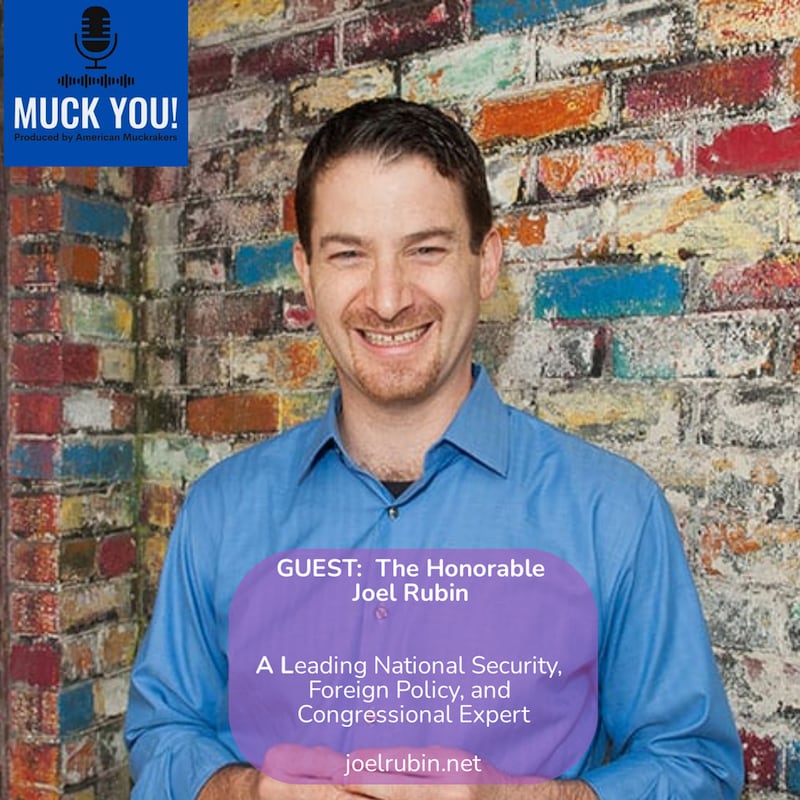
Joel Rubin, a former Deputy Assistant Secretary of State, joins David Wheeler on "MUCK YOU!" to explore the intersections of U.S. foreign policy and domestic issues, particularly how failures abroad can exacerbate the chaos at home. With a wealth of experience in the Obama administration and a deep commitment to democratic values, Rubin brings a critical perspective on the current political landscape and challenges the notion of "America First" as a guise for isolationism. He passionately argues that the U.S. must engage with allies and uphold its role on the global stage rather than retreat into a militaristic, unilateral stance. The conversation also delves into the politicization of foreign policy, exemplified by the scrutiny surrounding events like Benghazi, and how that reflects broader trends in governance today. As they navigate these complex topics, Wheeler and Rubin emphasize the importance of accountability, transparency, and a return to diplomatic principles that prioritize cooperation over confrontation. American politics often resemble a vast swamp, and this episode of MUCK YOU! dives headfirst into the muck with veteran strategist Joel Rubin. The conversation kicks off with host David Wheeler introducing Rubin, a former Deputy Assistant Secretary of State with a wealth of experience in foreign policy and national security. As they explore the turbulent waters of American foreign policy, Rubin shares insights that highlight the interconnectedness of foreign and domestic issues, particularly how failures abroad can exacerbate the challenges faced at home. He emphasizes the importance of accountability and effective diplomacy in a time when America is often split between partisan divides and the noise of political grift. Through humor and candor, the discourse sheds light on the pressing need for a return to principled governance and international cooperation, underscoring that America’s leadership role in the world is vital, not just for global stability, but for the health of democracy itself.
Takeaways:
- The podcast 'MUCK YOU! dives into the murky waters of American politics, exposing the grifters and power grabs threatening democracy.
- Joel Rubin, a seasoned foreign policy expert, discusses the repercussions of foreign policy failures on domestic issues, particularly under the Trump administration.
- Through his experiences in the Peace Corps and various government roles, Joel highlights the importance of grassroots engagement in effective public service.
- The conversation emphasizes the need for more transparency and accountability in foreign policy, advocating for a shift back to diplomacy over military might.
Links referenced in this episode:
Companies mentioned in this episode:
- American Muckrakers
- J Street
- American Jewish Congress
- Obama White House
- Carnegie Mellon University
- USAID
- State Department
- Hillary Clinton
- Chris Stevens
- Benghazi
Transcripts
Welcome to Muck You!, the unfiltered podcast from American muckrakers, where we dig deep into the dirt of American politics, expose the power grabs and call out the grifters dragging our democracy through the mud.
I'm David Wheeler, and today we're thrilled to muck it up with a guest who's no stranger to the trenches of foreign policy, national security fighting, good fight against authoritarian creep and creeps.
Please welcome Joel Rubin, former Deputy Assistant Secretary of State, Democratic strategist, Jewish activist with a sharp mind behind the briefing book substance.
Joel spent years in the Obama White House, on Capitol Hill, and leading outfits like J Street and the American Jewish Congress, all while sounding the alarm on everything from the Iran deal to Trump's Russia playbook and the rise of anti Semitism at home.
In an era where America first too often means America fractured, Joel's here to break down how foreign policy failures fueling our domestic dumpster fire. Joel, thanks for joining the muck. Let's get into it.
Joel Rubin:Let's do it.
Sally Muckraker:Thank you, David, for including me on your wonderful podcast.
David Wheeler:Cool. Well, you're probably one of the most distinguished guests we've ever had and the most. The highest ranking, I guess. So welcome to the show.
You are the Peace Corps in. Oh, yeah, Costa Rica. What drew you into that?
Sally Muckraker:Best two years of my life. I mean, look, I shouldn't say like that, but I mean, clearly two of my, my, my glory years. I was really lucky by dumb luck.
I was basically told by my sister, sounds like what you want to do after college is join the Peace Corps. Because I wasn't clear on how I wanted to engage the world. I wanted to be volunteer. I wanted. I'm an idealist.
I cared about understanding other places around the world. And she had the brilliant idea.
er college and in night, from:And I lived there for two years and I'm still in close touch with my friends from the village 30 plus years later. So it was, it was a brilliant two years.
Joel Rubin:Cool.
David Wheeler:So when, when did you end up at State after that, then?
Joel Rubin:Yeah, look, you know, I ended up.
Sally Muckraker:Going back to graduate school.
Felt like it was really important to get some more skills, especially after serving overseas and working in the field for two years in grassroots development.
It was pretty clear to me out in the countryside in Costa Rica, that the decisions being made affecting people in the field were being made in the capitals. And I wanted to understand what was that all about and how could I get there? Quite frankly, I never lived or worked in Washington.
I grew up in Pittsburgh. I went to college at Brandeis University outside of Boston.
And so to me, I loved politics, but I Never was in D.C. and so on a trip home for my sister's wedding, I ended up visiting Carnegie Mellon University. They have a policy program there and people would go to work in Washington. I thought, that sounds right. That's a good fit.
idential management fellow in:I love the federal service and I hate what has happened to it under the Trump, Trump administration.
And began a career working in public service that I thought I was going to do for 30 years until some things like the Iraq War popped up and made me change my mind.
Joel Rubin:Grad school, came to work in. In Washington. I went to work in federal government.
David Wheeler:Right, right.
Joel Rubin:And then spent seven years at usaid in the Energy Department, and then at the State Department. And I was there in Military Affairs Bureau after September 11th.
I chose to go there because I was giving a speech outside the PENTAGON actually, on September 11th, when the plane hit, and just was stunned by that, like all of America, and felt like I needed to be in a place where I could help support us in our, at that time, fight against what felt like an existential threat of terrorist strikes against the US And I went to work at the State Department and I went into the Bureau for Political Military affairs and then the Bureau for Near Eastern affairs, working primarily on Afghanistan and War on Terror. And then was there, as I saw the neocons steer the ship in the wrong direction and lead us to an invasion of Iraq.
And I was in the building in the State Department as they're doing that, and felt like this, and this is just the moment where it hits you. It's like the only people that really make major decisions in national security are the political people.
who, who stole an election in: David Wheeler:Gotcha. So what, besides the fact that you wanted to be part of the decision making process, what else drove you there?
Was it primarily Iraq and all that debacle?
Joel Rubin:Yeah, I mean, I think as someone who grew up fascinated with international and then getting to work overseas in the Peace Corps and living and spent. I spent about a year of my life in Israel, as well as a kid and have a lot of friends and family over there.
I just, I felt like what had happened to America as a result of the invasion of Iraq was that we were, we were behaving like a monstrosity and we were not behaving like an ally. And we were not promoting peace. We were promoting instability.
And you know what's crazy about American national security is that while it's a massive enterprise and a trillion dollars a year now is our defense budget decisions are really made by very few people.
And I just felt like the Democratic Party at that time was the only party that was willing to speak truth to power and say, we need to get out of this war in Iraq. We can do national security better and smarter and use diplomacy more effectively. And I wanted to be part of that.
And this is back in: ed getting our energy back by:Seen as a party, a group of thinkers and leaders who could make America safe and use that effectively from a political perspective to win elections and turn the ship state back into something that would actually have the United States be an active player in promoting global peace rather than undermining it.
David Wheeler:So you, you served under several Secretaries of state. Sounds like you were there with Powell. Potentially.
Joel Rubin:I was, yeah, I was. He was like an island of sanity in the Bush administration.
Sally Muckraker:When you're.
Joel Rubin:Yeah, when you're in there, you're like, who are the good cabinet secretaries? Oh, there's one.
David Wheeler:Yeah, exactly. With his head screwed on straight. And I, I had a couple interactions with him when he was alive and he was just a delight.
He was very professional and, and, you know, was not a dilettante whatsoever.
I remember one of my favorite quotes of hymns was somebody put out a, a note that he liked a certain, certain brand of scotch or something in his room when he was traveling. And he said, that's not true. I never said that. And I don't want it.
Joel Rubin:Well, you know, I'll never forget when he told people that he would look up, he would use the Google to find it, find things.
in the Gulf, the Gulf War of: David Wheeler:Yeah.
Joel Rubin:I mean, him and Schwarzkopf. But remember in 96, they wanted him to run for president. He said no. Yeah.
And then he came in and he was like the reasonable, rational one who had been through war, been through Vietnam, understood the costs, and he really got outflanked by the neocons, by the Cheneys of the world, by the Wolfowitzes and the Condi Rices, and they moved us into a war. And he was there. And he chose to play loyal soldier and he chose to advocate for the war at the United Nations.
And it's a real tragedy because if he had, if he had done something different, perhaps, or been.
Been a little more listened to, we might have avoided what truly has been the single most calamitous national security decision of the United States since World War II.
David Wheeler:Yeah. And it's, it's interesting how he ended up in the Bush administration in the first place. He.
I, I assume it was, and I, I don't know this, but I assume it was because of his loyalty to, you know, President Bush 1 and his relationship there. And he assumed he was going to have a similar relationship with the President's son, and he took the job under that premise.
And he's such, you know, a loyal soldier. It seems to me like he would have been better suited to be a Democrat. But what's your take on that? How did he end up in that administration?
Joel Rubin: s, in, I think,:I think the idea that he'd be a Democrat was fanciful. He never changed parties. But to be Secretary of State is, Is the job of a lifetime. It's the greatest job in government, maybe outside of president.
You travel the world, you are esteemed, treated with respect. You have essentially control of the ship of state. And he was incredibly, well, incredibly experienced for that kind of job.
And I, you know, he had a team around him, Dick Armitage was his deputy secretary. Larry Wilkerson was the chief of staff. I was a peon there, but I remember they would always be accessible to us.
Armitage famously wrote an email to the whole staff saying, get up to Capitol Hill, get to know your counterpart.
more directly here. It's like:And I got to meet people on Capitol Hill and I met with the Democrats and I would go up and talk to the staff and be like, huh, so these guys are making decisions up here. They don't have a whole bureaucracy. They're Democrats. They're pushing hard against the Bush administration. This is a really great place.
How do I do that? How do I integrate the policy and the politics and the advocacy into one package? And that's what they do on Capitol Hill.
And it was really eye opening.
It was because, in many ways, of the Powell Armitage belief that you had to work throughout the government and with the government and with the Congress, treat the Congress with respect.
And remember, Powell was the guy who, and this is echoing into where we are now today with Venezuela, he was the guy on point for getting the authorization for the use of military force against Iraq. Now, substance aside, that was the right call. Go to Congress, get an authorization if you're going to make war. We're not doing that now with Trump.
Nobody's calling for that in the White House. And they, they're not being transparent about what they're trying to do with the regime change policy towards Maduro and how they want to do it.
But Powell, he did do that to his credit, and he brought in the whole government. And of course, at the time, it looked like they had strong bipartisan support for invading Iraq.
David Wheeler:That's right. You're absolutely right. And sorry to harp on your past, but it all just goes up today.
Well, Joe, I'm fascinated by folks that, you know, start out as career and switch over to the political side of it. And it's not an easy jump to make, and it's a philosophical jump more than anything else, I assume.
But you ended up at State with, with Secretary Clinton, is that. That's right.
Joel Rubin:Secretary Kerry.
David Wheeler:Carrie.
Joel Rubin:Carrie.
David Wheeler:Oh, okay. So you were, you were post Clinton, but you ended up testifying about Benghazi, correct?
Joel Rubin:Yes.
David Wheeler:And again, I'm sorry to dig back into the nastiness of that time, but, you know, what was your one takeaway from that? What was the one kind of lesson that you learned that as you know going in, you would have maybe done differently?
Joel Rubin: ,:But that was to me, the culmination of years long engagement in the politics of Benghazi that I started myself after the attack when Chris Stevens, the ambassador who was a friend of mine, and he was a Peace Corps volunteer and he was a career foreign service officer, when his name began to get invoked politically and used as a cudgel against President Obama and then Secretary of State Clinton. And I was on the outside of government at that point, working in the nonprofit world and political advocacy on foreign policy.
And I started writing and going on TV and saying, this is ridiculous, you can't politicize this. Now fast forward several years later, there was an ongoing investigation into the records about Benghazi.
And this committee, the Benghazi Special Committee, held a hearing and I ended up being asked by leadership at the State Department to testify because I was in the Bureau for Legislative affairs handling the document retrieval. And when we prepped for the hearing, people on the inside were like, oh, Joel's been working on this for a long time.
He has, he has, he's had thoughts about this and views and, and he's ready for this. Right?
David Wheeler:And let's throw him to the wolves.
Joel Rubin:Yes. So let's do it and let's give him give as good as he can get. And I did. And that was exactly the point.
David, the takeaway is this is politics of foreign policy like at its, at its finest, most vitriolic most state is is is these testifying in front of Congress on a hard political issue on a foreign policy topic. And they came after me and I gave it back.
And they I remember Congress from Illinois saying to me, Pete Roskam saying to me essentially that I wrote an article saying that Republicans are politicizing this tragedy and I'm a partisan. And I said to him, you know what sir, Chris Stevens was a friend of mine. And I went right back at them.
And then after I paused, Elijah Cummings, who was departed now, but he was ranking member, he basically said, you know, Mr. Rubin, you just shared a story about your friend and let me tell you, he started attacking the Republicans for it. And that was it. Man, getting in the fight in full public view, standing up for your viewpoints, giving as good as you got, being a professional.
I didn't call names. I wasn't obnoxious I didn't ignore, I responded. But that's what people want.
And people want to see in all parts of the political process, those who are engaged in it really be engaged. And so for me, the lesson I learned from that, if anything, was that we need more of that rather than less.
That's how we make change in our country, and that's how we make better policy, and that's how we make better foreign policy in my niche is by fighting and arguing and being in public and being smart and then coming up with the best solutions, but not cowering and not hiding and not being afraid of being criticized.
David Wheeler:But at the time, Joel, you know, you were called out as being, you know, Mr. Tough Guy in front of Congress. And I mean, I remember it. It was a big deal.
Joel Rubin:It was. And you know what? I have a pinata over here in the corner of my office because a friend of mine said they were watching it on tv.
A lot of Hill staff I was friends with because, you know, I worked with the Hill all the time, and they're like, oh, man, let's give Joel to pinata. Because that's what it looks like in that hearing. Like, oh, my God, look at that boom, boom, boom. You know, back and forth and, and all.
But, you know, come in green. Right.
And I, I knew the staff sitting behind the members of Congress, and I kind of knew where the, the members were going to come from and what they were going to say. It was hardball. But I live just fight another day. Still have my job, you know, still.
David Wheeler:Yeah, yeah. No family.
Joel Rubin:And then that's it.
David Wheeler:Yeah. And then Secretary Clinton's follow on when she testified was pretty damn amazing, too.
I remember sitting there watching the whole dang thing, and she killed it.
Joel Rubin:I think she like 11 hours or something.
David Wheeler:Yeah.
Joel Rubin:I mean, it was crazy. And, and what it does people forget.
David Wheeler:That, though, Joel, that, you know, she sat there and listened to those son of a bitches rake her over the coals over something that she had very little control over. And.
Joel Rubin:But here's the point, David. At the core of it, this isn't about shits and giggles, right? This is about policy and the right way America should be engaging in the world.
And Chris Stevens, you know, I emailed with Chris before he went out to Benghazi. He, as I mentioned, he was a Peace Corps volunteer in North Africa.
That was like the dream job as an American ambassador to go out to a new country and transition and try to fix it. Right.
And to me, what was the most grotesque political impact and the most grotesque impact overall of the tax related to Benghazi killing is that it, it besmirched the memory of a man and his colleagues who were trying to do the best for the United States in a complicated, difficult world. And it belittled their service.
And I felt like, as someone who'd served in federal government as well as in the Peace Corps, you know, military vets feel this way as well. Our service needs to be valued by the political people who send us to those jobs.
And I felt like Hillary was defending his service and the Republicans were attacking it and trying to use it for key political points against her. And they did get some points against her from it, let's be honest.
But to me, that was like a sign of something that we should not have in our foreign policy making process. And that is something. That was why I was proud to be able to fight back against it in that, in that testimony.
David Wheeler:Yeah. And I think the thing that's most irritating is those motherfuckers, they have no idea what they're talking about.
They've never, most of them haven't even been to the Middle East. They haven't been, you know, south of France in their lives. So they have no idea what it's like on the ground.
And then they're going to impose this terrible story against a hero in this country, two heroes, frankly, Secretary Clinton, in my mind, as well as Chris Stevens, and make a mountain out of a molehill over a terrible situation. It's like blame, it's like blaming Gavin Newsom for a, for a earthquake or something. It's just ridiculous.
Joel Rubin:It's insane.
And, and it's like, rather than being responsible leaders who bring the country together when the tragedy occurs, it's like, how can we score a political point? How can we move our, to our advantage? How can we undermine the morale and credibility of America's, you know, diplomatic core overseas?
Let's do it all at once.
e, with Trump a year later in:None of that is, is, is guaranteed to happen there. These are all decisions made by people who choose to make these calls.
And that, that's my point from the Iraq experience that led again, is it's the political decision makers who really do decide, even in a greater way, have greater influence over than foreign affairs and domestic policy. They make decisions that truly sh. Shift our, Our, our nation's standing in the world. And they can do it on a dime.
David Wheeler:Yeah, they can. You know. Did you ever run across Christy Vilsack at usaid?
Joel Rubin:No, but her husband. Yes. Who is a, A Pittsburgh.
David Wheeler:Pittsburgh guy. I'd forgotten about the Pittsburgh side Academy.
Joel Rubin:That's true, but.
David Wheeler:Yeah, but she was one of the leadership at USAID on, I think it was education initiatives. And she told me some unbelievable stories about the little bit of money they would allocate and the effects it would have on the developing world.
And all of that is just gone now. It's just a tragedy that was allowed to happen. So you mentioned the name of somebody that I never met, unfortunately, but Elijah Cummings.
What an amazing human being that gentleman was. And don't you miss the days of that kind of leadership in the Democratic Party?
Joel Rubin:I, I miss so much of, of like watching him. I'll just to him and then I'll expand it. But there are, sometimes there are members of Congress you watch and you immediately feel better.
You feel calmer and more comfortable. He was one of them. He would speak in ways that would not only advance a point of view, but also do it in a way that would bring people together.
Everybody loved him and he had a perspective. Baltimore represented. We are losing those titans. Yes. Quickly.
And I gotta tell you, maybe I'm a bit of an ageist, but I don't mind older members of Congress. I think there has to be a tipping point as to when it's time to hang it up. But I am, I'm a bit of a snoot. I like experience in my leaders.
I like having people around who have seen different perspectives and worked in different fields and gone through the hard work, like John Lewis, Elijah Cummings. You know, you look at these, these titans. Nancy Pelosi. When I was in the Senate, I worked for a year for Tom Parkin, 36 years from Iowa.
I mean, these are people who. Byron Dorgan like some of these old, old dogs, like they were solve the earth. And they, they knew how to get things done.
And at their core, they believed in the American people and they had an ethics and a service quality to it that you gain over the years.
And when you appreciate how lucky we are to be Americans and lived in this amazing, amazing bounciful country and, and, you know, we shouldn't just have people come in at 38 and stay for four years and then sell out to become lobbyists. Right. Like we should have something better and deeper in our elected officials.
David Wheeler:Yeah, yeah. You know, my, my first campaigns, and folks that are listening today understand that I'm from Iowa, but I, One of my first campaigns was Tom Harkin.
years old in:I don't know if you ran across Phil Davitt or Mark David, his son, but I grew up literally four miles from Cumming, where Tom Harkin lived and lives. And so the Harkin family I know very well. And God bless that man and God bless you for working for him.
I mean, he, he was a terrific member of the Senate.
Joel Rubin:You know, he was a liberal Democrat who worked with everybody in Iowa and they all loved him. And I think that's, that's like a role model of, of leadership. I remember when I was a fellow, I was a congressional fellow for him.
That was my transition out of the State Department to Capitol Hill. And I ended up as a fellow. They gave me the postal office issues and so amongst other things. Right. And.
And Sioux City, Iowa, had a major crisis with the post office and Steve King, who was like a pre Tea Party right winger.
David Wheeler:Yeah, yeah. Nut job.
Joel Rubin:Representing it. Nut job. He walked over to Senator Harkin's office to meet post office and we had him there.
And I went out like, you know, he worked for the people who represent who he represented. He didn't care about the party. That's what we need.
David Wheeler:And across the aisle with other his colleagues in the Senate.
Joel Rubin:Absolutely.
David Wheeler:They just got the, you know, the ADA Americans with Disability Act. He was one of the original co sponsors of that, or actually I think he was the original sponsor of it.
Joel Rubin:It was his.
David Wheeler:And got. Got that baby done as. As well as some really terrific farming issues and programs that survived to this day. But.
Joel Rubin:Okay, so Tom Hardy, let me say one more thing though, if I may, on this. The tragedy of it, all, right, is that he did vote to authorize the war in Iraq, and he did that and he lamented it for years after.
And I remember in an interview he was giving once, he said so talking about how it was the worst decision he made.
it politically. Karl Rove in:And Democrats essentially split in the Senate plus all of the Republicans. And it was about three quarters of the Senate voting for the aumf, Harkin included. And so it shows you the vulnerability of politicians as well.
When the political environment is shaped in, in and utilized and pushed in a way that good policy becomes less important than, than aggressive politics.
David Wheeler:Right. And the one guy that didn't vote to authorize that ended up in the White House. Tom was running for president at the time.
This wasn't during the Obama days, but Tom Harkin was running for president. So I'm sure that played into his vote into that as well.
And then the other person who voted for it that I think probably regrets it is Secretary Clinton. Senator at the time.
Joel Rubin:So anyway, Joel, so that's the great distinction.
David Wheeler:Yeah, yeah.
Joel Rubin:President Obama.
David Wheeler:Yeah, yeah. Let's, let's move on from your state days to maybe a little more political, if you don't mind.
Joel Rubin:Sure.
David Wheeler:So you're a member of the, are you a member of the Chevy Chase Council?
Joel Rubin:No longer. I did it for six years. But about a year ago or so we time out and I decided not to run again.
David Wheeler:All right, well, my father, the strategist in Iowa told me never run for anything that is local. He said, how many calls did you give it regarding dogs?
Joel Rubin:Well, it's worse than that. I, I was, I was here during the pandemic, so it was like everything local and I saw every neighbor all day long and.
David Wheeler:Right, but you got paid a huge amount of money to do that, right?
Joel Rubin:Those sandwiches for meetings. We didn't even get those once we were at home during the pandemic resume. I mean, it was horrible. I didn't even get food benefit.
Yeah, for us it was leaf blowers. That was the big, that was the big one.
David Wheeler:Oh yeah, that's right. That's right. You know, I think in Baltimore they've out outlawed them, haven't they?
Joel Rubin:Yeah, you know, it's. Leaf blowers are not the issue as much as the sound. Right. So a gas powered leaf blower is noisy as hell. The electric powered one is quiet and so.
David Wheeler:Yeah, yeah, exactly. All right, so what's the lesson you learned?
Joel Rubin:You went from, you know, big, big.
David Wheeler:Issues, big broad issues to local issues. What, what, what did you take away from that experience?
Joel Rubin:Well, I, I'll mention my great failure. I did run for Congress.
I was deputy assistant secretary appointed by, by the Obama administration to be the senior liaison to the House during that, that time.
When I, when I testified the Congress, and I think the, the, to answer your question that I didn't fully answer before is the thing I learned, the lesson I took away that maybe, you know, I would do differently. So I thought because I could testify, I should be in Congress, too. So.
David Wheeler:Look at some of these knuckleheads. Come on.
Joel Rubin:I know. What the hell.
David Wheeler:Yeah, I know Lauren Boebert better than she knows herself. Oh, my God.
Joel Rubin:You need to.
David Wheeler:You should be there over her any day of the week.
Joel Rubin:It turns out the qualification for Congress is not necessarily capability or capacity to do the job. That is.
David Wheeler:Yeah, sometimes I wonder if it's, you know, fake appendages and, and supplemented lips, but don't go there.
Joel Rubin: I ran for Congress. I lost in:And I did the Jewish world work and all this on the side, but I got involved politically and I got elected to the local town council and stayed on for six years. I've been doing a lot of other things, but I got to tell you, this is still, to me, it was an incredibly valuable experience. Right.
Because politics is about so many inputs coming at you. And the most important inputs for elected officials are the inputs from their constituents.
So if you're going to want to serve and get into elected office and advocate for certain positions, you need to know what the people who you claim to represent thinking and what they care about. And so as a town council member for six years, my number one job was making sure I knew what people done. And after that, then that was the baseline.
Then I could have my own ideas, my own initiatives. And sometimes I would try it and I would push it out there and see if it would stick.
But it really taught me so much more than just like, having great policy background ideas and doing things and going to Capitol Hill and sharing my great, wonderful ideas. Aren't I cool? You know, when you're on Capitol Hill, the member of Congress is the business, and you're like an appendage.
It's their name on the door, not you. And the only way they keep that name on the door is if they keep on getting votes. So it really taught me a lot about how politics really works.
David Wheeler:Yeah. And if you aren't listening, you're done. You're toast. I mean, I ran for the state senate out here and had.
I like you, it was a great experience for me, and it taught me to shut my mouth and listen to folks. And that I wasn't half as smart as I really thought I was.
Joel Rubin:You're, you're, you're, you're twice as smart as you think you are, but nobody realizes it.
David Wheeler:Right.
Joel Rubin:But, but it is.
David Wheeler:I mean, it is a challenge to have to listen to people bitch and moan about things that matter to them. I mean, they may not seem important to you, but they sure are important to them and you're the one who.
Joel Rubin:Can do something about it.
David Wheeler:Well, right.
And, and that makes the good politician is ones that can listen and then distill that into something that's actionable and, and communicate back to the folks. But. All right, so let's, I want to talk a little bit about the Trump days. I hope you're comfortable with that.
Joel Rubin:Sure.
David Wheeler:Where, where do you see our foreign policy headed at this point?
I don't even know what our foreign policy is that, you know, the Trump doctrine seems to be throw shit against the wall, and if it doesn't stick, then make a crisis out of it so I can fix it. What's your take on the Trump no foreign policy?
Joel Rubin: eway on this one. This is not:In many ways, the same thing on the domestic side, where it doesn't feel like they're making it up as they go along, even though there is a lot of chaos associated with the decisions. The same thing goes on foreign affairs. I think there's a very intentional attitude towards re. Organizing America's role in the world.
And my argument would be into a direction that can be cataclysmic and very dangerous for us and certainly for global security as well, damaging to our economic standing and our political standing. But nonetheless, this is their vision. And they just put out national security strategy. They're following it. And the strategy can be some.
It's a very radical strategy. It can be summed up as seeking hegemony in the Western Hemisphere. Hegemony meaning military dominance of this region.
America first is actually America's first, meaning north and South America.
And we see that playing out in action with Venezuela and the strikes and the rhetoric towards Panama and the rhetoric towards Canada, which is very aggressive, and rhetoric towards Colombia as well. You're next. So that's it.
And then it's handing over in the sphere of influence mindset, harking back to the 19th century, handing over Europe to Russia, or at least allowing Russia more Freedom of action and being frankly a light touch on China, which was the boogeyman in, in the first term and now seems to be like, you know, we'll deal with them.
And what's, what's perplexing in this, I'll close with this is, is that this, this flies in the face of what a lot of his base fell in love with him for on foreign affairs. You know, the hawkish view on China, anti trade, follow through on the trade agenda, anti NATO. He's getting there.
Certainly no wars and definitively no unprovoked wars, no regime change wars. And he's sort of ignoring that idea and has bombed more in his first year than Biden did in all four years of his term.
So I think there's a very clear reorientation of America's role in the world and we're seeing it in real time.
David Wheeler:So to what end though? I mean, you know, reorganizing North America and controlling it? But, but to what end? Or, and, and is it sustainable?
Joel Rubin:I don't think it's sustainable.
I don't think the American people are built for a country that closes our eyes to the rest of the world and treats our hemisphere as nothing but a military target. But that's sort of what we're getting.
And the immigration theme which runs throughout every policy decision in this administration is also part of the foreign policy which is essentially we're going to lock down America. No one's coming in and we are going to be belligerent and proactive towards the southern hemisphere. And they're not coming in either.
And I just don't think that's sustainable. I don't think that you can advance American interests through power projection unilaterally. We're going to need allies.
And the allies that we are cultivating in South America as well as in Europe tend to be from right wing orientation, conservative political parties. And the idea of sovereignty and non interventionism is a theme that's used. But there is significant political intervention.
We've seen the Europeans already up in arms angry about that. And so I don't think it's sustainable. I think I'll just close with this. What is so troubling to me is it sort of ignores the lessons.
It's almost like let's, it's like our domestic policy is about getting rid of the Civil Rights act, basically turning us backwards. Right. And I think there are.
Foreign policy is about turning our back on the institutions that made us strong after World War II and go into a pre World War I great power era. That's the mindset.
And in the world that's so global and interconnected and in a country that's so diverse, this is a radical attempt to reengineer society as well as our position towards the rest of the world.
David Wheeler:And who's driving it? It's not Trump. Well, I mean, because he hasn't thought through the. He doesn't even know the word, what the word hijab hegemony means. Neither do I.
Joel Rubin:Hegemony.
David Wheeler:Thank you. Well, it's an app. That was an Appalachian accent. Sorry about that.
Joel Rubin:We're such dorks in foreign policy. So there's been an. There's been a fight inside Republican foreign policy circles now for a number of years.
Neoconservatives, the Iraq architects versus libertarians, the Rand Pauls of the world. And there have been. There's been a lot of intellectual work done to sort of posit one versus the other. What people didn't.
And they sort of like Rorschach test, viewed Trump advances one camp or the other. What people didn't see coming was that.
And also, I have to add, the libertarians, the isolationists who say, don't get involved in any war, generally talk about it within the Middle east and Asia mindset. Nobody looked at Latin America as a target market at all. But they were viewing America as being too globally extended.
Too many bases around the world, too much money, too many commitments, global hegemony.
And one could say that that's sort of like the Russian argument and the Iranian argument against the United States is that you're too out there and you're blunting our. Our power and influence. And Biden and Democrats, we don't want to see Russia take over Europe or Iran to take over the Middle East.
That's sort of our orientation. But the isolationists, the, quote, realists are comfortable with that if it doesn't affect us, quote, unquote, which of course, ostensibly it does.
But nobody saw coming what Trump is doing and his team is doing, which is a hybrid, which is isolationism from most of the world, but neoconservatism in the Western Hemisphere, in our part of the world. And so he's sort of doing it all.
David Wheeler:Yeah, yeah.
Joel Rubin:Stages.
David Wheeler:And what happens when Russia takes down some American airplanes? You know, they tried to last year, evidently, based upon reporting. I think it's a Wall Street Journal or the Financial Times.
Joel Rubin:What happens around the country? What happens? Well, you tell me what happens, right? Like, I mean, this is an unknown thing, right? Like, there's an assumption in Trump world.
I believe that the president is seen as so powerful and strong and people want to be nice to him that they wouldn't dare. Right. So like they won't dare is, is the viewpoint. But we thought after the Cold War we were extraordinarily strong.
And I'll never forget September 11th. Some people dared. It's a very unpredictable world and you have to always be preparing for that.
And one of the key lessons out of the post Cold War era is that we need allies and partners to strengthen our security and advance our interests and we can't do it alone. That military power alone is never a panacea. We have learned the hard way of the limits of it.
David Wheeler:It's like trying to tell your kids what to do all the time. They may follow it for a little bit, but at some point there's going to be a riot in your home.
Joel Rubin:Yeah. They may live in your house, they may eat your food, they may take your rides, and they may still tell you to screw off.
David Wheeler:Yeah, exactly. And behind the scenes, they're stealing your quarters out of your car.
Joel Rubin:So that's the thing. I got to say this one last thing, David. Look, when we got rid of usaid, we didn't just get rid of like a good humanitarian tool for, for the world.
We also got rid of a tool for American power and influence around them.
And I just don't understand why we do that and why we're now putting all the onus of our ability to be strong around the world on our Defense Department or, you know, Pete Hagsett basically, which to me is incredibly short sighted and dangerous.
David Wheeler:Yeah, yeah, we won't even talk about Hex, Seth. I'll, I'll lose my mind.
So listen, one more serious question, then I've got a, A, a round of quick answers and then we'll conclude here in maybe four or five minutes. You still good?
Joel Rubin:I am, I am. Okay, good.
David Wheeler:So, you know, the State Department, I think, has issued some ridiculous requirements for inbound visitors into this country.
And I have a theory on that, which I'm not really a conspiracy guy, but one thing I did learn during the Bush years was, and a lot of people forget this, you know, because he gets along with Michelle Obama.
Now, w. Back then when whatever he would say, he would say, you know what, we're going west tomorrow, I would immediately look east because in my, in my mind, everything they said, they were, you know, they were, they were really pointing another direction. I didn't believe anything came out of his mouth essentially.
So I'm wondering, you know, does, does Trump just not want a bunch of foreigners in our country next year? Is that why he's imposing these ridiculous, you know, you've got to give five years of your social media history. You've got to give a DNA sample.
What's your, what's your take on this archaic, ridiculous requirements for foreigners enter the country?
Joel Rubin:Extreme betting, isn't it?
Look, the, the, the terrorists who killed two or killed a Guards member in, and we did another in D.C. a couple weeks ago, got here legitimately vetted, legitimately served alongside us in Afghanistan, then got radicalized here and came in and committed the heinous attack. And immediately Afghans were targeted, right?
And immediately we're going to come in with 500 guards members to secure DC whereas he wasn't even from DC nor was the Guard member.
That, like, attack had nothing to do with D.C. and I, I say this to, to point out, like, the reaction to anything done by someone who is not from the United States as a citizen is extreme. And so you can see that as the prism through which the vetting policy is now underway for visas.
They don't want people to come in only if they can verify, without a doubt, beyond any possible level. And we don't even know what the subjective standards would be. Right. Like, we don't know what is okay and not okay.
Is it criticizing American policy towards NATO? Is that bad? Is it saying something pro Ukraine? Would that be bad? Like, literally, we have no idea what the subjective standards are.
It should be about security. It should be ties to terrorist organizations. It should be any criminal history. Those are legitimate vetting demands.
But I don't think that's where it's going to be, and I think this is just the moment we're in right now, is to try to keep people out of the United States as much as possible.
David Wheeler:Yeah, I think it's to keep him out because he wants to do something next year. He doesn't want a bunch of extra people here.
Joel Rubin:Well, look, the less hospitable we are, you know, it's drying up. You hear it all over the place. University students don't want to come here anymore.
David Wheeler:And the crown, the Canadians alone, Canadians alone have had a substantial impact on Las Vegas.
Joel Rubin:They're not coming here, not coming here, not coming. And I think that is the question for the American people. Is that the world we want to live in? Do we want to be isolating?
Because this is a policy of self isolation and containing. And you look at national security. He's proposed the golden dome to basically build a shield over the United States.
So this is, this is a very different orientation towards the rest of the world.
David Wheeler:Yeah, well, if I was a foreigner, I don't think they'd let me in. So.
Joel Rubin:You know, who knows? Who knows what? You know, what other countries. This is the thing, every action is the reaction. Every tariff we put on someone else can tariff us back.
So are we now going to have to do, are we now going to have to submit our social media history if we go overseas to another country every time?
David Wheeler:Yeah, well, the uk. The UK implemented some countermeasures against Americans when Trump did this the first time.
So I, I don't think the MAGA folks give A Honestly the 35% that still supports him. They think all foreigners are slimy French people. All right, Joel Rubin, that was a master class in cutting through the noise.
Thank you for bringing your fire, your facts and unapologetic take on keeping America accountable on the world stage.
Folks, if you haven't already, dive into Joel's the briefing book on Substack and follow him on X at Joel Martin Rubin at For the breakdowns you won't get anywhere else. It's voices like his that remind us muckraking isn't just exposing closing the rot, it's rebuilding on solid ground.
That's a wrap for this episode of Muck you from American Muckrakers. Joel's breakdown solidifier under you smash the subscribe button. Rate us is 5 stars wherever you listen.
Join our substack American Muckrakers for early access to episodes, lawsuits and the bad fuel takedowns. Got a tip or a target? Hit us up, baby. [email protected] Stay vigilant, stay vocal. Democracy doesn't clean itself.
I'm David Wheeler and when Trumpers annoy you, tell them muck you.
Sally Muckraker:This has been Muck you, hosted by David Wheeler in Spruce Pine, North Carolina. Thanks to our guest today, Mr. Joel Rubin, one of our country's lead authorities on foreign policy, defense policy and Congress.
merican muckrakers, copyright:Enjoy additional episodes with Errol Musk, Pamela Hemphill, Denver Riggleman, Anthony Scaramucci, David Jolly, Adam Kinzinger, Paul Bigala, Mark McKinnon and others at American Muckrakers. Please subscribe and support our work on Substack. Thanks for listening. And y' all come back for the next episode of Muck.






