Shownotes
Hi there and a very warm welcome to Season 6 Episode 47 of People Soup.
Listening is one of the most powerful communication skills at work — yet it’s often the one we practice least.
What happens when someone really listens to you at work?
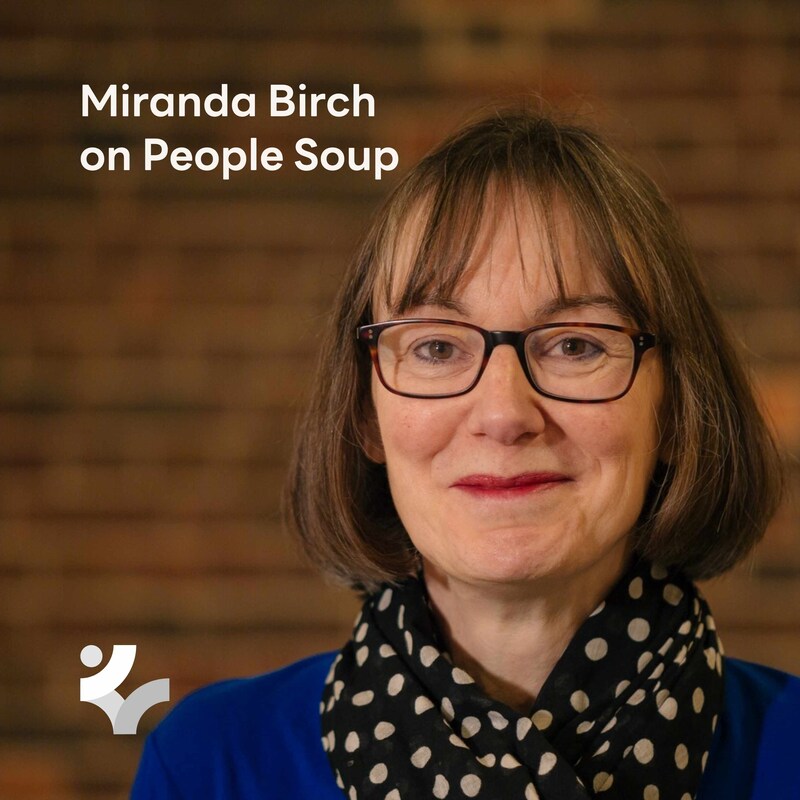
In this episode of People Soup, Ross McIntosh talks with Miranda Birch — former BBC journalist and founder of The Richest Conversations — about the power of listening and why better conversations can transform how we work together.
Drawing on her career in broadcasting and interviewing, Miranda shares what journalism can teach us about communication at work, leadership conversations, and creating the space where people feel heard and understood.
Ross and Miranda explore:
- Why deep listening is becoming a rare skill at work
- How great interviewers build trust and rapport quickly
- What leaders can learn from broadcast journalism techniques
- The connection between conversations, confidence, and wellbeing
- How simple moments of connection — even saying hello — can have a powerful impact.
You’ll also hear Miranda’s reflections on growing up surrounded by radio, her journey into the BBC, and how curiosity and listening shaped her approach to storytelling.
If you’re interested in better communication at work, leadership skills, coaching conversations, or workplace wellbeing, this episode is packed with insights you can use straight away.
So get a brew on, settle in, and enjoy part one of Ross’s conversation with Miranda Birch.
About People Soup
People Soup is a podcast that mixes stories, science and a sprinkle of daftness to explore what helps people thrive at work and beyond. Drawing on behavioural science — especially Acceptance and Commitment Therapy (ACT) — Ross shares practical ideas to help you build a better work life.
- Connect with Miranda on LinkedIn
- The Richest Conversations – Helping your organisation to make more impact, through the voices of its founders, teams and clients
Here's the People Soup Website.
And you can subscribe to the People Soup YouTube Channel here.
Visit Ross' Website.
Connect with Ross on LinkedIn
People Soup on Instagram which also features plenty of Ross' photos of the Andalusian life.
Transcripts
Miranda: you might have gathered that I'm big on learning. so I think the thread through everything I've done, whether it was local radio or BBC radio four, or now where I'm talking to business owners or their teams or leadership teams, it is that privilege of having a conversation diving deep quite quickly, entering their world because obviously I can be with people from lots of different sectors. So I think there's the learning bit and what I love is when, as a result of that conversation, and you might see this too in your coaching practice, where you see a light bulb moment go off in the person you are talking to because you've given them the space to retrace their story and then suddenly they see their work in a a different light.
you at work? Not the kind of [:Because when that happens, something interesting often follows. Ideas sharpen, confidence grows, and sometimes people even see their own work or themselves in a completely new way, and that's exactly what today's guest helps people do. In this episode, I'm joined by Miranda Birch, a former BBC journalist who now helps organizations create what she calls the richest conversations.
file and feel more confident [:They help people learn. They help voices be heard, and they help organizations uncover the stories and insights that might otherwise remain hidden.
you'll hear Miranda reflect on growing up with radio in the background, her journey into journalism at the BB, C, and how interviewing people across very different worlds shaped the way she thinks about listening. We also explore what broadcast journalism can teach us about better workplace conversations.
some lovely insights in this [:
Ross: Miranda Birch, welcome to People Soup.
Miranda: It's really lovely to be here. I love the title of your podcast as well. I love it.
Ross: Oh, thank you. Thank you so much. Now, Miranda, in my podcast, I have a little section from my research department who've been doing a bit of digging about you and finding out stuff about you. So I'd like to present what they've found, and they're not always a hundred percent accurate, so please just keep an ear out about what they've discovered. So it says here, Miranda works with two kinds of people, marketers who are under pressure to do more with less and need smarter ways to create video content about their customers and colleagues and founders who want to raise their profile, grow their business, and feel more confident on camera. How does that sound as a summary of,
Miranda: That sounds good
Ross: [:Miranda: Thank you. Well done a hundred percent so far.
Ross: Miranda's approach is shaped by a career spelling both the B, B, C, and the business world. And she has gathered this wisdom into an approach called the Richest Conversations. This uses broadcast journalism techniques and helps people capture short, authentic conversations that create warm, memorable marketing content that audiences genuinely connect with. The result is authentic stories, relevant insights, and a surprising amount of high quality video content created in a very short space of time.
Miranda: Good. Well done. Research department.
Ross: department thought they were, They were pretty delighted, Miranda. They really thought they were onto something and they thought you were the author. Of classic titles such as Naked Captive, A Summer of Suffering, and Breaking Him In New Slave from Mistress Lucy
Miranda: The that right at the start.
Oh [:Ross: Yeah, with a little bit more looking, not too much. They realized it wasn't you because this author, the other Miranda Birch, specializes in books about dominance and submission, but I just thought I'd double check.
Miranda: Yes, you can double check and if anyone wants to link up with me on LinkedIn, you'll notice my last line is about the other Miranda Birch, who, oh, I dunno if you want this story of how I discovered her. But anyway, I did discover her and it's, it's really the fact that I do want you to dominate your niche or your career, but not in the way the other Miranda Birch means.
So yes, just to be clear, I'm not she or they or him
. Maybe some pivotal moments [:So I think it began with my father who was a print journalist. So he worked in what was known as Fleet Street in the 1960s and seventies. so Fleet Street, for international listeners was a road with really big, well-known British newspapers. It's, it's all changed now, but he worked for the Sunday Telegraph and The Daily Telegraph, and he said quite early on to me, Miranda never become a journalist and.
Being a rebel, I, I did decide that I wanted to become a journalist, but not in the end in print journalism. I, I chose the, the BBC, and I think that was partly because I was, I grew up in a household where we did watch telly, but we did listen to a lot of BBC programs and my father worked on a weekend newspaper.
o sit with me and listen. So [:pivotal moments, shall I give you
Ross: Oh, yes, yes.
Miranda: So I, I ended up doing a, a French degree and spent a year in France and during that year I, I joined, radio Dijon Compus, where I, I did a quiz called Brain of Burgundy, which was really a ripoff of a quiz on Radio four called Brain of Britain. And looking back, I found some of my old scripts, I cannot believe what torture.
I put these very high flying students through like untangling. rhyming cockney slang and deciphering faux ami French, which are words that sound very like the British word, like, which you might think is library, but actually it isn't. It's a bookshop. Just really challenging quizzes, which they battled their way through.
of enabling others to learn [:Little rectangular things. I came from an analog industrial age of radio and I sent them all in the post and BBC radio, Sussex asked me to come and visit them, and I got a freelancing position for about five pounds a week as it was then in the late eighties. So it was very free in the freelancing world.
And eventually I became a presenter on that radio station. But the thing I really love was interviewing people, entering their worlds, finding out about how they built their businesses or their charities or, you know, taking me around different parts of Sussex. That's what I loved, that sort of learning.
So that [:Ross: Yeah. Thank you. And just maybe just pause there. And I'm curious about growing up listening to the radio I did too. My mum always had Radio four on in the background, and I used to listen to Woman's Hour and. The arches and the comedy on Friday night. I used to try and stay up late for that. But what, what was it that sort of captivated you about that?
Miranda: That's a very good question, I think. It was the fact that you could use your imagination, I suppose that is a cliche, isn't it? But when, so you talk about comedy programs on Radio four, like, sorry, I haven't a clue. And I just, I couldn't see the speakers, but they were quite cheeky. and you could sort of sense that through the laughter and you could almost see the expressions on their faces, hear them smile, and then the pausing.
using on the human voice and [:So I think that's what I loved about radio as well as the fact I could do other things alongside it, you know. Gardening or ironing or doing the washing up, what, whatever it was. my multitasking side quite likes that, that I'm learning even when I'm doing something mundane.
Ross: and, and you talked about Listen With Mother, which I remember too, but I also remember, do you remember something called Music and Movement?
Miranda: I don't, I'm sorry, I don't.
d I, it was really formative [:Miranda: Yes, yes. Actually, you talking about acorns into oak trees, I'm sure I probably did hear that episode or something similar because I do remember unfurling myself
with my hands raised to the ceiling.
Yes,
Ross: so you talked about being a bit of a rebel and your dad saying, don't go into. Journalism and, and you did. Are there any other ways that this rebellious side of Miranda manifested itself?
ite rebellious, challenging. [:Called Desert Island dis on BBC Radio four, which if you're based in the UK you you might know it's it's premises. You are cast away on a desert island. These are famous politicians and business people. And, you are le only left with eight records from your life. So you have to choose very carefully which eight records, h songs summarize different parts of your life.
ine and science fascinating. [:You, you know, and I think they felt I was a, a rebel. I was featuring things that weren't usually featured. so I think I have a tendency of questioning, trying to look for gaps in things. Maybe voices that are sidelined, are or overlooked with the best, best possible intentions. I, I don't mean to be critical of my lovely old program, but you know, it's just finding gaps
and therefore that can be quite challenging.
For people, certainly when I was on feedback, I had to defend, defend my position and explain why I chose the guess I did,
Ross: . So any, any other pivotal moments? So there was this moment when you were in France. How did, how did that come about?
ree, part and parcel of that [:I just love immersing myself in other worlds. And obviously when you speak a foreign language, as you all know, having moved to Spain,
you have to reach a level of fluency in order to develop friendships and relationships if you, if you can. And I'd love doing that. I love the learning around that and actually getting to know people and understanding where they came from and their culture.
So the impetus of that was my studies, but I built on that. Yep.
Ross: Anything that stands out that you discovered about the the French culture or the way of life?
there for these two years in:Again, it sounds like a cliche, but I still, I now live in Brussels and what I am. Amazed at, and I know Brussels is in France, but I think there's a similar mindfulness about going into a small shop and spending maybe 10 or 15 minutes discussing what sort of cheese you might want for the weekend and different tastes of your guests or going into a butcher's and discussing different cuts of meat.
fork and all of that sort of [:You know, if you've got the money to afford them, that just make a difference. Things that you might often overlook, but actually appreciate if you stop in a shop and discuss the finer, the finer details of, you know, a particular vegetable or whatever it is. I just, just like that. I like that in the present feel on.
tly it's probably because my [:It's, that's when the real conversation starts. And,
Miranda: I love that.
ow this thing where they say [:Miranda: No, because you've got to talk as you digest evidently, which could take as long as the eating bit.
Ross: Yeah, and it's, it's the appreciation of the art of conversation. I think that the, the Spanish really embrace whether it's a, a, a, story, whether it's a, a tall tale, whatever it might be. It feels like people are genuinely interested in each other and listening to each other a bit more. It can be deceptive 'cause sometimes it feels like everyone is talking at once, but I think that's just a function of, but in an environment where it's not your mother tongue being spoken. So not sure where I'm going with that. It's just, it's just interesting to think about the different cultural approaches to conversations.
ur description of wanting to [:grab and go.
Ross: Hmm.
Miranda: I was just wondering, do they, are you lad your phones on the table when you are eating out in a Spanish restaurant?
Is that part of the thing?
Ross: Yes. People might even check their phones. it, it doesn't seem to be that they're not permitted or allowed, perhaps they're not as glued to them as they might seem to be in a, in a UK environment. This could be a bit rose tinted spectacles, I think, because I would say possibly with younger people, you might look at a table in a, in a cafe or a bar and everyone is talking and on their phones. So I'm not sure about that. I don't have any definite conclusions on that.
films they were watching, it [:Like they would dissect the characterization and the angles of the film and different scenes. yeah, so I think there's the willingness to talk about things in granular detail, whether it's food or film, which reflects what you are saying as well. It's that diving in really diving in wholeheartedly, investing in that moment.
Ross: Mm-hmm. So, thinking back to your career, what, what drives you in, in what you do now?
Miranda: Well, you might have gathered that I'm big on learning. so I think the thread through everything I've done, whether it was local radio or BBC radio four, or now where I'm talking to business owners or their teams or leadership teams, it is that privilege of having a conversation diving deep quite quickly, entering their world because obviously I can be with people from.
I think there's the learning [:And I always get a feel of yes,
not that I'm competitive, but it's just that's what rewards me is seeing that, because I know they'll go away from that conversation and something will stay with them because of that moment. I think as well, there's quite a bit around confidence, so I. I love interviews.
When I was a presenter, I wasn't a natural presenter. I was quite awkward. I just used the presenting bits as stepping stones to get to my next interview. And if I'm in a meeting, I will still often take my time to say what I think. And I think it's a lack of confidence, which over time I, I've got over.
ld tell the people that were [:So that thread of confidence of feeling respected enough to be able to share their view. Because they, everybody has a right to share their view. I think that's come through some of the projects I've done as well as, you know, since I've left the BBC, including one where I did work in Kent interviewing people who were facing very, very big challenges, unemployment, or.
nt to them. And I found that [:So that's around confidence building, you know, giving people the right to, to, to share their voice. So I think linked to that is that feeling of justice and trying to raise the profile and raise the voices of people who might otherwise be overlooked. I think that's quite strong in my values. So whether that's being more egalitarian, being more even handed, fair dealing, yeah, that means a lot to me as well.
cause it's, I guess what you [:Miranda: So I think one of the things, it's very basic before you meet somebody is doing your research on them,
as you did on me and my, and my namesake. only because then you might find connections, things in common, whatever it is. You know, you spotted something they said and you immediately demonstrate that you've taken time.
vel, it's about, no, I'm for [:I'm wholeheartedly here and I'm going to be with you for as long as it takes. I'm not getting up and going. And that sense that someone is settling in to listen to you is really, really important. And you, and as you know as a coach, you can demonstrate that in different ways. In fact, you've been doing it during this conversation referring back to things that they've said which Proves to me that Ross has been listening to me right from the start. But those little, those little things referring back or recapping or reacting in your body language or mirroring all those things, gently remind the person who's opposite you that you truly are listening to them. And I feel in this world where people are often looking at their phones, that's even more powerful.
that sense of appreciative, [:Tell me more, which is what you do naturally in your coaching.
May I say?
Ross: Yeah, and you're absolutely right. You know that I think it's a rarer thing these days to be, to be heard and to be, to have someone you're speaking to, who, who is. Actively listening and not listening to, to respond, but listening to understand or appreciate. It's, it's something that's not really afforded to us sometimes in everyday interactions.
'cause even in close friendships, I think if I'm describing something to a friend, the tendency could be that they come back and said, oh yeah, that happened to me and it was much worse for me. It's almost like a, a competition. It's not particularly helping.
Miranda: Alan Alder, the actor, does a podcast and he describes it as dueling monologues, which I really like.
guess we're also looking to [:Miranda: So the. The project I talked about going to Kenton and talking to people about just little acts of wellbeing. In fact, I was, I was doing some clearing out and I know, I know we're not visual, but I'll just, you, I'll flap it and you can hear I've got the original, poster that was part of this campaign called Six Ways to Wellbeing.
You might have heard it as Five Ways to Wellbeing, which are little things that we do every day, sometimes without even stopping to think about it. being active, you know, taking the stairs, doing a little walk, keep learning, giving. So that might be giving someone a compliment or giving someone time, not getting up and going at the end of a meal, but just sitting with them and listening, connecting with people, saying hello to your neighbor saying, how you doing to the person in the shop that's serving you.
Taking notice, being [:But then you are also connecting with people through that conversation. So that's another way to wellbeing because you are giving them your time and that refers to give you are, you are affording them the space to share their ideas. So conversations I think, encompass quite a few different ways to wellbeing, which are recognized by public health institutes all over the world.
nstorming or whatever it is. [:And as part of a good meeting, people come up with ideas, and if you are a good facilitator, those ideas will be appreciated and they spark somebody else's ideas and goodness knows where that leads to. Well, I would say enhanced wellbeing for organizations and the people in it. But yes, that's why I love conversations and that's why I love that particular project around the five or six ways to wellbeing, because that's really important to me.
And by chance I realized that having those conversations can feed all those different aspects to wellbeing.
Ross: Oh, it's so lovely to hear you talk about the the five or six ways to wellbeing. 'cause it's something I used to discuss with my dad
Miranda: Oh, did you? particularly during the pandemic.
n did a podcast episode with [:And I just think, I just think that's such a beautiful thing. I'm not sure how it would go down in the UK though.
Miranda: No, I'm laughing because probably people will be shaking their head and go, right, avoid, avoid the gaze. Don't look, don't look at this person.
Ross: Yeah. Who's this Nutter? Yeah.
Miranda: But it is around humanity, isn't it? And I think AI and all the fears around that means those moments of humanity and connection. Are becoming even more important, whether it's in the workplace or in a restaurant. I also went to an interesting talk, and I cannot remember the name, but I'll send you the name, who was saying how, you know, as libraries closed, particularly during COVID or Parks, closed, all those spaces for the incidental hello and striking up of conversation with a stranger.
d go off feral and strike up [:But you know, that sort of incidental connections, often flourishing thanks to children, but between adults that's become. Less easy or li libraries when, when did I last go to a library, you know, and be looking at a book and ask somebody's advice about, have you read this one? You know, it's those spaces that seem to be on the decline.
So if we can resurrect those. Serendipitous, Moments of hello?
Ross: Yeah. And it's something my mom and dad used to rib me about when they used to come and visit me when I was in South London or in Brighton. And we'd go into London and I'd tell them, please don't speak to people on the tube. They'll just think you're weird. And most of the time they abide it by my terrible rules.
imes they just start talking [:Miranda: Yes. But then once, I imagine once they'd taken the compliment about the bag, so that's yet more giving and connections, they probably came away and went back home and said, do you know we met this lovely couple from the northeast on the tube, because suddenly it flips from, ooh.
Ross: Yeah.
Miranda: Let's dismantle that convention too.
Oh wow. That actually made my day. And that's the thing about wellbeing and the five ways to wellbeing those fleeting things. That's what I love
Ross: Do you think humanity is in trouble from the lack of connection and from everyone on their phones?
da: personally. Yes. But I'm [:Ross: Lovely.
Miranda: in relation to a lot of things that's going on, going on in the world at the moment, to be honest.
but then we have control over that when, you know, in the workplace as well, we can. We can tell ourselves we are extraordinarily busy. That is true, but from my experience of maybe even just having 30 minute conversations with people in that sort of wholehearted way and stopping, and as you say, pressing the pause button, actually that can deliver so much in terms of insight that people are now embracing that a bit more and realizing how useful that is to pause
in order perhaps to go faster later.
But you do need to stop[:for all sorts of reasons.
Ross: I described it the other day to a client like it's, imagine you're on a travelator at the airport and it's going at faster speed than usual. Sometimes a coaching session or a training session is like stepping off a. Quite fast travelator and you're kind of a bit disorientated and kind of trying to get your balance and it's, and it can take a while to land in a different environment. Oh, I'm glad to hear about your daughter. That's, that's, that's encouraging. I'm hoping that that's replicated
Miranda: But I suppose it's just one, one example. But I have had conversations with people saying. Actually it's going too far. We need to, well, you can't stop the a AI world and get off, but you can make time, you know, as you were saying, to walk into a restaurant and say hello or spend time after a meal talking to people.
You can, there are little habits I think you can shape
Ross: Hmm.
sarily take up too much time.[:Ross: Exactly. Habits and choices we can choose to do things even if it feels a bit odd or uncomfortable. Now thinking about where you are now and thinking back to young Miranda at school, is there any advice you would offer young Miranda in in a school days?
Miranda: So I was the quiet one in a classroom and even now I think. Disagreeing, dissent, often fearful about that, but also learning actually, if you voice your opinion, which is different to the person on the receiving end, if you do it in a way that's respectful, actually that can lead a, it helps you because you've vented whatever you need to vent.
I think that's prevented me [:But yes, had I known that when I was younger, that dissent and disagreeing, even though I was a rebel, I don't think I was that much of a rebel, to be honest, Ross. But you know, just. Just that fact of voicing something that other people might not agree with wasn't the end of the world.
Ross: Yeah. Thank you. And a people soup feature that has some connections to Desert Island desks, as we've talked about earlier. Is choosing a song, a song choice, that would announce your arrival in a room, not forever, but for the next few weeks, whether it's a virtual room or a real room. Have you any thoughts on what your song would be?
Miranda: Yes, so it would be on a rotation. The current song would be Alberoni Sung by Baxter Dury.
really like it partly 'cause [:So I like music that's got a real rhythm and uh, I dunno if you know Baxter Durry, he son of Ian Durry part of the punk movement in the seventies. Someone I grew up with when I was 14. Bought one of his singles. It was full of rather rude words, but at 14 it seemed right at the time.
And his son, also has a lovely way with words and Alberoni is actually all bar one stuck together.
And it's a song about being stuck in all bar one, having met somebody very hopeful about a relationship, hopes are dashed and he's stuck in all bar one, but he calls it abalone.
And I just love that play on words and the fact it's quite fast moving.
everything. But I also like [:recently. I know. So I like that sort of thread. He carried on the family business and I'm, I'm big on threads in people's narratives. So many reasons for that.
Speaker: That's it folks. Part one of my conversation with Miranda Birch in the bag. In this first part, we heard how Miranda's love of listening began from childhood radio programs to early broadcasting experiments in France to producing and interviewing at the BBC. And we explore something that feels increasingly rare in modern workplaces, the power of giving someone your full attention.
about how conversations can [:in part two, we'll go deeper into Miranda's approach to creating what she calls the richest conversations and what leaders, communicators and organizations can learn from the craft of interviewing. You'll find the show notes for this episode at People Soup Captivate fm or wherever you get your podcasts.
And if you found this episode useful, please do share it with someone who might benefit from a reminder about the power of listening. Thanks to Andy Glenn for his Spoon magic and Alex Engelberg for his vocals. But most of all, dear listener, thanks to you. Look after yourselves. Pay supers And buy for now.
Miranda: so I think there's [:


