Shownotes
Audio • Season 1 • Episode 6 • Series 1 Episode 6 - Elizabeth's Religious Settlement.
© 20 26 The Rise of the Protestants., Author, Shaughan Holt.
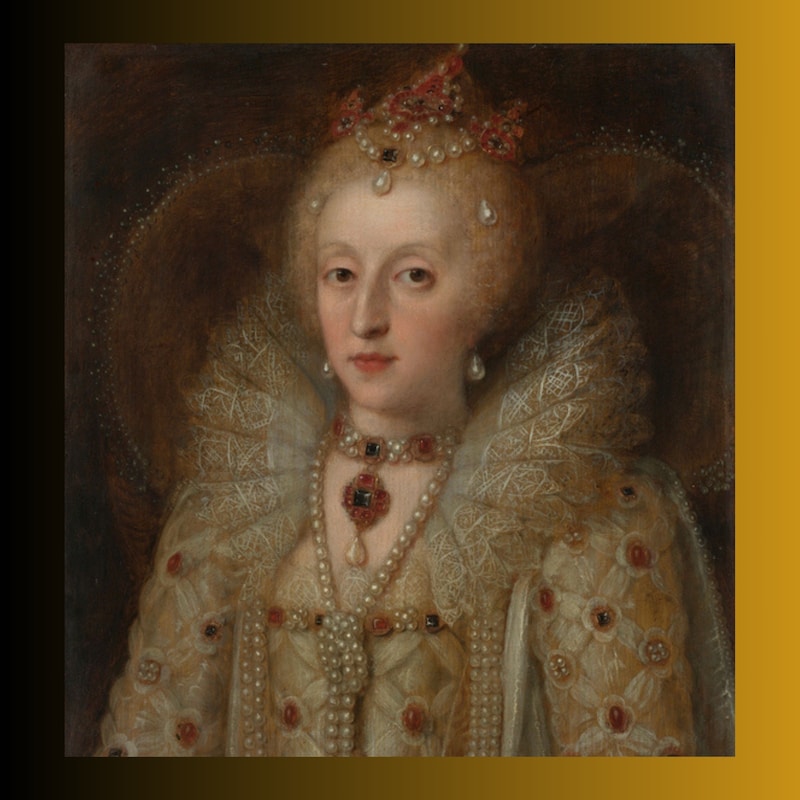
The Artwork isa Portrait of Elizabeth I, Queen of England, by anonymous Artist.
It location is The Rijks Museum, Amsterdam.
The Music is The Volta, a couples' renaissance dance.
The Protestant exiles, who had fled Mary’s revived heresy laws and executions, were beginning to return to England and campaign for ecclesiastical reforms.
They sought to recreate the pattern of church life recorded in Scripture without vestments and prelates such as cardinals, abbots, or bishops.
When Elizabeth became Queen, she worked with the Privy Council, intending to devise a religious settlement that would unite the country under a single Church.
The Elizabethan Religious Settlement, introduced in 1558, aimed to bridge the gap between Catholics and Protestants and address the variations in their religious services and beliefs.
It attempted to make England Protestant again, without alienating a population that had
previously supported Catholicism under her sister Mary.
Heinrich Bullinger was a Swiss reformer and theologian; he succeeded Ulrich Zwingli as head of the Zurich church and pastor at Grossmünster.
His publication “The Decades” was the most famous of the 150 treatises and manuscripts he wrote.
© 20 26 The Rise of the Protestants., Author, Shaughan Holt.
"All rights reserved. No part of this podcast may be reproduced, translated, distributed, or transmitted in any form or by any means, including photocopying, recording, or other electronic or mechanical methods, without the prior written permission of the copyright holder, except in the case of brief quotations embodied in critical reviews and certain other non-commercial uses permitted by copyright law".
Requests regarding translation, licensing, or republication should be directed to: [email protected]
Your feedback matters, send me an email at [email protected], with any comments, suggestions, or criticisms.I read every message.
Transcripts
© 20 26 The Rise of the Protestants., Author, Shaughan Holt.
"All rights reserved. No part of this podcast may be reproduced, translated, distributed, or transmitted in any form or by any means, including photocopying, recording, or other electronic or mechanical methods, without the prior written permission of the copyright holder, except in the case of brief quotations embodied in critical reviews and certain other non-commercial uses permitted by copyright law".
Requests regarding translation, licensing, or republication should be directed to: [email protected]
Your feedback matters, send me an email at [email protected], with any comments, suggestions, or criticisms.I read every message.
Series 1.
Episode 6.
Elizabeth's Religious Settlement.
The year is 15 58.
From 15 53 to 15 58, Queen Mary conducted a systematic campaign, which resulted in the execution of hundreds of Protestants, many of whom were burned at the stake.
Her actions, added, to rising resentment among the populace, particularly in light of her unsuccessful war against France, which ended in January 15 58 with the loss of Calais - England's last stronghold in France.
From May 15 58, Queen Mary began to suffer from serious health issues, characterised by persistent abdominal pain.
She passed away at St James's Palace London, on 17 November 15 58, at the age of 42, during an influenza epidemic.
In her final testament, Queen Mary had expressed her desire, to be interred alongside her mother, Catherine of Aragon.
Spanish-born Catherine had spent the final years of her eventful life in exile, abandoned by her husband, Henry VIII, because of the King's quest for a legitimate son and heir.
Catherine died on 7 January 15 36 at Kimbolton Castle at the age of 51, and was interred at Peterborough Abbey.
Her burial site reflecting her status as a Princess of Wales, rather than that of a Queen.
King Henry did not attend the funeral of Catherine, and prohibited their daughter Mary, from taking any part in the ceremony.
Gravely ill, childless, and deserted by her husband Philip, Mary’s hopes for a Catholic England, died, with her.
Despite Mary's final deathbed request, Queen Elizabeth decided to have her interred in Westminster Abbey, in a chamber they would ultimately share.
The Puritan movement in England started in the 15 30s, but the term "Puritan" did not appear until the 15 60s.
The movement grew during Queen Elizabeth's reign from 15 58 to 16 03, despite facing political suppression in the 15 90s.
The Puritans, sought to eliminate the influence of Roman Catholicism, pushing for a unified Protestant church that adhered closely to the teachings of the Bible and the principles of Reformed theology.
During the reigns of James I, (16 03-16 25), and Charles I, (16 25-16 49), the divide between Anglicans and Puritans grew wider.
These conflicts ultimately led to the English Civil War (16 42-16 51), the short rule of Oliver Cromwell as the Puritan Lord Protector of England (16 53-16 58), and the establishment of the English Commonwealth (16 49-16 60).
The year is 15 59.
Elizabeth's coronation took place on Sunday 15 January 15 59.
She was carried through London's streets, filled with cheering crowds on a golden litter, following a magnificent day-long celebration.
The ceremony was held at Westminster Abbey, and was a compromise between existing Catholic customs and the new Protestant practices that the Queen aimed to establish.
During the coronation, Elizabeth was crowned by a Catholic bishop, who read parts of the service twice--once in Latin and once in English.
These and other changes, made prior to the establishment of her Religious Settlement, will have given a clear indication, of what to expect in the future.
They demonstrated, a deliberate strategy of gradual religious change, embodying her phrase - 'making haste slowly'.
The full proceedings of a coronation during medieval times, including those of Elizabeth and later monarchs, can be divided into four main parts:
The new monarch must first take possession of the Tower of London, which holds significant importance.
The second stage involves the sovereign’s journey through the city to Westminster, on the eve of the coronation.
The third stage is the coronation ceremony itself, held in Westminster Abbey, which includes a grand procession to the abbey.
Finally, the fourth stage is the banquet that takes place in Westminster Hall, after the ceremonies in the abbey.
At that time, it was desirable to invest the new sovereign as soon as possible with the full authority that anointing and crowning conferred.
Mary had died on 17 November 15 58; Elizabeth was crowned in her place within two months.
She had a rapturous reception from London's populace – sick of all the burnings and failures of Mary’s reign – when she rode into the city as Queen.
Following her ascension to the throne, Elizabeth welcomed Edward Grindal back from exile in England, where he succeeded Edmund Bonner as Bishop of London.
Protestant refugees who had escaped the harsh heresy laws and death penalties imposed by Mary were also starting to return to England with a mission to enact changes within the Church.
Their goal was to establish a form of religious life that aligned with the teachings of Scripture, free from elaborate church attire and the influence of high-ranking clergy such as cardinals, abbots, and bishops.
Elizabeth was raised as a Protestant in Catherin Parr's household.
Catherin Parr was born in 15 12, probably in the Blackfriars district of London.
Catherin served as Queen of England and Ireland from 15 43 to 15 47, making her the last of King Henry VIII's six wives and the final Queen consort of the House of Tudor.
She married Henry on 12 July 15 43, and outlived him by one year and eight months.
Catherin had close relationships with Henry's three children, actively participating in the upbringing of her stepchildren, Elizabeth and Edward VI.
She also played a crucial role in convincing Henry to enact the Third Succession Act in 15 43, which reinstated her stepdaughters, Mary and Elizabeth, to their rightful positions in the line of succession to the throne.
Six months after Henry VIII's death, Catherin married Baron Thomas Seymour of Sudeley, her fourth and final husband.
Sadly, their marriage was short lived.
Catherin died on 5 September 15 48, at the age of 36, due to complications from childbirth.
Her funeral service was held on 7 September, and it was later described as the first Protestant burial in England, Scotland, or Ireland conducted in English.
The Religious Settlement.
During the reigns of Henry VIII, Edward VI, and Mary I, England experienced significant changes in its religious practices.
Queen Mary I attempted to restore Catholicism, revoking the Supremacy Acts, which had been introduced by Henry VIII.
However, when Elizabeth the first, ascended to the throne, she collaborated with the Privy Council, to create a religious settlement, aimed at uniting the country under a single Church.
The Elizabethan Religious Settlement, implemented in 15 58, sought to reconcile the differences between Catholics and Protestants, and address their varying religious practices and beliefs.
Her intention was to return England to Protestantism, while avoiding alienating a populace that had previously embraced Catholicism during her sister Mary's reign.
The Elizabethan Religious Settlement was composed of the following principal elements:
• The Supremacy Act, establishing Elizabeth as head of the Church of England.
• The Act of Uniformity, setting out the appearance of Churches and services whilst banning the Mass and its ceremonies.
• The Royal Injunctions, consisting of 57 regulations, actively governing Church matters, requiring preachers to be licensed and the banning of pilgrimages.
• The 15 59 Book of Common Prayer.
• The Thirty-Nine Articles, an attempt to define English Protestantism.
The Elizabethan Prayer Book, commonly referred to as the 15 59 Book of Common Prayer, was the official liturgical book, used by the Church of England during the Elizabethan era.
This publication played a crucial role in shaping the religious practices of the time.
The current official liturgical book, used by the Church of England, is based on a revised edition, known as the 16 62 Book of Common Prayer.
This revision draws heavily from its predecessor, and has remained in use ever since.
William Cecil, the first Baron Burghley, was born on 13 September 15 20, in Bourne Lincolnshire.
Cecil was a prominent English statesman, who played a crucial role as Queen Elizabeth’s chief adviser, throughout much of her reign.
He held several influential positions, including Secretary of State and Lord High Treasurer.
He identified the following as the primary goals of English foreign policy:
• To create a united and Protestant British Isles.
• To establish complete English control over Ireland and form an alliance with Scotland.
• To protect England from invasion by building a powerful Royal Navy.
William Cecil, played a significant role in the 15 59 Religious Settlement, an achievement that mirrored his Anglican theological beliefs.
Like most of the population, he would grow more Protestant as time wore on, happier to persecute Catholics rather than Puritans, and having no love for ecclesiastical jurisdiction.
Despite encountering resistance from extreme factions within both the Catholic and Protestant groups, several aspects of the Settlement endured.
These included the substitution of altars with communion tables, the use of the English language, and the prohibition of traditional mass services.
These elements, continued to be observed in the following centuries, and still have a visible impact within the Anglican Church today.
Martin Bucer, a key figure in the German Protestant Reformation, was born on 11 November 14 91 in Alsace, France.
Initially, Bucer joined the Dominican Order, but under the influence of Martin Luther in 15 18, he arranged for his monastic vows to be annulled.
He then relocated to Strasbourg, where he began his work in the Reformation.
Although he may not be as widely recognised as contemporaries like Martin Luther and John Calvin, Bucer played a notable role in the early stages of the Protestant Reformation.
His contributions significantly shaped the development of Lutheran - Calvinist and Anglican beliefs and practices.
As a former Dominican priest, he worked as a pastor - scholar - preacher - reformer, and diplomat, and was instrumental in initiating and stabilising reforms throughout the Holy Roman Empire.
While in Strasbourg, he drafted Church orders, liturgies, and catechisms, worked with prominent intellectuals, and served multiple parishes.
After the Schmalkaldic War ended in 15 47, Emperor Charles V launched a divisive campaign aimed at reintegrating Protestants into the Catholic Church.
As a result, many Protestants began to retreat from the Holy Roman Empire out of fear for their safety.
The Schmalkaldic League, was a defensive alliance, formed by Protestant territories of the Holy Roman Empire during the Reformation, to defend themselves collectively against any attempt to enforce the recess of the Diet of Augsburg in 15 30, which gave the Protestant territories a deadline by which to return to Catholic practices.
Established in February 15 31 at Schmalkalden Germany, the league was led by Landgrave Philip the Magnanimous of Hesse and John Frederick-the-first of Saxony.
Brunswick, Anhalt, and the cities of Mansfeld, Magdeburg, Bremen, Strasbourg, and Ulm were also among its other original members.
Despite receiving multiple offers of sanctuary from Wittenberg and Geneva, Bucer, ultimately chose to accept Archbishop Thomas Cranmer's proposal, to travel to England.
Bucer, along with Paul Fagius and others, arrived in London on 25 April 15 49, where Cranmer welcomed them with full honours.
A few days later, Edward VI and his court were introduced to Bucer and Fagius.
Paul Fagius was a scholar of Biblical Hebrew during the Renaissance and an advocate for Protestant reforms.
He died of the plague, shortly after arriving in England, 15 49, after briefly being active in Hebrew philology and Old Testament interpretation.
His friends buried him in St Michael's Church Cambridge.
Meanwhile, Bucer, who was also in declining health, dedicated his last two years to lecturing at Cambridge, and aiding Thomas Cranmer in his revision of The Book of Common Prayer.
Bucer, originally from Germany, served as a clergyman in Strasbourg for twenty-five years, and died in Cambridge on 28 February 15 51 at the age of fifty-nine.
He was an asylum seeker, due to his religious beliefs, yet he struggled with the English language and did not particularly enjoy the English climate or cuisine.
Despite these obstacles, Bucer secured the role of Regius Professor of Divinity at Cambridge University from December 15 49 forward, and all official correspondence was conducted in Latin.
Archbishop Thomas Cranmer appointed the German to this role.
King Edward VI and a host of other English evangelicals of that era endorsed his selection.
There is a small brass plaque, set into the chancel floor of Great St Mary's Church, situated in the heart of Cambridge.
Its Latin inscription, coupled with its unassuming location and diminutive size, doesn’t exactly make it a crowd-puller for tourists.
However, this marker honours one of the key reformers of the sixteenth century: - Martin Bucer.
In his work "De Regno Christi," or "On the Kingdom of Christ," Martin Bucer outlines his vision for the Reformation, of both the Church of England and the government.
He argues that the Reformation should impact all aspects of society, not just the Church.
Bucer was deeply concerned about the social conditions in England, and strongly advocated for Deacons to assist the poor and needy.
He also viewed marriage as a social contract, which should allow for divorce when necessary.
His vision for society, emphasised Christian discipline, guided by a firm and authoritative approach.
Shortly after completing his book, Bucer fell ill and passed away on 28 February 15 51.
His funeral took place at Great St Mary’s Church in Cambridge.
Years later, following Queen Mary's ascension to the throne, a trial was initiated against Bucer and Fagius, with accusations of heresy, as part of her attempt to restore Catholicism in England.
They were declared guilty, posthumously, and Queen Mary ordered their graves to be exhumed, along with the incineration of their remains and their books.
And so, on 6 February 15 57, the long-dead bones, of the Protestant theologians Martin Bucer and Paulus Fagius, were sent to the stake.
On 22 July 15 60, Queen Elizabeth formally rehabilitated both reformers.
A brass plaque on the floor of Great St Mary’s Church, marks Bucer’s grave's original location.
In contrast to the prominently displayed tribute to Latimer Ridley and Cranmer in Oxford, Bucer’s bronze marker is not easily visible.
This lack of visibility also reflects Bucer’s influence on Anglican evangelicals.
Nevertheless, it is important to take a moment to acknowledge our debt to Bucer, and to express gratitude for his contributions and service.
The year is 15 59.
Power rests in the hands of the Archbishop.
Matthew Parker was born on 6 August 15 04, in the parish of St. Saviour in Norwich.
He studied at Corpus Christi College in Cambridge and was ordained as a priest in 15 27, during which time he developed a sympathetic view of Lutheranism.
Parker served as the dean of a college of priests in Suffolk, and on 4 December 15 44, following Henry VIII recommendation, he was elected master of Corpus Christi College.
In addition to these roles, he served as Henry VIII's chaplain and held the significant position of vice-chancellor at the University of Cambridge from 15 45 until 15 49.
Queen Mary had compelled Parker to resign and withdraw from public life, but after Elizabeth’s coronation, he was recommended for the position of Archbishop of Canterbury.
The unsettled conditions and the executions before Elizabeth’s succession however made it challenging to locate the four Bishops willing and suitably qualified to consecrate him.
Despite these circumstances, he was chosen for the position of Archbishop.
Matthew Parker was elected on 1 August 15 59.
The ceremony did not take place until 19 December, and was conducted at Lambeth by William Barlow, formerly Bishop of Bath and Wells; John Scory, formerly Bishop of Chichester; Miles Coverdale, formerly Bishop of Exeter; and John Hodgkins, Bishop of Bedford.
Archbishop Parker, was responsible for overseeing the revision of Archbishop Thomas Cranmer's forty-two doctrinal articles from 15 53.
The Archbishop of Canterbury plays an important role, as the leading bishop and primary representative of the Church of England.
In addition, they act as the symbolic leader of the global Anglican Communion, and serve as the bishop of the Diocese of Canterbury.
The year is 15 60.
While the Elizabethan Settlement was generally well-received, significant minority groups, expressed dissatisfaction, with the state of the Church of England.
The demand for "further reform", during the 15 60s, would lay the foundation, for what we now call the Puritan Movement.
The Puritans, found both the Anglican Settlement and the established Church unsatisfactory.
They called for more reforms within the Church and the State of England, insisting that the Gospels be proclaimed with the same passion and conviction, they observed in the Continental Reformed Churches.
The Puritans opposed the authority of bishops, the mandatory use of the Book of Common Prayer, and several rituals practised by the Anglican establishment, believing these elements to be obstacles to true religion and godliness.
The Puritans aimed, to eliminate all practices and beliefs, associated with Catholic idolatry.
This included, rejecting the Mass, the surplice, kneeling during the Lord's Supper, clerical vestments, engraved images, and indecent theatrical performances, as well as addressing the frequent desecration of the Sabbath.
Their objective was to base these changes on Scripture, rather than on human customs.
The Puritans sought a comprehensive Calvinistic Reformation, and aimed to transform, both the English Church and society.
Queen Elizabeth’s political consultants and court officials had significant connections with Puritan leaders.
Many supported Puritan views on theology, politics, and the English Church's Reformation and society.
Such men in Elizabeth’s court of advisers included:
William Cecil, Chief Adviser to the Queen, Secretary of State, and Lord High Treasurer.
Francis Walsingham, the Principal Secretary to the Queen, and her Spymaster.
Walter Mildmay, Chancellor of the Exchequer.
Robert Dudley, Earl of Leicester, a close friend and one-time suitor to the Queen.
Despite her strong commitment to Anglicanism, Elizabeth relied heavily on these men, for support in reinforcing the Crown, and for personal and governmental advice.
The development of English Puritanism during the Elizabethan era was fundamentally influenced by, four-significant, religious reformers: Calvin, Bullinger, Vermigli, and Beza.
These figures, maintained frequent communication with the English Crown and Reformed leaders in England.
Calvin and Bullinger commended Queen Elizabeth for her efforts in the Reformation and the establishment of the Anglican Church, encouraging the Puritans to exercise patience.
In contrast, Beza was notably more vocal, in his support for the Puritan movement.
Throughout the 15 60s and 15 70s, Calvin's writings became increasingly popular in England, gaining widespread distribution and readership.
Additionally, Beza and Bullinger's works also gained popularity during this period.
Heinrich Bullinger, was a Swiss reformer and theologian, born on 18 July 15 04, in Bremgarten Switzerland.
He led the Zurich Church, and served as pastor at Grossmünster, following in the footsteps of Ulrich Zwingli.
Bullinger became a significant and respected figure, in the Swiss Reformation movement.
He is well-known for co-authoring the Helvetic Confessions, and for his important collaboration with John Calvin, on the topic of the Real Presence of Christ in the Eucharist.
The Helvetic Confessions consist of two documents that articulate the shared beliefs of Calvinist churches, particularly in Switzerland.
The Second Helvetic Confession, completed in 15 61, was solely the work of Heinrich Bullinger.
Bullinger, initially composed this Confession for his own use;-
'As an abiding testimony of the faith, in which he had lived, and wished to die'.
However, events led to its publication, and ultimate adoption, as the Swiss National Confession.
So, what was meant to be a personal declaration of faith, ended up being one of the most universally accepted confessions of the Reformation period.
The Confession is too lengthy for detailed analysis; however, the following summary may provide insight into the breadth of topics covered.
Chapters 1 and 2: The Scriptures and their interpretation.
Chapters 3 to 11: The Doctrine of God; Idols, Images and Saints; The One Mediator; Providence; Creation; The Fall.
Free Will and Man's Ability; Predestination and Election - Jesus Christ, True God and Man.
Chapters 12 to 16: The Law of God; The Gospel; Repentance and Conversion; Justification; Faith and Good Works.
Chapters 17 to 30: The Church and its Only Head; The Ministry; The Sacraments; Ecclesiastical Assemblies; Prayers and Singing; Feasts and Fasts; Catechising and Visiting the Sick.
Burial, Purgatory and Apparition of Spirits; Rites and Ceremonies; Celibacy, Marriage and Domestic Affairs; The Civil Magistrate.
Bullinger’s Confessions, sees the doctrine of Christ as pivotal.
Bullinger's extensive writings, established him, as a highly respected theologian, in England during the Reformation.
Throughout his extensive literary journey, he authored 150 treatises and manuscripts.
Among his notable works is "The Decades," which gained him widespread recognition.
This publication consists of fifty theological addresses, organised into five distinct groups.
Each address is an informative, detailed exposition of an important doctrine, providing an overview of faith and the life of Christian obedience.
The impact of The Decades can be seen in the numerous Latin and vernacular versions of his writings, which had a significant influence on English, Dutch and German-speaking Protestants.
Bullinger's literary works gained immense popularity among English readers, marking the beginning of his writing career.
Between 15 50 and 15 60, printers produced 77 editions of Bullinger's Latin treatise, "Decades," and in England, they printed 137 editions of its vernacular translation.
When it was first published, "The Decades" outsold Calvin's "Institutes" in England, despite both works serving a similar purpose.
Initially, Bullinger's significance during the Reformation was not fully recognised.
However, he would eventually emerge as one of the most influential theologians of the Protestant Reformation in the 16th century.
Bullinger died in Zürich at the age of 71 on 17 September 15 75.
Heinrich Bullinger.
Fifty Godly, and Learned Sermons, divided into five Decades, containing the chief and principal points of Christian Religion, written in three several tomes or sections, by Henry Bullinger, minister of the church of Tigure in Switzerland.
15 77 First edition in English, with a large printer's device on the title page, primarily printed in black letter type.
Imprinted in London by Henry Middleton for Ralph Newberry, dwelling in Fleet Street a little above the Conduit.
Translated out of Latin into English, by H.I. student in divinity.
Throughout Queen Elizabeth’s reign, he was seen as a mentor, to the many English church officials, who had benefited from his generosity.
Elizabeth herself recognised his influence, as vital in countering the stricter Calvinistic Puritans, when supporting Church matters.
Additionally, it was Bullinger from whom she sought guidance, in preparing her response to Papal accusations, when Pius V initiated the final break between the Papacy and the English Church in 15 70.
Historically, Henry VIII implemented several important Catholic principles, through his Act of Six Articles in 15 39.
Violating these principles was considered illegal, and could result in death, as punishment for heresy.
As a consequence, many English Protestants sought refuge in Zurich under Bullinger, to escape religious oppression.
After Elizabeth’s inauguration, many of these displaced individuals returned, bringing with them ideas for reform.
Unfortunately, Elizabeth did not support the specific form of Calvinism they presented.
Instead, she aimed to mediate between the Protestants and Catholics, rather than between the Church of England and the Puritans.
The 39 Articles of 15 63 established the doctrines of Elizabeth's Church, representing a compromise between Roman Catholicism and Protestantism.
Elizabeth rejected the notion of scrutinizing people's beliefs, asserting that there is only one saviour, Jesus Christ, and all the rest is a dispute over trifles.
What she required from her subjects was visible conformity to her directives.
Although not everyone agreed with her proposals, most accepted them as the foundation of their faith.
Today, it is widely acknowledged that her decisions helped significantly reduce religious tensions in England, avoiding the conflicts prevalent in France during the late 16th century.
The Treaty of Berwick, which took place on 27 February 15 60, in Berwick-upon-Tweed, was a negotiation involving the Duke of Norfolk, as Queen Elizabeth’s representative, and the Scottish Lords of Congregation.
Its purpose was to establish terms, leading to an English naval and military presence in Scotland.
The Crown’s primary goal was to remove the French soldiers protecting Mary of Guise’s Regency, the mother of Mary Queen of Scots.
Meanwhile, the Scottish nobility, aimed to expel the French forces, and support the Scottish Reformation.
This conflict, led to the French troops retreating, while they fortified the port town of Leith, against the combined forces of the English and rebel Scots, culminating in the Siege of Leith, on 17 March 15 60.
The French forces, had been stationed in Leith since 15 48, and had been ordered to defend the town, to the last man.
Queen Elizabeth’s secretary, Sir William Cecil, arrived in Leith to negotiate a truce, and it was during this time that Mary of Guise became gravely ill.
Ultimately, the town was not taken by force, and the French troops left peacefully, under the terms of a treaty, signed by Scotland, England, and France.
The siege ended, with the signing of the Treaty of Edinburgh, on 6 July 15 60.
This treaty was pivotal, in ensuring the future existence, of Protestantism in Scotland.
In 15 60, John Knox returned to Scotland, with the support of Protestant leaders, including James Earl of Moray, the half-brother of Mary Queen of Scots.
Knox held a strong belief, in the possibility of achieving a successful Protestant Reformation in Scotland.
Inspired by Calvin's Protestant principles in Geneva, he aimed to bring a similar transformation in Scotland.
He believed that Scotland could achieve the same level of success, by embracing the same level of commitment, demonstrated in Geneva.
