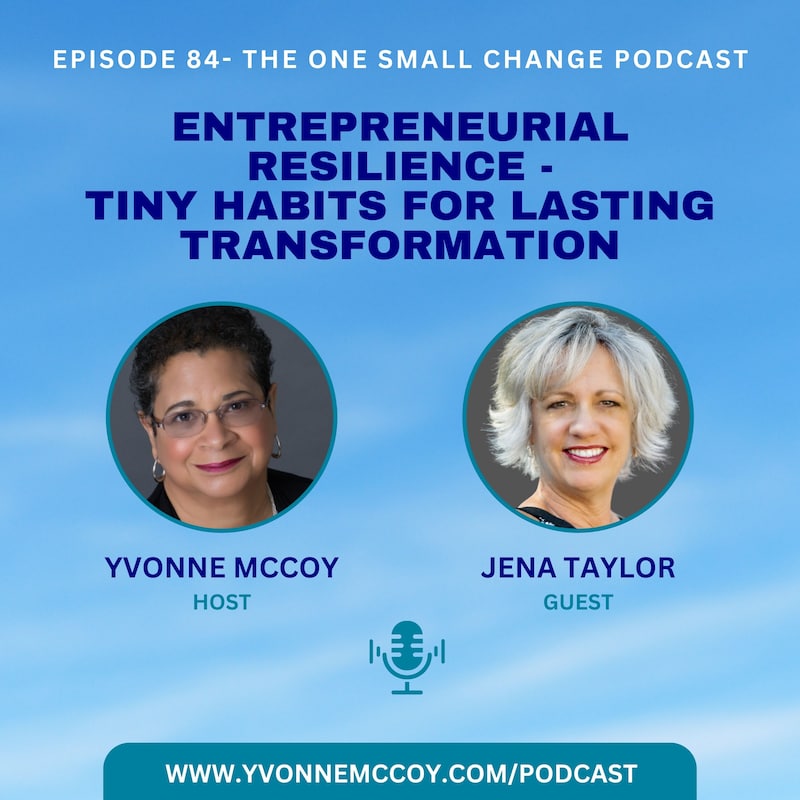
Shownotes
In this inspiring episode of One Small Change, Yvonne McCoy sits down with Jena Taylor to explore the transformative power of resilience and the profound impact of incremental decisions in overcoming adversity. Jena Taylor shares her deeply personal journey of recovery after a traumatic brain injury and the cascading challenges that followed, including profound loss and life transitions. Listeners will learn practical tools for building resilience, moving beyond a victim mindset, and embracing change—whether in entrepreneurship or personal growth. The conversation is full of warmth, humor, and actionable insights for anyone striving to bounce back from life’s setbacks.
Guest Bio:
Jena Taylor is a speaker, coach, and the host of the upcoming "Resilience Brilliance" podcast. A survivor who has rebuilt her life after a traumatic brain injury, she now helps high-achieving individuals overcome adversity with neuroscience-backed strategies and heartfelt support. Her unique approach combines playfulness, lived experience, and actionable tools, empowering clients to build resilience, adapt to change, and find joy in the everyday moments.
Chapters:
00:00 Reclaiming Life After Adversity
05:58 "Gamifying Growth with Humor"
07:50 "Striving for the Best Self"
11:40 "Recovering from Gradual vs. Acute Challenges"
13:33 "Resilience: No's Lead to Yes"
18:56 "Curiosity and Unconventional Opportunities"
23:17 "Embracing Failure for Success"
24:00 "Overcoming Fear of Commitment"
28:15 "Supercharge Your Business Podcast"
Quote from the Guest:
“Emotion is what moves it through. Emotion gives it the motion to leave.”
Link:
Claim your free seat at Jena’s next training "Resilience Reset: Overcome adversity, beat burnout, and reclaim your life": https://pages.resiliencebrilliance.co/webinar
Transcripts
Welcome to the One Small Change, and I am glad you're back with me this
Speaker:week. And I am happy that we're going to be on a journey of exploration
Speaker:and transformation. I'm your host, Yvonne McCoy, and I bring
Speaker:almost 30 years of entrepreneurial experience and I have a passion for
Speaker:discovering growth through the power of seemingly small change.
Speaker:And this week we're going to have a guest who's going to be talking about
Speaker:how they had a smaller, unexpected or insignificant decision
Speaker:at spark both remarkable transformation and growth. And
Speaker:it could be in their personal life or their professional life.
Speaker:And today we have with us the amazing
Speaker:Jena Taylor. Jena, thank you
Speaker:for coming and spending time with us today. Thanks,
Speaker:Yvonne, for having me. I'm happy to be here. So why
Speaker:don't you tell us what you do and what was the thing that made
Speaker:you decide to do that and be better at it than
Speaker:anybody else? Absolutely.
Speaker:I know this is a titled One Small Change podcast
Speaker:and I am a story of repeated small
Speaker:changes. I had a traumatic brain injury that required
Speaker:me to completely learn how to do everything all over again. I couldn't walk,
Speaker:I couldn't talk. Not so small,
Speaker:right? Yeah. And it, you know, I, I devoted a whole year. I had
Speaker:zero short term memory. I couldn't drive, I couldn't work, I couldn't,
Speaker:I couldn't function. I remember walking into the kitchen and I didn't know
Speaker:why, and so I just stood there and looked at the mountains.
Speaker:So what I did at that point was I adapted a
Speaker:mantra. And my mantra was reclaim my life. I had
Speaker:to reclaim my life. Otherwise,
Speaker:what else did I have to look forward to? What was this new version of
Speaker:me going to be? Was it going to be
Speaker:somewhat similar to what I was prior
Speaker:to the accident, or was it going to just be this
Speaker:version of that current self that wasn't acceptable to
Speaker:me? So I did many small things to
Speaker:get to where I am today, but I couldn't get
Speaker:to where I am today without each one of those
Speaker:small things. And because of
Speaker:the, the effort that I did, cognitive therapy,
Speaker:occupational therapy, physical therapy,
Speaker:I mean, every therapy, vision therapy, I even had to have like
Speaker:tape on my glasses so that my vision
Speaker:wouldn't be impaired by my frames. So little small
Speaker:things like that, and people were like, well, I'll buy you dinner, but you have
Speaker:to wear your tape glasses. I'm like, okay, you know,
Speaker:I couldn't be in a crowd, I couldn't be in a dark. I had to
Speaker:be in a dark room. I had to wear visors, hats,
Speaker:earplugs everything. Because I was so
Speaker:stimulus sensitive and so because of all
Speaker:of these things, I am who I am today. And
Speaker:the theme is resilience. And I would go
Speaker:through multiple traumatic effect events.
Speaker:And one of them was 10 weeks after a major,
Speaker:major operation. And the day I had
Speaker:the surgery, I went under. I lost my service animal. She died in her
Speaker:sleep. And everybody thought, Jena's going to lose her shit. Well,
Speaker:I didn't. I had a goal. I had to do more small
Speaker:things. I had to do my rehab. And I knew I
Speaker:needed another dog in my life. But I couldn't get a puppy because I couldn't
Speaker:walk. I had a walker or crutches. And
Speaker:ten weeks after my surgery, my longtime partner died
Speaker:of a very traumatic death. It was
Speaker:long time addiction combined with alcohol withdrawal,
Speaker:which if you're not familiar with alcohol withdrawal, it's the most withdrawal of any
Speaker:drug. And you can.
Speaker:The first 24 hours is the most dangerous. Then 36
Speaker:and 72. But within the first 24 hours, the
Speaker:hallucinations are pretty good. And he took his own life in a very
Speaker:traumatic fashion. So that's kind of when I fell
Speaker:apart. And then I had to do one small thing,
Speaker:right, to get myself back into my
Speaker:resilient shape. And I adopted
Speaker:Mickey, my black chow chow. And he got me
Speaker:out of bed every day. And that was the one. It was a big thing,
Speaker:but it was one small thing that I added to my life. Some people think
Speaker:that's a major responsibility, but for me it's not. And that,
Speaker:that's how I got back onto my resilient
Speaker:theme. So, you know, I think sometimes that
Speaker:pe people don't realize, first of all, I'm
Speaker:exhausted from everything that you've been through. I, I
Speaker:can't even imagine it. But what, what I hear is it's kind of like
Speaker:putting one foot in front of another, you know, that, you know, a
Speaker:journey starts with that first step.
Speaker:And you know, when I was losing weight,
Speaker:you know, I, I don't know if I told you at one point I weighed
Speaker:440 pounds and I lost almost 200 pounds.
Speaker:So. So for me it was about all the small
Speaker:things that I did continuously every day, you
Speaker:know, that to, you know,
Speaker:change old habits and form new habits. And you
Speaker:didn't always see the results right away, but
Speaker:by the fact that you continued to do it, you started,
Speaker:it became cumulative. And so then you
Speaker:started to see results, you started to see change.
Speaker:Right. So with this
Speaker:amazing background and overcoming as much as you did
Speaker:tell us what you do for your clients. Thanks.
Speaker:So what I do is I take the lessons I learned,
Speaker:the tools that I researched, a lot of them are neuroscience
Speaker:backed and I, I present
Speaker:it with humor and heart.
Speaker:And it's like for
Speaker:me, when I was going through my brain injury and overcoming all of
Speaker:the obstacles and the setbacks, I made it kind
Speaker:of like a game because I like games. And if you gamify something,
Speaker:your participation in it is a little bit more committed. And
Speaker:so I have that. I'm a very playful person by
Speaker:nature and so I have that kind of
Speaker:an aspect to it that I think brings a lot
Speaker:of warmth and encouragement and
Speaker:enables people to adapt because there's a
Speaker:lot of resistance to change. And if there is a
Speaker:warm supporting environment, we all need social
Speaker:support. And if we have even just one person who's our
Speaker:champion, then, then that fosters that environment.
Speaker:And so that's one of the things that really sets me apart from
Speaker:other people. In addition to. I'm a
Speaker:lived experience. I've lived through this and I
Speaker:haven't even, like, there's so many events that I haven't even
Speaker:mentioned that people are like, why are you still
Speaker:smiling? Why are you happy? Why do you have joy in your life?
Speaker:Well, because I, I live resilience and life is
Speaker:meant to be lived joyfully. And so I bring that
Speaker:into my training. And so you. Do you
Speaker:work mainly with entrepreneurs or just anybody who is,
Speaker:is trying to recover from, from a particular situation or just wants a
Speaker:better life? Yeah, yeah, that's a great question. I work with high
Speaker:achieving people, high achieving people because
Speaker:they have a higher burning desire and
Speaker:you need to have that burning desire. If you're, if you think
Speaker:like, let's take my example. When I had my brain injury, I had those two
Speaker:choices. I could be the best version of my
Speaker:new self or I could accept that I was never going to get better.
Speaker:So high achieving people choose that route of wanting
Speaker:to be the best version of themselves. And that's important because that facilitates
Speaker:change. And then also part of my
Speaker:brain injury is I sometimes forget things. Can you repeat the question again? So I
Speaker:was saying, who are the people that you work with and kind of what
Speaker:situations are they in? Oh, thank you. Yep. So the couple
Speaker:different situations. People who want to overcome adversity,
Speaker:maybe they're going through a life transition. You know, the sandwich generation. Right
Speaker:now, people my age are having aging
Speaker:parents move home with them and they're taking care of them. They also have had
Speaker:their adult children move back into the house. Like wait a second, when we
Speaker:grew up we, we were going to be on our own and the kids were
Speaker:on our own and the parents were on their own and three little happy families.
Speaker:Right. That scenario is, is different today. And so there
Speaker:are people and women especially, we
Speaker:sacrifice so much for other people
Speaker:at. And we take care of everything and everyone at the end detriment of
Speaker:ourselves. And so anyone who, who
Speaker:resonates with that is someone that I like to
Speaker:work with and burnout anybody in the corporate
Speaker:world who's a high achiever and is feeling burned out. And
Speaker:the Gallup 2025 State of the
Speaker:Workforce has two lists. $2.9
Speaker:trillion in losses to US corporations alone
Speaker:by disengaged employees. There are a lot of unhappy
Speaker:employees in the corporate world. And so if, if you're one of
Speaker:them, you could really benefit from my resilience training
Speaker:programs. You know, one of the things that you said that, that hit
Speaker:home with me is I remember I could not wait
Speaker:to leave home. That was like my main goal in life.
Speaker:Right. So I feel very weird that all three of my
Speaker:kids at some point moved back in. You
Speaker:know what I'm talk. Well,
Speaker:and there's also grandparents raising grandchildren. Yes,
Speaker:yes. I mean life is very different. I mean I, I would
Speaker:not have survived and had a business if my husband hadn't
Speaker:retired the year that my parents need started to need
Speaker:a lot more assistance, you know because he was
Speaker:the one that really kind of stepped in so I could still, still
Speaker:work my business. And you know, he did a lot of stuff for them.
Speaker:So there is that, that feeling of being torn in so many different
Speaker:directions. I mean, I think that
Speaker:what people don't understand is that
Speaker:you get grind down. You.
Speaker:Let's see how I can say this. Yes, there are situations like
Speaker:yours, like having a brain tumor or having a car accident, you know, that
Speaker:are, that are very specific things. Things. But
Speaker:the thing I think that people don't realize
Speaker:is the detriment that happens from being
Speaker:grind down daily to the point that you are
Speaker:just. Yeah,
Speaker:exhausted, Utterly exhausted. Like no, no gas in the
Speaker:tank, no joy, no fulfillment. And when our
Speaker:soul is empty, that's a very dangerous place to be.
Speaker:And I think, I think people can rebound
Speaker:faster from a specific one time
Speaker:incident because they know that it is one time. I
Speaker:mean it can be huge. But you know that it, you know, you know when
Speaker:it started and you know, you know what you have to do
Speaker:and, and yes, people go about it differently, but the
Speaker:everyday grind, you don't realize when it actually
Speaker:started and it just, it's like, you know, putting the
Speaker:frog in the boiling water, you know, you know, putting it in the water and
Speaker:turning up the heat. It doesn't know, you know, that kind of thing.
Speaker:So I could see where this would be of an incredible
Speaker:help to people, you know, because. But the problem is that a lot of us
Speaker:don't realize it. I mean, how do you, how do you help?
Speaker:You know, and I'm going to, because my audience is mainly entrepreneurs.
Speaker:Can you talk a little bit about the kinds Absolutely.
Speaker:That entrepreneurs face that,
Speaker:you know, rejection, rejection, setbacks.
Speaker:How many times have we, like I'm, I'm a serial entrepreneur myself, so I get
Speaker:it. There's. You're one person typically most of the time
Speaker:and you have to wear so many hats. You're wearing the
Speaker:greatest, the visionary, the technical.
Speaker:Let's not forget your, your own, your, your, you are usually your own IT person.
Speaker:And then you have to build this. If it's
Speaker:a product and minimal viable product or you have to have something
Speaker:out there and if people aren't buying it or if
Speaker:they're not happy with it, or if you don't get contracts, whatever
Speaker:it is that your business is, you, we
Speaker:as business people have to rebound
Speaker:from rejection. And I think that's probably
Speaker:resilience helps people rebound. And one
Speaker:of the, one of the great quotes that Michael, my long term time
Speaker:partner would say is he would smile and dial
Speaker:because we shared office space and he would be making these
Speaker:calls out, just cold calls one
Speaker:after another and, and he, I listened to him in awe because
Speaker:same same thing. He'd say the same thing, leave the same message. But it
Speaker:didn't sound like it was a repeated thing. He was jazzed and I'm like,
Speaker:how do you do that? How do you get 10, you know, how do you
Speaker:get so many no's and just you just done, dial,
Speaker:smile, call, same thing. And he says
Speaker:every no gets me closer to a yes. So that, that's the
Speaker:resilience. We need to remember when we are in business
Speaker:that we are going to have setbacks, we're going to have trials and tribulations and
Speaker:then we're going to have some successes. That it's like golf, you
Speaker:know, if you play golf, you keep coming back when you have
Speaker:that one great shot and that's all it takes in business is that one great
Speaker:moment to keep us being resilient. Well,
Speaker:I think as entrepreneurs probably we are our worst enemies.
Speaker:I mean it's like, oh, I could have done that better? I can't believe I
Speaker:did. I mean, I. You know, a lot of times I'll say to my clients,
Speaker:would you talk to a friend like that? Right? You know? Yeah.
Speaker:I mean, you. Would you go, oh, my God, of course. You know, but, you
Speaker:know, we. And. And, you know, my joke is, how
Speaker:many times did you quit this week because
Speaker:you have something happen? It's like, is this really worth it? It might, you know,
Speaker:then, you know, the. The part of you that goes, oh, no, I
Speaker:need to do this. I have to do this. You know, and you pick yourself
Speaker:back up again. And my quote was, when I was losing,
Speaker:it doesn't matter how many times you fall down. It only matters how many times
Speaker:you get up. And then I added how fast, because you
Speaker:said, well, I'm gonna start again, you know, in a month or a week or
Speaker:whatever. It's going to take you forever. But if you can start, you know, rebound
Speaker:right away, you know, you know, it.
Speaker:It. It's not really. It's a dip. It's not,
Speaker:you know, a ditch, I guess. Right, right. And the other thing to
Speaker:remember is I'm a man mindfulness practitioner. We
Speaker:have to be able to remove that emotional charge from things, right?
Speaker:So you. If you envision it, you know, like a TV screen, right.
Speaker:Your brain is a TV screen. So an idea comes in,
Speaker:it's here. All of a sudden you see it,
Speaker:and then you've got to let it go out. And if we
Speaker:keep processing things in a fashion like that, it
Speaker:removes that emotional charge, which allows us to pick ourselves up a little bit
Speaker:faster. Okay, so that. That's a great
Speaker:tip. So when you see something and you
Speaker:process it, what's the next step?
Speaker:So. So you see it, you process it,
Speaker:feel it, feel it in its ugliness. If you have to cry,
Speaker:if you have to scream, if you have to go, whatever it is,
Speaker:emote. Emotion is what
Speaker:moves it through. Emotion gives it the motion to leave.
Speaker:And then you go, okay, I've emoted done.
Speaker:But it's when we hang on to that, when it's here and
Speaker:we're hanging on to it, that's what, like, grinds us down.
Speaker:Because then we got a chip on our shoulder. We're bitter, we're angry.
Speaker:Well, we can't be productive. We can't be. We can't sell ourselves.
Speaker:We can't sell our business. We can't come across to our. Our client, our clients
Speaker:and customers like everything's great. Like, we're happy if we've got a
Speaker:chip on our shoulder or we're angry, we are
Speaker:going to project that. And this is one of my favorite
Speaker:quotes, Dale Carnegie. People do business. People like to do
Speaker:business with people they like. So we have to be our true
Speaker:self. We have to be in a homeostat, static place
Speaker:in our own life so that we can
Speaker:attract the right clients.
Speaker:I think I'm listening to what you're saying, and I'm, I'm, I'm kind
Speaker:of saying to myself, how many times have I
Speaker:heard something or somebody said something that,
Speaker:you know, years ago my therapist said, you're a grudge collector.
Speaker:Oh, yeah? What's that serving you? Tell you everything that I thought
Speaker:you did wrong back to God knows when, right?
Speaker:Let go of that. Thank God. Let it go, Let it go.
Speaker:The other thing that has helped me is
Speaker:understanding that the way we react to things
Speaker:a lot of times is based on our previous experience.
Speaker:And so we have a default. And,
Speaker:and you know, when, when you don't give it any thought, you go to
Speaker:that default. And typically that default is judgment.
Speaker:You know, it's like something's wrong with somebody, something's wrong with me,
Speaker:something. You know, if you can, if you can stop
Speaker:that and go to a place of curiosity
Speaker:and say, tell me more about that. You know, I mean, I
Speaker:used to say to people, this is not a good business
Speaker:idea. You know, you're not going to make money on this. Right.
Speaker:Which I'm sure was soul crushing, right?
Speaker:And now I've learned, and I, I don't think I've ever
Speaker:said this in a podcast, but there was somebody, I think on Tick Tock or
Speaker:whatever that was selling farts in a jar,
Speaker:thousands of dollars. And I was like, if you can make money at this, you
Speaker:can make money at anything, right? So after that
Speaker:I started saying, all right, tell me more about
Speaker:this. Tell me who you think would need this. And being curious and really
Speaker:digging into what they were trying to accomplish and, you know, how
Speaker:I could help them accomplish that. But I, I'm,
Speaker:I started, I got the detoured, but I think the whole
Speaker:thing was. How many times do we hear something, make a decision
Speaker:about it that
Speaker:we're adding to, like a whole bunch of stuff
Speaker:that's not necessarily healthy for us. Do you
Speaker:know someone? Yeah. It's about prejudice. The problem with prejudice
Speaker:is there probably is one seed of truth in it. You
Speaker:may have met one person that is a certain thing
Speaker:that did a certain thing, and that may be true. And then you
Speaker:take that and generalize it to everybody. That's like that person,
Speaker:whether it's. Oh, yeah, and that's the same thing with a name. Like if you
Speaker:meet somebody and they have, let's say their name's Larry. That's just.
Speaker:No, this says, you know, this is fictitious. Right. My example. But
Speaker:you met a Larry, and Larry was not kind. Larry was
Speaker:bullying. Larry was everything that you just like, oh, right,
Speaker:okay. Then you go and you're in your life and then all of a sudden
Speaker:you get introduced to somebody whose name is Larry. Oh, now you've got
Speaker:everything that you thought about Larry right up here. And you,
Speaker:you're projecting your previous Larry experience with
Speaker:brand new Larry, who's none of those things. But we
Speaker:have this. This, like you say, this
Speaker:prejudice that is so buried in our subconscious, or.
Speaker:Bias, we can call it. And I think what we do is we collect
Speaker:evidence that supports whatever that bias is. So it just
Speaker:gets bigger and bigger. And that's where I think what you were talking about,
Speaker:you know, processing it and then letting it go. It doesn't,
Speaker:it doesn't add to that pile of misinformation.
Speaker:You know, it causes us to make, you know, to see the world
Speaker:incorrectly or not to see it as. As being as good as it
Speaker:possibly could be. This is amazing.
Speaker:I, you know, I, I think we could talk about this for a
Speaker:lot longer. A really thoughtful frame of mind, but
Speaker:let, let's get kind of a little bit practical and stuff. And you
Speaker:already gave us one tip, which was, you know,
Speaker:take things in, observe it, emote, and then
Speaker:get rid of it. Right. If it's not. If it's not useful, I would assume
Speaker:y. Do you have any other tips that as entrepreneurs that we can use?
Speaker:Yes, this is, this is kind of one of my biggest pet peeves.
Speaker:People. People like to be the victim and they like to fall into
Speaker:this victim mentality and they use excuses.
Speaker:Well, I didn't get that project because they
Speaker:weren't ready for me. I didn't get this project because
Speaker:they didn't like me. You know, you think of the
Speaker:different scenarios instead of using
Speaker:that. I'm going to go on that theme of curiosity. When
Speaker:you lose a project and you don't get a client or
Speaker:a project, you don't win it. Stop
Speaker:and be curious. Why Take those
Speaker:filters out, remove that victim mentality, have a
Speaker:clear head and really reflect on,
Speaker:did I do this right? What can I do better? How can I not
Speaker:repeat this? What can I learn from this? That's the best one.
Speaker:What can I learn from this? So that I'm
Speaker:Better. We talked about earlier, the small steps made
Speaker:successively make a huge impact. If we do one thing
Speaker:differently, how does that change?
Speaker:How does that help us? How does that improve our outcome?
Speaker:So I think, you know, when you say that one of the.
Speaker:It was a small change, but it was a huge change.
Speaker:You know, I grew up in a situation where failure was not
Speaker:really an option. What I realized was that that was keeping me from
Speaker:trying things. If I didn't think I could do it,
Speaker:I would. I wouldn't. You know, if I thought I was going to fail, I
Speaker:wouldn't do it. It's funny because it, that came up just recently because
Speaker:I thought I had pretty much fixed it,
Speaker:you know, because what I realized is failure is part of the,
Speaker:part of the formula for success. You actually learn more from your failures than you
Speaker:do from when you succeed. Because when you succeed, you go, okay, great,
Speaker:I'll just do this again. And it. And the same circumstances may not
Speaker:be there. And so you do it again and it doesn't work. And you're like,
Speaker:huh, Right, Right. My daughter said to me, she was, I, I just
Speaker:recently took up Pilates, so for those of you that are getting on the tail
Speaker:end of my podcast, you're going to be hearing about Pilates all the time.
Speaker:But she said, you know, I've noticed every time the instructor
Speaker:asks you to do something, you say no,
Speaker:and then you do it. And that's part of that, that, that whole thing.
Speaker:I, that whole, you know, years and years of if I
Speaker:say no, then I, and then I do something, then I haven't
Speaker:failed because I haven't actually committed to doing it. Do
Speaker:you know what I mean? It, you know. Yeah. So weird to me, she noticed
Speaker:that, that I, that I'm still doing it. So, okay, I took you off. I
Speaker:took you off. So we've got the, we've got the, you know, emote. Let it
Speaker:go. Get rid of the filters and stop being a victim. Learn from what
Speaker:you're doing. And you have a gift too, right? I
Speaker:do. I do. I offer free live training with
Speaker:me once a month. It's typically the last
Speaker:Tuesday of the month with the exception of January, February and March.
Speaker:And then it'll be on Thursday. And it's called Resilience
Speaker:Reset. And it's a high level,
Speaker:meaty one hour session with me to really
Speaker:give you some tips that you can use right away to
Speaker:start building your resilience and, and think about this. Like if you
Speaker:go to the gym and you start lifting weights, you're you want to,
Speaker:you know, transform your muscles. So if you take a resilience training
Speaker:from me, you are flexing and
Speaker:building your resilience muscle that will help you
Speaker:navigate life's turbulence. Because life
Speaker:isn't always smooth. It's very bumpy. And
Speaker:sometimes some people, like me, I've had this
Speaker:just really crazy, turbulent life.
Speaker:But sometimes you look over and your friend is like, live in,
Speaker:like, the dream. And you're like, how is this? You know? But
Speaker:every one of us has turbulence in our lives.
Speaker:And. And if you flex that resilience muscle
Speaker:and build it, you will be able to adapt
Speaker:much better, recover faster, and feel better
Speaker:when you come through on the other side. And I think there's an. Another
Speaker:story. Do I have time for one more quick story? If it's quick.
Speaker:Okay, so there's a. A prophecy or, you
Speaker:know, something that, like the, the buffalo and the cow and
Speaker:in the Indians, the Native American Indians, they
Speaker:would, you know, like, you think about the
Speaker:buffalo. You see the buffalo, they're
Speaker:big, strong, right? And then you got our domesticated cattle.
Speaker:Well, be the buffalo. Why?
Speaker:Because when there's a storm, the buffalo head
Speaker:straight, they duck their heads, and they head straight into that storm.
Speaker:They're going to go through the storm faster. It'll be more
Speaker:intense, but they're going to get through the storm faster.
Speaker:Cattle, on the other hand, they turn tail and
Speaker:they walk and they walk the same
Speaker:direction as the storm. So they have to go through the
Speaker:storm longer at less velocity, but they're
Speaker:in it longer. So I always say, be the buffalo.
Speaker:Oh, that's fantastic. Okay,
Speaker:before we run out of time, when was the last time you did something new
Speaker:for the first time? Yeah, I thought you were going to stump me on that
Speaker:when I read the question. So I have two examples.
Speaker:Two weeks ago, I went to the Modern, the Museum of
Speaker:Instrument, Musical Instrument Museum, Mim here
Speaker:in Phoenix. And that was the first time. And then
Speaker:professionally, I signed up for Riverside
Speaker:fm and I'm using them as my podcast
Speaker:recording. And it's been learning a lot.
Speaker:And I had. I was really stumped by the focus on my camera.
Speaker:So, yes, I spent a lot of time learning this week.
Speaker:Fantastic. All right, time for commercial before we run out of
Speaker:time. So, as always, I'm going to ask you to make sure you share and
Speaker:engage on social media about the podcast. And one of the
Speaker:reasons that I did it was I want to help you to supercharge your business.
Speaker:And I wanted to be able to give back to this community and introduce
Speaker:you to a lot of interesting people that could help you to grow your
Speaker:business. So I hope that you will continue to join us for the one small
Speaker:change where even the tiniest can yield a monumental
Speaker:transformation. And if you haven't done it yet, check the first
Speaker:episode. And also check the.
Speaker:Every quarter I do the cl. The. The quarterly clarity check in
Speaker:which I just did, and see if you can come up with any
Speaker:ideas. Okay, Jena, what's your
Speaker:favorite quote or your. Your last words of wisdom before we end?
Speaker:Oh, I have so many. I'm just going to finish
Speaker:with the same one. It bears repeating. Dale Carnegie.
Speaker:People like to do business. People they like.
Speaker:And can I put a plug in for my podcast? Sure. And the notes
Speaker:will be that. That will be in the notes as well. So what's the name
Speaker:of your podcast? The podcast is Resilience Brilliance, and it
Speaker:will be releasing here in October. Fantastic.
Speaker:Okay, so there'll be a link for that. There'll be a link for Jena's free
Speaker:gift below. And we need to wind up.
Speaker:So, you know, I always say, remember, change
Speaker:can be simple, but it's not always easy. It requires courage,
Speaker:resilience, and a willingness to step out of your comfort zone
Speaker:if you are in your comfort zone. If you stay in your comfort zone,
Speaker:you are not growing. If anything, the world is going
Speaker:forward and you're getting left behind. You are stagnating. So
Speaker:I want to make sure that you continue to join us for the one small
Speaker:change. As we embark on this journey, I want you to have a
Speaker:bold vision and look for innovative possibilities. Until the
Speaker:next time you come, stay curious. And, Jena,
Speaker:thank you so much for being here. Thank you. Thanks for having me. It
Speaker:was great. Bye, everybody. Bye.