Shownotes
For so many women, ADHD has been misunderstood for decades — often internalised as laziness, failure, or not trying hard enough.
But what if that story was never true to begin with?
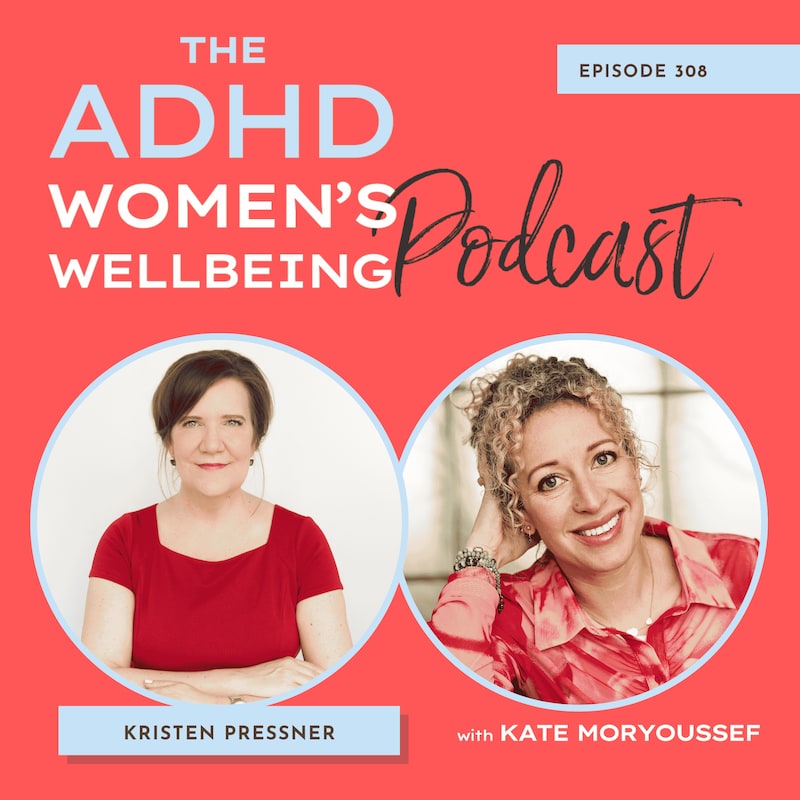
In this week’s episode of the ADHD Women’s Wellbeing Podcast, I’m joined by Kristen Pressner, Global Head of People & Culture, TEDx speaker, and passionate advocate for neurodiversity for a conversation on ADHD, leadership, parenting, and why understanding your brain can change how you live, work, and relate to yourself.
Kristen brings both professional insight and deeply personal experience to this conversation, sharing what it’s been like raising four neurodivergent children while navigating a high-powered career, and how this journey has reshaped the way she understands ADHD, both at home and in the workplace.
This is a conversation that gently challenges some of the narratives many of us have grown up with, particularly the idea that ADHD is about laziness or lack of discipline, and instead invites us to explore what might be possible when we approach ourselves (and others) with more curiosity, compassion, and understanding.
In this episode, we explore:
- Kristen's experience of supporting her family through their neurodivergence diagnosis
- The different emotions that can come with an ADHD diagnosis
- Why understanding the biology of ADHD can help us work with our brains
- The impact of undiagnosed neurodivergence on mental health and relationships
- Why so many people may not recognise themselves in traditional narratives
- How creating non-judgmental environments can reduce shame in those with ADHD
- How to feel safe to survive, which allows you to thrive
- Why knowing your needs can be tricky, and how to gently explore this
- Practical ways workplaces and managers can support neurodivergent employees with meaningful, individualised accommodations
- How Kristen has brought her lived experience into her leadership work to support others more effectively
- The concept of a “brain friend” and how having someone alongside you can make navigating life with ADHD feel less overwhelming
- How tools like AI can support neurodivergent people to process thoughts, communicate needs, and better understand themselves
This episode is a reminder that there is nothing “wrong” with your brain, and that with the right support, understanding, and space to explore what actually works for you, things can begin to feel a little more possible.
Timestamps:
- 00:01 - Introduction to ADHD Women's Wellbeing
- 00:48 - Kristen's Family's Journey of Neurodivergence
- 12:30 - Navigating Neurodivergence in Family Dynamics
- 29:40 - Navigating Neurodivergence in Parenting
- 37:51 - Understanding Neurodivergence and Its Impact on Relationships
This week’s episode is sponsored by Understood.org, the leading nonprofit dedicated to empowering the millions of people with learning and thinking differences, like ADHD and dyslexia. If you’re parenting a neurodivergent child, I’d recommend listening to their podcast, Everybody Gets a Juicebox, as it’s full of relatable stories and practical tools to help your family thrive while protecting your own wellbeing, too!
The ADHD Women's Wellbeing Live Event Recording is here!
My first-ever ADHD Women's Wellbeing Live event sold out, and now the full experience is available to you wherever you are, whenever it feels right.
Alongside three neuro-affirming experts, we spent four hours exploring the questions that matter most to late-diagnosed women. Get lifetime access here!
Inside the ADHD Women's Wellbeing Live Recording, you'll find:
- Kate Moryoussef on post-diagnosis growth and her gentle framework for what comes next
- Dr Hannah Cullen on the neuroscience of ADHD and why your brain works the way it does
- Hannah Miller on reconnecting with purpose through a neurodivergent lens
- Adele Wimsett myth-busting on hormones, HRT, progesterone and perimenopause
Understand yourself more deeply, feel less alone, and finally access the expert knowledge you deserve. Because every woman with ADHD deserves access to the knowledge, expertise and understanding that for too long simply hasn't been available to us.
To get lifetime access for £44, click here.
Join the More Yourself Community - the doors are now open!
More Yourself is a compassionate space for late-diagnosed ADHD women to connect, reflect, learn and come home to who they really are. Sign up here!
Inside the More Yourself Membership, you’ll be able to:
- Connect with like-minded women who understand you
- Learn from guest experts and practical tools
- Receive compassionate prompts & gentle reminders
- Enjoy voice-note encouragement from Kate
- Join flexible meet-ups and mentoring sessions
- Access on-demand workshops and quarterly guest expert sessions
To join for £26 a month, click here. To join for £286 for a year (a whole month free!), click here.
Links and Resources:
- Find my popular ADHD workshops and resources on my website [here].
- Follow the podcast on Instagram: @adhd_womenswellbeing_pod
- You can connect with Kristen via her website, LinkedIn (Kristen Pressner), Instagram (@kristen_pressner), Facebook (Kristen Pressner), X (@kpressner) or TikTok (@kristenpressner).
Kate Moryoussef is a women's ADHD lifestyle and wellbeing coach and EFT practitioner who helps overwhelmed and unfulfilled newly diagnosed ADHD women find more calm, balance, hope, health, compassion, creativity and clarity.
This week’s episode is sponsored by Understood.org, the leading nonprofit dedicated to empowering the millions of people with learning and thinking differences, like ADHD and dyslexia. If you’re parenting a neurodivergent child, I’d recommend listening to their podcast, Everybody Gets a Juicebox, as it’s full of relatable stories and practical tools to help your family thrive while protecting your own wellbeing, too!
Transcripts
Welcome to the ADHD Women's Wellbeing Podcast.
Speaker A:I'm Kate Moore Youssef and I'm a wellbeing and lifestyle coach, EFT practitioner, mum to four kids and passionate about helping more women to understand and accept their amazing ADHD brains.
Speaker A:After speaking to many women just like me and probably you, I know there is a need for more health and lifestyle support for women newly diagnosed with adhd.
Speaker A:In these conversations, you'll learn from insightful guests, hear new findings, and discover powerful perspectives and lifestyle tools to enable you to live your most fulfilled, calm and purposeful life wherever you are on your ADHD journey.
Speaker B:Here's today's episode.
Speaker B:Welcome back to another episode of the ADHD Women's Wellbeing Podcast.
Speaker B:I am Kate Moy Youssef.
Speaker B:I'm your host, as always, here to have conversations that hopefully you will find interesting, enlightening, educating, and hopefully will build your awareness around ADHD and how that looks and feels in women and across our families as well.
Speaker B:And I'm so excited that we have a brilliant guest today who is hopefully going to help shed even more light on this.
Speaker B:We've got Kristin Pressner.
Speaker B:Now, Kristin is a global Head of People and Culture for a multinational.
Speaker B:She's also recognized as a top HR influencer, known for her TED Talk or TED Talks, including why is it that so many people just can't get it together?
Speaker B:It's a fantastic talk.
Speaker B:I'd highly recommend it.
Speaker B:On neurodivergence, which led to an invitation to the World Economic Forum's Global Brain Economy initiative.
Speaker B:She's also a mum of four kids, four neurodivergent kids and a neurodivergent husband.
Speaker B:We've got lots in common and so I just wanted to bring her onto the podcast so we can talk about life, families, work, but also something that she is so passionate, passionate about, and that is about being a bridge builder between the neurotypical, I'm saying everything in inverted commas, and to the neurodiverse communities and find ways where we can all just come together and work really well and understand each other and support each other.
Speaker B:So welcome to the podcast, Kristin.
Speaker C:Thank you so much, Kate, for that amazing introduction and it is an absolute pleasure to be here with you today.
Speaker B:Oh, well, we've connected because on many different places.
Speaker B:But you know, to start with, we've both got four kids and they're both all neurodivergent.
Speaker B:So I remember I sent you a message saying, between us, we've got eight neurodivergent kids that's in itself a podcast.
Speaker B:If people don't really know about your story, maybe haven't watched your TED Talk.
Speaker B:Can you give us a little bit of a snapshot into the before and after of your life, of this understanding and this awareness?
Speaker C:Yeah.
Speaker C:We had four kids in five years.
Speaker C:We were from the United States.
Speaker C:And then about 18 years ago moved with my work to Switzerland.
Speaker C:And I was watching the kids grow up.
Speaker C:And I mean, I work in human resources, so I'm kind of in the potential identification business.
Speaker C:And I saw so much incredible potential and just gifts and capability in my husband and kids.
Speaker C:And our mode of parenting was what was called love and logic.
Speaker C:So you let the natural consequences teach.
Speaker C:And I found it odd every once in a while that it didn't seem like there was what I would call a learning loop.
Speaker C:Like if a kid would wait till the last second to prepare for an exam and then do poorly on the exam, that there wouldn't be a lesson learned not to do that again, for instance.
Speaker C:And as the kids started to get older and start to need to do what I call adulting more, where you start to give them more and more responsibility and autonomy, and so does the school.
Speaker C:It was like all of a sudden like them being the smartest one in the room and school coming eastfully and all of that started to get rattled.
Speaker C:And for us, that big moment was happening right in the middle of the pandemic as well.
Speaker C: With: Speaker C:You know, whether that was sport or rhythms of going into the classroom or things like that.
Speaker C:And so all of a sudden I found myself asking why my kids couldn't get it together.
Speaker C:And I hated myself for thinking it because they seemed so talented.
Speaker C:And the only thing that could compute in my own brain that could describe why wildly talented, high potential people weren't thriving more was that was character flaws, was that they were lazy or lacked ambition or whatever.
Speaker C:And as we started to identify this and engage in conversations, I would give them all this great advice, you know, the stuff that had worked for me, and they would nod and say, yes, makes total sense, I'm going to do that.
Speaker C:But then they wouldn't.
Speaker C:And I honestly, I started to feel kind of gaslit because at scale, I had four or five people in my house asking me for advice, telling me it was brilliant and not applying it.
Speaker C:And so it was really, really frustrating.
Speaker C:And for us, the epiphany came when our youngest Daughter, she was seeing a therapist.
Speaker C:And all of my stories are with the permission of my family and I do want to put that out there.
Speaker C:And her therapist said, you know, hey, I think you ought to look in to see whether or not you might have adhd.
Speaker C:And I remember she came home and told us that, and I was like.
Speaker C:Because my mental model of ADHD was kind of like, oh, everybody's getting diagnosed with ADHD these days.
Speaker C:And I thought that it was nine year old boys bouncing off the wall, because that's what everybody thinks who doesn't know.
Speaker C:So I tried not to be too outwardly dismissive, but inside I was, you know, okay.
Speaker C:But I started to look into it more and educate myself.
Speaker C:And I started to realize it isn't nine year old boys bouncing off the walls.
Speaker C:And the very things that she was struggling with that was causing so much frustration could very well be caused by adhd.
Speaker C:And it started, you know, I always say, you know, you kind of pull the loose thread in a sweater and the whole sweater unravels.
Speaker C:That's what happened in our house.
Speaker C:Because then I found out that there's a high correlation to ADHD being genetic.
Speaker C:And I'm like, well, if that's the case, then looking at my husband, and he was like, I think it's me.
Speaker C:And then I was like, well, if it's you and it's her, what about the others of us in this house?
Speaker C:And so we, you know, I started really educate myself.
Speaker C:And we realized that pretty much everyone in our household was neurodivergent.
Speaker C:And I was kind of the odd man out, you know, I was the executive.
Speaker C:I kind of had the normal neurotypical worldview.
Speaker C:And normal, typical things worked for me.
Speaker C:And so I suddenly had an explanation for feeling gaslit and like the odd man out.
Speaker C:And the deal that I made with myself at the time, because it wasn't, it wasn't always just joyful and fun and easy.
Speaker C:It was awful.
Speaker C:And I wasn't sure literally that everyone in my family would survive what we were going through.
Speaker C:And so I made a deal with myself that if I cracked the code, what was going on, I would share it with everyone.
Speaker C:And that's why I did the TEDx talk, because it's a pretty easy pill to swallow.
Speaker C:14 Minutes.
Speaker C:What I thought, what was wrong about that, what really is and what you should do about it.
Speaker C:And I've been thrilled with the response because I truly think it's a gift to the world to help clear up this mass misunderstanding, that the only explanation for Seeing certain things equals character flaws.
Speaker C:Lazy, can't get it together.
Speaker C:When in fact there's a wholly different explanation.
Speaker C:It's biological.
Speaker C:And people don't appreciate just how hard the wind in the face is of folks who are struggling.
Speaker C:And by the way, they might not even know themselves.
Speaker C:It's not like you take a test and it's like, oh yeah, you're neurodivergent.
Speaker C:It's not like you're pregnant, you're not, you have heart disease, you don't.
Speaker C:And so a lot of people who are neurodivergent, they also don't know it.
Speaker B:Yeah, 100%.
Speaker B:And it's like this invisible block that you don't know about and you don't have a way to describe it.
Speaker B:And like you said, it's just like, why can't you just get yourself together?
Speaker B:You know, this is the formula.
Speaker B:And especially, I guess, your job, like human resources, you're resourceful and you are wanting to fix problems.
Speaker B:And with adhd, it's not just a quick fix.
Speaker B:And that's why, you know, you know, TikTok's full of quick fix hacks, all these different things that you should be doing for adhd, but it's so much more deeply ingrained and systemic that it's understanding it and understanding it so deeply and how it shows it up so uniquely.
Speaker B:And I'm sure with your four kids, does it show up very differently in all four of them?
Speaker C:Yeah.
Speaker C:Oh, so insightful because, you know, confession time.
Speaker C:I was a busy executive in the middle of a pandemic whose family was falling apart and a lot of it was life or death.
Speaker C:And so I was a woman on a mission to figure out what the one fix was and apply it at scale and fix everyone and move on with my life.
Speaker C:And not for lack of trying.
Speaker C:I probably probably spent a year and a half chasing that and realizing it wasn't working.
Speaker C:And you know, the analogy I use is that children's toy where you have a sphere and you're putting shapes in the little shape holes.
Speaker C:I would jam and jam and jam their little triangle shapes into my sphere, but they weren't triangles is ultimately what I figured out.
Speaker C:And so, you know, if you push too hard of the wrong shaped toy in the wrong slot, you'll break the toy.
Speaker C:And I think this is why I keep talking about it wasn't a matter of like squirrel.
Speaker C:Haha, funny, it was life or death because there are very real consequences in all corners of your life that come with not understanding your own brain Having it be invisible.
Speaker C:I use the analogy of extra high hurdles.
Speaker C:So if my hurdles are this high, I can just jump over them.
Speaker C:But if their hurdles are 10 times higher, you know, they're just looking at the hurdle going, what would you have me do?
Speaker B:Or overwhelmed.
Speaker C:Yeah, or wind in your face.
Speaker C:Or wind in your back.
Speaker C:And so once I realized there was something invisible to all of us at play, it changed my perspective.
Speaker C:And so the real unlock that I came to is there is no scaled solution to your point.
Speaker C:The ADHD brain, for instance, doesn't get motivated and then take action and then get outcomes and based on importance like the typical neurotypical brain does.
Speaker C:So if you tell me your taxes are due tomorrow and that's super important, that's enough to get me going to do something about it.
Speaker C:And in my experience with my family, something being important, they get it.
Speaker C:They're not dumb.
Speaker C:They know it's important, but it's not enough to biologically get, you know, the neurotransmitters and the prefrontal cortex going to actually deliver some outcomes against it.
Speaker C:So once I figured out that to get that triggered, it took interest.
Speaker C:Well, it didn't take me long to realize, well, interest changes more frequently than importance, and interest is individual.
Speaker C:And so once I figured that out, that was when I cracked the code.
Speaker C:Aha.
Speaker C:I've got to figure out how to get their brain going.
Speaker C:And it might not make logical sense to me, but it doesn't need to make logical sense to me.
Speaker C:It needs to work for them.
Speaker C:And so in our house, we just really, you know, I was like, there is no shame, There is no judgment.
Speaker C:So if your room's a mess, no one cares that your room is a mess.
Speaker C:But what can we do to change the situation?
Speaker C:If you don't want your room to be a mess, and it might be, then instead of being like, it's important to clean your room, it becomes, why don't you guys swap rooms and clean each other's room?
Speaker C:That's more interesting, right?
Speaker C:And so we learned to kind of hack has positive and negative consequences, but we learned how to better figure out how to hack what was going to work for them right now.
Speaker C:And to be more aware of the fact that I can conjure the energy that I need most of the time if something's really important.
Speaker C:But my experience of my family members is that motivation and that inspiration and the energy to do things is more like surfing a wave.
Speaker C:And so if the wave comes, you've got to jump on the wave and surf it.
Speaker C:And if the wave hasn't come, you can't force a wave.
Speaker C:And so we had to learn to understand the rhythms of their energy and the rhythms of their inspiration better and kind of be more jumping on it versus trying to force it into the timing that I would say a neurotypical world would expect.
Speaker B:Yeah, I mean, I think it's so incredible to hear understanding those rhythms and also without the judgment and the shame, because if you are the neurotypical, again, inverted commas, if you're the person that is not quite aligning with the adhd, it can feel really hard to live in a house full of adhd.
Speaker B:The mess, the chaos.
Speaker B:Like you say, not doing things when they need to be done.
Speaker B:You're a busy woman, there's a lot on your plate.
Speaker B:And then having that extra patience to be able to put into your family, I guess, what it needed, but it clearly was needed because there was no awareness there.
Speaker B:And, you know, I'm interested to know, how did your husband and your kids respond to their neurodivergent diagnoses?
Speaker B:Like, were they happy to have an explanation or did they connect with it?
Speaker C:Yeah, it's a great question, you know, well, having four kids, having more than the average number of kids, kind of creates this little microcosm that you can study for yourself.
Speaker C:And I think a lot of people are really curious because they're like, well, she knows more than the average person because she has more data points.
Speaker C:But maybe just to go back to your original point of how hard it was, I really, you know, because some people who are listening to your podcast might be neurotypical spouses or parents.
Speaker C:And I really want to give a shout out and say, you know, I see you.
Speaker C:Because it was awful.
Speaker C:It was awful because we had a way that we imagine the distribution of household duties and it didn't depend on me so heavily because the deal was my husband was a stay at home parent and ran our household and I was the one who focused on work.
Speaker C:And I was expected to do both for a while.
Speaker C:And it was awful.
Speaker C:And it is frustrating as heck.
Speaker C:And I can, you know, with, with my husband's permission, give you a million examples of things where I was just like, if you can't change this thing, I can't fathom what that tells me about how you don't care for me because it's really easy to take it like that.
Speaker C:And I had to really, really let go of some of my preconceived notions about what relationships mean and what showing you care means.
Speaker C:If people in my house really, really try hard but forget important things or make promises and then don't see them through.
Speaker C:Like, it's really, really ingrained in our society to see those as an affront.
Speaker C:And I had to teach myself that it is not personal, it is not an affront.
Speaker C:It doesn't fly in the face of the trust in our relationship.
Speaker C:They have way more wind in their face.
Speaker C:And so what would I wish for, you know, because I know the world was built for me and I have wind in my back and it makes it more useful.
Speaker C:And so for me, this is like the most important message that I try to share with partners who might be neurotypical in a neurodivergent household.
Speaker C:You're going to have to let go of this notion that making promises and maybe not always keeping them perfectly shakes the very foundation of what makes the relationship work.
Speaker C:Because it's not that personal the way it would be if you did it.
Speaker C:But to answer your question, so it was fascinating to me because my daughter, when the therapist said, you know, I think she might be adhd, she came home skipping so happy she'd read Percy Jackson.
Speaker C:She had been convinced she'd been, in retrospect, she'd been saying for years, I think I have ADHD.
Speaker C:But when a 7 year old reads Percy Jackson and has an ADHD character they associate with, I was like, okay, you know, you don't have adhd, you're fine.
Speaker C:And so she says now, like redemption.
Speaker C:I was right, I said it all along.
Speaker C:So she was overjoyed because I think it provided an explanation for some things that had been really hard in her life and what was different about her brain.
Speaker C:And I think she felt seen and understood for the first time time.
Speaker C:My husband was the same way.
Speaker C:He jumped for joy, like, aha, now I get it.
Speaker C:And so then comes all the baggage of I always felt like I was different, I always felt like there was wind in my face, I always felt like I was broken.
Speaker C:And so all the shame, you know, et cetera.
Speaker C:And so he's like, if there's an explanation for this, this is so liberating.
Speaker C:It also is with late diagnoses, of course, comes with what might have been.
Speaker C:And you know, he could kind of retro look in the rearview mirror of his life.
Speaker C:And it explained a lot of really painful moments and memories.
Speaker C:And so it's, I'm sure, hard not to end up in the what might have been mode.
Speaker C:My other three kids were a whole different ball of wax.
Speaker C:So as I started to scan the horizon and say, hmm, maybe there's neurodivergence in the other children as well.
Speaker C:And so three of my kids have been diagnosed with adhd, one's not been diagnosed.
Speaker C:She shows traits, and it's all on a continuum.
Speaker C:But in her case, the diagnosis criteria is basically that it's caused a big amount of suffering in different elements of your life.
Speaker C:And she's been successful in school, been successful in her relationship so far.
Speaker C:I would love to have a conversation about the cost that that came at and why that's not a factor in the diagnostic criteria.
Speaker C:But by the letter of the law, she's not received a diagnosis, but it's clear that she's divergent in a lot of ways.
Speaker C:And so.
Speaker C:But the other three, I think it took on average seven to 10 attempts to get them to even open up to the thought that they might be neurodivergent, that there might be something else at play.
Speaker C:My son and I did some advocacy at a school system on neurodiversity last week, and I interviewed him about his experience of not understanding his brain, teachers saying terrible things about his laziness, et cetera, when it wasn't laziness.
Speaker C:And we were talking about it.
Speaker C:And so it's fresh in my mind his answer, because he was asked by the audience how he felt about his diagnosis.
Speaker C:And he said, I didn't want to be disordered.
Speaker C:I didn't want to be broken.
Speaker C:I didn't want there to be something wrong with me.
Speaker C:I thought of myself as a pretty smart guy, and all of a sudden you're telling me my personality is a disorder.
Speaker C:And so I would say that's a pretty good encapsulation of how the other three felt.
Speaker C:But the good news is the conclusion that I came to the thing that does scale is what I call being a brain friend, which is, in essence, just being inclusive to recognize what might work is broader than we think the diagnosis or our read of what's going on definitely could have an explanation other than character flaws and not trying.
Speaker C:And that we're kind of a no judgment, curious, shame, free household.
Speaker C:And so you don't need a diagnosis to live in an environment where everyone's like, hey, we all are wired differently, we all shine differently, we all have different gifts.
Speaker C:And so for us, that's been a massive unlock because it doesn't require a diagnosis.
Speaker C:It just requires that shame and judgment free environment to let people feel okay understanding who they are and be that.
Speaker C:And so I remember once taking a walk with my son and him saying, you know, mom, when I'm walking and talking with you, I really, I'm trying to pay attention to you, but it's really hard.
Speaker C:And my mind wonders.
Speaker C:And you know, I was like, what did I say?
Speaker C:I was like, don't worry, that happens to everyone sometimes, right?
Speaker C:Because it does happen to everyone sometimes.
Speaker C:And he started, you know, mom, sometimes when I'm reading, even when I'm giving it all of my energy, I have to read the same paragraph over and over and over again to get the content.
Speaker C:What did I say?
Speaker C:Don't worry, that happens to everyone sometimes.
Speaker C:And I think this is the tricky bit.
Speaker C:There's something that's invisible that happens to everyone sometimes.
Speaker C:And so it's easy if you're everyone to assume that we're all, we all have the same amount of hurdles, the same height of hurdles.
Speaker C:And I think my big epiphany is that's not true.
Speaker C:My hurdles are, it's like if I have to, you know, go to the ladies room, you know, a few times a day, but my family members have to go 600 times a day.
Speaker C:That's not the same height of hurdles, even though we both have to go to the ladies room.
Speaker C:And so many people have said to me, wait a minute, I didn't realize everyone else doesn't have to work as hard as I do for the thing.
Speaker C:Even in the diagnostic process, it's like, does this person struggle with this or struggle with that?
Speaker C:What's normal?
Speaker C:So I know if they're struggling relative to normal and there's no answer for that.
Speaker C:So it's all very personal judgment related.
Speaker A:So I want to speak to those of you who are currently parenting neurodivergent children while also navigating your own ADHD or neurodivergence, and probably feeling pretty exhausted right now.
Speaker A:Maybe you've had moments of overwhelm, frustration, or even what some of us call mum rage.
Speaker A:And then that guilt follows.
Speaker A:I just want to say that you're not alone in that.
Speaker A:That's why I want to share a new podcast that I've been listening to called Everyone Gets a Juice Box for Parents of Neurodivergent kids.
Speaker A:It's from Understood.org and I've been listening to Everyone Gets a Juice Box.
Speaker A:And what I really appreciate about it is how it holds space for the real experience of parenting, not this polished online social media version.
Speaker A:The podcast has honest conversations about burnout, emotional overwhelm, meltdowns, but also so much compassion and understanding and even those moments of humour and Relief that we all need.
Speaker A:It reminds me that struggling doesn't make you a bad parent, it makes you a human one.
Speaker A:And doing something incredibly nuanced and demanding, like parenting neurodivergent children, especially after a late diagnosis ourselves.
Speaker A:And alongside that validation, there are practical tools and insights that help you support your child while also taking care of yourself.
Speaker B:It's the kind of podcast that leaves.
Speaker A:You feeling a little lighter, a little more in stores and a little bit more hopeful.
Speaker A:So to listen, search for Everyone gets a juice box in your podcast app or go on the Understood.org website and you'll see it there.
Speaker A:That's Everyone gets a juice Box.
Speaker B:Now back to today's episode I'm interested to know a little bit about.
Speaker B:I guess when you went public, when you started talking about this, your job is your job and you do you know what you do.
Speaker B:But what was that overlap?
Speaker B:Did you start seeing that overlap?
Speaker B:And were you able to bring in this knowledge and this life experience that you were understanding and bring this to hopefully help more people?
Speaker C:Yeah, it's such a great question.
Speaker C:I would say the way it worked for me is I had a. I had a near term problem in my family that I desperately wanted to solve and I made a promise with myself that if I figured it out, I would share it.
Speaker C:Because I was really convinced that this wasn't a problem only in the Pressner House.
Speaker C:And now with some time under my belt, since it's become abundantly clear it isn't a problem only in the Pressner House.
Speaker C:And there's a lot of people who are really appreciating being the bridge between kind of what's the worldview on this and what's reality behind ADHD and the suffering that people have when they're in a world that wasn't built for the way their brain is best optimized.
Speaker C:So for me it was like a question of families and possibilities and relationships.
Speaker C:But of course, as you point out, I work in hr and I started to think about my workplace and how this plays out at work and how many of us are not built to stand in front of a computer screen for eight hours a day without a break, or how many of us aren't built for loud open space workplaces.
Speaker C:And really, it's been amazing as I've opened up this discussion in my employer and with other HR executives, because the vast majority of the kind of accommodations that someone who's neurodivergent would want in the workplace cost less than 500 pounds.
Speaker C:They're in the Negligible cost range.
Speaker C:It's usually noise canceling headphones, a little more autonomy over my schedule, you know, the ability to get some breaks built in during the day so I can manage my energy.
Speaker C:It's not, I need to work from Fiji.
Speaker C:And so I just.
Speaker C:As an HR executive, I remember thinking, and even as a parent in the beginning, like, it was like, accommodations.
Speaker C:I'm like, what accommodations are going to help a kid who struggles with time management, saves everything to the last second, like, what accommodations will work?
Speaker C:And in the end, the vast majority of the accommodations that you get academically is like, extra time on tests.
Speaker C:And I was like, that's, that's useless.
Speaker C:That's not going to help at all.
Speaker C:But at least once we got everyone a little bit more optimized, it helped a ton.
Speaker C:They're pretty minor interventions here, but on the extra time, you know, there's the people, and I was probably formerly one of them who were like, well, if we all have to get something done in an hour in real life, then it can't be that you get it done an hour and 15 minutes, you know, because real life calls for an hour.
Speaker C:So how could it be in schools that we give you extra time?
Speaker C:But at least in talking to my kids, they don't actually need the extra time.
Speaker C:They finish their tests within the allotted time.
Speaker C:Yes, their brain needs to know they have the extra time so their brain isn't 25% distracted by counting down time instead of doing the thing.
Speaker C:And it's like, now understanding that I'm like, these are just such minor things to help.
Speaker C:Because we haven't yet talked about all of the.
Speaker C:Well, a little bit.
Speaker C:We have the brilliance and the beauty and the gifts and the talents that neurodivergent brains can bring.
Speaker C:But for me, it's a question of you have to solve surviving first, and then you can have the opportunity to actually have thriving.
Speaker C:And I would argue in a world where we've now got AI that's going to take up the boring tasks and things like that, like, it's going to flip and become advantageous to be a neurodivergent brain.
Speaker B:That's so interesting.
Speaker B:That's so interesting because I think that as well.
Speaker B:But I also fear that AI is gonna.
Speaker B:We're gonna lose the executive functioning muscle that we struggle with anyway.
Speaker B:But as we know, with all revolutions and that have gone on throughout the world and how we morph anthropologically, this is just another thing, you know, with technology and everything.
Speaker B:But I do see how AI is helping so Many neurodivergent people.
Speaker B:And it's helping us use that word that you use, be.
Speaker B:That bridge is a bridge.
Speaker B:You know, I.
Speaker B:There's so many things that I would struggle with from a administrative perspective or just getting a thought into an action, into something real, like a real, you know, whether it's a workshop, a course, or a presentation, I'd have all the ideas, so many ideas.
Speaker B:I was like, but then how do I do.
Speaker B:How do I get it onto a page?
Speaker B:How do I create it?
Speaker B:And AI has been so good because it's all my ideas.
Speaker B:It's just taken away those really tricky steps to then get me to the place where I can present and do what I do best.
Speaker B:So I do think we need to start thinking about the bridges.
Speaker B:And the bridges are tech.
Speaker B:But I also love what you're.
Speaker B:You're saying is like, how can humans be those bridges?
Speaker B:And humans.
Speaker B:You work for big tech companies, huge global companies, who are going to be almost modeling down to the smaller corporations of how we now bring in neurodivergent understanding so we can get the best out of your employees.
Speaker B:And I don't think it's a bad thing to have flexibility or autonomy in your working hours.
Speaker B:I don't think it's a bad thing to go for a walk and get some fresh air.
Speaker B:I don't think it's a bad thing to not be distracted.
Speaker B:So put some headphones in.
Speaker B:Maybe we need some food.
Speaker B:Natural light.
Speaker B:Maybe you don't want to be in an office with, like, fluorescent bright lights in our, you know, in our eyes.
Speaker B:It's just a.
Speaker B:It's just an understanding.
Speaker B:And so many people don't have that understanding yet, do they?
Speaker C:Exactly.
Speaker C:And this is the thing, like, if I want to be a brain friend to you, if I want to create the circumstances in which Kate is most likely to thrive and shine, I first need to start by being open and asking you, okay, in what circumstances do you thrive and shine?
Speaker C:And you need to be able to answer me.
Speaker C:And in my experience, the vast majority of people don't know thyself well enough to do that.
Speaker C:And so it really starts with.
Speaker C:And that's where I'm saying there's still a burden on the neurodivergent person to get some help or use ChatGPT or reflect a little bit and understand what are the circumstances in which I thrive the best?
Speaker C:What do I hate doing?
Speaker C:And I would rather stick needles in my eye.
Speaker C:And what should you outsource?
Speaker C:What should you give me?
Speaker C:But if that work has been done.
Speaker C:And then because in the workplace the research shows that about 80% of whether or not a neurodivergent person will be successful is driven by their line manager.
Speaker C:And so I'm pushing for more awareness among leaders to just understand this.
Speaker C:And so then if I say, Kate, in what circumstances you shine and you say, you know what, I'm useless before 9am so can we not have meetings before 9?
Speaker C:Can someone grab me before the team meeting because I might be distracted and down a deep wormhole and forget.
Speaker C:And can we not go back to back to back to back?
Speaker C:Generally I can work with that in the workplace.
Speaker C:And then you're able to bring, instead of use all your energy just trying to mask and survive.
Speaker C:You're using your energy to produce awesome stuff that only you can do.
Speaker C:And it doesn't take that much off the leader.
Speaker C:And that's what most leaders are telling me is that they're, they're like, once the person is able to articulate what they need, it's not so hard to give it.
Speaker C:But they can't give something that can't be articulated yet.
Speaker C:And I think that's the tricky bit.
Speaker B:I love all these questions because you're teasing out of people.
Speaker B:Like you say it's sometimes it's so hard for us.
Speaker B:We've just got like this overwhelming mush of things like that we find tricky or the things that we don't like or things that we, you know, we struggle with.
Speaker B:And sometimes just I can't do that.
Speaker B:That's just really.
Speaker B:And we don't.
Speaker B:And then you just unpick it a little bit.
Speaker B:And that is so helpful for someone who struggles with overwhelm.
Speaker B:And you know, if it's somebody who could do that, like their line manager, they can see that they've got a great person here, but they struggle with certain things.
Speaker B:It's like, okay, let's unpick it, let's find ways because we, we want to tease out the genius, don't we?
Speaker B:Because there's a lot of genius there.
Speaker C:There really is.
Speaker C:And, and a lot of people don't have a dreamline manager.
Speaker C:And I do want to acknowledge, you know, not everyone's a brain friendly line manager.
Speaker C:And so one of the things that, that is very possible and at least we're doing is here's a place where we use AI enabled chat to coach people.
Speaker C:So it'll just ask good questions.
Speaker C:And so for instance, I do this all the time and say, you know, I'm trying to get to this outcome Ask me a series of questions, one at a time that I will answer, and then it will help me clarify something.
Speaker C:So you can use AI and you don't have to involve your manager in it.
Speaker C:You can just come out, you know, and that's what's so beautiful about it.
Speaker C:You don't need to go to your manager and say, I have an ADHD diagnosis and I need xyz.
Speaker C:What you say is the circumstances in which I thrive the most look like this.
Speaker C:And you normalize having a conversation among teams and what are the circumstances under which you thrive the most?
Speaker C:And what are the circumstances around which you thrive the most?
Speaker C:And generally speaking, and this is what cracks me up, when I was looking at my family, I would see absolute genius in things I couldn't do if my life depended on.
Speaker C:On it.
Speaker C:But I saw absolute rubbish on things I do with my hands tied behind my back, like mundane adulting tests, like knowing where my keys are or being on time or doing laundry.
Speaker C:And so first it was really irritating because it seems like those are baby tasks and the ones they were great at were like big and important tasks.
Speaker C:But.
Speaker C:But then I thought about it and I'm like, this is the perfect match.
Speaker C:There are plenty of people in the world who are good at mundane adulting tasks, so let them.
Speaker C:And let's free up the people who have other gifts and talents not to feel bad about that, because the combination gets everything done.
Speaker C:And so if we just started to open ourselves up to that, it would, it would, I think, create so much more capacity and possibilities and movement and potential in the world.
Speaker C:But if people are still just trying to survive in a world built for neurotypicals, we'll never get to that point.
Speaker B:Yeah.
Speaker B:You make me think of my son because he's 20 and diagnosed ADHD and he's second year at university, still studying economics and politics.
Speaker B:And he is so, so clever.
Speaker B:So clever.
Speaker B:And he spent the whole Christmas period writing this essay, which I swear I didn't.
Speaker B:And I. I tried to understand it.
Speaker B:I understood, like, snippets of it.
Speaker B:Incredible, you know, dissertation that he had to hand in that was working on the whole time.
Speaker B:And he was really in the zone because he'd chosen a topic that he loved so much on politics and economics.
Speaker B:And he was citing this and, and researching that and all of that.
Speaker B:And we read it and I was, like, blown away.
Speaker B:But he.
Speaker B:On, on the flip side, his bedroom is.
Speaker B:Is a terrible state.
Speaker B:He didn't unpack from his suitcase for two weeks after our holiday.
Speaker B:So he Lived outside his suitcase and would step over his suitcase every single day.
Speaker B:And I said to him, does it not bother you that you've got a suitcase in your bedroom?
Speaker B:We got back from holiday two weeks ago.
Speaker B:No, I don't even really see it.
Speaker B:And it's just helpful because I can just take the clothes out and put them back in the suitcase.
Speaker B:And part of me is like, I really want to teach my son that.
Speaker B:You come home from holiday and it's really annoying.
Speaker B:Like you don't want to unpack.
Speaker B:No one likes unpacking.
Speaker B:I hate it.
Speaker B:I hate it with a passion.
Speaker B:But I've learned that I just put a podcast in and I close the bedroom door and I unpack and I just do what I can do and I have my travel stuff and I put it all away back in the cupboard and it's done.
Speaker B:And part of me wants him to, to want to be able to do these tasks because that is life, isn't it?
Speaker B:And not, and not put all this pressure on him to kind of like be normal and do all those things.
Speaker B:But the other part of me is like he's got a, clearly got a brilliant brain.
Speaker B:So I still struggle a little bit with it.
Speaker B:I struggle with what kind of parents am I being if I don't, you know, push.
Speaker B:Please unpack your bag, please tidy your bedroom, please make sure that you are putting your clothes in the dirty washing basket.
Speaker B:I don't know what I'm asking.
Speaker C:No, I totally get it.
Speaker B:From one mother to another, it's like it's hard still.
Speaker C:Yeah.
Speaker C:Parenting is not for the faint of heart.
Speaker C:And I, I had this idea of what good looks like and it was a tidy room and it was self driven and it was knowing what you, your keys are and it was being on time and it was, you know, being able to get a first gainful employment without any help.
Speaker C:And anything short of that felt like to me, you're not adulting, you're not acting age appropriate, whatever.
Speaker C:And I think there's a couple things that I remind myself of.
Speaker C:First of all, you really raised wisely.
Speaker C:There's not an absence of brilliance.
Speaker C:There's brilliance.
Speaker C:So he's got his brilliance, his place where he's interested and I'm sure going to have a really great impact in the the world.
Speaker C:The other thing that I remind myself is that on average the frontal lobe, so the brain's command center were like planning and organizing tasks and breaking things down and making sure you're thinking ahead and all of that.
Speaker C:It's delayed by three to five years in people who have ADHD.
Speaker C:And so you know, my son, he turned 18 and decided, you know, he should be allowed to take all 18 year old decision adult decisions.
Speaker C:And I'm like, listen, you have an impulsivity disorder that causes your brain to be delayed.
Speaker C:So I'm going to treat you like you're 15 for purposes of huge decisions.
Speaker C:And so what we did in our house is I said on a scale, decisions will fall on a scale of 1 to 10.
Speaker C:Ones are what am I going to have for lunch?
Speaker C:Tens are who am I going to marry?
Speaker C:And I said one through sevens.
Speaker C:Go nuts.
Speaker C:Live and learn, enjoy.
Speaker C:Make mistakes.
Speaker C:Do you eights, nines and tens.
Speaker C:I'm talking things like dropping out of school, getting a face tattoo, getting married.
Speaker C:For those I would recommend a one week waiting period and talking to someone and I'm pointing to myself here who doesn't have an impulsivity disorder just to have thought it through from all angles and if you still want to do it, go nuts because you're an adult.
Speaker C:And he didn't like it at first, but it really served us well.
Speaker C:And now my kids are a titch older and I'm experiencing that somewhere.
Speaker C:It's different with each kid, but somewhere between 20 and 25, their frontal lobe catches up to age appropriate and it all works out.
Speaker C:And so, you know, in the example of your son who's 20, I think of maybe he'll be a messy room guy and live out of a suitcase guy.
Speaker C:I mean, there's people like that who are adults, right?
Speaker C:So in that regard, then I just decide, is that the battle worth picking?
Speaker C:Is that the thing that's going to make the difference if it doesn't bother him?
Speaker C:I just tease because we got one of those in our house too, and I just tease.
Speaker C:I hope you marry someone who doesn't bother mind, that's why.
Speaker C:But you know, it takes all kinds to make the world go round.
Speaker C:And I think as parents we're always balancing.
Speaker C:When do I intervene and lean in and when do I let it breathe?
Speaker C:And it's definitely, I think it's definitely harder when you're parenting a neurodivergent kid.
Speaker B:Yeah, it is, it is.
Speaker B:And you know, he says it doesn't bother him, so why should it bother me?
Speaker B:And so I've decided that I don't go into his bedroom because it does bother me and I don't like to see it.
Speaker B:But he is hygienic, he showers, he always looks really lovely and presentable.
Speaker B:He's he typically gets to where he needs to get to on time.
Speaker B:So I'm like, okay, so he's ticking lots of other boxes and I'm just not going to go into his bedroom.
Speaker B:And then when he lives at university, I'm just not going to go there either to see his house and his bedroom because I like a tidy space.
Speaker B:I'm like the ADHD person that my space has to be tidy so I can breathe and my nervous system can regulate.
Speaker B:So I'm always the one in the kitchen wiping the surfaces and hoovering the floor and cleaning the kitchen table and making sure that our living space feels nice and calm because I need that and our bedroom and I have to kind of hand it over back to my kids a little bit and say like, if you want to live like that, that's fine, but I just can't go in there.
Speaker B:There's no rule book, there's no guidebook.
Speaker B:Like I know we have these amazing, like now we're understanding more.
Speaker B:You were talking about marriage earlier.
Speaker B:I was thinking, you know, there's some very good marriage therapists, ADHD neuroaffirming marriage therapists that books who've, I've read.
Speaker B:I'm like, this is incredible.
Speaker B:You know, we've got a much higher rate of marriage breakdown, divorce in neurodivergent couples, especially sort of neurodivergent, neurotypical.
Speaker B:This is gold.
Speaker B:Like we need to know all of this but we still have to take little moments and we have to look after ourselves and we have to hand responsibility to others and have autonomy and all of this.
Speaker B:But I, I genuinely think these conversations are so valuable because sometimes we feel like we're doing it on our own, sometimes we feel like we're drowning.
Speaker B:And to hear I think someone like you, who's got a really high powered job, who is working in global corporates, who are going to be leading from top down and also managing a family, a big family to see what you're doing and guess what, you're recommending to be that brain friendly person.
Speaker B:I saw.
Speaker B:Have you got a, like an initiative or did I see a website or something that you're doing?
Speaker C:Yeah.
Speaker C:So I, I'm not looking to turn this into my, a new job or anything like that.
Speaker C:I literally am doing this from the depths of my heart to try to help people who might be going through what I went through go through it faster and more clearly because it was awful and I was lonely and I didn't.
Speaker C:The resources weren't available.
Speaker C:And so as I do my advocacy and as I start to find things that were helpful to me, I started to just compile them on KristinPressner.com a website where you can find both my TEDx talks, the different podcast resources that were helpful to me.
Speaker C:And I'm actually working with a colleague in a tech firm on creating a, what's called a learning pathway or an AI enabled journey that changes the way it teaches based on you and how you interact with it and how you learn best to help create more neuro inclusive workplaces.
Speaker C:And he and I have agreed to give that away for free to the extent that we can.
Speaker C:And so this is just something I do because I want to leave the world better than I found it.
Speaker C:And you know, you talked about marriage and, and we haven't talked so much about the dark side, but I feel like I, I feel like I'd be remiss if I didn't.
Speaker C:You know, people think of ADHD as kind of like this haha squirrel, haha funny.
Speaker C:And you know, with adhd, on average there's a reduction of lifespan by about a decade.
Speaker C:There's a three to five times the death by suicide rate.
Speaker C:There is a high comorbidity of anxiety, depression, disordered eating and substance abuse disorders, which means if you've got adhd, you probably also have one or more of those things.
Speaker C:They're deadly.
Speaker C:This isn't squirrel, haha funny.
Speaker C:This is breaking up marriages, ruining parent child relationships, causing people to drop out of school, causing people to choose to end their own lives, causing an unmeasurable amount of hurt in our world.
Speaker C:And the worst part about it is if we could just get people to better understand it, we could release all this potential instead of have all that hurt.
Speaker C:And so you talked about marriages ending more, et cetera.
Speaker C:I mean, you know, I can look around and I can name marriages that clearly ended because of a misunderstanding about neurodivergence.
Speaker C:I see, you know, people come to me and saying, I haven't talked to my adult child in many, many years and now we're trying to reconcile because I have a better understanding.
Speaker C:The possibilities are endless.
Speaker C:If we clear up this mass misunderstanding about something that's invisible but biological, that's making it harder for people to do things that the world presupposes should be easier.
Speaker B:Yeah.
Speaker B:Wow, you just said that so beautifully.
Speaker B:Like it really does hit home when you hit, when you hear it like that, 100%.
Speaker B:And it's making me think that, you know, this brain friend, wouldn't it be amazing?
Speaker B:You know, in Businesses and in schools that if you have a diagnosis and you know that you're friendly with someone who can do those things, like get you to class on time or help you take notes at meeting, whatever that might be, that you can always, like, buddy up with someone.
Speaker B:So in school you could have someone.
Speaker B:You know, I think about my daughter, she's ADHD dyslexic.
Speaker B:And I know if she had a couple of friends who just kind of like checked in and just double checked, make sure you've got a test tomorrow and have you taken your books back to the library or whatever that might be, how lovely would that be?
Speaker B:And then the person, the neurodivergent person can be that person that's creative or does something fun with them or brings the enthusiasm and the interest or whatever it might be.
Speaker B:And we use each other, we really do, because there's no good, there's no bad, but we're different.
Speaker B:And interacting with in a way that it's not like you should be like that you need fixing.
Speaker B:It's just like, okay, let's lean into each other so we can support each other.
Speaker B:And I think through your.
Speaker B:What you're doing, your advocacy and your awareness and your help and contributions is, is.
Speaker B:Is amazing.
Speaker B:And I would love to keep talking to you to hear what else you're doing.
Speaker B:But if anybody's listening right now and thinking, I want to kind of bring a little bit into what you do into their work, maybe they work in human resources and they want to add a little bit of whatever this is into their line of work, what's the best way to start to do that?
Speaker C:It's funny, my mom always had the saying, everyone does a little, so no one does a lot.
Speaker C:And that was how I kind of ran our household.
Speaker C:People would be like, how do you all do it?
Speaker C:Before the neurodivergence, it was like, how do you do it with four kids and a big job and living in a country you aren't from originally?
Speaker C:And I was like, everybody does a little.
Speaker C:So no one does a lot.
Speaker C:But that's the interesting thing about this work and being a brain friend and what I would wish for, for the world.
Speaker C:No one needs to go spend their lunch hours doing podcasts and neurodiversity advocacy or make this their life's work or have it be a huge slog.
Speaker C:Literally, all I'm asking for parents, teachers, coaches, spouses, everyone to do is realize there could be another explanation for you observing that someone can't get it together and isn't Living into what you see as their potential and get curious about what might be going on.
Speaker C:Get curious in a non judgmental way about what might be hard for them, might it be harder than average for them, what might be easy for them, under what conditions they particularly shine.
Speaker C:And if we all just did that, like I imagine that we kind of got this view of holding my hands about a foot apart.
Speaker C:We've all got this view of this is normal.
Speaker C:And if we all just expanded that by six inches on either side and said, no, okay, I'm gonna allow this to be normal.
Speaker C:It's unfathomable.
Speaker C:The amount of potential that will get released on the world and the amount of hurt and suffering that will be dialed down.
Speaker C:It's unfathomable.
Speaker B:Yeah, it's absolutely that.
Speaker B:It's just fluidity, curiosity, flexibility and an ability, like you say, just to just kind of open, open minds and just have a bit more of a growth mindset of.
Speaker B:There's a very old fashioned way of looking at things of like, life should be hard and you only learn through like, you know, really difficult situations.
Speaker B:And, and I'm thinking of certain people who maybe take their foot off the parenting pedal a little bit when their kids leave is like, no, they need to learn the hard way.
Speaker B:You know, if they can't do that, then they need to learn.
Speaker B:And it's like, well, let's just try and be a little bit more compassionate here.
Speaker B:Let's just try and you know, and it doesn't have to always be the way we were brought up and the way our parents were brought up.
Speaker B:It's.
Speaker B:Things are changing and we've got better understanding and like you say, we want people to thrive and shine and we want our kids to do that and employees and colleagues and all of that.
Speaker B:So I'm so glad that we've had this conversation, Kristen.
Speaker B:It's been really fabulous and I really hope that it's helped whoever's been listening.
Speaker B:And please do share this, this conversation because I think this is, this is something that many people must, must listen to.
Speaker B:But just send people to your website, is that right?
Speaker C:Yeah.
Speaker C:I would recommend people just look up Kristin Pressner on YouTube and listen to the TEDx talk because it's purposefully less than 15 minutes, very shareable because then they don't have to explain themselves or one another or whatever.
Speaker C:You can just forward it.
Speaker C:And I've, I've done the work of creating the arc of the story to help people rewire their brains a little bit from what's kind of the mass understanding of the world to what's actually really going on there and the implications and what we ought to do differently about it.
Speaker C:And so I would point people in that direction and, you know, if they like what they see, you know, you know the drill, like comment, share.
Speaker C:Because trying to change an understanding of the world is a big undertaking, but it happens one person at a time.
Speaker C:Yeah.
Speaker B:Well, thank you so much, Kristin, and I hope to speak to you very soon.
Speaker C:Thank you, Kate.
Speaker C:Thanks for having me.
Speaker C:I really appreciate it.
Speaker A:Thank you for being here and listening to today's episode.
Speaker A:I just want to remind you that if you are looking for more support on your ADHD journey, there are so many resources waiting for you [email protected] so inside the ADHD Women's Wellbeing Workshop library you'll find practical and compassionate guidance and on topics such as nervous system regulation, rejection, sensitive dysphoria, perfectionism, emotional regulation, hormones, parenting, and so much more, all designed specifically for late diagnosed neurodivergent women.
Speaker A:You can also explore my new book, the ADHD Women's Wellbeing Toolkit, which was published by dk, which is also available in ebook and audiobook, which is packed full of tools to help you feel calmer, more regulated and more like yourself.
Speaker A:And if you do crave a bit more deeper connection and ongoing support, come and join us inside the More Yourself community.
Speaker A:It's a gentle space for learning, reflection and connection with other neurodivergent women.
Speaker A:And you'll also find the recordings from our first ever ADHD Women's Wellbeing Live event, which brought together incredible speakers and a room full of full of inspiring women for a truly special day.
Speaker A:We have recorded it all for you and it's there to buy.
Speaker A:So whether you're just starting your journey or looking to go deeper, there's something there for every stage.
Speaker A:Just head to ADHD womenswellbeing.co.uk to explore everything.
Speaker A:And as always, thank you so much for being here and for being part of this community.
Speaker C:Sam.


