Shownotes
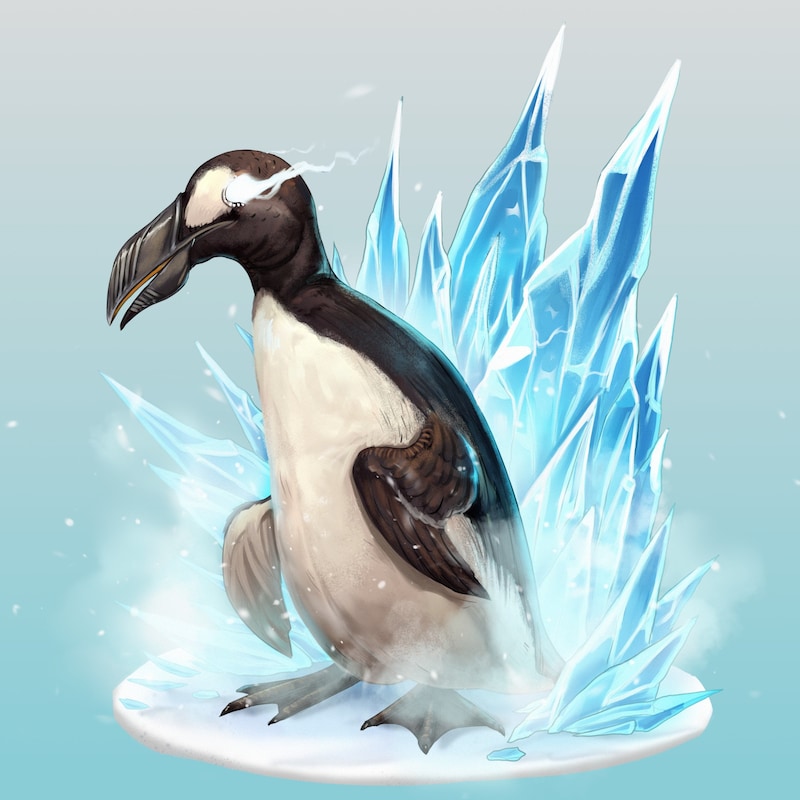
The great auk is a powerful bird with a bone-chilling extinction story. It's getting a second life as a D&D monster. Get the great auk and two other extinct animals for your D&D campaign: https://store.magehandpress.com/products/book-of-extinction-preview
Episode transcript: https://scintilla.studio/monster-extinction-great-auk/
Guides:
Kieran Suckling, Executive Director and Founder of the Center for Biological Diversity
Tierra Curry, Senior Scientist at the Center for Biological Diversity
Stan Rachootin, Professor Emeritus of Biological Sciences at Mount Holyoke University
Appearing courtesy the Beneski Museum of Natural History, Amherst College
Like this stat block? Did I miss something? Let me know on Twitter: www.twitter.com/SparkOtter
"Extinction Theme" by Alexandre Miller, The Boy King of Idaho
Transcripts
The giant auk is sort of like a giant flightless puffin.
Kieran Suckling:It's a very large bird it's three feet tall, black and white,
Kieran Suckling:a very dramatically colored with a white eyepatch during, during part of the year.
Kieran Suckling:It would molt and lose that layer, but had that white eyepatch during part of
Kieran Suckling:the year, but with these very little wings on this tall body, and very
Kieran Suckling:robust, strong looking creature, and this very powerful, stout, hooked beak.
Kieran Suckling:In fact, some of the early names for it, were spearfish.
Kieran Suckling:The Norse name for it was gejrfugl which means "spearfish".
Lucas:Welcome to Making a Monster: Extinction.
Lucas:This is the companion podcast to Book of Extinction, a monster manual of animals
Lucas:lost to the natural world, but given a second life through Dungeons & Dragons.
Lucas:Natural history is already a part of the DNA of fantasy games.
Lucas:Many of our favorite monsters began as tall tales of exotic animals.
Lucas:Bringing extinct species into D&D is the best way tabletop gamers can
Lucas:honor their memory and move people toward action in the climate crisis
Lucas:and accelerating mass extinction.
Lucas:In this episode, we discover the great auk, the garefowl, what the
Lucas:Intuit called isarukitsoq and the New Englanders called "The Wobble",
Lucas:and turn it into a D&D monster.
Lucas:If you want to follow along with this build, you can go to
Lucas:scintilla.studio/extinction right now to download a digital preview of the book,
Lucas:which includes a stat block for the real great auk as well as the magical version
Lucas:we'll be creating at the end of the show.
Lucas:Go ahead, I'll wait.
Lucas:Take your time.
Lucas:One note before we get started, I apologize in advance if I mispronounce
Lucas:any words in this episode, especially those from native languages.
Lucas:I have only seen them in print and not heard them spoken.
Lucas:If you have correct pronunciations or other resources that would help
Lucas:me as I try and get these right, please contact me using the link
Lucas:in the show notes to let me know.
Lucas:This episode has two guides to the natural world.
Lucas:The first is Stan Rachootin, Professor Emeritus of Biological Sciences at Mount
Lucas:Holyoke University, giving a tour of the Beneski Museum of Natural History.
Lucas:The second is new to the show.
Kieran Suckling:My name is Kieran Suckling, and I am the Executive Director
Kieran Suckling:and founder of the Center for Biological Diversity, which is a endangered species
Kieran Suckling:protection group that mostly works, here in the U.S., but also internationally.
Kieran Suckling:And we try to save, all species, great and small from, from butterflies and
Kieran Suckling:insects to polar bears and wolves, uh, keep them alive, and to end the mass
Kieran Suckling:extinction crisis that's been sweeping over this planet for the last 500 years.
Kieran Suckling:And we do that primarily through, litigation, uh, suing corporations that
Kieran Suckling:are killing endangered species, but very often suing state and federal governments,
Kieran Suckling:which are supposed to be enforcing laws to protect them, but often often fail.
Lucas:So let's go back to a time before the eighth century, when the great
Lucas:arch had populations in the millions and was an important cultural and
Lucas:agricultural icon for native cultures in Newfoundland and Scandinavia.
Stan Rachootin:The giant auk lived all around a lot of the Northern Hemisphere.
Kieran Suckling:When nesting in, uh, Northwest Europe, they
Kieran Suckling:nested in very large numbers.
Kieran Suckling:So there would be like thousands of them covering, this rocky area together,
Kieran Suckling:making a, you know, a cacophonous noise.
Kieran Suckling:It did not fly because of its tiny wings but it was most at home in the water
Kieran Suckling:and it would swim very rapidly, very agile, and would catch fish with this
Kieran Suckling:powerful beak and, and consume them.
Lucas:The great auk was perhaps the greatest seabird in the ocean
Lucas:and the worst bird anywhere else.
Lucas:They were flightless, they could run no faster than a human could walk,
Lucas:and they could hardly climb at all.
Lucas:The two months of the year great auk nesting pairs spent on land
Lucas:to raise that year's single chick made them incredibly vulnerable.
Lucas:The species survived by choosing nesting sites that were nearly impossible for
Lucas:anything but a great auk to reach.
Kieran Suckling:It was such a good swimmer that to get on land.
Kieran Suckling:It would, it would live in these areas where, um, you know, rocks would sort
Kieran Suckling:of drop straight into the water and getting up onto these rocks would
Kieran Suckling:not be necessarily an easy thing to do with waves splashing, but it
Kieran Suckling:could accelerate so fast through the water, it would just shoot out of the
Kieran Suckling:water, and then land on, on the rocks.
Kieran Suckling:And so very, you know, dramatic powerful animal, but we don't, uh come
Kieran Suckling:across such large birds, very often.
Kieran Suckling:And also birds that are so, so robust.
Kieran Suckling:You know, you think it was delicate little birds and delicate little songs.
Kieran Suckling:And this was a very robust creature.
Lucas:But the intersection of that Venn diagram between habitable and
Lucas:inaccessible shrank as warming seas pushed the creature farther and farther
Lucas:north and human seafaring techniques became more and more advanced.
Lucas:At first, the great auk could only be taken by the most committed hunters like
Lucas:the native Beothuk people of Newfoundland.
Lucas:The Beothuk invented a special crescent-shaped canoe to hunt great
Lucas:auks on an island they called Apponath.
Lucas:That same island would be called Funk Island by the European sailors
Lucas:who reached it in the 16 hundreds.
Kieran Suckling:Precisely because it lived in such remote areas.
Kieran Suckling:It did not encounter humans very often.
Kieran Suckling:It did not encounter mammalian predators very often.
Kieran Suckling:They wouldn't be preyed upon by polar bears.
Kieran Suckling:But so for that reason, it was not afraid of humans.
Kieran Suckling:Uh, and this was ultimately it's, um, downfall, because humans could approach
Kieran Suckling:them, capture them, kill them very easily, despite how big they were, because
Kieran Suckling:they just had no, no fear of humans.
Kieran Suckling:In fact, there's descriptions that people would, just pluck their feathers, that
Kieran Suckling:they first were captured for feathers.
Kieran Suckling:A lot of birds were.
Kieran Suckling:The millinary business was huge at one point.
Kieran Suckling:So feathers were collected mostly for women's hats, and imported to Europe,
Kieran Suckling:America as well, but they would just pull the feathers out of the bird, um, without
Kieran Suckling:necessarily even killing it at first.
Kieran Suckling:And then it would die from exposure without the protection
Kieran Suckling:of its, of its feathers.
Kieran Suckling:Um, it was quite remarkable.
Stan Rachootin:But sealers, people who hunted seals, found that these
Stan Rachootin:were easier to hunt than seals.
Stan Rachootin:Bash them over the head, vast amounts of fat, you could render
Stan Rachootin:them very quickly and use the fat for all sorts of things and sell it.
Stan Rachootin:And so their populations crashed a lot.
Lucas:In 1794, a sailor on HMS Boston named Aaron Thomas
Lucas:described how this was done.
Lucas:If you come for their feathers, you do not give yourself the trouble of killing them.
Lucas:But lay hold of one and pluck the best of their feathers.
Lucas:You then turn the poor penguin to drift with his skin, half naked
Lucas:and off to perish at his leisure.
Lucas:This is not a very humane method, but it is the common practice.
Lucas:While you abide on this island, you are in the constant practice of hard
Lucas:cruelties, for you not only skin them alive, but you burn them alive
Lucas:also to cook their bodies with.
Lucas:You take a kettle with you into which you put a penguin or two,
Lucas:you kindle a fire under it.
Lucas:And this fire is absolutely made of the unfortunate penguins themselves.
Lucas:Their bodies being oily soon, produce a flame.
Lucas:There is no wood on the island.
Stan Rachootin:Then as they were getting very, very rare at the beginning of the
Stan Rachootin:19th century, there was a, you know, in terms of people's fascination with
Stan Rachootin:natural history, a whole bunch of people all over Europe wanting to collect the
Stan Rachootin:eggs of every single European bird.
Stan Rachootin:And this was the rarest European bird.
Stan Rachootin:And so "eggers" would go out to find giant auk eggs and sell
Stan Rachootin:them for a vast amount of money.
Stan Rachootin:And that put a lot of pressure on them.
Stan Rachootin:And then, in fact, there was a whole monograph portraits of all the remaining
Stan Rachootin:great auk eggs, you know, their, their eggs about this big, and they have some
Stan Rachootin:brown, dark brown mottling on them.
Kieran Suckling:they'd lay one egg at a time, very large brown mottled egg, um,
Kieran Suckling:and then fiercely defend that, that egg,
Stan Rachootin:And you wouldn't necessarily want a beautiful hand, hand
Stan Rachootin:colored book of poor pictures of each egg, but there is, that book exists by
Stan Rachootin:Alfred Newton of Cambridge University.
Stan Rachootin:Um, yes, of course.
Lucas:The last nesting colony of great auks lived on an island off the coast
Lucas:of Iceland named Geirfujglasker,or Garefowl Rock, a five acre islet
Lucas:at the end of a lava rock skerrie.
Lucas:Geirfujglaskerwas protected by howling winds, rough seas, and inaccessible
Lucas:terrain and seemed like it could be a permanent refuge for the auk.
Lucas:In 1830, it blew up.
Lucas:A volcanic eruption sank the island beneath the sea, causing the auks
Lucas:to move to nearby Eldey Island
Lucas:On June 3rd, 1844, a four-man expedition visited Eldey Island
Lucas:to find the last living pair of auks for a foreign merchant.
Lucas:One of them refused to make the landing in what he called "Satan's weather."
Lucas:So three fishermen, Jón Brandsson, Sigurður Ísleifsson and Ketill
Lucas:Ketilsson entered the island, caught and killed the last two
Lucas:great auks, and smashed their egg.
Lucas:We have Sigurður's firsthand account, given to great auk specialist,
Lucas:John Wolley some years later:
Lucas:" They walked slowly.
Lucas:Jón Brandsson crept up with his arms The bird that Jón got went into a corner but
Lucas:[mine] was going to the edge of the cliff.
Lucas:[I] caught it close to the edge – a precipice many fathoms deep.
Lucas:Its wings lay close to the sides – not hanging out.
Lucas:I took him by the neck and he flapped his wings.
Lucas:He made no cry.
Lucas:I strangled him."
Stan Rachootin:And that was the end of the great auk.
Lucas:Usually at this point in the story, people get real quiet.
Lucas:Of all the extinction stories I've heard and told over the course of
Lucas:this project so far, this one makes people the most genuinely angry
Lucas:and you're right to feel that way.
Tierra Curry:I've given talks before where I put up the pictures of an
Tierra Curry:extinct species and start telling their stories and people walk out of the room.
Tierra Curry:And I finally realized I can't just lead with that or be like, okay, here's all the
Tierra Curry:gloomy extinction statistics I have to be like, and here's what we can do about it.
Tierra Curry:And so for me, action is the antidote to despair.
Lucas:That's Tierra Curry, senior scientist at the Center
Lucas:for Biological Diversity.
Tierra Curry:I talk to people about extinction every day and
Tierra Curry:I take a lot of hope from the things that people are doing.
Tierra Curry:The Dungeons & Dragons community is exploring extinction now, like I talk to
Tierra Curry:elementary school students who are doing projects on climate change, or people
Tierra Curry:contact me asking for how to build a pollinator garden in their community.
Tierra Curry:There's so many good people out there doing so many creative things.
Tierra Curry:And because I do extinction outreach, I get to talk to people every day
Tierra Curry:who were doing something like from having bake sales, to writing songs,
Tierra Curry:to writing poetry, to painting murals, whatever it is, people
Tierra Curry:care and people are doing stuff.
Tierra Curry:And that, that gives me a lot of hope.
Lucas:Here are two ways you can take action in the climate crisis.
Lucas:First, donate to conservation through Book of Extinction.
Lucas:Go to scintilla.studio/extinction, or follow the link in the
Lucas:show notes to download the preview of Book of Extinction.
Lucas:You can pay what you want for it, and whatever you pay will be
Lucas:donated to conservation efforts to preserve endangered species,
Lucas:habitat, and biodiversity.
Lucas:I'm currently meeting with conservation organizations to select a project and
Lucas:organize a grant, and you can follow this podcast or join my email list to
Lucas:get the details as they are finalized.
Tierra Curry:I am
Tierra Curry:so excited about this.
Tierra Curry:You really don't know how excited I am about it, because it's like, it's a
Tierra Curry:whole community that is passionate and driven and probably like resourceful and
Tierra Curry:willing to dive into details on stuff.
Tierra Curry:And I can just see this community running with this and being like
Tierra Curry:we're going to end extinction is that could be the tipping point
Tierra Curry:in the D and D community like
Tierra Curry:extinction and extinction ends here.
Lucas:Second, share these stories with the people you play games with
Lucas:just telling people these animals existed and what they represent
Lucas:begins to reverse the sliding scale of decreasing biodiversity by helping
Lucas:people realize what we've already lost.
Lucas:It matters how we portray these stories.
Lucas:The choices we make in art can persist for decades or centuries to come.
Stan Rachootin:There was one great auk that was a pet of the
Stan Rachootin:king of Denmark and he made a little sort of pearl leash for it.
Stan Rachootin:And he walked around with his auk on a leash and a portrait was painted of it.
Stan Rachootin:And then other people as auks got, as the great auk got rarer and rarer,
Stan Rachootin:would use that portrait and copy it.
Stan Rachootin:And so many of the portraits of the wild great auk have a white ring around
Stan Rachootin:its neck, which was actually a necklace that was put around the pet auk's neck.
Kieran Suckling:Actually I want to say one more thing about the
Kieran Suckling:great auk that's interesting.
Kieran Suckling:So, its genus name is Pinguinnus, and it was found by Europeans course much
Kieran Suckling:earlier by, uh, indigenous people, but, but it was found by Europeans much sooner
Kieran Suckling:than penguins were ever discovered because they occur in Northwest Europe as well
Kieran Suckling:as, um, Northwest, uh, North America.
Kieran Suckling:And you know that's why we have this old Norse name for it.
Kieran Suckling:But so it was the original penguin.
Kieran Suckling:Penguins were not yet known.
Kieran Suckling:So when penguins were later discovered by Europeans, they said, oh,
Kieran Suckling:well this is a very similar bird.
Kieran Suckling:And so we're going to call these ones penguins as well.
Kieran Suckling:You tend to think the penguin would have the first name penguin and it would
Kieran Suckling:go the other way, but it went, the other direction and it wasn't until
Kieran Suckling:much later, uh, actually Carl Linnaeus, developing the original taxonomy
Kieran Suckling:system, separated them, them out.
Kieran Suckling:With all these birds there's very interesting stories of the names,
Kieran Suckling:which goes back to the whole question of hybrids and monsters, because they
Kieran Suckling:all start blending into one another.
Kieran Suckling:There's not one of them that has some singular story of being what it is.
Kieran Suckling:It's always, "well, we thought it was that, and it was related
Kieran Suckling:to this and then its name changed and then someone heard the name
Kieran Suckling:differently and every one of them.
Kieran Suckling:And so consequently, they're all hybrid mythological beings
Kieran Suckling:tied to other, other creatures.
Lucas:So let's start with a great auk and let's make a monster.
Lucas:We'll call it the ocean, master the undisputed king of the seas
Lucas:for this creature to maintain its inaccessible habitat in a world
Lucas:of magic where wizards can fly.
Lucas:It has to have magic of its own, which means it cannot remain a beat.
Lucas:Dungeons and dragons classifies monsters into 14 distinct types.
Lucas:I hope Linnaeus shows us how influential such a system of
Lucas:classification can be on our discourse.
Lucas:I mean, that's a podcast for another time.
Lucas:It's enough for now to say that creatures with the beast type interact with
Lucas:the world in strictly physical ways.
Lucas:No.
Lucas:D and D beast has the ability to cast spells.
Lucas:So the ocean master gets upgraded to a Celeste.
Lucas:There's a suite of spells in dungeon, the dragons that changed
Lucas:the very terrain you pass through.
Lucas:Perfect for the ocean master, but which ones depends.
Lucas:In my experience, terrain spells can take up to twice as long
Lucas:to resolve as other spells.
Lucas:So we'll limit the kit by setting the Monster's challenge rating at three,
Lucas:this trims out some of the higher level spells like reverse gravity.
Lucas:We can also remove a few that don't match the great ox of
Lucas:original story plant growth.
Lucas:Isn't the best choice for a bird that spent 10 months out of the year, floating
Lucas:in the ocean in the final render, we have a small creature with a fearsome
Lucas:beak attack and in eight spell cat.
Lucas:Fog cloud Ray of frost, spike growth, call lightening control, water, ice storm,
Lucas:and wall of stone with the ocean master in your campaign, you can replicate at
Lucas:your table, the experience of navigating through treacherous, Icelandic, seas.
Lucas:What does it look like to sail those waters?
Lucas:What merchants offer would make it worth the danger and what would
Lucas:have happened to the great arc?
Lucas:If it had been able to control its habits.
Lucas:Instead of the other way around special.
Lucas:Thanks this episode to Fred Vienna and the Beneski museum of natural history
Lucas:at Amherst college for contributing the recording of professor Richard he's to.
Lucas:Thanks also to Karen suckling and Tiara Curry at the center
Lucas:for biological diversity.
Lucas:And thank you for listening to making a monster extinction.
Lucas:If bringing D and D to conservation matters to you, please visit
Lucas:scintilla.studio/extinction to download the book of extinction preview.
Lucas:You can pay what you think it's worth, or you could just have it, but whatever
Lucas:you pay through that page will be donated to conservation efforts to
Lucas:preserve endangered species habitat.
Lucas:And bio-diverse.
Lucas:If you really like what I'm doing with this podcast, consider supporting
Lucas:the show on Patrion patrons of making a monster, get access to a ton of
Lucas:extras, including music, cut tape bonus episodes, and a master list of all the
Lucas:stat blocks and discounts past guests have given to listeners of the show.
Lucas:I'll see you next week with a brand new one.




