Shownotes
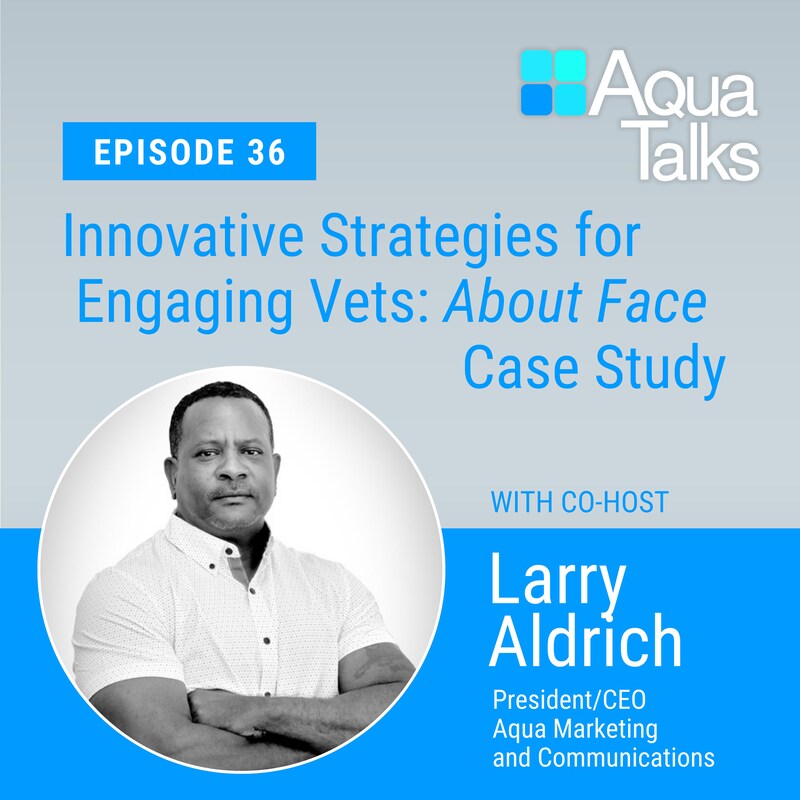
The central theme of this podcast episode revolves around the About Face program, a vital initiative aimed at assisting veterans grappling with Post-Traumatic Stress Disorder (PTSD). As we engage in a comprehensive dialogue, hosts Larry Aldrich and Mady Dudley delve into the intricacies of this program, highlighting its significance in providing veterans with a platform to share their experiences and access much-needed resources. The discussion further explores the challenges and triumphs associated with the management of the About Face website, which serves as a documentary hub for veterans to recount their personal narratives. We emphasize the importance of approaching this sensitive subject with care and respect, ensuring that the voices of veterans are not only heard but valued. Ultimately, this episode serves to illuminate the broader implications of marketing communications within the federal space, particularly in fostering connections with those who have served our nation.
IN THIS EPISODE:
- 00:07 - Introduction to Aqua Talks
- 03:10 - Transitioning to AI in Federal Government
- 11:51 - Approaching Veterans with Care and Understanding
- 16:47 - Understanding the Importance of Veteran Support Programs
- 21:03 - Understanding the About Face Program and VA Partnerships
- 32:30 - Transitioning to Federal Outreach and EAC Public Relations
TAKEAWAYS:
- The Aqua Talks podcast serves as a platform for innovative marketing discussions, emphasizing the importance of making meaningful connections with audiences.
- Hosts Larry Aldrich and Mady Dudley delve into the unique challenges of marketing for federal agencies, particularly in relation to veterans' issues.
- The About Face program is pivotal in providing support for veterans dealing with PTSD, showcasing the importance of personal narratives in healing.
- Adapting to change within the federal landscape requires continuous learning and adaptation, fostering resilience within organizations.
- Utilizing AI tools has become essential for maintaining competitiveness in the evolving market of marketing and communications.
- The podcast highlights the emotional weight of working on veteran-related projects, emphasizing the necessity of delicacy and respect in outreach efforts.
Transcripts
Welcome to Aqua Talks, where marketing meets bold game changing ideas.
Join your hosts, Larry Aldrich and Mady Dudley as they explore the art and science of cutting through the noise, capturing attention and fostering meaningful connections with your audience.
Whether you're a destination marketer, government contractor, or simply passionate about the transformative power of marketing, AquaTox offers engaging discussions, fresh insights and actionable strategies designed to inspire and inform.
Speaker B:Hi, welcome back to Aqua Talks, the podcast for marketers. Whether you're just getting started or you're already within the industry, my name is Mady.
I'm the public relations director at Aqua and this is a podcast brought to you by brensystechnology. As always, I'm joined by Larry Aldrich, our co host.
Speaker C:Hello, I'm Larry Aldridge, President CEO of Brensys Technology and Aqua Marketing Communications. Hi, Matti, how are you?
Speaker B:I'm really good. How are you?
Speaker C:I'm good. Excited to have this next episode and have a good conversation.
Speaker B:Yeah, I feel like I'm going to learn a lot.
Since Brensis acquired Aqua, I've just been learning so much about federal government clients and I'm excited to hear about all the successes and work that you all have had.
Speaker C:It's fun, it's challenging, it's a headache, it's a whole lot of chaos wrapped up in a good lollipop.
Speaker B:Amazing. One of my favorites. Before we get started, trends, I would love to ask you any trends within the federal government or.
Yeah, anything top of mind for you right now?
Speaker C:Well, right now in the federal government, there's a lot of changes. Change is good. It's challenging, but it's always good.
And it helps to continue to keep you as an organization on your toes and make sure that you're doing your research, make sure that you're constantly trying to evolve. This time around, some of the changes are a little more drastic and they're coming at you fast and hard.
And as long as your, you know, you stick to your processes, you keep up with industry news, keep up with your research, you make your adjustments and then you continue to move forward.
Speaker B:Yeah, then it's more of like, change is a scary word. So maybe evolving.
Speaker C:Evolving, yes. It's always evolving. Yes, constantly evolving.
And it's just like any other organization you want to continue in any other industry, you want to continue to follow the trends, see what the trends are set new trends, not just follow what everyone else is doing, but see and understand how the industry is evolving and make sure you stay on the cutting edge.
Speaker B:Yeah, anything top of mind for staying.
Speaker C:On the cutting edge, let's say. I would say right now you have to use AI as a everyday tool.
You have to use AI to continuously compete and make sure that, let's just say AI is your personal assistant. You have to have them right next to you at all times.
Speaker B:Yeah, yeah, absolutely. And we've had discussions in the past of, you know, moments to use AI, maybe moments not to. So we're not like completely all in, but. Yes, exactly.
It's essentially another employee at your disposal.
Speaker C:Just like the job market out there, it's changing. It's a new market, it's a technology based market. And to compete, to be a part of tomorrow's market, you have to be technology based.
Speaker B:Yeah, yeah. Well, let's get into this interview. I'm excited. We're gonna learn some more about one of our clients, About Face.
This is a case study we're doing working with the VA's National center for PTSD on the About Face program. Can you start explaining what it is and why it matters?
Speaker C:Okay. The Veteran Affairs Virginia NCPTSD national center for Post Traumatic Stress Syndrome About Face website redesign and maintenance contract.
We are the current incumbent actually, and I say that because we just had to do another five year recompete as the current incumbent and we re won the contract. We are starting our sixth year doing the About Face website.
So the About Face website is a documentary website designed for veterans with PTSD to tell their stories. So as you know, PTSD is something that, you know, the veterans deal with on a daily basis.
Whether you know, they have come forward to talk to someone or they're holding and said, we hope we continue to do this outreach to veterans with PTSD or think they may have it to come talk, have that conversation. Go to your local va, use all the resources that are out there for you.
But on the About Face contract website, excuse me, you're hearing stories from other veterans with ptsd. We're talking about their everyday life.
And we take that, we interview the veterans with ptsd, we produce that, we take the documentary style videos from the interviews that we have, we upload them onto the website. We also take the clips from the videos and we put those on social media. There is a About Face social media site for Facebook, Twitter and YouTube.
You can also go to the About Face website, which is part of the NCPTSD website. But the About Face is a separate website that's part of that organization. On that website. We first migrated it from Ruby on Rails over to Drupal.
Once we did the migration, obviously we set up the entire website to be redesigned from top to bottom. We do monthly content changes, we continuously add new videos. We have bi weekly meetings to talk about content changes.
We look at every aspect of that website from font to colors to the structure and we discuss that and we make monthly changes. We also take the clips and we put those clips on social media where we talk and we also have discussions and meetings about those clips.
We have our UX designers are part of making the content and continuously changing the content. We do the maintenance. You have your broken links or you have anything that may slow down the website. So it's, it's an ongoing program.
It's a, it's a, it's a huge contract.
Love working on that contract, love working with the veterans, love working with the va, specifically NCPTSD and quite a few other offices that we work with at the va.
So I love, I am a veteran myself and I love working with other veterans whether it's through the VA or through some of the other federal agencies where, and state agencies where we work with veterans.
Speaker B:So six years ago what is, what really drew Brensis to this specific project?
I know you said you're a veteran and they have really important resources but what really stood out to you and how did, how do you think that Brensis skill set could complement this existing thing?
Speaker C:So six years ago we were working with the va, we were doing research, we were networking with certain agencies in the va, doing our research, looking inside of a different agencies. The VA was our main agency we really wanted to target. So working on researching the va, their mission, their goals.
Being a veteran, myself, we came across this project and it was up for contracts for the solicitation came out. We started working on putting together a great proposal to go after this contract.
Being a full service marketing communications firm that we are, this was a website, graphic design, technical video production per se type project and it fit in our scope perfectly. So we put together a good program, we put together a great team and we won this project.
Now looking at the way that this contract is set up and when I say that the specifics of what they need to do this website, it is a very unique website. It is. There's a lot of moving parts which is part of this program from the video production to the maintenance to the design.
So we knew it would be challenging. It has been challenging, it's been fun. We've been learning a lot. We've became better as an organization because of this program.
Speaker B:I love that.
Speaker C:So that was one of the main reasons Why? I said, let's do this. Yeah, it's challenging. It's not easy, but it's definitely worthwhile. We have had our headaches, but we've learned from those.
We've made our mistakes, but we've learned from those. We've been. We've become closer to the people we work with at the va. So it's been an overall exhilarating feeling.
And I've learned a lot about PTSD and veterans with ptsd. I do not have it myself, but I have friends with ptsd.
And actually we've been talking going forward with a very close friend of mine that I grew up with, who he was in.
Over in the desert, and he was with PsyOps, and he was blown up in a Humvee, and he spent six months in the hospital at Fort Bragg, and he suffers every day. I talk to him a little bit. He's. He's doing very well. He's very happy, but he has his nightmares. He tells me.
So we will be having a conversation with him in the next couple of months. So, you know, I've had my personal relationship with some really close friends of mine with ptsd, and working on this program is personal for me. So.
Speaker B:Yeah, thank you for sharing that and thank you to you and your friends for your service.
Speaker C:Thanks. Appreciate it.
Speaker B:In terms of. I mean, since it's so close to your heart and since this is such an important thing to. I mean, they're.
They're helping veterans, they're helping veterans families. What special care and responsibility do you feel it takes to approach this kind of project?
Speaker C:Delicacy? Because we, as humans, we all, you know, we're all jousting with our own demons. So that's.
Speaker B:That's profound. I love that I'm going to start saying that.
Speaker C:So we take that when we're talking about veterans, when we're talking to veterans, we know that we're all dealing with something personally, as I said, jousting with our own demons. They are on a different level. They have seen and heard and been around things that the majority of people have never couldn't even imagine.
I spent time in the military, and I haven't seen nothing compared to what a lot of these men and women have seen. You know, it was just we've had different jobs, we've had different experiences, and we had to. Some.
Some people had to go and do some things that let's, you know, what our country asked us to do, and some were harder than others. So delicacy, I would say you.
We we approach it in a very, very delicate manner because, you know, there could be triggers that we don't want to affect, to push. And, you know, we want to. We want to approach it with respect and approach everyone with respect and understanding of what they're going through.
Speaker B:So you would say it's really a sort of case by case basis.
Speaker C:Yeah, yeah. And patience. Because it could be hard to ask certain questions.
It could be hard to have some conversations, and you could have certain veterans, like a very. Another very close friend of mine who's no longer with us, who just doesn't let you know what they're going through. And then one day they're gone.
And it's like, I wish you to talk to me. I wish we could have tried to find help in other ways. But, you know, so.
Speaker B:Don'T smile after that. I'm gonna cry.
Speaker C:Well, I mean, I smiled because I saw the look on your face.
Speaker B:You're smiling because I'm crying?
Speaker C:No, I'm smiling so I wouldn't, you know, get a look on my face.
Speaker B:Oh, I'm so sorry, Larry. That. I mean, that is just. It's such important work, and that is what, like, really makes. You have to balance the emotional with the technical of it.
So, I mean, and this kind of work, especially when you're so close to it and have had personal experience with it, it's.
I feel like things when you're grieving or when you're going through something hard, you have to take more time and, like you said, delicacy with it and patience. But you kind of have to give your team a buffer and be like, hey, have you had anyone in your life?
I mean, not even asking that, but if someone has personally been affected by it, I could foresee this being something that. It's not just separating life and work. It's this really important work that is being influenced by past trauma.
Speaker C:It definitely helps you dig in a little more. We all like to believe, and we definitely all work very hard in our jobs every day and who we are.
When you have that personal experience and you've had some tragedy in that personal experience, makes you really want to try to make it more of a difference, try to help. I mean, the only difference we can try to make is through help. And everyone.
A lot of people are too proud to ask for help or to even let off that they need help. And that was in the case of my friend, the one who isn't with us anymore. You know, great, amazing guy. His personality was just stunning.
Astonishing and stunning. And he's the kind of person that would always wanted to be in the center of the center. There would be a hundred people in a room.
He had to be in the center, getting all the attention. Everyone you know loved him. He can make you love him, you know, just through, you know, his conversation.
And the happiest person, you would never think that, you know, inside there's something in there that's burning and still, you know, and then, you know, people like that will never let you know that they're hurting.
Speaker B:Yeah.
Speaker C:And this contract, this program, the About Face program, is a program designed to help veterans with ptsd, whether they want to come out and ask for help, or at times you, hey, sit back, just review this website, review these videos. If you want to come out and have someone to talk to, come talk. There's lots of. There's lot, there's hotline out there, VA hotline.
There's numbers, there's people at the va, there's communities that would be there to have that conversation with you.
And we hope that this About Face program, you know, really reaches out to as many veterans with PTSD and veterans without ptsd, the whole community and stakeholders and family and caregivers to understand and know that there's help out there and there's ways, there's people that want to talk to you.
Speaker B:How do you feel like working with the VA And About Face has really made help or asking for help more accessible to veterans with PTSD without ptsd? Just. You say that it's hard for them to ask for help. How do you think it's sort of further expanded the effort?
Speaker C:The About Face program really goes a long way into helping, but it's one small piece. The VA itself, the Veteran affairs itself, its mission is to work and help with veterans. So there are a lot.
The whole organization is designed for that.
And there are a lot of veterans that definitely need the benefits that they get, whether it's housing, whether it's clothing allowance, whether it's shelf food, health care, which is huge. So this is the Bout Face program is one small piece of a huge organization that's whole mission is designed to help veterans.
So there's a lot that is being done on a daily basis. And I talk to people every day that have, you know, they question the VA question, are we doing enough for veterans? Yeah, we're doing a lot.
And every day we're continuously looking to do more from the town halls or talking to veterans where they reside. There are other offices out there that just sit around and say, hey, what else can we do to help veterans?
So the About Face program is a small program inside the va, inside of ncptsd, that does a lot to reach out and do outreach for veterans. Now we do have other case studies for other programs that we're working on for outreach to veterans.
Brensys Technology was designed as a company to do outreach to veterans.
Speaker B:Amazing. So what did this specific project reinforce for you about working in federal and veteran focused spaces?
Speaker C:This program was, I would say, one of Brents flagship programs. It was definitely one of our more challenging programs.
It's not an easy program to run and manage, but we're doing it, we love it, and it helped us and helps us grow as an organization. And I want to. Can you kind of re. Ask that question to make sure I'm hitting it exactly the way you're asking?
Speaker B:Of course. Let me reference it again. Whatever you need.
So what does this, what did this project reinforce for you about working in federal and veteran focused spaces?
Speaker C:So this.
This program really let me know as a business leader, as an organization leader, as a veteran, that I want to continue and how important it is working with the federal government, working with the va because it's touching. Again, it's personal. I've been there, I've done that. I understand the lingo, I understand the thought process, I understand the missions.
It helps me and reinforces not just me, but our whole company, our whole organization to understand the mission of the agencies that we work with, whether it's a federal agency, whether it's a state agency, whether it's Punta Gorda beach, what's their mission? And the better we understand that mission, the better partner we are to that organization.
And working on this program, the About Face program and the website, it reinforces that because it's. You have to dig in deep.
And by digging in deep, you're seeing aspects and you're seeing small pieces and bits of how important this is, not just to yourself, but to other people.
Speaker B:I'm curious along that vein. So measuring success with this client. It's not commercial. We're not necessarily tracking specific numbers. Right.
Like, how were we able to measure the success of this specific campaign?
Speaker C:Well, this specific campaign, one, there were multiple parts. The migration piece, migrating it from Ruby on Rails to Drupal in a time frame under budget.
Speaker B:Okay, can you explain what those are? I mean, I have no idea.
Speaker C:Okay, I'm sorry. Ruby on Rails, Drupal. Those are CMS platforms.
Speaker B:Okay.
Speaker C:So Ruby on Rails and Drupal were, let's just say, a platform that was on because you have WordPress sites. So Drupal is what most VA agencies use. I believe all of the VA is moving over to Drupal without going too technical.
Drupal is a solid platform that is becoming one of the better known platforms that a lot of agencies and a lot of organizations are moving to. That's keeping all of the technical jargon out of it. But so you have your WordPress, you have your Ruby on Rails, you have your Drupal.
There's a lot of other platforms out there. So being able to take where that website is housed and moving it over somewhere else. So that's a huge aspect.
Then taking a current website and completely redoing the website. So there's lots of steps involved in that, from framing it to the font to the way it looks completely.
So you're redesigning a whole website and it's a huge website. Think about all of the veterans all over the world.
Speaker B:Yeah.
Speaker C:So all of those go into the outcome as far as. Then there's another part of it from other agencies or other programs that do the outreach.
So even though we have work with other programs where we do outreach to veterans, all of it is taking. It's like looking at, let's just say, an octopus with multiple arms.
So all of these arms are grabbing different sections of and pulling it into the body of it. That's kind of how the VA works, so to speak.
So when we look at outcomes for this program, we are getting out to veterans, other places or organizations are doing the outreach. So with that outreach, we're getting veterans and stakeholders and caregivers to all alike to come to the website.
We do have the metrics that we are able to see what the visitation numbers look like.
But a lot of that goes to another organization with the VA because the VA has different offices set up to look at all of the metrics, their clicks, their online viewership, and they do that with all of their different websites. VA has lots of different websites. How we look at outcomes is basically multiple fold.
We'll just call it that from designing the website, the videos of the website, making sure that all of these parts and pieces for this website are put together. The program itself, about face, is not measured on a lot of the metrics that we might measure on putting together another website.
Because let's just say that website is designed to bring someone to an airport or bring someone to a concert. They don't have the resources that the VA has that are going to outreach to the veterans to bring them to certain Places.
Speaker B:How much of this. I mean, I'm just so focused on messaging. How much of this was working with the VA to sort of. I don't want to say rebrand, that's very sterile.
But to re. Explain PTSD to veterans or make it more approachable.
Speaker C:So we do a pre interview with the veterans and we talk to them a little bit about their comfort level and what they feel comfortable talking about. And then we do the schedule another day where we actually do the interviews. And with that, this program is basically veteran centric.
And we kind of had these pre discussions. They kind of lead towards what they want to talk about, as long as it's based on what falls under the structure of the description of the title.
We're talking about whether it's nightmares, whether it's something that's tied to sleep apnea. So that's kind of the lead that we have.
We know that working with our caregivers, working with our clinics, the vha, what's an initiative, and we do it based off of that.
Speaker B:Okay, great. I think that's all the questions that I have. Unless. Is there anything that we didn't cover that you want to mention?
Speaker C:Nothing that we didn't. That I particularly want to mention, knowing that it's a huge program and there's a lot involved and wow, this conversation.
We would give it a lot more justice if we brought bringing in some of the stakeholders that are part of the program. I mean, we can go really deep on this.
So, I mean, this is just like scratching the surface of not only the About Face program and how big this program is, how important it is to the va, how important it is to veterans with PTSD and their family.
Speaker B:And.
Speaker C:That'S why when we started continuously, we started actually our podcast, we wanted to talk about, yes, it's Aqua Talks. We wanted to talk about all of the.
From a marketing standpoint, all of the clients that we work with, all the clients that we want to work with, but we also want to go into what we could talk about from a federal standpoint, particularly veterans, but all federal conversations that are out there from a marketing standpoint, talking to veterans, outreach to veterans.
One of the reasons why, going as we move forward, we want to make sure that we're hitting an episode monthly where we can talk to veterans, marketing and outreach to veterans and the federal contract as a whole, because I think that's a part that's really important, especially with all of the veterans that we have out there, all of the family members, everyone somewhere is connected to a Veteran. And we just want to make sure that we're continuously doing our outreach to veterans.
I know I say veterans, but I want to say we do a lot of work with the federal government and marketing to the federal government and marketing with the federal government, let's say, on their programs, on their contracts. It touches all of us.
And whether it's DHS has programs, whether the VA has programs, whether the army, the Air Force, the Navy, any of those agencies have programs, it all still affects the civilian life.
Speaker B:Yeah. Yeah, it sure does.
Speaker C:So we're marketing and working with the federal government and the state government to market a lot of programs, to do outreach on a lot of programs that affect us in our civilian life.
Speaker B:Well, today you are making me feel extra special for the veterans in my life. So thank you, Grandpa, Uncle Ed, Bruce, Jeff, Luke, Stephen. I could go on a little bit longer, Tyler. So thank you all so much for your service.
And thank you, Larry. I think this is really important work.
Speaker C:Thank you. And I want to say as a teaser, we'll definitely be talking with you more as a leader in our organization in public relations.
And I know you're working on another really important federal project called EAC Public Relations Project. Do you want to just really quick as a teaser, what does EAC stand for?
Speaker B:I'm sorry, I'm emotional right now. I need a second. EAC is Elections Admissions or Elections Assistance Council. Right?
Speaker C:Yes. So we'll be having a program where we'll be talking about one of our case studies that Maddie's leading up with the EAC Public Relations program.
So that'll be another interesting one to talk about.
She's doing a lot of great things with public relations with the organization BRENTSIS and acwa, and we look forward to having that conversation with you.
Speaker B:So, yeah, I'm looking forward to working more with the eac. They're a great team and doing something very important also.
Speaker C:Yes. Thank you. And thank you to all of our veterans out there.
Speaker B:Thank you.
If you want to learn more about Aqua Talks, please go to aquatalks.com More importantly, if you're a veteran or you know someone who's struggling with ptsd, please check out the About Face website. There are a bunch of resources there. And thanks again for tuning in.
Speaker C:Thank you.
VO:You've been listening to Aqua Talks, where marketing innovation takes center stage with bold ideas and actionable insights. Ready to take your strategies to the next level?
Visit aquataks.com to book your free consultation and explore resources that empower you to thrive in today's fast paced marketing world. Until next time.
Speaker B:Time.
VO:Stay bold, stay inspired, stay imaginative.