Shownotes
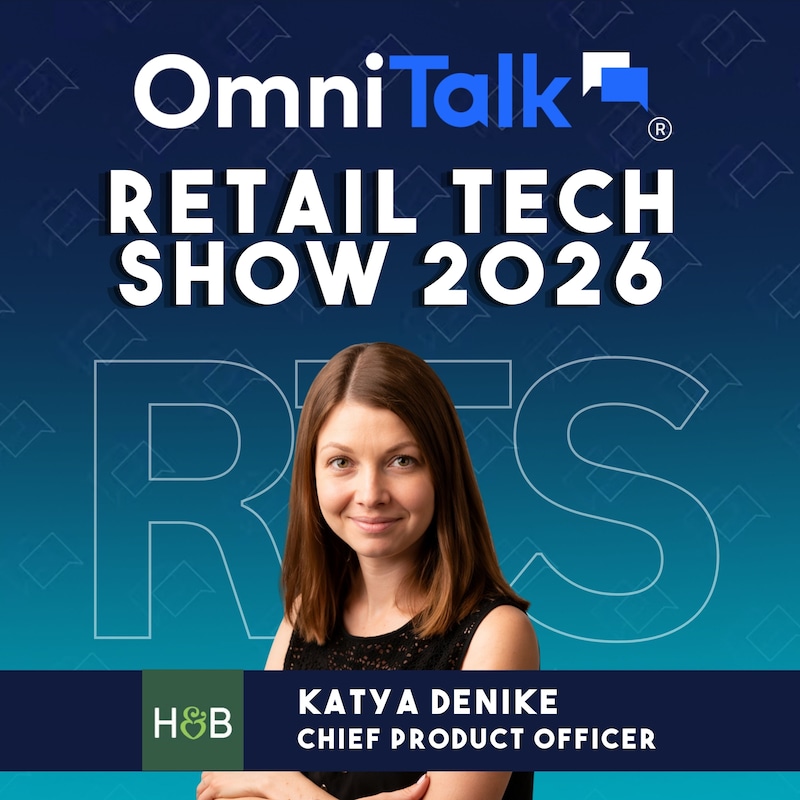
Live from Retail Technology Show 2026 in London, Omni Talk Retail’s Chris Walton sits down with Katya Denike, Chief Product Officer at Holland & Barrett, to discuss how one of Europe’s leading wellness retailers is using technology, product thinking, and AI to transform the customer experience.
Katya shares why Holland & Barrett brought its mobile app in-house, how it grew from a struggling outsourced platform into a major digital growth driver, and why retailers should own the products that create true competitive advantage.
They also explore how Holland & Barrett organizes product teams across customer, colleague, and partner experiences, why operational technology matters just as much as customer-facing innovation, and how AI is reshaping retail faster than any previous technology wave.
From personalized wellness journeys to internal productivity gains, Katya explains why the next era of retail belongs to companies that think like product builders.
Key Topics Covered:
• Why Holland & Barrett brought its mobile app in-house
• Growing app revenue share from under 5% to 30% of digital sales
• When retailers should build vs. buy technology
• Why product ownership should extend beyond customer-facing tools
• Organizing teams around customer, colleague, and partner experiences
• How AI is changing software development and retail operations
• Personalized wellness recommendations powered by AI
• Why retailers must adapt quickly or risk falling behind
• How product mindset drives both customer and employee innovation
• What the future of AI-powered retail could look like
Thank you to Vusion for supporting Omni Talk Retail’s live coverage from Retail Technology Show 2026, and thank you to our listeners for joining us during the event.
#RTS2026 #RetailTechnologyShow #OmniTalkRetail #HollandAndBarrett #RetailInnovation #AIinRetail #DigitalTransformation #ProductLeadership #WellnessRetail #Vusion
This podcast uses the following third-party services for analysis:
Podcorn - https://podcorn.com/privacy
Transcripts
Hello, everybody.
Speaker A:Welcome back.
Speaker A:This is Chris Walton.
Speaker A:I am Omnitalk Retail and we are coming to you live from the Retail Technology show in London from the Vuzion podcast studio.
Speaker A:Now joining me is Katja Denike, the Chief Product Officer at Holland and Barrett.
Speaker A:Katya, welcome to omnitalk.
Speaker B:Hello and thank you.
Speaker B:Delighted to be here.
Speaker A:Yeah, it's great to have you.
Speaker A:Now, we've had folks from Haul and Barrett on our show before, but never had you before.
Speaker A:So tell us about, tell us about yourself and tell us about your role as Chief Product officer.
Speaker B:Sure.
Speaker B:So as you said, Chief Product officer, been doing this job for the last five years.
Speaker A:Wow, that's a long time for a Chief Product Officer.
Speaker B:Yes.
Speaker B:One thing you need to know about Holland Barrett is the time that just flies like this because many, many things are happening.
Speaker B:It's anything but a boring place to be.
Speaker A:Yeah.
Speaker A:And remind our audience too, what is it that Holland and Barrett does and sells?
Speaker B:Yeah.
Speaker B:So probably if you're in the uk, you would know that.
Speaker B:But for the more international officer, for more international audience, we are health and wellness brand.
Speaker B:We have more than thousands of stores over UK and Benelux mostly, but also in other locations.
Speaker B:We have our digital business which grows stronger and stronger every year.
Speaker B:And we sell health and wellness products, but also do advice and services.
Speaker B:We recently launched back your body campaign.
Speaker B:You might seen it on tv.
Speaker B:If you haven't, I hope you will enjoy it.
Speaker B:But back your body is all we are about and I personally relate to this strongly.
Speaker A:So what did you do in the five years before Holland and Barrett?
Speaker B:Yeah, so anything and everything, to be honest.
Speaker B:I've been in product for the last 15 years, so to speak.
Speaker B:I've been connected most of this time.
Speaker B:Prior to running product teams with AI and machine learning.
Speaker B:Most of my early product roles were at this space because I have a math degree.
Speaker B:And when I decided to become a product person, so it was just a natural intersection of things to do, implementing machine learning everywhere.
Speaker B:I worked straight prior to Holland and Barrett.
Speaker B:I've been in health tech startup which had a mission to help people to live over 100 years old.
Speaker B:A very, very big and bold one.
Speaker B:And prior to that I worked for large tech companies in E commerce sector mostly.
Speaker A:Okay, got it, got it.
Speaker A:Yeah.
Speaker A:Well, that sounds very germane to what your current role is too, that last job.
Speaker A:All right, so one of your claims to fame, I was doing the research.
Speaker A:Oh, and by the way, I love the mathematics degree.
Speaker A:Yeah, I was doing the research.
Speaker A:I love when mathematics degrees come to retail.
Speaker A:But I was doing the research and one of the claims of fame is that you decided to take your mobile app in house and you took it from being what, you know, some might call a struggling third party product.
Speaker A:Third party product, excuse me.
Speaker A:And I think the revenue when I was doing the research said it was like the less than 5% of your digital revenue.
Speaker A:The ratings weren't great on it and you wanted to take it over and you've grown it now to represent 30% share of the business.
Speaker A:So what didn't work with the outsourced model that convinced you that that was the right move to make and how have you found success with it?
Speaker B:Great research, first of all.
Speaker A:Thank you.
Speaker B:Another thing that is very important to say is that's not only me.
Speaker A:Yes.
Speaker B:That's a talented and passionate team of people because if you don't have it, don't do in house.
Speaker B:That's what you need.
Speaker A:Yes, that actually is, that is an awesome lesson.
Speaker B:Yeah, yeah, yeah.
Speaker B:So you need to validate, validate this first.
Speaker B:But I think if you distill it, it's of course about thousand things, right.
Speaker B:And it also depends about the specific third party you have because some of them are great, some of them are terrible.
Speaker B:You have kind of all the range.
Speaker B:I think if you distill it down, it's mostly about speed, so.
Speaker B:And speed on different levels.
Speaker B:Right.
Speaker B:So in our case, what we were able to do by introducing a better tech is just the, the app works faster first of all, so you just get like all those basic tasks faster.
Speaker B:But also talking about speed in the other, let's say end of it, it's about the speed of your delivery of features that have a customer value because it changes, right?
Speaker B:Industry changes very fast.
Speaker B:And one year your customers might need a very, very fast onboarding and checkout.
Speaker B:And every year now like you need probably AI based tools in your app so you can talk to the advisor and receive it.
Speaker B:And by having an in house team, you kind of in the majority of cases you're able to deliver it faster, faster, faster because you bypass lots of stages of giving it back to the vendor or unpredictability for what matters as well.
Speaker B:I also ultimately believe that it's like opposite of death by thousand cuts when you have a thousand small moments where someone who is building your product, they immersed in your business.
Speaker B:And if that's a product you want to be one of the core strategic advantage of your business, which in our case app most certainly is, you need someone who is doing it, who is responsible for it to be fully immersed.
Speaker A:Got it.
Speaker B:In the process.
Speaker A:Got it.
Speaker A:So I'm curious then, so I guess based on that answer, like if you want to be a successful retailer in the modern age of omnichannel retailing, I guess, would you advise that everyone take that approach?
Speaker B:Yes.
Speaker B:For the products you want to.
Speaker B:For the products that are your competitive advantage.
Speaker A:Right, right.
Speaker B:You don't have to build everything.
Speaker B:But if you want it to be your unique competitive advantage, I would probably advise to keep it close to heart.
Speaker A:Got it.
Speaker A:So if a mobile app is key.
Speaker B:To your business, then yes, yes, absolutely.
Speaker B:And for us it was key for many reasons.
Speaker B:Because you kind of always with your mobile phone.
Speaker B:Right.
Speaker B:And because we don't want to be just someone who sells products.
Speaker B:We want to be your health and wellness ally in a broader sense.
Speaker B:It opens us lots of opportunity to help our customers in the better, more profound ways.
Speaker A:Yeah.
Speaker A:And for a retailer, there's very few retailers where the app doesn't play that role too.
Speaker A:For most of them, probably.
Speaker A:All right.
Speaker A:The other thing I love about when I was doing my research on you is I love whenever I get to talk to a chief product officer whose purview or their job is it goes beyond just the core customer facing applications like you actually are in charge of logistics, pricing, pricing, data management, all the things that go on behind the scenes in terms of the products that make the organization run too.
Speaker A:Would you argue that every retailer should be organized that way as well?
Speaker A:You can see where it's kind of a leading question because I kind of think that that may be the best answer.
Speaker A:But I'm curious what you think.
Speaker B:Yeah, so I think organization wise and you have been.
Speaker B:We've made a lot of strategic choices.
Speaker B:Our tech organized like we have customer experiences, we have colleagues experiences and we have partners experiences.
Speaker B:And then you can cut it and slice it in any way that is relevant to you.
Speaker B:For us it's been quite dynamic in a way that when we felt that there is an important thing, like more important prominent thing this year, we would put more research and more focus on that one.
Speaker B:So I wouldn't say, you know, there is no yes or no answer to that one.
Speaker B:So I'll give you the worst politician answer.
Speaker B:No.
Speaker B:Yes or no.
Speaker B:Not black and white, but I think in terms of owning the development of those products.
Speaker B:I'll go back to my point of your strategic advantages at Holland Barrett.
Speaker B:We probably even overplayed it as I mean we had at the beginning of our journey of the digital transformation, we probably had a bit of a bias to building more things.
Speaker B:And also.
Speaker B:Yes, yeah, and also we did see because so much of like you might seen that talk of Anthony earlier on the stage, but so much of our tech was those years ago just pen and paper or Excel spreadsheets.
Speaker B:So you couldn't partner very well with someone like you couldn't just bring a third party from let's say for pricing solution and then what they will need to partner with Panay Pamper on the other side.
Speaker B:Right.
Speaker B:So what we had to do is gradually build all the layers from system from scratch.
Speaker B:That's like one of the reasons for our decisions.
Speaker B:But overall, for all the retailers out there, my advice would be just constantly apply critical thinking.
Speaker B:Yes.
Speaker B:Especially currently with the AI world.
Speaker B:Sorry, that was a bit obvious, wasn't it?
Speaker B:Yeah.
Speaker B:Best ones from me.
Speaker B:Eat your five vegetables per day, apply your critical thinking.
Speaker B:And no, that isn't the reason it's actually important right now because of how much noise we get with the AI and also because probably what I'm telling you now will be different in six months because how fast industry is changing.
Speaker B:So I feel that's quite important.
Speaker B:Always going back to the first principles.
Speaker A:Got it, Got it.
Speaker A:So.
Speaker A:So.
Speaker A:Got it.
Speaker A:So, so what I'm hearing you say, so if I play that back to you because I want to make sure I capture this for both myself and for the audience.
Speaker A:So like you're saying like, you know, you're gonna develop yourself.
Speaker A:What is your core strategic advantage?
Speaker A:And I think I've heard that in a lot of interviews that I've done over the years.
Speaker A:But then in terms of like the organizational management or structure of who oversees what gets done by whom, do you.
Speaker A:Does that also depend on the retailer or do you think like it is good to shepherd that from one point of point of view, from the leader in charge.
Speaker B:That's such a good question.
Speaker B:I think where is it depends on your stage of development probably because in our case we have tech technology that runs across all the parts of the business, across all the functions.
Speaker B:Because in all those areas you mentioned, you have the places that benefit severely from technology, but also we have business partners on those parts of the business who will be responsible for various operational parts of it.
Speaker B:So it's always a close partnership.
Speaker B:And I think it depends on how you slice it and how you organize it.
Speaker B:It truly depends on your business.
Speaker B:And then your competitive advantage, for example, is your supply chain your competitive advantage.
Speaker B:Do people expect you to deliver things within a day?
Speaker B:Which sometimes holding barred orders now comes to me In a day they used to come and they used to take ages.
Speaker B:So that's how I would think about it.
Speaker B:Like, what they need from this and what is my best way to achieve it.
Speaker A:That's interesting.
Speaker A:Yeah, that's interesting.
Speaker A:Yeah.
Speaker A:Yeah, I think you're right.
Speaker A:I mean, it probably does depend on the retailer.
Speaker A:And the reason I was asking the question or kind of, you know, probing so much is I feel like.
Speaker A:I feel like in my experience of doing this for eight years, I feel like the retailers that really get it have taken a similar approach to what you all take, where you have a unified, you know, commitment to product centralized from the.
Speaker A:From the Chief Product Officer.
Speaker A:All right, so the other thing you mentioned, shift gears a little bit.
Speaker A:You said you have a background that is steeped in ML, you have a lot of ML experience.
Speaker A:So how different does that world of your previous ML experience feel from the AI conversation that's happening in retail right now?
Speaker A:And are most retailers doing AI or are they just kind of talking about it?
Speaker A:Like, what's your take there?
Speaker A:How much time do I have?
Speaker B:Yes, exactly.
Speaker B:Like, do we have about 10 hours, guys, are you going home and stuff?
Speaker B:But no, jokes aside, you know, like, yeah, I've happened to be in this space for quite a while.
Speaker B:Yeah, I had like this passionate about AI enthusiast and my LinkedIn profile for, I don't know, the last 10 years or whatever since I had LinkedIn.
Speaker B:And I think back a lot to my first roles when I used to be a person, for example, assessing AI vendors.
Speaker B:And 15 years ago, believe it or not, there are still AI vendors that would come to you and you would ask a lot of problem questions.
Speaker B:And you were like, okay, guys, what is AI AI about what you do?
Speaker B:And you kind of drill and drill and drill and then you figure out what they use.
Speaker B:Google spell checker.
Speaker B:You know, that's math.
Speaker B:Yes, yes, yes, yes, exactly.
Speaker B:And it's like some.
Speaker B:And you're like, okay, so that's just calling a cool stuff.
Speaker B:And there is a bit of it still in the space, but profoundly, I think, what has happened in the last two years, and especially since December, because in December, there has been a massive shift with the new versions of cloth and everyone else.
Speaker B:And I'll tell you in a second what the shift is, but it's a huge, huge change for everyone.
Speaker B:It's a huge change for people.
Speaker B:Huge, profound change and very ambivalent one for people who work in technology, but also for everyone across the world.
Speaker B:And I think probably as a society, not only in retail, we talk about it a lot.
Speaker B:Right.
Speaker B:There is AI, AI, AI everywhere.
Speaker B:I don't know, your kettle screams AI on the you in the morning.
Speaker B:But yes, we still underestimating it because I don't think lots of us took a pause to think, okay, what do these old things mean and what they do mean?
Speaker B:And I'm sorry for talking about it for a long time, but as you said, that's my background, so I naturally reflect on it a lot.
Speaker B:So for the technology areas on the retail technology show, some of the best, like workflow has completely changed some of the best engineers and all of the best engineers probably now not writing the code since that December.
Speaker B:Then kind of the coding machines got so fast.
Speaker B:Yes, exactly.
Speaker B:And if you look at the whole product landscape that means like okay, everyone else needs to adjust and change their job.
Speaker B:But then on the.
Speaker B:So there is clearly lots of opportunity.
Speaker B:But on the other hand, lots of AI slope has appeared and it became more difficult than ever to differentiate between what's truth and what's not true.
Speaker B:For example, can you imagine, I don't know, like a corporate email box for example would be that.
Speaker B:Or like, let's say when you open like just your personal email, how many of those emails AI generated now you receive and how many of those you're actually reading?
Speaker B:Or are you asking your cloud assistant, hey, give me a summary of those you see?
Speaker B:So now we swiftly moved from people talking to people to AI talking to AI and us reading a summary.
Speaker B:And I think there's lots of examples like this.
Speaker A:Wow, that, oh man, that's trippy here at the end.
Speaker A:Wow.
Speaker A:All right, well then, so okay, so where are you placing your bets then when it comes to AI, if it's going to be this life altering technology, as you kind of said that it is, you know, just beyond even retail.
Speaker A:Where as a retailer are you placing your bets on the future of AI?
Speaker A:Where do you think it'll impact you the most in the short, medium and long term?
Speaker B:Yes.
Speaker B:So I think that's already passed the benchmark of light entering technology.
Speaker B:It's diffusion is very fast.
Speaker B:But quoting CEOs of some of the big companies, not infinitely fast for all the companies, but probably we're seeing this technology in retail across the retail being adopted much faster than any other tech breakthroughs we've seen before.
Speaker B:So that's something to think about in terms of what it means for us within like 6 months, 12 months, 24 months.
Speaker A:Yeah, whatever horizon.
Speaker B:Yeah, whatever horizon it is.
Speaker B:So in six months probably not much you can Continue like you are in 12 months.
Speaker B:If you didn't do something, you're dead in the space.
Speaker B:So I mean is that, is that.
Speaker A:Organizationally like on the productivity side, is on the consumer, consumer facing side?
Speaker A:Like you know, if you're looking at like 12 months, if you're worried about not doing the right thing in 12 months, like which side of that is more important?
Speaker B:When I'm talking about 12 months, I think like if you haven't adopted and you haven't embraced the change at all, you're probably like hopelessly behind it in many, in many, many ways in terms of where it is.
Speaker B:Like if you break it down, there is an internal part, right, where developers process will change.
Speaker B:But it's not that simple, right?
Speaker B:There is a lot of parts to it because now you can generate your code very fast.
Speaker B:What does it mean for the quality, what does it mean for your design prototypes, et cetera, et cetera.
Speaker B:So you probably need to redesign this whole space internally.
Speaker B:The other part is about product layer, right?
Speaker B:The product features you can create and the ways in which you can help your customers are now so much more than we used to have the opportunity to cater for.
Speaker B:Now you can do much more quality and less training required, personalized recommendations, tailored plans for your health, combining this with that.
Speaker B:Is that so?
Speaker B:And it's only for Holland Barrett, but every retailer will have an opportunity like this on the product layer and finally on the like more global layer.
Speaker B:Because as like the whole population, you probably didn't talk to GPT like two years ago, right?
Speaker B:And I don't know how long how basically did you open your any of the AI agents today already or not?
Speaker B:Let me put you on the spot a little bit here.
Speaker A:Today, no, but yesterday for sure, yes.
Speaker B:Now it's like the daily thing in our hand and our behavior will change.
Speaker B:For example, I'm doing my waitress orders now through some agent I built so I don't go to the website anymore.
Speaker B:And that will a question I have which is we are going through the most certain bets to the least certain, but still probable is how much it will change the overall behavior of consumers in retail.
Speaker B:Like will we have a reality in 24 months which is plausible where you just go and you ask hey GPT, order this, that and that for me.
Speaker B:Look in my fridge.
Speaker B:Here's a photo of my fridge.
Speaker B:Like just analyze what I've run out of.
Speaker A:And yeah, that's also the use case we hear.
Speaker A:Yeah, yeah.
Speaker A:My big takeaway though from what you just said.
Speaker A:If I roll it back A little bit is sure.
Speaker A:I think what I heard you say too, and I don't want to put words in your mouth, so correct me if I'm wrong when I heard you say this, but the motif that I heard you say is that from a product perspective, and you being a Chief Product Officer, the great thing about AI is it actually enables you to create more products, better products, faster.
Speaker B:Absolutely.
Speaker A:Well, and that's kind of inspiring, too.
Speaker A:If we keep our head, our head in the right.
Speaker A:If we keep our eye on the ball or keep our head in the right direction, we should be able to use it to that end to help define ourselves as retailers in process the products that we give for our consumers.
Speaker A:At the end of the day.
Speaker B:Yes, absolutely.
Speaker B:The opportunity is massive.
Speaker B:I'm always like, you know, I'm thinking about it in a way that you have to always understand all the side effects to take the full leverage of the opportunity.
Speaker B:So that's why I've spent so much time talking about side effects per se.
Speaker B:But yeah, you're absolutely right.
Speaker B:The things that can be done for the customers and having like, training the models in a way that can leverage all the real science experts we have, that's where I think the real value will come in.
Speaker B:And I'm massively, massively excited about that.
Speaker B:Like, excitingly worrying.
Speaker B:The future is excitingly worrying.
Speaker B:That's the phrase I would probably use.
Speaker A:Well, it kind of brings our whole interview and conversation full circle too, because it, you know, it tells us, you know, it tells the retail executives listening.
Speaker A:Okay, you've got to keep a product mindset on what you're developing for the consumers.
Speaker A:But then you also got to keep a product mindset in terms of what you're developing for your employees, too, in terms of how they're going to do their jobs better from an efficiency standpoint as well.
Speaker A:All right, well, thank you.
Speaker A:That was great.
Speaker A:I enjoy.
Speaker B:Thank you so much.
Speaker B:That was a good to talk to you.
Speaker A:Yeah, it's really fun.
Speaker A:Really fun.
Speaker A:And it's great to.
Speaker A:Great to get to interview you and get to know you.
Speaker A:And so thanks for your time again.
Speaker A:Katya Denike of Holland and Barrett, thanks for being with us.
Speaker A:Thanks to Fusion and the Retail Technology show here in London for sponsoring our coverage all conference long.
Speaker A:And as always, on behalf of all of us at omnitalk, as always, be careful out there.