Shownotes
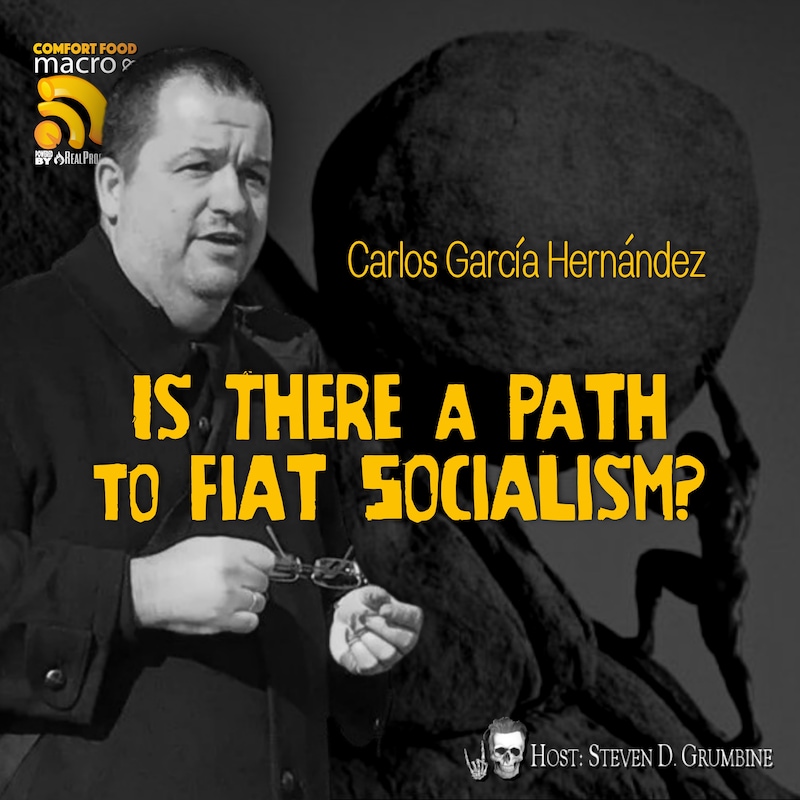
Carlos García Hernández, author of Fiat Socialism: Achieving the Goals of Socialism Through Modern Monetary Theory, joins Steve to revisit their discussion of topics covered in his earlier visits to the podcast.
Their dialogue wrestles with a deceptively simple question: if we already have the monetary capacity to guarantee jobs, housing, and public goods, why does capitalism still dominate? Through a sharp exchange, Steve and Carlos explore whether Modern Monetary Theory can be a pathway to socialism or whether deeper structural barriers rooted in class power and imperial dominance stand in the way.
While there’s broad agreement on the failures of neoliberal capitalism and the need to subordinate economic power to political control, tensions emerge around strategy and theory. Carlos leans toward a vision of “fiat socialism” centered on access to goods and services and the transformative potential of monetary sovereignty, while Steve pushes harder on the limits of education alone, emphasizing class struggle, ideology, and the near-impossibility of reform within existing institutions.
The result is less a blueprint and more an investigation that forces us to confront not just what’s possible, but why it isn’t happening.
Carlos García Hernández is the founder and director of Lola Books, a publishing house that has introduced MMT to Spanish and German readers. He is the author of Fiat Socialism: Achieving the Goals of Socialism Through Modern Monetary Theory.
@Carlos_G_H_ on X
Transcripts
All right, folks, this is Steve with Macro and Cheese.
My guest today is a returning guest. It's been a hot minute. We did some RP lives with him. We have gotten his book around.
We've talked about it, and we allowed it to, I don't know what you want to call it, like, seep. We allowed this book to seep like a good tea. We allowed it to seep and we thought about it. And we're at a next level with this next conversation.
And this is regarding fiat socialism, achieving the goals of socialism through modern monetary theory. The author of the book will be my guest today, Carlos Garcia Hernandez. And Carlos has been with me several times.
Again, we've done RP lives, we've done podcasts, we've talked behind the scenes. And I think that he and I are largely aligned.
I think there may be some areas where maybe we don't agree, but I think we're like, in that 95 percentile where I'm going to say, hot diggity dog, there's somebody I agree with out there. So with that, the author of the book again is Carlos Garcia Hernandez. The book is called Fiat Socialism.
And now that we've had a year or so to think about it, and we've talked to all kinds of different socialist theorists as well, this is kind of us coming back together and talking through some of what I consider to be the obvious problems we see in the world today in achieving any of these kinds of goals.
Also understanding China and some of the other roles of the various countries and what we can do to make this happen, I mean, I'm beyond the point of talking about, hey, guys, maybe we can go ahead and vote for a few more progressives and we'll have a Green New Deal. We already have seen how capital works to destroy movements.
We can pretend capitalism doesn't exist if that makes you feel better, but then that means your government hates you. Okay? So that means your government hates you.
But in reality, when you think about it, your government is in bed, hand in glove with capital and all the big money makers and the big money shakers out there. The revolving door in industry, man. Well, we had Bill Black on talking about the revolving door and all the elite, control fraud and stuff.
Hey, we're just going to go to these institutions and we're going to put them in jail. We're going to, we're going to go after them.
But these institutions have not once but twice impeached Donald Trump, have literally giving him a felony. And the man is the President of the United States right now.
If you still believe in this fake democracy, man, oh man, I want some of the drugs you're taking because I've taken all the illegal ones in the past and they never got me there. So I need some of that other Hopi and weird stuff that people are huffing on that makes them think that they're going to vote their way out of this.
So without further ado, let me bring home my guest, Carlos. Welcome to the show, sir.
Carlos Garcia Hernandez:Thank you very much. It's such a huge pleasure to be with you here. I thank you very much for this invitation.
Steve Grumbine:Now, be careful. I must have the cooties or something like that, because I'm saying tough things.
And I know that most people within the MMT space are extremely careful. They still believe in institutions, they still believe in the politicians that can make these things happen.
And I think that's where my nearly 15 years of advocacy for modern monetary theory has a little bit of a rupture, because I can't stand thinking of Joe Biden sticking the landing after calling people illegals and sitting there committing a genocide in Gaza. There's just too many differences. I just don't know how to fix that gap.
And this book that you've written, while I'm not going to say I don't agree with it because I think I agree with it more than not. But I want to ferret through some of these ideas, and we talked about it offline, and I really appreciate your candor.
I really appreciate the fact that you see things pretty clearly with that. Carlos, what do you think is the main barrier to us achieving any form of socialism? Any form of progress, really?
I mean, you're talking about fiat socialism here, but where we are today is just 100% unadulterated finance capitalism on steroids with a dose of fascism to keep us in line, xenophobia to freaking make everybody scared to come out of their houses and a bunch of militarized police to terrorize people, especially university students, etc.
I see a whole bunch of hate, I see a whole bunch of fascism, and I don't see a whole lot of this vaunted democracy that everybody swears about literally will not Even engage with you when you bring up Gillens and Page the Princeton study that shows there is 0.0% impact on public policy for what the working class wants. It is literally only the elite, the wealthy that have any sway your thoughts?
Carlos Garcia Hernandez:Well, in my opinion the answer is very clear.
The main obstacle we have for a socialist transformation of society is the knowledge about how economy works, especially the monetary production economies we live in. You know, so basically understanding what money is, I think that the majority of the population doesn't understand.
And that is exactly what modern monetary theory does. It explains how monetary production economies work.
I really think that if the population would understand how it really works, what money is and what does it imply, I think that everything else would very much be a very little problem. We would find a way out. Absolutely. The problem is that there is a very big misconception about what money is and how the economy works.
I think that is the main problem.
Steve Grumbine:So I want to throw a structural problem at you. The nature of capitalism and the nature of institutions.
Gramsci, when he spoke of institutions, talked about the cultural hegemon, the hegemonic thought, the fact that institutions are a representation of the ruling class.
So all of the institutions that make up the things we think we know are guided directly by the elite institution makers, those folks that raise run the country, the oligarchy.
And all fingers and all facts and all signs point to the fact that the United States, and I'm using the US only right now, because we're an empire and we have direct impact on the global South. We have a direct impact, as you see, in Europe, the vassalization of Europe to the United States interests, et cetera.
And within that oligarchy, within that elite group of people that are running around with AI and weaponizing nanobots and I mean literally domestic spying, literally the turning of the Department of Defense into domestic terror group.
Really at this point, I don't know how you overcome that hegemony, that absolute iron fist of control that the oligarchy has without a rupture, without some sort of tipping point for the people. You think just teaching them about modern monetary theory will fix voting?
How will their knowledge of MMT help them overcome those structural barriers?
Carlos Garcia Hernandez:I think that if people understood economy and understood mmt, we would find a way out of the rest of the problems. That's why I say it is the main problem. I don't mean it is the only problem.
I agree with you that in my opinion the big hope for humanity is not in the West. In my opinion, the big Hope for humanity is absolutely outside of the West.
I think that the European Union, NATO and the United States is absolutely rotten to the core. I feel that this is an ending empire.
And I think that we have to look outside of the European Union and the United States to find a little bit of hope. I am a big defender of what is going on with the brics. I come from Spain. I have defended it publicly.
I think that the best way to vote would be to leave the European Union and to join brics, and of course, by all means leave NATO, which is the biggest terrorist organization in the history of the humankind. But that is a another sphere. I think that we have to differentiate about three different spheres. First is our program, the goals we want to have.
That is our final goals. And we have to differentiate that from the strategy and the tactics. That is exactly what Gramsci also told us.
We have a strategy, we have tactics, and then we have our final program.
So I think that depending on where you are, it's not the same to be in Belarus or to be in China, or to be Russia or to be in the United States or Spain. Depending on where you are, you have to find the right strategy and the right tactics to get to your goals.
And the goals, in my opinion, should always be the same. And those goals are socialism. Now, why do I propose a new way of understanding what socialism is?
I propose a new way because in my opinion we have to follow the idea defended by David Greber when he talks about baseline communism. But we can find in my book Fiat Socialism, and I talk about it extensively. The book is a version of what David Greber calls baseline communism.
What is the difference between this kind of communism and the communism we used to have at the beginning of the 20th century? Well, the main idea is that socialism or communism, I don't really differentiate a lot between these two words.
The main idea is not the property of the means of production, but the access to products and services. So the main question is who has access to what and under what condition. The size of the private sector could and should be decided democratically.
And it should be the size that we decide is socially useful.
And I defend this idea in my book saying that the law of the tendency of profit to fall, defended by Marx in the third book of the Capital, is wrong there. What he wants to prove is that if you allow the private sector to be bigger than merely families, your system is going to collapse.
And the way he defends this idea is through commodity based money. For him, money was gold or silver always and in my opinion, that is absolutely wrong.
What modern monetary theory teaches us is that money is not a commodity. Money is typing in the Excel files of their central bank. It's not a commodity. And that is why you can have private enterprise.
And that doesn't mean that your system is doomed to collapse. And I also talk about how the 20th century have proven this.
Only when the governments were absolutely incapable of running the economy, like was the case in China and in Russia and in Germany, the system collapsed. If you had some things, like for example, the New Deal or K mechanism, the system that allows private enterprise doesn't have to collapse.
And that is a fact.
That is a fact that this prophecy which says that if you allow private enterprise to have a room and to exist means that your economic system is going to collapse, is not true. It's not true.
So in that sense, I think that we have to move forward from that prophecy that we find in Marx's work and go more towards what David Greber called baseline communism. Who has access to what and under what conditions? And that is exactly what I explained in my book. And I think that is the main question.
The size of the private sector should be the size that we consider socially useful. That could also mean that we get rid of private enterprise. Absolutely.
Because we have, for example, in the West, a reactionary bourgeoisie that doesn't allow at all any kind of social progress, any kind of social transformation, and is very much ready to kill anybody who tries to bring forward socialist policies, then you might very well say, well, you know what? In this moment of this historical period, we are going to get rid of private enterprise because it is not socially useful.
Again, we have to have different strategies, different tactics, depending on where we are. But the main idea is that if you allow the private enterprise to exist, that doesn't mean that your system will have to collapse.
That is the main idea.
Steve Grumbine:I think we can look at China and see for certain exactly when the state decides it's within its best interest to allow a private sector role. But make no mistake, if she decides, or democratic centralism of sorts, I mean, if they decide that it doesn't serve their purpose, it's gone.
Carlos Garcia Hernandez:Absolutely.
Steve Grumbine:Wealthy people decide that they want to screw the workers over or hurt whatever, they will be killed, they will be imprisoned, something will happen. It will not just be, ah, it's too big to fail, you know.
Carlos Garcia Hernandez:Absolutely.
Steve Grumbine:I just want to make it clear because there's an element to me that sees a lot of folks very willing to pretend, I mean, cosplay a Democracy, cosplay, that we can do these things. But in reality none of these situations currently exist. And I'm looking at Europe even. I mean Europe is under the gun of neoliberal elites.
Carlos Garcia Hernandez:Absolutely.
Steve Grumbine:It is in no way, shape or form a democratic society. And I feel bad because I see a lot of good people I care a great deal about acting like they can vote their way out of this.
And occasionally there'll be this random politician that will pop up out of the blue. And we had a guy here who, you know, retired the minute he acknowledged mmt and that's it.
The rest of the politicians here, and I believe my personal beliefs, I believe it's a big old theater. I believe that the ruling elites don't really care about government.
Government serves as a means of manufacturing consent and it literally pushes the agenda of those elites.
I don't get emotional about their stuff anymore, I don't really follow their stuff anymore because each time there's always a parliamentarian around the corner or a rotating villain to snatch the ball away from Charlie Brown right when he goes to kick the field goal. So as far as I'm concerned, there needs to be a revolutionary vanguard of some sort.
There needs to be some form of group of people that are not mealy mouth, are not seeking access politics, are not sitting there pretending like these folks are good people and this system itself is ripe to fail.
This system itself, the only reason why it doesn't fail is because they've got guns, they've got weapons, they have got the power of fascism using these techniques to silence and squelch and diminish what the working class could ever achieve. And with that I see people that will defend capital and make excuses for the elites. And I fundamentally don't understand it.
Obviously each country is different, but you live in Europe, you already know. What do you think it would take for you guys to break free from that neoliberal stranglehold?
I mean the cultural hegemony that allowed everybody to believe that system was good, pretty damn strong. The vast majority of people didn't take the time to learn about anything and just bobbleheaded along and went along with it.
What are your thoughts on how you would even bring that to be beyond the United States? And then we can talk about how empire might have a say in that too.
Carlos Garcia Hernandez:Again, I think that the key point is that people understand how the economy works. I think that is the main point.
I mean, going back to strategy and program, I think that what you are really saying or that is the way I Understand, it is that we need a political sphere that is above the economic sphere, that has the ruling part of the total economy. I mean, it cannot be that economic powers control the political powers. It has to be the other way around, just like it happens in China.
In China, there is a political sphere that controls the economy, not the other way around. The other way around is what happens in the European Union and the United States.
There, the economic sphere, meaning the oligarchy, controls the political sphere. The political sphere is under or below the economic sphere. And that is the main problem.
We always have to have a political sphere which is independent from the economic oligarchy that decides what to do and what not to do. And that is, in my opinion, the main idea. The main idea is that politics should be above the oligarchy always.
Steve Grumbine:So let's examine that, because I agree with you. I believe that oligarchy should be eradicated. Let me be on record, if I'm not already on record. That said, how would you go about making that happen?
And then I want to get into more of an MMT angle here, but go ahead and tell me your mind, because I think people genuinely think that once we talk about mmt, they slap an I voted sticker on their forehead and they think somehow or another miracles are going to happen.
Carlos Garcia Hernandez:Well, in a way, I am more pessimist than you are.
I mean, you say, well, the reason why they survive and the reason why they can do whatever they want is because they have the Arabs and they have the military and they have the army. Which is true. But in my opinion, the reality is sadder than that. It's more sad than that.
In my opinion, they also have the majority of the population. I mean, they have the minds and hearts of almost everybody.
I mean, seeing what the people think in Spain or in Germany, the two countries where I live, think about, for example, what's going on in Ukraine or what's going on in Palestine, not so much in Spain, but in Germany. It's really heartbreaking. They have been brainwashed to the point that they cannot really see what the reality is.
So it is not only that they have the arms and they have the army, they also have the hearts and minds of the majority of the population. And why is that?
Well, it's because the economic system that we live in doesn't allow the majority of the people to understand very basic things that the MMT really explains. For example, taxes don't fund public spending. This is very little information. This is very few bytes of information. Well, good luck.
If you Try to explain that to the majority of the population. You can say that, you can explain that, you can clarify what MMT means, and you can put all the evidence on the table. They will not believe it.
They will defend to the very bitter end that you have to collect taxes if you want to spend. Not even this very little piece of information comes through, not even the most basic things of economic activity gets through the school.
And that is, in my opinion, the biggest problem we have. Because if they could understand this, if they could understand these basics, everything after that is pretty simple.
Once you understand this, it's pretty simple to understand that unemployment and Spain is the country in the European Union with the highest unemployment rate. Unemployment is a monetary phenomenon. It depends on how much the government is willing to spend on national currency. That is what unemployment is.
So the governments that are monetary sovereign decide what level of unemployment they will have in their economies because they can always hire everybody that doesn't have a job in national currency.
Steve Grumbine:Let me ask you this real quick, because this is where class, in my opinion, kicks in. And a lot of people ignore clas. And I noticed it online, a lot of people try to say that, no, no, I got a class lens. I really do, honest to goodness.
And it's just simply not a class analysis that I see.
You know, really, in fairness, the class interests of the elite, the bourgeois, the ruling class, their interests are not about making everybody happy and whole. Their interests are in fact, power and control.
And, and at the end of the day, I mean, we've seen here recently the evidence of this through the global phenomenon known as Jeffrey Epstein and all the elites and all the money movers, even our famous Noam Chomsky, who is a famous anti communist and also pedophile defender, the idea of a job guarantee and the idea of us being able to spend to eradicate poverty and to eradicate joblessness and to stabilize the lives of people, well, that's in the class interest of working class people. But working class people aren't at the top and their interests are not being represented.
I think this is a major divide here in terms of beyond going, you know, to say, hey, you know, we can do these things. Of course we can. Of course we could do those things.
But the class interest of the people making those decisions is not to make us happy, healthy and whole.
Carlos Garcia Hernandez:The problem is worse than that. It's not that the interest of the working class is not being defended.
The problem is that the working class is not demanding its rights to be defended. That is the problem. They have sided with their masters. And that is the main problem.
I mean, the day that they discover that we can all have a society without unemployment and without poverty and with very nice standards for everybody and with permanent full employment, the day that they understand it, everything will be very easy. The problem is that the bad guys win when they are more than the good guys. It's always like that. It's like in a movie.
If the bad guys are outnumbered, the good guys, they win. They win. The question is, when the working class understands how society works and how the economic system works, it's over. It's over.
Steve Grumbine:Well, Carlos, let me pause there, because I agree with you in principle. But the actual network of information that we are all prey to, I mean, we all live on social media.
I mean, there is this snobbery that goes into not sharing people's stuff, which is just revolting to me.
But there's a deeper one than that, and that is that the rich, these elite people, these sickos like the guys at Palantir and guys at Oracle, these folks own TikTok, they own Facebook, they own Amazon, they own Netflix, they own all the different movie outlets, they own the radio waves, they own everything. And then these freemium services like Substack, which I love, they are also there to do the devil's work, if you will, for these elites.
This is not like conspiracy. I mean, they've narrowed it down to where I think five people own almost all of the media that there is.
So the way people get taught, the way people hear information, is directly impacted by that. And then we've got this weirdo group that's the tone police that runs around scolding folks, trying to remind them to be polite.
And so within this space, we have got a horrible gap between the desire to change the world and the ability to change minds. And being able to get this information in front of people is not just a desire. I mean, I put in 24 by 7 trying.
And a lot of the folks I work with put the same amount of time in themselves, and they're frustrated because their work doesn't get noticed. It doesn't get out there.
The people that are supposed to be fellow travelers can't be bothered to share their work, can't be bothered to comment, can't be bothered to give algorithm feeding likes and so forth.
Whether it be Substack, whether it be Twitter, whether it be Facebook, whether it be Instagram, wherever it is that we have pathways to get information out there, there's a weird resistance to doing the thing that is necessary to make that happen. I don't see the willingness of the people that do know this stuff to actually say, hey, it's really important that I share this stuff.
And I also don't see the actual ability within their system to overcome their system. I'm looking for a path, man. I'm like in a. In a maze, and I'm looking for doorway that gets out of the maze.
And, you know, it's like that saying, we're both in the maze. How do we get to the cheese? How do you get past all of the barricades to knowledge transfer?
I mean, we've got almost 400 podcasts, all of which are the best and brightest of mmt, of social theory of history, you name it. And we struggle mightily to get that word out there. How do you do it?
Carlos Garcia Hernandez:If I could answer that question, I mean, I hope I could answer that question.
But I think we can say that, number one, in the west, their strategy, coming back to the difference between program and strategy, their strategy has been very successful. They have brainwashed most of the population. So their strategy in order to defend their privilege has been very successful. That is, number one.
Number two, the situation is very difficult. There is no magic balance.
I mean, if we say, oh, we have found the solution and now we just have to go through it, and the solution is going to be very hard, the solution is going to be very painful, and the solution is going to take a long time. That is, number two. And number three, we have to look at things from other perspectives.
If you live in the United States, it's very reasonable to have the opinion that you have.
But things don't look like that if you are in Belarus or if you are in Russia, or if you are in China, or if you are in North Korea, or if you are somewhere in the BRICs, or even if you are in the developing countries that are getting closer and closer to the BRICs. This kind of rhetoric from the west is not selling anymore in Africa. Africa is putting out the colonial powers.
It is not selling in lots and lots of countries in South America, you know, so we have to look at those countries outside of the horror that the west has become and start working with them.
Intermission:You are listening to Macro N Cheese, a podcast by Real Progressives. We are a 501c3 nonprofit organization. All donations are tax deductible.
Please consider becoming a monthly donor on Patreon Substack or our website, realprogressives.org now back to the podcast.
Carlos Garcia Hernandez:I think we have to work much more closely with the political forces of China, the political forces of Russia and the political forces of Africa, for example.
Tauri I think we have to join forces with them and come up with a new strategy that defeats the strategy that the oligarchy is actually implementing in the west that is stopping any kind of change in the socialist endeavor. And that is what we have to do.
We have to talk to Russia, we have to talk to China, we have to talk to the developing countries in South America and in Africa.
And together we have to find a new strategy that is better than the strategy that the oligarchy in the west is currently using and that is outnumbering us. People don't see in China or in Russia or anywhere else an alternative to the economic system that we have in the West.
As horrible as it is and as bad as it sounds, people just don't see it. And this is not to say that the economic system and the political system in the BRIC countries is wonderful. I don't think so.
I think they also have a lot of problems. I think China has a lot of problems. There are many things that the Chinese government does that I don't like.
There are many things that the Russian government does that I don't like.
But I think that the economic model and the political model that they are implementing is much better because they have a political sphere that controls the economic sphere. It is the political powers, the democratic political powers of those countries that control the oligarchy.
The oligarchy cannot do anything without the approval of the political sphere because they know that the next day they will be outed. That's it. If the government decides that you are not socially useful, you are out, you disappear. And that is the way it should be.
And that is the main thing we have to come up. And I don't know how to do it. I wish I could tell you. I think it's very easy. We have to do this. I don't know how to do it.
In my opinion, the struggle is to explain people modern monetary theory and how it really works.
Steve Grumbine:Okay, so with that in mind, and you know what? I don't have the answers either. I just know that pretending like Ro Khanna is going to save us isn't the answer. No, you know what I mean? I just.
These are things that I can say empirically. And what. I guess my question to you then comes back and we'll roll it back a little bit away from some of the negative.
Well, it's all going to be negative because right now I don't think you can fix anything unless you've got a very sober analysis, a sober assessment, Pollyanna niceties, things like that isn't to me, I feel like it's lying at this point. I feel like it's telling a big whopper of a lie and people's lives are dangling in the balance on Hopium based on fraudulent, fake.
Yeah, we're going to source the vote. We're going to overcome this bourgeois democracy and pretend like it's a real democracy when in reality it's not.
It doesn't even have characteristics of real democracy. And I think defining democracy at this point is really important. I think understanding what it is that we are seeking is really important.
And so for me, I've come to believe that there is another way of presenting modern monetary theory other than the hey, we could do Green New Deal and talking about balance of trade and things like that.
While important, I think it's important to show what is possible and then making people make them like taking a dog to make them smell the poop they left on the floor. I think we need to make people really wrestle with the idea of this is what is possible. Why isn't it happening?
Why is this politician somebody told you to celebrate, who is just an absolute waste of life. Why are you sitting there and allowing them to lie to you about debt and deficits? Why are you allowing them to lie to you?
I don't think it's effective anymore to pretend like let's teach a modern monetary theory and and then everybody's going to vote better and then we'll win. Because I think that is a complete lie. It's just a lie.
At this point, from my vantage point, if you think about people trying to wake them up, people are very upset in general, but they just don't know why.
And so I do believe that helping people understand mmt, teaching them mmt, teaching them how it works in each country that they live in and showing them what is possible and then asking them why isn't it happening.
Unfortunately, you've got to overcome the person goes, well, there's only about 30% of the people that voted and if we can get everybody to vote, it'll change everything. That has just. I don't think I can handle any more normiesms, you know what I'm saying?
Like I think MMT we can give the positive view of we'll have a Green New Deal and here's these great things that we can do.
That's one angle, but that's an angle that I Believe sets MMT knowledge up for failure because it misses the point that we do not live in a God blessed democracy. And the people that pretend like we do have really fundamentally, they've definitely made me feel a different type of way.
And I have been a 24 by 7 by 365 advocate of this stuff. And I've grown to be very disillusioned with that kind of normie thinking.
What do you think about the alternative view as opposed to here's what we could do like, because people's false consciousness, who they think they are and what they think they're doing today stems from a very fundamentally flawed understanding of economics for sure. And you could see this within socialist movements as well. They got great sensibilities, but they got terrible economics.
Help me understand in your mind what you think would be a good wake up call, a good way of presenting MMT in a real way, in a realist way where you have realism when you say, well, you know, you don't live in a democracy or whatever. How would you present mmt?
Carlos Garcia Hernandez:Steve, the real socialist revolutions that have succeeded, I'm talking about the October Revolution and the Chinese revolution and of course the Cuban revolution. Why did they succeed? Because they were the majority. Because most of the people supported the revolution.
Most of the people supported the real change that the revolutionaries were defending. And once they were a majority, they took power one way or another.
Of course, it was very naive to say that we are going to vote our way out with the Russian royal family in power. It is absolutely naive to think that that was possible. Well, then the people opted for the revolution.
They were the majority and they did it and they found a way to do it. Same thing in China. China was a disaster before the Communist revolution and they were the majority.
The majority of people were back in the Communist Party and at the end they won. One way or another, they won. And the main point is that they knew exactly what the economic program of the Communist Party was.
Lenin explained exactly what he wanted to do. They knew exactly what they were going to expect and they supported it.
They understood what the message was, they understood what the economic problem was and they said, yeah, let's do it, let's do it. We cannot do it through peaceful means. We are going to do it through revolutionary means.
We are going to do it through the means that we can use in order to find our goals.
But the main point is that they were the majority of the society and they had a very clear economic program that they were going to follow because the party explained Very, very clearly what they were going to do with the economy and how they were going to do it. And that is the way to go. First of all, we have to be a majority.
You cannot say no, we are going to take the arms from the army or whatever and we are going to do a violent revolution because people are not going to follow you. You have to have the majority of the population behind you. Behind you means behind an economic program.
Once we have an economic program, people defend it, people identify themselves with it, then that's it. We will find a solution. It would be much better, in my opinion, if that solution was peaceful and there is no need of using violence.
But if that is not possible, well, then we will find a revolutionary solution that is not peaceful. It doesn't matter. The important thing is that people understand what they want and they have an economic program to follow.
Once they understand that that program represents its interest, then we will find a way, one way or another. In my opinion, the biggest risk or the biggest danger on the side of MMT is revisionism. Now we are experiencing a watering down of mmt.
All of the sudden, even some founders, not all of them of MMT say, well, you know, monetary sovereignty is not that important. Having your own currency is not that important. You can defend MMT and you can at the same time defend the euro system and the European Union.
No, you can't. No, you can't. If you don't have monetary sovereignty, you cannot defend mmt mnt and the Euro is absolutely incompatible.
And the problem is that we have reactionary supremacist forces on the side of MMT that are watering down the potential of MMT or at least how MMT was born. And they are trying to do the same thing they did with key nationism. Keynesianism was a way to find the economic means to have full employment.
And all of a sudden, some years after that, we find neo Keynesianism. And neo Keynesianism nowadays is the same as neoliberalism. And that is what is happening with mmt. We used to have MMT based on monetary sovereignty.
The book that Randall Ray wrote, it's called Modern Money Theory, A Handbook for Monetary Sovereign Countries. You know, monetary sovereignty is a must for any kind of MMT proposal that we have.
And now we have a NEO MMT that is saying, oh no, let's have a neoclassical mixture here. Let's put together neoclassical economics and mmt.
And now what we are facing is that many people are defending some kind of NEO MMT that doesn't have anything to do with the original mmt. And that is actually reactionary in its proposals and that is the risk we are facing now. That is actually what is happening right now.
I see people that call themselves MMTRs that defend the European Union and the Euro. It is insane and nobody says anything.
I find everything that MMT was based on has been perverted in order to make a neoclassical mixture, put everything in the same basket and now all of a sudden everything is mmt. Euro is mmt. European Union is mmt. Everything is mmt. No it isn't. That is, in my opinion the biggest danger that we face now on the files of mmt.
It has been watered down to make a neoclassical fusion that has nothing to do with the original message and potential of mmt.
Steve Grumbine:I have found myself really pulling deeply into historical socialism and really getting into theory and better understanding capital and class. And it has become important to me that I bridge that gap for people. And that's one of the reasons why I brought you back on Carlos.
And next time we talk I want to have an even harsher, more fine tuned, like really, really dig in even deeper next time. We have you on, but for this time let's talk to Marxist Leninist Maoists for a moment.
People that have a true understanding of class and class struggle but maybe don't understand fiat currency.
Can we give them an MMT 101 with the understanding we're not trying to break them, we're trying to bring them into the fold, we're trying to give them this tool. How would you present that to Marxist Lennox Maoists?
Carlos Garcia Hernandez: iks stay in power? Written in:Lenin explains the role of the central bank of the Soviet Union and he says we are going to take the central bank of Russia now, the central bank of the Soviet Union and we are going to implement a full employment policy. Everybody will have a job. We will have a planification committee called the Gospel Plan. We are going to build an economic strategy.
Everybody will have a job and we will pay them with rubles from the central bank. And that is exactly what he explains there.
Through the central bank we will have a full employment policy and we will determine what goals we want to achieve. And a couple of decades later, a very poor country and a very undeveloped country called Russia.
Now the Soviet Union put a guy in space and was an economic Superpower exactly the way he says. And that is absolutely compatible. That is actually the same that MMT defends.
We are going to take our monetary sovereignty, we are going to have a permanent full employment policy, and we are going to achieve the goals of socialism. I mean, not in the case of mmt, but in the case of fiat socialism. What do you want full employment for?
Well, it's very simple to achieve the goals of socialism, to achieve the living standards that you cannot achieve in capitalism. Capitalism will never have permanent full employment. Capitalism will never have permanent housing.
Capitalism will never have permanent healthcare, et cetera.
Once you have full employment policies, and you use that in order to achieve the socialist living standards that cannot be achieved in capitalism is when you can overcome capitalism through modern monetary theory.
If we begin to water this down and say, no, you know what, the European Union, the shoe cleaners of NATO are the good guys, and we are going to go to the European Parliament, and even though we have the euro and that means that we don't have monetary sovereignty, they are going to help us out. We are going, no, no, no. That is not the way. That is absolutely not the way.
So I would tell everybody to read that piece by Lenin and compare it to what modern monetary theory proposes, and I think they will find a very clear way forward.
Steve Grumbine:I love it, man. That's really good.
And just so you all know, we're going to look behind the scenes when we put this episode out and hopefully we'll be able to add it to our show. Notes, Carlos, we're getting up near time and, you know, for me, I want to make a quick statement.
I appreciate the level of rigor that you put into researching your book. My biggest problem with it had been I am living in the United States and the United States is the largest neoliberal project on the planet.
We are 100% about privatizing absolutely everything, down to drinking water and the trash that people put forward as good candidates are stupid enough to go along with it or bought off enough to go along with it.
So for me, it was very, very hard as I'm fighting against mass privatization and my own little teeny world that I inhabit here at Real Progressives and this podcast, Macro and Cheese, I couldn't see past the idea of allowing private sector.
But looking at what China does and understanding that while I don't agree with everything China, I want to be clear, this is not like me being a sycophant for China. But if I just take Lenin as you brought up at his word, and think of State and revolution and the withering away of the state do we come administers.
You know, basically we eliminate class. We eliminate that component as time goes on. But it doesn't start that way. There's an entire taking over of the proletariat of society.
And in order for fiat socialism to occur, I believe the proletariat, as you say, needs to outnumber. But these are the details, man, that we've got to get through. And how do we overcome them? And I know we don't have an answer 100%.
It's very challenging. And the one thing about capitalism is it morphs and it changes and it learns from its mistakes. It's a system. It's not the good or bad people.
It's a system that literally demands a lot of bad things. So you can't buff the edges off of capitalism. You've got to kill capitalism.
And in the sense of how do we get to fiat socialism, I think this is really. This is where I'm stuck. This is the sticking point for all of it.
Because most people don't want to go past the idea that they can put an I voted sticker on their forehead and walk away.
In fact, I've got friends who think that by me calling out these truths that somehow or another that because they're struggling for Social Security or they're struggling for other things, they think somehow or another by speaking the truth, that that is in some way a violation of their ability to survive. When in reality, I think as a transitional strategy, we need to be looking at building community resiliency outside of the system.
We need to be building parallel systems outside the system so people can do a general strike, so that people can take direct action, so people can overcome the stranglehold that these systems and capital and the absolute marriage and intertwining of state and capital that has occurred can be overcome. I don't see any other way around it. But your final thoughts on that, sir?
Carlos Garcia Hernandez:No, I agree with you. I agree with you. In my opinion, the most important economic sectors should be public and should be nationalized.
I think health should be nationalized. I think energy should be nationalized. And I think that the public enterprises should control the strategic economic sectors.
What I mean is that I don't see any use in making Macro and Cheese or real progressives or my company, Lola Books, public. I think that is something that, you know, it is really not important.
I don't think that my company, Lola Books, will function better if we make it public or we nationalize it. I think that I run my company pretty well. And I think that you do the same with your company.
So I don't see any problem with letting that kind of enterprise to exist. But I agree with you that at least in Spain, and I think that in the US the same, the strategic economic sectors should be nationalized.
Health, education, water, energy, all these should be in public hands. Absolutely, absolutely. But at the end, it is up for the people to decide. That is my opinion. And why do I think that is the right thing to do?
Well, because it helps to achieve socialist goals. You cannot have full housing of people if you don't have the public sector taking over most of the land.
You know, most of the land should be in the hands of the public sector so everybody can have decent housing, things like that. I think it's very simple.
If you want to access the services and the goals of socialism, you have to have a very big public sector, you know, but that doesn't mean that it has to be 100% of the economy. No. Does it mean that the private sector in Spain and in the United States has to have the same size? No.
It can have different sizes, it can have different companies, we can have different strategies. And that is what I mean when I talk about flexible socialism.
But I agree with you that the strategic and most important economic sectors should be nationalized. Absolutely, yeah.
Steve Grumbine:I mean, I can think back to workers guilds and stuff like that and co ops and other things of that variety where people in general do own the means of their own production, but it's controlled, if you will, by the state. The state doesn't allow predatory behavior.
Carlos Garcia Hernandez:Exactly.
Steve Grumbine:Like we can all be against it, but when you're really against it, you start behaving differently. The things that you put forward are different. The kinds of strategies that you put forward are very different.
And I see a lot of folks that are willing to play within the capitalist system, within the oligarchy, and play access politics. Be very careful in how they frame things, not speak so that working class people can hear.
I mean, one of the biggest challenges of them all is looking at paywalls. People paywalling their content, paywalling every. If you really want change, then you need to make your information accessible to people.
You know, I mean, it can't be gatekept.
And I think there's a lot of gatekeepers out there that knowingly block voices that maybe are a little bit more coarse and radical in desiring change and a little bit too much inside voice, outside voice. Kind of like Hillary Clinton's I have my public and I have my private.
I think these kinds of things maybe work well within neoliberal elite society, but I think that they are really, really harming working class people in a way that I don't think people fully realize. So I will give you the final thought to take us out.
Carlos, what do you want people to get from this conversation and what do you want them to take forward?
Carlos Garcia Hernandez:I think we agree in most of the things that we have talked about. I just want to reiterate the idea of baseline communism. Who has access to what and under what conditions?
That is the main question we have to answer, and that is the main strategy we have to develop in order to overcome capitalism and achieve the goals of socialism. In that sense, I think that the property of the production of means is not the main question.
I think that the main question is the access and we can manage the economic system in order to have a size of the private sector that is socially useful, so to speak. So in order to do that, we have to have an economic sphere that is always below the political sphere.
I think that the political powers should be in charge and they should decide above and over the economic sphere. If we have a system that is the other way around, like in the European Union and in the United States is when all the problems are not solvable.
If the economic sphere and the elites and the oligarchy controls the political powers, there is no way out. We have to change that.
Steve Grumbine:Amen, brother. I'm with you on that. All right, so I'm going to go ahead and first of all, thank you for taking the time to do this. We will do this again, my friend.
We are fellow travelers and I want to figure out what I disagree with you on. I don't know, everything, you know, I mean, like, I want to find out where we agree. I want to wrestle with this, buddy.
I don't want this to be like, I'm tired of being a zombie, just marching around saying textual fund spending.
Carlos Garcia Hernandez:I get it.
Steve Grumbine:I'm with you. I've said it more than anybody I know. But at the same time, it's so much more than that.
And I think getting to that and finding that sweet spot and figuring it out and documenting it and moving forward, I think that's powerful. And I'm going to look forward to working with you in the future on that. Carlos, I mean that from the bottom of my heart.
Carlos Garcia Hernandez:Steve, thank you very much. It means a lot for me to be here with you. I think you are doing an excellent job and I really appreciate this time with you.
And Mao Zedong used to say, patience is the most revolutionary virtue. We have to be patient and keep on going.
Steve Grumbine:Amen, brother. All right, well, I lack that, so I've got to get some patience banked up here, bro. All right, without further ado, folks, my name is Steve Grumbine.
I am the host of Macro and Cheese and the founder of Real progressives. We are a 501C3, not for profit. We are desperate for your donations. We do not pay all our stuff.
So wherever you are, you'll be able to get our stuff and you won't have to pay a fee. So that means that we've got to ask those who do have the ability to consider donating to the cause. We are not rolling in it. We need your help.
You can go to patreon.com real progressives, make a one time or a monthly donation. You can go to our substack, which is Real Progressives, and find all of our podcast material there.
But you can also donate and become a subscriber there as well. You can also do it at our website, real progressives.org and become a monthly or a one time donor. Folks, we really do need your contributions.
And I do want to say one more thing, Carlos, I know it's a little late for you, but we do a Tuesday night meeting every single week called Macro and Chill, where we get together on a zoom call where we have everybody that wants to come show up and build community, listen to the podcast in 15 minute segments. We have it done in a video format, so it's kind of fun and cheeky and we sit there and we discuss it in between things. Sometimes it's spirited.
It's always, always, always beneficial. Especially when we get people that are willing to talk and look for solutions. And Carlos, you're welcome anytime.
But when we do this one, I'll give you a special invitation, see if we can get you to come and join us again. I know it's late for you, buddy, so I won't be offended if you say, sorry, man, I can't.
Carlos Garcia Hernandez:No, no. It will be a pleasure. It will be a pleasure to be with you. Thank you so much.
Steve Grumbine:You got it. All right, folks, on that, on behalf of Macro and Cheese, my guest, Carlos Garcia Hernandez, we are out of here.
End Credits: with the working class since:






