Shownotes
What if your fear of AI is louder than your love for your students?
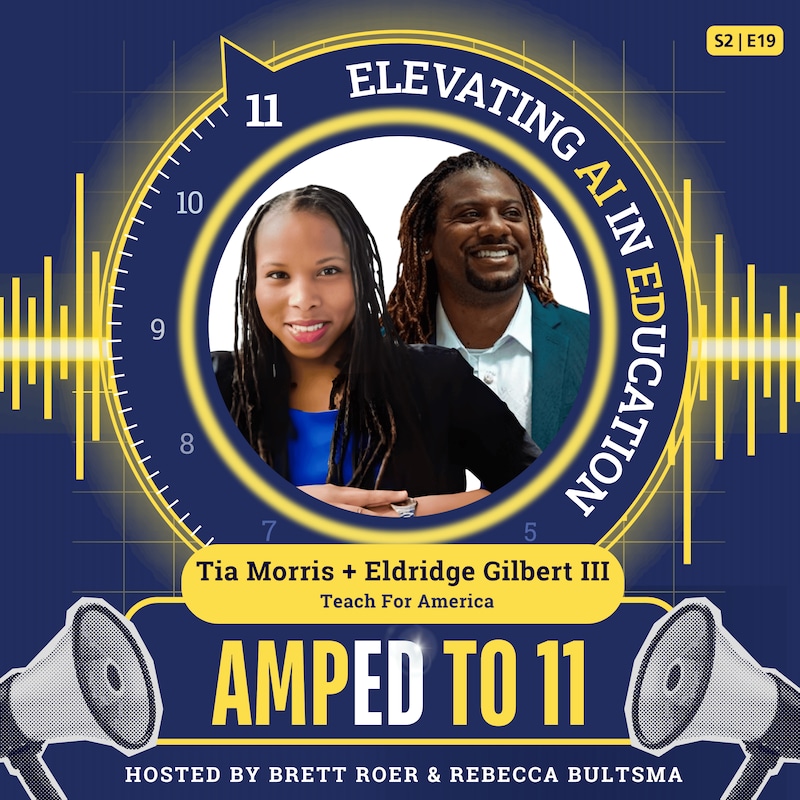
In this episode of AmpED to 11, we go deep with two bold trailblazers reshaping what it means to lead in education right now: Tia Morris, Executive Director of Teach for America New York, and Eldridge Gilbert III, SVP at SEO Scholars + Co-Founder of Legit Leader. Grounded in decades of experience and driven by fierce urgency, both are asking the right questions—and refusing to accept systems that leave kids behind.
Tia’s a self-proclaimed “Gen X-er afraid of AI” who realized fear wasn’t an option when equity was on the line. Elle’s a former principal firing on all cylinders to make leadership more sustainable and radically human. Together, they challenge the status quo: Is AI cheating—or is it exactly the kind of tool we need to differentiate learning, expand access, and lighten the cognitive load on exhausted educators?
This episode doesn't just graze the buzzwords. We press into deep tensions—like student agency in the age of chatbots, ethical guardrails for AI, and why leadership needs to walk the talk before teachers ever will. You’ll walk away feeling informed, fired up, and ready to ask better questions.
What you’ll learn:
- Bold truth: Is fear of AI standing in the way of justice in education?
- Revolutionizing rigor: How AI can sharpen—not replace—critical thinking
- Beyond writing emails: The untapped potential of agentic AI in schools
- The ethical minefield: Privacy, bias & protecting the hearts of our kids
- Leadership first: Why the AI shift succeeds or fails at the top of the org chart
- Pedagogy meets innovation: How teachers can model AI literacy through metacognition
Hosted by Brett Roer and Rebecca Bultsma, this episode brings curiosity, human-centered tech, and a not-so-subtle invitation: If you're still sitting on the sidelines of AI in education... why?
Tune in, subscribe, and share if you’re ready to turn up the volume on what’s possible in education.
Transcripts
Eldrige Gilbert: What is it gonna help us do that we couldn't do otherwise? How does it make me more efficient? Like, how does it make me, um, how does it speed up the resource that I need to do?
Tia Morris: I am not passionate about ai.
Tia Morris: I am passionate about fostering a world where my students can thrive. I'm passionate about education. I'm passionate about creating sort of like a more just equitable education system.
Brett Roer: All right. Greetings everyone. Welcome to today's episode of the AmpED to 11 podcast. We have double the pleasure and double the learning to happen today 'cause we have two incredible guests. We have Tia Moore is the executive director of Teach for America, New York, as well as Eldridge Gilbert, the senior Vice President of SEO Scholars and the co-founder of Legit Leader.
Brett Roer: We also are obviously joined by my incredible co-host, Rebecca Bolima. How are you doing today, Rebecca?
creeping in here in Canada, [:Brett Roer: Same here.
Brett Roer: I had to rock my amped to 11 Skullcap today for the first time in New York with this cold weather, but I am honored to actually be recording this from TFA New York headquarters, uh, where Tia Morris is the executive director. So Tia and El welcome today. How are you both doing?
Tia Morris: I'm doing well. Like you, Rebecca.
Tia Morris: I am dreading Winter is coming. I feel like I'm in an episode of Game of Thrones, and so I know it is coming, but I still try to kind of creep and, uh, still hold onto the little 60 degree days that we're getting, but doing okay, otherwise,
Eldrige Gilbert: I'm also doing well and feeling the exact same. Like, ugh. It is, it's fall is creeping away for me.
Eldrige Gilbert: And I love a, I love a fall, you know, scarf situation, but it feels like it's going by too fast, but otherwise doing well.
n today. Um, this is such an [:Brett Roer: So just breaking, breaking trends all over the place here and. Tia and El wanna definitely start with your stories, right? So both of you just bring such incredible energy and urgency to education and innovation. Tia, I remember one of the first times we met, um, was actually, uh, learning about a really innovative tool play lab and watching your eyes light up and you were just like, let's get into some good trouble here.
Brett Roer: So I'd love if you could share with everyone your why, how you arrived at this moment, at the intersection of education and innovation, and you know, where you see it going today. Tia, you wanna start us off?
Tia Morris: Absolutely. So I am a servant leader. I consider myself a warrior for social justice. I, I am a Jersey girl, born and raised, and, uh, went to school in New Jersey, Seton Holland.
nd that led me on a journey, [: rer Corps member in Harlem in:Tia Morris: I felt kind of like a doctor and a plague. I felt like I was just putting band-aids on solutions and I really wanted to be at an altitude where I can help to change systems. And so that led me back to being executive director of Teach for America. And you know, where I am today. You know, we've heard the talk that education is the sort of civil rights movement of, of our era.
ho gets left behind. And so, [:Tia Morris: And so that's how we got here.
little, uh. A little after in: fact that it goes beyond the.[:Eldrige Gilbert: The classroom, it involves all of the wellbeing and all the other pieces of a student's life that are really important for them to thrive. Uh, and so I did that for a couple of years. I was a school principal in Houston, uh, and then I moved to the Bay Area and, uh, did school leader management with kipp, uh, and got a chance to look live, what it was like to support principals in different challenging environments.
Eldrige Gilbert: And then moved to Brooklyn, uh, to do similar work and, uh, have moved over into a nonprofit space, uh, after working in Coney Island for five years as a chief schools officer. So for me, all of those different places, all the different students and principals and lives that I touched, uh, left me with a deep sense of obligation to make sure that I was giving back, you know, an obligation to make sure that I'm.
bout opening those doors and [:Eldrige Gilbert: Um, help build leader better capacity amongst them, uh, so that we can do this work of closing achievement, the achievement gap and, and the opportunity gap in a really meaningful way, um, as the world continues to change. So that's what's bringing me here today, um, and brought me to, uh, the journey of co-founding a legit leader.
Rebecca Bultsma: I love the both of those stories. We're so grateful you're sharing all that you've gathered along the way with us and with our listeners. One of the things that we really like to do here on the show, uh, Brett actually started it this season, but this idea of like. Talking good behind people's backs. How kind of compliments mean more if you find out somebody was saying something nice about you behind your back.
t you would love for them to [:Tia Morris: So one person who I'd love to give a shout out to is Yamilée Toussaint .
Tia Morris: She is a Teach From America alum. She founded an organization called STEM from Dance. Um, and I love that she is trying to change the game when it comes to girls seeing themselves as scientists, seeing themselves as good, as good at math, understanding that they can marry their love of something, dance with coding, with the sciences, with maths.
Tia Morris: And so she's doing this now and started as a passion project for seeing like when she was in the classroom, that the young girls who didn't feel confident in math, didn't feel confident in science. She started as a passion project and now it's something that started in New York City and it's, it's, you know, it's growing across the country.
t, that you would ever meet. [:Rebecca Bultsma: That's a great one. Yeah, I can't wait to look her up. Oh. Got anybody on mind?
Eldrige Gilbert: The first, um, is like one of my mentors, Carlos Moreno.
Eldrige Gilbert: He is the, um, he leads big picture learning schools and he's like my fraternity brother. I met him when I was like seven, 18 years old. I've known him for a really long time and he is just a phenomenal leader. He like wrote a book recently and was, I've gone to his book talks and just seen them, like generations of students that he's touched in the ways that he has cultivated like new leadership and really pilot like new opportunities for students and internships through all the different ways that Big Picture Learning does school.
charting this path that, uh, [:Eldrige Gilbert: And it was like her brainchild to think about how we can revolutionize school leadership. And I just, I really admire the courage and the force, like the vision that she has and like the impact that we could be making. So, shout out to, shout out to Judy. Um, my other co-founders, probably Matt, but I'm gonna give, I'm gonna give it to Judy and Carlos today.
Rebecca Bultsma: Those are good ones. I think you might get another chance later, so if you've got some more in the back of your mind, just hang onto those. I think Brett is going to give you another opportunity in a little bit. So. You may not be aware, but part of like my background and the space that I work in primarily has to do with AI ethics and specifically K 12 ethical, uh, scenarios and risks and kind of some of the less cool part of ai.
s connected to generative AI [:Eldrige Gilbert: Uh, you know, the thing that I'll say that top of mind is not necessarily the. Use of AI in schools. But the ethics for me is around like the kind of conversations that AI is being, you know, empowered to have with students that become across certain boundaries. Um, whether it be, you know, romantic, sexual, whatever.
Eldrige Gilbert: And just having been a middle school and a high school principal, I know how some students who, um, are lonely or like, you know, want to be in relations and know how that can grow and morph and change. And I really worry about students whose use of AI isn't, um, monitored in a way such that they begin having conversations that really can be dangerous for them, like on a personal level, but then can transcend into like how they engage in groups of people and their expectations of others.
d not having like that human [:Eldrige Gilbert: Um, I don't have a solution 'cause I also know that this is a, you know, it's a new space and everyone's exploring and we want kids to explore too. But it is something that is on my mind, um, and, and gives me a little bit of concern, particularly with the age of students, um, that are beginning to engage with ai, uh, without, um, kind of without monitoring and on their own.
Tia Morris: I appreciate you sharing that l because I am thinking a lot about the risks as it relates to our young people. You look at that case recently with, uh, the young person where AI sort of is convincing it to commit suicide, that sort of thing. And so the way I think about the AI is that it's, it's like just the next phase of innovation on the information superhighway.
Tia Morris: And like, [:Tia Morris: That centers humanity. And so whether that's like looking at bias and the sort of bias that that can be in, in, in, uh, in ai, ensuring that there are equity checks somehow. Um, thinking about, I'm also thinking a lot about privacy. And so not only the sort of data, but also just the privacy concerns in general and what needs to happen to ensure that we are protecting the, the, the privacy of our students, but just our data in general in an increased surveillance state.
ink especially as educators, [:Rebecca Bultsma: You bring up some really good points and, and I know California has recently passed a bunch of new laws designed to protect kids.
Rebecca Bultsma: When it comes to ai, things like age verification or they're required to flag every time, uh, a kid talks about something they shouldn't document that, report it to the governments. The government can gather some insights on this. Uh, it's better than nothing, I guess, but you're right, there are a lot of concerns connected to relationality, uh, with children and how only relating to AI chatbots relying on that as their primary source of advice or support versus in the fifties, if you needed support, you eventually had to find a human.
points around the, the bias [:Rebecca Bultsma: Do you think it's something that we need to be addressing sort of at a teacher level, at a broader scale? Just curious what your experience and conversations around that have been.
Tia Morris: Some of the pushback that I've gotten from teachers about AI deals with this and so in an, in an attempt to. Really begin to integrate this into our work and how it is we're training new teachers entering the field.
Tia Morris: We had a number of sessions now where we integrate into the new teacher training and we were really surprised. I thought that, you know, a generation much younger than I would be would be embracing this. And we had a lot of pushback this summer in our new teacher trainings. And some of it was around some of the ethics around the impact on community, but others of it, you know, was around protecting kids and bias and those sorts of things.
Tia Morris: One [:Tia Morris: So while I'm not, you know, writing the laws right now, I'm not creating the programming one. Teachers can create their own programs. So we actually did actually have them, um, work with some play use play lab to create some of their own programs to understand how they can actually be creators. If you think it's unethical, let's create something that can actually meet the needs that you have.
skills that they need to, to [:Tia Morris: So the more that educators can actually embrace it, the more we can mitigate these challenges and actually have it be an accelerator for our students as opposed to something that's gonna ultimately, uh, just, uh, hurt them or harm them.
Eldrige Gilbert: I think the, the equity and bias pieces, some of what we chat, what we found when we were starting to build our tools and really being intentional about the guardrails and what we're asking our tools to reference to, like make sure that we're balancing out the ways in which, uh, the internet sees the world and like all of the information that AI is getting alongside how we want, you know, how we want it filtered so it responds and direct and directs it's gazed towards a certain, um, a more broad experience of the world and like a more, a different set of reference points.
xperiencing, um, both how we [:Eldrige Gilbert: And then also using tools that have, uh, that kind of mindset, that framework, um, built in ahead of time so that when you're, you know, you don't need to do all the work yourself, but you can be thoughtful and selective and, and be discerning about what you use and making sure that. We're sending a message to, to future creators.
ing bias, especially harmful [:Rebecca Bultsma: I often talk to people about some of these issues and they feel big and overwhelming. So we have to kind of compartmentalize into things that are kind of big and out of our control, like how these models were trained, as you mentioned on an internet. That kind of sucks. And then things that we can influence within our sphere, right?
Rebecca Bultsma: Like you said, bringing awareness and then things that we can, on an individual level, actually control, which is, you know, choosing our resources. I love the word you used, discerning, uh, pat Yongprodit, who is with code.org. I listened to him speak at a keynote last week and he really focused on, uh, for teachers teaching about AI and teaching with AI and making sure here's what's wrong with it, but here's how you use it and you use it well.
Rebecca Bultsma: So I think both of what you've brought up aligns so nicely with that. Brett, we're leaving you out. Anything you wanna chime in on here?
id that, um, you know, just, [:Brett Roer: One is Michelle Culver, she does the Rhythm project. She co uh, founded that. So I've been so fortunate I've been using that in my keynotes. So last week I had a few hundred educators in one district playing that game. And what's great is. The idea of it is, is this scenario, would it help strengthen human connection, erode human connection, or you need more context?
Brett Roer: And just having all these different educators just immediately have very strong opinions. And then afterwards asking them, well, what's actually guiding, whether it's strengthening or eroding it, it really just comes down to your own biases and values. No judgment on that. But that's ultimately where we are in the world of ai.
Brett Roer: So that's just been so interesting how we all have these really strong opinions and sometimes it authentically can help strengthen your connection with students in the classroom or parents or make you more equipped for human connection. And other times it can obviously be the thing that erodes it.
mazing tool that came out of [:Brett Roer: How do you want people to see you? How can you then create a prompt that can be put into an image generator and it teaches adults how, how important specificity is to prompt engineering, and then how quickly you could turnkey that to any age level. I have a kindergarten daughter who I've done that with to make pictures of herself.
Brett Roer: You know, what adjectives you use to describe yourself? How do you, how do you share those things? How do you compare and contrast? Um, you know, different adjectives and different wording. So like, there's so many ways you can teach kids about bias by just asking them to talk about themselves. But teachers especially I find, love it 'cause they want the pictures to look and reflect them.
ems to be a common theme for [:Brett Roer: As you all are working together with people around, you know, how to guide and how to, how to instruct and lead, um, educators, especially on AI guidance, where do you see as the best ways we can use AI to reduce some of those inequities? Tia that you, that you highlighted, right? We want to make sure this is a bridge, not a barrier to opportunity.
Brett Roer: What are some ways you're seeing that this could potentially help, um, those systemic barriers that, you know, we've all, we've all seen and experienced in our work in education?
Tia Morris: I think the biggest, uh, the, the thing that's most promising to me regarding how I see education moving is the use of AI and tech in general to bridge some of the, the longstanding opportunity achievement and achievement gaps that we see certain communities.
years, but we've [:Tia Morris: And in many cases, I think that schools don't have sufficient capacity, meaning like the human capacity, the resources, uh, the materials. And I see like AI as being a potential way to, to bridge some of this gap. Specifically thinking about, um, I'm fascinated with and want to learn more about agen to ai.
have an individualized path [:Tia Morris: Like there's someone I didn't shout out earlier. With Sean Klamm from playground, IEP, like, I appreciate that technology, really thinking about how it is we meet students with special needs and how we develop, um, uh, a, a system that helps the school be able to support all of those kids. But in my opinion, every single child has special needs because every single child should have a differentiated learning plan.
Tia Morris: And it's, it's virtually, it's very challenging for most teachers to do that. And so the more I see tech use in classrooms where teachers are able to either replicate themselves, um, meaning like they're able to kind of have that lesson in small groups or they're able to help differentiate or they're able to truly help meet students where they are, that's something that makes me really hopeful because it's something that's gonna ultimately bridge the gap that's been, uh, really preventing a number of students from achieving at their highest capacity.
ust talk about the fact that [:Rebecca Bultsma: We're seeing that attitude actually with this demographic specifically really be negative towards AI adoption because that was their initial experience with it. How do we get from that place where, uh, they're hesitant and they feel that way about it to a place where they're embedding it and using it to actually move student success forward?
Rebecca Bultsma: Any ideas?
Tia Morris: I think we have to take the same approach that we've taken over time and just one, understand that this is a natural course of history. I'm sure when a calculator was first invented, people probably thought it was cheating or spell check or all of these different solutions that we use now using the computer to research.
not going to the library and [:Tia Morris: Two, I think the more, uh, the more we can integrate this into schools, I, I have not seen holistically school systems and school buildings really integrating the use of ai. Um, and, and, and only a marginal use of technology. You know, very basic, like typing basic research, not really leveraging technology and tech solutions for the supportive learning in ways that truly can revolutionize it.
they actually don't have the [:Tia Morris: And so I think that those are two things. I think the more we can normalize it, uh, the more we will allow it to actually be, uh, like just a natural part of the fabric of a school. And I also think that we have to be real about the concerns. Like we can't shy away from them. We need to be real and talk about, you know, water in Mississippi and what's happening in the community, or talk about the chips and what's happening in the Congo.
Tia Morris: Like, part of what I think this generation wants is they wanna, they wanna be real. They wanna know that we're thinking about it and not, yes, we're thinking about it. And also while we're doing it, we're building the sort of ethical use that can allow our students to actually now be creators and not just consumers of it that can allow them to be some part of the solution.
e we normalize it, the, the, [:Brett Roer: Absolutely. L you know, tough act to follow there. But, uh, good luck and we'd love to hear your thoughts on this.
Eldrige Gilbert: Yeah, I mean, I think I would, I would echo a lot of what Tia said, but I would say that. If leaders aren't using the tools, it's very hard to get your teachers and your students comfortable with it.
Eldrige Gilbert: Right? So, and, and that starts, you know, things like this start at the top. Like, if as a leader I'm scared of AI and I, and I was, and I, you know, have like some concerns. If I'm not leveraging agentic AI as it gets to like my scheduling my tasks and like identifying how I should be used, you know, spreading out my time.
Eldrige Gilbert: And if I'm doing that and then not getting to the things that are most important, like spending time with teachers and leaders, uh, then ultimately I can't help trickle that, beha those behaviors down, that help to reduce the barriers that people feel. 'cause those emotional barriers, that fear piece is gonna be the roadblock for.
ike this whole generation of [:Eldrige Gilbert: Like that's, that's like how these tools are supposed to work. That's the calculators. I was just having a conversation this weekend with you about AI and calculators came up, graphing calculators, right? It's like, why would you do it by hand? Like that just doesn't make any sense. We can get to so much more math.
Eldrige Gilbert: You can get to so much deeper learning if you, if I believe you have the basics and then, you know, we, we can like skip that part so I know you're, know your multiplication. Like let the calculator do that part and like, let's get into deeper understanding. So I think part of it is about raising the bar for the conversation.
anything has its pluses and [:Eldrige Gilbert: Wikipedia is not right to be trusted. How can AI help direct us to the article, to the website that's gonna get us exactly what we need that's reputable, right? So that we can get into the act of learning. We can get an act of being with kids. Um, we don't have to, you know, spend so much time on like your grammar.
Eldrige Gilbert: Like, we can use the ad, help us with it. Let's talk about the content. Like, let's make sure that you're being nuanced and thoughtful, right? Like, these are the things that we should be thinking about AI helping us do as educators, um, so that kids are not afraid of it. And then not using it to cheat, but using it to spend time on the higher order, thinking on the things that, um, that I'm more trying to solve the problems of the world.
m not doing it, then I'm not [:Eldrige Gilbert: And I would also like, kind of echo to your point around like the, the impact of ai, the water, the ch like the environment. Like I think, you know, this generation is thoughtful about all of those things and doesn't want us to skip over the impacts. And so it is okay to be honest about like, yes. Like that is, you know.
Eldrige Gilbert: That is part of the consequence of like this new technology, maybe that'll get better, but that may not be a reason to dismiss it on an, on an in and of itself. And so we can hold both things at the same time. You can hold the challenging ways that it impacts the larger world, and we can embrace what it could do for us on an individual level and hopefully move us forward.
Eldrige Gilbert: Um, [:Eldrige Gilbert: And we need to, you know, where it's appropriate. We need to grapple that and, and move forward so we can, we can make lives better and different. And, and AI is a tool that can, that can be a resource to that.
Tia Morris: El, what that just sparked for me is a question that I kind of asked myself, but, uh, now that I think I, I wanna ask my teachers and educators and folks who are sort of AI resistant, and it's about fear.
Tia Morris: And the question is, is your fear of AI stronger than your love for your students?
Eldrige Gilbert: Hmm. Ooh, that's a, that's, I
world where my students can [:Tia Morris: And I can't let my fear of ai, it is not stronger than my love for my students. And so that is what drives me to embrace this. Even though, you know, naturally it would not have been a direction. I mean, I saw iRobot and all the movies and things like, you know, I was kinda one of those like, I don't know.
Tia Morris: And I also was like, is it cheating? You know, I've been in a doctoral program and I'm like, can I, can I, can I use AI at all? And so. I've had to wrestle with my own challenges. And so I think being real with people that like you can actually have concerns and still drive this work forward for kids.
Rebecca Bultsma: I think there's a TED talk there, Tia.
Rebecca Bultsma: Yeah.
lopment and growing like the [:Eldrige Gilbert: Like I need to love that more than my fear, and I need to love them enough to be like, okay, I'm gonna show you how to do it. So like you can get over your fear so you can be a better leader faster. I think that was, you know, one of the things that drew me to so much of my like secondary career work and even like legit leader is being like, I wish I had been a better principal.
Eldrige Gilbert: I just wish I had been better. I wish I had been less exhausted all the time. Like I wish I had been less intimidated for difficult conversations that I was gonna have. I wish I had been more prepared, you know, for my day. I wish, you know, there were so many moments of not wanting to ask questions and ask for help, and I can help you do that.
Eldrige Gilbert: Like, I, you know, it would've been great if when I was struggling with, you know, an agenda for like a tough, uh, tough conversation with an AP or someone, then I could have gone to tool like, how do I start this conversation? Or Here's what I wanna say, and here, help me soften it, help me shorten it, help me.
ke emotional energy and time [:Eldrige Gilbert: Spend more time with people in a better and more efficient way. And I, you know, I really do believe that my experience as like a school leader would've been different if I had had some tools, um, to help me and, and, and, and had less shame about the things that confused me or challenged me that I thought no one else had challenges with.
Eldrige Gilbert: Um, even though everyone did, I didn't know that, but it would've, it would've created space for me that I, that I think would've been meaningful.
Brett Roer: Yeah. Hey, um, we rarely get someone like Tia, you know, you, you're leading, you know, the work of TFA in the largest school district and the largest city in the United States.
things I love doing is when [:Brett Roer: What do you want adults in your lives to know about how you're using ai? And then what I love doing when I get the chance to do a keynote is I just mirror back what they said and I pull exact quotes I think will resonate with the audience. So just last week we got to speak to an entire district, the all of the, the PD day.
Brett Roer: And like we got to tell them, here's exactly what your students want you to know in this room. Like, one is the fact that like, AI can't replace your human relationships. Like they know, like, AI can help us learn, it doesn't care about us. And I love being able to show that. Like, also like it helps you learn the way my brain works.
Brett Roer: It helps me learn the way I want. So Tia, you know, I get, I just wanted to share something. I always tell people like, if I could have been a principal right now, here's what I would love to do with my kids. Or about, as a teacher, tell your students, you know, use your AI scale one to five or zero to five and be like, guys, tonight, level five ai.
Brett Roer: Tomorrow we [:Brett Roer: Anything you synthesize that fits on like one piece of paper, you can review that and then it's level zero during the actual essay. Then afterwards I'd be like, okay, so y all cheated last night, right? What did you use? And one kid's like, oh, I made a podcast outta my notes. Oh, I turned it into a short video.
Brett Roer: No, I went to this tool. And kids would be like, wait, where'd you find that? That's free. How'd you do that? And all of a sudden, like you just learned how your kids learn and you think that they're, you know, you're, you're empowering them to actually explain their learning styles, which we all do. And to highlight something you all said about cheating, I was really fortunate.
o AI literacy and integrity. [:Brett Roer: I'm like, I don't think so. She's like, why not? I'm like, because I just want this to be really good for my audience. She's like, right. So like teachers aren't cheating when they're doing it, if they're using it authentically to push the rigor and the discourse and make it more engaging. Then we said, well, what if students felt the same way?
Brett Roer: What they're doing matters. And so, Tia, something you said that I really wanna push, and you know, again, you're in a seat of change and I'm so envious of that for you and I'm so proud of you that you're in that seat is you get to say, imagine like when we talk to people about, well. Students shouldn't use this, um, technology for this skill.
Brett Roer: So I'm always like, my son's in third grade, he needs to learn the mental processes and writing out and explaining his answers in math. Once he's quote unquote mastered that, then ask someone what exact thing, what's your why? Why are you giving them this task? And is it something that AI can make even better?
ple to ultimately go back to [:Brett Roer: Like a more edge of your seat learning experience? So I just wanted to highlight, like that's the question that hopefully educators are thinking, why would I do it this way versus the other way? And there's no right or wrong answer, but if you can't understand like why you're even asking people students to do it, well that goes back to really good pedagogical skills and AI can just enhance that.
Tia Morris: I mean, I 100% agree with you Brett, and I'm. Excited that you're doing that, that's so important. Work. And you know, we have to figure out how to get you out into some more districts. We are work, we actually, we only part, we only place new teachers in New York City, but we are a statewide region. And so I was up last week in Ra, Syracuse, Rochester, Buffalo, meeting with the districts, meeting with educators.
% agree with [:Tia Morris: Also, how do we teach students? So I love the sort of level five, level three level zero AI use because one, we're normalizing it, we're helping 'em to understand. It's similar to anything else we would teach students in terms of. For example, when I was a classroom teacher and I taught language arts and writing, I would help my students understand when how to code switch.
Tia Morris: And so when it was okay, when they needed to, to speak in standard American vernacular English, I would say I like this conversation's in save or when they could speak, uh, the way that they would speak with their friends. And I would help them understand it. Like you differentiate and it's imp it's an important skill to know.
I think that if we are able [:Tia Morris: And the teacher could actually help the student understand how to leverage it for those reasons, right? So. If we don't want them using it in ways that we feel are unproductive to them, let's actually help them understand the metaprocess. Let's trust our kids. Our students are smart. They're smart. Our kids know they have their own agency.
Tia Morris: And if we are able to tap into that and say We respect you, let's help you understand it, then they actually become the consumer we, but they become the creators we want as opposed to just consumers. And then as consumers, they're more responsible consumers. So I think we do a disservice. And I partially think it's a lack of imagination.
exposure to even know. Like [:Tia Morris: And I think that many people are waiting for some big. Professional development and a big, you know, a big shift on like the education spectrum. And I don't know that that's coming yet. I think the teacher prep programs are far, I think they're bigger fish to fry before they get to the AI challenges. I think the teacher prep programs are a little bit outdated and so I think they're slightly bigger fish to fry.
Tia Morris: And so until then, what can we do to make it seem like this is just something that we use as an everyday part of our work and let's talk about how we use it. So I appreciate that work that you're doing and can't wait to see more of it.
Brett Roer: Yeah. One thing that you just said, because again, you're at this, you're at this intersection, right?
thing, uh, getting to speak [:Brett Roer: But what we kept reflecting on was like. When I want to see a teacher really like, um, whole class instruction is their metacognition, right? So if you're a history teacher, it's like, so when I said, this is my thesis statement, it made me think, okay, what evidence, what's the best argument? Okay, this is a fact here, there's a fact, and obviously that's transferrable to any skills.
Brett Roer: And I said, you all are excellent at that. So now imagine if. You're now using an AI tool and you're like, so last night's homework, I decided this is level two AI use because I want you to use AI to find these great facts. Then I need you to take those facts and decide what's the most important fact to actually write after your thesis.
ou showed students that, and [:Brett Roer: How are you engaging? And then creating with AI are different skill sets that we want our students to do. And that's like the one time I want teachers to talk. Explain how you came up with that. You're the quote unquote expert in the room on subjects and turn it over to them. But it's here. Like we, they know that.
Brett Roer: So I guess, sorry, that was a long-winded way of saying, always validate that educators are. Great educators. This is just a new thing to educate students on, but like, don't, don't forget how you're a great teacher. This is just a new thing you're teaching students that you're gonna pick up pretty quick.
Brett Roer: It's just don't lose the, don't lose sight of how good you are at explaining things, um, in other fields. Just translate to this now. And with that, we have our two favorite questions. Rebecca, do you want to frame for everyone how we flip the script in the middle of our, in the middle of our show?
verse where suddenly we turn [:Rebecca Bultsma: And, uh, we're gonna make you the hosts for a second so that you can ask us anything you want. A question for Brett and or I, uh, if you have anything that would be within the sphere of what we do or what we've seen now is your moment.
Eldrige Gilbert: I'm, I'm curious from, from the work that you all are doing, the perspective that you have, what are your fears?
Eldrige Gilbert: Like, what are you, what, what keeps you up at night as you think about, um, AI adoption, particularly in schools? I think, yeah, I'm, I'm curious about like what, what concerns you in the field right now?
Brett Roer: This is, this is Rebecca's, this is what I read, Rebecca's LinkedIn and just conversations. 'cause no one scares me more because she knows more than Rebecca.
Brett Roer: Go ahead, Rebecca.
orried robots are gonna take [:Rebecca Bultsma: Um, who has the power, who's behind the robots? Who's deciding whose voices matter and whose voices don't matter and who has like those questions of power on an existential level scaring me the most. I think what I've been diving into a lot recently, just in preparation for a, a state summit that I'm speaking at is I did a deep dive this last week into, um, ai, the deep fake nudes that kids are making, like where you can just like use an app to, and so I did a deep dive and I just wrote about it today and I went to see how many apps I could find and what they were and how easy they were to access, um, as if I was a kid.
links that are being shared. [:Rebecca Bultsma: And I think that was really upsetting to me. So on a, a broader scale, the impact on kids, teenagers, um, some of the downstream negative effects of this technology, you know, the cognitive offloading, we talk about what happens if kids, these COVID kids who kind of were forced to coast for a while now don't get this and now are entering real world, world profession.
Rebecca Bultsma: Just the impact downstream of what this means for kids in relationships, um, how they relate to people. The consequences for their actions of using these apps. And it all really scopes back out to that question of power. Why are people in positions of power allowing these apps to exist? Why are we not doing more to protect kids?
Rebecca Bultsma: And why is this not a priority? So those in a, in a nutshell, but Brett knows I could go all day every day, but that's kind of mine as of today. Brett, what about you?
Brett Roer: You [:Brett Roer: And it was the scariest thing ever. It was like, I guess when someone probably has a self-driving car for the first time and they're like, am I really just gonna like let this car drive itself? Like this feels very scary. And then I'm sure very soon after you like, take that for granted. But that was my moment yesterday for the first time doing that.
Brett Roer: Today I walked from, you know, where Tia's office is at, uh, in lower Manhattan to the Apple store. And like I passed, you know, the World Trade Center, and I read a lot about memorials and I passed the museum, which I've been to. And sometimes AI reminds me exact, I actually had a moment where I was watching people take pictures and I'm like, somehow this is so surreal and normal that like, that day you can remember like it being a beautiful day and then like a very bad thing happened that you would've never expected.
r that like will just hit us [:Brett Roer: And I, I sometimes just have that feeling creep into like very like peaceful, serene moments that I obviously never would've thought of before. So that's probably the thing that keeps me up most is like. I know where this could go. And I read all that and yet still, I'm like, like, this is fun. I just, you know, it helped me write an email in a way.
Brett Roer: I can't believe it actually can do. That's such a different thing. So that's probably like, am I taking the novelty for granted? And like, not really thinking about 10 years from now what this could mean, um, if it goes a certain direction. Hard hitting questions. Now I see why you were nervous l at the beginning of this podcast.
Brett Roer: Y'all don't y'all bring it.
el AI is most underutilized? [:Tia Morris: What could it mean for humanity if they were to lean into it more?
Rebecca Bultsma: I think like as a, like an academic and as a researcher, I just. I see and I tell people all the time, like using AI to write stuff for you is like the least interesting way to use it. If people use it like as a PhD level, Socratic dialogue partner to push back and gap check and spot where their blind spots are and what they're not seeing, and use it as a tool to help identify their own hidden bias or their own hidden assumptions.
omfort and identify what I'm [:Rebecca Bultsma: I think if everybody used it in that way, we would develop more empathy as a society and we would make better decisions. That's my answer.
Brett Roer: The way that I use AI that I wish more people utilized it for is the following. And I wanna first preface, like everything I'm about to say needs to be followed with like privacy, consent.
Brett Roer: But I always tell people the second I'm talking to someone where it goes from like personal to professional when it comes to like improving education, I always say, if you don't mind, could I record this? Like I wanna capture your wisdom. I'm never going to hear someone say it exactly the way you are.
Brett Roer: And what I find so interesting is we hold town halls, listening sessions, all these things, and we still rely on like one person to take notes, which is not even biased. It's just like you only can take so many notes. And also then that person's not present. You can't be an amazing note taker and a present participant.
safest, most ethical way for [:Brett Roer: Could you bring my parents to this? Like everyone's talking about AI and yet we're not ever taking like ask everyone the same questions, compile it and say, actually we just talked to 500 people in your community. Here's what you actually want. And I've done that at the state level where we traveled across Ohio and I just kept building it and showing them like, here's what you want the educators across Ohio, red, blue, rural, urban, suburban.
Brett Roer: This is what you want. And I'm just mirroring back your words. And it shocks me still that like that's the key thing that I could have never done as a principal or a leader. And like you can bring your community together and then you can actually show them this is how I know this is relevant. And I do that all the time with communities and I'm still constantly mesmerized by like how powerful it is and how.
recognize, like that is the [:Tia Morris: That's so powerful. That is so powerful. Imagine if you were able to take that conversation and, uh, conversation with students, conversation with teachers, and those be the ones who are informing the next engineer, who's designing the next AI tool.
Tia Morris: Imagine that. Or Rebecca, if this sort of like PhD, Socratic sort of seminar ish push, uh, uh, agent, AI agent was available in every single. Politician, CEO organization president, they actually had to go through that filter before they made decisions, before they made legislation, before they made a decision about the company.
Tia Morris: Like imagine how that would totally shift society. So I think those were both very, very powerful examples of ways that AI could truly help to push us all forward.
Rebecca Bultsma: Yeah. I'd [:Brett Roer: Ooh, the flip, flip the reverse. Uno. Reverse the Uno reverse. Uno reverse.
Tia Morris: The reason why I am in this work in a way that I am is because I do believe it is under AI is underutilized in education and academia in general.
Tia Morris: And, uh, I agree that I agree that drafting an essay, writing, drafting an email, like those are the least, those are useful, but probably some of the least creative ways and I. I think that in academia and education, one other way that I think AI is un underutilized, and I'm really interested, this is why I'm, I'm more interested in learning more about AgTech ai, really learning more about how to leverage it.
ld actually help us support. [:Tia Morris: You know, many of us who are running nonprofits. We're constantly battling the resource constraints, having enough people raising enough money and being able to move the work in ways to drive impact. But what if we were able to bring AI agents and to take care of some of the back office soft stuff, or to think about some of the baseline level tasks that we have team members performing that would free up the human capital to interact with the public, to interact with donors, to actually be present.
ld the tools that could help [:Eldrige Gilbert: I, you know, I was thinking of something similar to Tia when I thought about wraparound services and how do you identify community needs? Because I feel like I, as an educator, I was always tasked with like, oh, what do we do outside of school? Like, you spend a lot of time in school, but like, you spend the majority of your life actually, like, not in this like bubble that we are, that we can create.
ally thinking about that or, [:Eldrige Gilbert: Like there's something to, like, as you age and how are we helping folks who are, you know, in the, the later years using AI to, to address some of the concerns that they have that they're like living with. Whether that's loneliness, um, whether it's like access to resources and how they, like how you go out, making sure that they can get out of the house, get to what they need.
Eldrige Gilbert: There's, there's so much more beyond, um, the educ outside of the realm of education that, that concerns me and that I always kind of wished I could get involved with. And it wasn't quite like my path, but it makes me curious about how ai, AI could help to solve some of those larger issues that are like more systemic.
re some areas of the, of the [:Eldrige Gilbert: And it makes me wonder about how AI could be helpful to like, raise that onto people's radars in, in ways that then you kind of can't skirt around. Um, but I'm not sure what that would look like. But, but that's, I think there's the potential there to help it be a thought partner as people are thinking about things that, um, that communities need that are not, not on their radar or have been dismissed.
Eldrige Gilbert: That's something that is just how this group people have to live.
Brett Roer: First of all. Thank you. Those are incredibly insightful answers and something I just heard today, someone say like, AI is the thing that helps you solve the thing right? The problems existed. Pre ai, AI can be a solution to some of those things you talked about, like elder care, community-based problems outside of the schools and communities we, uh, served and serve.
t mentioned like funding, so [:Brett Roer: He's doing tremendous work and helping make sure every dollar gets maximized for every student that they deserve in those communities. And they do a great job of helping nonprofits and educational districts think through that. But I'd love to hear from both of you as we close out in our final question, who are those final people you wanna make sure everyone knows about that play, uh, that are near and dear to your hearts that are doing the incredible work that you want to be working alongside of to solve some of these challenges?
Tia Morris: I really wanna highlight Sean Klamm and Playground, IEP. Students with special needs. Special needs are some of our most marginalized students in the education system, and they quite often go without getting sufficient services, and I'm worried about their future. Given the shift that we're going in, the sort of federal government as it relates to education and some of the protections that are being pulled back, I don't know how they're gonna fare.
ls and districts are able to [:Tia Morris: That we're updating the account, that we're looking at when it needs to, when we need to have the next meeting to ensure that the services that they're getting are actually still aligned with their needs. Playground IEPI think is a wonderful tool to help schools do that. And so I wanna shout out Sean.
Tia Morris: He would be on my team if I were building a, a superpower, you know, a a, a super squad for, for education.
ck Educator Development and. [:Eldrige Gilbert: And, and for a couple of reasons. One, you know, all the research about. The progress that students can make when you have someone you know, who looks like you, in particular for our black male students, but also because, because of ai, and this probably eludes to someone else that I should be thinking about, but because of ai, jobs are changing, right?
Eldrige Gilbert: Like the entry level jobs and there's gonna be so much, a much greater need, uh, for men to leave young men to like leave fields and like finance and all that kind of stuff because those entry level jobs are going away. And we need men in particular young to be educators, so wanna be teachers, so wanna be nurses to like get into the fields that I think are traditionally, um, fields that we encourage young women to go into.
t: And so I just think about [:Eldrige Gilbert: So that's one person, um, that I, that I would have on my, my super team.
Tia Morris: Quick one and then I will throw it back to you, El. So be ready. 'cause I'm gonna toss it back very quickly to you, Lori. Beer Lori Beer is the co-chair of my board at Teach for American New York. She's the Chief Information Officer at JP Morgan Chase.
so committed to the economic [:Tia Morris: So I wanna shout her out for the work that she's doing and just for the powerful example that you know, that this could, could be for, for other communities and other companies.
Eldrige Gilbert: I'm trying to look it up because I'm nervous now I'm blanking. But the CEO of Robinhood, I just went to a conference and, um, he spoke and now I can't remember his name because I, I feel nervous and so I'm like, ah, no, I'm gonna, you got it Tia, do you,
Brett Roer: is it Richard?
Brett Roer: I'm not gonna Buery Would that be the person you're referring to?
funding to like, make their [:Eldrige Gilbert: Um, and so I think I would wanna, I'd want to have him on my team to like really be pushing. Pushing the fundraising piece and pushing like, uh, these are the organizations that might be off, that might not be on your radar, but that we should be investing in because they're touching, um, more lives than what, than you, than what I can see, um, in front of me right now.
Eldrige Gilbert: So that would be, they would book you on my team.
Tia Morris: So, uh, that just made me think about how I would want my team to be well-rounded and similar to the sort of Sharif El-Mekki, um, option Eldridge, I'm thinking about a good friend of mine, Dr. Ruby Ababio-Fernandez. I don't know if you know her, Ruby, uh, she was a school teacher.
the organization that really [:Tia Morris: The next wave of textbooks is really thinking about tech. Like people are not buying textbooks in the same way. And so tech is the new wave of that. And so having somebody there who can really influence this sort of tech direction of, of a, of a, of a, of a company that's really thinking about education, I think could really help to ensure that some of the building is happening in the equitable ways that we've been talking about.
Tia Morris: Some of the building is really including the humanity of the people that we serve. And some of the building of this work truly reflects, I think, the, the highest possibility of the dream that we have for our kids and for our futures. So I would want somebody like that on the team as well.
Rebecca Bultsma: That is a powerhouse list.
that exact reason I discover [:Rebecca Bultsma: Uh, we are grateful to have you here, and I know Brett feels the exact same way.
Brett Roer: Yeah, so I want to say thank you. This is our first time having two folks join us for, um, the AmpED to 11 podcast. And I think it really, you know, doubled the, um, doubled the outcomes. This was so incredible. I learned so much. I'm always so grateful and honored to have folks like you join us and share their wisdom.
Brett Roer: And, uh, we are so excited and I can't wait for this to come out and people to listen and learn from you all, just like we did. And as you said, Tia, there's so much great work to be done. I hope that all of us continue to do this work together alongside those Ocean 11 folks, alongside those folks we're talking good behind their backs on.
Brett Roer: And I just want to thank you both so much again for joining us and to our audience out there, thank you so much for listening and, uh, we look forward to joining you next time on the AmpED to 11 podcast. Have a great day, everyone. Thanks
Brett Roer: [: