Shownotes
Audio • Season 1 • Episode 5 • Series 1 Episode 5 - Geneva: The First English Study Bible. (Transcript added).
© 20 26 The Rise of the Protestants., Author, Shaughan Holt.
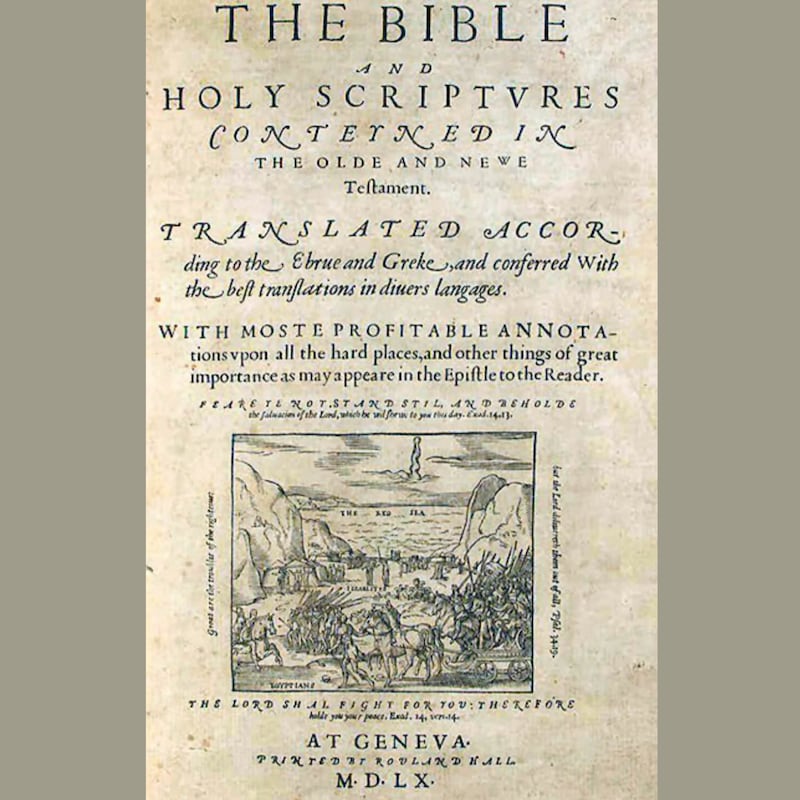
The artwork is the cover from an original copy of the Geneva Bible dated 1560.
The Geneva Bible is one of the most historically significant translations of the Bible into English, preceding the Douay Rheims Bible by 22 years, and the King James Version by 51 years. It was the primary Bible of 16th-century English Protestantism and was used by William Shakespeare, Oliver Cromwell, John Knox, John Donne and others.
It was one of the Bibles taken to America on the Mayflower and its frontispiece inspired Benjamin Franklin's design for the first Great Seal of the United States. Benjamin Franklin's design for the Great Seal of the United States featured a scene from the Exodus in the Bible. The design illustrated Moses parting the Red Sea with his staff, while Pharaoh and his chariots were submerged by the waters. Franklin's design also included the motto:- "Rebellion to tyrants is obedience to God."
The Music is I Greet Thee, Who My Sure Redeemer Art,
Sung by the Capitol Hill Baptist Church, Washington, D.C. Author: Anonymous. Source: French, 1545; French Psalter, Strasbourg, 1545.
First published in 1560, the Geneva Bible was a groundbreaking work that represented a remarkable achievement in Renaissance scholarship, printing, and Reformation theology.
John Knox, a Scottish minister, theologian, and writer, played a crucial role in shaping the Church of Scotland. His work and ministry also contributed to developing the Puritan movement in Elizabethan England.
John Calvin spent much of his life as a minister in Geneva. His ideas, actions, and sermons greatly influenced the Protestant Reformation and transformed Geneva into Europe's intellectual capital.
Theodore Beza established the Academy of Geneva using Strasbourg's successful model. By the end of the sixteenth century, many distinguished Englishmen had made Geneva an essential place to study.
In 1545, John Bale published his book, "The Image of Both Churches," which provides a detailed commentary on the Book of Revelation, the final book of the Christian Bible.
© 20 26 The Rise of the Protestants., Author, Shaughan Holt.
"All rights reserved. No part of this podcast may be reproduced, translated, distributed, or transmitted in any form or by any means, including photocopying, recording, or other electronic or mechanical methods, without the prior written permission of the copyright holder, except in the case of brief quotations embodied in critical reviews and certain other non-commercial uses permitted by copyright law".
Requests regarding translation, licensing, or republication should be directed to: [email protected]
Your feedback matters, send me an email at [email protected], with any comments, suggestions, or criticisms.I read every message.
Transcripts
© 20 26 The Rise of the Protestants., Author, Shaughan Holt.
"All rights reserved. No part of this podcast may be reproduced, translated, distributed, or transmitted in any form or by any means, including photocopying, recording, or other electronic or mechanical methods, without the prior written permission of the copyright holder, except in the case of brief quotations embodied in critical reviews and certain other non-commercial uses permitted by copyright law".
Requests regarding translation, licensing, or republication should be directed to: [email protected]
Your feedback matters, send me an email at [email protected], with any comments, suggestions, or criticisms.I read every message.
Series 1.
Episode 5.
Geneva: The First English Study Bible.
The English Geneva Bible, printed in 15 60, was financed by the English congregation in Geneva and dedicated to Queen Elizabeth.
It was published at a time, when the Roman Catholic Church had banned all Bible translations into the vernacular or everyday languages.
The Bible's title reflects its origins, as the translation was prepared by English reformers, living in the Protestant stronghold of Geneva Switzerland, who had fled England during the reign of the Catholic queen Mary I.
The Geneva Bible, which owes much to the work of William Tyndale and Myles Coverdale, was the first translation to rely entirely on the original Greek and Hebrew texts, rather than the Latin Vulgate.
Coverdale's earlier English translation, released in 15 35, laid the groundwork for this groundbreaking achievement.
Geneva is commonly referred to as Breeches Bible, due to its unusual translation of Genesis 3:7, which describes Adam and Eve, making breeches to cover their nakedness.
This edition of the Bible was read by Shakespeare, and he quotes from it in his plays.
Its influence continues to the present day through its incorporation in the King James Version, which remained the Standard English Bible for several centuries.
The original 15 60 edition of this work, was printed in modern Roman type, while some later versions, such as the one from 15 89, used the traditional Gothic-style typeface.
Notably, the pages of this volume tend to be quite dark, compared to other books from the same period, mainly due to the use of lower-quality paper.
This choice was deliberate; the Protestant reformers aimed to make this edition of the Bible more accessible and affordable for everyday Christians.
Nevertheless, even with these efforts, the price would still have been beyond the reach of many in the population.
A key aspect of Protestant teachings was the belief that every Christian should have the freedom to read and interpret the Bible independently.
A notable feature of the Geneva Bible is the inclusion of printed marginal notes, which can help readers in understanding the text's meaning.
These notes vary, from explanations, by the translators regarding word choices, to their theological interpretations.
The latter, particularly highlights the edition's pronounced anti-Catholic stance, frequently depicting its clergy as false teachers, lacking biblical authority.
Attacks on the Roman Catholic Church, are particularly pronounced in the marginal notes, accompanying the book of Revelation.
The notes, reflect a distinctly Calvinist theology, underscoring the belief, that only God's will and mercy, govern election, reprobation, salvation and damnation.
Moreover, the marginal notes advocate for resistance against tyranny, a stance that ultimately played a role in its decline.
King James considered the content from Geneva to be seditious, going so far as to criminalise its possession, convinced that the notes fuelled social disobedience.
John Knox was born in 15 14 in Haddington, East Lothian, where he became a prominent minister, theologian, and writer, playing a crucial role in Scotland's Reformation.
He was instrumental in shaping the Church of Scotland, guiding its break from the Catholic Church, and founding it as a denomination, rooted in the Reformed tradition.
The church follows a Calvinist Presbyterian approach, characterised by the absence of a singular head or governing body.
Instead, it emphasises the belief that God, invites its followers, to worship Jesus.
During his time in England from 15 49, John Knox spent five years preaching and advocating for the English Reformation under the rule of Edward VI.
Knox’s influence on the Puritan movement in England was significant, and he made his mark on the English Church through his involvement in the English Book of Common Prayer.
Queen Elizabeth would later embrace this book, as part of her efforts to restore the English Protestant Church.
However, after Catholic Mary Tudor took the throne Knox was compelled to escape to France, eventually finding refuge in Geneva.
The English-speaking congregation at Geneva chose Knox as their minister, even though he didn't arrive until September 15 56.
Knox departed for Scotland in 15 57 but soon returned, leaving again in January 15 59 after being granted the city's freedom.
Knox was impressed with Calvin’s Geneva, calling it “The most perfect school of Christ”.
In the year 15 56, a debate emerged among the English Protestant exiles in Frankfurt, regarding the type of liturgical worship to adopt.
Some members, favoured the English liturgy, while others, supported the French Reformed Order.
To resolve this conflict, John Knox and several other ministers crafted a new liturgy, drawing inspiration from established Continental Reformed Services, though it still needed some refinement.
Arriving in Geneva later that same year, Knox published a revised version of this liturgy, tailored specifically for the English congregations in the city.
It wasn’t long before Knox's book gained popularity in Scotland, leading some Reformed congregations there, to incorporate it into their services.
This work, known as the Book of Common Order--also referred to as the Order of Geneva or Knox’s Liturgy--became the first, Reformed worship manual in the English language.
Knox presented it to the English congregation in Geneva in 15 56, and it was subsequently adopted by Scottish Reformers in 15 62, with further revisions made in 15 64.
The Book, describes various communal worship practices, which include spoken prayers and sacred rituals.
Unlike a Book of Common Prayer, the Book of Common Order aims to create a shared framework, for worship, without dictating specific wording.
Most of its prayers are intended for ministers to recite, following a tradition, set by John Calvin.
The Geneva Bible is one of the most influential and historically significant translations of the Bible into English, predating the King James Version by 51 years.
Many readers preferred the Geneva Bible, due to its forceful and vigorous language, which made it more appealing than the previously published Great Bible of 15 39.
It was widely used by 16th-century English Protestants, including notable figures such as William Shakespeare, Oliver Cromwell, John Knox, John Donne, and John Bunyan.
During the English Civil War, English Dissenters favoured the Geneva Bible as their primary scripture.
Oliver Cromwell's soldiers also held the Bible in high regard, incorporating it into their own "Soldiers' Pocket Bible".
A copy of the 15 99 version of the Geneva Bible was brought to America on the Mayflower.
The Geneva Bible holds great significance, as it was the first Bible to be mechanically printed and mass-produced, making it accessible to the general public.
Known as one of the earliest study Bibles, it features extensive notes and verse citations, that allow readers to delve deeper into the text and compare passages.
Additionally, it provides helpful study materials, such as introductions, maps, and illustrations made with woodcuts.
However, members of the pro-government Church of England were critical of the annotations in the Geneva Bible because they reflected a Calvinist and Puritan perspective.
In response to this disapproval, King James commissioned a new translation known as the "Authorised Version," or the King James Bible.
By early 15 54, many Protestants had fled England to escape persecution under Queen Mary's rule.
Under the leadership of John Calvin, Geneva began to emerge as the intellectual and spiritual capital, for European Protestants.
English Protestant leaders, including Miles Coverdale, John Foxe, Thomas Sampson, and William Whittingham, sought refuge in Geneva, fearing severe persecution if they stayed in England.
Sadly, their fears were well-founded; over 200 Protestants were executed by burning in England before Queen Mary died in November 15 58.
The year is 15 57.
In Geneva, a group of exiled Protestant scholars, supported by John Calvin and Scottish Reformer John Knox, undertook the significant task of publishing an English Bible that wouldn't need the approval of the English crown.
Their efforts culminated in the 15 57 release of an English version of the New Testament.
Both the New Testament and its Preface were prepared anonymously.
Evidence suggests that William Whittingham, an English gentleman and scholar from Oxford, completed the work on his own.
Supporting this claim is a manuscript held in the Bodleian Library at Oxford, titled "The Life of Whittingham."
This manuscript recounts, how a group of learned men in Geneva, convened to review existing English translations of the New Testament, with the intention of making revisions.
Among those mentioned are Miles Coverdale and Christopher Goodman, who was an Oxford scholar from Brasenose and Christ Church colleges.
Additionally, Anthony Gilbe and Thomas Sampson, the Dean of Christ Church, were also present.
Sampson had recently been close, to the Hebrew scholar Immanuel Tremellius, at Cambridge and later in Strasbourg.
The committee, likely included John Knox and later featured William Kette, John Baron, John Pullain, John Bodley, and W. Williams for the complete Bible.
Among these scholars, William Whittingham played a key role in supervising the translation, of what is now known as the Geneva Bible.
He collaborated with Myles Coverdale, Christopher Goodman, Anthony Gilby, Thomas Sampson, and William Cole.
Several of these individuals, would later become prominent figures in the Vestarian controversy.
Whittingham, was directly responsible for the first book, "The English New Testament," which was published in Geneva in 15 57 and laid the groundwork for the Geneva Bible.
Notably, the publishers chose to use Roman font, instead of the more traditional Gothic.
They also organized the verses into paragraphs, and included helpful textual and explanatory notes.
These innovative features would later be incorporated into the Geneva Bible.
In 15 60, William Whittingham published the first edition of the Geneva Bible, which included both the New and Old Testaments.
This pioneering English Bible featured verse numbers and incorporated additional words not found in the original texts.
The translators emphasized these extra words in italics, to enhance understanding and improve the flow of the text.
Whittingham's approach, involved crafting concise and clear summaries for each book, to help readers understand and remember the content.
Over time, King James ruled the summaries were seditious, which ultimately resulted in the ban of the Geneva Bible in 16 11.
However, despite the king's opposition, the enduring popularity of the Geneva Bible significantly influenced the translators of the later King James Version.
William Tyndale and Myles Coverdale were the first to translate the Old Testament, directly from Hebrew manuscripts, building upon their earlier English translations.
Much of the translation work was done by William Whittingham, who was John Calvin's brother-in-law.
A fellow at Christchurch College, Oxford University, Whittingham was a multilingual diplomat and courtier.
He eventually succeeded John Knox as the minister of the English congregation in Geneva.
The Geneva: Bible of the Pilgrims & Puritans.
This is a leaf or page from one of the earliest printings of the famous Geneva Bible, which was printed between the 15 60s and 16 44 and is likely over 380 years old.
The leaves or pages, measure approximately 8 to 9 inches tall by 6 to 7 inches wide.
Printed on 100% rag cotton linen sheet, not wood-pulp paper like books today, they remain in excellent condition - even after over 400 years.
Each leaf is a unique piece of ancient artwork, carefully produced one at a time using a movable-type press, and later hand bound together into whole Bibles.
The Geneva Bible was the first English Bible to break the chapters of scripture into numbered verses, and the first true “Study Bible”, offering extensive commentary notes in the margins.
It was also the first Bible to be brought to America, arriving on the Mayflower.
This influential text played a significant role in shaping early American society and its government.
The Geneva Bible was a Bible of firsts.
• The first Bible in English, translated from the original languages that did not depend upon the Latin Vulgate.
• The first English Bible translation, intended for lay Christians, following Martin Luther's 15 34 German Bible, produced for the German laity.
• The first Bible in English, to use contemporary verse divisions.
• The first Bible that used italicised words, when English translation was required, in addition to the literal Greek rendering.
• The first Bible in English, with a commentary, making it the first study Bible.
• And finally, the first English Bible that a committee, and not an individual had translated.
During Shakespeare's lifetime, eighteen of his plays were printed in a small, affordable format known as a “quarto.”
A quarto, is a book in which each printed sheet is folded twice--first in half and then in half again--resulting in four, double-sided leaves, or eight pages.
This small Bible, measuring a modest quarto in size, contained a wealth of information.
The text, typically printed in Roman type and presented in two columns with numbered verses, served as an encyclopaedia of biblical knowledge.
It was a masterpiece of Renaissance scholarship, printing, and Reformation theology, and it was rightly popular and highly successful.
Many people relied on it as their primary Bible, during the late sixteenth and early seventeenth centuries.
However, in 16 11, political and commercial interests arose that aimed to reduce its influence, and by 16 60, these interests had effectively removed it from public view.
The original King James Bible was typeset by publishing houses contracted to Robert Barker, the King's Publisher at that time.
Barker held a monopoly on the printing of the King James Bible.
Blackletter font, was used in early editions of the King James Bible, published in 16 11.
There is mystery surrounding the designer of this font, which bears a resemblance to a typeface known as either “Pica Textura” or “Texte Flamand” sold by Mr. Hendrik van den Keere's publishing house.
However, Keere died in 15 80.
Chapter numbers and episode titles in the podcast companion book are displayed in a specific modern font, which mimics Blackletter, and is referred to as KJV16 11.
Another possibility is that Wolfgang Hopyl, created the Font.
A third possibility, is that the Font was made by Barker himself or an associate, imitating the styles of Keere and Hopyl, as the works they printed were very popular in England at that time.
Whatever the truth, the Font is a beautiful work of art.
The work of the Geneva Academy.
Theodore Beza founded the Academy of Geneva, inspired by the successful model, previously established in Strasbourg.
Its objective was to educate many men, regardless of their nationality, particularly those aspiring to become scholarly ministers.
The Academy offered an education broader than just theology, consisting of multiple faculties, and by 15 60, student enrolment had surged from 160 to over a thousand.
The academics of Geneva University were beginning to emerge, as European leaders in education and research.
Renowned for their commitment to excellence, they implemented the most effective methods for teaching, and conducting research across the humanities.
At the same time, the scholars at Beza's Academy were acquiring proficiency in editing ancient texts.
By the end of the sixteenth century, many prominent Englishmen had made Geneva a key centre for study.
The Geneva scholar-printers produced twenty-two versions of French Bibles, which led to the appearance of the first English Geneva Bible in April 15 60.
John Calvin was born in northern France and spent most of his life as a minister in Geneva, where he developed close relationships within the community.
His ideas, actions, and preaching had a profound impact on the Protestant Reformation, transforming Geneva into an intellectual centre in Europe.
During his early editorial work, Calvin demonstrated a deep appreciation for the writings of Greek and Roman authors as he engaged with their classical texts.
His most significant contributions included creating translations from Hebrew into the
Vernacular.
He is famously quoted as saying, "Every person has the right to call upon God; salvation's door is open to all individuals”.
The printing of the Geneva Bible in English.
The year is 15 58.
At least two English exiles had experience as printers before their time abroad.
Rowland Hall, a founding member of the Stationers' Company in London, had set up his printing press in Geneva in 15 58.
The English congregation there, including influential members, such as the affluent merchant John Bodley, whose son Thomas later founded the Bodleian Library often, funded the Bible's production.
This remarkable work, heralded as a significant accomplishment during Elizabeth's reign, was not printed in London or Edinburgh until 15 75 and was always produced in large quantities.
The Geneva Bible quickly became the preferred Bible for the English and Scots, being used extensively in their homes, local study groups, and prophesying gatherings.
Its popularity stemmed, from being the first comprehensive Bible study guide available in English.
The Bible aimed to provide enlightenment on various aspects of the scriptures, and over time, it underwent enhancements that further increased its appeal.
In 15 79, Scotland saw the printing of its first official Bible, known as the 'Bassandyne Bible'.
This pivotal edition, a direct reprint of the original Geneva Bible from 15 61, was published in folio format in Edinburgh.
Produced by Thomas Bassandyne, this Bible quickly gained recognition, and became a foundational text for the Scottish community.
Authorities quickly mandated that it be placed in every parish Kirk, for public use.
While the preface and dedication - ‘To the heich and michtie Prince James the Sext King of Scottis’,- is in Scots, the main text is in English.
Since the Bible was the most popular book in Scotland – and often the only book found in poorer households – the English text had a very damaging impact on the Scots language.
Literacy was largely driven by a desire to read the Bible, so schooling, gradually became associated with English rather than Scots.
The work was originally dedicated to ,- Prince James,- but this creates some confusion.
During the Hampton Court Conference in 16 04, the now King James, claimed, that he had only just, seen a copy of it.
After relocating to Geneva, Calvin revised Olivétan’s French Bible translation.
Pierre Robert, also known as Olivétan, was born around 15 06 and was Calvin’s cousin.
He achieved fame for translating the Bible into French, and it is widely acknowledged that he produced the first-ever French rendition based on the original texts in Hebrew and Greek.
His work greatly influenced the English expatriates in Geneva, who referred to the French Bible when developing their translation.
The 15 60 English Geneva Bible included several user-friendly features, including Book introductions, chapter summaries, and theological and textual notes in the margin.
It even borrowed illustrations and diagrams from the French Bible, with many of the notes provided by Calvin's commentaries.
The translators of the Geneva Bible did an excellent job in faithfully reproducing the original text from Genesis to Malachi.
Considering that fifty years had passed since its initial release, it was remarkable that one hundred and twenty editions in various sizes had been printed by 16 10, and all three versions were still available for purchase.
The layout and presentation of the Geneva Bible played a significant role in shaping the modern Bible, as we know it today.
When examining the Geneva Bible, you can easily recognise similarities to contemporary Bibles.
Here are a few examples:
Chapter and Verse Divisions.
Robertus Stephanus, a Parisian scholar who relocated to Geneva, is credited with the creation of verse numbers, which are subsequently used throughout the Geneva Bible.
Style of Type.
In 14 70, Nicolas Jenson, introduced the first Roman typeface, drawing inspiration from Black letter and Italian Humanist lettering, as well as from European scribal manuscripts of the 15th century.
Roman type, often referred to as "normal," is characterized by its upright style and simplicity.
Jenson recognized, that less ornate letterforms, allowed for more text to fit on a single page, resulting in shorter books and quicker setup times for printing.
Prior to this, printers primarily used the older Black letter or Gothic typefaces for earlier editions; however, the 15 60 Geneva Bible was printed in Roman type.
Marginal Notes.
Geneva had a comprehensive system of annotations or commentaries, which included marginal glosses, that is, notes or brief explanations, written in the margins.
Laurence Tomson is credited with these annotations.
He undertook the translation of L'Oiseleur's gospel commentary, for the 15 60 version of the Geneva Bible, a project initially pioneered by Camerarius.
In 15 99, Franciscus Junius, added his commentaries on the Book of Revelation, replacing earlier annotations by John Bale and Heinrich Bullinger.
Bale's book, "The Image of Both Churches," significantly influenced these notes, and also contributed to the content of Foxe's "Book of Martyrs”.
The annotations from Junius and those derived from Bullinger and Bale, were explicitly anti-Roman Catholic, and mirrored the themes of Protestant Apocalypticism during the Reformation.
Apocalypticism, refers to a religious belief that the "End of the world" is imminent, even within one's lifetime.
This belief often goes hand in hand with the notion that a catastrophic global event is on the horizon, poised to thrust civilization into chaos and turmoil.
The Geneva Bible, began to be published in smaller sizes, making it easier to carry, and more affordable than earlier versions.
Initially, it was printed in quarto format, but later, publishers produced smaller octavo editions, as well as a few larger folio editions.
By the late 16th century, the price of the Geneva New Testament had significantly decreased, allowing people to purchase it, for less than the average weekly wage of a labourer.
John Bale was an English churchman, historian, controversialist, and Bishop of Ossory in Ireland, born on 21 November 14 95 in Covehithe, near Dunwich, Suffolk.
At twelve, he joined the Carmelite friars in Norwich, possibly relocating to Carmelite Hulne Priory near Alnwick in Northumberland.
Bale was crucial in fostering English Protestant self-awareness during the 16th century.
Under Henry VIII's rule, Bale's writing and production skills were employed in the struggle against the Papacy.
His influence was significant, for John Foxe and his work 'Book of Martyrs'.
Additionally, Bale's play Kynge Johan was an important connection, between medieval mystery plays and Shakespeare's time.
Bale's most notable contribution, was his reinterpretation of English history, in light of the Reformation.
His assertion, that Joseph of Arimathea, had brought a proto, Protestant faith to Britain, which he claimed was purer than Catholicism, had significant implications.
He argued that England was chosen by divine providence, to safeguard Protestantism from Roman political interference and non-Biblical beliefs.
His portrayal of England as the New Israel, influenced the mindset of the Elizabethan era and left a lasting impact on John Winthrop, and the New England settlers in 16 30, instilling in them a sense of national mission.
Upon returning from exile with the accession of Queen Elizabeth, he received a prebendal stall at Canterbury.
He died in November 15 63, and was buried in the cathedral.
John Bale, was a tireless collector and worker, and examined many of the valuable libraries of the Augustinian and Carmelite houses before their dissolution.
Bale voiced strong disapproval and shock, over the demolition of libraries, due to the dissolution of the monasteries; writing, the destruction is without thought and will always be a most dreadful disgrace.
His collection carries a wealth of information, which would have otherwise disappeared.
His handwritten notebook, housed in the Bodleian Library in Oxford, organises the resources gathered for his two published catalogues.
John Bale published his book, "The Image of Both Churches," in 15 45.
The book provides a commentary on the Book of Revelation, the final book of the Christian Bible.
Bale takes brief passages from Revelation, and expands upon them through paraphrasing.
His commentary, aims to clarify the meaning of key events, such as the opening of the seven seals, the first beast, the second beast with two horns, the sounding of the trumpets and the Horsemen going forth.
He was particularly concerned with correctly identifying the Antichrist.
According to Bale's interpretation, the Book of Revelation foretells that during the last age, which will occur between Jesus’ ascension and the world's end, individuals and a false Church will appear, suppressing God's words and persecuting the Saints who hold it dear.
Bale identifies two types of Churches.
First, the false Church, or Church of Antichrist, persecutes those who do not obey its dictates.
However, Bale does not entirely limit his criticism to the Roman Church.
Typical of the Puritans, he also accuses the young Church of England.
By contrast, the "true Church" truly loves and teaches God's word.
Some more controversial interpretations often associate the beast and false prophet with the Papacy, in both its political and religious aspects.
Seventh-day Adventist writers also hold this view, claiming the Image of the Beast represents an unholy alliance between the Protestant Churches and the Papacy.
They suggest the Mark of the Beast could signpost a Universal Sunday Law, as per Revelation 13 : 16-17.
Believing that those who respect and keep observing the Sabbath on its traditional seventh day will be bestowed with the Seal of God.
While those who do not comply, are likely to be marked or branded.
The term "Antichrist," along with its plural form, appears only four times in the New Testament, specifically within the First and Second Epistles of John.
2 John 1 : 7 NRSV.
“Many deceivers have gone out into the world; those who do not confess that Jesus Christ has come in the flesh".
"Any such person is the deceiver and the Antichrist”.
1 John 2 : 22, NRSV.
"Who is the liar but the one who denies that Jesus is the Christ? This is the Antichrist, the one who denies the Father and the Son".
While the term "antichrist," derived from the Greek antikhristos, is exclusively found in the Epistles of John, Jesus uses the comparable term "pseudochrist" or Greek pseudokhristos which signifies a "false messiah".
Matthew 24 : 24 and Mark 13 : 22, NRSV.
"False messiahs and false prophets will appear and produce great signs and omens, to lead astray, if possible, even the elect".
Attacks on the Roman Catholic Church, are especially prevalent in the marginal notes to the Book of Revelation.
One example may be seen in the explanation for Geneva Bible Revelation 17 : 3-4, found in note f in the margin.
"This woman is the Antichrist, that is, the Pope with the whole body of his filthy creatures, whose beauty only stands in outward pomp and impudence.
In Christian eschatology, the Antichrist refers to people, prophesied by the Bible, who oppose Jesus Christ and would substitute themselves in Christ's place, before the Second Coming.
Christian eschatology, studies and discusses matters such as death and the afterlife, Heaven and Hell, the Second Coming of Jesus, the resurrection of the dead, the rapture, the tribulation, millennialism, the end of the world, the Last Judgment and the New Heaven and New Earth in the world to come.
