Shownotes
Primary progressive aphasia (PPA) is a group of language led dementias where communication difficulties appear before memory loss. Despite this, diagnosis can often take years and access to specialist support remains inconsistent.
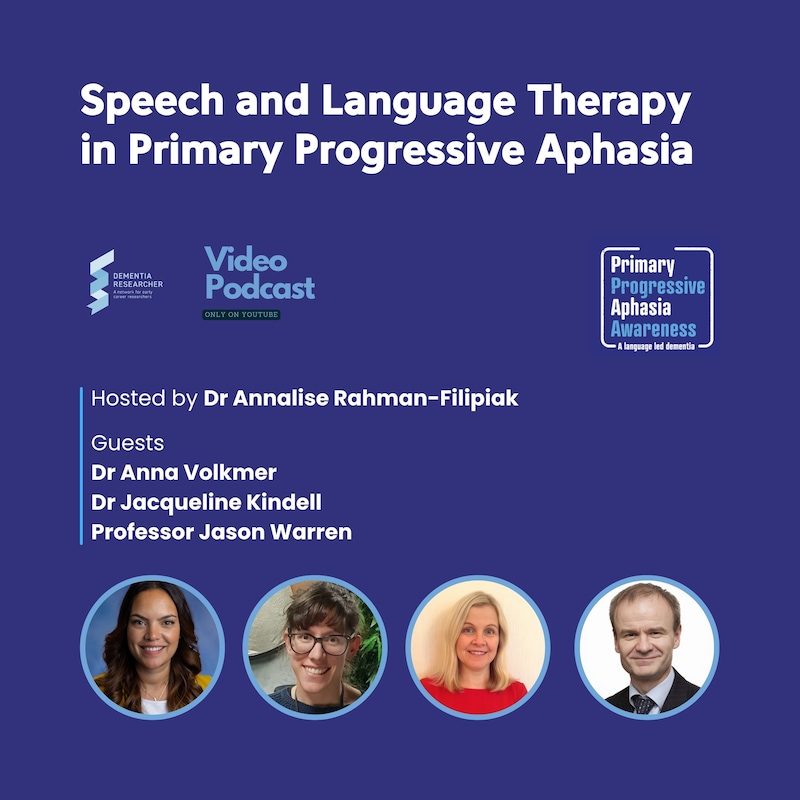
In this episode of the Dementia Researcher Podcast, Dr Annalise Rahman Filipiak speaks with Professor Jason Warren, Dr Anna Volkmer and Dr Jacqueline Kindell about the role of speech and language therapy in diagnosing and supporting people living with PPA. The discussion explores why diagnosis is often delayed, how speech and language therapists contribute to multidisciplinary assessment and care pathways, and why early referral can make a meaningful difference for patients and families.
The conversation also looks at international differences in access to services, the importance of communication support across the course of the condition, and the growing global movement to improve awareness through Primary Progressive Aphasia Awareness Day.
PPA Awareness Day 2026 - speechtherapyppa.com/ppa-awareness-day
About the guests
Jason Warren - Professor of Neurology at University College London and the National Hospital for Neurology and Neurosurgery. His research focuses on dementia, language disorders and diagnostic markers for primary progressive aphasia.
Anna Volkmer - Associate Professor and Consultant Speech and Language Therapist at University College London. Her work focuses on communication interventions and support for people living with primary progressive aphasia and their families.
Jacqueline Kindell - Speech and Language Therapist and Lecturer at The University of Manchester with extensive clinical and research experience in dementia and communication disorders.
Key Takeaways
- Primary progressive aphasia is a group of dementias where language difficulties appear before memory problems, which often makes diagnosis harder.
- Diagnosis can take several years because many dementia assessment tools focus on memory rather than communication and language.
- Speech and language therapists play an important role in diagnosing PPA by assessing language, communication and motor speech changes.
- Speech and language therapy is currently the main treatment available to help people with PPA manage communication difficulties.
- Early referral to speech and language therapy helps people and families adapt communication strategies and plan for future changes.
- Access to specialist speech and language therapy services varies widely depending on where people live.
- Communication support can improve quality of life and reduce wider pressures on health services by improving understanding between patients, families and clinicians.
- Primary Progressive Aphasia Awareness Day aims to improve recognition of the condition and promote early referral to speech and language therapy.
A transcript of this show, links and show notes and profile on all our guests are available on our website at www.dementiaresearcher.nihr.ac.uk
Follow us on social media:
- www.instagram.com/dementia_researcher/
- www.facebook.com/Dementia.Researcher/
- www.twitter.com/demrescommunity
- www.linkedin.com/company/dementia-researcher
- www.bsky.app/profile/dementiare…archer.bsky.social
Download and Register with our Community App:
Transcripts
- [Announcer] The "Dementia
Researcher Podcast,"
Speaker:talking careers, research,
conference highlights,
Speaker:and so much more.
Speaker:- Hello, and welcome to the
"Dementia Researcher Podcast."
Speaker:My name is Annalise Rahma-Filipiak.
Speaker:I'm a neuropsychologist
and assistant professor
Speaker:at University of Michigan.
Speaker:And I am pleased to be back
to host today's episode.
Speaker:Today, we will be talking
about the role of speech
Speaker:and language therapy in
primary progressive aphasia.
Speaker:(cheerful music)
Speaker:Many of you will know that
primary progressive aphasias,
Speaker:or PPA, are a group of
language-led dementias associated
Speaker:with Alzheimer's disease
and frontotemporal dementia.
Speaker:The main and leading symptom
Speaker:is speech and language difficulty.
Speaker:And the main treatment for these symptoms
Speaker:is speech and language therapy.
Speaker:This year marks the second
PPA awareness campaign,
Speaker:and the focus of which
is referral to speech
Speaker:and language therapy early.
Speaker:So in honour of this
important awareness effort,
Speaker:this episode will highlight
research on early diagnosis
Speaker:and care pathways to speech
and language therapy.
Speaker:I am joined by three wonderful guests
Speaker:who specialise in this topic,
Jackie, Jason, and Anna.
Speaker:First, Professor Jason Warren,
Speaker:who is a professor of neurology
at University College London
Speaker:and the National Hospital for
Neurology and Neurosurgery.
Speaker:Jason is a world-leading
behavioural scientist
Speaker:in the field of PPA.
Speaker:We are also joined by Dr. Anna Volkmer,
Speaker:also from University College London
Speaker:and the National Hospital for
Neurology and Neurosurgery.
Speaker:Anna is an associate professor
Speaker:and consultant speech
and language therapist.
Speaker:And last, but not least,
Speaker:we are joined by Dr. Jackie Kindell,
Speaker:another speech and language
therapy researcher and lecturer,
Speaker:but from Manchester University.
Speaker:Hi, Jason, Anna, and Jackie.
Speaker:- Hi.
- Hello, guys.
Speaker:- Hello.
Speaker:- Thank you so much for joining us today.
Speaker:To start off, could I ask you
each to introduce yourselves?
Speaker:I'll start with you, Jason.
Speaker:- Yeah, so I'm Jason.
Speaker:I'm a clinical neurologist.
Speaker:And I run a clinic with
a particular interest
Speaker:in primary progressive aphasia here
Speaker:at the National Hospital for
Neurology and Neurosurgery
Speaker:on Queen Square.
Speaker:And I'm also a brain researcher.
Speaker:And the particular interest
Speaker:of my research group is
in developing new ways,
Speaker:new markers of diagnosis for
primary progressive aphasia,
Speaker:and also, more broadly,
hearing in dementia.
Speaker:- Fantastic. Anna?
Speaker:- Perfect. Thank you.
Speaker:My name is Anna Volkmer.
Speaker:I'm a speech and language therapist.
Speaker:I've worked for 25 years clinically
Speaker:as a speech and language therapist,
Speaker:but I'm also an academic, a researcher.
Speaker:And my research and my clinical
work has really focused
Speaker:on supporting people with
primary progressive aphasia
Speaker:and their family members,
Speaker:as well as people with
other types of dementia,
Speaker:and really understanding what we can do
Speaker:in terms of interventions
Speaker:and helping them to live well for longer.
Speaker:- Thanks for being here.
And lastly, Jackie?
Speaker:- Hi, I'm Jackie. I'm also a
speech and language therapist.
Speaker:I've recently moved to the
University of Manchester.
Speaker:But before that, I've
kind of had the privilege
Speaker:of a long career specialising in dementia
Speaker:as a speech and language therapist.
Speaker:So I've always worked in
older adult mental health,
Speaker:so people with dementia in
memory clinics or on the wards,
Speaker:or the community mental health team.
Speaker:And in that service,
Speaker:you would work with,
obviously, communication,
Speaker:but eating, drinking, swallowing issues,
Speaker:all kinds of dementia.
Speaker:But obviously, part of that,
Speaker:and a significant part as a
speech and language therapist,
Speaker:will be people with
primary progressive aphasia
Speaker:or other sort of language-led
dementias, really.
Speaker:So I'm interested in the whole spectrum,
Speaker:from the earliest through
to the latest stages,
Speaker:'cause people come to us with PPA
Speaker:at all different points
within our pathway.
Speaker:And, you know, we have to
provide the care to them
Speaker:at all of those different areas, really.
Speaker:- So glad to have you all.
Speaker:(cheerful music)
Speaker:- To kick us off, I'd like to talk
Speaker:about why an early diagnosis
may be difficult in PPA.
Speaker:As we already touched on
during the introduction,
Speaker:getting a prompt diagnosis
is often an issue for people
Speaker:with PPA, but why is this?
Speaker:Jason, I'd like to start
with you, if possible.
Speaker:From a medical perspective,
what is it about PPA
Speaker:that might make it difficult to diagnose?
Speaker:- Yeah, so I think it's
difficult, probably,
Speaker:for three main reasons, really.
Speaker:So first of all, it's something
Speaker:that strikes an incredibly
complex brain function,
Speaker:and it's a brain function
that is extremely diverse.
Speaker:You think about all the many ways
Speaker:that we are called upon to
communicate in daily life,
Speaker:and most of those can be affected
Speaker:by primary progressive aphasia.
Speaker:So it can come on
Speaker:in a bewildering variety
of different ways.
Speaker:And it's also, those functions
are really quite close to us.
Speaker:I mean, language is one of
the things that makes us human
Speaker:and defines us as individual humans.
Speaker:And it's sometimes really difficult
Speaker:to get at things that are so close to us.
Speaker:I think the second major issue
Speaker:is that it's not
well-recognized by clinicians,
Speaker:certainly not by
neurologists and by doctors,
Speaker:but probably not by, more widely,
Speaker:other varieties of clinicians.
Speaker:And I think that this is partly
Speaker:because we've got an image of
dementia, which is, at large,
Speaker:which basically says that dementia
Speaker:is memory failure of older people,
Speaker:Hence, and that doesn't really apply
Speaker:to people with primary
progressive aphasia.
Speaker:And the third main reason is that we,
Speaker:even if it is suspected,
Speaker:don't have good tools to
diagnose and measure it.
Speaker:Many of the instruments that
we use, the diagnostic tests,
Speaker:the cognitive tests that we
use to diagnose dementia,
Speaker:are really geared toward memory
Speaker:and other types of problems,
Speaker:not toward language and communication,
Speaker:and certainly not toward communication
Speaker:as we use it in everyday life, really.
Speaker:And even brain scanning, which
is incredibly informative,
Speaker:or can be incredibly informative,
Speaker:even that can lack sensitivity
for picking up the diagnosis.
Speaker:So it's very easy for people
to either not be diagnosed
Speaker:or to be sent down a rabbit
hole of misdiagnosis.
Speaker:- Can I ask a follow-up question to that?
Speaker:So how long on average does
it take for an individual
Speaker:to get a diagnosis?
Speaker:- It takes much too long.
Speaker:And we know this both from
sort of a clinical hunch,
Speaker:but it's a hunch that's
been now substantiated
Speaker:with actual surveys, measurements.
Speaker:So the senior postdoc in
my group, Chris Hardy,
Speaker:has studied this in detail,
Speaker:and has done a live survey
of caregivers and partners
Speaker:for people with primary
progressive aphasia.
Speaker:And asked them, among many other things,
Speaker:to recall how long it took
them to get a diagnosis.
Speaker:And it's several years in most cases.
Speaker:And in some types of
primary progressive aphasia,
Speaker:you may be even as long
as five years on average.
Speaker:And that tends to be,
Speaker:which I'm sure we'll talk
about, the semantic variant,
Speaker:which is the one that
doesn't obviously affect
Speaker:the way language sounds,
the way someone talks,
Speaker:can go disguised or unsuspected
for a very long time.
Speaker:And if you think about someone
living with uncertainty,
Speaker:not really being sure
what's happening to them
Speaker:or to their loved one,
for five years or longer,
Speaker:I mean, that's not a
satisfactory situation.
Speaker:- Not at all.
Speaker:Thanks for giving us some range there
Speaker:to ground this conversation.
Speaker:Anna, I'd like to turn to you.
Speaker:Can you explain to us then
Speaker:what the role of speech
and language therapists is
Speaker:in supporting a diagnosis of PPA?
Speaker:- Absolutely.
Speaker:I work with Professor Warren,
Speaker:Professor Jason Warren, actually,
Speaker:in our diagnostic clinic
Speaker:at the National Hospital at Queen Square.
Speaker:And my role is to support
the diagnostic process
Speaker:through assessments.
Speaker:So, for example, I often
will become involved,
Speaker:or separately assess,
sometimes we jointly assess,
Speaker:and sometimes I separately
assess people's,
Speaker:or a motor function.
Speaker:We know that people
Speaker:with non-fluent variant
primary progressive aphasia,
Speaker:their symptoms are led by
a motor speech disorder
Speaker:and apraxia, as well as an agrammatism.
Speaker:So my role would be to pick apart
Speaker:whether somebody's presenting
with a motor speech disorder
Speaker:versus somebody perhaps
who has a logopenic variant
Speaker:of primary progressive aphasia,
Speaker:when it's more to do with word retrieval,
Speaker:versus somebody with a semantic variant,
Speaker:where it's looking at word meaning.
Speaker:So part of my job role would
be doing some language testing
Speaker:and some motor speech testing
Speaker:alongside Professor Warren
and the medical team.
Speaker:I would also, in that conversation,
Speaker:be supporting the person to
also understand their diagnosis,
Speaker:if and when we get there.
Speaker:We often find that some of the
clients we are working with,
Speaker:especially the people with
language difficulties,
Speaker:might find some of their
constructs around the nomenclature.
Speaker:I said that word wrong.
Speaker:I always stumble across that
word. Well, there you go.
Speaker:These jargonistic words are difficult
Speaker:for people to understand.
Speaker:They're often quite abstract.
They're not visible.
Speaker:And sometimes part of my role will be
Speaker:to perhaps support the person
Speaker:with the language
difficulty and the partner
Speaker:to make sure they followed
the diagnosis giving,
Speaker:and then also talk about support.
Speaker:Perhaps that's my most important role,
Speaker:actually, in that interaction.
Speaker:And we know from the
research that we've done
Speaker:with Professor Jason Warren,
Speaker:and in my lab, in the
Better Conversations Lab,
Speaker:where we've asked people
about their experiences
Speaker:of having primary progressive aphasia,
Speaker:and the support they've got afterwards,
Speaker:and the access to speech therapy.
Speaker:They often have said that
it's really difficult
Speaker:to find a route to speech therapy.
Speaker:So often, my job role is to make sure
Speaker:that people just don't drop off a cliff,
Speaker:that they feel supported.
Speaker:I think Jason, though, you
might like to add to that.
Speaker:Is that a fair description of what I do?
Speaker:Do you wanna refine my description?
Speaker:- Yeah, that's a modest
description of what you do, Anna.
Speaker:I mean, speech and language therapy,
Speaker:I'll say for the first
time in this podcast,
Speaker:is absolutely vital,
Speaker:and is far underutilised
for various reasons,
Speaker:and is really the main
treatment that we have
Speaker:for primary progressive
aphasia at the moment.
Speaker:And in some ways, that's
unfortunate, of course,
Speaker:but in other ways, it's
a major opportunity,
Speaker:which, overall, we don't make enough of.
Speaker:- That is an incredible description
Speaker:of what seems like a very
multifaceted role that you play.
Speaker:As a neuropsychologist myself,
Speaker:I just have to say I
appreciate the attentiveness,
Speaker:not only to the multimodal assessment,
Speaker:but also to the feedback process,
Speaker:and how that, in and of
itself, can be therapeutic,
Speaker:and can sort of launch families
Speaker:in the right direction or the wrong one.
Speaker:So really interesting to hear.
Speaker:And I'm sure we'll circle back to this.
Speaker:Jason and Anna, it must
be useful having support
Speaker:from speech and language therapy.
Speaker:Is there much research on
who should diagnose PPA?
Speaker:- There's not nearly enough.
Speaker:I mean, it's been, traditionally,
Speaker:a field dominated by neurologists.
Speaker:And in some ways, that's understandable,
Speaker:because neurologists have the
province of language aphasia,
Speaker:traditionally, in stroke.
Speaker:And they're often trained to
assess language in that way.
Speaker:And they really were
responsible for, I guess,
Speaker:the initial recognition of
primary progressive aphasia,
Speaker:which, by the way, dates back to,
Speaker:well, at least the 19th
century, probably before.
Speaker:Obviously, it was called
different terms then,
Speaker:but there were very clear descriptions
Speaker:from neurologists from those times
Speaker:that gets periodically
forgotten about by neurologists,
Speaker:and then rediscovered, as
it did about 40 years ago.
Speaker:And so I think neurologists
have dominated the landscape.
Speaker:But I would say, as a neurologist,
Speaker:that it really, really
needs to be a team effort.
Speaker:And the fundamental reason for that
Speaker:is that neurologists
are quite reductionist
Speaker:in their approach.
Speaker:It's how they're trained usually.
Speaker:And they like to measure things,
Speaker:and they really like to focus
on what people can't do,
Speaker:because that's usually what
they use to make a diagnosis.
Speaker:But you need to have a
speech and language therapist
Speaker:to give the complementary picture,
Speaker:and also to be able to
tell us what someone
Speaker:is actually doing in their
daily live, beyond tests,
Speaker:which sometimes can be the
whole clue to the diagnosis.
Speaker:- Yeah, that functional
impact is so important,
Speaker:and much more important to our patients
Speaker:than how they might perform
on a particular test.
Speaker:Jackie, I'd love to bring you
into the conversation here.
Speaker:Are speech and language
therapists regularly
Speaker:or always involved in
diagnosing PPA in the UK
Speaker:or even internationally?
Speaker:- No, unfortunately, not.
Speaker:It's a very variable picture,
Speaker:and I think therein lies the problem.
Speaker:So you kind of have these
certain centres of excellence,
Speaker:or, you know,
Speaker:long-standing speech and
language therapy practitioners,
Speaker:posts where people have
been for many years,
Speaker:and then other places
where there's, you know,
Speaker:really challenging access, really.
Speaker:And I think, well, in the UK,
we call it a postcode lottery,
Speaker:so it depends on where you
live as to what you get.
Speaker:And I think we would all agree
Speaker:that's not really a good state of affairs.
Speaker:So it's very historical in
terms of how services, you know,
Speaker:how services have been
organised or commissioned.
Speaker:So you might go to one locality,
Speaker:and they'll have a speech therapist based
Speaker:with their memory clinic
Speaker:or with their older
adult mental health team,
Speaker:or their neurology team.
Speaker:And I guess that's the other
issue, is that in the UK,
Speaker:some of the diagnosis
is done in psychiatry,
Speaker:and some of it's done in neurology,
Speaker:and some of it's done in psychiatry,
Speaker:then they go to neurology, you know?
Speaker:So it's not a simple pathway either.
Speaker:So that makes it a bit more complicated.
Speaker:But some places, you'll have
a few speech therapists,
Speaker:and then, literally, next door,
Speaker:no speech and language therapists at all,
Speaker:and find it very difficult to access that.
Speaker:So in the group that I'm involved with,
Speaker:in the north of England, you know,
Speaker:we've got some amazing areas
Speaker:with some really innovative practise,
Speaker:which is very heartening.
Speaker:You know, speech therapists
that are very involved
Speaker:with looking, you know,
in their memory clinic,
Speaker:anyone that's atypical,
Speaker:language seems to be the dominant thing,
Speaker:they go straight to the speech therapist,
Speaker:really clean kind of pathway.
Speaker:That works really well.
Speaker:We've got another service,
Speaker:they've taken their speech therapist,
Speaker:and they've trained them
Speaker:at as a advanced clinical practitioner.
Speaker:So they've had extra training
Speaker:from their speech and
language therapy post,
Speaker:to look at scans or
blood tests or whatever,
Speaker:to do that additional diagnosis.
Speaker:So we've got some really
interesting areas of innovation,
Speaker:really, and where that's happened.
Speaker:I think that's because those services
Speaker:have kind of recognised
that speech therapists
Speaker:have got the underlying
neurology training,
Speaker:and like you've said,
that neuropsychology,
Speaker:to be able to kind of pull it out,
Speaker:and it's actually part of our training.
Speaker:So I think sometimes people don't realise
Speaker:what a speech therapist
does till you get one,
Speaker:and you kind of think, "Oh,
(laughs) that's what you do.
Speaker:That's what knowledge you've got."
Speaker:And I think, you know,
Speaker:that innovation is tended to
occur in those kind of places,
Speaker:but no means is it uniform.
Speaker:And I think Anna and I would say
Speaker:that replicates
internationally, doesn't it?
Speaker:- It does.
Speaker:I was just gonna add, 'cause
we did a survey back in 2016,
Speaker:a UK-wide survey, of speech
therapy practise in PPA.
Speaker:And then Jackie and I run,
Speaker:so I'm in the south of England,
Speaker:Jackie's in the north,
we just alluded to that,
Speaker:but we also have a UK-wide
group of speech therapists
Speaker:who specialise in PPA.
Speaker:And we repeated a couple of questions
Speaker:from that survey a couple of years ago.
Speaker:And where, say, 10 years ago,
speech therapists, only 10%,
Speaker:less than that, had any kind
of care pathway for people
Speaker:with primary progressive aphasia.
Speaker:And it was really, really patchy.
Speaker:On our survey, more recently,
Speaker:we had 20% having care pathways.
Speaker:You know, the examples
that Jackie has mentioned
Speaker:are examples that, we
know those clinicians,
Speaker:and they're people who
are much more recent
Speaker:in their positions.
Speaker:We've also replicated that,
Speaker:in an international basis,
elements of that survey.
Speaker:Jeanne Gallee is a speech
and language pathologist
Speaker:in Washington, in research.
Speaker:And she worked with Jackie and I
Speaker:in our International Speech Therapy group.
Speaker:And we're seeing really similar
patterns internationally,
Speaker:if I'm honest.
Speaker:We are finding that people
aren't, as Jackie said,
Speaker:there's no training, and
that's internationally,
Speaker:there's reduced confidence,
Speaker:there's limitations in
terms of commissioning,
Speaker:so funding opportunities,
Speaker:and then we are seeing
that there's barriers
Speaker:in terms of awareness, broader awareness,
Speaker:of the role of what we do.
Speaker:So there's a few things
impacting on that data.
Speaker:Have I missed anything, Jackie?
Speaker:- No, I think that's it, isn't it?
Speaker:I think it's just that
kind of variability,
Speaker:really, isn't it?
Speaker:So, you know, we did a big
listening event in our city,
Speaker:and it was just really interesting.
Speaker:Some people with PPA had had
just the most amazing service,
Speaker:and other people had to work really hard,
Speaker:and they'd also missed out on some basic,
Speaker:I would say, some basic advice, really,
Speaker:in terms of how they were managing things,
Speaker:you know, about, you know,
Speaker:how their language might deteriorate,
Speaker:or how their writing would be affected.
Speaker:They hadn't put advance planning in
Speaker:in terms of some of those things.
Speaker:So it was really quite
difficult being in that space,
Speaker:seeing people in quite,
(chuckles) you know,
Speaker:not a large city, but, you
know, differences in experience.
Speaker:And I think it's not a good thing, is it,
Speaker:when you've got that.
Speaker:So we've got, you know, both ends.
Speaker:But as Anna says, it's getting better,
Speaker:and I guess that's what we've
got to hold onto, I think,
Speaker:and that's why things like
this are really important,
Speaker:'cause by raising that
awareness, you know,
Speaker:I think that's how people
can kind of understand.
Speaker:And sometimes it starts small.
Speaker:We've had services where
people have started
Speaker:with half a day a week, you know,
Speaker:and they work at a clinic half day a week,
Speaker:and then put all that,
Speaker:actually, that, "We need more of that,"
Speaker:you know, and then
that's half a, you know,
Speaker:then the halftime posts,
then a full-time post,
Speaker:and then that services
become two therapists.
Speaker:So sometimes it's not
large amounts of money
Speaker:that can make a difference.
Speaker:It's small things that can then grow
Speaker:and can kind of show the need.
Speaker:- That's really helpful to know.
Speaker:And I think you're pointing out
Speaker:that this really is an
international issue,
Speaker:not only dementia care capacity broadly,
Speaker:but for these very, very
highly specialised services
Speaker:for individuals with
atypical presentations.
Speaker:In addition to this fantastic podcast,
Speaker:any other resources you might point out
Speaker:to folks who are looking to learn more
Speaker:about speech and language therapy,
Speaker:or even just how they might fit
Speaker:into the multidisciplinary team?
Speaker:I'll give that to everyone broadly.
Speaker:- Well, the first thing,
that's good question,
Speaker:the first thing that
springs to my mind is,
Speaker:in our International Speech
and Language Therapy network,
Speaker:we've got a researchers from
25 countries worldwide now.
Speaker:And one of the things that we've done
Speaker:is recognise the need for more resources.
Speaker:So we are trying to share,
Speaker:that's why we came together
in the first place.
Speaker:Locally, we've done the same,
Speaker:to share case presentations,
share practise.
Speaker:And internationally, we
wanted to do the same,
Speaker:and actually translate
some of those resources in,
Speaker:'cause there is some research,
Speaker:there are some studies going on,
Speaker:there are randomised
control trials, one or two,
Speaker:on speech and language therapy,
Speaker:that are trying to influence policies.
Speaker:We might be leading one at UCL,
Speaker:but they're, you know,
they're in their offing.
Speaker:There are qualitative research studies
Speaker:and smaller group trials.
Speaker:But actually, clinicians on
the ground need resources,
Speaker:and other professionals
need to know what we do.
Speaker:So our international group has a website
Speaker:where we try and share clinical resources.
Speaker:But as a more locally in the UK,
Speaker:I guess this is where the
PPA Awareness Day comes in.
Speaker:Actually, this is what the focus is,
Speaker:of we wanted to mention on this podcast.
Speaker:And that's come in because people with PPA
Speaker:that we've worked with
have said, "Yeah, you know,
Speaker:all your wonderful aim
Speaker:to create randomised controlled trials
Speaker:that will influence policy,
Speaker:it's all really wonderful.
Speaker:However, can we do
something much more basic?
Speaker:So we can see speech
therapists trying to increase,
Speaker:you know, small amounts of money.
Speaker:We can see professors of neurology trying
Speaker:to help us live well.
Speaker:But can you do some work,
Speaker:just to let everybody
know that if we have PPA,
Speaker:we need to have a referral
to speech therapy?"
Speaker:That's it. That's the care pathway.
Speaker:So out of that was born a collaboration
Speaker:where we are trying to increase awareness.
Speaker:This is part of a research piece
of work we've done as well.
Speaker:So we've used lots of
different participatory methods
Speaker:and qualitative research methods
Speaker:to underpin this awareness piece,
Speaker:and work together with
researchers, neurologists,
Speaker:as well as people with lived experience.
Speaker:- I have lots of specific questions,
Speaker:but that's a really helpful start.
Speaker:- Can I call out a couple of things?
Speaker:So first of all, I'd
really like to call out,
Speaker:we have a national PPA
support group in the UK,
Speaker:as part of Rare Dementia
Support, with its website.
Speaker:And they have a lot of
resources associated with them,
Speaker:and they do actually take people remotely,
Speaker:and sort of involved in
our webinars and meetings.
Speaker:And Anna and I are involved with that.
Speaker:But also, there will be,
I think, other, you know,
Speaker:sources of support.
Speaker:For example, Association
for Frontotemporal Dementia
Speaker:in the US has some very good
things, as I'm sure you know.
Speaker:And there may well be other things.
Speaker:And the second thing I wanted to call out
Speaker:is that we're trying
to build this resource.
Speaker:So we've just launched, I think,
Speaker:really exciting development,
Speaker:trying to do what Anna has done
Speaker:with the speech and
language therapy community,
Speaker:with the neurological community.
Speaker:So Chris Hardy's now assembling,
Speaker:we think we'll have over 100 neurologists
Speaker:from many different countries,
about 30 different countries,
Speaker:all of whom have an interest in a PPA,
Speaker:to try to join them all up.
Speaker:And I'm hoping that that will run and run.
Speaker:And on the back of that,
Speaker:we will actually generate
one of the main impetus
Speaker:of founding it, actually,
Speaker:is to generate publicly
accessible things across countries
Speaker:that we will be major resource.
Speaker:So looking into the,
hopefully, intermediate,
Speaker:short-term, intermediate-term future.
Speaker:- You just asked a
question or made a comment
Speaker:that triggered a question in
my mind about other countries.
Speaker:What does the diagnosis of
PPA look like elsewhere,
Speaker:so maybe beyond the Western
world, for instance?
Speaker:- It's a massive issue for the field.
Speaker:The bias that exists
because of the history,
Speaker:the modern history of its rediscovery,
Speaker:is being dominated by the
English-speaking world.
Speaker:And, you know,
Speaker:there's a huge
overrepresentation of English
Speaker:in the literature and in
terms of our understanding
Speaker:of these diseases.
Speaker:And what we're starting to
see now are direct comparisons
Speaker:between English PPA and, for
example, Italian-speaking PPA,
Speaker:which we happen to have
been involved with,
Speaker:and with a group in Milan,
Salvatore Mazzeo's group.
Speaker:And it's revealing, really,
quite important differences
Speaker:between PPA in different languages,
Speaker:and presumably in different cultures,
Speaker:which we are even less good at measuring.
Speaker:So I mean, it's vital that
we do much more collaboration
Speaker:and try to look at what people
are using diagnostically
Speaker:across languages, because
there are huge swathes.
Speaker:I mean, if you do a PPA
map of PPA research,
Speaker:it's terrifying.
Speaker:There are huge swathes of the globe
Speaker:which are just a completely incognito.
Speaker:We don't look at those languages,
Speaker:have never seen what PPA
is like in those languages.
Speaker:And, you know,
Speaker:the vast majority of the
world's population is there.
Speaker:So we really need to break that all open.
Speaker:And I think, you know, there
are some tantalising clues.
Speaker:For example, we think
Speaker:that there are some very unique
features to PPA in Japanese,
Speaker:for example, which are not
well understood at the moment.
Speaker:And we really need
Speaker:to get a lot more communication
going between neurologists
Speaker:as well as speech and language
therapists internationally.
Speaker:But it is a huge issue for the field.
Speaker:- What I would say, though,
Speaker:is the PPA Awareness Day was
started in the UK last year.
Speaker:And last year,
Speaker:in the process of setting
up the PPA Awareness Day,
Speaker:we shared some of that with
our international colleagues,
Speaker:and it ended up being celebrated,
Speaker:let's use the word, across
six countries worldwide.
Speaker:And the PPA Awareness
Day recordings from 2025,
Speaker:last year's Awareness Day,
which span six countries,
Speaker:are available on the International Speech
Speaker:and Language Therapy PPA website.
Speaker:And there's six recordings from Greece,
Speaker:Italy, Canada, the States, England,
Speaker:I'm sure I've forgotten one, France.
Speaker:And then there was a later
one done in Australia.
Speaker:This year, we have PPA
Awareness Days going
Speaker:across 13 countries worldwide.
Speaker:So now, we're also including Norway.
Speaker:We are hoping to have a South
American country involved,
Speaker:and possibly Germany and Austria.
Speaker:You know, we mentioned the issue of access
Speaker:to speech therapy is an
issue across the world.
Speaker:And we are engaging the PPA
Awareness Day internationally,
Speaker:on the same day this year, it
will be on the 10th of April.
Speaker:And we will all be hosting
webinars around about midday,
Speaker:except in Greece, where, of course,
Speaker:it's Greek Easter on the 10th of April.
Speaker:So in Greece, they're holding
their event a week early,
Speaker:but we are hoping it will
be at midday, like a fan,
Speaker:like a bunch of fireworks
around the world,
Speaker:at different times of midday.
Speaker:But Jackie, I was wondering,
Speaker:we should compare notes, really,
Speaker:what locally, in terms
of multilingual people...
Speaker:- I was just thinking that
exact question, actually, Anna.
Speaker:- Yeah.
Speaker:I mean, in London, I still hear stories
Speaker:of people not being referred
to speech therapy with PPA
Speaker:'cause they don't speak
English as a first language,
Speaker:or they spoke multilingual.
Speaker:Do you hear that in the
north of England as well?
Speaker:- Yeah, I think so, yeah.
Speaker:But also, I think,
Speaker:just access to dementia
diagnosis more generally-
Speaker:- Exactly.
- Is different as well,
Speaker:isn't it?
Speaker:So it's part of a broader
picture, isn't it?
Speaker:And then how services are
configured within that,
Speaker:really, I think.
Speaker:And so people, when they come, are often,
Speaker:not always, but sometimes,
are really quite late.
Speaker:And some of those opportunities
are missed, I would say.
Speaker:- We did do a study at UCL.
Speaker:We asked 10 family members
Speaker:and people living with the
diagnosis of rare dementia,
Speaker:so we included non-language-led dementias,
Speaker:about the difficulties
Speaker:they had accessing diagnosis and support.
Speaker:We had to be quite purposeful,
though, 'cause we ended up,
Speaker:purposeful, I think, is the research term,
Speaker:'cause we had to recruit
people to that study
Speaker:who had already got to us, gotten to us.
Speaker:But they said exactly these things,
Speaker:these clinical experiences,
that Jackie and I described,
Speaker:they said the same.
Speaker:there were things like stigma,
Speaker:and within their own
communities, their own families,
Speaker:and also within the healthcare profession,
Speaker:and, you know, within
the healthcare community,
Speaker:but also between the people living with it
Speaker:and the way they interacted.
Speaker:So it's a complicated
sociopolitical situation.
Speaker:So we are continuing that programme
Speaker:to try and raise awareness
and also support access.
Speaker:- That's fantastic.
Speaker:And I'm excited to hear more about it.
Speaker:Bringing it back down
Speaker:to this patient and family
experience question,
Speaker:is there research on the best timing
Speaker:to start speech and language therapy
Speaker:beyond as early as possible?
Speaker:Jason, what are your thoughts?
Speaker:- Yeah, yes, as early as possible.
Speaker:And in fact, where possible,
Speaker:we really like to involve
speech and language therapy
Speaker:in the diagnostic pathway.
Speaker:And that's, you know,
built into our clinic,
Speaker:but, unfortunately, it's
not always feasible.
Speaker:So I guess, I defer to Anna and Jackie,
Speaker:but I guess most of the roles,
Speaker:speech and language therapy
Speaker:is still in post-diagnostic support.
Speaker:And that should definitely
be offered at the first,
Speaker:you know, time that we diagnose someone.
Speaker:And I think, I won't presume
to steal their thunder,
Speaker:but I think it's true that the ways
Speaker:that it can help do differ
over the course of the illness.
Speaker:But Jackie and Anna
might elaborate on that.
Speaker:- Yeah, we've certainly done
lots of research on timing.
Speaker:It's lots and lots of
qualitative research.
Speaker:We've done interviews and focus groups.
Speaker:And people with lived experience with PPA
Speaker:and their family members
all agree that they'd like
Speaker:to access the services
as early as possible.
Speaker:And to quote one of my client's wives,
Speaker:she said that when her husband started,
Speaker:she thought her husband had
fallen out of love with her,
Speaker:and then she noticed symptoms,
Speaker:and he got a diagnosis of PPA,
Speaker:and she thought, "Well,
I have to stay with him."
Speaker:And then she saw a speech
and language therapist
Speaker:and realised that he'd
always been in love with her,
Speaker:it's just the way he
communicated had changed.
Speaker:And she wished she'd
seen a speech therapist
Speaker:even before diagnosis.
Speaker:- Jackie, I'd love to hear your thoughts.
Speaker:I do wanna make one quick comment, Anna,
Speaker:about what you just said.
Speaker:I feel like there's a theme
that's come up commonly
Speaker:on this podcast and others
about the importance
Speaker:of involving lived experience
Speaker:in all of your research studies,
Speaker:and really the richness
of qualitative research,
Speaker:what that brings to,
Speaker:you know, to complement
our quantitative studies.
Speaker:So thank you so much for sharing
that quote and that story.
Speaker:I mean, very, very powerful.
Speaker:Jackie, I'm wondering,
Speaker:from your perspective and the
patients that you work with,
Speaker:we know that these conditions develop
Speaker:and manifest over many
years, even decades.
Speaker:And I can see that working
Speaker:with a speech and language therapist,
Speaker:we've talked about
there's access challenges,
Speaker:and that there would be
some significant burdens,
Speaker:both on the side of the clinical team
Speaker:and on the side of the
patients and the families.
Speaker:How does that work?
Speaker:How does that play out with your patients?
Speaker:- Yeah, I mean,
Speaker:so I think that's an
interesting question, isn't it?
Speaker:And I think for me,
Speaker:it's about configuration of
dementia services more broadly
Speaker:for all of the team.
Speaker:So sometimes people say that, you know,
Speaker:"It's gonna cost a lot
having this speech therapist,
Speaker:and, you know, all these
sessions you're gonna be doing."
Speaker:And you kind of go, "Well,
it's not configured like that,
Speaker:it's not configured
like that for community
Speaker:of psychiatric nurses
visiting people with dementia
Speaker:or occupational therapists,
or the rest of the team."
Speaker:So I think, for me, it's about
how we configure services,
Speaker:and then how we get the right people.
Speaker:And, you know, in the
NHS, we have this saying,
Speaker:it's the right people,
with the right skills,
Speaker:in the right place, at the right time.
Speaker:And that's making sure that,
Speaker:you know, at points of their journey,
Speaker:that people are gonna have support
Speaker:for whatever their need is at
that point in time, isn't it?
Speaker:So I think when we're talking about people
Speaker:with language-led dementias,
Speaker:primary progressive aphasia, you know,
Speaker:presuming you've been given your diagnosis
Speaker:at an early stage,
Speaker:then the post-diagnostic process
Speaker:is going to involve understanding
of language by definition,
Speaker:isn't it, by absolute definition.
Speaker:So if you want to explain what,
you know, semantic variant,
Speaker:or semantic dementia, as we
sometimes call it locally,
Speaker:you've got to really understand
semantics, haven't you?
Speaker:You can't really explain that
Speaker:without understanding what that is.
Speaker:You know, and if you're
talking about agrammatism,
Speaker:well, that's actually,
Speaker:so some of these things are
quite techie, aren't they,
Speaker:in terms of understanding
underlying language impairment.
Speaker:So, you know, if you
look across your team,
Speaker:and you kind of think,
"Who's got that skill,"
Speaker:it is quite clearly the discipline
Speaker:that's been trained in linguistics,
Speaker:which is your speech and
language therapist, isn't it?
Speaker:And I think that argument,
Speaker:it goes for all things,
doesn't it, really?
Speaker:So that, you know, if people need help
Speaker:with sort of managing
activities of daily living,
Speaker:they need to get an occupational
therapist, don't they?
Speaker:But the OT's not gonna be
involved forever necessarily,
Speaker:constantly visiting,
checking that you've got...
Speaker:You know, they'd be involved,
Speaker:and they'd, you know, help
you out during that period,
Speaker:your adaptation, and then, you know,
Speaker:they just kind of back off,
Speaker:and might be called in
again in the future.
Speaker:And speech therapy is exactly the same.
Speaker:So you kind of get involved at transition,
Speaker:or a point where people might need help
Speaker:with a particular thing,
Speaker:whether it's a post-diagnostic thing
Speaker:or training the care partner
around communication,
Speaker:or an issue around eating,
drinking, and swallowing.
Speaker:And you'd work with them
to provide the advice
Speaker:for adaptation at that point, you know?
Speaker:And that might be,
Speaker:sometimes you go, and
it might be one session,
Speaker:or it might be four sessions, you know?
Speaker:And then you'd kind of come
away again, wouldn't you?
Speaker:So you kind of dip in and dip out
Speaker:across the journey of dementia.
Speaker:But that's how we configure
services more broadly, don't we?
Speaker:And that's kind of underpins
our dementia strategy
Speaker:in the UK,
Speaker:where people have to have
that kind of timely support.
Speaker:And the idea is, if we offer that support,
Speaker:then it reduces people
needing additional things,
Speaker:because things have all
become unravelled, you know,
Speaker:and they need extra help
from the health service
Speaker:because somebody's become
dehydrated, or, you know,
Speaker:or it reduces people going into care
Speaker:because they can manage better.
Speaker:So that's the foundation for
our whole dementia strategy.
Speaker:And for me, these people
have got language problems
Speaker:in the dementia strategy.
Speaker:So if we want to be, you know,
Speaker:if we want to be thoughtful
about what their issues are,
Speaker:for me, it's just a natural, you know,
Speaker:it's a natural part of
that equation, really.
Speaker:So I think it's different from stroke,
Speaker:where you might have lots
of intervention early on.
Speaker:You know, when I worked,
Speaker:it's a very long time since
I've worked in stroke,
Speaker:but when I worked in
stroke, and, you know,
Speaker:you'd see people a number of times a week,
Speaker:and still people do that in inpatient,
Speaker:so there's many appointments early on.
Speaker:But our appointments
are spread out over the,
Speaker:so actually, if you added them up,
Speaker:it probably wouldn't be that
many appointments at all.
Speaker:But actually, you know, it's
spread over a longer period.
Speaker:So it's very much like we
would have with dementia
Speaker:or other progressive
neurological conditions,
Speaker:we kind of dip in and sort,
and then we back off again.
Speaker:That's the thing I'd say.
Speaker:- Can I underpin that with
some research as well?
Speaker:So I just thought about this.
Speaker:We've mentioned qualitative research,
Speaker:we've mentioned patient
and public involvement.
Speaker:I dropped in the odd RCT.
We've talked about surveys.
Speaker:We did a health economic study
Speaker:that's currently under review.
Speaker:And we asked people with PPA
Speaker:and their family members
across the UK about that.
Speaker:We did what was called a
discrete choice experiment,
Speaker:which is a health economics methodology.
Speaker:And basically, what we
found was that people
Speaker:don't expect continuous
speech and language therapy
Speaker:in a leisurely fashion, in their homes.
Speaker:What they really want is,
what they said they want,
Speaker:they told us, they prioritised
above anything else,
Speaker:is they quite happily
see a speech therapist
Speaker:on teletherapy even,
Speaker:and as long as they were a
speech and language therapist
Speaker:who knew about PPA.
Speaker:So they quite happily
Speaker:just have a few sessions
every so often, let's say,
Speaker:with an expert speech therapist
Speaker:who knows about PPA on teletherapy.
Speaker:So we're not talking about huge amounts
Speaker:of thousands of pounds.
Speaker:We are talking about a few hundred pounds,
Speaker:a few sessions, over, say, several years.
Speaker:- Can I make some points from
a neurological standpoint?
Speaker:So first, for one really,
Speaker:really important thing
we try to get across,
Speaker:but which there's a long
way to go on the messaging,
Speaker:is that aphasia is totally
colonised by stroke,
Speaker:which, of course, is understandable.
Speaker:'cause if you looked at everybody
coming along with aphasia,
Speaker:you know, 99 out of 100 will
have had a stroke for that.
Speaker:But the problem is that if you happen
Speaker:to be the unlucky 100th
person that it's got PPA,
Speaker:the models for stroke do not apply to you.
Speaker:And this is not helped, unfortunately,
Speaker:by kind of high-profile messaging,
Speaker:which likes to term PPA aphasia,
Speaker:because it's nicer to say that
Speaker:than to say that someone has dementia,
Speaker:but gives very misleading
impressions about prognosis,
Speaker:about what people's needs
are at a given point in time.
Speaker:And, you know, this is
an evolving situation.
Speaker:In stroke, as Jackie rightly says,
Speaker:you have an intensive kind
of early intervention model,
Speaker:because you expect the
brain's natural recovery
Speaker:and plasticity to kick in and help.
Speaker:That is not happening,
Speaker:at least not nearly to
the same extent, in PPA,
Speaker:and the needs are gonna be
evolving indefinitely, really.
Speaker:And, you know, with this
argument about economics,
Speaker:you know, I think what
really we want to see,
Speaker:which is really difficult to implement,
Speaker:but we want,
Speaker:is for speech and language therapy,
Speaker:like other forms of therapy in dementia,
Speaker:to be both reactive and proactive,
Speaker:so that, you know, it's flexible.
Speaker:And if it is that, then it
quickly pays for itself.
Speaker:Because if you think about
relatively simple interventions
Speaker:from a speech and language therapist
Speaker:that improve communication,
Speaker:how much money that might save
Speaker:in terms of wasted
investigations, wasted procedures,
Speaker:people not getting the
care they need until,
Speaker:you know, maybe those care
needs are much escalated,
Speaker:you know, communication
impacts all aspects of care.
Speaker:So, you know,
Speaker:facilitated communication
quickly pays for itself.
Speaker:So I think it is a really
difficult health economic model,
Speaker:because, on the one
hand, you're trying to,
Speaker:you know, factor in therapists' time.
Speaker:They're expert practitioners and all that,
Speaker:so they're quite expensive,
Speaker:but it's much harder to weigh
in what the true savings are.
Speaker:And this is a message that
we fight to get across.
Speaker:- Those are such excellent points.
Speaker:And again, this theme keeps coming up
Speaker:about the multiple roles
Speaker:that speech and language therapists play,
Speaker:not only in directly caring
for and treating the patients,
Speaker:but advocating for them,
Speaker:communicating really
complicated nomenclature
Speaker:or concepts to patients' families,
Speaker:and maybe even to other providers.
Speaker:So really diverse role
that all of you play.
Speaker:So now, let's move on and talk more
Speaker:about the awareness campaign.
Speaker:(cheerful music)
Speaker:So we talked a little bit about this,
Speaker:but Anna, I'd love to ask you,
Speaker:what made you start this
PPA awareness campaign?
Speaker:You talked a bit about it, but
what was the impetus for you?
Speaker:- So I was designing a
randomised controlled trial
Speaker:and running a randomised controlled trial.
Speaker:And I mentioned earlier
Speaker:that during this design of that trial,
Speaker:people with lived
experience were saying to us
Speaker:that this is a lovely trial.
Speaker:You know, it's really important.
Speaker:We were looking at
communication partner training,
Speaker:so working with couples.
Speaker:They said, "But how do we
even access speech therapy?
Speaker:You know, how do other
people access speech therapy?
Speaker:You need to do some research on that.
Speaker:And we'd like to help. You
need to design a care pathway."
Speaker:So we decided to
collaborate with Dyscover,
Speaker:who are the only speech therapy charity.
Speaker:We collaborate with Rare Dementia Support.
Speaker:And also, this year,
Speaker:we're collaborating with
Royal College of Psychiatry,
Speaker:and in the UK, who have a register
Speaker:of a large percentage
of our memory clinics.
Speaker:And we also are collaborating
Speaker:with the Royal College of
Speech and Language Therapy.
Speaker:So building a network with
trusted organisations,
Speaker:and then working with a group,
Speaker:a much wider group of people with PPA.
Speaker:Last year, we co-produced
a logo, our key messages.
Speaker:We ended up actually also
co-producing a series
Speaker:of mini awareness campaigns.
Speaker:We know need to influence the public,
Speaker:but we also need to influence referrers.
Speaker:We need to influence other
speech and language therapists.
Speaker:We need to influence student
speech and language therapists.
Speaker:We need to influence
several different people.
Speaker:So we've been celebrating many
awareness campaigns leading
Speaker:up to the PPA Awareness Day.
Speaker:So we co-produced that last year,
Speaker:and then we evaluated the impact.
Speaker:We know that we can't
change health behaviours,
Speaker:but we know we can change
awareness and knowledge.
Speaker:That's what an awareness campaign can do.
Speaker:So we explored that with feedback.
Speaker:And we did also look at our activity,
Speaker:how many people we were hitting.
Speaker:And across the six
international campaigns,
Speaker:we had hundreds of at
attendees in every webinar
Speaker:around those six countries
who participated last year.
Speaker:In fact, we had over 700
registrants at the UK event.
Speaker:And we had thousands and
thousands of engagements
Speaker:on social media.
Speaker:But our feedback really showed
Speaker:that the main thing that
changed was people's awareness.
Speaker:Annalise, you said it about
the breadth of our role.
Speaker:(Anna and Jacqueline laughing)
Speaker:And that's the kind of thing that people,
Speaker:that's what developed,
Speaker:that people realised that
perhaps some their misconceptions
Speaker:around what traditional
speech therapy might be
Speaker:might not be the only thing we offer,
Speaker:and that referrers, people
with lived experience,
Speaker:were developing that expansive knowledge.
Speaker:So I've kind of told you what inspired me,
Speaker:and then how we did it, and
then we need to keep doing it.
Speaker:- Incredible.
Speaker:Jason, who do you think needs
to know about this very,
Speaker:very broad role of speech
and language therapy in PPA?
Speaker:Who else?
Speaker:- Well, we really want
everyone to know about it,
Speaker:but I would say, from
a medical perspective,
Speaker:we want anybody that's involved
Speaker:in the diagnosis of
dementia to know about it.
Speaker:And, you know, really, obviously,
Speaker:well, maybe not obviously,
but clearly, memory clinics.
Speaker:And as Anna pointed out, in the UK,
Speaker:that landscape tends to be led mainly
Speaker:by old-age psychiatrists.
Speaker:And of course, it may be geriatricians
Speaker:or gerontologists in other countries,
Speaker:et cetera, other specialties.
Speaker:But whoever's involved, certainly
in running memory clinics,
Speaker:clearly, neurologists need to
know more about it as well,
Speaker:what role it has to play.
Speaker:And GPs, because even though
they may only have one person
Speaker:with PPA that they see in
their practise, who knows,
Speaker:you know, it's the same principle,
Speaker:that you want the GP to be able to pick up
Speaker:on the one life-threatening
case of headache
Speaker:that they see come through
their door. (chuckles)
Speaker:So you really want them to pick up
Speaker:that this person has unique needs,
Speaker:and refer them appropriately,
Speaker:and then be able to kind of take charge
Speaker:of the coordination of care.
Speaker:So I'd say,
Speaker:certainly, all those medics
need to know about it.
Speaker:And I'd say, with respect to neurologists,
Speaker:you are sort of, I suppose,
the group that I know best,
Speaker:there are a couple of
sort of really key things
Speaker:to try and sort of get across to them.
Speaker:And it's really based around
current misconceptions.
Speaker:I mean, one misconception that they have,
Speaker:we have to fight,
Speaker:is that speech and therapy
essentially assess swallowing,
Speaker:which, it is a really big and important,
Speaker:vital part of what they do,
but only one part of it.
Speaker:And the other kind of related perception
Speaker:is this sort of nihilistic view,
Speaker:that, well, you can't really do anything,
Speaker:you can't give people
with dementia training.
Speaker:So what's really the point?
Speaker:And, you know, to get across
that they're a fundamental,
Speaker:basic, everyday communication
aids and strategies
Speaker:that are really gonna make
people's lives different,
Speaker:which the speech and language
therapist can deliver.
Speaker:So I think it's teaching them, you know,
Speaker:that we have speech
and language therapists
Speaker:who are taking interest,
Speaker:but is also pointing out to
them why it's actually going
Speaker:to be practically useful
for them to refer.
Speaker:- Well, you heard it here, people.
Speaker:Make sure you forward this episode
Speaker:to your colleagues (laughs)
in different disciplines.
Speaker:Jackie, I'd like to end
with you on this question.
Speaker:From your perspective, do you
feel there's been a change
Speaker:in awareness in the role of
speech and language therapy?
Speaker:And where's that going?
Speaker:- Yeah, I think there has.
Speaker:You know, I'm positive. I think there has.
Speaker:(laughs) I think the penny
is beginning to drop,
Speaker:that we don't just practise
people, you know what I mean?
Speaker:That actually we do that
broader kind of role.
Speaker:And I think that's
absolutely crucial, isn't it?
Speaker:That broader kind of
everyday communication role
Speaker:that we have.
Speaker:So I think in our own
profession, and I, you know,
Speaker:I can think back my first
dementia placement in the '80s.
Speaker:So I can certainly say
that things have changed
Speaker:since that time.
Speaker:And I think within our own profession
Speaker:as speech and language therapists,
Speaker:there were some barriers
within our own profession
Speaker:as to whether we should or shouldn't.
Speaker:You know, as Jason says,
it was very stroke-focused.
Speaker:You know, so I think that's changed.
Speaker:People have realised
there's a broader group.
Speaker:I think what I would like to see,
Speaker:perhaps building on Jason's point there,
Speaker:is that sort of local
services kind of work out
Speaker:where some of the blocks are
Speaker:for people getting to
speech and language therapy,
Speaker:'cause sometimes, you
know, as Anna said there,
Speaker:it could be people's perceptions.
Speaker:But I think sometimes,
Speaker:it's just because services are
organised in a certain way,
Speaker:and then kind of referrers give up,
Speaker:'cause it's quite difficult.
Speaker:So I think people that commission
Speaker:or organise services should, you know,
Speaker:I'd like them to have an awareness
to think about, you know,
Speaker:'cause if they haven't
got a speech therapist
Speaker:that's a specialist, now, how
are they going to get access
Speaker:in the main speech therapy department
Speaker:that's based in the
hospital, the community?
Speaker:And why don't people
get from there to there?
Speaker:What are the blocks along the way?
Speaker:And sometimes it's because, you know,
Speaker:that service does stroke,
Speaker:and that service does neurology.
Speaker:And is PPA a neurology,
or is it a dementia,
Speaker:and is it, you know?
Speaker:And locally, we don't do dementia.
Speaker:You know, it gets all quite complicated.
Speaker:And so that's also about
awareness, isn't it?
Speaker:'Cause sometimes the
referrer wants to refer,
Speaker:and the speech therapist wants to take,
Speaker:but there's these other barriers
in the middle somewhere.
Speaker:And I think that's where awareness
Speaker:can start making you think,
Speaker:"Now, hang on, let's see if
we can't work this through."
Speaker:And that doesn't actually
take any more money
Speaker:to work those pathways through.
Speaker:It's just about, you know,
about looking at those basic,
Speaker:everyday things and those
referral processes, I think.
Speaker:So I do feel things are changing.
Speaker:They're not where I want
them to be, you know,
Speaker:but perhaps we'll get
there, get there soon.
Speaker:And the PPA Awareness Day is
gonna help that, definitely.
Speaker:So it's keep pushing, isn't it?
Speaker:And keep pushing it from
different angles, really,
Speaker:with all these different
stakeholders we've got around
Speaker:that can improve that kind of
awareness, really, I'd say.
Speaker:- Really excellent points from all of you.
Speaker:(cheerful music)
Speaker:- Okay, if you do not know much about PPA,
Speaker:or you do, but you want to know more,
Speaker:please sign up for the 2026 PPA
Awareness Day on April 10th.
Speaker:You can find the registration link
Speaker:in the show notes for today's episode.
Speaker:But Anna, to remind us,
Speaker:what's the focus of this
year's Awareness Day?
Speaker:And is there anything
else you wanna tell us
Speaker:before we sign off?
Speaker:- I think, to emphasise
the focus, is that people
Speaker:with primary progressive
aphasia experience speech,
Speaker:language, and communication difficulties
Speaker:as their main and leading symptom.
Speaker:And early referral to
speech and language therapy,
Speaker:as early as possible, is the main message.
Speaker:And the main message we are giving this to
Speaker:are the people who do
the diagnostic stuff.
Speaker:So that's why we're collaborating
Speaker:with the Royal College of
Psychiatrists in England,
Speaker:the Royal College of Speech
and Language Therapy,
Speaker:as I mentioned, Rare Dementia Support,
Speaker:and Dyscover, a charity,
Speaker:it's a speech therapy
charity that work with PPA.
Speaker:That's in the UK.
Speaker:Around the world, we're collaborating
Speaker:with the National Aphasia
Association in the States,
Speaker:with Australian Aphasia
Association in Australia
Speaker:and Speech Pathology Australia.
Speaker:We're collaborating with
organisations in Greece,
Speaker:Brussels, France, Switzerland, Norway.
Speaker:This is a test for me, by
the way, to remember all the,
Speaker:Canada, we've got Quebec,
Speaker:and Toronto is locations in Canada.
Speaker:We have events happening
in Austria, as I said.
Speaker:Oh, goodness, I know
I've missed other places,
Speaker:but please do sign up.
Speaker:And if you are in another country,
Speaker:and you can't find the
relevant link for your country,
Speaker:get in touch, and we'll
try and connect you.
Speaker:- Thank you so much for that overview.
Speaker:Any final thoughts, Jason, Jackie?
Speaker:- I'd just like to have a brief message
Speaker:for any medical colleagues
who might be listening in,
Speaker:just to say that if you
do see somebody coming
Speaker:through your clinic, your surgery,
Speaker:with word-finding difficulty,
Speaker:most of them won't have PPA,
Speaker:but they might, so do
please think about it.
Speaker:There are some resources
that we can make available,
Speaker:they're public domain,
Speaker:designed at non-expert medical audiences
Speaker:in terms of the sort of steps
you can take to diagnose them.
Speaker:But in particular, think very early
Speaker:about your friendly local
speech and language therapist.
Speaker:- Well, thank you all
so much for your time.
Speaker:I think we've had a really
fantastic discussion here.
Speaker:And some take-home points for
me are just the importance
Speaker:of a very early thought about
PPA on your differential list
Speaker:if you're a clinician,
Speaker:and reaching out and consulting early
Speaker:with your speech and language
therapist colleagues,
Speaker:because it certainly seems
like there's many cases
Speaker:of late diagnosis and misdiagnosis
Speaker:that have massive implications,
Speaker:not only for patients and their families,
Speaker:but broader economic and
social implications as well.
Speaker:We heard really compelling
discussion about the many roles
Speaker:that speech and language therapists play
Speaker:in that multidisciplinary team,
Speaker:so not only in the diagnosis process,
Speaker:but conveying results, explaining results,
Speaker:and really meeting with patients
Speaker:and families across all stages of their,
Speaker:you know, disease journey,
or diagnostic journey.
Speaker:We talked about some of the
important considerations
Speaker:for how we might expand
speech and language therapy
Speaker:as well as the broader sort
of dementia care capacity
Speaker:across different cultures,
Speaker:across non-English-speaking
cultures and areas.
Speaker:And finally, we talked about
this fantastic campaign,
Speaker:the PPA Awareness Day 2026,
Speaker:which I will be very
excited to tune in for.
Speaker:So I wanna end by just
saying thank you so much
Speaker:to our wonderful guests,
Speaker:so Professor Jason
Warren, Dr. Anna Volkmer,
Speaker:and Dr. Jackie Kindell,
Speaker:for sharing your experiences
and your perspectives today.
Speaker:As we mentioned,
Speaker:the links to both last year's
Awareness Day resources
Speaker:and the signup for this year's
PPA Awareness Day webinar
Speaker:will be included in the show notes.
Speaker:Thank you all for listening.
Speaker:I'm Annalise Rahma-Filipiak.
Speaker:And you've been listening
Speaker:to the "Dementia Researcher Podcast."
Speaker:Everyone, thanks so much.
Speaker:- Bye. Thank you.
Speaker:- Bye. Thank you.
Speaker:(cheerful music)
Speaker:- [Announcer] The "Dementia
Researcher Podcast"
Speaker:was brought to you by
University College London,
Speaker:with generous funding
Speaker:from the UK National
Institute for Health Research,
Speaker:Alzheimer's Research UK,
Speaker:Alzheimer's Society,
Alzheimer's Association,
Speaker:and Race Against Dementia.
Speaker:Please subscribe, leave as a review,
Speaker:and register on our website
Speaker:for full access to all
our grade resources,
Speaker:dementiaresearcher.nihr.ac.uk.







