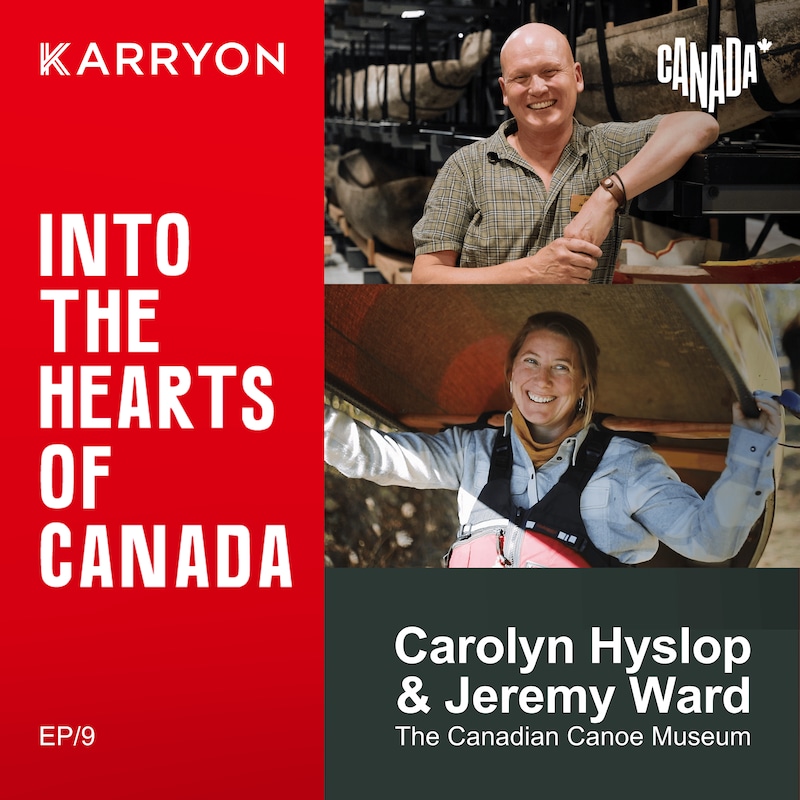
Shownotes
In this episode of Karryon Into the Hearts of Canada, hosted by Matt Leedham, we head to the Canadian Canoe Museum in Peterborough, Ontario.
The museum is just a ninety-minute drive from Toronto, where the landscape is defined by lakes, rivers and ancient canoe routes.
My guests are Carolyn Hyslop, Executive Director of the Canadian Canoe Museum, who has led the institution through a major transformation including the delivery of its new waterfront home, and Jeremy Ward, the museum's Curator, a man who started as a volunteer in 1997 and has since built birch bark canoes, curated more than ten major exhibitions and helped bring thousands of years of paddling history to life.
Together, they explore how something as simple as a canoe can expand our understanding of a country, reshape how we think about travel, and connect us to water, land and each other in ways we didn't expect.
Learn more about the Canadian Canoe Museum here
Into The Hearts of Canada is presented by Karryon, in partnership with Destination Canada.
Subscribe to Into The Hearts of Canada Podcast here
Visit: www.destinationcanada.com for more on Canada
Visit: karryon.com.au for more from Karryon
Presented by Karryon, Into the Hearts of Canada takes you beyond the guidebooks and into the heart and soul of one of the world’s most progressive travel destinations. Hosted by Karryon’s Matt Leedham, this 10-part series explores the people, places, and powerful ideas shaping the future of travel through a Canadian lens. From Indigenous knowledge-keepers and local changemakers to iconic landscapes and regenerative tourism pioneers, each episode offers an intimate conversation with the people reimagining what travel can be:
For the traveller, communities, and the planet. Whether you’re a curious wanderer or a travel professional seeking fresh insights, this podcast invites you to see Canada with new eyes and an open heart.
Into the Hearts of Canada is presented by Matt Leedham.
Mentioned in this episode:
ITHC midroll updated 14/07/2025
Transcripts
Carry on together in travel.
Speaker B:This podcast series is brought to you by Destination Canada.
Speaker B:A land of breathtaking natural beauty, meaningful experiences, and warm, welcoming people.
Speaker B:Canada is a place where every journey connects you more deeply to nature, culture and community.
Speaker B:Start your journey today at www.keepexploring.com.
Speaker A:It is a remarkable place.
Speaker A:There is something here for everybody, but it is a one of a kind experience worldwide.
Speaker A:There's nothing else like it is a place that does resonate with many people at a really emotional level.
Speaker A:When you're looking for a really authentic experience, an authentic experience that people are looking to connect with people, one of the things that we provide here is a really meaningful way for people to meet other people.
Speaker A:If you get right down to the huge level, there are really good people doing incredible things and this place showcases that.
Speaker B:Welcome to into the Hearts of Canada, the podcast where we share the stories of extraordinary people transforming Canadian tourism.
Speaker B:I'm your host, Matt Leadham, checking in from Barham Bay on Bundjalung Country.
Speaker B:Today we're heading to Peterborough in Ontario, 90 minutes from Toronto, right at the gateway to cottage country, where the landscape is defined by lakes, rivers and ancient canoe routes.
Speaker B:On the shores of Little Lake sits the Canadian Canoe Museum, a beautiful waterfront facility housing the world's largest collection of canoes, kayaks, and paddled watercraft.
Speaker B:It's here that more than 600 vessels tell stories that stretch back thousands of years.
Speaker B:But this is far more than a museum filled with beautiful watercraft.
Speaker B:It's a living archive of craftsmanship.
Speaker B:A library, if you will.
Speaker B:A meeting place for Indigenous knowledge, contemporary voices, outdoor culture, and national identity.
Speaker B:A place where you walk through history, then step outside and you can paddle into it.
Speaker B: tarted as a volunteer here in: Speaker B:Together, they explore how something as simple as a canoe can expand our understanding of a country, reshape how we think about travel, and connect us to water, land each other in ways we didn't expect.
Speaker B:If you're curious about Canada beyond the postcard, this one's for you.
Speaker C:Well, hello, Jeremy and Carolyn.
Speaker C:It's so wonderful to have you both on this episode of the podcast.
Speaker C:First question that I like to ask everybody is, where are you checking in from today.
Speaker A:Well, we are so pleased to be checking in from Peterborough, Ontario, Canada, here at the Canadian Canoe Museum, which you, Matt, have had the pleasure of visiting.
Speaker C:Indeed I have.
Speaker D:Yep.
Speaker A:You're on the shores of Little Lake, on a beautiful 5 acre parcel of waterfront property.
Speaker A:The most exquisite building, we think, surrounded by the most exceptional collection of canoes and kayaks and paddled watercraft from around the world.
Speaker D:But you're not biased?
Speaker A:No, I'm not biased.
Speaker D:And the canoe museum is also located on Michisagi first nations territories which are part of the Williams Treaties.
Speaker D:Territories.
Speaker D:This is a landscape of the canoe and this river that we are next to has an ancient canoe route and we see it every day, which kind of inspires so much of what happens here.
Speaker C:I'm guessing the landscape's just looking a tad different to when I was there in September.
Speaker A:It is a little bit different.
Speaker A:We're in the middle of winter right now and the beautiful thing is that we are a year round destination.
Speaker A:So we are both a cultural and recreational destination.
Speaker A:When we got back from holidays, there were cross country ski marks leading up to the museum.
Speaker A:So it is a place that people can walk to, ski to, snowshoe to, or in the summer paddle to.
Speaker C:And so let's just talk about Peterborough for a second just in terms of the location of it.
Speaker C:So it's about, I believe it's around about 90 minute drive from Toronto, I think, isn't it?
Speaker C:Roundabout.
Speaker C:But how would you describe the place in terms of its relationship with water, wilderness and the outdoor culture?
Speaker D:There's well today Peterborough, which is 90 minutes from Toronto, as you say, and it's about 50 minutes if you drive north of Lake Ontario.
Speaker D:So if you're looking for large landmarks on a globe, you can find it that way as well.
Speaker D:And it's located right at the sort of fringe of what comes to be many call cottage country.
Speaker D:It's a lot of lakes in this region and stretching further north in land of bush and waters extends right up to James Bay.
Speaker D:Many cities sprinkled throughout.
Speaker D:But Peterborough's history is an ancient canoe route and it was a conduit for travel and trade in this area, but with a number of first nations in the region, but also for about a hundred years this was a community and a region that was the sort of the global epicenter of wooden canoe manufacturing for about a century.
Speaker C:And I mean the canoe is such a powerful symbol in Canada and looking at the logo that you have for the museum as well is a beautiful example of that, I guess.
Speaker C:So from I mean, from your perspective, why does that still matter so deeply today?
Speaker A:Well, I think the canoe or the kayak means so much to different people.
Speaker A:I think for a lot of people, the canoe is sort of emblematic of this idea of moving through nature rather peacefully.
Speaker A:And a lot of people think of it like that.
Speaker A:They see the sort of the calm waters and the canoe on the lake and loons calling and beautiful summer days.
Speaker A:But other people think of the canoe as a great big, huge 36 foot dugout canoe that it race along the shores of the Pacific Northwest out in British Columbia and Haida Gwaii area.
Speaker A:So that area thinks of canoes in a much different way.
Speaker A:And if you're up in the Arctic, of course you're into a kayak, so.
Speaker A:So it does mean so much.
Speaker A:But I think, you know, we can all rally around this idea of we are really fortunate to have such an expansive country with so much water.
Speaker C:Yeah.
Speaker A:Rivers and lakes and three oceans and to be connected so quickly and easily to water.
Speaker A:The canoe in the early days was one of these vehicles that helped people move around this incredibly watered landscape.
Speaker A:I think there's some connection for people historically, culturally, but then a great way to connect with nature.
Speaker C:Yeah, absolutely.
Speaker C:So let's talk about the museum itself.
Speaker C:I think in Australia we, we do canoe here, we kayak, but certainly not to the level that yourselves would in Canada, I don't think.
Speaker C:And so for me, you know, we're going to a canoe museum.
Speaker C:I thought, oh, this is going to be interesting.
Speaker C:I wasn't prepared at all for what I ended up seeing, just from a sheer scale perspective for starters.
Speaker C:So, I mean, for our listeners, can you paint a bit of a picture of the museum itself and why it's really so different to what people might think of as a standard museum, let's say.
Speaker A:My goodness, Matt, I love that you said that you weren't expecting what you found.
Speaker A:People think, why a canoe museum?
Speaker A:Honestly, that makes us so happy because they think they're going to come across a warehouse full of dusty old canoes.
Speaker A:But man, it has been, we have been on this endeavor to sort of break people's understanding of where, where you can go with this idea of a canoe.
Speaker A:So the museum itself, so the building we've just finished a year, about a year and a half we've been open.
Speaker A:So.
Speaker A:So this is a brand new facility that we're in right now.
Speaker A:But what we wanted to do with this new facility was to create an experience.
Speaker A:So when you arrive at the museum, you're expecting an experience.
Speaker A:You're going to experience authentic workshops.
Speaker A:You're going to be able to see the world's largest collection of canoes and kayaks, but also experience and be able to make something in the exhibits.
Speaker A:And then if you're able, you can go outside and get, hopefully, if we've done our job well, we've inspired you to want to get into a canoe or a kayak yourself and get out onto the water and to experience paddling as part of your time here at the museum.
Speaker A:So we want to write from beginning to end, take people through this experience of visiting a museum and really trying to redefine what a museum is so that a.
Speaker A:You can have a really great time.
Speaker A:It's accessible to all the different people in your group.
Speaker A:So you have be visiting with a multi generational family and the little kids have something to.
Speaker A:When they're at the museum, they might get into one of our canoes and go fishing.
Speaker A:And the older people might enjoy reading the panels and taking in the audio stories.
Speaker A:Or you may have some older folks that aren't interested in museums at all and they're down in the cafe having a cappuccino and a scone.
Speaker A:Or you may get the really distracted folks that want to go outside and just listen to the birds and check out the plants and the trees on the property.
Speaker A:And then it's all grounded, of course, in the collection that is, you know, first and foremost, our major priority is sharing the collection and caring for it.
Speaker A:And that's a big part of the work that we all do.
Speaker A:But Jeremy certainly carries a big part of that.
Speaker C:Yeah.
Speaker C:So I mean, Jeremy, do you want to talk to us a little bit about the collection, I believe, is it 600 canoes you've got there in the.
Speaker C:As part of the collection?
Speaker D:More or less, yeah, it's.
Speaker D:It's north of that.
Speaker D:It's 640, roughly.
Speaker D:And these are canoes and kayaks.
Speaker D:And we've really focused on the, I guess the canoe and Canadian identity or mythology.
Speaker D:And it certainly takes a big place there.
Speaker D:And we are well aware that following the canoe where it leads takes you very quickly around the globe.
Speaker D:So while perhaps the majority of the collection, probably three quarters of the watercraft collection here come from North America, that still leaves a lot of canoes that take us to Papua New guinea and Hawaii and Thailand and Philippines, Guatemala, you name it, Samoa and so on, Solomon Islands.
Speaker D:The collection includes dugout canoes that have been recovered from the bottoms of lakes and rivers, places in North America.
Speaker D:We care for one of the oldest birch bark canoes that survive in the world here at the museum.
Speaker D:It's an enigmatic canoe that we're still following it, its path over the last several centuries.
Speaker D:You know, of course Carolyn mentioned the big dugout canoes, the big red cedar log canoes from the Pacific northwest, but also racing hulls and double hull Pacific ocean from the.
Speaker D:The Polynesian cultures as well.
Speaker D:But we also have a lot of work to do with the collection that we care for, and we're travel back to the communities or the families that these come from.
Speaker D:Now, that might take us to a camp or a cottage somewhere in Canada where some family's grandparents or great grandparents, you know, donated their family canoe that had some remarkable journey that might from a name that people around the world may recognize who unbeknownst to them, you know, it was part of their life.
Speaker D:So the collection reveals all of these amazing different parts of the world.
Speaker C:It really feels like, well, a library of sorts when you go in there.
Speaker C:Kayaks are all, you know, up in these beautiful rows, like huge bookshelves.
Speaker C:And one thing I really loved as well, I think when you took us on the tour, Jeremy, was the story of where indigenous people can come and actually borrow the canoe, I think can take it for a while and bring it back, which again, much like a library, which I'd never heard anything like that before with regard to a museum.
Speaker D:Museums everywhere that care for indigenous people's belongings are picking are finding their own way today, I think, in how they serve and how they care for these collections and what is the role that they play.
Speaker D:The story that you're mentioning most recently was a very powerful one where a young man, we just met him by accident as he was on a group tour, and he said he thought a dugout canoe from his family was in a museum collection.
Speaker D:And we explored where that went and realized we were standing about 24ft from his great great grandfather's Doug.
Speaker D:And so it's inspired a canoe building back in his home community.
Speaker D:New canoe is being made and we were able to bring the old canoe down and load it up for transport.
Speaker D:And we drove it to his first nation and spent the day there to bear witness and celebrate with them the work that so.
Speaker D:And the canoe, it's a lovely feeling to think, you know, it might have had a breath of familiar fresh air while it was at home and heard the songs and stories and then it's back here, but now with a new story to tell.
Speaker C:Yeah, that's amazing.
Speaker C:I really, really love that.
Speaker C:That's Beautiful.
Speaker C:And I mean, how would you say that the museum honors Indigenous knowledge and craftsmanship and I guess lit cultures in the way that those stories are told.
Speaker C:And I guess one example I'd just say was that again, when we visited was that you had this amazing workshop where you had craftsmanship in residence, basically, who were building a canoe from scratch.
Speaker C:And we got to go in and, you know, literally touch and feel and hear the story of how they were putting it together.
Speaker D:Well, that's so true.
Speaker D:And it is a collection like this is such a celebration of craftsmanship.
Speaker D:It's astonishing, the work that's in there and how these were made and the engineering and the art form and culture that's there.
Speaker D:Yeah, we have a Builders in Residence program where we're bringing in three or four highlight signature makers to the museum every year.
Speaker D:And we host them for a number of weeks and they meet the public and we're also filming them and producing a lot of content that'll flow out and be archived with them as well to use how they want to use.
Speaker D:So that's in.
Speaker D:In for the public, you know, to imagine getting off the bus and coming into the canoe museum and getting out of your coach, caravan or car, and there you are meeting as we had these.
Speaker D:These Inuit kayak makers from the Arctic, from the Baffin island.
Speaker D:Or this coming year, we have an incredible birch bark canoe builder, a West coast dugout canoe maker here.
Speaker D:We have some amazing people coming to the museum.
Speaker D:It's just suffering, but I think above all that is our perception or our partake that the museum is a big house.
Speaker D:And one of the privileges we have here is to gather together people, different perspectives, and create opportunities for them to share with each other.
Speaker D:And new perspectives are picked up all the time here.
Speaker D:And I think that's what resonates with people when you have folks coming together from very different backgrounds and over such a simple thing as a little boat that's pointed at both ends most of the time.
Speaker D:But they have such fertile ground for conversation.
Speaker A:I mean, so, yeah, finding the Builders in Residence program is becoming one of these sort of central programs that it ties in all of the education and school programming.
Speaker A:Teachers are really looking for ways to in particular, how to teach about the Canada's history and in particular, how to engage directly with authenticity experiences that involve Indigenous people.
Speaker A:And so to have Indigenous makers in our space and school teachers and school groups coming, we provide again, like we were.
Speaker A:Jeremy was saying, like the service, like, how can we serve all these different communities?
Speaker A:And for school groups really looking for ways to teach history in a different way.
Speaker A:We can offer that in a lot of cases, some of these traditions have been lost or they haven't passed down because of the different histories and colonization and the impacts of that.
Speaker A:And so it's.
Speaker A:There are many folks that come through a lot of our builders as well, that are seeing canoes in our collection or kayaks in our collection that they haven't seen, and that may lead to a conversation, and we're open to that.
Speaker A:Where these.
Speaker A:The canoe may go home or the kayak may go home.
Speaker C:Yeah.
Speaker A:Wouldn't that be amazing?
Speaker C:It's so amazing for us.
Speaker A:It is, yeah.
Speaker A:It's a real privilege to be able to share this place and make it accessible so it can do good.
Speaker C:Yeah.
Speaker C:Well, it's a beautiful segue into our next little question, which is really about your own personal stories and what led you to.
Speaker C:Both of you to the canoe museum and your mission, as you so really just described there so beautifully.
Speaker C:So give us a little bit of background on what led you to where you are today.
Speaker A:I've been here over 20 years, and I came to the Canoe Museum with a background in education.
Speaker A:I was a teacher, and I was very much interested in the intersection of outdoor and experiential learning.
Speaker A:And the museum and place, for some reason captivated my imagination and found that it captivated the imagination of students and pretty much anybody that we.
Speaker A:That we ended up engaging with, whether that be little kids or big kids.
Speaker A:And so for me as a paddler, mostly like wilderness canoe tripping, as that's sort of my paddling style is I like to go out for multiple days at a time and.
Speaker A:And be away.
Speaker A:And so for me, I felt like there's this perfect intersection that.
Speaker A:That could.
Speaker A:That sort of really grab me, and I've stayed and it's been so, so amazing.
Speaker A:And I'm so.
Speaker A:I mean, I love coming to work every day.
Speaker D:Love.
Speaker A:We built a place that we want to come to work.
Speaker C:Yeah.
Speaker D:Yeah.
Speaker A:It's incredible.
Speaker A:But that's me, Jeremy.
Speaker D:Well, my background.
Speaker D:I was destined to be, you know, employable anywhere in the world with a background in indigenous studies, Canadian studies, with a side hustle of canoe making.
Speaker D:And I probably was the luckiest man alive when.
Speaker D:When this remarkable collection, which had grown to about 500 at a summer camp where I was finishing my.
Speaker D:My studies and I had apprenticed with some canoe makers.
Speaker D:But there was this incredible collection of canoes that was coming to Peterborough under new stewardship, and it was everything that I always wanted to work on which was working on the collection and sort of fostering the skills of, of the canoe building and, and conservation and restoration, but also sharing with the public and sort of facilitating, engaging with the objects themselves in different ways.
Speaker D:So started with exhibits over getting close to 30 years now and that I've also been involved with this 20 something.
Speaker D:So it's been a big part of our lives and neither of us have lost any of the passion.
Speaker D:If anything, if anything it's just gotten louder given the opportunities that we now have.
Speaker D:More than that.
Speaker D:You know, Matt, I think it's, it's seeing it reflected back people who come here like yourself for first time not knowing what to expect and to talk with them and see the points that they connected with in the collection and all of the extensions of that.
Speaker C:One thing I really love to know is as, as Canadians and thinking about canoeing and going right back to your sort of childhoods.
Speaker C:Let's.
Speaker C:Let's put my little therapy hat on here almost.
Speaker C:It's thinking about your first experiences of being in a canoe or a kayak.
Speaker C:Like can you remember, was there something that you could remember way back when you first was really thought, oh wow, this is something else.
Speaker A:We don't want to get into the therapy session.
Speaker C:No.
Speaker D:Maybe.
Speaker C:Maybe the therapy bit was overdoing it a tad.
Speaker A:Matt, I gotta tell you, I, I didn't, I didn't start out as a paddler as a young kid.
Speaker A:I came to canoeing and paddling in my teens and for me it was a real transformational moment when I realized the amount of self confidence and autonomy that can come from.
Speaker A:From having really well done, well led outdoor experiences.
Speaker C:Yep.
Speaker A:It changed who I was as a person and I found myself and that sounds super cheesy, but never heard you say that.
Speaker A:It was like I really, it was, it was a big moment and it is my path to who I am now.
Speaker C:Yeah.
Speaker C:That's beautiful.
Speaker C:Thank you, Jeremy.
Speaker D:I did grow up in a paddling family, but I guess looking back, I did turned my back on it in my teens as.
Speaker D:For a period as you do as a teen.
Speaker B:Sure.
Speaker D:And then found my way back to it through the making.
Speaker D:But you know, we grew up doing canoe trips with family and returned to that.
Speaker D:And certainly like Carol and my family, we go on canoe trips every year and that's a big part of our life.
Speaker C:Yeah, beautiful.
Speaker C:Beautiful.
Speaker C:So let's talk about, I guess the themes of the museum and leading themes here around stewardship, conservation and respect really for the natural world, which is the bigger kind of story, I guess, that you're telling.
Speaker C:How does the museum sort of approach those themes as a.
Speaker B:As an overarching story?
Speaker A:You really can't disconnect the canoe from the waterways.
Speaker A:And so I think for us, a big part of every story is where are these, where are these canoes being used?
Speaker A:What is the connection to that landscape and that waterscape?
Speaker A:And how do we foster a better sense of stewardship for the water?
Speaker A:I think one of the primary roles of a museum is, is to share knowledge and to educate.
Speaker A:And so starting there is building awareness.
Speaker A:And that's a big part of our work is in school programs, public programs, and adult programs and tours is how do we raise awareness about water, Water stewardship, connection.
Speaker A:Like people don't connection to, you know, where their river in their backyard goes.
Speaker A:You know, how.
Speaker A:How fortunate are we to have so much fresh water on in this part of the continent that we're on.
Speaker A:And it's such a valuable resource for us.
Speaker A:So that's a big part.
Speaker A:And then once you're on the landscape, you're thinking about, you know, how does it.
Speaker A:How is this landscape impacted by human activities and through climate change and that it's.
Speaker A:It's not too far, too hard to get there from, from sort of the bow seat of the canoe.
Speaker A:You can explore all of these topics
Speaker C:and keeping the stories alive, as you said before, Jeremy, so, so important to this too, isn't it?
Speaker C:You know, in a.
Speaker C:In the world we live in today, where we're just flooded with a lot of information, it's really about keeping those stories going and passing them on to the next generations.
Speaker D:That's so true.
Speaker D:It's so true.
Speaker A:Some of the canoes that we have on disposal in the exhibition hall, many of the people that paddling were paddling to inspire others to get outside into nature, to build their own personal connection to a landscape.
Speaker A:And from connection, of course, comes a sense of responsibility and stewardship.
Speaker A:Big part of the work is to get people into, into a canoe and onto the water again.
Speaker C:When I was in Ontario, and you're so fortunate, I guess, in, what is it?
Speaker C:250,000 lakes, I believe, in Ontario and over 100,000 kilometers of rivers.
Speaker C:I think it is.
Speaker C:It's a.
Speaker C:It's a huge expanse of water.
Speaker C:And I think it feels like it's a. Yeah, from a slow, meaningful travel kind of perspective, it's a.
Speaker C:It's a very different way to experience country, I guess, as you're traveling through
Speaker A:it, what you see from a.
Speaker A:From a river or A lake reflecting back on the landscape.
Speaker A:It's so different and it is a really beautiful way to travel.
Speaker A:But the other thing is it's really accessible and that's part of the work that we try to do here, is to teach good paddling so that people have a really positive experience.
Speaker C:So coming back to the museum for a second, is there a canoe or an artifact, a particular artifact that consistently kind of stops visitors in their tracks?
Speaker C:Is there a real favorite there that the real draw card?
Speaker D:Well, there are, there are certainly Canada.
Speaker D:There are a lot of well known people who.
Speaker D:Canoeing was a really significant part of their life.
Speaker D:Yes.
Speaker D:Names that might be familiar.
Speaker D:Gordon Lightfoot would be one.
Speaker D:The musician.
Speaker D:It was a Canadian musician.
Speaker D:It was a big antidote to life on tour for him.
Speaker D:So there are some sort of celebrity canoes, I suppose, but I think for most of us, and it's such different reasons why people do stop in their tracks and they can't believe they're having a moment.
Speaker D:And I, yeah, we've certainly seen quite emotional moments happen and it's something that takes people to a point in their life.
Speaker D:Whether and it sometimes is the smells or it's the.
Speaker D:It brings memories to the surface of a formative moment in their life.
Speaker D:There are family canoes here that people come and visit annually just to sort of reconnect with a branch of their family and we make that available to them.
Speaker D:So we'd have a long list to get through.
Speaker D:If I started picking off examples to call out.
Speaker D:It is, it's amazing how varied the responses are and the reasons why.
Speaker C:Yeah, great.
Speaker C:So for our Australian travelers listening, what makes a visit to the Canadian Canoe Museum such a meaningful addition to, you know, their time in Ontario?
Speaker A:This is one of a kind of experience.
Speaker A:So it's a kind of experience that you're not going to get anywhere else in the world.
Speaker A:And so there's something really special about that.
Speaker A:It is a remarkable place.
Speaker A:And I, as I said earlier, there is something here for everybody.
Speaker A:But it is a one of a kind experience experience worldwide.
Speaker A:There's nothing else like.
Speaker A:And I think it's a, it is a place that does resonate with many people at a really emotional level.
Speaker A:And so when you're looking for a really authentic experience where, you know, you can.
Speaker A:An authentic experience that people are looking to connect with people.
Speaker A:And one of the things that we provide here is a really meaningful way for people to, to meet other people.
Speaker A:And that breaks down some of the stress and the worry of this world right now that we're in where if you get right down to the human level, there are really good people doing incredible things, and this place showcases that.
Speaker A:It's an incredibly beautiful facility, which is uplifting and inspiring.
Speaker A:We need more of that in this world.
Speaker C:Absolutely.
Speaker C:It's a beautiful building.
Speaker C:The architecture is incredible, and the grounds, and then just the fact that you can actually get out on the water as well, I think is a really fantastic opportunity for people.
Speaker C:Looking ahead now, you know what.
Speaker C:What role do you see the museum playing in shaping how Canadians and visitors understand both Ontario and the country itself?
Speaker D:Well, certainly in Canada, and I know in Australia and New Zealand, but that there is an important period of reckoning underway right now as we're coming to grips with the complex histories in these countries.
Speaker D:But it is a place where we have created a lot of space for people to share their perspectives.
Speaker D:And these are Indigenous people and non Indigenous people who are reflecting on some familiar kind of journeys through history, but bringing new narratives to this.
Speaker D:And what I mean by that, I think, is that for the public, you're meeting a lot of contemporary people speaking their words.
Speaker D:Not in my words, not in Carolyn's words.
Speaker D:They're speaking in their own words from their experience.
Speaker D:Some of the words are challenging, but they're principle and they're worth hearing.
Speaker D:The museum can be a really important first step for people who are finding their way, and we are always adjusting our course in that journey.
Speaker D:But I think that is a significant contribution.
Speaker D:It's not what a lot of people come here to get, but I think an important part of the museum experience that is not loud and, you know, it's not down your throat, it's just.
Speaker D:It's people sharing.
Speaker D:And that's.
Speaker D:That's really a big takeaway.
Speaker D:I think the other, another one that is a big standout here is, you know, Canada is seen as a.
Speaker D:Is a big place of wilderness and a majestic beauty of the landscape and varied landscapes and so on.
Speaker D:And the canoe, as we've talked about through our conversation, is in many ways such an ideal way to explore those places in.
Speaker D:You know, there are parts of this country you cannot explore any other way.
Speaker D:Leave no impact, no scars on the landscape as you travel.
Speaker D:But referring to what I just said a moment ago is there's this interesting opportunity here to realize that it's so much of this world, and certainly in Canada, there's this incredible wilderness and this beauty of that.
Speaker D:But you might also remember or discover that this wilderness is also somebody's old homeland and be aware of that, too.
Speaker D:So both of these kind of ideas can coexist.
Speaker C:That is where travel can change the world, isn't it?
Speaker C:In a good way.
Speaker C:And being a connection point, as you say, and opening up a different perspective that people would never consider before through
Speaker A:the canoe and the different kinds of canoes and kayaks that you can find in the collection start to understand a little bit more about this country.
Speaker A:Yeah, but I think there's sort of.
Speaker A:It is such a huge country in so many different ways that the canoe has been sort of created.
Speaker A:You do get this full perspective, like through a canoe, which is really surprising.
Speaker A:And I think that is actually quite fun.
Speaker A:That disc or a kayak can really expand your way of thinking about this country and continent and really our world that we all share.
Speaker A:I mean, so many people for years and years and years, hundreds of years, thousands of years, have been traveling this country by canoe.
Speaker A:It's neat.
Speaker A:We are connected through all those different times.
Speaker D:I think if people imagine what comes to mind thinking about traveling to Canada and they're the familiar go tos of Banff or Whistler or Peggy's Cove on the east coast, or points in between Northern Lights and Yellowknife and all of that, the Canoe Museum offers something profoundly different that is intrinsically Canadian, which is the story of the connection of people to these landscapes.
Speaker D:So it is a different offering of that sort of fundamentally Canadian experience.
Speaker C:Yeah, I think it's one that is going to be, you know, really popular for Australians because we are very intrepid explorers.
Speaker C:I think you probably have a lot more water than we do, but, you know, I think it's.
Speaker C:It's something that Australians would really, really enjoy.
Speaker C:So.
Speaker C:Yeah.
Speaker C:So look, signing off for today, what message would you like to share to our Australian travel audience in particular and our trade audience?
Speaker C:We've got a lot of travel advisors listening to this show who, of course, would love to share that story to their clients far and wide and get more people to come and visit.
Speaker C:So.
Speaker A:Yeah.
Speaker C:What would you like to sign off with as your message to everybody down under here today?
Speaker A:Well, we've had years of experience of working with tourists and with trade officers.
Speaker A:We're ready and we are open.
Speaker A:And we would love to host different travelers and tours from all around the world, because I think people will find something totally unique and have an experience here that they can't have anywhere else in the world.
Speaker A:And we're going to have fun doing it.
Speaker C:Yep.
Speaker C:And it's a lot of fun.
Speaker A:It's a lot of fun.
Speaker D:She's perfect.
Speaker D:That was Great.
Speaker C:A great way to sign off.
Speaker C:I absolutely love that.
Speaker C:Yeah.
Speaker C:When people talk about paddling down under, we think of surfing because we're paddling out and you know.
Speaker C:So this is a.
Speaker C:This is a slightly different play on that for our Australian audience.
Speaker C:Wow.
Speaker C:Well, look, thank you both so much for our conversation today.
Speaker C:I've thoroughly enjoyed it.
Speaker C:As I said, I just loved visiting you guys and hoping that you're going to get many Australian visitors coming to experience the museum themselves and get out on that beautiful landscape and water that you have surrounding the museum.
Speaker C:And as I say, thanks again so much for coming on today and having a chat with us all.
Speaker A:It's been a pleasure.
Speaker A:This has been great.
Speaker A:Yeah, we're really grateful.
Speaker D:We look forward to meeting your listeners too.
Speaker D:You come back too.
Speaker C:Brilliant.
Speaker C:We'll see you soon.
Speaker A:Okay, take care.
Speaker A:Thank you very much.
Speaker B:The Canadian Canoe Museum is more than a collection of watercraft.
Speaker B:It's a reflection of how Canada has moved, connected and evolved over the centuries through stories of craftsmanship, Indigenous knowledge, exploration and stewardship.
Speaker B:This museum is remind us that travel isn't just about where we go.
Speaker B:It's about how we move through a landscape and how we listen when we arrive in a country defined by water, the canoe remains one of its most powerful symbols.
Speaker B:Simple in form, profound in what it carries.
Speaker C:For travelers looking for something that goes
Speaker B:beyond the surface, and for advisors wanting to offer clients a cultural experience that could only exist in Canada, this is a must visit when you're heading to the Toronto Toronto region.
Speaker A:Carry on together in travel.






