Shownotes
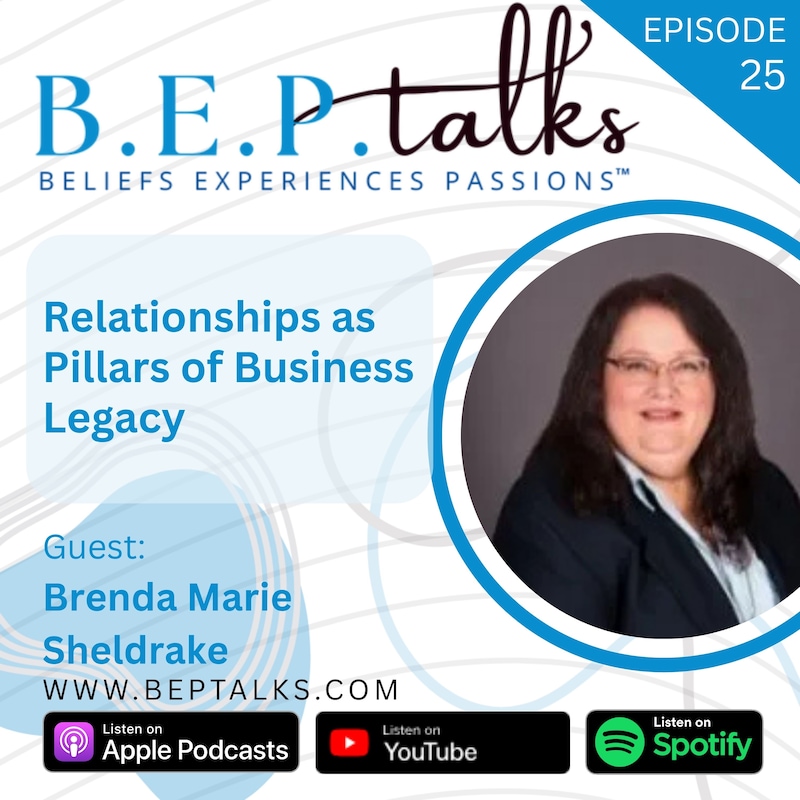
On this episode of BEP Talks, I sat down with Brenda Marie Sheldrake to uncover the real connection between lead generation and legacy. It’s not just about collecting contacts—it’s about building authentic relationships with people who share your values, and creating a reputation that stands the test of time. We explored how your everyday actions and kindness can shape the legacy you leave, both in business and in life. Want to build a business and life people remember for the right reasons? Start with genuine connections.
How are you building your legacy, both in business and in life? Let’s continue building meaningful legacies and supporting each other in business and beyond.
Join the Building Better Business Relationships community on Facebook (free level: “No Entrepreneur Left Behind”) https://www.facebook.com/groups/buildingbetterbusinessrelationships
Connect with Brenda on LinkedIn — she welcomes your messages!
https://www.linkedin.com/in/brenda-marie-sheldrake-lead-generation/
---------------------------------
B.E.P. Talks makes it possible to connect with those who most resonate with your own personal or professional life – or both. Follow-up in the moment or come back to them when you need them most, attend their events, read their books, participate in their courses.
Visit often! Meet experts from the cross section of the world. Let them motivate, inspire and educate you.
🎤Interested in telling YOUR story?
Visit https://www.beptalks.com/ for all the info you need.
Schedule an interview. Expand your reach and influence. Begin to change the lives of others by changing your own.
You’ll love the experience and your audience will appreciate you.
🔎Explore the MeetN Platform: https://meetn.com/features?x=94034
▶️Subscribe to our Channel: / @beptalks
Follow Us on Social:
Facebook: / thegsew
LinkedIn: / johnstonbeth
Transcripts
Well, hey there, and welcome to this edition of BEV Talks, where
Speaker:wonderful, generous people come to share their stories, to share their
Speaker:beliefs, their experiences and their passions. So
Speaker:to inspire you, motivate
Speaker:you, educate you. Pardon me. And sometimes just
Speaker:to entertain you. No exception today.
Speaker:My guest today is Brenda Marie Sheldrake.
Speaker:And we have some very important things to talk about. Would you please join me
Speaker:on the BEP Talk stage? There she is.
Speaker:I am so sorry.
Speaker:Nothing like live tv. Nothing like live tv. But
Speaker:you know what? That's part of what BEP Talks is. It's just authentic. It's just
Speaker:two gals sitting down here chatting. So welcome, Brenda. Thank you so
Speaker:much for joining me here on the BEP Talks stage.
Speaker:Thank you, Beth. I'm happy to be here. My absolute pleasure.
Speaker:When I heard that it was going to be my pleasure to meet you
Speaker:because this is the first time we're meeting and to share a BEP Talk
Speaker:conversation slash interview with you, I was very curious
Speaker:because I came to realize that
Speaker:lead generation was attached to you. And when I think of lead
Speaker:generation, I think of a very important component. Component of the overall sales
Speaker:system and the marketing. Very, very important.
Speaker:A key part of building a business. And then I heard
Speaker:about you as building legacy through
Speaker:relationships. Would you please tell
Speaker:me and our audience how those two things jive?
Speaker:Well, it's actually, it's. It's really very
Speaker:simple if you understand the way that I generate
Speaker:leads, because, number one, I don't do a done
Speaker:for you service. I don't have a done for you service. I
Speaker:teach entrepreneurs to generate their own leads. And what I'm
Speaker:teaching them how to do is I'm teaching them how to get referrals and
Speaker:introductions to their qualified candidates to people
Speaker:that they want to meet so that they never have to
Speaker:cold call again. So really, it's about building the
Speaker:relationships you want that'll take your business to the next level, which is
Speaker:also what legacy is. I love that. Now you
Speaker:said that. It's like, hello, it makes so much sense. So it's
Speaker:combining two sides, if you will. Same
Speaker:coin. Two sides, but one coin.
Speaker:You have stressed to me for two seconds before
Speaker:we went live here that you do it through building
Speaker:relationships. So important, so important.
Speaker:How do you use the power
Speaker:of building strengthening relationships
Speaker:to grow both your business and to create
Speaker:a legacy which can be made through your business,
Speaker:but also through your personal life. How do they intersect?
Speaker:Well, I did a talk recently on a summit on legacy,
Speaker:and I asked a question, and I think the question that I Asked will kind
Speaker:of answer this question, because the question I
Speaker:asked was, if someone says your
Speaker:name in a room and you're not there,
Speaker:what will other people say?
Speaker:That is your legacy. And if you are an entrepreneur,
Speaker:you want to be confident that people are going to be recommending and saying
Speaker:positive things about you. If they're not recommending your business,
Speaker:at the very least, they're saying that you're un honest, dependable,
Speaker:punctual, that you deliver
Speaker:quality, those kind of things. That's legacy. But
Speaker:it's also what you need in order to succeed in business.
Speaker:Absolutely. You know, I've heard the word legacy a lot
Speaker:lately, and it seems that we're having
Speaker:maybe a little bit of a change in what it means. And you've just kind
Speaker:of expressed that legacy is not about, you know, that someone did a
Speaker:documentary 100 years after you died or that you're
Speaker:written in history books and that you're part of this main, main
Speaker:role that you played historically for the world.
Speaker:We all have a legacy. We all have the
Speaker:right to somewhat control it,
Speaker:to build it, to determine what we want our legacy to
Speaker:be. Is that what I'm hearing? Absolutely, I
Speaker:believe so. When I was first invited to be part of the Legacy
Speaker:summit, I couldn't figure out, kind of
Speaker:like you were saying, I'm like, I'm a lead generation
Speaker:strategist, why did they want me on a legacy summit? And then I
Speaker:went even further and, and, and I'm going to tell a secret here.
Speaker:I looked at it and I was like, I'm not rich.
Speaker:I don't have a legacy to leave. I'm not leaving
Speaker:a legacy behind. I'm going to be one of those people who
Speaker:just flip flew through life. But I don't
Speaker:have a legacy. And so I was, I was thinking about it, I was thinking
Speaker:about it, I was like, okay, so, so what is, what is
Speaker:legacy? And what I landed on
Speaker:was I started thinking about my dad.
Speaker:And my dad passed away about three years ago.
Speaker:But I, I, in the summit that I talked on, I shared the story of
Speaker:my dad. My dad was an electrician, a general
Speaker:contractor in a small company in a small
Speaker:town. Never had a great big
Speaker:pension, never had a great big, there were, there was nothing
Speaker:huge about him. He was small, he was five feet tall and
Speaker:he, he didn't work for one of the big companies
Speaker:that did any of the big name things.
Speaker:But when I finished the summit talk, one of the things
Speaker:that I said was, if you go to Smithville,
Speaker:Ontario right now, which probably many of your listeners don't even know
Speaker:where that is. And if you do, hello, friends. I miss you.
Speaker:If you go to Smithville and you ask
Speaker:where's the house that Bob Sheldrake built?
Speaker:He's been gone for three years. People are going to be able to point you
Speaker:to that house. He left a legacy.
Speaker:His name is his legacy.
Speaker:And I think that's all you can be left with sometimes.
Speaker:Yes. And legacies can be negative as well.
Speaker:I mean, it's the reputation you leave behind. Is that kind of the
Speaker:easiest way to define legacy? Absolutely.
Speaker:Reputation you leave behind. So you are part of his legacy,
Speaker:though. I am. You are. You absolutely are. You
Speaker:mentioned your dad. My dad has gone many, many years, more than
Speaker:three. But I cannot go any, anywhere back
Speaker:to my hometown that people around
Speaker:my age, a half a generation
Speaker:older and a full generation younger
Speaker:will not walk up to me and talk about my dad.
Speaker:Exactly. Everywhere he ran the sports program,
Speaker:he got kids into colleges, college
Speaker:scholarships. He got kids out of jail, and he kept kids out
Speaker:of jail. He got athletes to the NBA.
Speaker:He contributed to the lives of so many
Speaker:people in addition to his own six children.
Speaker:And that brings such joy to my heart. And he is
Speaker:mentioned in books, by the way. He is mentioned in books. So it
Speaker:doesn't have to be as grand as that. We all
Speaker:will leave a legacy, whether we think we are or we aren't.
Speaker:We will. We will. So
Speaker:let's go back to lead generation and
Speaker:legacy. From a business
Speaker:person's perspective,
Speaker:how do we create those relationships
Speaker:through business
Speaker:that will create legacy that, that keep our reputation
Speaker:alive? How do we, how do we seek to do that?
Speaker:Well, I think. I think the first thing you have to do is you
Speaker:have to focus on
Speaker:building relationships with the kinds of
Speaker:people that share your mission,
Speaker:values, vision. There it is. They don't have to be in
Speaker:the same business as you, but if they don't share your mission, values and
Speaker:vision, then you're probably going to be banging up against each other
Speaker:quite often. Right. But if you parallel, if you're
Speaker:congruent, then when they mention the
Speaker:other person's name, they're going to mention yours alongside it.
Speaker:Right, right, right. So
Speaker:saying you don't get to choose your family, but you can choose your friends, you
Speaker:can also choose your business partners, those with whom you
Speaker:want to have a business relationship. I'm going to go
Speaker:back to my dad for a second because he always taught us as we were
Speaker:growing up, you know, choose your friends wisely because you are only as
Speaker:good as the company you keep. And we
Speaker:all, we all know that, you know, always make good decisions. So when
Speaker:you're choosing business partners,
Speaker:people with whom you want to do business leads, people that you want to have
Speaker:as customers, as clients, you get to choose them, don't
Speaker:you? You get to say, I do want to do business with you for you,
Speaker:but I don't have to. I get to choose.
Speaker:And I think, I think that's really important distinction
Speaker:because sometimes we let our bank
Speaker:account do the choosing for us.
Speaker:And I'm not saying that, that you
Speaker:ignore your bank account when you're picking clients or that
Speaker:if somebody comes along who's got a big deal for you that you're going to
Speaker:turn them down. But honestly, if
Speaker:I'm being very truthful and genuine with you, if someone
Speaker:came along and they had a million dollars
Speaker:and they said to me, I want you to do xyz,
Speaker:and I didn't agree with whatever XYZ was
Speaker:or the business that they were in,
Speaker:I didn't feel good about attaching my name to it.
Speaker:I'd turn down the million dollars because it's not worth
Speaker:the million dollars. You can,
Speaker:as. As crazy as this sounds, you can make more money,
Speaker:but you're going to have to work awfully hard to repair your name if
Speaker:it gets damaged. If you ever could. Yes,
Speaker:yes. Once you. What would be the right word?
Speaker:Once you lose that trust, ability,
Speaker:that accountability that people don't want
Speaker:to. I don't know that you can gain it back. It's like in any
Speaker:relationship, you might be able to
Speaker:gain it back somewhat superficially, but I think deep down
Speaker:it's still rooted. You don't forget. You don't forget. I agree with you.
Speaker:The shadow is always there. Who is it? Who is that woman?
Speaker:She was a really big name on
Speaker:television and everything, but then she got arrested for.
Speaker:She was. It was associated or accused of, like, embezzling.
Speaker:Actually, I think there were several of those people.
Speaker:But. But it. So it happened. And
Speaker:then people said, oh, no. Well, she got out of
Speaker:jail. She got released from jail.
Speaker:She got good lawyers. The good lawyers defended her and she got out of jail.
Speaker:But that doesn't mean it goes away. Like, if I,
Speaker:if I said her name, you would go, oh, yes.
Speaker:And. And I think we can. You don't have to just think on a
Speaker:movie star level of that. I think there are people.
Speaker:There are people in our community, there are people in our neighborhood. There
Speaker:are people in our world who will come across
Speaker:us. We'll cross our path, but we're just as happy that they keep
Speaker:walking. They're not somebody that we want to.
Speaker:To hook up with or to hook ourselves to
Speaker:be associated with. Right, right. You know, that
Speaker:is so true. You've just said a couple of. I got to tell you, there
Speaker:are several people that I'm thinking, oh, it could be that one or it could
Speaker:be this one. I don't want to mention any names because I don't want to
Speaker:disparage anybody, but. But we've all heard those stories
Speaker:and there are many of them. There are many of them. And I do believe
Speaker:in redemption. I do believe in contrition. But
Speaker:you can't change the past. You can
Speaker:change, but you'll remember the past.
Speaker:You can choose a new path, but the past will always be
Speaker:there. The rear view mirror will always be there.
Speaker:So how do you work with people from the lead generation
Speaker:perspective, which business owners
Speaker:always need to find new clients, always need to know
Speaker:where to try to find and build those new
Speaker:relationships, to grow a business, to scale a business.
Speaker:What role can you play for those people?
Speaker:So I have a newer slogan that I'm using
Speaker:these days that I use with people slogan is
Speaker:this. Entrepreneurs say all the time that they believe that
Speaker:they have a lead generation problem, that they need more leads.
Speaker:But when you really take a close look,
Speaker:if you open up your telephone book, if you open up your
Speaker:Rolodex, if you open up your cell phone, if you
Speaker:look at your contact list in your CRM, you
Speaker:have lots of leads. What you really
Speaker:need is to work on your relationship
Speaker:building system. Because when you
Speaker:get those people to know you and
Speaker:know what you do, know what's important to you, know what you stand
Speaker:for. So that when they're talking to somebody else,
Speaker:they say, oh, you've got to talk to Beth,
Speaker:because Beth can help you in this way. Right,
Speaker:right. And that goes back to your legacy. So now I'm
Speaker:seeing the bridge between the two. And you know one of my
Speaker:favorite sayings, Maya Angelou, people don't care how much you know until they know how
Speaker:much you care. That's very much part of
Speaker:the, I'll call it the art, but a skill
Speaker:set of building a relationship but doing it authentically
Speaker:because otherwise, you know, eventually you'll put a pin in that balloon
Speaker:and it'll just go away. So we have different
Speaker:relationships through life. There's another saying, you have friends even
Speaker:for a reason, a season or for a lifetime.
Speaker:That's not to say that we abused a relationship or misused
Speaker:a relationship. We Served its purpose,
Speaker:we met its goal, and then we moved on. Is that. Is
Speaker:that fair to say? I think that's very fair to say.
Speaker:I don't think that when we pick out people, we say, okay, I'm going to
Speaker:be your friend for a month, or, I'm going to be a friend for a
Speaker:year. No, no. There was. There was a
Speaker:lady. Many years ago, I met
Speaker:a woman, and I always hope when I do
Speaker:podcasts and when I talk about her, I hope that somewhere out there, she's out
Speaker:there. And I'm not saying her name, but there was this
Speaker:lady, and I met her at a very
Speaker:sensitive time in my life. My mom had just passed away. I was
Speaker:missing her terribly, was so, so heartbroken.
Speaker:And this woman came along, and she went with me to
Speaker:some events that I wanted to go to. I was going to. I
Speaker:was looking for something to believe in, something to carry me a message.
Speaker:And I. What I hooked myself to was those people who
Speaker:channel messages from people who have passed.
Speaker:And I went to an event where there was a woman who said that
Speaker:she, with the help of her spirit guide, carried messages
Speaker:from people who had passed. And I went check it out and
Speaker:see what it was like. And we went together. And
Speaker:this. This lady, she went with me because I was afraid to go alone.
Speaker:And I didn't get a message that night. But
Speaker:what I did get was I. I started to build this really
Speaker:strong cemented relationship with this lady. That
Speaker:relationship lasted for about a year, and
Speaker:then we just kind of grew apart for a lot of different reasons.
Speaker:And today, I don't know where she is, but I hope that if she
Speaker:hears this podcast, that she knows how much of a difference
Speaker:she made in my life at that time. Oh,
Speaker:so receive that message, whoever you are out there. And you know what? There might
Speaker:be many people who that message can serve, maybe not
Speaker:necessarily through their relationship with you,
Speaker:Brenda, but in a relationship with another person,
Speaker:that we cross paths for a reason, even if
Speaker:it's just in passing. You
Speaker:know what I say to people.
Speaker:People have said, observed about me, Beth, people are always
Speaker:smiling at you. And I'm like, oh.
Speaker:I became aware of that. I became aware of it
Speaker:that when people are smiling at me, I am
Speaker:thinking of my mother, who kind of had a Mona Lisa
Speaker:expression. It was always pleasant. It was never
Speaker:intrusive. It was never, like, out there. But
Speaker:I realized I'm kind of feeling her spirit and must be wearing that
Speaker:expression and sharing it with somebody else.
Speaker:And I'm thinking, could there be an easier way to have
Speaker:a momentary relationship in the life of. Of another person.
Speaker:And was with one of my brothers,
Speaker:and we were in a big store, and he said to me, do you talk
Speaker:to everybody? And I said, you know what? If our eyes connect, I
Speaker:try to, because, I don't know, the last time, maybe someone
Speaker:was kind to that person. And in that moment,
Speaker:I have a gift to give. They
Speaker:can receive it or not, but it
Speaker:takes nothing to do that. It costs you nothing, and
Speaker:you get so much back. So maybe part
Speaker:of our legacy can be anonymous.
Speaker:You were just that woman, just that guy,
Speaker:just that child at some place or time
Speaker:that made another person feel better about
Speaker:themselves, their life in that moment.
Speaker:Am I oversimplifying this? No, you're not.
Speaker:In fact, there's a. There's a.
Speaker:I belong to a group for quite a while called the Happy Neighborhood
Speaker:Project. And the person who started
Speaker:the Happy Neighborhood Project, his
Speaker:idea, his mission, it started when the
Speaker:economy. When the market crashed the first time. And
Speaker:his mission was to. To. To bring some happiness. To.
Speaker:To bring back some happiness to. To people in general. And
Speaker:he used to stop people on the street and he would say to them, what
Speaker:does. Can I ask you a question? What does happiness mean to you?
Speaker:And he stopped a young man one day and he said to him, can I
Speaker:ask you a question? What does happiness mean to you? And the young
Speaker:man said, I'm in an awful hurry. I have to go.
Speaker:And. And he said, but could you just take 2 seconds and answer
Speaker:that question? And the young man said, no, I have to go. And he asked
Speaker:one more time, and he still didn't get an answer. And I'm going to shorten
Speaker:the story because I know we're running short on time. The
Speaker:young man saw that man who had asked him the question
Speaker:days later, and he said, I
Speaker:want to thank you. I was in an awful hurry to
Speaker:go and jump off a bridge.
Speaker:I was on the way to kill myself when
Speaker:you stopped me. And your question
Speaker:changed my thoughts enough
Speaker:that I didn't do it. Now, if he had
Speaker:never seen that young man again, he would never have known that he made that
Speaker:big a difference in someone's life. So you never know
Speaker:when you say, have a nice day, or how are you today? And
Speaker:you listen to their answer. You never know how much of a
Speaker:difference you made for someone or didn't make or didn't
Speaker:make. And if somebody snaps at, you,
Speaker:remember something, somebody,
Speaker:maybe somebody just stomped on their toe just before you came along.
Speaker:You know, you never know what just their last
Speaker:Conversation. This conversation.
Speaker:I'm loving it. We need to talk again. It's gone in a
Speaker:direction that I wasn't really thinking it might, but things
Speaker:happen for reasons. And I just want to say to the audience,
Speaker:we've shared two sides here. Brenda Marie Sheldrake
Speaker:brings so much to the table through her own experiences and through
Speaker:business and through personal experience.
Speaker:And take the time, share a smile,
Speaker:create a legacy. People may
Speaker:never know your name, why you crossed
Speaker:paths, but you did and you
Speaker:had an opportunity to be of value and service to
Speaker:them. Don't pass up the opportunity. Trust me.
Speaker:It's a gift you give that person, but the real gift
Speaker:is the one you give yourself.
Speaker:Brenda Marie, we have to talk again. There's so much more to uncover here. Lots
Speaker:more layers to peel. I thank you so much for being
Speaker:my guest on BEP Talks, for sharing personal
Speaker:experiences. More than just, well, part of your story, bringing
Speaker:your dad into the story, which allowed me to bring my dad. I am so
Speaker:grateful to you for that. And I want people to get in touch with
Speaker:you. Where are they going to get in touch with you? So I
Speaker:have the building Better Business Relationships community on Facebook.
Speaker:There is a free level available to anyone with the
Speaker:tagline no entrepreneur left behind. Or best of
Speaker:all, connect with me on LinkedIn. Brendan Marie Sheldrake. I'm
Speaker:always take everybody's message and I'm always
Speaker:happy to book a call with you. Look for my message on LinkedIn. My
Speaker:friend, thank you. You have a blessed day. And to all
Speaker:of our listeners and viewers, thank you. You need to be in touch
Speaker:with a wonderful person like Brenda Marie Sheldrake
Speaker:and don't pass up the opportunity
Speaker:to be the light in the life of somebody else. That
Speaker:is your legacy. And it couldn't be more beautiful than that. As we
Speaker:always say. As we always say, may the best
Speaker:always be yet to come. I believe it can be. And until we
Speaker:talk again,