Shownotes
We often assume that bad architectural decisions come from bad architects. But what if there are no architects at all—just a team of software developers trying to do their best, with no one in the room who knows how to facilitate a decision of that magnitude?
That's the situation Gien Verschatse found herself in early in her career. The team had just been pulled off a Phoenix project—a fresh-start initiative killed after six months—and reassigned to maintain a legacy system built on technologies that were outdated even then. Eager to modernise, Gien organised an EventStorming session to map the technical debt from an emotional angle: what frustrates you most? What makes your job difficult? The session was, in her words, an absolute disaster—she couldn't get people to step away from how the system currently worked. Meanwhile, a developer with a dominant personality pushed hard for an event sourcing implementation. It was cutting-edge technology, exciting, new. And that was enough. "The person who was the loudest in the meeting got their way. There was no plan. There was no sitting down and thinking this through. It was just 'this is the latest and greatest and we're going to do that.'"
The event sourcing system got built entirely alongside the existing codebase. The emotional wall of technical debt stayed untouched. QA didn't know how to test the new system. IT didn't know how to deploy it. People started leaving. Gien eventually left too—after a massive burnout, feeling like she'd failed. It took fifteen years and a career as a consultant to see it clearly: the problem wasn't the technology. It was that nobody in that room knew how to make architectural decisions together, and nobody was there to facilitate the ones that needed to be made.
This conversation explores what happens when dominant personalities fill the vacuum left by absent facilitation, why value-based heuristics are a more effective lever than emotional appeals, and what Gien—now co-author of a book on decision-making—would do differently today.
Key Discussion Points
- [00:01] The Phoenix That Died: Gien's team is pulled off a promising fresh-start project and reassigned to a legacy system with outdated technology
- [03:00] The EventStorming That Failed: An attempt to map technical debt emotionally collapses—the team can't imagine beyond how the system currently works
- [04:00] The Loudest Voice Wins: A dominant developer pushes event sourcing through with no plan, no consequence-mapping, and no one with the skills to push back
- [05:00] The Architecture That Solved Nothing: The new system is built alongside the old one; QA can't test it, IT can't deploy it, the technical debt remains untouched
- [06:00] The Exodus and the Burnout: People leave one by one; Gien leaves after burnout, carrying a sense of personal failure that took years to reframe
- [09:00] Quit Sooner: Gien's hard-won advice—it's okay to leave bad environments, and finding one is not a personal failure
- [20:00] Digging Into the Preference: How Gien now uncovers the value-based heuristics driving strong positions—fear of skill obsolescence, career anxiety—without triggering defensive reactions
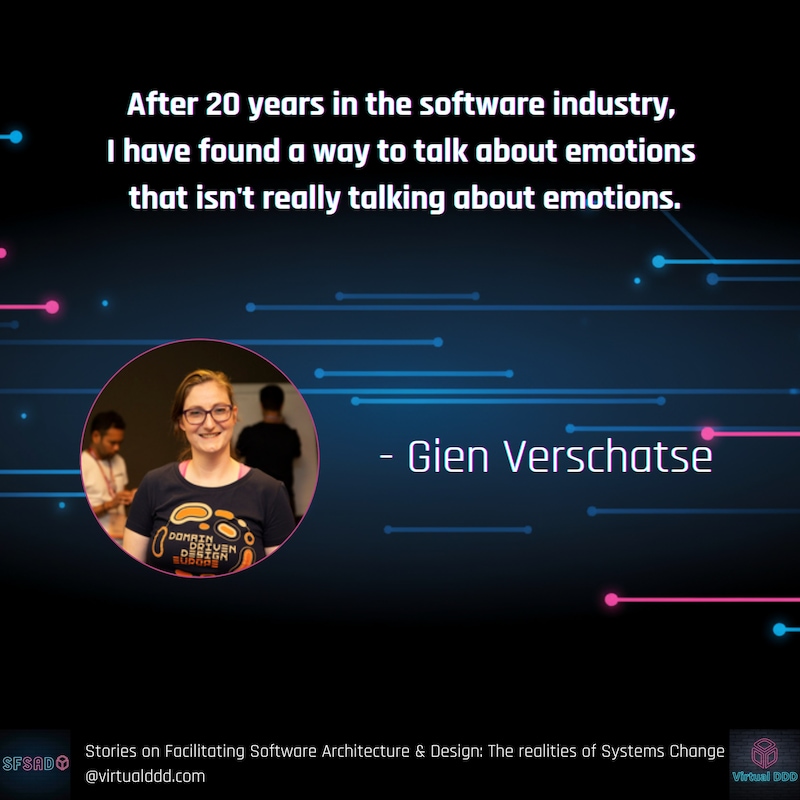
- [22:00] Talking About Emotions Without Talking About Emotions: After 20 years in a male-dominated industry, Gien's approach to surfacing emotional drivers through values-based framing
Guest: Gien Verschatse, Evelyn van Kelle Hosts: Kenny Schwegler, Andrea Magnorsky
Transcripts
Hello everyone and welcome back to another,
2
:episode story of facilitating
Software Architecture and design.
3
:With me today is, hin za,
and, she'll tell us a story.
4
:And with me are my
co-conspirator Andrea Mag Norski.
5
:And we have Evelyn Van here as well still.
6
:Hello.
7
:Gien Verschatse (she/her): Hello.
8
:Kenny Schwegler: very curious,
what story, you have to share.
9
:Gien Verschatse (she/her): Okay.
10
:Um, so my story is about something
that happened very early, in my career.
11
:I think I have been working for, Two,
three years at that point in time.
12
:so I got a job and I, started
out on a Phoenix sort of project,
13
:like, we're going to do it better
and we're going to start over.
14
:And so I was part of that
team for like six months.
15
:but then the company decided to kill it.
16
:they said that it's taking too long.
17
:It's not going to be
sellable as a project.
18
:So we're going to kill it and you're
going to work on the old product.
19
:But the old product, had not been,
you know, modernized, very well.
20
:It had very old, technologies.
21
:It still had fbe, uh, things like that.
22
:And even back then, that was
already pretty, outdated.
23
:And so it wasn't an
emotionally sort of fun.
24
:Change, at that point as well.
25
:but at the same, you know, time, you
know, you have to make the best of
26
:it, eh, because well, you know, you
have to row, with what you were given.
27
:and so we had a, a team
lead and we had a manager.
28
:the manager used to work, in the
team and sort of got promoted
29
:from senior developer, to manager.
30
:team lead had also worked
there for a long time.
31
:we had a very outdated, project,
and we had no architects.
32
:Just to make this clear, everyone
was a software developer and most
33
:of what we knew was from developing
software and it was almost a monolith.
34
:We had a few services, but.
35
:Not that much.
36
:but we were very much domain-driven,
design, sort of, enthusiastic about it.
37
:so I thought I'm gonna organize
an event storming, session to
38
:sort of see, where we're at.
39
:to together with sort of mapping all the
technical debt that was actually there.
40
:I did that from an emotional point of view
is so going to the team and asking, okay,
41
:what is the most frustrating, what is the
most bothersome, that we have, right now?
42
:Um, uh, what annoys you?
43
:What makes it difficult to do your job?
44
:Things like, well, I dunno, any VB
and I have to actually program in it.
45
:So that's quite difficult.
46
:the event serving was
an absolute disaster.
47
:Um, it was my first, I think I also
mentioned that one in the book, um,
48
:at some point, um, because I could
not get people away from how it was,
49
:so I wanted to see how we could do it
better, but I couldn't get people to
50
:step away from how it worked right now.
51
:Okay.
52
:so that did not go well.
53
:Um, and the, the wall of, of, you
know, emotional, technical death in
54
:a sense, if I could call it that.
55
:Um, we also wanted to tackle that,
but there it was one person who
56
:also had a very sort of dominant,
character and or team lead.
57
:It was the exact opposite.
58
:Um, and our manager also.
59
:Was a bit more dominant.
60
:Also, did not really have the necessary
skillset are required in management
61
:because you see that often when software
developers get promoted to management
62
:positions, because they're very
good at their job, which is software
63
:development, but it takes a whole
different kind of skillset, which they
64
:don't have, and which people also don't
think you need to learn e because.
65
:Well, you're supposed to be able
to do all of that communicating
66
:and all that kind of stuff.
67
:You're just supposed
to be able to do that.
68
:So the meetings were always very tense.
69
:already when we were
trying to, to modernize.
70
:and this one person who was very
dominant, sort of, got their way.
71
:So we were going to, implement
an event sourcing source system.
72
:Um, but the thing was that, um, it
was implemented completely, next to
73
:everything that was already there.
74
:and so that that emotional wall
that, we have created was not being
75
:tackled at all, because of that.
76
:And no matter what I tried or, or
how we tried to, to change that,
77
:basically we would only get relief
like two, three years later when we
78
:could kill certain parts of the old
system and start using the new system.
79
:Uh, and we also had a QA team.
80
:and you know, the software was kept
on sites due to, very sensitive,
81
:information, inside that domain.
82
:And so, the it who had to deploy, just
got messages and it was so difficult
83
:all the time, and they didn't know how
to actually do that because you had
84
:queues now and, and you had all that
stuff, which you didn't have before.
85
:and, you know, QA also didn't know how
to test it decently and how to do that.
86
:and eventually what you
saw is that, you know.
87
:People got fed up and started leaving,
the company, because, you know,
88
:management was not that great either,
but even within the team, there
89
:was just, there was no end to it.
90
:This is not going to end.
91
:We, we will never see anything better.
92
:The job won't be easier.
93
:and a lot of people, you know, left
because it just wasn't fun anymore to
94
:be a software developer on that team.
95
:I left too, after a gigantic burnout.
96
:and I tried and I felt like I
failed, that I could not work in that
97
:situation and that I swapped jobs.
98
:but you know, now, all those years
later, being less emotional, it was
99
:just, it was pretty toxic to work in.
100
:And the architectural
decision that we made.
101
:was just really bad and it, we
didn't think about it at all.
102
:It just, the person who was the
loudest in the meeting got their way.
103
:and there was no plan.
104
:There was no sitting down
and thinking this through.
105
:It, it was just a, this is the latest
and greatest and we're going to do that
106
:and, you know, screw everybody else.
107
:screw all the other teams
thinking about what actually
108
:will this, this be like for it?
109
:And qa, nobody gave us any thoughts.
110
:Me neither because I was, you know,
very new at the job and I didn't really
111
:know how to think about architectural
architecture and design and how to
112
:make decisions like that because,
you know, there was nobody there
113
:that knew how to do that either.
114
:so that is pretty much, my story.
115
:I don't think the company
still exists at this point.
116
:Um, I, I know at, at some point.
117
:there was like one person still
maintaining the product because it
118
:was still used, by certain customers.
119
:but the company, you know, because
it didn't really get any better, the
120
:company invested in, another similar
product, that they acquired, basically.
121
:Kenny Schwegler: Yeah, so
do you wanna go, Andrea?
122
:Andrea Magnorsky: yeah, just sounds
very like, you know, you're left
123
:and burnout and, it feels like a
very, kind of sad ending thing to,
124
:to a story and what it worse still.
125
:It wasn't just you, it was like
all these other people as well.
126
:So I guess you're sharing this because
you're trying to say, Hey, you, this
127
:doesn't need to be the way, what
are, if you could come back to, you
128
:know, if you could time travel and
deliver like, t-shirt side slogan to
129
:pass him, what would the T-shirt say?
130
:Gien Verschatse (she/her): Leave now.
131
:But depending on how much I go
back in time, obviously, because
132
:now a, you all those years is 15
years later or something like that.
133
:I don't know why I stayed.
134
:Like you try to make
the best of something.
135
:but I didn't have the
skills to go against.
136
:people who had a very dominant
sort of, quality, to them.
137
:And I dunno why I tried so hard
to make this work at the moment.
138
:They killed the Phoenix Project, which
is why I took the job in the first place.
139
:I'm not, I'm not, I
wouldn't say don't try.
140
:it's just that quit sooner.
141
:It's okay to quit.
142
:bad environments, bad situations, and try
to find a job, where you think, you know,
143
:it's more about collaboration instead of
the loudest voice in the room, where you
144
:have a manager, you know, that actually,
listens to the teams and things like that.
145
:It's not, not a bad thing to do.
146
:I felt like a failure then.
147
:Right now.
148
:I should have left soon.
149
:Kenny Schwegler: Is that
a, is that a rat flag?
150
:In a way, a very dominant
authoritarian, nowadays they call
151
:it, CV driven, development, right?
152
:I, It made this whole survey why
people choose technology and it,
153
:it's like, yeah, to pimp my, resume.
154
:Resume is the English word.
155
:I think.
156
:but, but it would that now be a
red flag for you if you're in the
157
:same situation where you're like,
well, I, there's nothing to do here.
158
:And, and my manager once said,
you pull a dead horse to water,
159
:it still stays at that horse.
160
:So, yeah.
161
:Gien Verschatse (she/her):
actually a good one.
162
:it's not, the dominant
character is not a red flag.
163
:Per se, 'cause you know, I have, I, I
have friends, that are quite dominant.
164
:I have, people I've worked with in
the past who also are, quite dominant.
165
:Eh, they take up a lot of space, in
collaborations and conversations.
166
:and it doesn't necessarily
have to be a bad thing.
167
:it's that if everyone, if, if, if
the environment and the the culture.
168
:Allows that to become something
toxic, then you have a problem.
169
:and also because this person did have
quite good technical skills and you
170
:know, it was based on how good or you
technically, whether or not you had
171
:something to add, I would say that
would be the red flag, not the dominant.
172
:Uh, things in the, uh, not things, but
not the dominant people in the room.
173
:But how does the company, how does
the team, how do you deal with it?
174
:'cause you can deal with it in
a healthy way and you can deal
175
:with it in an unhealthy way.
176
:And if you feel like this is unhealthy,
which I very much felt 'cause I
177
:had a burnout in that situation,
then you should, you know, that's
178
:a red flag and you should leave.
179
:Evelyn van Kelle: So if that situation
would occur now, like with all the
180
:experience and, and the years that
you, that you have now, like you
181
:would enter that same situation,
but as the person you are now.
182
:What would you do differently?
183
:With like a leaf early.
184
:Okay, sure.
185
:But like with that, that specific, person.
186
:Well, how would you, how would
you approach that in now?
187
:Gien Verschatse (she/her): I think
first of all, I would, be like, okay,
188
:this is one option that we have there.
189
:There are other things that we can do.
190
:Um, E and i, I would, put their,
proposal next to all the other
191
:things that you can do architectural
wise to improve the legacy system.
192
:I would also dig a hell of a lot deeper
in the consequences because it's only
193
:when you started doing that that you
realized, oh, actually, you know.
194
:What is really bothering people?
195
:What makes the job unpleasant, like is
not being tackled at all, because of this.
196
:and I would, you know, notice that
sooner with the experience that I had.
197
:And it would also bring that up as
something not positive, negative about
198
:going for that implementation and saying,
okay, if we still want to use all these
199
:technologies, what is a different way
that we can actually approach that?
200
:which actually also relieves some of these
frustrations that the developers have.
201
:Or we don't put all our eggs in the
same basket and we tackle some of
202
:these, you know, unpleasantness.
203
:Right along next to it, you don't
have to dedicate a hundred percent, to
204
:just, you know, event source system.
205
:Andrea Magnorsky: there's something
else, I found with people.
206
:I work with a few people that
remind me of this person.
207
:Gien Verschatse (she/her): Mm-hmm.
208
:Kenny Schwegler: I think we all do.
209
:I think we all do.
210
:Andrea Magnorsky: we'll, I think
we all have, and, and sometimes
211
:this, this, this behavior comes
from a lot of insecurity and, and
212
:sometimes cannot talking, about it.
213
:In a more, not like
saying, Hey, like a clip.
214
:It sounds like you're insecure.
215
:Uh, that doesn't work.
216
:But, but if you cannot try to
address the, what, like start
217
:prodding at the underlying course.
218
:Course.
219
:Like, sometimes I felt
like I have good, outcomes.
220
:I'm not saying that that's the, the
only way, but if you're, if you're
221
:in a position where like, okay, I
wanna try something sometimes kind of.
222
:put a coaching hat on and dealing
with the, the, I hear you.
223
:You're worried about us not being able
to, complete this, or I hear that you are
224
:trying to pay your mortgage, e either of
those in a, especially the mortgage one.
225
:Slightly more subtle ways.
226
:Can help, but, it depends a, on the
person, especially when there's no strong
227
:management, I, I feel, I feel that,
yeah, it's a tough situation to be in.
228
:Gien Verschatse (she/her): Yeah.
229
:And I mean now when I go to companies, I'm
a, I'm a consultant most of the time, so
230
:I enter in a different sort of position.
231
:And that also made me realize that, well,
you know, it was between colleagues.
232
:We were all colleagues.
233
:And so as I said, no one knew how
to make architectural decisions.
234
:We did not have that knowledge.
235
:No one really had that, role, but
also nobody was facilitating this.
236
:I was facilitating some of it, but
still I had a lot of skin in the game.
237
:So I had opinions.
238
:And we go back to a facilitators do
need to stay neutral, once in a while.
239
:Well, not once in a while,
but most of the time.
240
:and as a consultant, I sometimes
have to sort of, still give advice.
241
:So I can't stay a hundred percent
neutral, there, but I don't eliminate,
242
:any of the other people's ideas
or, or how it is there either.
243
:So I feel like having someone like that
would've been very beneficial, because I
244
:was just a colleague with other colleagues
who are trying to make the best, of a
245
:not so pleasant legacy system basically.
246
:Kenny Schwegler: I had that experience
before where I was, facilitating.
247
:So Scru master role and an engineer
quite work well because, you
248
:know, I had my opinion and you're
getting into old situations now.
249
:Writing the book with you.
250
:I learned many things,
but I have two questions.
251
:Did this story your healthy obsession?
252
:Decision making.
253
:So that's, that's question number one.
254
:And question number two is, I, I, I
learned and started using a lot of the
255
:ProCon fixed list that you talk about,
and also the theory about decision
256
:making where you talk about, well,
a decision has information as input.
257
:It has, options as input,
but also preference.
258
:And what I hear from your story, and that
would be my question, is that this person.
259
:I assume it's, he had, had preferences.
260
:So how nowadays would
you make that visible?
261
:Right.
262
:Usually, you already mentioned if you
just do, and I've done this before, do
263
:the pro con fix list with the group.
264
:That already helps tremendously, right?
265
:Because then you go factual into the
options and that will already set the
266
:stage, but sometimes there's still
this preference underneath that people
267
:can, that can dominate the group.
268
:So how would you, how would you,
so that's just question number two.
269
:So question number one,
this is trigger your healthy
270
:obsession with decision making.
271
:And question number two, how do
you deal with the preferences
272
:nowadays to make that visible?
273
:Gien Verschatse (she/her):
I wish I could say yes.
274
:but there wasn't one thing
that triggered my, my healthy
275
:obsession with decision making.
276
:It was, it was the worst.
277
:Like that was the worst.
278
:I, I, I did ever have.
279
:Uh, it was burnout and, and, and leaving.
280
:But I kept hitting very similar things.
281
:Yeah.
282
:Like, Andrea immediately said like,
oh, this does not sound unfamiliar.
283
:I think Evelyn also said that
this does not sound unfamiliar.
284
:And the, there has to be a better way
to do all of that is because, at regular
285
:intervals you go into meetings and you
hit these dominant people in the room.
286
:And who yells the loudest, eh, sort of.
287
:Gets their way.
288
:And, you know, that's, that's,
a repetitiveness of, of that
289
:is what, gave me a healthy
obsession, with it, basically.
290
:So that's, answering question
number one, and I already forgot
291
:question number two, Kenny.
292
:Kenny Schwegler: Is, is so,
293
:Gien Verschatse (she/her): Yep.
294
:Kenny Schwegler: yeah, I hear this person
had a preference for event sourcing.
295
:I also have preferences.
296
:Right.
297
:And, especially with someone
who's being dominated.
298
:How would you make that explicit
that, that preference of a decision.
299
:Gien Verschatse (she/her): Yes.
300
:So I, I would dig more into why
this strong reaction towards this.
301
:back in the day, it was, it
was quite a while, while it
302
:was beginning of my career.
303
:So event sourcing was quite new.
304
:back then, and, and like right now I
can understand that e we got kicked
305
:off a Phoenix project, which was
using quite the latest, trends and
306
:technologies into something e so, you
know, which didn't have that much new.
307
:And if, you know, your
skills are very easily, um.
308
:Perhaps lead in, in, uh, this
market as a software developer.
309
:And so I think it also came somewhere
from that, from, from being scared that
310
:if I ever try to find a new job and I have
to work years in this very old system,
311
:I won't be able to find, the new job.
312
:so I would a dig more into
a wider strong reaction.
313
:A go a bit too.
314
:Trying to find the value based heuristic
in behind this very strong preference.
315
:Eh?
316
:like, I find it more important that my
skills stay up to date than actually
317
:tack tackling the emotional, hardships
that the team has is sort of a
318
:value-based, thing that's behind it.
319
:And so I would look more at that
as well to make it explicit.
320
:Because very often people don't always,
I mean, not many people sit down
321
:and think, okay, what are my morals?
322
:What are my ethics?
323
:Which values do I have in life?
324
:Which heuristics do actually,
you know, drive that.
325
:I think all four of us in this room, um,
have done that and we do understand more.
326
:Where these emotional and these
preferences actually start coming from.
327
:Or if we don't understand, we have the
tendency to figure that out for ourselves.
328
:But most people don't have that.
329
:And most people, don't really
analyze their emotions.
330
:they definitely don't understand
the values or, or ethics or
331
:morals that are pushing them.
332
:Um, and so I think that.
333
:Looking a, formulating those value-based
heuristics and making them understand
334
:that, okay, like this is how you see the
world and this is where it is coming from.
335
:And then you are able to say, but do
you understand that this person has
336
:a completely different heuristics
because different values are pushing it?
337
:it makes it easier to have conversations
and you're not talking that big about
338
:emotions, which also doesn't scare people.
339
:'cause you're talking about
value-based heuristics and preferences,
340
:which is basically we're talking
about your emotions, but in a
341
:way that people don't quite get.
342
:You're talking about their emotions.
343
:Um, so yeah, I think that's, uh, yeah.
344
:So after 20 years in the software
industry, which is male dominated, I
345
:have found a way to talk about emotions
that isn't really talking about emotions.
346
:Kenny Schwegler: Cool.
347
:Yeah.
348
:Andrea Magnorsky: now to finish,
349
:Evelyn van Kelle: I think
that's a great ending on.
350
:Kenny Schwegler: No, but I think it, it
shows the importance of, uh, hopefully
351
:we can change that, that, uh, we do.
352
:So thanks.
353
:This, uh, this was another story.
354
:Thanks for sharing your story, Heen.
355
:to the rest of you please, and here's
my, like, subscribe to, to our podcast,
356
:YouTube, or any way give us feedback.
357
:we also have a descrip, descrip,
sorry, a Discord channel where you
358
:can join us, where you can start
talking about, these stories, but
359
:also more on domain driven design
or, software design and architecture.
360
:so I hope to see you there.
361
:give us some feedback thanks again
for, listening, watching, reading
362
:in, and, until next time, bye-bye.
363
:Andrea Magnorsky: Hi.
364
:Thank you.
