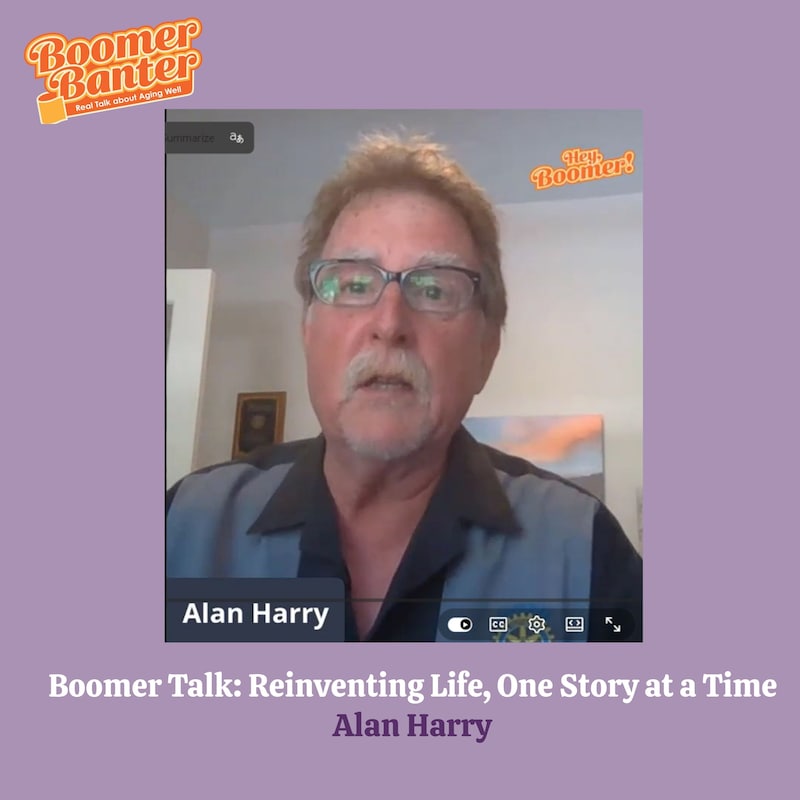
Shownotes
Today, we're diving into the wild ride of reinvention! Alan takes us through his life story, full of twists and turns that remind us all that it's never too late to change gears. From his early days in a small coastal town to navigating the challenges of family, careers, and even some unexpected bumps in the road, his journey is all about finding purpose and connection. We chat about how important it is to have guides along the way—those folks who help us see the way when the path gets a bit foggy. So grab your favorite drink, kick back, and join us as we explore how dreams don’t have deadlines, and life’s all about those meaningful conversations.
This is a story of overcoming setbacks, both early in life, and after 50. Rebounding from a setback is not as difficult when you are in your 20's or 30's. But what happens when you are over 50 and your career is pulled out from under you? How do you rebound and reinvent yourself? Alan Harry will talk to us about how this happened to him and how he has come back.
This podcast uses the following third-party services for analysis:
OP3 - https://op3.dev/privacy
Transcripts
Foreign.
Speaker B:Hello, hey Boomer listeners.
Speaker B:My name is Wendy Green, and this is the fifth episode of hey Boomer.
Speaker B:Every week we get new people joining the hey Boomer Facebook page.
Speaker B:And one of the things that really helps us as we're doing this Facebook Live is to know who's out there.
Speaker B:So if you could take a moment and make a comment in the comment box, just saying hello, that really is useful.
Speaker B:And the other thing is that hey Boomer.
Speaker B:The.
Speaker B:One of the purposes for hey Boomer is to start meaningful conversations.
Speaker B:And a conversation means that we're all engaged.
Speaker B:So as we are going through this conversation today, if you would take a moment and join us, put a comment in the comment box, let us know your thoughts, send words of encouragement.
Speaker B:Those are always helpful.
Speaker B:We love that.
Speaker B:And just be involved in the conversation.
Speaker B:If some people that you wanted to hear what we're talking about are not able to join us today, share this with them and then have that conversation with them and spread this understanding.
Speaker B:Because what we want to do is increase understanding.
Speaker B:We really have more similarities than we have differences.
Speaker B:We all want the love of our family and friends.
Speaker B:We all want to feel the basic needs are met, the housing and the shelter and the food.
Speaker B:We all also want to feel useful.
Speaker B:And we all would like to feel that sense of safety, security, good health.
Speaker B:Some of that has been questioned or threatened by this COVID 19 virus that we're going through right now.
Speaker B:And one of the ways.
Speaker B:In fact, Alan and I were just talking before we came live.
Speaker B:One of the ways that we're bonding with each other is we are actually having more conversations now than we may have had or more meaningful conversations because we're taking the time to reach out and talk to people.
Speaker B:Hi, Matt, Kathy and Doris.
Speaker B:Good to see you out there.
Speaker B:So let me tell you about my friend and my guest today, Alan.
Speaker B:Harry.
Speaker B:Alan and I met when we.
Speaker B:When I was representing the Rotary Club at a home and garden show.
Speaker B:And Alan came by with his lovely wife, and I noticed they had a Rotary logo.
Speaker B:So we spoke a little bit, and now they're members of our club, which is just fabulous.
Speaker B:We love that.
Speaker B:We also have had a lot of similar.
Speaker B:Well, similar and different, which is what this is all about, right?
Speaker B:Similar and different reinventions of our lives.
Speaker B:I certainly did not start out my life being a Facebook broadcaster.
Speaker B:And I am so appreciative.
Speaker B:I just have to tell you, I am so appreciative of the time that Alan has taken to prepare for this story and part of going through this journey of preparation apparently has been very meaningful to him as well.
Speaker B:So I will let him tell you about that.
Speaker B:But let me tell you a little bit about Alan before we get started.
Speaker B:He grew up in a beautiful small coastal town of Aptos, California.
Speaker B:Is that how you say it, Alan?
Speaker A:Aptos.
Speaker B:Aptos.
Speaker B:Thank you.
Speaker B:He's an only child and considers many of his close friends as also part of his family.
Speaker B:Alan attended Aptos High and graduated from Chico State with a BS in sociology and a master's in public administration.
Speaker B:During his summers at home, he worked at several jobs, including shoveling asphalt curbs as a security guard and working for his father's vending business, filling candy bars and sodas into machines and collecting coins.
Speaker B:After leaving college, Alan worked in city government, in management planning, parks and recreation, and general services in Chico and the San Francisco Bay area.
Speaker B:Alan met his wife Kathy in the coastal town of Half Moon Bay.
Speaker B:That's such a romantic place to have met.
Speaker B: And they married in July of: Speaker B:They blended a family and are proud parents of five sons, Jeremiah, Adam, Nicholas, Brendan, and Cameron.
Speaker B: In late: Speaker B:Alan and Kathy lived in Truckee for 21 years, where he managed a cable TV company and worked for the Truckee Electric and Water District, and then worked for the water and sewer district on Lake Tahoe, which is one of my dream places to go.
Speaker B: In: Speaker B: And in: Speaker B:And while running their own real estate business.
Speaker B: Alan's father passed away in: Speaker B:And at this point, they realized they were watching their grandkids grow up on their refrigerator.
Speaker B:And they decided to leave California and move here to South Carolina, where they could be closer to two of their sons and their two precious grandchildren.
Speaker B:Alan is active in the community, and he devotes some of his time to community service, various service organizations, including Rotary International and the Susan G. Komen Foundation.
Speaker B:He and Kathy share a passion for boating.
Speaker B:Enjoy.
Speaker B:Enjoy many of the area's activities with their dogs, Jake and Ara.
Speaker B:Arya.
Speaker A:Arya.
Speaker B:Okay, so, Alan, I'm so glad that you agreed to do this.
Speaker A:Thank you.
Speaker B:How are you doing today?
Speaker A:I'm doing just fine.
Speaker A:It's a beautiful day out here, and, yeah, life couldn't be much better.
Speaker B:Awesome.
Speaker A:Yeah.
Speaker B:Well, where would you like to start with this reinvention story?
Speaker A:Well, as you said, I've spent some time working on this.
Speaker A:It was a very.
Speaker A:Here we go.
Speaker A:I'm an emotional guy.
Speaker A:So this was a very cathartic process of going through and remembering some things that I had forgotten.
Speaker A:But I thought I'd start at the beginning, because as boomers, our beginnings are, in many cases, much the same.
Speaker A:My dad was in the Navy, got out and went to work in a lumber mill, and then started up a vending company.
Speaker A:And my mother was a teacher until I was born.
Speaker A:They got married in Visalia, California, and then soon after moved to Sacramento.
Speaker A:And then after being in Sacramento for approximately eight years, they moved to the coast of California, down in Aptos.
Speaker A:Not a move that my mother wanted to make, nor my grandparents, because my mother.
Speaker A:I'm an only child.
Speaker A:My mother was an only child, too, and her parents, my grandparents, who truly were very important pieces of my life, the very beginning of my life, they moved down as well.
Speaker A:So I guess what I'm going to do is just start from there and continue on.
Speaker A:And, yeah, if you have any questions, just roll them right in.
Speaker A:So, as I said, my dad owned a vending company, and that was in Sacramento, California, with my grandfather.
Speaker A:We moved to Aptos.
Speaker A:Being an only child and my dad working all the time, I was a fairly sheltered kid.
Speaker A:My dad wasn't around to play football or to throw baseballs, so I got into acting and singing and things of that nature through our church.
Speaker A:And that was something that my mom would go along with.
Speaker A:Anything having to do with physical activity, she wasn't too keen on, only because I was her only kid.
Speaker A:And although my folks tried for quite a while to have more children, they couldn't.
Speaker A:So I can understand why my mom was the way she was.
Speaker A:But at the right age of 18, I decided I needed to get the heck out of there.
Speaker A:And so I moved to Chico, California, where I started college.
Speaker A:And as I said, my dad was in the vending business.
Speaker A:And at that time, vending was not computerized and controlled.
Speaker A:And so I went to school on nickels, dimes, and quarters, and it was pretty cool.
Speaker A:I had a very good opportunity to go to school there.
Speaker A:However, my first year, I completely flunked out, because what happens when you live a sheltered life at home?
Speaker A:You get away and you sort of blow it that first year.
Speaker A:So one of my first, one of my.
Speaker A:I wouldn't say best memories, but one of my first memories about having to reinvent myself was sitting at a dining room table with my mom and dad while they were determining whether or not I was going to be able to go back to college in Chico or go to the junior college in town.
Speaker A:And my grandparents, as always, had a key to the front door, so they let themselves in without knocking.
Speaker A:And they walked in as my mother was ripping me apart.
Speaker A:And my grandmother walked over and stood behind her and said, now, Gina, did you explain to Alan that you flunked out at Cal Berkeley as well and that we gave you the opportunity to continue your education?
Speaker A:And so, again, there we go.
Speaker A:My grandparents stepping into my life and really being very important.
Speaker A:So I was able to go back to school.
Speaker A:And at that time, during my sophomore year, I met my first guide.
Speaker A:Now, there's going to be a couple things that'll wind through this and thread through.
Speaker A:One is reinventing, and the other is having guides in your life.
Speaker A:So I met my first guide.
Speaker A:His name was Rick.
Speaker B:Rick.
Speaker B:You met Rick while you were in school, and you were kind of like, on probation.
Speaker B:You had to make this work.
Speaker B:Right.
Speaker A:He worked for the counseling office, and he was.
Speaker A:I was assigned to him to basically get me through my second year.
Speaker A:And so Rick really helped me gain some focus, learn some life skills, get away from those that were causing, you know, bad influences and being able to move forward.
Speaker A:And so, with Rick's help and guidance, the first rendition of Allen actually began.
Speaker A:And that was getting involved with nonprofits.
Speaker A:I worked with an organization called Cave Community Action, Volunteers in Education.
Speaker A:And I was an intern and then administrative assistant with them underneath the two directors, one of which was Rick, and did that for a couple of years, started a grant program called the Grant Research center to assist people in learning how to gain funds for nonprofits.
Speaker A:And it was great.
Speaker A:And then Rick decided to move on to other things, and there was a job opening, and I applied for it, and the other co director didn't want me to be around.
Speaker A:The folks that were interviewing me said, you're great, but we have one problem.
Speaker A:Doug doesn't want you there.
Speaker A:So here we go.
Speaker A:Alan gets to reinvent himself again.
Speaker A:So I jumped.
Speaker B:So had you graduated from college at that point?
Speaker A:I was still going to school.
Speaker B:You were still in school.
Speaker A:I know.
Speaker A:Excuse me.
Speaker A:I had gotten my social.
Speaker A:My sociology degree.
Speaker A:Okay, but a degree in sociology and a quarter at that time could get you a cup of coffee.
Speaker A:Want to get a master's in something?
Speaker A:And so I thought, well, you know, I love working with elderly folks.
Speaker A:I cherish them deeply.
Speaker A:So I got into recreational therapy and started my master's in that.
Speaker A:Got an internship with the veterans home in Yountville, California, which is in the Napa Valley, a beautiful place.
Speaker A:The rec therapist that I was working under at that time decided that she didn't want to be in the business anymore.
Speaker A:So she left.
Speaker A:And I was asked to, without a degree, to jump in as a rec therapist.
Speaker A:And I did, and it was great.
Speaker A:And I had a wing of about 25 guys, veterans, that weren't very healthy, and worked with them, keeping them happy and keeping them motivated and keeping them away from alcohol, which was always the biggest problem that we had.
Speaker A:And it was wonderful until they all started passing away.
Speaker A:And I took it very seriously, took it a little bit too seriously.
Speaker A:And so with that, I jumped out of rec therapy and jumped into public administration.
Speaker A:My third change at that point.
Speaker B:And as you were going through this, Alan, if I remember from your story, Rick was kind of advising you still about these different changes, is that right?
Speaker A:Yes.
Speaker A:So Rick and is.
Speaker A:And at that.
Speaker A:Then, at that time, his wife, Jackie Ferris Reese, really became big parts in my life.
Speaker A:I got married for the first time.
Speaker A:The woman that I married was one of the teachers in my rec.
Speaker A:My master's program.
Speaker A:We got married, had our first child, and that's when I basically jumped out of rec therapy and moved into public administration.
Speaker A:And then did pretty good with that.
Speaker A:I enjoyed that.
Speaker A:Numbers, stats, people, assisting folks was all great.
Speaker A:Had an opportunity to work in Chico, Glenn county and then the city of San Rafael.
Speaker A:And I did that for a number of years.
Speaker A:We had two children, Brendan first and then Cameron.
Speaker A:And then I started finding myself running.
Speaker A:And running is a great thing if you take it in moderation.
Speaker A:But I found myself running 96 miles a week.
Speaker A:And in order to run 96 miles a week, you tend to be on the road all the time, either driving to or from a run.
Speaker A:Found another guide in my life, a guy that I went to high school with in elementary school with Digby Horner.
Speaker A:And I ran with him for quite a long time, 96 miles a week.
Speaker A:And then we did three marathons in three months.
Speaker A:And again, that's going way over the top, would not recommend that for anybody.
Speaker A:And after the third marathon, I was having problems walking, so I went and saw my doctor, and he said, you know, you basically screwed up your feet, so you're not going to be running anymore.
Speaker A:So at that, with that, I didn't have an outlet any longer.
Speaker A:And soon thereafter I ended up getting a divorce.
Speaker A:Because what I had found that I was doing in all that running was running away from various things.
Speaker A:So I finally kept.
Speaker A:Finally got myself together, was still in Half Moon Bay, working for the city, was having a great time, was able to take care of my kids on a part time basis.
Speaker A:And then one day this woman walks into my office while I was the acting planning director and sat down and wanted to talk about groundwater wells and the development of some property.
Speaker A:And wouldn't you know it?
Speaker A:That is Kathy.
Speaker A:That was Kathy.
Speaker B:And weren't you lucky?
Speaker A:Oh, you have no idea.
Speaker A:That was, that was one of the big.
Speaker A:I can say that that was one of the most important moments in my life because it changed my life.
Speaker A:Didn't run much anymore, started biking a little bit more than running and we were there.
Speaker A:We got married in 91, blended a family with five great boys who are all fabulous citizens.
Speaker A:They weren't always, but they they are now.
Speaker A:And then we decided, after some serious talks between myself and my boss about the budget within the city of Half Moon Bay, we decided that we were going to get out of the Bay Area, raise our kids someplace special.
Speaker A:And that's when we had the opportunity to move up to Truckee, California.
Speaker A:And that was the fourth rendition of Allen.
Speaker A:Because now there were no city government jobs available at that time.
Speaker A:So I took over a cable television company and managed that for eight years.
Speaker A:It was a great time.
Speaker A:I had an opportunity to lobby for small cable companies in Washington D.C. so now I've gone from nonprofit to the public sector to now the private sector with cable television.
Speaker A:And it was a good time.
Speaker A:We enjoyed ourselves quite a bit.
Speaker A:Really got back to what I back to my roots, as it were.
Speaker A:Found myself singing and dancing and acting and getting involved with the community through the Rotary Club there and just having a fabulous time.
Speaker A:I have a number of stories that I could share, but I don't have time to dig into those.
Speaker A:But it was a good time and that reinvention was a very good one for us.
Speaker A:And it was at that point that I started getting a little bit big for my britches because things were going along pretty good.
Speaker A:And I had the opportunity to meet my second guide.
Speaker A:Now let me interject.
Speaker A:Kathy has been a guide all the way along, but Kathy's my best friend and I look at her as my soul mate.
Speaker A:So when I talk about guides, I'm not talking about my family.
Speaker A:So I met a woman by the name of Ruth Frischman.
Speaker A:Who was an attorney, small little gal with a very bright mind and a very strong ethic.
Speaker A:And she sat me down and taught me to one, shut up and listen more than I talk.
Speaker A:And I still think about that whenever I.
Speaker A:Whenever I.
Speaker A:Whenever I get a little bit too big for my britches, I think about her quite a bit.
Speaker A:But things were going along just great, and the cable company was doing well, and it was doing so well that the family that owned it decided that they were going to sell it.
Speaker A:So what do you do when you have boys going to school up in Truckee and you have a bride who has a really good job and you start looking around to see what you can do?
Speaker A:I was very lucky and had the opportunity to apply for a job with the Truckee Donner Public Utility District.
Speaker A:And since I was involved with cable tv, they wanted to build a fiber to the home project because our services up there were pretty minimal.
Speaker A:So here we go.
Speaker A:Jump into the fifth rendition of Alan now.
Speaker A:Now I'm out of the business sector, I'm back into the public sector, Starting to use various things that I had learned over the course of my life up to that point in time.
Speaker A:And it was going along great, and we.
Speaker A:We were having fun.
Speaker A:We were able to take the kids on vacations.
Speaker A:We were able to spend time with the kids, because working for the public sector, it's an 8 to 5 job, pretty much unlike business when you private business when you were working all the time and everything was going great.
Speaker A:And then 911 happened.
Speaker A:And when 911 happened, we all felt that.
Speaker A:Many of us felt it a little bit differently having five sons.
Speaker A:Our son Adam determined at that point.
Speaker A:That there being five of them, one of them had to go to war and that, pardon me, and that he was the only one that had the street sense to be able to make it back.
Speaker A:And I have a memory of him holding court on our deck in Truckee with his four other brothers who were saying, what in the heck are you doing?
Speaker A:You're never going to come home.
Speaker A:We're going to lose you.
Speaker A:And he said, no, each of you guys, you'd never make it a day, but I'm going to be fine.
Speaker A:And so he left.
Speaker A:And he was in Iraq during some of the most bloodiest times of that war.
Speaker A:And he was there for 15 months.
Speaker A:And I can tell you, we didn't breathe for 15 months.
Speaker A:We didn't exhale.
Speaker A:But.
Speaker A:Sorry.
Speaker A:But you know, as we all have to do, you know, our parents were in the war and we had other friends who had children that were at war.
Speaker A:And so we were.
Speaker A:We held it together.
Speaker A:And then Adam came home.
Speaker A:And when Adam came home, life was good again.
Speaker A:And everything started to move along in a very positive manner.
Speaker A:Kathy and I were able to relax a little bit more.
Speaker A:We actually bought a boat, took it out on the Delta.
Speaker A:We felt pretty darn successful.
Speaker A:And a job came up in the Tahoe City area of California, over on Lake Tahoe, which was a great job.
Speaker A:It was the job I was going to retire out of.
Speaker A:It was the job that everything I had been working on throughout my career really filled in.
Speaker A:I filled in all the parts.
Speaker A:It was great.
Speaker A:What I didn't realize was that I went to work for a person that wasn't the greatest manager in the world.
Speaker A:And after almost two years of working that job, I was told I hadn't passed probation.
Speaker A:First time I had ever lost a job, truly lost a job.
Speaker A:And I was 51 years old.
Speaker A:I was going to retire four years later, and I now didn't know what I was going to do.
Speaker A:My Kathy had a great job.
Speaker A:We had a home.
Speaker A:Our kids were pretty much all grown and gone at that point.
Speaker A:And we had talked since the day that we had first met, that we wanted to be together seven days a week, 24 hours a day during 665 days of the year.
Speaker A:So I decided, with Kathy's guidance, to get my real estate license.
Speaker A:So, boom.
Speaker A:Now all of a sudden, Alan is in what I have here now.
Speaker A:I think I'm in my sixth.
Speaker B:It's been a lot.
Speaker B:Yeah.
Speaker B:And I think you didn't include some of the things, the changes that the boys actually put you through.
Speaker B:So there were certainly.
Speaker A:Yeah, that.
Speaker A:Well, got the real estate license in.
Speaker A:It was July 4th.
Speaker A:We were out on our boat in the California Delta.
Speaker A:Kathy pulls up on her phone.
Speaker A:Look, you got your license.
Speaker A:Everything is great.
Speaker A:We're celebrating.
Speaker A:It's wonderful.
Speaker A:We went home and within two days we got a phone call from my mom saying that Brendan, our number four son, was in the hospital and we shot down to San Francisco.
Speaker A:To make a long story short, he had brain cancer.
Speaker A:He had a tumor the size of a small grapefruit in front of his right frontal lobe, which had pushed his brain all the way back like a piece of wet bread.
Speaker A:He had surgery on the 10th or 11th July.
Speaker A:And our granddaughter Sophia, our first granddaughter, was born the day before his surgery.
Speaker A:I think I shared this with you, Wendy, when we were chatting earlier, we were driving from San Francisco down to Santa Clara, where Sophia was Going to be born.
Speaker A:All I could think about was begging God to not give me one and take one in her place.
Speaker B:And imagine how that was a little.
Speaker A:That was a little rough.
Speaker B:Yeah.
Speaker A:So, yeah.
Speaker A:So new.
Speaker A:So out of work, getting into real estate at 51, having Brendan go through brain cancer.
Speaker A:Sophia was born.
Speaker A: d, which is why we always say: Speaker B:Let me.
Speaker B:Let me ask you just a moment, Alan.
Speaker B:So 51.
Speaker B:So many of us when we have lost a job and we're over 50, there's this scary sometimes reality of we're never going to find another job like we had.
Speaker B:I mean, how did, how did that fear affect you?
Speaker B:What did you do with that before you decided to move into real estate?
Speaker A:Oh, well, sadly, I spent a lot of time drinking.
Speaker A:I spent a lot of time crying.
Speaker A:I went very.
Speaker A:I went inward quite a bit.
Speaker A:Didn't really want a lot of help from anybody.
Speaker A:Kathy was a trooper and stuck by me and gave me a lot of.
Speaker A:A lot of guidance and a lot of strength.
Speaker A:I pretty much stayed away from most people.
Speaker A:I didn't stay in touch with Rick or Ruth, didn't talk to my kids much.
Speaker A:I sort of wallowed in it for a while, but then it became blatantly obvious that I couldn't continue to do that.
Speaker A:We had a rental in a small town called Portola in California, and we lost that.
Speaker A:Our renters had moved out.
Speaker A:I didn't have any income.
Speaker A:We were not going to.
Speaker A:This was also during the downturn, so everything sort of imploded at that point and we didn't know what we were going to do.
Speaker A:I went around looking for work.
Speaker A:Everybody said, thank you, but no thank you.
Speaker A:You're not.
Speaker A:You're a little old.
Speaker A:Stick with us for four years and then you're going to be gone.
Speaker A:You know, why should we put time and energy into you?
Speaker A:And so it was at that point, after talking with Kathy and a number of people that she had known and I had known for years that were in the real estate business and had become very successful, everybody said, you should give this a shot.
Speaker A:And I did.
Speaker A:And I'm blessed that I have those folks in my life.
Speaker A:Absolutely.
Speaker B:Thank you.
Speaker A:Yeah.
Speaker A:And so we got.
Speaker A:I got into real estate.
Speaker A:Brendan is out of.
Speaker A:Is out of the doctor's office.
Speaker A:Sophia is doing great.
Speaker A:The balance of her boys are doing fine.
Speaker A:I sort of figured that our life was like a royal flush.
Speaker A:I mean, we not only was like A royal flush.
Speaker A:Symbolically, it was in many ways.
Speaker A:We went to Reno to get away for the weekends and get a couple sales under your belt, get a couple commissions.
Speaker A:Yeah, I have a little few dollars I can go spend.
Speaker A:You gamble and you hit a royal flush and you win $4,000.
Speaker A:Wow.
Speaker A:Got to go to Mexico for one of my birthdays.
Speaker A:Kathy and I had an opportunity to do a whole bunch of things.
Speaker A:Things were going along really well, but as.
Speaker A:As I should have realized because of what had happened in the past, whenever things are going along really smoothly, you also end up having a bump in the road at some point.
Speaker A:Everything doesn't go smoothly all of the time.
Speaker A:And that then brought about the crossroads that we really found.
Speaker A: In February of: Speaker A:My mom had died a year prior.
Speaker A:My dad called and said, so can you do me a favor?
Speaker A:I need to go to the doctor's office tomorrow.
Speaker A:Could you come down and take me?
Speaker A:And I said, sure, what's up?
Speaker A:He goes, well, I felt I blacked out in a grocery store.
Speaker A:I've lost my license.
Speaker A:They don't know what's causing it.
Speaker A:And so I then began the journey back and forth, taking dad to the doctor, coming home, calling, hi, made it home.
Speaker A:Oh, by the way, Alan, I forgot to tell you, I don't have any groceries in the house.
Speaker A:So I would go back down the next day.
Speaker A:And.
Speaker B:And how far.
Speaker B:How far was this drive, Alan?
Speaker A:About an hour 45.
Speaker B:Every day?
Speaker A:Every day.
Speaker A:And during the course of a month, I put 4,100 miles on my car, driving back and forth to take care of dad.
Speaker A:So Kath and I sat down, talked to all the kids, and determined that our best bet would be to rent our house out, move down to the Greater Sacramento area, Cameron park specifically, and be there with dad.
Speaker A:Kathy applied for a job with Lion Real Estate down in the Sacramento area.
Speaker A:And she had worked with the president of the company previously.
Speaker A:So he hired her immediately, which was great, although her commute was over an hour each way.
Speaker A:And, yeah, that was hard on her.
Speaker A:I got into real estate down there, and everything was moving along great until all of a sudden, dad, we found him hunched over the sink in the kitchen.
Speaker A:And with that, we took him to the hospital.
Speaker A:And it was within four days that he came home to a hospice bed.
Speaker A:So next rendition of Alan, I became a caregiver.
Speaker A:And after never really cooking a whole heck of a lot, became a pretty decent child chef for him.
Speaker A:And he lasted for nine months.
Speaker A:The doctors were amazed by that.
Speaker A:They said that the care that he had received, really helped him quite a bit.
Speaker A:And I have to tell you, it was one of the best times of my life because as I shared at the beginning, my dad was never around.
Speaker A:And so here we were thrown together.
Speaker A:And there's a reason for that, I believe, if you're spiritual, I think God put us in that spot at that point in time.
Speaker A:And he and I became great friends and talked to each other constantly, every day until the day that he passed.
Speaker A:And with that, it was very, very sad, very heart wrenching.
Speaker A:But we moved on and I got back into the real estate business and then received a phone call that my friend Rick, guide number one, had passed away.
Speaker A:Massive heart attack.
Speaker A:He had never been to see a doctor since he was a teenager, had never looked into what was going on.
Speaker A:And he died, left two kids.
Speaker A:And his wife had died a number of years previously and he had remarried Marilyn.
Speaker A:Wonderful woman.
Speaker A:And yeah, he.
Speaker A:The loss of Rick was actually harder than the loss of my dad and still is.
Speaker A:I miss him dearly.
Speaker A:But I kept on thinking about Rick.
Speaker A:And Rick's big thing was, you're the rebound king.
Speaker A:Don't let anything get you down.
Speaker A:You have come out of so many different situations that weren't positive.
Speaker A:And you look what you've done for yourself and what you've done for your family and what you've been able to be for your friends.
Speaker A:So I was really happy about that.
Speaker A:And then within a matter of months after that, I almost lost Kathy.
Speaker A:We were sitting in.
Speaker A:Well, we had been driving around and she wasn't feeling too good.
Speaker A:And we went in and had her see the doctor and they put a halter monitor on her.
Speaker A:And we turned it in on a Monday morning.
Speaker A:And that Wednesday, while we were working together at the Folsom lion real estate office, Kathy got a phone call saying, what are you doing?
Speaker A:We need you to come down to UC Davis Med center emergency room right away.
Speaker A:Well, to make a long story short, Kathy had to have emergency surgery the following day to put a pacemaker in because she had heart block.
Speaker A:And if it had not gone, if it had gone undiagnosed, her heart would have just stopped at some point in the very near future.
Speaker A:So I almost lost her.
Speaker A:Which brings focus back on things.
Speaker A:What's really important, what's not really important.
Speaker A:And it was at that point in time that Kathy and I continued to work, but really started focusing on Rotary and the Susan Komen foundation as we've lost a number of friends to breast cancer.
Speaker A:We met a great woman, Sally Dunbar, who has A walking team in the greater Sacramento area called the Hooters.
Speaker A:Hands up for Hooters.
Speaker A:Our mascot is an owl.
Speaker A:It's pretty, pretty cool little Hootie.
Speaker A:So Kathy and I started doing walks and we did the our first.
Speaker A:That next year we did our first Coleman walk.
Speaker A:60 Miles in three days.
Speaker A:We both raised over $2,300 to do the walk for the Komen foundation.
Speaker A:And then we've done it a number of years since.
Speaker A:But it really helped us quite a bit.
Speaker A:And we started going on vacations again after dad passed and we came out to South Carolina to visit Adam and Winnie, our son and daughter in law and their two kids.
Speaker A:And we realized that Alan had his first why when we blended our family back in 91.
Speaker A:And my second why was a parent when we were out here probably seven years ago now, maybe eight.
Speaker B:Can you tell me just what do you mean by your why?
Speaker A:Why do you get up in the morning?
Speaker A:Why do you do what you do?
Speaker A:Why do you take care of yourself physically?
Speaker A:Why do you strive to do okay in business to be able to have a little extra money that you can do things for Your why we raised five boys.
Speaker A:We had a good life together, Kath and I, and continue to have that.
Speaker A:But now we have these grandbabies out here with no other sons looking to have any children anytime in the near future.
Speaker A:So we thought, okay, we need to think about this.
Speaker A:And so as, as I think Kathy has shared with you before, Wendy, we were watching our kids grow up on the refrigerator and that's not a whole heck of a lot of fun.
Speaker A:So we then devised a plan.
Speaker A:And that plan was to move out of California.
Speaker A:We thought about it for a number of years.
Speaker A:We spent many treks, coming times, coming back here to travel around the state of South Carolina because we knew we wanted to be here because that's where the grandkids were.
Speaker A:And we determined that the best place to be was the upstate for a number of reasons.
Speaker A:The kids, the weather, the lack of hurricanes really we didn't think about tornadoes at that time.
Speaker A:But yeah, we devised a plan and, and we put that plan into motion.
Speaker A:And within a year and a half of putting it in motion, we told everybody didn't go over really well with some.
Speaker A:Our friends weren't really happy that we were leaving.
Speaker A:Our kids weren't really thrilled that we were moving back here.
Speaker A:But we thought, you know what?
Speaker A:We need to do that and we need to take all that knowledge that we have gained through all these different renditions of me and different Renditions of Kathy and come out here.
Speaker A:We moved out here with no regrets, making South Carolina our home.
Speaker A:Now Travelers Rest, which is God's country, Definitely just fell in love with it.
Speaker A:So here we are now, having a great time, and we're so glad you're here.
Speaker B:We are so glad you're here.
Speaker B:You have been, what, such a wonderful addition to life here in South Carolina.
Speaker B:Into the Reedy River Rotary Club, for sure.
Speaker B:Yeah.
Speaker B:So this has been an amazing story, Alan, and I know you have a beautiful way you want to wrap it up.
Speaker B:Just before you do that, I. I just have to say again, I appreciate the time you took to go through and think through all of this.
Speaker B:Alan told me the other day it was very cathartic.
Speaker B:And, you know, that's a gift that he shared with us and that maybe we gave to him to be able to do this.
Speaker B:And that's.
Speaker B:I just am so appreciative.
Speaker B:So thank you, Alan.
Speaker A:Thank you.
Speaker B:Do your wrap up because it's really.
Speaker A:Nice for giving me the opportunity to do this, and I hope that I haven't bored anybody with that long story.
Speaker A:But to just summarize all of it, we as boomers were raised by World War II vet, World War II vets, and women that were either vets themselves or stayed at home and watched their friends and family perish.
Speaker A:These are depression kids that held on to everything.
Speaker A:You know, we were all meant to go to school, get a job, stick with it, be truthful, be honest, be loyal, and then when we have the opportunity, retire and live out the balance of our life, just sort of enjoying ourselves like my dad did, playing golf all the time, which was great.
Speaker A:And I think it's important to note that we were never really taught how to negotiate our lives.
Speaker A:We're put on a path, and then what happens when there's a bump in the road or there's a crossroads that you have to take?
Speaker A:Do you go right?
Speaker A:Do you go left?
Speaker A:What decision do you make?
Speaker A:I don't think that we were given those skills.
Speaker A:At least I wasn't as I was growing up.
Speaker A:And I was really lucky in that I had guides.
Speaker A:Rick, Cathy, Ruth, and just a great number of friends that have helped me.
Speaker A:I want to note that after relocating here to restart our business, we got ourselves a business coach.
Speaker A:His name is Michael Fanning.
Speaker A:He does Ninja Selling.
Speaker A:It's a group out of.
Speaker A:He's out of Washington State, but they're out of Colorado.
Speaker A:Great program.
Speaker A:And he worked with us for a number of months and helped us really get ourselves on track.
Speaker A:So again, guides, you know, you never want to forget those guides no matter how old you are.
Speaker A:I'm now 64.
Speaker A:We came out here when I was 63, I think maybe 62.
Speaker A:I can't remember.
Speaker A:We've been here for a while, but Michael's guidance assisted greatly.
Speaker A:And then most recently I was getting into a funk.
Speaker A:This is prior to COVID 19 hitting, but missing friends, missing family, not really knowing.
Speaker A:I mean, our direction was fine, business is going well, but I just really wasn't up to it.
Speaker A:Things just, it was getting boring in many ways and really lost direction.
Speaker A:So we have a great friend named Kyle Thompson and she is a coach, used to be a manager of a real estate company with Kathy and in the greater Sacramento area.
Speaker A:And she gave me a number of pointers and tidbits in our calls on Wednesday mornings, one of which was to speak out on things, contact people.
Speaker A:I call three people a day and have for quite a number of weeks now, months now, just to touch base because people don't talk anymore.
Speaker A:People text, people email.
Speaker A:People don't write cards and letters to each other.
Speaker A:People don't really communicate the way that we did years and years ago.
Speaker A:So Kyle really assisted me with that.
Speaker A:So again, guides, you're never too old to have a guide.
Speaker A:And then lastly, I wanted to say that I'm going to read this because I thought I typed it out pretty good.
Speaker A:There are not many teaching how to negotiate our changing world these days.
Speaker A:Thus, we as boomers need to be guides, the next batch of leaders for those millennials that think that they can do it all and now are seeing themselves in a really bad spot because they've either lost their jobs or they're having to be self starters while working from home.
Speaker A:And that's not easy to do.
Speaker A:But we as boomers can help them just by talking to them.
Speaker A:I mean, we all know at least 10 or 15 millennials that are either kids or grandkids of our friends and grand family or folks in our own Rotary Club that are young and are moving forward.
Speaker A:But I think it's really important for us to if we're in a funk, helping somebody else really will bring you out of that funk.
Speaker A:It's never too late to rebound or to reinvent.
Speaker A:And a saying that Kathy and I live by and we that we found a couple of years ago is that dreams don't have deadlines.
Speaker A:It doesn't matter how old you are, how young you are, where you are in your life right now, you can still dream you can still reinvent and you still can be as successful as you want to be and as happy as you want to be.
Speaker B:So I love that dreams don't have deadlines.
Speaker B:Thank you, Alan.
Speaker B:And talking to people, I mean, that's what this is all about, having good conversations.
Speaker B:And I agree.
Speaker B:We as boomers can definitely guide others, including ourselves.
Speaker B:Yeah.
Speaker B:All right, so let me just tell you briefly about my guest for next week.
Speaker B:Her name is Kate Sally Palmer, and Kate started as a syndicated political cartoonist.
Speaker B:She is a long line of South Carolinians, and when she decided to leave that field, she still wanted to use pictures and stories.
Speaker B:And so she is now writing children's books, illustrated children's books that talk a lot about her personal family history and now then the history of things that have happened in South Carolina.
Speaker B:She's a fabulous storyteller.
Speaker B:So.
Speaker B:So another reinventing herself in a sense, right.
Speaker B:From a cartoonist to a children's book author.
Speaker B:I think you'll really enjoy listening to her talk and tell some of her stories.
Speaker B:If you would like to share a story with us here on hey Boomer, I would love to hear from you, so please email me.
Speaker B: The email address is heyboomer: Speaker B:And we all have stories to tell, so let's start sharing our stories one conversation at a time.
Speaker B:Thank you, Alan.
Speaker A:Thank you, Wendy.
Speaker B:This has been hey, Boomer.



