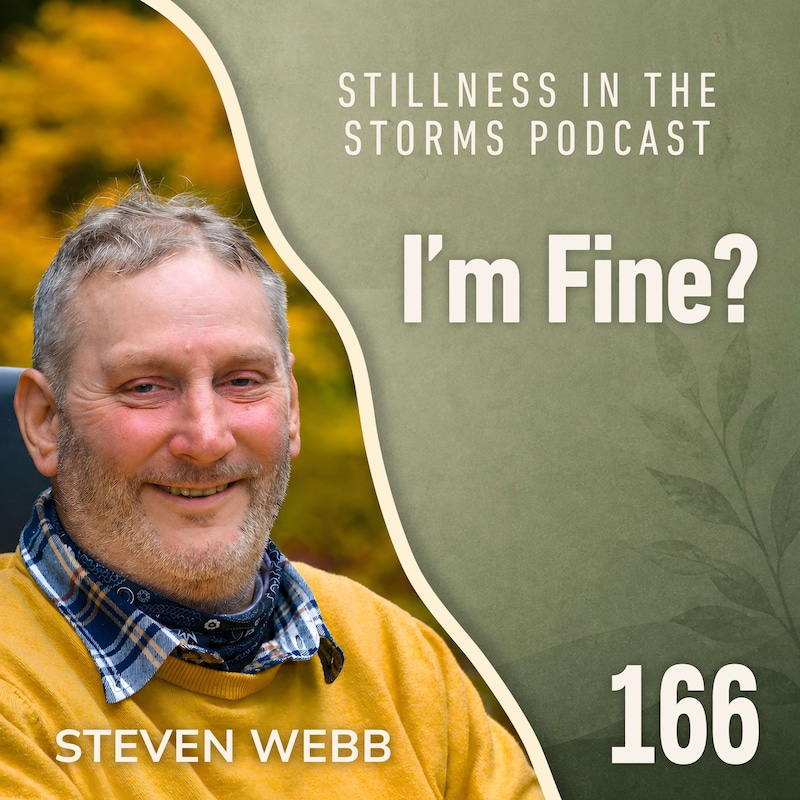
Shownotes
Links to Steven Webb's podcast and how you can support his work.
- Donate paypal.me/stevenwebb or Coffee stevenwebb.uk
- Steven's courses, podcasts and links: stevenwebb.uk
Two words I have said roughly 25,000 times. Most of them on autopilot.
Description
Two words. Probably the most common two words spoken in the English language. Two words I say almost every single morning, and you probably do too. I'm fine. In this episode I work out that I have said it about 25,000 times to my carers over the last 35 years, and almost none of those times did I actually stop and think about it. I want to look at why we say it, what it costs us, and what happens when we don't. There is a Brené Brown quote, an old Zen master story I have always loved, a Thursday afternoon last week where I cried for 20 minutes and then bought a book on Amazon, and a small image about letting go before your hand hurts. You don't have to stop saying I'm fine. You just have to notice when you do.
Key Topics
- 25,000 mornings, two carers, and the most automatic answer in my life
- Why "I'm fine" is armour, and why armour is not always the wrong thing to wear
- The three reasons we wear it (and why "just think positive" is the worst advice in self help)
- The cost of saying it on autopilot, especially to the people who actually want to hear you
- An old Zen story about a master on his deathbed who said the most enlightened thing he could have said
- Brené Brown on numbing emotions, and why you cannot block only the bad weather
- A real Thursday afternoon I sat here and cried for 20 minutes, then immediately bought a book
- The hand metaphor: I let go a little earlier than I used to, before my hand hurts
Companion Meditation
When Anxiety Visits (IPM101). Five minutes. You sit down, you say hello to whatever is actually here, and you ask it why it came. It is the practical opposite of saying "I'm fine." Available on Insight Timer, Aura, and the Inner Peace Meditations podcast.
If this episode meant something to you, please share it, leave a review, or treat me to a coffee at stevenwebb.uk.
Supporters
Alex, Nina, Zoe, A Ma, Kevin, Katarzyna, Deborah, Christopher, and Ariel for recent coffees and PayPal donations.
Special thanks: MumMik's Cleaning Services for buying a course this week.
You keep this podcast advert free.
Transcripts
Hello and welcome.
Steven Webb:I'm Steven Webb.
Steven Webb:This is Stillness in the Storms, and this is the podcast that helps you
Steven Webb:to find peace in difficult times.
Steven Webb:No fluff, no quick fix.
Steven Webb:It's just honest down to earthwards from someone who
Steven Webb:tries to live every single day.
Steven Webb:So today I want to talk about so huge thank you to Alex, Nina, Zoe
Steven Webb:A Ma, Kevin, Katarzyna, Deborah, Christopher, Ariel for supporting
Steven Webb:me with a coffee or PayPal donation.
Steven Webb:Recently, a special thank you goes out to Mum Mix Cleaning Services.
Steven Webb:Bought a course this week and yeah, it all helps.
Steven Webb:You're amazing.
Steven Webb:You keep this podcast completely advert free.
Steven Webb:And if you'd like to join them, you can find me at StevenWebb.uk.
Steven Webb:So today I want to talk about two words, probably the two most common
Steven Webb:words spoken in the English language.
Steven Webb:Two words that I say almost every single day, and you probably do too.
Steven Webb:I'm fine.
Steven Webb:Or maybe I'm good and I want to look at why we say it and what it costs
Steven Webb:us and what happens when we don't.
Steven Webb:So the core question is what are we actually doing when we say I'm fine?
Steven Webb:So for the last 35, 34, 35 years.
Steven Webb:I've had two carers come in and get me outta bed now then if I was poorly, they
Steven Webb:may have just washed me and sometimes on the, when I was 12 months on the
Steven Webb:spinal unit, it may have just been one.
Steven Webb:So the amount of times I've said I'm fine or I'm good, or a variation of
Steven Webb:it, given there's two of them is, and I did do a quick calculation.
Steven Webb:It's probably 25,000 times by the time I've probably said it more
Steven Webb:times during the day as well.
Steven Webb:When the changeover that is 25,000 little encounters that maybe probably
Steven Webb:1% of them I might have said, no, I'm struggling today, or Now I'm
Steven Webb:tired, or something different.
Steven Webb:But in general, the conversation goes the same way every single morning.
Steven Webb:I have five main carers and some of them have been with me 30 years,
Steven Webb:and some of them have been with me on and off for 20 years, and others
Steven Webb:have been with me for several years.
Steven Webb:But what's really interesting as the more time goes on, the more I meditate
Steven Webb:and the more I try to take notice, and it only happens about one in 20
Steven Webb:times that I actually take notice.
Steven Webb:But every single carer and every single encounter, however benign we think it is.
Steven Webb:Good morning.
Steven Webb:How are you doing?
Steven Webb:Yeah, I'm fine.
Steven Webb:Whoever initiates that is different with each carer.
Steven Webb:It's, some of them don't speak first.
Steven Webb:Some of them I've almost always gotta say hi first.
Steven Webb:Other ones, they're saying hi on the way in through, and some of
Steven Webb:them when I say, how was your day?
Steven Webb:They'll pause and think about it.
Steven Webb:Others would just go, yeah, it's fine.
Steven Webb:Yeah, it's good.
Steven Webb:And it's really interesting and it isn't always the same.
Steven Webb:Some of them will just stop and think.
Steven Webb:Some of them don't even hear you and I can really tell the difference
Steven Webb:in whether they're there, whether they're really thinking about it.
Steven Webb:Whe whether they're okay.
Steven Webb:Even if they say the words, I'm fine or I'm good.
Steven Webb:'cause you can just tell when you slow down.
Steven Webb:But with that said, most of the time it's still automatic.
Steven Webb:Nearly 90, 95% of the time, it's automatic.
Steven Webb:I go through town, yeah, I'm fine.
Steven Webb:Yeah, I'm good.
Steven Webb:And when I encounter people, especially open social times, I'm good.
Steven Webb:And sometimes you might carry on the conversation.
Steven Webb:So more and more recently I've been thinking about it and.
Steven Webb:I think of all the opportunities that are missed that we could
Steven Webb:just connect with someone, even an always complete stranger or someone
Steven Webb:we haven't seen for a long time.
Steven Webb:Where we just stop and go and they go, how you doing?
Steven Webb:You go, do you know what?
Steven Webb:I'm really struggling.
Steven Webb:You don't need to do anything with it.
Steven Webb:But I'm really struggling at the moment and it opens the door for
Steven Webb:them to go, do you know what?
Steven Webb:Me too.
Steven Webb:Because I dunno.
Steven Webb:Anyone that isn't struggling with something, I dunno.
Steven Webb:Anyone that wouldn't like to.
Steven Webb:Just share just something they're going through and we wear the, I'm fine or
Steven Webb:I'm good, as like armor, it protects us.
Steven Webb:It doesn't let anybody in, and it also allows us to show up.
Steven Webb:It keeps the day moving.
Steven Webb:There's nothing wrong with this armor and sometimes I'm fine is the best
Steven Webb:answer because there is conversations I don't wanna have with someone.
Steven Webb:And it might be that particular person.
Steven Webb:It might be why I'm feeling it could be, and I might even be not feeling good
Steven Webb:and I might jazz it up a bit and go, yeah, no, I'm really good at the moment.
Steven Webb:Anyway, I'll see you again as I drive off because it is a useful tool.
Steven Webb:It's not something we should write, never say I'm fine.
Steven Webb:Again, block those words from our vocabulary.
Steven Webb:And I think I've heard someone say about that on a podcast at some
Steven Webb:point for the next three weeks.
Steven Webb:I want you to never say I'm fine.
Steven Webb:It's just not practical.
Steven Webb:It just doesn't work.
Steven Webb:I struggle with advice, things like that, but it's a good tool.
Steven Webb:But if we use it wisely, again, it's like I say to everything.
Steven Webb:Everything has a healthy and unhealthy version.
Steven Webb:If you are on autopilot all the time, and that's your go-to answer
Steven Webb:no matter what and with everybody, then it's quite unhealthy.
Steven Webb:But if you choose to do that with certain people and you choose to stop
Steven Webb:and pause and answer it honestly because.
Steven Webb:Sometimes when I ask the carers in the morning, sometimes
Steven Webb:I'm not of the mood to care.
Steven Webb:I don't care about their answer.
Steven Webb:I care if their legs fall in off or something bad happened, but I'm not that
Steven Webb:worried if they got into traffic on the way in or they've had a rough weekend.
Steven Webb:People look at me as a really caring person.
Steven Webb:I'm really not.
Steven Webb:I'm working on it, but I'm really not.
Steven Webb:So sometimes when I ask the question, how are you doing?
Steven Webb:It's quite shallow.
Steven Webb:Other times I ask the question after I've meditated and after
Steven Webb:I've slowed down a little bit, I go, anyway, how was your weekend?
Steven Webb:I genuinely wanna know.
Steven Webb:I'm really interested.
Steven Webb:And it's not just conversation.
Steven Webb:And those times I do hope that they pause and they think about it.
Steven Webb:So there's three main reasons we don't want to burden other people
Steven Webb:with it, especially when someone who especially cannot fix it.
Steven Webb:And especially if we know they're going through problems themselves.
Steven Webb:We don't want that person, the one who is always struggling to know,
Steven Webb:and we genuinely believe that.
Steven Webb:If we say it enough, it'll be true.
Steven Webb:We'll believe it.
Steven Webb:If we go around, just think positive, be on the positive side of life.
Steven Webb:I personally think that's bollocks.
Steven Webb:Just think positive is just an absolute worst bit of advice in
Steven Webb:spiritual and in self-help and books.
Steven Webb:It's terrible.
Steven Webb:And I've got several podcasts, what to do.
Steven Webb:Changing the way your subconscious mind gives you more positive thoughts
Steven Webb:or more thoughts that you genuinely like because it's not the fact that we
Steven Webb:don't like our thoughts, it's just the fact that we don't like the thoughts,
Steven Webb:we don't like, we don't mind our thoughts when they're nice thoughts.
Steven Webb:No one wants to get rid of them unless they're in a bit too
Steven Webb:much and it's a bit awkward.
Steven Webb:We all know that scenario.
Steven Webb:I think there's a cost to, I'm fine and I think it's a heavy cost because
Steven Webb:even if someone you're relatively close to and they say, how are you doing?
Steven Webb:And listen to how they do it.
Steven Webb:If they look up and go, hi, so how are you doing?
Steven Webb:That's a genuine question.
Steven Webb:If you open the door and go, how are you?
Steven Webb:That's not a genuine question.
Steven Webb:Not always.
Steven Webb:People talk differently.
Steven Webb:I'm no expert on how people talk, but you can tell when someone looks at
Steven Webb:you and actually stops what they're doing and asks you, how are you?
Steven Webb:That's your cue to go.
Steven Webb:Do you know what?
Steven Webb:Gimme a moment.
Steven Webb:Thank you for asking.
Steven Webb:This is how I'm feeling.
Steven Webb:That is a real connection.
Steven Webb:That's a real opportunity.
Steven Webb:And the thing is, you can even tell them that you don't
Steven Webb:need to do anything with this.
Steven Webb:'cause I get the impression that you've got enough on your plate as well.
Steven Webb:But thank you so much for listening because we're not listened to.
Steven Webb:We want the world to hear us.
Steven Webb:We want the whole world to see our suffering.
Steven Webb:We want the whole world to see what we're going through.
Steven Webb:And I'll be honest, we do.
Steven Webb:Let's be honest about this, and we also want the whole world to know
Steven Webb:how much of a hero we're being, because I've done this as well.
Steven Webb:I spoke about this and I normally get quite a reaction when I say about this, is
Steven Webb:we all do believe we're a hero in our own lives, whether we are going through a hard
Steven Webb:time, we have that dialogue in our head.
Steven Webb:Do you know what I'm doing?
Steven Webb:All right?
Steven Webb:Despite everything I'm fighting, despite everything, I'm still here.
Steven Webb:We have got that hero's journey in our head, and of course we have it.
Steven Webb:We have to have it because we wouldn't really function, we wouldn't
Steven Webb:really see any point in life.
Steven Webb:We would lose all kind of hope if we didn't have that.
Steven Webb:Even when we're the most victimized part of our life.
Steven Webb:Victimized is that word.
Steven Webb:Even at that most time when, and we're all victims at time or our own thinking, we
Steven Webb:can still think of ourselves as the hero.
Steven Webb:And we tend to tell the story from that perspective.
Steven Webb:We don't wanna say it out loud because we think that's arrogance.
Steven Webb:We think that's, but it's not.
Steven Webb:There is a fine line between confidence and arrogance and being honest and being
Steven Webb:proud of who you are and what you do.
Steven Webb:As always, I'm going off topic,
Steven Webb:but when someone does ask you a, just see if that's that little pause.
Steven Webb:See if they're taking the question seriously.
Steven Webb:And it is just a way of saying, I'm here for you for a moment.
Steven Webb:And I don't think enough people are honest.
Steven Webb:I don't think people are honest nowadays.
Steven Webb:I think we're so full of the chaos of life that we don't want to sit
Steven Webb:down or we don't think we have time.
Steven Webb:And the cup of tea that we have with a friend, we almost want it to be a
Steven Webb:lovely, positive, upbeat conversation.
Steven Webb:I'll tell you what, A honest conversation over a cup of tea for 40 minutes
Steven Webb:saying, I'm struggling because of this, and the other person says the
Steven Webb:same, that's the best conversation you of all day because the old adage was
Steven Webb:that problem shares a problem halved.
Steven Webb:I don't know.
Steven Webb:I dunno quite where that comes from, but it certainly feels better
Steven Webb:to have been heard, to be seen.
Steven Webb:And I dunno where this fits on the spiritual journey or anything like
Steven Webb:that, but there's a twofold to this.
Steven Webb:There's the listening.
Steven Webb:If you ask a question, pause, look at them, genuinely hear it.
Steven Webb:And remember, you don't need to fix it.
Steven Webb:You don't need to jump in.
Steven Webb:If they've had a bad day, just listen.
Steven Webb:And do what my nan does.
Steven Webb:Whenever anybody used to come in, moaning to my nan and whatever happened.
Steven Webb:I remember going in one day, moaning about a couple of people
Steven Webb:and about what they thought of me.
Steven Webb:I was like 17 at the time, and my nan just looked up and goes, well, I'm sure
Steven Webb:they thought very highly of you as well.
Steven Webb:Would you like a cup of tea?
Steven Webb:And God, she was like a zen master that was like cut to the bone.
Steven Webb:It's like, yeah, they probably thought the same about me actually.
Steven Webb:And yeah, a cup of tea.
Steven Webb:Fix everything.
Steven Webb:More tea in that.
Steven Webb:An old English thing.
Steven Webb:More tea.
Steven Webb:Vicar.
Steven Webb:I have no idea what that's about.
Steven Webb:Swift.
Steven Webb:It's got bad connotations.
Steven Webb:I apologize now I have no idea.
Steven Webb:I love one.
Steven Webb:One of my favorite quotes is by Brene Brown, and if you haven't read her books,
Steven Webb:read her books about vulnerability.
Steven Webb:They're so easy to read.
Steven Webb:Thank you Brene Brown for your vulnerability and your honesty.
Steven Webb:She said "we cannot selectively numb emotions. When we numb the
Steven Webb:painful emotions. We also numb the positive emotions." So going
Steven Webb:back to that conversation with a friend over a cup of tea.
Steven Webb:You have to have both conversations,
Steven Webb:and if someone's trying to avoid it, just allow them to avoid it.
Steven Webb:If they do say, I'm fine.
Steven Webb:And you just say, are you sure, I can listen.
Steven Webb:And they go, no, really, I'm fine.
Steven Webb:Leave it at that.
Steven Webb:Don't push.
Steven Webb:And just to drive home the honesty, A great zen master was on his deathbed.
Steven Webb:His students gathered around him expecting wisdom.
Steven Webb:They expected him to die the way he had lived.
Steven Webb:Calmly, peacefully, accepting.
Steven Webb:The end is natural.
Steven Webb:They had studied with him for decades.
Steven Webb:They knew his teachings on impermanence.
Steven Webb:They knew his teachings on deaf.
Steven Webb:They were waiting for the final lesson.
Steven Webb:And the master opened his eyes.
Steven Webb:He looked at them and in a small voice, he said, I don't want to die.
Steven Webb:Then he died.
Steven Webb:The students were shaken.
Steven Webb:Some were embarrassed by their teacher.
Steven Webb:They had wanted some noble exit.
Steven Webb:They felt cheated.
Steven Webb:They felt like it would be the ultimate lesson.
Steven Webb:But one of them years later understood the master had given them the final teaching.
Steven Webb:Even then, the teaching was the truth.
Steven Webb:He didn't perform peace.
Steven Webb:He didn't dress up his fear in robes.
Steven Webb:He told them what was exactly the true at the moment, I don't want to die.
Steven Webb:That was the most enlightening thing he could have said.
Steven Webb:Because it was honest.
Steven Webb:Because it was honest then okay, the astute among you are gonna go.
Steven Webb:Yeah, but that's the ego.
Steven Webb:Yes it is.
Steven Webb:'cause that's what dies.
Steven Webb:It's the I that dies.
Steven Webb:And he deliberately said, I don't want to die.
Steven Webb:And that was the ego being honest.
Steven Webb:The ego's not a bad thing.
Steven Webb:The ego is what it is.
Steven Webb:The ego is your stories.
Steven Webb:It's who you are.
Steven Webb:It's the roles you play.
Steven Webb:It's technically not who you are, but it's who you.
Steven Webb:It's what we use to be able to experience life through, no, that's not even
Steven Webb:correct, but that's a different podcast.
Steven Webb:I know that story.
Steven Webb:You may have heard that story.
Steven Webb:He is told in many different traditions and there's a particular zen master
Steven Webb:that apparently said it, but it is an old story and it fits with any anybody.
Steven Webb:I think the honest answer is, and the honest answer might not be that either,
Steven Webb:and I think honesty is treated as a flaw.
Steven Webb:It's worth saying that.
Steven Webb:I think most of us just feel fear of being honest.
Steven Webb:What if I actually tell them I'm having a really crap day?
Steven Webb:What if I tell them I want to cry?
Steven Webb:So Thursday afternoon, I was sat here about two o'clock.
Steven Webb:I felt really emotional and I don't know what it was.
Steven Webb:I really don't.
Steven Webb:But I felt so overwhelmed.
Steven Webb:I felt so tired and.
Steven Webb:I just cried.
Steven Webb:I cried for about 15, 20 minutes and then I think I fell asleep.
Steven Webb:'cause my head, I suddenly woke up with my head, like just
Steven Webb:leaning forward in a chair.
Steven Webb:My neck nearly felt like it broke and I was so sore.
Steven Webb:But boy did I need that.
Steven Webb:And I don't really remember what it was about now, but I messaged one of
Steven Webb:my friends and said, you know what?
Steven Webb:I'm feeling really emotional right now.
Steven Webb:And she listened.
Steven Webb:And you know what I did?
Steven Webb:I did my normal A DHD thing just before I actually fell asleep.
Steven Webb:I bought a book and because that book solves everything, and I
Steven Webb:messaged her and said, guess what?
Steven Webb:I've got gone and done.
Steven Webb:She said, go on.
Steven Webb:So I bought a book.
Steven Webb:She said, of course you have.
Steven Webb:And I laughed.
Steven Webb:That made me laugh so much.
Steven Webb:Of course you have.
Steven Webb:'cause that's what we do.
Steven Webb:We reach out to try to fix our problems in that moment, I went on to Amazon.
Steven Webb:I bought a book.
Steven Webb:I'm probably not even gonna read it, but it was a step in the right direction to
Steven Webb:fix my life in that moment because I felt like my life was spiraling, but it wasn't.
Steven Webb:It was just a moment of emotion.
Steven Webb:So just before I go, just let me say this clearly and I am as messed up as you are.
Steven Webb:I'm still struggling every day.
Steven Webb:I don't even like meditation half the time, to be quite honest.
Steven Webb:I don't think I ever like meditation.
Steven Webb:I still get caught up in my thoughts.
Steven Webb:I still say I'm fine or I'm good when I'm not.
Steven Webb:I think the only difference between me now and 10 years ago, or perhaps me and you,
Steven Webb:is I suffer slightly less and not because I've stopped having thoughts, I haven't.
Steven Webb:The thoughts still come.
Steven Webb:Luckily they just take hold less.
Steven Webb:They clinging to me less.
Steven Webb:I go with them less or maybe more accurately.
Steven Webb:I let go before my hands hurt to take it to a metaphor.
Steven Webb:That's the only difference
Steven Webb:I let go before my hands hurt.
Steven Webb:You don't have to stop saying I'm fine.
Steven Webb:It's a useful piece of social fabric, so to speak.
Steven Webb:Sometimes it's the right answer, but once a day, just maybe with
Steven Webb:the right person, maybe just even with yourself in the mirror.
Steven Webb:Try another answer.
Steven Webb:Actually, today's a hard one.
Steven Webb:See what happens.
Steven Webb:See what room it gives you, and just open that hand a little earlier.
Steven Webb:And of course, you know what I mean by opening your hand just.
Steven Webb:Accept it, let it go perhaps.
Steven Webb:And I've done a companion meditation with this and the meditation that goes
Steven Webb:with this is called when anxiety visits.
Steven Webb:It's a five minutes, you sit, you say hello to whatever is actually
Steven Webb:here, and you ask it why it came.
Steven Webb:It's the practice of the opposite to, I'm fine, you can find it on.
Steven Webb:Insight timer, aura, or wherever you listen to Inner peace meditations,
Steven Webb:and I will link to it below.
Steven Webb:So I'm running out of energy, as you can probably tell by my voice.
Steven Webb:So I'm gonna go now and I'm gonna say thank you.
Steven Webb:Take care of yourself, stay curious, and I love you.





