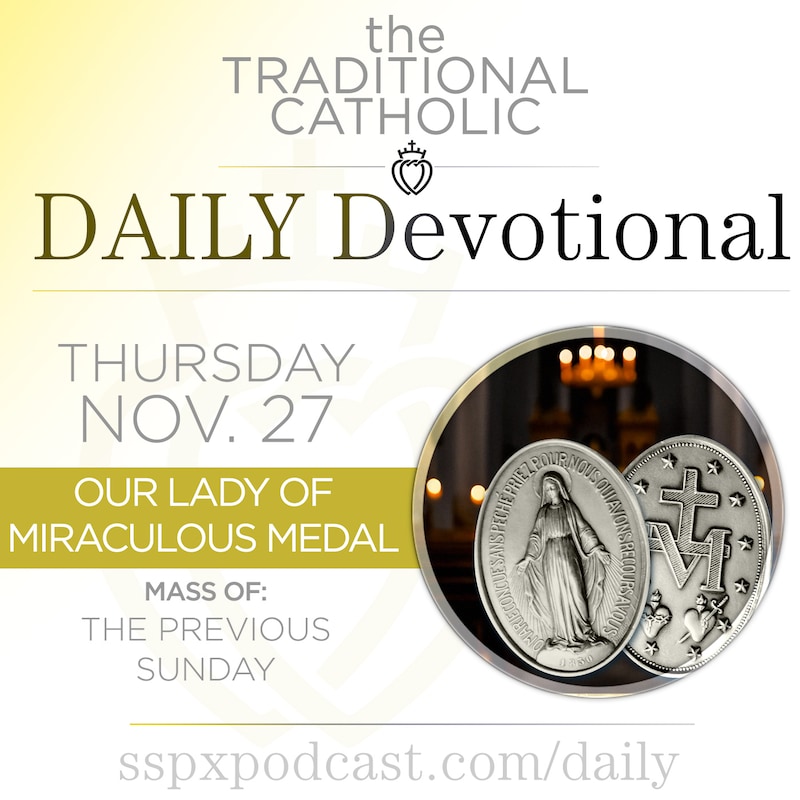
It’s a Feria, The Miraculous Medal, 4th Class, with the color of Green. In this episode: the meditation: “The Particular Judgement”, today’s news from the Church: “Declaration against the New Mass: Fr. Calmel”, a preview of the Sermon: “The Last Things”, and today’s thought from the Archbishop.
Have feedback or questions about the DD or our other shows? podcast@sspx.org
Sources Used Today:
- “The Particular Judgement” – Death, Judgment, Heaven, and Hell: Meditations on the Four Last Things by St. Alphonsus de Liguori
- “Declaration against the New Mass: Fr. Calmel” (FSSPX.news)
- Bux Refutes Cardinal Cupich on the Liturgy
- https://fsspx.news/en/news/fr-bux-refutes-cardinal-cupich-liturgy-55609
- “The Last Things” (SSPX Sermons)
- The Spiritual Life – Archbishop Lefebvre (Angelus Press)
The Feast of the Miraculous Medal is one of the gentlest and most personal celebrations in the Church’s calendar, because it touches the place where devotion meets everyday life. Celebrated on November 27, it commemorates the day in 1830 when the Blessed Virgin appeared to a young Daughter of Charity, Saint Catherine Labouré, in the chapel of her community on the Rue du Bac in Paris. The world at that time was restless. France had weathered revolution after revolution, and the poor were suffering intensely. Into that anxious atmosphere, Our Lady came not with grand spectacle, but with the simplicity of a mother who sees her children’s need.
Catherine Labouré was a quiet and practical Daughter of Charity who longed for a glimpse of Our Lady. One night she was led to the chapel, where Mary appeared and spoke with her like a mother to a child, later showing her the now-famous image of the Virgin standing on a globe with rays of grace pouring from her hands.
Our Lady asked that this image be struck as a medal, promising abundant graces to all who wore it with trust. Catherine revealed the message only to her confessor, who brought it forward cautiously, and soon the first medals were minted. What followed astonished even the Church. Reports of healings, sudden conversions, reconciled families, protection in danger, and peace in suffering spread through Paris and beyond. Within a few years, millions of medals had been distributed, and even skeptics began calling it “miraculous.”
One of the earliest and most famous stories was the conversion of Alphonse Ratisbonne, an agnostic banker in Rome who reluctantly agreed to wear the medal as part of a friendly challenge. While waiting for a friend in a church, he was suddenly overwhelmed by a vision of Our Lady and left the church a changed man. His conversion became a catalyst for renewed Marian devotion throughout Europe.
Missionaries carried the medal to every corner of the world. In famine-stricken Ireland, families pinned it to their children’s clothing. Soldiers in the American Civil War and later in World War I and II wore it for protection, often attributing narrow escapes or unexpected peace to Mary’s care. In the United States, the medal became closely associated with Saint Katharine Drexel and the early growth of Catholic immigrant communities, who saw it as a sign that heaven had not forgotten them.
In many Catholic homes, it was placed above doorways or tucked under mattresses as a quiet prayer for safety. Some families kept a small bowl of medals ready to give to visitors, believing that offering one was itself an act of evangelization. And to this day, countless Catholics tell stories of prodigal children returning to the sacraments, illnesses easing, or hearts finding peace after years of turmoil — all linked to wearing the medal with trust.
Its theology remains simple and profound: Mary’s hands are open because grace pours freely; her foot stands on the globe because Christ’s victory is sure; and those who call on her never stand alone.
O Mary, conceived without sin, pray for us who have recourse to thee!
- - - - - -
- - - - - -
Explore more:
What is the SSPX Podcast?
The SSPX Podcast is produced by Angelus Press, which has as its mission the fortification of traditional Catholics so that they can defend the Faith, and reaching out to those who have not yet found Tradition.
What is the SSPX?
The main goal of the Society of Saint Pius X is to preserve the Catholic Faith in its fullness and purity, to teach its truths, and to diffuse its virtues, especially through the Roman Catholic priesthood.
Authentic spiritual life, the sacraments, and the traditional liturgy are its primary means of bringing this life of grace to souls.
Although the traditional Latin Mass is the most visible and public expression of the work of the Society, we are committed to defending Catholic Tradition in its entirety: all of Catholic doctrine and morals as the Church has always defended them. What people need is the Catholic Faith, without compromise, with all the truth and beauty which accompanies it.
https://sspx.org