Shownotes
"What happens if I make my house airtight but have no mechanical ventilation?" This question comes up more often than you'd think, and the answer might surprise you. We sat down with Cameron Munro from Passive Analytics and Brad McEwan from Sanford BuildCo to tackle this and other building questions from our social media following that every builder should understand.
Building a high-performance home isn't just about achieving airtightness - it's about understanding how all building elements work together. The key takeaway? You cannot have an airtight building without proper mechanical ventilation. The energy and comfort benefits only work when you maintain healthy indoor air quality.
For builders serious about high-performance construction, remember that details matter, and investing in proper ventilation systems isn't optional - it's essential for creating truly healthy homes.
If you’d like to submit a question for us to discuss on the podcast, reach out to us on Instagram.
LINKS:
Connect with us on Instagram: @themindfulbuilderpod
Connect with Hamish:
Instagram: @sanctumhomes
Website: www.yoursanctum.com.au/
Connect with Matt:
Instagram: @carlandconstructions
Website: www.carlandconstructions.com/
Transcripts
So we're gonna do a bit of a question answer podcast today with our good friend
Speaker:Dr. Abel Cameron Monroe, the building scientist, rocket scientist, and Brad
Speaker:from Sanford, BuildCo Plus Hamish.
Speaker:So these are questions we actually put on I on social media recently and
Speaker:just got people to ask, uh, ask us anything essentially, and we thought
Speaker:we'd have a bit of fun with it.
Speaker:Um, and see what people come out with.
Speaker:But I've got five here that are really appealing, um, with one of them being
Speaker:asked multiple times, and it's something I think we've actually spoken about before.
Speaker:Cam, the question I have here is what will happen if I make a house so airtight
Speaker:but have no mechanical ventilation?
Speaker:Well, it'll be pretty energy efficient.
Speaker:You're not gonna get the air loss.
Speaker:The problem is gonna become down to air quality.
Speaker:It will need to be opening those windows very regularly.
Speaker:And then you're relying on those windows to actually provide adequate
Speaker:ventilation, which you can't.
Speaker:This is the whole point of HRV, that it's about predictability and control.
Speaker:So you are utterly dependent on the weather outside to provide the adequate
Speaker:air movement through the building.
Speaker:And so the energy benefit you had from going airtight is
Speaker:now lost, uh, the final risk.
Speaker:Is one of moisture because you've got no predictable way of removing
Speaker:the moisture from the space that you, that you do have with HRV.
Speaker:It's not a good place to be.
Speaker:Have you guys had clients say, oh, we wanna build air type, no
Speaker:mechanical ventilation, not air type, but want to mystically pluck
Speaker:a number Like I want to build.
Speaker:3.5 aach h and not worry about, uh, mechanical ventilation.
Speaker:You are builders.
Speaker:You can do that, can you?
Speaker:Yeah,
Speaker:but this is, I think this is the issue when we talk about air tightness,
Speaker:like, and the magical number, like you, I, you've said it before, cam,
Speaker:that like every house needs some form of mechanical ventilation.
Speaker:And I think the issues when, in our industry we talk mechanical
Speaker:ventilations, HRV, they've got exhaust fans, so, and rental.
Speaker:Yeah.
Speaker:Yeah.
Speaker:So what, where does that And fans, so you.
Speaker:Yeah.
Speaker:You do need some mechanical ventilation to some extent.
Speaker:Yeah.
Speaker:Or, or, I, I keep saying this in my view, the, the question of
Speaker:mechanical ventilation is utterly independent of air tightness.
Speaker:Yeah.
Speaker:Every home needs mechanical ventilation, just like every home needs toilets and
Speaker:the kitchen sink and everything else.
Speaker:It should just be not even a question.
Speaker:And I think you've even talked about like the important thing
Speaker:is the ventilation part of it.
Speaker:Not, not the heat recovery.
Speaker:Not the heat, not the heat recovery, it's just the ventilation.
Speaker:Absolutely.
Speaker:And so the, the usual pushback is, oh yeah, but a H HRV heat
Speaker:recovery ventilation is gonna cost me north of 20 grand.
Speaker:I don't have that money.
Speaker:I don't wanna do that.
Speaker:Okay.
Speaker:So the way to provide that ventilation is an extract only system with a makeup.
Speaker:And so it can be as simple as the $20.
Speaker:Okay.
Speaker:Um, bathroom extract fan, leave it on 24 7 and then you have a window
Speaker:open at the other end of the house.
Speaker:So you continually draw air through the house, but intuitively that will cause
Speaker:a problem to your heating and calling a, a massive problem unless you happen
Speaker:to live in a benign climate where it's 23 degrees outside all year round.
Speaker:Yeah.
Speaker:So
Speaker:if you don't have mechanical ventilation, what will you sort of feel and see?
Speaker:Have you guys experienced anything?
Speaker:I mean, personally, no.
Speaker:And I think luckily.
Speaker:In my professional experience in building higher performing homes that are also
Speaker:airtight, that we've always had some kind of dedicated ventilation system.
Speaker:Now, there has been some projects where early on when we've been, when
Speaker:we were quoting and I guess getting into this high performance space, sure.
Speaker:We were trying to put in some of the passive house principles.
Speaker:And ventilation always comes up as, oh, well why don't we just get rid of that?
Speaker:There's $25,000.
Speaker:And luckily I have never been in a situation where that has happened
Speaker:because the project's just fallen over.
Speaker:So personally, thankfully, I've never been in a situation where we built an air type
Speaker:building and there's been no ventilation.
Speaker:And what I'm interested hearing, 'cause you build up building scientists.
Speaker:How you both have different conversations with clients about it.
Speaker:'cause I feel like the conversation you'd have with a client about
Speaker:mechanical ventilation is different.
Speaker:How you would have the conversation but trying to get to the same point.
Speaker:Well, I'm not trying to sell anyone on it.
Speaker:I'm just saying if I'm building a house, this is how I'm doing it.
Speaker:So how would the Dan go?
Speaker:How about, let's then go back a step.
Speaker:If you are a young builder and I want to build for the first time, and I
Speaker:understand the importance about it, how would you talk to the client about it?
Speaker:Other than being like, no, it's going in.
Speaker:I just think if you're a young builder, you should be wanting to eliminate as
Speaker:much risk on your heart as possible, and that's how you eliminate the risk.
Speaker:I still, to this day, can't figure out a recipe to build to
Speaker:a certain level of air tightness.
Speaker:And even if you periodically tested your build as you were doing it, um.
Speaker:And then you, you know, whatever, especially with modern architecture,
Speaker:everything's square set.
Speaker:If you're doing a good job, you're corking everywhere.
Speaker:You're gonna be relatively airtight without really giving it a, a full send.
Speaker:So say you end up at 3, 4, 5, aach h you probably really should have legitimate
Speaker:mechanical ventilation, and now you don't have budget or provision for it.
Speaker:Yeah, I think it's pretty good.
Speaker:Co. When you bring in the air tightness, didn't they just do a new study that
Speaker:found the air tightness was better than what they originally thought it was?
Speaker:Yeah, so the C-S-I-R-O has commissioned some two studies
Speaker:over the last past 10 years.
Speaker:The one, I think sometime about 10 years ago found that the average, uh, air
Speaker:tightness of a new build residential dwelling in Australia was about 15 a CH.
Speaker:And now in the most recent one, it's down to about seven.
Speaker:Yep.
Speaker:So that's great progress for the industry in barely a decade.
Speaker:And if you are averaging that out over, you know, volume builds, which probably
Speaker:lot leak is a sieve and then, but are they, this is the thing I reckon maybe
Speaker:they're not as, as much as we think prob probably not, and that's why
Speaker:the average has come down to seven.
Speaker:But I'm saying like a nice custom build where a builder actually gives his shit.
Speaker:And that becomes your lower end of air tightness, which is
Speaker:bringing that average down as well.
Speaker:And remember also all of these apartments are going in that are precast concrete.
Speaker:That's very hard not to make those airtight.
Speaker:Yeah.
Speaker:Yeah.
Speaker:I think that's the thing.
Speaker:I think we probably think that like residential, there's residential.
Speaker:When there's commercial, the commercial side of residential
Speaker:weather building apartments.
Speaker:I think that's something that when we all talk, we just think standalone
Speaker:home, the the, at the risk of repeating myself a comment that I said to Joel.
Speaker:Uh, on a past episode, the blower door is testing the whole house, like
Speaker:all your leaks could be coming from one, one room, and then the rest of
Speaker:your home is completely airtight.
Speaker:So picking an arbitrary number and saying, well, below six air changes,
Speaker:you need mechanical ventilation.
Speaker:If all of that's coming out of one room, well.
Speaker:There's a huge amount of risk in that home of having mold and condensation
Speaker:and or even degradation of that building fabric because the, all
Speaker:the wall assemble is getting ruined.
Speaker:So, Goma, there's a couple of suggestions.
Speaker:Perhaps we're speaking with clients about how to, to sort of discuss this that
Speaker:might help is firstly to point out that we breathe about 10,000 liters of air a day.
Speaker:So huge quantity there.
Speaker:Now, if we think about all of the other things in our lives that we
Speaker:consume, we consume water from the taps that we assume without even thinking
Speaker:about it, is not gonna make us sick.
Speaker:Now there's a whole infrastructure behind that.
Speaker:There's testing of the water quality all the time, and it
Speaker:clearly there'd be a scandal.
Speaker:If there was a contaminant in our water system that made us sick, then that'll
Speaker:be first, you know, headline on the news.
Speaker:When we go into the supermarket and buy food, we know that there's a whole
Speaker:infrastructure behind that of testing.
Speaker:Those f those foods to make sure that they're not gonna make us sick.
Speaker:We have no such oversight of our air quality in our buildings, and we spend
Speaker:85 to 90% of our time in buildings.
Speaker:So air quality is fundamental and it's a complete oversight in both
Speaker:our building code and our wider.
Speaker:You know, community perception because we just don't see, feel, think about,
Speaker:uh, what we breathe most of the time until we get those acute events like
Speaker:the bushfire smoke type of events.
Speaker:Is air quality important to you as a client?
Speaker:Well, yes, of course.
Speaker:Everybody would intuitively say so, but I'll just open my windows will be
Speaker:the response, and then I think I would say, well, okay, you are currently
Speaker:living in a house without mechanical ventilation under a hundred bucks.
Speaker:Let's buy you a sensor.
Speaker:And a CO2 sensor is a good place to start and let's put that in your
Speaker:bedroom for a week and see where that, that resides afterwards.
Speaker:And I can almost assure you that in that master bedroom overnight,
Speaker:those CO2 concentrations will go well above the nominal a thousand
Speaker:parts per million that we always talk about, often well above 2000.
Speaker:And that's your indicator that what you think is happening, I've got good air
Speaker:quality, might indeed not be the case.
Speaker:Now to emphasize here that it's not CO2 per se, that's the main
Speaker:problem, but it's an indicator of the level of air infiltration
Speaker:and exfiltration in that space.
Speaker:So you can only react to what we can see and feel.
Speaker:Well, we can't see and feel air quality particularly, but we can certainly
Speaker:monitor it with these very cheap tools.
Speaker:So there's a, and a lot of that can also explain other things that you
Speaker:might be experiencing physiologically.
Speaker:Like I'm, I'm always waking up tired.
Speaker:Headaches, headaches, stuff, all that kind of stuff.
Speaker:Yeah.
Speaker:So.
Speaker:Two things here.
Speaker:A recent study estimated that poorly controlled asthma cost a healthcare
Speaker:system, $4,600 per person per year, and then in 20 to 2120 to 21, it
Speaker:was an estimated 581.7 million was spent on the treatment of asthma
Speaker:in Australia, which re represented 0.6 of the total healthcare system.
Speaker:Expenditure and 90% of all respiratory conditions.
Speaker:So I mean, that, that's talking about one component of a healthy indoor environment.
Speaker:I mean, there's so many things.
Speaker:Yeah, there's so many, there's so many benefits of, um, a
Speaker:controlled internal environment.
Speaker:So what I'm saying is like, yeah, we like those systems that say that
Speaker:anywhere from eight 18 to 30 grand to install, let's just say that.
Speaker:Yeah.
Speaker:Like, but that's for a whole house.
Speaker:And if we were to start introducing this into the housing systems,
Speaker:surely there has to be a decrease in.
Speaker:The, this benefit that's gonna be needed from a healthcare perspective?
Speaker:Respiratory.
Speaker:I mean, if you think about it logically like that, then it should be subsidized.
Speaker:Ah, I, it, that would make so much sense.
Speaker:Like, hey, subsidizing water tanks, you're subsidizing insulation,
Speaker:you're subsidizing solar panels.
Speaker:Batteries, subsidized, HI vs.
Speaker:Or solar.
Speaker:Solar or mechanical ventilation.
Speaker:Yeah.
Speaker:Like it that you've checkmate and there's parliament next.
Speaker:Uh, like, you like it, it, yeah, we've.
Speaker:We seem to throw so much money, but rather than like, we're gonna spend it on this,
Speaker:but what if we actually can prevent it?
Speaker:I think that's half the issues.
Speaker:Yeah.
Speaker:But a term is four years in the government.
Speaker:Three years Federal elect.
Speaker:Three years fed.
Speaker:Sorry.
Speaker:Three years.
Speaker:Three years.
Speaker:There you go.
Speaker:Three years.
Speaker:That's all.
Speaker:They're, that's all they're thinking about.
Speaker:They're not thinking long term like that.
Speaker:But we also need to acknowledge, I think that a lot of these chronic
Speaker:conditions, asthma being one example, are mostly multifaceted in their cause.
Speaker:Yeah, yeah, yeah.
Speaker:We can't, I, I don't think it's reasonable to argue that if we put
Speaker:HRV in every, in every single dwelling in Australia, we've solved the asthma
Speaker:problem.
Speaker:But what if, but what if it reduces about like five, 10%?
Speaker:And, and that's always what we're talking about when we treat
Speaker:these chronic health conditions.
Speaker:This is a multifaceted response.
Speaker:Tented
Speaker:10% is 85 million a year.
Speaker:Like that's.
Speaker:Huge.
Speaker:Like that's a huge amount of money that we can spend.
Speaker:I, I just look at it this way as like, when I speak to clients, like,
Speaker:do you want mold in your house?
Speaker:No.
Speaker:Do you like cleaner air?
Speaker:Yeah.
Speaker:Do you wanna filter out all the nasties?
Speaker:Yeah, we wanna filter 'em all out.
Speaker:Okay.
Speaker:Do you like, like moisture and just humidity and all
Speaker:this, that feeling inside nut.
Speaker:Okay, but you want to cut out the mechanical ventilation?
Speaker:Oh no.
Speaker:We'll have that in now.
Speaker:Like you.
Speaker:So 85 million is only 4,250 units HRVs in a hunt.
Speaker:If we put his fit in.
Speaker:Pardon?
Speaker:Pardon.
Speaker:Problem.
Speaker:But also subsidize the whole No doubt.
Speaker:No, you're right.
Speaker:You're right.
Speaker:But you could subsidize the unit and the installation's the same.
Speaker:And as long as they're commissioned with the report on the provision that
Speaker:you also achieve a good airtight test.
Speaker:Like you get a subsidy and then you incentivize also banks.
Speaker:Well, you're, you're also, you're also incentivizing advising
Speaker:more competition in the market.
Speaker:Yeah.
Speaker:'cause more people will see an opportunity.
Speaker:And I think that's the biggest problem in this space right now is that there's,
Speaker:there's no incentive for the broader industry to adopt this stuff because
Speaker:they're not gonna make money out of it.
Speaker:But also like even look private health insurance, like, Hey, you have one
Speaker:of these, we're gonna reduce it.
Speaker:Like you, some of them have, if you join the gym, we're gonna reduce
Speaker:your private health insurance.
Speaker:Hey, we're gonna reduce your private health insurance as well if you
Speaker:have one of these in your house.
Speaker:And I think that's the only rate we're gonna start seeing widespread adoption
Speaker:because we're in a society at the moment.
Speaker:It's like one, the first question isn't like, what does it do it?
Speaker:What does it cost?
Speaker:That's the first question we get with anything.
Speaker:What's the cost?
Speaker:What's the extra cost?
Speaker:Oh, it's building so expensive.
Speaker:We're gonna add more and more and more.
Speaker:And I remember also there's this immediate comfort benefit to an occupant of
Speaker:walking into a home with nice, fresh air.
Speaker:You feel it?
Speaker:Straight away.
Speaker:You smell it.
Speaker:You know, if you go away for holidays for a month and then come back and
Speaker:you're used to walking new sort of a stale space, well, that won't
Speaker:happen if you hate to have H hrv.
Speaker:Mm. Now you're sitting in, in the living room watching TV in the evening.
Speaker:You don't feel the need, the compulsion to open a window
Speaker:because it feels stuffy in here.
Speaker:Mm. Yeah.
Speaker:I think the one thing though, if you go back to like the basic for
Speaker:mechanical ventilation, I've learned from experience like you, like I
Speaker:can't rely on my clients still to turn on the fan when have a shower
Speaker:and then they instantly switch it off.
Speaker:So we had a case where there was mold on the ceiling and I was like,
Speaker:Hey, what do you do with your fan?
Speaker:They're like, oh, no, we never use it.
Speaker:One that's on you as the client, but two, it still comes back on
Speaker:me because it's like, well, how do I, I can't force you to do it.
Speaker:So I would always suggest now is at least have a timer switch that it has to be on
Speaker:some form of a timer switch that, or you can, you can run 'em on a humidity sensor.
Speaker:Yeah, yeah, yeah.
Speaker:Or some form of like, it should be at least mandatory.
Speaker:It has to be on something.
Speaker:And you're, you are talking about a home that doesn't have a central, I'm talking
Speaker:like your basic low air, I shouldn't say low end, but the basic starter pack.
Speaker:Yep.
Speaker:That, that it should have to be on a humidity sensor, or it
Speaker:should have to be on some form of.
Speaker:Anything because again, it's, yeah, and it's a few hundred bucks.
Speaker:It's like 500 bucks to get a basic fan with a humidity sensor.
Speaker:Yeah.
Speaker:And vent it.
Speaker:The insulation installation is all the same space, just above the room.
Speaker:Yeah.
Speaker:Anything else you wanna add on that question?
Speaker:I. I just, I forget what the actual question was.
Speaker:Now
Speaker:I just say H RV's gotta be the last thing you get rid of.
Speaker:Like we've gotta acknowledge that building a house is super expensive right now.
Speaker:Everybody's trying to find ways of cutting out costs.
Speaker:Please.
Speaker:The H RV is the last thing you get.
Speaker:Get rid of.
Speaker:Yeah.
Speaker:Yeah,
Speaker:yeah.
Speaker:Alright.
Speaker:This is a bit of a, I reckon this person lived in America.
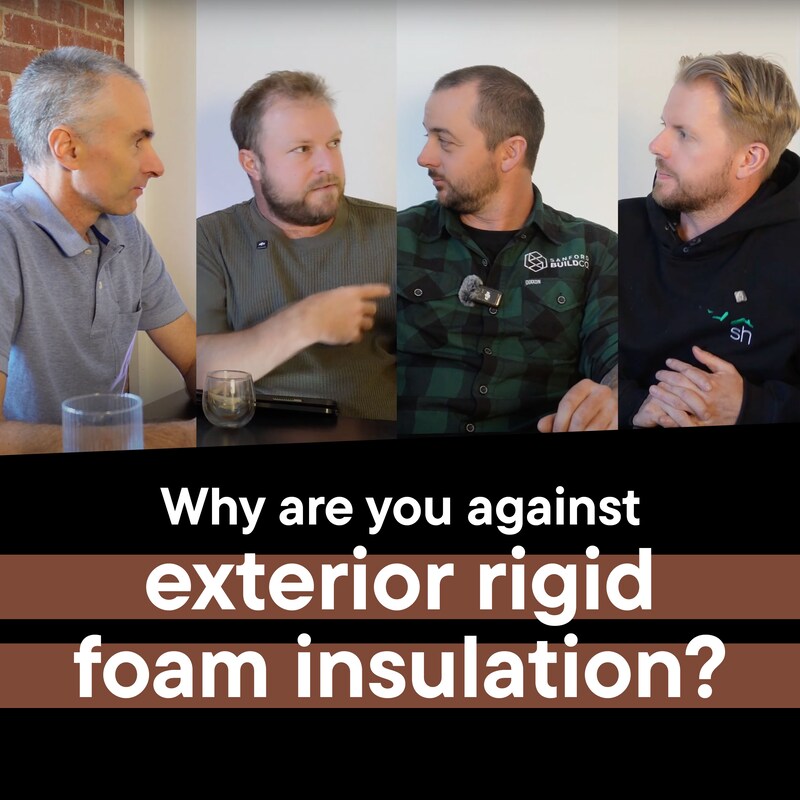
Speaker:But you don't seem to advocate for the use of external rigid foam insulation.
Speaker:Why not?
Speaker:So firstly, the material properties, so it's a petrochemical, it's gonna
Speaker:last for a squillion years, which on a building is potentially a good thing.
Speaker:But you know, there are end of life of our buildings.
Speaker:What do we do with these products at the end of life?
Speaker:Now many of the manufacturers will tell you they're fully recyclable.
Speaker:Well.
Speaker:At least in Australia find me a recycling facility for these things.
Speaker:You know, even a lot of the products that we know, we do have recycling streams for.
Speaker:In Australia.
Speaker:We have very low recovery rates.
Speaker:So there is a problem inherently, in my view, with the material itself from that
Speaker:point of view, from a building durability or a construction point of view.
Speaker:The issue comes down to vapor permeates.
Speaker:That all foams are far more vapor retardant or they let less vapor through,
Speaker:and your obvious alternative being your bat insulation, like a glass full product.
Speaker:And so the concern then is depending on how you choose to do it, whether
Speaker:you are actually introducing a moisture problem into your, into your building.
Speaker:Now, that's not to say that you can design that out.
Speaker:You absolutely can.
Speaker:You can build a. Foam built building and it will perform excellently, you know,
Speaker:your classic esky type construction.
Speaker:Uh, but the, the main thing to me comes back to that materiality,
Speaker:that the petrochemical base.
Speaker:So how about like something like waffle pods?
Speaker:'cause I've always cons, like I know that's not, it's
Speaker:a clever idea for, and insulation, no,
Speaker:it's not even insulation.
Speaker:It depends where you put it.
Speaker:So if you put under slab, like I, I, it goes back to where I'm
Speaker:getting the rigid insulation.
Speaker:Is I, I don't like waffle pods at all.
Speaker:I think, like I've had issues with them recently trying to dispose of them and not
Speaker:So you're saying the waffle doesn't have a oven?
Speaker:Uh, it look, it, it provides some thermal resistance, but I suggest we overplay it.
Speaker:Um, what's the main role of a waffle?
Speaker:It's a void form.
Speaker:Yeah.
Speaker:It's trying to create a space to reduce the amount of concrete we,
Speaker:we use and therefore drive down the cost of building that slab.
Speaker:Yeah,
Speaker:that's why we invented it.
Speaker:And then we thought, oh, well, when you say it like that actually
Speaker:doesn't sound like a bad thing.
Speaker:It's not a bad thing.
Speaker:Yeah.
Speaker:I've got no problem with that idea of reducing concrete use
Speaker:coming back to our material.
Speaker:But now you're choosing it with EPS though, which is, is it any better?
Speaker:Well, well, exactly.
Speaker:And you're creating this composite material you think
Speaker:of end of life recyclability.
Speaker:We have the same in our recycling streams.
Speaker:You know, we have in Australia, as we know.
Speaker:Commingled recycling.
Speaker:We chuck our glass and with our plastics, well, with our cardboard and our, and
Speaker:then someone somewhere has to separate those as that wa those waste streams out,
Speaker:which is very difficult and costly to do.
Speaker:Uh, here we are creating this monster sort of, um, Frankenstein material
Speaker:that's a mix of EPS, foam and concrete.
Speaker:I'm think throw, I'm gonna throw some to all
Speaker:of you here,
Speaker:um,
Speaker:when we're doing a uncoupled slab.
Speaker:We are putting the XBS on the underside of our vapor barrier with the hope thought,
Speaker:whatever, that if they ever did go to recycle that slab that it's separated.
Speaker:Do you think that's a, that's a good question because I'm about
Speaker:to do my first that style of Yeah.
Speaker:Always.
Speaker:Always.
Speaker:Yes.
Speaker:And then, and then, um, and then, because I had the issue recently last
Speaker:year, is we were demolishing a home.
Speaker:And there was, uh, there, I think from my understanding, the EPA have changed
Speaker:the rules around disposal of EPS.
Speaker:And because it was in the concrete, it's now hazardous waste and everything
Speaker:goes by weight and concrete's heavy.
Speaker:So now that kind of suck with the concrete, so then you pay a fortune.
Speaker:So it's a really good point.
Speaker:Then something that I'm like, oh, I've gotta note that down to tell my team.
Speaker:Yeah, plastic on the, over the, yeah.
Speaker:Yeah.
Speaker:I mean, uh, like if you.
Speaker:Are you not tap you're not taping the xb s either?
Speaker:No, no, no, no.
Speaker:Not taping the xb s No, we're just putting the, the, so xbs base down
Speaker:and then um, plastic and then steel concrete off of that shouldn't be any
Speaker:issues from a structural buildability.
Speaker:Zero.
Speaker:No.
Speaker:Yeah.
Speaker:In my opinion, zero zero.
Speaker:But like when they're going to cut it and then jack it up,
Speaker:is some of that getting mixed?
Speaker:I. And, and just another sort of counterpoint to consider, as we've
Speaker:discussed previously, all insulation works on the basis of still air gaps.
Speaker:Yes.
Speaker:And that's the same for X-P-S-E-P-S as it is for glass wall and other products.
Speaker:And so if you've got that XPS sitting below the water table under the slab Mm,
Speaker:and it gets moisture into it, and you get water in in those air gaps instead of air.
Speaker:Water is far more thermally conductive than air.
Speaker:Ooh.
Speaker:And so potentially you are degrading the performance of the insulation.
Speaker:Oh, yes.
Speaker:Now XPS is far more water resistant than say, EPS and certainly glass wool, but it
Speaker:is not, you know, you dunk XPS in a bucket of water and leave it there for a month.
Speaker:It's gonna have some moisture.
Speaker:Yeah.
Speaker:And we, I think we've actually asked you this question before, during, you know,
Speaker:when, when we've gone to build this.
Speaker:But like in my mind, I, I don't know, and you can answer this
Speaker:depending on the thickness.
Speaker:You kind of over exaggerate the lack, like drop in performance.
Speaker:'cause I think we're talking about maybe, maybe it was even Ransom
Speaker:Street, I can't remember, but we were talking about putting the XBS on the
Speaker:underside of it and then the plastic, and then I think you said, well,
Speaker:if that gets moisture in a certain level in that XBS, we can only then.
Speaker:Put into the PHPP that it's 70 mil xbs, or 80 mil XB s or something like that.
Speaker:So being conservative about it, the problem
Speaker:probably is you don't quite know Yeah.
Speaker:What ratio to assume for a particular site, you know, what's the water?
Speaker:So Yeah.
Speaker:And then, then, then to completely eliminate that two layers of plastic
Speaker:and then, and we've got more plastic, fuck, we've got more plastic.
Speaker:But is it, are we now, is this, if this is the worst part about our building,
Speaker:to me that's like, yeah, it's like.
Speaker:That's okay.
Speaker:Two, do you sometimes take the Boomer approach like surely in a hundred
Speaker:years when they're gonna fix, remove that slab, which the way we build
Speaker:slabs now should never really move and should always be able to be reused.
Speaker:I. Yeah.
Speaker:Is it just going to be like, they'll have a system to recycle it?
Speaker:Potentially.
Speaker:I don't
Speaker:think that's ethical.
Speaker:I don't think that that's, I don't think we should pass on a problem
Speaker:to our children and grandchildren.
Speaker:Say, you guys fix it.
Speaker:No, we've had enough of kicking the can.
Speaker:We've done done enough of that.
Speaker:It hasn't worked for you.
Speaker:Right.
Speaker:And just blow
Speaker:me.
Speaker:Blow your away.
Speaker:Why?
Speaker:Why we don't have products like global here.
Speaker:Like, I mean, so expensive.
Speaker:In the US they have Daniel GL, who works for Matt Risinger, did a really good
Speaker:post a few years ago, and he reshared it where they had a highly reactive
Speaker:site and they used a cardboard type product instead of a waffle pod that's
Speaker:designed to just deteriorate a goal.
Speaker:Avoid format.
Speaker:Yeah, avoid format.
Speaker:And you, they use the, is it couple complex?
Speaker:Is that the plastic now?
Speaker:The recycled, yeah.
Speaker:Recycled
Speaker:plastic.
Speaker:Yeah.
Speaker:Yeah.
Speaker:So we have a few other options of void form.
Speaker:Again, we're just trying to create an egg cavity, um, that are plastic based now.
Speaker:Okay.
Speaker:It's not great material.
Speaker:You could argue it's an end of life thing, but we've gotta stop.
Speaker:I would suggest talking about these things as recycling.
Speaker:Like you're not taking those old PET plastic Coke bottles and making 'em into
Speaker:couple X by X whatever, and whacking 'em in your slab and saying That's recycling.
Speaker:That's recycling is reusing for exactly the same or better purpose.
Speaker:We are down cycling.
Speaker:We're taking a material, we're using it for a good purpose plastic bottle.
Speaker:Then we are using it for a. Avoid former in a slab and that's it.
Speaker:After that, there's,
Speaker:you know, could you say it's a better purpose?
Speaker:'cause we shouldn't be just using plastic bottles.
Speaker:So it is up-cycling as something it should be if constructed there forever,
Speaker:well yeah, but find a building that's there forever.
Speaker:So can I, because touch on this down cycling thing for a second.
Speaker:I mean, okay, upcycling sounds better.
Speaker:GaN cycling doesn't sound as good.
Speaker:But is down cycling better than just throwing it out?
Speaker:We could argue that, but of course we've gotta try and get to that
Speaker:fully circular economy where we're recycling for like, for like,
Speaker:and then I guess you also need to look at what is the, um, the
Speaker:embodied carbon in turning it from this product into that product.
Speaker:And at what point is there a tipping point?
Speaker:Mm.
Speaker:And you know, even if you can recycle it back to an equivalent, same
Speaker:product, if that's gonna require a huge amount of energy to clean it.
Speaker:Melts it down, refabricated it back in.
Speaker:Then obviously you've got that, that impact as well.
Speaker:What a's tenured?
Speaker:I know.
Speaker:So did we get an answer if you use external ridge ation?
Speaker:What was the question?
Speaker:Do you seem, you don't seem to advocate for the use of
Speaker:external rigid foam insulation?
Speaker:Here's your question.
Speaker:Um, zipper, and we don't have it here, but what is, I thought
Speaker:zipper was a, was a foam product.
Speaker:Is that
Speaker:not vapor?
Speaker:Vapor closed.
Speaker:Vapor closed.
Speaker:Yeah, that's right.
Speaker:It is.
Speaker:But it's on the exterior of your construction.
Speaker:Yeah.
Speaker:Okay.
Speaker:Yeah, and it really is from a builder's perspective, a great product.
Speaker:Like we don't hobby here or anything similar.
Speaker:Like it's what one, maybe two trips around the building compared
Speaker:to the four, five we might take.
Speaker:And you're externally inciting in the same top process.
Speaker:So, yeah, it wouldn't make a whole lot of sense.
Speaker:Is it all their insulation?
Speaker:Insulation?
Speaker:They're doing that and then they're doing, yeah.
Speaker:And remember also just when we think about using foam as insulation in
Speaker:our buildings, you know, all three of you probably have done sips before.
Speaker:Yeah.
Speaker:And all of our SIPS panels are OSB faces with a, a phone call.
Speaker:Yeah.
Speaker:So yes, you can absolutely do it, but as a client, you probably just need to.
Speaker:Comfort yourself so you're accept accepting that this is a
Speaker:petrochemical of dubious recyclability.
Speaker:Does water tr, which you kind of feeds into what we're talking about a little bit
Speaker:before, does water travel down under the slab insulation and end up under the slab?
Speaker:Well, isn't that very dependent on your site conditions and how you've managed?
Speaker:According to some people, water doesn't get past your eves and go under a house.
Speaker:Matt knows what I'm talking about.
Speaker:I was about to say the architect's name.
Speaker:I've got a mate who lives in rural New South Wales on a waffle pod slab, and
Speaker:they've had so much heaving from the ground conditions that in the middle
Speaker:of his house, you can slide your entire arm under the internal wall frame.
Speaker:'cause as the outside of the house has heaved and with the trusses tied into
Speaker:the internal walls, it's lifted them.
Speaker:And that's how much it's moved just from.
Speaker:The expansion of highly reactive clay.
Speaker:Whoa.
Speaker:I know.
Speaker:So is it, this is not a slab though.
Speaker:Yeah, slab.
Speaker:I know like some of our slabs, I've looked at soil test results recently and they,
Speaker:they can expect up to 60 to 70 mil of movement within the soil at any time.
Speaker:And I've actually experienced it.
Speaker:One of our houses, what we did is we lasered our subfloor, perfect.
Speaker:Lasered the top of the frame.
Speaker:Perfect.
Speaker:Lasered our windows.
Speaker:Perfect.
Speaker:Put it in that floor and then we'll just lasering some joinery.
Speaker:And my team are like, we, it's 50 mil hour somewhere and it's soaked 50 mil.
Speaker:What we, I, so I called the foundation people that we did the alternative footing
Speaker:and they were freaking out and we called the soil engineers like, oh no, no, no.
Speaker:We can expect, we can expect another 20 mil.
Speaker:This is normal.
Speaker:So when we have, and because what was happening is 'cause we're on bedrock
Speaker:across the whole site, we'll only be able to get down to a certain level.
Speaker:So once the water hits that bedrock, you'd have nowhere to go.
Speaker:It just was, it just would slow.
Speaker:And it was, that 2021 remember was really, really wet.
Speaker:And obviously it just saturated the soil and the ground had just become like a big
Speaker:swimming pool underneath it and build up.
Speaker:Actually all the claim is just expanding and pushing it up.
Speaker:I had an issue with, uh, with a, with a project from friends of mine and
Speaker:we finished a house at the end of 2021 and there was ham days of rain.
Speaker:Yeah.
Speaker:In over that summer, like it was astronomical.
Speaker:I. And all of a sudden everything started moving cracks everywhere,
Speaker:and then it hasn't moved since everything started, hasn't moved since
Speaker:being the really good builder that I am, I went and fixed everything,
Speaker:but I did say, this is not on me.
Speaker:Everything's been checked.
Speaker:The foundations and everything were correct.
Speaker:I almost guaranteed from the water.
Speaker:Yeah.
Speaker:And everything's now settled down.
Speaker:Well, water manage, I think it should be the first question on any site, they get
Speaker:a site survey, what's apart from water?
Speaker:Like how are we gonna get water just away on site?
Speaker:I mean, and it also then goes to, you know, whenever you're looking at a set
Speaker:of plans and you've got a small server and there's 36 board piers in, and
Speaker:you're like, you kind of know why now.
Speaker:Well, there are project in Clifton Hill and there's 38
Speaker:board peers in there on a slab.
Speaker:That's.
Speaker:We usually have 'em every 1200, 8, 10.
Speaker:It's tiny, like it's a tiny slab, but we, we've had 'em, we at one
Speaker:of our projects now, we were nine meters deep with screw piles.
Speaker:That's when we hit bearing capacity and it's, I'm okay with it because at the end
Speaker:of the day, it's what needs to happen.
Speaker:You get that at your side at it, muffle?
Speaker:No.
Speaker:What's the, oh yeah.
Speaker:But like scratch the surface and you're hitting rock.
Speaker:Yeah, it's, but don't you also with rock, don't you, if you are in rock,
Speaker:don't you have to at least be certain, like you've gotta start grinding out
Speaker:the rock to be a certain depth down.
Speaker:I think still minimum your footing still need to be a certain Yeah, yeah.
Speaker:To be able to perform.
Speaker:So yeah.
Speaker:But that's the, if you are already at the bearing capacity and you look
Speaker:at like American construction, that was clearly the whole site flat.
Speaker:And then form up their footings on top and then adequate,
Speaker:adequately create drainage around.
Speaker:Whereas we dig in and hope that nothing's gonna fall in that hole.
Speaker:And what was the question again?
Speaker:Because I think we probably, but, but, but, but also with that, I'm pretty sure
Speaker:with America as well, they don't usually have gutters and downpipes, do they?
Speaker:It depends on the area, but you should see how well they
Speaker:manage where that water goes.
Speaker:It's not like, oh, they don't have a gutter and it just falls onto the footing.
Speaker:They actually great everything, A lot of planning.
Speaker:Obviously there's, you know, poorly executed things like
Speaker:everywhere in the world, but.
Speaker:Where they don't have gutters and stuff.
Speaker:Obviously if you've got gutters in areas where you get huge amount of snowfall,
Speaker:your gutter's only gonna last so long before it falls off the side of the house.
Speaker:So you might as well just not have a gutter.
Speaker:That's a fair point.
Speaker:Yeah.
Speaker:And then just create, um, manage where that water goes once it hits the ground.
Speaker:Yeah.
Speaker:Talking 'em to, uh, JTE from Treasure Builders, they're building a place up
Speaker:in dinner plan at the moment and I was having a chat with 'em over the weekend.
Speaker:Like there's no gutters, no gutters or anything up there 'cause it
Speaker:just fills up with water and freezes and they just all fall off.
Speaker:Yeah, but they're managing it through, um, drainage.
Speaker:So should every job then have a str, like a civil plan attached that is
Speaker:actually designed and signed off?
Speaker:Do you think that should be an norm?
Speaker:Well, let's tend to think about it.
Speaker:What kills buildings?
Speaker:What?
Speaker:Okay.
Speaker:Well there's your answer.
Speaker:It's a cost more.
Speaker:Well, also it's also across.
Speaker:Yeah.
Speaker:We always talk about how much it's gonna cost at construction,
Speaker:but how much does it cost to then rectify it in 2, 3, 4, 5 years?
Speaker:You know, it's like, yeah.
Speaker:Mark's now just.
Speaker:Put out a thing the other day, which was awesome.
Speaker:Like, you know, we build houses that your grandparents will fight over and not fix,
Speaker:or your grandchildren will fight over.
Speaker:You know what, let's just also just take a moment and just acknowledge how
Speaker:good Mark's marketing's at the moment.
Speaker:Yeah, it's, yeah, it's awesome.
Speaker:Serious photos.
Speaker:Really good.
Speaker:Be serious photos.
Speaker:This is a pretty interesting one actually.
Speaker:So when you get into passive house construction.
Speaker:What are the biggest mistakes you can make?
Speaker:Not ventilate properly.
Speaker:Yeah.
Speaker:But if you're building a passive house, you already, you
Speaker:have to ventilate correctly.
Speaker:Sequencing, I reckon is probably one of, sorry.
Speaker:It's, oh, can, can you talk about sequencing and air tightness?
Speaker:Well, I, I'm not a builder.
Speaker:I think Brad's better off talking about sequencing.
Speaker:Yeah.
Speaker:I think that, yeah, that's probably one of the biggest mistakes you could, you could
Speaker:make is not, not understanding when things need to occur or making profit provisions.
Speaker:Proper provisions for things not understanding how certain systems work.
Speaker:You know, if you've never put into HRV, you might not realize that
Speaker:it needs to have a drain point.
Speaker:You know, those, those sorts of things.
Speaker:Or like, you know, ask Drew how many build he goes to where a
Speaker:builder's never done it before.
Speaker:And you know, he gets a call up saying, oh, I'm ready for the HIV
Speaker:and they're so far down the line and he hasn't roughed anything in.
Speaker:Yeah, I'd say, I'd say, yeah.
Speaker:See, there's two things that I quickly come to mind.
Speaker:Is one, a condensation drain for your HIV.
Speaker:Mm-hmm.
Speaker:But going before that, for a, this one for architects is designing
Speaker:enough space for your HIV ducks.
Speaker:So having 140 mil dropdown minimum.
Speaker:Yeah.
Speaker:Minimum.
Speaker:I know that you actually have to, you've got heights and you're trying
Speaker:to fit in as much and I respect it.
Speaker:Um, but if you just go, if I allow 140 mil across the whole house.
Speaker:We we're most likely say one 50.
Speaker:Yeah.
Speaker:We, we can say, let's say one 50 with your bends.
Speaker:Yeah, yeah, yeah.
Speaker:Especially where the ducting goes into the manifold and then into the
Speaker:unit and, and have a dedicated space for your mechanical ventilation.
Speaker:Don't just try whacking in the cupboard under the stairs.
Speaker:Think about, well, we're gonna, how are the pipes gonna get there?
Speaker:How are we gonna get that outside?
Speaker:So I think it's also sitting down with, and if it's your first, my biggest
Speaker:suggestion is find someone to fight, be a bit of a mentor maybe, and be
Speaker:like, Hey, what did you make mistakes?
Speaker:What did you do?
Speaker:What can you do here?
Speaker:Is this the right location?
Speaker:Or trust someone like Cam and Joel to tell you that Like, no,
Speaker:that's, we can't put that there.
Speaker:Yeah.
Speaker:I actually took a client and another buildup.
Speaker:To Ish's job so they could see how the HRV duct work rolls into the unit.
Speaker:'cause they had allowed 90 mil and I was like, not the duck's 90 mil.
Speaker:They the duck's 90 Milt.
Speaker:I'm like, okay, tell it to stay in 90 Milt.
Speaker:And also you've gotta go under a top plate at some point.
Speaker:So there's 45 you've already lost.
Speaker:Yeah.
Speaker:And it's not one duct that comes into the unit on their particular build.
Speaker:It's 14 seven supplies and seven extracts.
Speaker:Like seven extracts.
Speaker:Oh, sorry, whatever.
Speaker:That's a lot of extra.
Speaker:And remember, you've got the manifolds here, you've got a
Speaker:whole lot of stuff going on.
Speaker:You've got your, so have the filters potentially.
Speaker:Uh, gotta deal with that.
Speaker:And then just back on the sequencing thing at the framing stage.
Speaker:Remember those starter strips?
Speaker:Yeah.
Speaker:That's how many times have we had to rework jobs where you pull out
Speaker:end plates to get those data strips.
Speaker:So it probably comes back.
Speaker:I know you said with your house, you, you eventually, you originally didn't
Speaker:get it airtight in your first house.
Speaker:But I'd say from our perspective, he's like, we got to learn from what he made.
Speaker:A mistake can just
Speaker:land on that second cam got his house airtight.
Speaker:Yeah.
Speaker:One, 1.2 ways.
Speaker:Yeah.
Speaker:Ken's already is airtight.
Speaker:It's airtight.
Speaker:This
Speaker:didn't fit the arbitrary numbers of the passage.
Speaker:Yes.
Speaker:Thank you for association saying thank you for pulling me up on that.
Speaker:But you are detailing and the your Oh, we needed that there.
Speaker:We needed that there.
Speaker:So you put that information out.
Speaker:Some people like go, oh, to my team, we need that there.
Speaker:We need that there because cam.
Speaker:Missed the arbitrary number, so we need to, we have, we
Speaker:have to get it sort of thing.
Speaker:I think that I'd say the sum of every time we fucked up, and I would almost
Speaker:say now, you know, there's a lot of things that we've learned from all the
Speaker:things that we fucked up on, which now we're not making those mistakes again.
Speaker:I think the other one, the biggest one as a builder, and the biggest mistake you
Speaker:can make as a builder is not setting your.
Speaker:Progress payments correctly?
Speaker:Oh yeah.
Speaker:For a passive house, it is the number one thing that will hurt you on a project.
Speaker:Can I just say one of my current projects right now, and I think I've talked to you
Speaker:about at least this year, three months, I went without a progress claim because.
Speaker:We got some sequencing out in our programming and it didn't quite match
Speaker:up with where our progress claims were.
Speaker:We then realized that we needed to actually build it in a certain
Speaker:way, so we actually stopped doing what we were gonna do to get the,
Speaker:that particular progress claim.
Speaker:And I went down to the, the.
Speaker:Line with money in my bank account for not having that dialed in.
Speaker:So you're not giving the same position, Neil.
Speaker:Yeah.
Speaker:What I've done in the past, and I've had that issue, is I just told the
Speaker:clients and asked to do a variation.
Speaker:We did, we to the progress payments, which you can.
Speaker:Yeah, we did.
Speaker:So, so, so we did that.
Speaker:Yeah, we did do that.
Speaker:But it still meant the next progress claim was still a ways out because we
Speaker:needed to balance the, the quantity of work involved in this and the
Speaker:quantity of work involved in that.
Speaker:And make them kind of equitable.
Speaker:So the bank would say Yes, I would.
Speaker:Yeah.
Speaker:And I'd say it becomes way more complex on a double story.
Speaker:That is where I have been caught out.
Speaker:Yeah.
Speaker:That's where I got caught out.
Speaker:And I, uh, it is the fact that your scaffolding can be up for a long time
Speaker:because if you've got external lining, you need to then seal the penetrations.
Speaker:You can do your battens, but you can't pull 'em a cladding 'cause
Speaker:the roughing needs to be done.
Speaker:After the roof and the weather tightness, but blow a door test
Speaker:because you're on insulation.
Speaker:So you start to like, play around with these things.
Speaker:If, if this is something we're talking about, like, I guess just outside of just
Speaker:the passive house, you're scaffolding allow much more than you think, oh,
Speaker:I, I I, it's 26, 30 weeks minimum.
Speaker:And then you've gotta make sure that all your trades are allowing to make many more
Speaker:visits than what they would normally make.
Speaker:Yep.
Speaker:It's not common roughing the electrical.
Speaker:In one hit coming rough in all the plumbing in one hit.
Speaker:External panels.
Speaker:Yeah.
Speaker:Just once you've wrapped your roof, before you put your roof sheets
Speaker:on your roof cluttering, you need to get your solar penetration.
Speaker:So there's the solar team coming out for a quick little
Speaker:yeah.
Speaker:Thing.
Speaker:You've got your stink
Speaker:bite from your plumber.
Speaker:Yeah.
Speaker:And now you've also got electrician usually running
Speaker:the antenna through minimum.
Speaker:Like in that.
Speaker:So you've already gotta seal those penetrations.
Speaker:And the other ones I always do is like the window manufacturer and deposit, like,
Speaker:'cause you gotta upfront them very early.
Speaker:If you have a pre-construction method like a SIPS or ACL T, like you need to.
Speaker:Fund that really early in the project.
Speaker:'cause you might be waiting 20 weeks to get them on site.
Speaker:And it's not just the deposit, it's all the other progress
Speaker:claims that come along with that.
Speaker:Yeah.
Speaker:It's not that we're trying to, as builders I would say, here, get money in our banks.
Speaker:It's, we've gotta spend it pretty quickly.
Speaker:Like it's just to keep approaching money in our bank so then we can pay.
Speaker:How about from your side, from a, when you do film modeling, what are
Speaker:the biggest mistakes you can make for someone that might be in the backend?
Speaker:Before we even get it on site,
Speaker:probably substitution.
Speaker:Well, it it, if you are on site, I was gonna say product substitution.
Speaker:Who would
Speaker:do that?
Speaker:Someone changes something somewhere during construction.
Speaker:Like it happens all the time.
Speaker:Whether it's coming from the client or the builder or architect.
Speaker:You know, I did it on my
Speaker:own house this week.
Speaker:You've done it on your own house and it's paint.
Speaker:From my point of view.
Speaker:But you know, the key thing is, particularly for a project that is
Speaker:seeking passive house certification, always, always run it by your passive
Speaker:house consultant before we do it.
Speaker:Now, it might well be fine, and in many cases it is, but you need to
Speaker:loop in your passive house consultant because there is a serious risk that
Speaker:you would jeopardize the likelihood of certification at the end of your project.
Speaker:And clearly if that's in your contract with your client.
Speaker:That could be a real problem.
Speaker:That is another thing that I was gonna say.
Speaker:Do not put in your contract that you will deliver a certified passive house.
Speaker:Yeah.
Speaker:Suspend got a story about that.
Speaker:'cause the building surveyor actually took that to the next thing and
Speaker:would not give the final CFO until there was a certified building.
Speaker:Yeah.
Speaker:And they couldn't release it.
Speaker:And they couldn't release the C. So just on what you were saying
Speaker:before, cam in the middle of COVID.
Speaker:My, one of my earliest sort of ventures into like a full, long certified building.
Speaker:Um, prices are going up, left, right, and center.
Speaker:We're trying to, you know, manage the budget.
Speaker:Um, and we've got COVID that we're dealing with building a passive
Speaker:house for some good friends of mine.
Speaker:Collectively, we made the decision to, um, change windows.
Speaker:During, because, 'cause I had ones coming from China Yeah, from China.
Speaker:We weren't sure how long they were gonna take to get to Australia.
Speaker:Um, the modeling went in on these particular windows, which performed better
Speaker:than the ones that we decided to go with.
Speaker:Now, luckily we didn't have, in our contract there was gonna
Speaker:be a certified passive house.
Speaker:We've got a certified drilling net, but it's a PHR low energy home because the
Speaker:windows are what tripped it over the edge.
Speaker:So I think it's also not as well performing, but also on the flip side,
Speaker:as a builder, like if I write, we will give you a certified passive house.
Speaker:I've could assume that he, like Cam's got all his modeling right.
Speaker:'cause what if he's got it wrong and I've written, we will give you one or
Speaker:we are gonna give you one That's a Yeah.
Speaker:Like what if we, all of a sudden he's allowed R four and we needed
Speaker:to get an R five installation of walls, so now I'm screwed.
Speaker:I've done all my bit.
Speaker:So what I would suggest is, as the builder is like, yeah, if you as
Speaker:a client and you want a certified passive house, say that you, the
Speaker:builder in the contract will reach 0.6.
Speaker:That's a very easy one for the builder to take control of.
Speaker:Is it though?
Speaker:I think getting air tidies, if it's a new house, it's so easy.
Speaker:Depends on materials because you know, we, me and Hamish have both done hemp gr
Speaker:houses and the one that I did very well could have been a certified passive house.
Speaker:What led us down was the air tightness and what let the air tightness down
Speaker:was the fact that we had no internal render, but that's on the design
Speaker:and actually picked up earlier, but also the wheel windows good.
Speaker:Yeah.
Speaker:Yeah.
Speaker:But nobody knew.
Speaker:No one can tell you, oh, you know.
Speaker:A 300 mil hemp creat wall is gonna achieve.
Speaker:Obviously we know pretty, if you, I'm pretty sure I said
Speaker:something as you building.
Speaker:Yeah, we know.
Speaker:Yeah.
Speaker:We know.
Speaker:You know, until, you know.
Speaker:Okay.
Speaker:That's a proven system.
Speaker:That's a good point.
Speaker:Yeah.
Speaker:Okay.
Speaker:When you're doing stuff with, you know, different things, yeah.
Speaker:There's no guarantee that you are actually gonna to get there,
Speaker:regardless of how hard you tried.
Speaker:Like, I tried really hard and we got to 0.82, the quote, the quotes that the, the,
Speaker:our tenure documentation of which we're appending to our contracts clearly stayed.
Speaker:That the project is targeting passive house certification.
Speaker:Not, not saying that we're building a passive house,
Speaker:but I think even setting aside the legal part of it, you know, we're all diligent
Speaker:trying our very best for our clients and we want to, if we say we're gonna want
Speaker:to try and make this a passive house, that's genuinely what we're trying to do.
Speaker:We don't wanna let down our clients.
Speaker:Yeah.
Speaker:And so as a passive house consultant, coming back to Matt's point,
Speaker:it is absolutely correct that there are a thousand different
Speaker:places you can muck up this.
Speaker:As from a modeling point of view, and I do that all the time.
Speaker:And that's why the certification process for me offers a great deal
Speaker:of value and confidence because by getting that independent QA, I've
Speaker:reduced the likelihood that any error I've made, uh, so significant
Speaker:as to jeopardize certification.
Speaker:Yep.
Speaker:So it, it's, it's providing me with confidence.
Speaker:'cause we all know we make mistakes and we've picked up those areas
Speaker:early and this all should be done pre-construction before you get to
Speaker:site, get that first review done always.
Speaker:And I plead with all the passive house site out there to get that done.
Speaker:And any, or the whole project team put, put that onus on, get
Speaker:the certifier engaged and get them to do that first review.
Speaker:I think the other thing is a mistake if you're an architect of building design
Speaker:or not, involved in the builder in early.
Speaker:That's your, your, I think personally you're playing fire.
Speaker:Yeah, we know that.
Speaker:Yeah, I know, but like, how much can we say it though?
Speaker:Oh, I think we could say it probably on every episode that we put out, but
Speaker:I think people are still gonna, I mean, you know, don't gonna say architecture
Speaker:will be architects and they'll want to go to tender and they'll wanna.
Speaker:But I think the issue is like, let architects be architects.
Speaker:Like that's what they're really good at.
Speaker:Let us, as builders tell you how to build that design so there you can
Speaker:potentially get more freedom with your architectural design if you
Speaker:allow us to have the input that what if we build it this way, worrying
Speaker:about these things a hundred percent.
Speaker:So you can push the boundary that little bit more.
Speaker:A hundred percent because at the end of the day.
Speaker:If you were to do a competitive tender as a passive athlete and
Speaker:architect and it didn't work, bang, variation, and I imagine the amount
Speaker:of variations that you could just claim because you like, you didn't
Speaker:put insulation on your drawings there.
Speaker:It's not there.
Speaker:It's same bridge.
Speaker:We need to insulate it.
Speaker:You would just rack up variation after variation after variation.
Speaker:Like no, I, I don't disagree with you, but I think a lot of that stuff you
Speaker:get washed out if you've got a good designer and then a certifier involved.
Speaker:And I've never had that issue by the way.
Speaker:I'm just talking in hypotheticals.
Speaker:But it becomes a false sort of like we go to tender and we don't involve the builder
Speaker:so late on the basis that we assume we can get a lower cost for our client by
Speaker:maintaining that competitive tension.
Speaker:But it tends to blow up and ultimately the client's phases because they're the
Speaker:ones that are gonna have to cop the extra cost of whatever needs to be changed.
Speaker:Yeah, yeah.
Speaker:And yeah, and I, I look at it too as well.
Speaker:Like, I think it's also very important to get an experienced team on early and.
Speaker:It's hard because now I'm sort of trying to push potential people
Speaker:who wanna get into this side of the industry away because like if I was
Speaker:a client wanting building a pastas, I would want someone that's done it
Speaker:before and have the runs on the board.
Speaker:It's like you go to a knee surgeon, do you go to a knee surgeon
Speaker:that hasn't done one before?
Speaker:But then there's also the flip side of that argument saying that
Speaker:everyone's gonna get their starts.
Speaker:No, no, no, no, no, no.
Speaker:This is, it's such, I know, this is, that was my follow up.
Speaker:Yeah.
Speaker:And that, and that's the hard conversation like.
Speaker:It is still new.
Speaker:It needs to come back to an education system.
Speaker:Like we have this passive hour certified tradesperson course.
Speaker:I think that should not be there and this stuff should be taught over the
Speaker:whole apprenticeship and that, so by the time the apprenticeship, you actually
Speaker:have that within your apprenticeship.
Speaker:It's part of it.
Speaker:So part of it having to have an extra course is just making
Speaker:it like, oh, it's scary.
Speaker:And the percentage of people that actually enroll, like there's thousands
Speaker:and thousands of tradies spa out a year.
Speaker:It's probably what, maybe a hundred that finished that course.
Speaker:So it's such a tiny percentage and I, for someone to learn to become a
Speaker:certified passive house trades person by just sitting in front of a computer and
Speaker:ask answering questions is ridiculous.
Speaker:And you should, until you have, maybe it's ridiculous.
Speaker:Is a good way.
Speaker:To get a, a base knowledge.
Speaker:True.
Speaker:But, but the outcome I think is wrong.
Speaker:Yeah.
Speaker:You should have to have project.
Speaker:You should, you shouldn't Yes.
Speaker:Do the course, but the outcome shouldn't be that you're a certified tradesperson.
Speaker:You should do the course and say you've done the course.
Speaker:Yeah.
Speaker:But there shouldn't be a certification at the end of it
Speaker:saying that you're a certified.
Speaker:Uh, until you've done X, Y, and Z off the back of that.
Speaker:Okay.
Speaker:So do they do the same with a certified passive house designer?
Speaker:A hundred percent.
Speaker:How about like a lawyer that hasn't done anything in court or a doctor
Speaker:that's never done surgery or,
Speaker:and a lot of those professions that you also have a sort of mentor?
Speaker:System, don't you?
Speaker:You know, as a, as a trainee doctor, you'll go into a hospital and you'll
Speaker:shadow a, a surgeon around or a doctor.
Speaker:Yeah,
Speaker:I know.
Speaker:I actually a hundred percent agree with you.
Speaker:But then do the training and then go and then, and then the certification
Speaker:part of it is, so you've got your degree and then you go and get your
Speaker:master's or, or like when you go for your builder's license, at the moment
Speaker:you have to show you three projects and that you've done that shows experience.
Speaker:So like Mark or Rory or Dave, that works for us.
Speaker:They've done it.
Speaker:They've got the experience on site.
Speaker:Yeah.
Speaker:You know what?
Speaker:They can go get ticked off because they can adequately
Speaker:show that they have done it.
Speaker:Yeah.
Speaker:And I think the system should be the same.
Speaker:If you haven't done one well, yeah.
Speaker:How do you, how can you kind of be uh, I'm an expert and I see it all the
Speaker:time and shits me out the wall that, oh, we're a passive house expert.
Speaker:We haven't even fucking walked in a passive house.
Speaker:Pretty sure my, um, Instagram says a passive house expert.
Speaker:Yeah, but you built them.
Speaker:But there's people out there who'd be like, and I get it all the time
Speaker:when we got for jobs against jobs.
Speaker:He's like, oh yeah, they're, they've um, they're passive house trades person.
Speaker:Like, how many have they done?
Speaker:None.
Speaker:I only did.
Speaker:The course.
Speaker:Yeah.
Speaker:Because I had clients asking, are you a certified passive house trades person?
Speaker:And I hadn't got a certified passive house at the time, but I'd worked
Speaker:on many and had got a couple to.
Speaker:But I think you can do that.
Speaker:I think you can.
Speaker:Like I, yeah, I think you can do the course and you can get the experience.
Speaker:I don't think you have to have built.
Speaker:A passive house.
Speaker:So here's a question.
Speaker:Are you still a Pacif House certified trace person?
Speaker:'cause I think one you have to, in, you have to renew with, is it International
Speaker:Passive House Association and log what you've done to keep your CPD points up?
Speaker:I don't think I actually am one anymore.
Speaker:Technically, I, I mean, maybe I'm not, but I, but like, this is the other thing
Speaker:I think, I think that just kicks in again, when you get a certified building.
Speaker:Yeah.
Speaker:But the thing is, like these people who are doing their passive house course
Speaker:five years ago haven't built one.
Speaker:You're not, you're no longer a certified trades person.
Speaker:Like that's you, which is stupid because you've done the studies.
Speaker:Yeah, and I'd say the studies that when we did a lot, you forget stuff too though.
Speaker:Like, you know, if, if stuff that I've learned in front of a computer five years
Speaker:ago, I'm gonna forget and things change unless I'm not actually doing it or
Speaker:actively going out and as you see, getting the CBD points or going to events or
Speaker:whatever, or listening to these podcasts.
Speaker:Yeah.
Speaker:But I think as a client, you probably don't want an
Speaker:inexperienced builder building.
Speaker:A certified passive house as their first thing.
Speaker:But the way that the industry is now, especially in Melbourne, Victoria,
Speaker:it's a lot easier to get some runs on the board as a trades person.
Speaker:'cause now there's more builders doing it.
Speaker:And if you reached out to any of those builders and said, Hey, I'm really
Speaker:keen to be involved on a, on a passive house project to learn, is there some
Speaker:capacity that I could jump on board?
Speaker:And get some real life onsite experience.
Speaker:I don't think there'd be many that would knock you back.
Speaker:I literally had a message yesterday for exactly that.
Speaker:Um, we're a chippy crew looking to expand.
Speaker:Uh, you know, our builders love what you do, really would interested in
Speaker:working on some high performance hangs.
Speaker:So it's happening now.
Speaker:I also say at the same time, this is also drives me insane, is your, and
Speaker:not picking on this carpenter, but you are framing you, you carpentry,
Speaker:framer, change the way you frame it.
Speaker:Like, no, that's how we now frame.
Speaker:We frame it a high performance level when you're doing California corners,
Speaker:this is how we're nogging out and you're just gonna force the builder to change.
Speaker:Yeah.
Speaker:I think sometimes also people just have to force that change and be
Speaker:like, this is how we frame now.
Speaker:It's better for the building.
Speaker:Yeah.
Speaker:Let's leave it there.
Speaker:Um, is there another question we, we've run out of time?
Speaker:Oh yeah.
Speaker:Oh, we reported the other question.
Speaker:Yeah.
Speaker:Okay.
Speaker:Well there you go.
Speaker:Um, thank you Cameron.
Speaker:And did we answer the
Speaker:question
Speaker:half?
Speaker:We got there so way off on a, we went off on a few tangents, but
Speaker:that's a whole idea of, I think it just creates great conversation.
Speaker:We can actually go back and forth and create the arguments, so yeah.
Speaker:Is that it?
Speaker:Yeah.
Speaker:Thank you.
Speaker:Thanks everyone.
