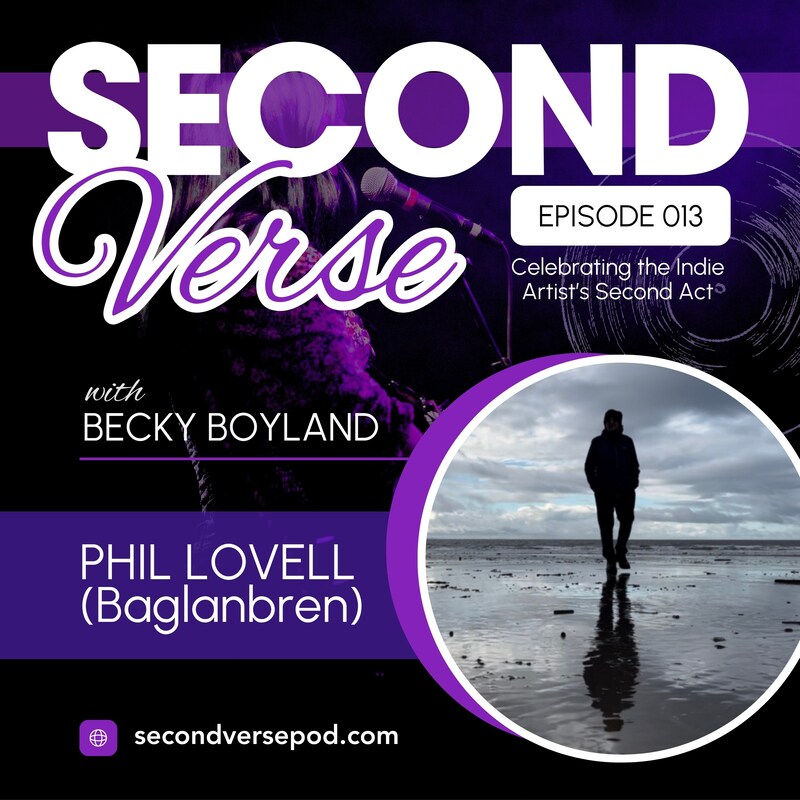
Shownotes
Phil Lovell: From Classroom to Songwriting - A Journey of Creativity and Persistence
In this episode of Second Verse, host Becky Boyland chats with Phil Lovell, a retired teacher turned songwriter who crafts thoughtful songs in English and Welsh. Phil shares his journey from nurturing his musical passion quietly while working in education for over 30 years to diving fully into songwriting and performing after retirement. They discuss Phil’s creative process, the impact of music on culture, the challenges of self-promotion, and the importance of pursuing one’s passion at any stage in life. Phil’s story emphasizes that creativity deepens with time and offers inspiration for anyone who thinks they’ve missed their chance. Stay tuned for his energetic Welsh song, 'Dw i’n canu fy nghân.'
Sponsors:
- Attitude Creativity: https://attitudecreativity.com/blueprint
- Singing / Straw: https://secondverse.com/singingstraw (affiliate link, 10% coupon auto-applied, or use code “secondverse”)
Connect with Phil Lovell (Baglanbren):
- Instagram: https://www.instagram.com/baglanbren/
- X: https://x.com/baglanbren
- TikTok: https://www.tiktok.com/@baglanbren
Phil’s Music:
- https://open.spotify.com/album/18FSt8LPogmNTxZuac3CCK?si=uD86_3SCRKCxBANCBKfknQ
- https://youtu.be/pYI8NEInZWA?si=Io1MNIuZsYfA9XTT
- https://youtu.be/D_Z4DvpRgwc?si=C-Wsppn3oA6hi89P
Featured Song:
“Dw i’n canu fy nghân” by Phil Lovell / Baglanbren, written by Phil Lovell (used with permission).
Timestamps:
- 00:00 Teaser Clip: Phil Lovell
- 00:27 Episode Intro
- 01:49 Welcome Phil and Early Musical Influences
- 03:36 Teaching and Songwriting Journey
- 04:51 Reconnecting with Former Students
- 05:37 Welsh Music Competitions and Traditions
- 06:45 Transitioning Back to Music After Retirement
- 07:18 Songwriting Courses and Collaborations
- 09:29 Performing and Recording Experiences
- 16:26 Sponsor: Attitude Creativity
- 17:47 Sponsor: Singing / Straw
- 18:45 Challenges and Rewards of Songwriting
- 25:23 The Importance of Arts in Education
- 34:18 Influences from the Past
- 36:50 The Craft of Songwriting
- 40:58 Realistic Advice for Aspiring Musicians
- 48:36 Conclusion and Farewell
- 49:38 The Coda
- 51:24 Featured Song: Dw i’n canu fy nghân
Transcripts
Teaser Clip: Phil Lovell
Phil Lovell: The first year after teaching, my wife said I didn't do anything for a year, just relaxed. Once I got a bit of energy back, my main focus is writing songs. I've got lots of ideas.
I, I'm not running outta ideas. There's another song. There's another song. There's plenty on my list of ideas I've got for writing songs.
It has been a matter of honing the craft, working at it. I think I've always been quite good with words, so for me, melody is king, but words are really important as well.
Episode Intro
Becky Boyland: Welcome back to Second Verse, the show that celebrates indie artists who've taken a bold turn or return toward music later in life. I'm your host, Becky Boyland, and today I'm taking you across the Atlantic to the poetic hills and harmonies of Wales. My guest, Phil Lovell, is a retired teacher turned songwriter, who crafts thoughtful, often bilingual songs in English and Welsh.
He's been compared to Neil Tenet, Nick Drake, and even Noël Coward and draws his musical DNA from greats like The Beatles, Cole Porter and Rodgers and Hammerstein. Phil didn't pursue music as a career early on. Instead he nurtured it in quiet corners while working in education for over 30 years. But since retiring, he's poured his energy into songwriting, performing in open mics, and even pitching a music centered TV series.
We'll talk about his creative process, the gift of time and reflection, the powerful role of music and the arts in culture and society, and some fascinating insights into the Welsh language and what it's like to pursue the passion of songwriting at a life stage when many are slowing down. If you've ever felt like you missed your chance or weren't sure if your music would matter, Phil's story is going to move you.
Let's jump in to Phil's Second Verse.
Welcome Phil and Early Musical Influences
Becky Boyland: Welcome, Phil. Thanks for being on Second Verse.
Phil Lovell: No problem at all.
Becky Boyland: Just like so many other artists, I imagine that you were bitten by the bug very early on.
Phil Lovell: Yeah, I suppose so.My father used to play the piano in the parlor, the special room, you only went in there when you had your Sunday best on. So my father used to play the piano, so that from a very early age percolated into my brain.
I started with music lessons, played the piano, stopped playing the piano in the lessons after a while, and thenmy father bought an electric Hammond organ when I was about 12. I stopped playing for quite a while and then quietly, secretly I started picking it up and, learning the chords I became more a chord person rather than, reading music straight off.
So that was a big difference. And I started writing music when I suppose, 15, 16, 17, writing rubbish. but that sort of works its way through eventually, I think.
Becky Boyland: So it's possible to secretly learn organ. I would think that it would stand out a bit.
Phil Lovell: Secretly in the fact that I was learning it when my father wasn't around, so I practiced when he wasn't around. And then I only sort of, revealed that I'd been learning when I got to some sort of level. Otherwise I think my father was quite critical. He'd say, That's wrong there, you should do this instead. So I sort offollowed my own trail for quite a while.
Becky Boyland: So the concept of ever becoming a professional musician would have gone out the window.
Phil Lovell: I don't think I had realistic aims of being a professional musician. I would've liked to have been a composer, songwriter, from a young age.
Teaching and Songwriting Journey
Phil Lovell: I used to play a lot with words, poetry. When I started teaching in my early twenties, I had to go to open mics and recite poetry, and so on, or the poems I'd written, all sort of ones, trying to be funny with them. Write some songs as well, but it was really, there weren't that many. There are three or four I look back on, and still quite like, I've rejigged them a bit from that era. when I went into teaching, I used them a bit.
I wrote a few songs for kids in the secondary school. So we used to do assemblies, concerts with some of the songs I wrote, but also in primary school, which is for, my students with them were under 11 — 7, 8, 9 year olds who, when a teacher writes something for them, they're really keen on performing.
So I would write Christmas songs, a few other things. There were other occasions when I did a few minor concerts myself. Teaching is such a busy job. You expend your energy on preparing resources, being creative with your lessons and so on. There wasn't that much time left to be musical.
Becky Boyland: I imagine that a lot of those students that got to sing those songs you wrote still remember that. What an amazing thing.
Reconnecting with Former Students
Phil Lovell: There was a reunion a few years back of kids I taught when I was probably in my early twenties, and these students were now coming towards 50. So there wasn't much of an age gap between me and them, maybe five or six years. One of the lads said to me, do you know what I am now?
I said, no, I've got no idea. Do you know what my job is? I'm an Elvis impersonator. Then he went on to sing one of my songs I wrote for him. It was the first time we'd ever been on the stage in front of the whole school. He remembered the words of this song I wrote about the school dinner blues, must have been 30 odd years ago.
So some sort of impact, yeah.
Welsh Music Competitions and Traditions
Phil Lovell: And there's a tradition in Wales as well of eisteddfodau, which is,there's a competitive element. So for example, my daughter, when she was three, four, she'd go to the local competition, which is eisteddfod with lots of different types of competitions. And then you'd have children from other schools and each individual child, they'd go on the stage one by one. You may have 20 children from just in the local eisteddfod, and they'd sing the chosen song. And three would be chosen . And they would then compete in the county, and then those would end up competing in Wales on the televised stage.
Sothere's a tradition in Wales of performing and singing from a very young age.
Becky Boyland: That's amazing. So, did you teach specific subjects or were you, grade teacher.
Phil Lovell: in secondary school I taught a range of subjects, English, Welsh drama, a variety of subjects, but in primary you teach everything.
Becky Boyland: Right.
Phil Lovell: Mind you, I'm not sure how good I was as science teacher, but by the, by.
Transitioning Back to Music After Retirement
Becky Boyland: So now as you are coming back to music. Talk about that transition. I understand that came because you've retired from teaching and what does that look like for you?
Phil Lovell: The first year after teaching, my wife said I didn't do anything for a year, just relaxed. Once I got a bit of energy back, that's been one of my main focus isparticularly writing songs. I'm quite prodigious at the moment. I've got lots of ideas.
I, I'm not running outta ideas. There's another song. There's another song. There's plenty on my list of ideas I've got for writing songs.
Songwriting Courses and Collaborations
Phil Lovell: in the last few years what I've done is to hone the craft , I've gone to several, which is where I met you, to several songwriting courses. The first one
was fantastic because it was with Willie Russell who wrote "Blood Brothers" and "Educating Rita" and so on, worked with the Beatles. And that was just amazing to something like 14 of us with him for the week.
Becky Boyland: Yeah.
Phil Lovell: And getting support from him and even co-writing a song with him. It was just amazing and that sort of gave me the belief that I could do it.
It has been a matter of honing the craft, working at it. I think I've always been quite good with words, so for me, melody is king, but words are really important as well. Somebody was saying to me recently that he doesn't like songs where the words, you know what's coming next. They're clichéd, and I'm the same having spent quite a bit of time writing poetry.
I do like to manipulate the words and think about them and make sure that they're as clever and as crafted as they can be for me. So I've been on several songwriting courses. Another one I went on was with, Dean Friedman, who's, a singer songwriter from America in the seventies. So those were amongst the first few.
And by now I'm trying to go on probably two at least a year, just out of enjoyment and learning something every, every year, every course I go on, I find I'm learning something, working with different people, different musicians. As a result of that, my songwriting has improved. As regards performance, being a teacher, being in front of kids, you just perform. A teacher generally is a performer, an actor, so I've not had any problem in confidence in standing up in front of people and singing or playing music, even if I'm rubbish. I've just got that front.
Performing and Recording Experiences
Phil Lovell: in the last year I've done a lot more, quite a few open mics, jamming sessions with people and realized I can do this, you know?
So yeah, that's where I'm at. Been to a few recording studios, only one that was any good, And probably doing another one, quite a major recording studio in Wales I'm hoping to go to this year. So yeah. So busy. Plenty of ideas.
Becky Boyland: And of course any songwriter is saying that's exactly the place you wanna be when you don't run out of ideas. But I really love that point that you made about teachers being actors and having to have not only that ease and that comfort, but also understanding that presentation is so important in education, and then to see that translated into your music performance, I think is really special.
That's a very cool insight that maybe a lot of people haven't thought about.
Phil Lovell: Yeah, I mean, it is strange. I think it was Bing Crosby said he never really got nervous when he was performing. And there are a few people like that. I don't, perhaps it's because of the teaching part of it and having to stand in front of kids from, 18 year olds from when I was 23, 24, just standing in front of them and telling them what to do or leading assemblies.
It's just part of the job. And, I just see it as, well, if you make mistakes, so what? It's not a big deal. You're just singing in front of people, It's not the end of the world.
Becky Boyland: Absolutely. And I think that can really translate for those who have this dream, they know they have this passion, but the first thing they think is, oh, I would be so terrified to be in front of people. But when you do it, when you get into it, if you remember, one, to stay in the moment, but also that doesn't really matter if you're just putting your best out there, it's gonna be okay.
And people generally do want to
Phil Lovell: Yeah.
Becky Boyland: be helpful and kind and loving, especially when they know that you're just trying something new and, getting out there for the very first time, people don't generally just wanna be mean.
Phil Lovell: And I think the worst thing you can do as a performer is to be worried about being perfect 'cause you'll never be perfect. Being able to see yourself as other people see you, is something that's really difficult sometimes. quite often people don't appreciate themselves. They don't actually understand what they're like from other people's standpoints.
And I think it's just important to be yourself. If you make mistakes, nobody cares. you'll probably get more support if you make a mistake rather than going, oh, sorry. I've seen situations where people are ending up, they, they make a mistake and you hear the swearing at themselves in front of an audience instead of just, oops, sorry, and move on.
You can make the audience uncomfortable, I think. And it is important not to make the audience uncomfortable. Just go with the flow. Do your best, and that's all you can do really.
Becky Boyland: Yeah, that's actually key. They need to feel that they're in good hands because there's nothing worse than watching a performer who you know is not comfortable and feeling as an audience member that you now are taking responsibility for how they feel. Those are the situations that are just so uncomfortable and awkward and painful for everyone. Whereas if you're just real and casual and dealing with anything that might go awry, But you're remembering that the audience is in your hands. That makes such a difference. It really, that
Phil Lovell: really does.
Yeah, I've been to some gigs recently, and one had the main singer in, he was so poor at relating to the audience yet his support was so relaxed, so funny, just expressed himself as a natural person, whereas the other person was putting on an act and the audience can see this is not the real person.
So I think it is important to try to be yourself, be natural, rather than perform as a different person from yourself. And yeah, I did mention acting. Of course, you have to put on a type of persona, but it needs to be yourself.
Becky Boyland: Kind of yourself, plus.
Phil Lovell: Yeah.
Becky Boyland: Might be having a bad day before you go and, perform. But at the same time, if you really get into it, you can fix your own bad day along with everybody else's. And, yeah, I just thought that was such a cool insight. So I wanted to spend a little time there, but, so you now are also doing some open mics and performance, and so talk about what you've got going on now.
Phil Lovell: Well, last weekend, I did two open mics. One was a Welsh language one which was supposed to go from 12 o'clock midday and finish at about half past two. There was a rugby game on. The pub was supposed to watch. And then after that, it was an hour or two of a open mic, but it went on for hours and hours and hours.
But it was a jam situation in the end. And that was really nice. There was a saxophonist and, a guitarist seemed to gel with what I was doing. So they would just busking along beside me with some of my songs, which is really, really nice. And then the following night, the, these two, host an open mic, about 20 odd miles away from you. So I went to that. it was an opportunity to work with other musicians, play around with 'em. So quite a few mics. There's plenty around here, but particularly, there's one I hope to do fairly soon in the Cavern Club in Liverpool, which is pretty famous one with the Beatle Street. But apparently it's not the same Cavern, but it's the same street. That's a very, very popular one specifically for songwriters. And Liverpool's not that far from here. You can get there in an hour.
Becky Boyland: That's gotta be so exciting, especially when I'm sure that there are, gigs that are just playing popular music. But to hear fresh stuff from other songwriters and, to have that opportunityto jam with folks, I can imagine that you would never want that to end.
Phil Lovell: Yeah. Yeah, for me, my favorite thing is where I've got somebody who's a good singer who sings my songs. So there have been opportunities for that or to sing together with somebody like that, that's a privilege. I really, really appreciate that. One of my thoughts as regards recording later in the year, is to record my songs, but also perhaps get somebody else to sing. Their versions of them with a backing music. So there'd be two versions. Mine with my limited voice range. but also, I know some very talented female singers, which I quite like them to sing one or two of my songs.
Becky Boyland: Oh, that's wonderful.
Phil Lovell: Yeah.
Sponsor: Attitude Creativity
Becky Boyland: We'll be back with more after this break.
Second Verse is sponsored by Attitude Creativity.
Many indie music artists don't have a website that grows their audience and reflects who they are, so they get lost in the noise of streaming. Marketing and brand messaging with Attitude Creativity helps boost your brand and build a site that hits all the right notes. You wanna be an artist who stands out from the crowd, and to do that, you need your music to be heard.
If your website doesn't reflect who you are or make an impact, you feel like a singer who's been handed a pair of drumsticks instead of a mic. You deserve a website and brand messaging you can be proud of, and that doesn't take time away from your music. As an artist like you, I understand how overwhelming websites and marketing can be, and that's why putting on my other creative hat, I put my decades of marketing and development experience to work for you.
You'll no longer have to apologize for your website. You'll look and feel like a professional with a custom StoryBranded website you can be proud of. And right now you can get a headstart with my free downloadable EPK blueprint and start building your electronic press kit to promote your music. Head to attitudecreativity.com/blueprint to get your copy.
That's Attitude, A-T-T-I-T-U-D-E creativity.com/blueprint.
Sponsor: Singing / Straw
Becky Boyland: Second Verse is brought to you by Singing / Straw.
Ooh, oh, you caught me in the middle of a vocal warmup. This is one of my favorite ways to wake up my vocal cords before a singing session or even a nice long conversation for the Second Verse podcast. It's the Singing / Straw, a simple but powerful tool for straw phonation, a vocal technique that promotes healthy vocal cord closure, and a gentle but mighty way to increase range and identify areas to work on. For me, it was key to regaining my voice after vocal cord paralysis, but you don't have to wait until a vocal injury to use it. In fact, I recommend that you don't. Make the Singing / Straw part of your daily routine. And you'll be amazed what your voice can do.
Check it out at secondversepod.com/singingstraw.
Challenges and Rewards of Songwriting
Becky Boyland: What has been the biggest challenge of bringing music back to a forefront in your life?
Phil Lovell: The biggest challenge is the admin, and pushing myself really. There's, a songwriter in Wales, a performer in Wales called Al Lewis, and I heard him on the radio a year or two ago and, he performed with some well-known artists in Britain, toured with them and he was talking about how he would send his music out to so many people and he'd get 99 rejections and get one, which would get him somewhere.
And that willingness to accept rejection constantly, this sort of attitude has got him. To record with some big artists in America, just through sending his music out there and being invited to perform or to record in the States. So that sort of attitude really where to push yourself to be assertive, being a bit more assertive than I am and accept all those rejections. I think it's the admin as well, the energy. What I really like doing is writing the songs. If somebody then took them off me and sang the songs, I'd be perfectly happy.
I wouldn't mind doing one or two concerts, but I like my life as it is. I like walking my dog every morning and doing the other things. I don't really require what I'm doing to be successful, mega success for anything like that. But if the songs on their own can lead them somewhere else and, get some mileage out of them, I'd be happy with that.
Becky Boyland: Oh, for sure. When we wanna bring it to the forefront as a writer more so than as a performer, there's still kind of elevating that hobby to its own position, and it's hard to not just still treat it the way that it was as a hobby.
And pushing myself to get in the studio sometimes and be a little bit more consistent is just reminding myself that, Hey, this has a different place in my life now. It's not just when I have time, it's I'm making time
Phil Lovell: Yeah, yeah,
Becky Boyland: to do things, but it doesn't mean that I always love filling out paperwork and doing all the things that are required.
Phil Lovell: The difficulty with quite a lot of creative people is they like the creative parts of it. And the rest of it, not keen on, but for those who want to make money out of it and make a living you have to do all those aspects as well. You have to do the self-promotion, all the tiktoks and Instagrams, I remember talking to Isa Abbott on the course in Knoydart and they were teaching me a bit about it and telling me what I should do and how I should go about it.
Even saying that, a boomer, not a term I normally use, but they were using about me, would almost have more chance of success on Instagram or TikTok because you'd be a bit more different. You know, you wouldn't be the run of the mill 'cause there are so many young people using it now being a point of difference.
I think I would quite like the creative aspect of that. Making interesting videos or daft videos about my songs, that imaginative part of it. But whether I would really want to put the energy into doing it every day and that slog. when it's no longer fun, and I suppose what I'm in it for is the enjoyment factor and the creative aspect of it.
I think as you're getting older, it is important you have something to fill your hours with. You're always learning, you're always improving yourself. So that's why I said I feel I've got lots of ideas at the moment for songs, and to me that's important that, writing a song's driving me rather than necessarily. becoming a huge success or having a dream like that, But there are certain songs I'd like to be pushed a bit further, but how much energy I'm gonna put into it is another matter.
Becky Boyland: Yeah. that is key what you said about fun especially for creatives when it comes to self-promotion or anything that they are gonna fill their time with, if that's sucking the life out of it. And as you talked about, when you were a teacher the amount of creative energy that had to be expended made it more difficult to come back and do more music in your off hours because you had to recharge. So often,it's recommended that people post every day andcreate wild and crazy and super creative and potentially expensive content, that just gets so overwhelming. That's not necessary anymore because it really stands out when people are real. That's what people wanna connect with, and those are so effective. To show the experience and the process of writing and creating and crafting is so much more powerful than having to create some huge gimmick that takes up so much time and energy that going back and writing after that is the worst thing you could think.
Phil Lovell: Yes, yes. When I was a teacher, it seemed to be whichever school I was in, I was drawn to the art department and the art teachers. I would prefer to go to the art department of a secondary school than to go to a gallery. Quite often, there was much more imagination there.
So many of the art teachers I talked to who were very creative people did very little art because they were teachers. They were putting it all into the kids, but not being artists or creative themselves. When they retire or get summer holidays then they become the creative people that they naturally are.
So time is, and energy, is such a big factor in being creative, and I admire those who can be extremely creative, can be writers when they've got a busy job and a busy life. Finding the time to do that shows a commitment, which as the years went by in my teaching, I certainly didn't have the time later on anyway.
Becky Boyland: Absolutely, and I think that is a good reminder for why it's so important that we do support people in the arts, because if they don't have the time, don't have the energy to put toward their art, we're all missing out. We don't get to see what they could create if they had the bandwidth. And we're always pushing so close to the limits, running on such limited bandwidth and we don't realize it until we start to just feel how that drains on every part of our energy and makes it difficult to then even dream again about the things we were so passionate about.
The Importance of Arts in Education
Phil Lovell: I dunno what's happening, in the States as regards to education, but the arts have been squeezed out of the curriculum. Everything is about English, maths and science. Few schools now have drama teachers. You might have an English teacher who then does a bit of drama, but you'd struggle to find heads of drama departments any longer.
So, and music again, struggles to have a real place within schools. it's all about, it's become functional education.
I think sometime in the future, the pendulum will swing to the other side, but at the moment we tend to be going, the wrong way in politics.
Becky Boyland: Yeah, and it definitely is very similar in the States. It's tacitly teaching children as they grow up, that these things are optional. And that they don't matter and they're not able to make the intellectual leap to the fact that we're surrounded by hopefully music and art and beauty
Phil Lovell: Hmm.
Becky Boyland: and all of these things.
So they really do have value but they also have a necessity. The adults who are making these decisions aren't making the intellectual leap, either, that it is draining on the children to not have this exposure. It's a long game. Eventually, hopefully they'll figure it out, but will it be too late? Will there be damage done because of lacking that exposure, lacking that understanding, that appreciation, and the therapeutic benefits of being able to be part of something creative.
Phil Lovell: Yeah, yeah, yeah, definitely. Being creative, those people who are creative, give quality to people's lives. The poorest people in the world, poorest societies, value the art and their cultures.
The danger is we become monolithic in our approach to culture. Valuing all the different cultures in the world is so important. Not valuing every sort of culture and every sort of country in the world leads to a mindset where you get the superiority complex of some countries that their culture is better than another's. You look at the attitudes towards immigrants, people who have suffered, who are in war zones, that inability to understand other people's standpoints. And I think coming back to the point about the arts. It's all about expression creativity and empathy. All these things are wrapped up in being creative, societies being creative, not just individuals, so music being part of that.
Becky Boyland: Yeah. And there's really such a beautiful community that always gathers around music, whether it's songwriters coming together and creating something that is greater than the sum of its parts, or just finding like-minded folks that, understand the fun and crazy way that the creative brain works. It's so important and, so beautiful to find community around the arts and around music. And it makes such a difference if you've been isolated something that's lacking that.
Phil Lovell: I think there is a difference as well. for me there is one, I just see things like playing classical music. It's almost like cover versions. I can never play classical music as several of the kids I've taught to are able to do that. And it's the same thing with cover bands. I don't quite get it.
Perhaps that's offensive to some people, but I think there should be a balance. I would like people to be more creative and okay if they give different versions of those songs, but when they're almost like a carbon copy attempt of a famous song, just put the CD on to me the, the, it's a, it's a creative process is, is important.
So, I suppose I do appreciate jazz versions and where people are being creative around the song, but yeah. Bit prejudice there, but,
Becky Boyland: It,
Phil Lovell: yeah.
Becky Boyland: good insight because I think the reason why people like to listen to cover bands is because they have this emotional attachment to a piece of music set in time. I know for me, I went to a concert of my favorite artist at the time, and he sang a song that I loved so dearly, ever so slightly different, and I wanted to rush the stage. I was so upset. I'm like, can you just sing it the way that it's on the recording? And so I understand that, but at the same time, I also, as a performer,
want the freedom to do something completely different of a well-known song. then when it comes to my own stuff in the studio, I wanna try something new. I wanna throw in a different flavor.
And it kind of goes back to taking care of the audience and sometimes give 'em a little bit of what they want. Here's this thing that's set in stone and we know we shall never deviate. And at the same time, introducing them to something fresh and new that they never saw coming.
And I think that wide range of what artists can offer in those different ways is just something so powerful.
Phil Lovell: Yeah. Yeah,
Becky Boyland: Go ahead.
Phil Lovell: Yeah, go on.
Becky Boyland: you're gonna be a contrarian, I could tell.
Phil Lovell: that's one of my weaknesses being contrary. I suppose if I go to an open mic, I'm quite bored hearing another Elvis song or whatever, if you're gonna do a song like that, do it differently.
Becky Boyland: I totally get it.
Phil Lovell: it's when that is the staple diet Right. There are songs I wouldn't mind other people singing, but I don't want a carbon copy. Give it your creative input. So make it different. Change the style, change the rhythm, whatever, if possible, do that.
I appreciate creativity.
Appreciating Quirky and Unique Lyrics
e Gilbert O'Sullivan from the:I do like that sort of style of writing, which you can't pin on anybody else. They just belong to that individual.
Becky Boyland: I was actually typing out some lyrics earlier this week and going through a song I wasn't familiar with, before I would finish typing the line. I knew what it was gonna be, and I was, was less than satisfying and I'd never, I'd never heard the song before.
I love doing something that feels familiar to pull somebody in, but also comes at them in a totally different way they didn't expect. it's just so memorable and it's so fresh. like a bolt of lightning each time that happens in a song. It's the most satisfying as a writer and as a listener. And I love when there's a new version of a well-known song and the version is so different, you don't know it's that song until they get to the chorus. I think that could actually be an excellent exercise for anybody who wants to build their chops to potentially. play live, or craft music for sync, istake a well-known song and come at it from a different direction. There's a new series I just started watching, and out of nowhere they're pulling these wonderful eighties songs and doing them in such a wildly different way I'm almost lost from the storyline because the song is so good, because it's so different. And that is, that captures me every time, and it's a great approach to take because it is something new.
Phil Lovell: And then also elevates what was so great about that song in the first place, that it can handle being in a completely different genre and it just brings those lyrics back to the fore. Yeah. I think it is, It's a matter of challenging yourself to be creative, to look at it from a different angle, trying to be different, have your own voice. There's a Welsh folk song which is traditional that's often sung in sporting occasion. But I've heard it done in so many different versions and each time it sounds different when it, you've got a blues version of it, fairly simple, straightforward song. I think I appreciate that rather than hearing the same version every time.
Influences from the Past
Becky Boyland: So you talked about Gilbert O'Sullivan. talk about some of your other influences over the years.
Phil Lovell: As a child of the sixties, you're gonna be touched and influenced by the Beatles, I always liked their lyrics being, off the wall. "Penny Lane," what was that about?
They didn't write typical songs. they played around with the formats. They brought Indian style music in, all sorts of genres were, in their music. The way that paul McCartney and John Lennon worked together. Just being very inventive and four working class lads from Liverpool doing that.
So that was definitely, there were so many songs with hooks in them, simple songs as well, but with clever lyrics, even if you look at something like "She Loves You," you know, you, you can hardly get simpler lyrics and that, but effectively done. So the Beatles there, but, I heard a lot of music from the thirties, forties, fifties, 'cause my father played the standards, the classics. So composers like Sammy Cahn, Gershwin, all those.As I grew up in the seventies as a teenager, I knew more of those than some of the contemporary music.
So I was very, very uncool amongst my contemporaries. people like James Taylor, Carly Simon, Tapestry, for example. I loved all that. But again, it was all to do with the words, the craft of the songs, the emotional impact of them, and, some Welsh language music as well. So impacted with those.
I suppose those are the major sort of influences on me. I think there is a bit of a hangover from going to chapel as a child. There was a strong, chapel tradition in Wales, which no longer is a strong chapel tradition, anymore.
But the sort of hymns I would sing or congregational singing, that was there as well. And that impacted the style of writing. Because those hymns have a different structure to contemporary songs. I think my style of writing has moved away from that, but for many years I would've too many verses.
Strong chorus, but too many verses and songs being too long.
The Craft of Songwriting
Phil Lovell: And I think one of the things which has impacted me really through the courses is to cut back, to weed, to be quite ruthless on how many verses there are. Don't be precious about what you might think you want to put in. You like that line, you've worked on it.
Somebody says, no, I don't like it. And be open to criticism, cutting things out. So definitely that's, something which has improved with me anyway. I think through the years is just honing the skill of doing it.
Becky Boyland: Both the artists and then also such things as hymnody and church music and how that can have that different impact and what you listen to around the house.
I definitely was influenced by, especially being the baby of the family, hearing a lot of music long before my peers were hearing it and growing up listening to music that predated me, but has persisted with me and been an undercurrent in the music that I write and sing.
Phil Lovell: Yeah. Folk music as well. There's traditional Welsh folk music but I think youngsters are more eclectic these days. They're open-minded, to all sort of genres, the music. Whereas I think my peers, growing up as a teenager would've laughed, the sort of songs I was interested in and the craft of them.
I, I liked the songs that Fred Astaire was, was singing and Big Crosby and Frank Sinatra. And so now some of those are quite cool. I think it's easier now and when I play in open mics, youngsters come up to me and say, oh, I like that song. And it might be in the style of, Noël Coward to an extent.
There's one song I do, but it goes down pretty well. If a song's good, it doesn't matter whether it sounds like a hundred year old song or in the style of a hundred years ago. So many of our adverts on TV or on the internet are using music from a long time ago.
Some of the classics crop up over and over again, I think.
Becky Boyland: Yeah. And it was so common. especially when I was growing up, that music was so genre segregated. You listen to a particular
format on the radio and there was never gonna be anything crossing those boundaries. in the early two thousands I was working at a radio station where our entire, format was seventies through current music.
Phil Lovell: Right.
Becky Boyland: my nephew, who was a boy at the time, would come home and say, I just heard this new song. And it was not a new song, but it was such a great change. And as much as I had this huge affinity for the songs of the eighties, because that's when I was growing up. It is so dictated by those genres.
There's something incredible about being able to have all these things mixed together in a playlist and to expose people to a much wider variety of music than they ever would've heard in the past. I still do have that affection for the radio station that I grew up listening to,
But I also love that everything is so accessible and well appreciated in a way that it wasn't before.
Phil Lovell: Yeah, I mean there's certainly genres which I don't get.
I do like comedy writer. I try and write some, comedy style, music as well. I've just written one, about a psychopath, which, has got that, trying to put that sort of element on it as well.
I remember as a kid listening to, some various comedy writers and that always stuck with you because the imagery was always so good.
Becky Boyland: A lot of times that also is a statement on something. unless it's Weird Al and then it's just wonderful and we all just love that.
Phil Lovell: Yeah, there are some comedy, songwriters who well appreciated here. Jake Thackery is one who was a folk, musician. And his name often comes up. Well crafted songs. But one in particular, which I suggest you look at, is somebody called Victoria Wood.
She's a heroine to so many particular women, I would say, because there were songs that only a woman could write. Look her up: Victoria Wood.
Realistic Advice for Aspiring Musicians
Becky Boyland: So what would you recommend, as advice to somebody who's thinking about taking their hobby, their passion, their dream, and actually making it reality?
Phil Lovell: Being realistic I think is one thing. I don't know if you, like me, are on any of the Facebook songwriter sites, and so many people are so unrealistic. You see them writing, they've written a sort of poem. and then put it on the, so what do you think of my song?
Nobody's listening to it and so on. There seem to be a lot of people who are unrealistic about it, and it is a craft. What I wrote, as a youngster, or when I didn't have that much time to be careful about what I was writing, much of it was rubbish. I think accepting criticism is really important part of it as well for anybody who's, gonna be a songwriter. To be a musician, to go out and play over mics or concerts or gigs I think, it is important to be very proactive and accept rejections, because that's part of it. To make, a successful career out of it, if that's what people want is a very difficult thing.
I think if you are going to make, any sort of business out of it, you have to be multifaceted and develop a range of skills. I'm not that experienced on that side of it. Perhaps you probably are much more experienced on that side of it, where doing one thing is not, you're putting all your eggs in one basket.
If you, if you're a good singer and you're hoping that's gonna be your career, we've seen enough programs on TV, The Voice and Simon Cowell's programs, X Factor the sort of comments they make about them, you are world class. I think you're gonna be amazing. And so you hear these comments.
There are so many people in this small patch that I live in, who have amazing talents, well beyond mine as regard to performance. Yet it'll only be a small band of people who will ever hear them. So luck, I think, is being realistic, that luck is an important part of it. and that thing, I dunno if you hear the quote about, inspiration is 1%, perspiration is 99% of success.
I think that's true. I've mentioned about the admin for me I enjoy the creative, parts of it. but all the hard graft, you've gotta be prepared for that, and being prepared for poverty and rejection. I sound like I'm saying don't, but if that is your passion, and that's who you are, whether it's on a professional level or on an amateur level, you have to make the decision as an individual about it.
You are an adult, so you have to decide.
Becky Boyland: And it's absolutely a bare minimum that you be skilled because that's what everyone is expecting. But at the same time, that person with pretty decent skills who actually works hard and networks and takes care of all of the details and tries to reach out and build community, will go farther than the person with extraordinary talent who just sits back and waits to be discovered because that's not the music industry anymore.
Phil Lovell: Yeah.
Becky Boyland: Once upon a time that was a thing, but it's really not. And so for anybody who really does want to follow their dream, yeah, you can go for it, but you do have to realize it is gonna be work, but it's hopefully not gonna feel like work because you're doing what you love.
Know that your skills are solid because that's what people will expect. And then that will get you more and more open doors.
Phil Lovell: Yeah, I think the danger is wanting fame because that is a false goal. If you want to make a living outta it, I think that's probably much more realistic. The music is about creativity, it's about yourself and what you stand for when you do that. And you might have to do a whole lot of things.
You might have to be an individual artist, or you might have to be a studio musician as well. You might have to produce, you might have to pick up these range of skills. But I think being realistic, being ambitious, some people obviously will, be very, very successful, but you're more likely going to win the lottery.
Becky Boyland: I think that's a great distinction between fame and making a living it's important because wouldn't you rather be able to walk down the street in anonymity and,
Phil Lovell: Definitely.
Becky Boyland: live comfortably, than be famous and all the trappings that come with it. it's not an easy life. We look at,
Phil Lovell: Yeah.
Becky Boyland: at those who are famous and think, oh, wow, isn't that amazing? But there's a trade off. There's always a trade off. So it's not an easy life.
Phil Lovell: Massive trade off, you know? Um, I think my ideal life would've been, and I've had a really nice life thus far, plenty to go, hopefully, but being a songwriter, a successful songwriter rather than mega successful performer. Just imagine going for a walk anywhere. Just doing the everyday things would be such a chore. You couldn't go to your local supermarket or anywhere. You couldn't go for a walk in the countryside. You'd meet up with people who'd want selfies all the time. Yeah. Initially, maybe. Oh, that sounds nice. But in the end it'd be such a chore.
So yeah. Agree with you.
Becky Boyland: For sure. Well, at the risk of potentially making you famous, where can people learn about your music and connect with you online?
Phil Lovell: If you type in on Google or whatever, Phil Lovell and then Baglanbren, there we are. Baglanbren. I've got some songs at the moment. Hopefully there'll be more in the future on Spotify and all the different things.
There'll be stuff on, TikTok and Instagram without doubt in the future, 'cause I'm gonna spend a lot of time making those, having fun making those, but there are some songs of mine, Phil Lovell, Baglanbren, type those in. You'll find me.
Becky Boyland: So later in the show I will share, one of your songs. And I'm just gonna have you say it right now because I won't be able to pronounce it.
Phil Lovell: It's "Dw i’n canu fy nghân," "Dw i’n canu fy nghân." " I'm singing my song."
There's what's called a nasal mutation in there. So the Welsh language has something called mutations in it, which is fairly peculiar to our language where the first letter in words sometimes changes. So people who learn the language, they have trouble with it. So the word for song is nghân. But when you have the word my in front of it, the word becomes fy nghân, fy nghân. So there we are.
Becky Boyland: That is fascinating
Phil Lovell: "Dw i’n canu fy nghân."
Becky Boyland: And I'm gonna
Phil Lovell: "I'm singing my song."
Becky Boyland: Of, much of the audience may not have heard anything in Welsh, so this will be a really wonderful opportunity, when we close out the show
Phil Lovell: Yeah, yeah,
Becky Boyland: that way.
Phil Lovell: There's an English version of the song as well. if I do open mics or any performance anywhere, quite often I do a mixture. I'll sing half the song in Welsh and half the song in English.
Becky Boyland: That's great.
Phil Lovell: But this one's in Welsh.
Becky Boyland: That's wonderful.
Phil Lovell: Yeah.
Conclusion and Farewell
Becky Boyland: Well, thank you so much, Phil. This has been really fun and I'm so glad that you've been here on the show.
Phil Lovell: Well, diolch, which means "thank you." Diolch. Hwyl fawr is well, goodbye. But basically you're saying "have great fun." So our way of saying goodbye to somebody is saying, have great fun: hwyl fawr.
Becky Boyland: Oh, that's the best.
Phil Lovell: and you're not saying it back to me.
Becky Boyland: I would destroy it.
Phil Lovell: Well, with your Welsh heritage I'm disappointed in you.
Becky Boyland: Well, I didn't get a chance to hear it growing up, but it's just so fun to get to hear it and to be able to share it with the audience. I don't think many of them would've heard Welsh and heard it sung. So I'm excited to be able to share that with everybody.
Thank you so much for being here.
Phil Lovell: Well have a good afternoon and it's bedtime for me, so nos da. Goodnight. That's an easy one. Nos da, "no stars" means goodnight. Nos da.
Becky Boyland: Love that.
Phil Lovell: Bye.
The Coda
Becky Boyland: I hope you enjoyed this thoughtful and enlightening conversation with Phil Lovell. From childhood piano memories to daily songwriting walks. Phil reminds us that creativity is not bound by age. It only deepens with time and intention.
One of my favorite takeaways was the huge impact our music, or art, can and should have on society. While we might think that our role is purely for entertainment, both ours and our audience's entertainment, we actually can have a much more profound role, and that's why it's all the more important that we create and release music into the world.
Another important part of the conversation is Phil's reminder to set both achievable goals and ambitious ones. That's such a powerful combination, especially for those of us in our second act. Whether you're building skills in music production, finding your songwriting voice, or just exploring your creative side, it's not too late to begin or begin again. If you've been holding back because you think your message isn't enough or your audience is too small, or because self-promotion feels awkward, let Phil be your nudge forward. Get your work out there. Keep showing up.
If you're ready to clarify your own message and elevate your online presence, visit me at attitudecreativity.com. And if you're enjoying this podcast, I'd love for you to subscribe, rate, and review it. It really helps most listeners discover these stories. Stick around to hear Phil's song, "Dw i’n canu fy nghân," an energetic and fun track that might have you singing along even in Welsh.
Until next time, keep chasing your Second Verse. And, hwyl fawr.
Featured Song: Dw i’n canu fy nghân






