Shownotes
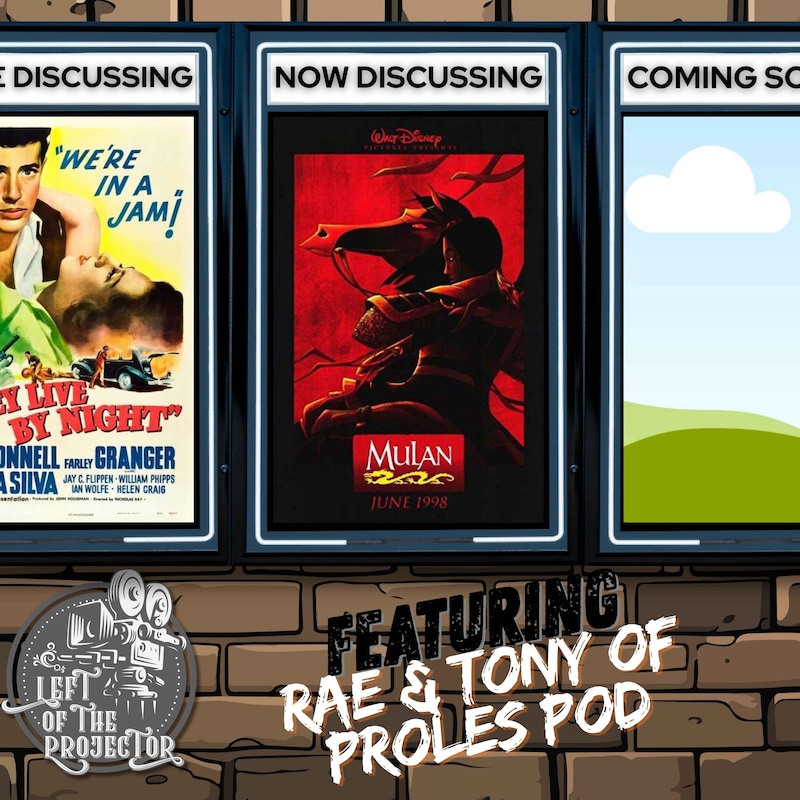
This week we are joined by Rae and Tony of the esteemed Proles Pod to discuss 1998's "Mulan," the animated one,(not that live action crap) starring Ming-Na Wen, Eddie Murphy, BD Wong, Miguel Ferrer, June Foray, James Hong, Pat Morita and George Takei. We ruin the childhood memory of this movie for everyone listening as we discuss how racist "Mulan" is relative to the rest of the Disney canon, demonstrate that Mulan herself as the original drone pilot girlboss of imperialism, debate animation fidelity, and threaten to beat up any seven year old that still thinks this is a good movie.
Guest Links
Left of the Projector Links
Left of the Projector on Letterboxd
Left of the Projector on Instagram
Left of the Projector on Patreon
Left of the Projector on Threadless
Host Links
Transcripts
Track 5: Hello, and welcome to Left of the Projector. I am your host,
Speaker:Track 5: Ward, back at it again with another film discussion from the left.
Speaker:Track 5: If you'd like to support the show for as little as $3 a month,
Speaker:Track 5: you can go to Patreon forward slash Left of the Projector Pod.
Speaker:Track 5: If you'd like to dress in style, we've got shirts, and at leftoftheprojectorpod.threadless.com,
Speaker:Track 5: you can grab one and show everyone you've got the best tastes around.
Speaker:Track 5: Wherever you're listening, give us a rating and subscribe, and you'll get notified
Speaker:Track 5: of our weekly episodes that drop every Tuesday. Now, on to the show.
Speaker:Track 5: This week on Left of the Projector, we'll be discussing the Disney animated
Speaker:Track 5: film Mulan, released in 1998, an era where Disney was stepping into Asian-themed
Speaker:Track 5: legends, and in this case, China.
Speaker:Track 5: The Disney adaptation takes the legend of Hua Mulan, and originally is thought
Speaker:Track 5: to be based on a folk song from the Northern Wei regime of 386 AD, and brings it to life.
Speaker:Track 5: The story follows a young girl, played by Ming-Na Wen,
Speaker:Track 5: as she impersonates a boy taking the place of her father
Speaker:Track 5: as the family is conscripted to war against the huns the rest of the cast includes
Speaker:Track 5: eddie murphy bd wong harvey feinstein miguel ferrer definitely more on this
Speaker:Track 5: later with us to discuss are two of the hosts of the proles pod we have antonia
Speaker:Track 5: and ray welcome to the left of the projector thanks.
Speaker:Track 4: For having us.
Speaker:Track 5: It's great to have y'all.
Speaker:Track 1: Thanks for being here. And I guess, Ward, you're joined by all three of us, Bill Ward and Evan here.
Speaker:Track 5: Yeah, I got Evan and Bill here too, I guess.
Speaker:Track 2: Yeah, we're here.
Speaker:Track 5: As always.
Speaker:Track 2: Evan let us out of the basement.
Speaker:Track 1: Well, Bill, you're still in the basement, but I'm curious.
Speaker:Track 2: That's true, I'm still in the basement.
Speaker:Track 1: So we had done, in the past, we had done a podcast with a couple of your other hosts of Pearl's Pod.
Speaker:Track 1: So I'm wondering, in this case, why you chose, like, normally we send out,
Speaker:Track 1: like, a list of films and stuff, but you were pretty intent on doing the line,
Speaker:Track 1: which, which, that's not a, that's not, I'm not saying that as,
Speaker:Track 1: like, a slight in any way.
Speaker:Track 1: But I'm curious why you chose it and, you know, maybe what made you think of doing it.
Speaker:Track 3: Okay, so this was my call. This was my suggestion. Hi, it's me, Ray.
Speaker:Track 2: Ray's like, I will now throw myself on my sword. I did this.
Speaker:Track 3: I did this. We were supposed to be on the show with you ages ago,
Speaker:Track 3: and I'm not entirely sure what happened, but it just didn't work out.
Speaker:Track 3: Previously, the list that you had given us included a children's section.
Speaker:Track 3: Childless, though I am, those are the bulk of films that I've seen.
Speaker:Track 3: And so when I got the updated list, it was all... Okay, I say this all the time.
Speaker:Track 3: I always say it wrong. And my husband is always like, this is not correct.
Speaker:Track 3: I keep wanting to say it was all adult films. But that is...
Speaker:Track 5: Just nothing but porn that's.
Speaker:Track 3: A different podcast yeah,
Speaker:Track 3: movies movies for grown-ups it was all movies for grown-ups um and i knew i was gonna be on it.
Speaker:Track 1: No it does it sounds better.
Speaker:Track 2: Yes left of the projector well yeah well known we run all yeah it's all porn
Speaker:Track 2: from the leftist perspective that's what we do here porn from the leftist perspective.
Speaker:Track 3: When a mommy when a mommy and a daddy love each
Speaker:Track 3: other or or when parents of
Speaker:Track 3: any gender as we're going to see through this movie love each other
Speaker:Track 3: because it is very obvious that he prefers ping but we'll table that i it was
Speaker:Track 3: all movies for grown-ups and therefore i had not seen them tony is a parent
Speaker:Track 3: himself he also like has a job etc and so i knew that if he was going to come
Speaker:Track 3: on maybe he also wouldn't have time to watch movies.
Speaker:Track 3: But Tony had mentioned before that when he was a youth himself,
Speaker:Track 3: he was obsessed with Mulan and spent an entire summer just watching Mulan.
Speaker:Track 3: And I was like, hey, I know a movie Tony won't even have to prep for.
Speaker:Track 3: And so I said, can we watch Mulan?
Speaker:Track 4: Real, let's add to that. So the summer of 1999, when that VHS came out for this
Speaker:Track 4: movie, I watched it every single day for like two and a half months in the morning.
Speaker:Track 4: I'd wake up, go watch that movie get some cookies get some um cereal and i'd
Speaker:Track 4: be good to go for the rest of the day so that was my jam for 1999 summer of.
Speaker:Track 2: So my wife's prediction that i will be a negative opinion in comparison to others
Speaker:Track 2: it was correct okay all right cool cool cool cool cool cool cool cool um also
Speaker:Track 2: evan and ward both have children and jobs and watch a fuck ton of movies,
Speaker:Track 2: my
Speaker:Track 5: Kids are in a horror.
Speaker:Track 2: Movie Pearls is a really reading.
Speaker:Track 3: Heavy like Pearls is a really.
Speaker:Track 2: Reading heavy show.
Speaker:Track 3: As it is plus Tony has to research for his other show so it's like,
Speaker:Track 3: We have to do all the things to run our own show on top of all of that.
Speaker:Track 3: And then Tony has a second show on that is what I think.
Speaker:Track 2: That is a good point. That is literally kind of.
Speaker:Track 3: And sometimes when you have families, right, it's like helps if you can stack your activities.
Speaker:Track 3: And I was like, worst case scenario, if he can't find another time to watch
Speaker:Track 3: it, he could watch it with his family.
Speaker:Track 4: But Bill does have a point here. It is not rare to have a job and to have children at the same time.
Speaker:Track 2: And watch movies.
Speaker:Track 4: It is not an uncommon. And watch movies.
Speaker:Track 3: I have neither. And I still don't watch movies. So there you go. The whole spectrum.
Speaker:Track 2: I mean, like I, I don't have children and I have a job. I watch movies,
Speaker:Track 2: but not nearly as many as Evan does. Evan watches movies.
Speaker:Track 2: Like if he doesn't, he will die.
Speaker:Track 5: It's, it's kind of impressive and borderline sad. What?
Speaker:Track 1: What is that? I missed that.
Speaker:Track 1: Yeah.
Speaker:Track 5: You edit these. Yeah.
Speaker:Track 1: Well, I mean, I do. I have been trying. I mean, I still read books for listeners out there.
Speaker:Track 1: They're also I read books, but I definitely lean more towards a movie and I
Speaker:Track 1: should shift a little bit more into the books. I'm doing better this year. So I'll.
Speaker:Track 3: Well, guys, we are so aspirational. We have jobs and watch books and read movies.
Speaker:Track 2: We read movies. I read movies all the time.
Speaker:Track 1: I mean, I listen to I listen to books, you know, audio books for for those who
Speaker:Track 1: who count. I listen to books.
Speaker:Track 2: I read books. I'm currently reading a book written by one of our former guests,
Speaker:Track 2: a friend of the show, Brianna Cox.
Speaker:Track 1: Good book so far. Well, we can talk about that at another time.
Speaker:Track 2: Yeah, we'll talk about that.
Speaker:Track 1: So I guess we know why you maybe chose this, but I did lead at the beginning
Speaker:Track 1: that you guys are on, have your own podcast, Pearl's Pod.
Speaker:Track 1: Do you want to maybe just remind folks? I'm sure that most people who listen
Speaker:Track 1: to this podcast probably neither know or listen to your podcast,
Speaker:Track 1: but just so people can be reminded what you do over there.
Speaker:Track 3: Pearl's Pod is like an extremely long form niche Marxist-Leninist history podcast.
Speaker:Track 3: So it's really, it really advertises itself. It's really for exactly the people
Speaker:Track 3: that it's for and not really anyone else.
Speaker:Track 3: Tony, do you want to introduce Tony's other podcast?
Speaker:Track 4: No, well, I'll say more about Prolspot. So we are formerly known as Prols of the Roundtable.
Speaker:Track 4: You may have heard the podcast in its original iteration from 2018 to 2020 before
Speaker:Track 4: that initial show fell apart.
Speaker:Track 4: It was kind of resuscitated in 2024 underneath the new name Prolspot.
Speaker:Track 4: So that's what we do. Our tagline is...
Speaker:Track 4: Correct me if I'm wrong here, Ray, but it's history, politics,
Speaker:Track 4: and culture without the liberalism.
Speaker:Track 4: And so from a communist perspective, it's kind of our jam.
Speaker:Track 4: Most notably, since the show rebooted in 2024, we took on the insane task of
Speaker:Track 4: putting together a 23-hour long narrative form discussion-having series on Joseph Stalin.
Speaker:Track 4: So if you do have 23 hours to spare, I recommend that you check that out.
Speaker:Track 4: Um, so yeah, we are the, the Stalin heads, uh, of the communist podcast verse.
Speaker:Track 4: Um, what Ray was alluding to earlier is that I do have another podcast as well.
Speaker:Track 4: It is known as actually existing socialism.
Speaker:Track 4: And the goal of that show is to have that perspective of socialist countries
Speaker:Track 4: that we often don't get in the West, which is, you know, a positive one.
Speaker:Track 4: And so I have scholars, uh, people who currently live in a socialist country
Speaker:Track 4: or previously lived in one to talk about their own experiences and kind of the
Speaker:Track 4: material realities of actually existing socialism countries that have actually
Speaker:Track 4: taken that step to develop uh in a socialist way.
Speaker:Track 1: Awesome yeah i i did listen to the not not the all 23
Speaker:Track 1: hours of the stalin episode but like all the base the base pieces of it and
Speaker:Track 1: it was uh it was quite uh impressively researched so kudos to the to that thank
Speaker:Track 1: you appreciate that incredible in the in terms of mulan i mean when you were
Speaker:Track 1: introducing a war, I couldn't help but,
Speaker:Track 1: I didn't go down like a deep down the rabbit hole on this and hopefully this
Speaker:Track 1: won't ruin your that the summer of 99 and listening or watching Mulan, Tony.
Speaker:Track 1: But like I was looking into what Disney was doing at that time,
Speaker:Track 1: which was they're trying to make a bunch of films that were like Asian themed
Speaker:Track 1: after Aladdin had come out and made them a ton of money.
Speaker:Track 1: And I don't, I mean, I can't help but separate, you know, just Disney from just
Speaker:Track 1: their taking over of the world of movies and media and everything.
Speaker:Track 1: And thinking about this from just what Disney's trying to put together.
Speaker:Track 1: I mean, what do you, do you think it's like reasonable, a reasonable story for
Speaker:Track 1: them to tell even, you know, like, do they have a perspective enough that's
Speaker:Track 1: worth telling the story of, you know, a legend of China?
Speaker:Track 3: Okay, so Tony and I were kind of talking about this a little bit earlier,
Speaker:Track 3: but I feel like there are certain parts of the world that the West uses to launder
Speaker:Track 3: its anxieties for which we as the Imperial Corps have no sort of cultural grounding.
Speaker:Track 3: And so East Asia is where we go when we want to launder our anxieties about
Speaker:Track 3: bringing honor to the family and to honoring...
Speaker:Track 3: and to like honoring our lineage. Right.
Speaker:Track 3: And I think that this is like something that we sort of experience.
Speaker:Track 3: And I think that in the relative like people were still doing OK in the late
Speaker:Track 3: 90s as certain people were still doing OK.
Speaker:Track 3: We had the illusion of OK-ness in the late 90s with neoliberalism and like this sort of like influx.
Speaker:Track 3: And as a result of our identity being flattened into consumers,
Speaker:Track 3: there are other things that get lost that we're sort of sacrificing.
Speaker:Track 3: And there's really like nowhere for those things to go.
Speaker:Track 3: So do I think that Disney has any business telling the story of Mulan as a Chinese myth?
Speaker:Track 3: No. Do I think that Disney is leveraging a vague gestures vaguely Western imaginary
Speaker:Track 3: of China in order to launder anxieties about lineage?
Speaker:Track 3: Yeah, I mean, I think that that's what's happening.
Speaker:Track 2: That's a very interesting take
Speaker:Track 2: it reminds me of we've discussed this
Speaker:Track 2: before and like my like i've returned to this like
Speaker:Track 2: personally and like here like the fact that like capitalism basically stole
Speaker:Track 2: the heritage of vast swaths of european culture and like the indigenous heritage
Speaker:Track 2: of the indigenous heritage of like,
Speaker:Track 2: most European peoples and like their roots.
Speaker:Track 2: And then when they come to, and then when they came to America,
Speaker:Track 2: it got even more lost in capitalism.
Speaker:Track 2: And so America culture, American culture, U S culture often tries to recreate
Speaker:Track 2: those things and commodify them in a way that serves the, the superstructure.
Speaker:Track 2: Um, for instance, I, I mean, I wrote a column about comic books for 15 years and to me,
Speaker:Track 2: like comic books and superhero stories are very much like the bedrock of like
Speaker:Track 2: us culture and like us, like cultural myth.
Speaker:Track 2: Like they are very much rooted in that. And yeah. So So, yeah.
Speaker:Track 2: And I think you're right. They're
Speaker:Track 2: like, you know, it's like white Westerners kind of glom on to other.
Speaker:Track 2: Because it's like it's almost like they're like, I miss I miss things that mattered and meant something.
Speaker:Track 3: Right. Right. But we don't have the ability to fully humanize another culture
Speaker:Track 3: and to actually examine it on its own face. All we can do is compare it to the
Speaker:Track 3: way the world looks to us.
Speaker:Track 3: Right. For people within the imperial core. And so, yeah, it becomes like the
Speaker:Track 3: knockoff of the knockoff.
Speaker:Track 3: I mean, hey, at least Mulan stays legibly China if you wanted to compare it
Speaker:Track 3: to Aladdin. Like, what are they even appropriating?
Speaker:Track 3: Is that is that the Gulf? Is it Turkey? Is it the Levant?
Speaker:Track 5: I no i
Speaker:Track 5: can yeah i completely agree with you especially like how
Speaker:Track 5: obsessive the theme of honor is in this
Speaker:Track 5: film but like as you're saying like no it definitely makes sure it's definitely
Speaker:Track 5: china because like it opens up with like the uh the water brush painting and
Speaker:Track 5: the great wall of china just to let you know just in case you didn't know this
Speaker:Track 5: is disney's asian film like if in case there's any questions about that this
Speaker:Track 5: is the asian one yeah it's.
Speaker:Track 4: Surprising they didn't do like a based on a true story.
Speaker:Track 1: Yeah well and this is um well
Speaker:Track 1: there's two well there's two things i was thinking about both of these is
Speaker:Track 1: one is when war mentioned the beginning sort of talking about the actors
Speaker:Track 1: who are in this and maybe maybe it's worth
Speaker:Track 1: talking about this now since we're talking about the just the film as a whole
Speaker:Track 1: is the i mean the main actress who plays mulan is a ming nong wen but then you
Speaker:Track 1: have eddie murphy and harvey feinstein and a bunch of other you know white american
Speaker:Track 1: not eddie murphy black but, you know,
Speaker:Track 1: not Chinese-American.
Speaker:Track 5: I was going to say, Eddie Murphy's wife.
Speaker:Track 4: Famous white American, Eddie Murphy.
Speaker:Track 5: We're here on Left of the Projector.
Speaker:Track 3: Wait, and for all of the Broadway heads that are, I'm sure, listen to your show,
Speaker:Track 3: hey, there's got to be like six of us, it's also worth noting that the speaking
Speaker:Track 3: voice of Mulan and her singing voice are voiced by two different actors.
Speaker:Track 3: And her singing voice is provided by Broadway hero, Lea Salonga.
Speaker:Track 2: The speaking voice of Lee Shang is B.D. Wong, but the singing voice is Donny
Speaker:Track 2: Osmond. And I'm just like,
Speaker:Track 2: Chinese people sing. Like, you
Speaker:Track 2: could have gotten a person of Chinese heritage who sings. They do sing.
Speaker:Track 1: And, you know, Harvey Fierstein as Yao, he's been in a lot of,
Speaker:Track 1: tons of films over the course, you know, a bunch of Disney movies.
Speaker:Track 1: I guess the point I'm coming to is, yes, you have this movie that's kind of
Speaker:Track 1: taking this mash of Chinese culture,
Speaker:Track 1: bringing it to Western audiences, and then saying, like, we couldn't be bothered to include, you know,
Speaker:Track 1: even people of Asian descent as the actors' voices when we easily could have.
Speaker:Track 1: I mean, a bunch of them are, to be fair.
Speaker:Track 1: But I don't know. I felt very like the Eddie Murphy voice to me was the voice
Speaker:Track 1: of like comedy they're trying to bring.
Speaker:Track 1: But it also felt extremely offensive in a way.
Speaker:Track 2: I think this movie doesn't get enough recognition for being as casually racist as it actually is.
Speaker:Track 2: I think it really does not.
Speaker:Track 3: Yeah, I think of the racialized offenses. Eddie Murphy's casting is like one
Speaker:Track 3: of the lesser ones, to be honest.
Speaker:Track 5: In comparison yeah did you see the huns with their yellow eyes.
Speaker:Track 3: Like the depiction like everybody's asian but then like the huns are like extra
Speaker:Track 3: asian in a bad way right like you know what i mean there's like there's like
Speaker:Track 3: so many other racialized jabs that happen yeah.
Speaker:Track 4: It's like almost in like in comparison eddie murphy's.
Speaker:Track 3: He's a dragon eddie.
Speaker:Track 4: Murphy's role is like progressive relative to the other crazy shit that they're doing in that movie.
Speaker:Track 3: Eddie murphy woke dragon yeah.
Speaker:Track 4: Eddie murphy as chinese dragon is like progressive.
Speaker:Track 1: Yeah i mean yeah that's that's probably true we were we were joking in our like
Speaker:Track 1: our group chat earlier when i was watching it sort of saying on a level of like
Speaker:Track 1: one to aladdin being like maybe one of the most racist you know disney movies
Speaker:Track 1: like where does the mulan fall in that and i think i say it was like what a
Speaker:Track 1: six or a seven i think is what i came to i don't know yeah,
Speaker:Track 1: in this six song.
Speaker:Track 2: Of the south is an 11 aladdin is.
Speaker:Track 1: 10 probably 10.
Speaker:Track 2: And then this is like at like yeah aladdin's 10 and then this is a six because.
Speaker:Track 5: The scale started as one to aladdin.
Speaker:Track 2: Yeah and because everyone else forgot the song of the south so.
Speaker:Track 4: It's like from one to from one to zippity zippity doodah what is.
Speaker:Track 2: Yeah like everyone else forgot everyone else the like evan and ward forgot about
Speaker:Track 2: song of the south and i was like you forgot about song of the south so that
Speaker:Track 2: has to be 11 that has to be 11 that.
Speaker:Track 4: That's why it's in the vault right now.
Speaker:Track 2: Yeah.
Speaker:Track 1: Yeah yeah we're we're saying you know it's it's so racist
Speaker:Track 1: that it took them until 2024 to remove it from
Speaker:Track 1: disney world or whatever as like a ride like oh yeah it's only now is that you
Speaker:Track 1: know a problem for us as a as a company that this is okay but yeah i mean the
Speaker:Track 1: like the characterization you mentioned the huns as being sort of like even
Speaker:Track 1: more racist or sort of depicted you know as more chinese it's very,
Speaker:Track 1: stark like the you know sort of the americanized
Speaker:Track 1: chinese with the you know mulan's family albeit i wouldn't even say it like
Speaker:Track 1: westernized i mean it's they're still trying to depict them very much as this
Speaker:Track 1: culture from a long time ago where they have arranged marriages and you know
Speaker:Track 1: the the woman you know reviews each woman to see how how their material but like,
Speaker:Track 1: level of bride material for someone in the community to bring honor as the very
Speaker:Track 1: first moment where we learn about honor.
Speaker:Track 4: Yeah and like it's even it even goes beyond just like
Speaker:Track 4: their the kind of like exaggerated orientalizing like features of the huns it's
Speaker:Track 4: even just the color of their of their skin and their clothing right they're
Speaker:Track 4: given this dark gray kind of filter to the uh to to their appearance which is
Speaker:Track 4: you know very much in line with just racist depictions of any other in Western media.
Speaker:Track 5: Yeah, and they get yellow eyes and claws.
Speaker:Track 4: Yeah.
Speaker:Track 3: Versus we have Mulan, as you said, trying to stay true to some,
Speaker:Track 3: again, like Western Orientalized version of Chinese, but she still and her family
Speaker:Track 3: still maintain this like extreme proximity to whiteness. And also...
Speaker:Track 3: very obviously tend to have like some kind of like affluent class positioning,
Speaker:Track 3: which Tony also mentioned to me before, that it's like very clear that her family
Speaker:Track 3: does not, even at the end where he's like, do you want to be in the government?
Speaker:Track 3: And she's like, girl, no, I could go home, live with my family where I don't have a job.
Speaker:Track 4: Yeah, that's one thing we were talking about before. And it's like the class
Speaker:Track 4: position of Mulan is very interesting because you see that no one in her family
Speaker:Track 4: ever does any form of work whatsoever.
Speaker:Track 4: The ancestors in one scene do mention that they have a farm of some sort which
Speaker:Track 4: we never see and i think the implication is that other people are working on
Speaker:Track 4: that farm right and so some.
Speaker:Track 5: Of them became acupuncturists.
Speaker:Track 2: Which is in and of itself which a racist trope like it is very like to me the
Speaker:Track 2: way i see the racism of this movie it's it's very distinctly three different
Speaker:Track 2: tiers of racism you have the the model minority,
Speaker:Track 2: Mulan's family is the very typical Chinese model minority American.
Speaker:Track 2: Acupuncturist. They become doctors. That's literally what it is.
Speaker:Track 2: They became acupuncturists. They become doctors.
Speaker:Track 2: And they have one child.
Speaker:Track 3: And it's a daughter, and they don't complain. Which I think in the original
Speaker:Track 3: myth, there's another sibling. He's just too young to be called to the war.
Speaker:Track 2: And then like, even, even to the point where like one of the ancestors pulls
Speaker:Track 2: out an abacus and talks about numbers and it's like, also, they're also really good at math.
Speaker:Track 2: They're also good at math. Okay.
Speaker:Track 2: Chinese people become doctors and they're good at math. Okay.
Speaker:Track 2: And they're very like, you know, the, the good ones are very concerned with honor and dignity.
Speaker:Track 2: And then we have the other kind of like Chinese immigrant,
Speaker:Track 2: which is really like the only way I can like describe it is the way Jim Crow
Speaker:Track 2: America depicted black Americans with the exaggerated features of that.
Speaker:Track 2: And then all the background Chinese characters,
Speaker:Track 2: all the background, exaggerate, buck teeth, they walk in a very specific kind
Speaker:Track 2: of like mincing, bowing way.
Speaker:Track 2: They are either, they are kind of effeminate in their ways while also being,
Speaker:Track 2: you know, kind of like stupid and not like measuring up. and then you have.
Speaker:Track 2: Then you have the Huns, which are like, literally, like, that's the best way to describe them.
Speaker:Track 2: The way, in terms of like the racist tropes, the way that every,
Speaker:Track 2: the West has always described everybody they've ever called a Hun.
Speaker:Track 2: Like, you know, this is the flip side of the, you know, you have the civilized
Speaker:Track 2: model minorities of East Asia, and then you have the monsters.
Speaker:Track 2: You have the sorcerers and the villains and the claws and all that.
Speaker:Track 4: Yeah, that's a great analysis. And, like, the monsters are motivated.
Speaker:Track 2: They have no motivation.
Speaker:Track 4: They have no motivation other than the fact that you have something and they
Speaker:Track 4: want it for some reason. And that there's no real, like, injustice that's taken place.
Speaker:Track 3: Which is never clear.
Speaker:Track 4: Yeah.
Speaker:Track 3: Which is never clear.
Speaker:Track 1: Some kind of revenge, but there's no actual motive for that revenge.
Speaker:Track 2: Because he built a wall.
Speaker:Track 3: Well, I think it's...
Speaker:Track 5: Yeah, no, it's...
Speaker:Track 3: I think it's more than this, though, because Mulan's father is already a celebrated
Speaker:Track 3: war hero. And he's, what, like 60 years old if he is a teenager when he joins the military.
Speaker:Track 3: There's only so many decades that he has had to have this illustrious military
Speaker:Track 3: career. So it's like, why are people always attacking this kingdom?
Speaker:Track 3: Like, they seem to be under threat a lot.
Speaker:Track 4: Yeah, it does beg the question that there's perhaps,
Speaker:Track 4: I mean, one could perhaps make the argument with the little information that's
Speaker:Track 4: given that the Huns are on actually a mission of, you know, trying to fight
Speaker:Track 4: back against an empire that is fucking around with everyone around them.
Speaker:Track 1: But they don't give you any backstory of content. They're just the evil people
Speaker:Track 1: that are doing the evil thing.
Speaker:Track 4: They have dark skin, so they're bad, right?
Speaker:Track 5: Yeah, I watched the movie. That makes sense.
Speaker:Track 2: It is very vague there is no motivation given.
Speaker:Track 1: Maybe this is off base like i one of the first things i noted down when i was
Speaker:Track 1: watching the beginning and i was trying to think about how this comes out in
Speaker:Track 1: 1998 obviously well past you know the chinese revolution decades after it but
Speaker:Track 1: still like in a period where i think the americans attitude towards china wasn't,
Speaker:Track 1: nearly as negative maybe as you would get 20 years
Speaker:Track 1: after that or even 10 years after that as china's growth
Speaker:Track 1: like it was magnified even more but i was thinking of
Speaker:Track 1: it as sort of like they're using this ancient
Speaker:Track 1: civilization or ancient chinese as the
Speaker:Track 1: backdrop for this mythos that they're or this myth the traditional hua muan
Speaker:Track 1: story but i feel like they're also trying to tell you that this is also what
Speaker:Track 1: modern china is like you know women are all being put in their place they don't
Speaker:Track 1: have any part of society and the men run everything.
Speaker:Track 1: And, you know, they it's this they're not any different hundreds and thousands of years later.
Speaker:Track 1: I don't know. Maybe that's a stretch, but I don't feel like they're they're
Speaker:Track 1: trying to tell you something about China now that's also bad.
Speaker:Track 1: That's not a very descriptive way to say it. I don't know. I don't know if that's a stretch or not.
Speaker:Track 3: No, I think that that's valid. I also think I just looked to double check.
Speaker:Track 3: Yeah, this is also, So, again, peak sort of one-child policy panic in the West,
Speaker:Track 3: even though we had much less animosity.
Speaker:Track 3: So, again, the centering of a family that just has one child and it's a girl
Speaker:Track 3: and she has this woke dad who thinks it's totally fine that he has this daughter.
Speaker:Track 3: But then also everything is sort of like about gender, which is its whole other
Speaker:Track 3: thing that we should, you know, talk about in this episode because I think that
Speaker:Track 3: this is Disney is exploring its own gender anxieties.
Speaker:Track 3: But I think that there's also the positioning in the U.S.
Speaker:Track 3: in the 90s where we're making sort of marginal, and it's basically just to acquiesce
Speaker:Track 3: with the neoliberalism needing more people to do more work because the cost
Speaker:Track 3: of living is about to skyrocket, that we start letting women into the workplace.
Speaker:Track 3: And one of the ways that these sort of Western women soothe their psyches is
Speaker:Track 3: just by thinking about how much worse all of the racialized women around the world must have it.
Speaker:Track 5: See, I thought about it in a slightly different time set where like they started
Speaker:Track 5: working on this film in 94 coming off the back of fucking the Somalia intervention and the Gulf War.
Speaker:Track 5: And I feel like this was the start of the more women drone pilot military recruitment.
Speaker:Track 5: And the focus on honor kind of tied in with that. That's where I was thinking with it.
Speaker:Track 4: It's funny you say that because I'm pretty sure it was Mike Pence who wrote
Speaker:Track 4: an article about the movie.
Speaker:Track 2: Gotcha. The live action one, right?
Speaker:Track 4: Yeah god no no mike pence no no no mike pence when he's i think he was a radio
Speaker:Track 4: show host back then oh yeah he he saw this movie and wrote a or wrote or spoke
Speaker:Track 4: about a critique of it saying that he was arguing for um getting more women into like the u.s.
Speaker:Track 1: Military kind of thing and.
Speaker:Track 4: So he raged against that.
Speaker:Track 1: Oh man that's.
Speaker:Track 4: That's it oh that's hilarious.
Speaker:Track 1: Wow i didn't know about that but i just looked it up i.
Speaker:Track 5: Didn't know that that's so fucking funny.
Speaker:Track 1: Yeah you see he called it liberal like liberal propaganda and i mean he oh.
Speaker:Track 5: Shit look at me and.
Speaker:Track 1: Mike pence having.
Speaker:Track 5: Something in common.
Speaker:Track 1: Hopefully that's the only look at.
Speaker:Track 5: That who would have thought.
Speaker:Track 1: Yeah i mean he wrote that it's uh well
Speaker:Track 1: like one of the quotes i just pulled up from it it says it is instructive that
Speaker:Track 1: even in the disney film young miss mulan falls in love with her superior officer
Speaker:Track 1: methinks the politically correct disney types completely miss the irony of this
Speaker:Track 1: part of the story they likely added it because it added realism with which the
Speaker:Track 1: viewer could identify with the characters you see now.
Speaker:Track 1: Stay with me on this. Many young men find many young women be attractive sexually.
Speaker:Track 1: Many young women find many young men to be attractive sexually.
Speaker:Track 1: Put them together in close quarters for long periods of time,
Speaker:Track 1: and things will get interesting, just like they eventually did for young Mulan.
Speaker:Track 1: Moral of the story, women in military, bad idea.
Speaker:Track 2: I feel like the way that was written kind of exposes Mike Pence's actual predilections.
Speaker:Track 2: And I'm not judging his predilections, i'm just saying i feel like he was giving
Speaker:Track 2: the game away a little bit the way he phrased things there.
Speaker:Track 5: Yeah people be fucking in the military whether there's women in the military
Speaker:Track 5: or not um that's just simple fact people be fucking that yeah so that's apparently
Speaker:Track 5: where me and mike pence diverges i think it's for more women drone pilots and
Speaker:Track 5: he's like no i don't like that and.
Speaker:Track 4: So evan i did.
Speaker:Track 5: I don't like it for the not the same reasons.
Speaker:Track 4: So, Evan, I do want to kind of flip your analysis around a bit. I was getting...
Speaker:Track 4: the impression that similar to how the
Speaker:Track 4: there's the Falun Gong cult in China and you
Speaker:Track 4: know they have these performances that all of us have come across a
Speaker:Track 4: pamphlet of some sort in some time in the past called Shen Yun right and
Speaker:Track 4: so the whole thing about Shen Yun is that it presents a vision of
Speaker:Track 4: China before communism when like China was
Speaker:Track 4: like so amazing and perfect and there was no injustice and all the hierarchies
Speaker:Track 4: were positive and all that all that reactionary stuff right And so I do think
Speaker:Track 4: that one reading of the movie is that it is presenting this China before communism
Speaker:Track 4: that is like very like sterile in like a beautiful way.
Speaker:Track 4: And like everything is, you know, everything is harmonious.
Speaker:Track 4: Yes, there are these oppressive structures of the gender stuff,
Speaker:Track 4: but things are like fairly nice and they need to protect it from the dark,
Speaker:Track 4: scary people because that's what we need to do kind of thing.
Speaker:Track 4: So I do think that there's a bit of both happening in the movie of how China is presented.
Speaker:Track 1: No, I mean, you're right. I mean, that's very much with even just like,
Speaker:Track 1: I think we were talking about the opening credits and sort of the way they show
Speaker:Track 1: the splendor and beauty of China is very clearly giving you this,
Speaker:Track 1: oh, in this mythical place when China was, you know, beautiful and not destroyed by, you know,
Speaker:Track 1: Mao and everyone after him and Great Leap Forward, whatever you want to go into.
Speaker:Track 1: I mean, that makes a lot of sense.
Speaker:Track 3: And maybe if you guys feel okay pivoting a little bit to discuss the gender
Speaker:Track 3: anxiety that is Mulan, the film that launched a thousand genders,
Speaker:Track 3: probably including mine, it kind of also, I mean, the backbone...
Speaker:Track 3: The backbone of the film is gender norms and adhering to one's gender norms
Speaker:Track 3: and exploring very niche-specific moments where you wouldn't necessarily have to do that.
Speaker:Track 3: And I think that this is also kind of a jab at post-socialist socializing China,
Speaker:Track 3: wherein they're aiming for some kind of equality that, of course,
Speaker:Track 3: the West has anxieties about and feels like, well, then what's going to happen?
Speaker:Track 3: We can't really give women equality and things like this, right?
Speaker:Track 3: And so it's also sort of laundering this idea of being like,
Speaker:Track 3: see what made this kingdom so majestic is that like women knew their place and men knew their place.
Speaker:Track 3: And every once in a while, you might get a great little girl who can do something big.
Speaker:Track 3: But at the end of the day, this is still she is the exception and not the rule.
Speaker:Track 3: And still at the end, although we can all acknowledge that he definitely makes
Speaker:Track 3: her dress as Ping in the boudoir, she still enters into, like,
Speaker:Track 3: a cisheteronormative marriage, or at least we get the idea that he is courting
Speaker:Track 3: her for marriage at the end of the movie.
Speaker:Track 2: I think it's very interesting. I think that is such an interesting aspect of it,
Speaker:Track 2: especially considering the nature of the original story, which is that like
Speaker:Track 2: she serves for 12 years and no one knows.
Speaker:Track 2: like literally her comrades find out that she's not a man like years later when
Speaker:Track 2: they go visit her at her like home and it's like not a big deal they're like
Speaker:Track 2: she's like yeah i'm a woman,
Speaker:Track 2: And they're like, oh, okay. That's it.
Speaker:Track 2: She was there for 12 years. No one noticed.
Speaker:Track 2: And then they visited her later. It's like, yeah, by the way,
Speaker:Track 2: I'm a woman. And they're like, okay. End of conversation.
Speaker:Track 3: But again, the West is not interested in exploring other ways of dealing with
Speaker:Track 3: relationship and identity. It is only interested in projecting itself onto the
Speaker:Track 3: rest of the world as a soft cultural product, right?
Speaker:Track 3: So that can't be, because obviously being a woman is icky and gross and bad
Speaker:Track 3: and makes you bad soldier.
Speaker:Track 1: It's such a good i mean it's such an interesting well way
Speaker:Track 1: they so like one of the early songs is when
Speaker:Track 1: she's talking i think one of the early songs is honor to
Speaker:Track 1: us all and she's talking about how they can bring them honor by
Speaker:Track 1: striking like a good match doing the sort of the normal the normal thing okay
Speaker:Track 1: woman you know is uh can pour tea for her husband she can say the nice things
Speaker:Track 1: and then you you know i think they specifically say men want a girl with good
Speaker:Track 1: taste calm obedient who work fast pace with good breeding and a tiny waist.
Speaker:Track 1: And so they're very explicitly telling you what they're supposed to be.
Speaker:Track 3: They're like, you need to be white, thin waist circumference.
Speaker:Track 3: And then there's another song later where all the men are like,
Speaker:Track 3: she also must cook me a variety of meats.
Speaker:Track 1: And then it goes from that. And then, okay, then she decides that she needs
Speaker:Track 1: to bring honor to her family because she's not able to do it.
Speaker:Track 1: She like completely botches the entire little interview with the matchmaker.
Speaker:Track 3: Because essentially she has some version of body dysmorphia or gender dysphoria
Speaker:Track 3: because she keeps saying that she doesn't look like herself in the mirror until
Speaker:Track 3: she gives herself like a fetching bob haircut and then goes to war it's.
Speaker:Track 1: Like the the women were expected to just do the things they're supposed to do and,
Speaker:Track 1: without being questioned like that's just what we do here.
Speaker:Track 3: Which is kind of the joke even from the get with the matchmaker where okay mulan
Speaker:Track 3: can't remember what she's supposed to do listeners,
Speaker:Track 3: spoiler alert if you haven't had time to watch this movie um so
Speaker:Track 3: she's like writing notes on her forearm in like old timey chinese ink right
Speaker:Track 3: and at a certain point the matchmaker grabs her arm and the ink transfers and
Speaker:Track 3: then the matchmaker touches her own face and it gives her a mustache and she's
Speaker:Track 3: already fat and she's got this mustache and then she lights her butt on fire
Speaker:Track 3: and then it's so funny and silly and then she pours water on herself and all
Speaker:Track 3: of her makeup comes off, right?
Speaker:Track 3: And so like one of the earliest scenes is already about this sort of like queering
Speaker:Track 3: gender and how it's so funny to step outside of your prescribed gendered lines.
Speaker:Track 3: And this is sort of like one of the major themes throughout the movie.
Speaker:Track 3: And I really think that it's because even though obviously as everybody's already
Speaker:Track 3: said, we don't really understand the socioeconomic situation of gestures vaguely
Speaker:Track 3: China in this gestures vaguely moment in history.
Speaker:Track 3: But what we do know is like the building blocks of fascism is the nuclear family, right?
Speaker:Track 3: Is the cis heteronormative nuclear family. And this is what is being challenged.
Speaker:Track 3: This is the anxiety that is being agitated throughout the film.
Speaker:Track 3: And we see it like from the beginning, right? That Mulan just feels like I don't
Speaker:Track 3: fit and I can only be this kind of girl.
Speaker:Track 3: And if I can't be this girl, then I'm going to the word that they use is crossdress.
Speaker:Track 3: Or as Eddie Murphy says, take her drag show on the road. Yeah.
Speaker:Track 1: Yeah, I don't want to call this like playing devil's advocate.
Speaker:Track 1: But if, you know, looking at it from the sort of like the liberal lens,
Speaker:Track 1: if you will, is the general way that Disney portrays women is through,
Speaker:Track 1: you know, the princess motif of, you know, the typical way.
Speaker:Track 1: And this one was such was probably I can't think of any movie before this where
Speaker:Track 1: there is a female protagonist play that wasn't a princess.
Speaker:Track 1: So for them, this was sort of like in their minds, they're selling this as the
Speaker:Track 1: woman can actually do things in a different way.
Speaker:Track 1: Like they're going to do it through a man, quote unquote, manly,
Speaker:Track 1: you know, portray themselves as a man and they can do just as much as well under this.
Speaker:Track 1: way and i i don't i think it's like it's very disingenuous to look at.
Speaker:Track 3: Yeah i mean it's a bourgeois feminism right is the argument that
Speaker:Track 3: it's a it's a pants a predecessor to the pantsuit nation that they're sort of
Speaker:Track 3: putting forth this rich white proximal girl who essentially is a princess it's
Speaker:Track 3: not a kingdom so there isn't a princess it's an empire right but she is the
Speaker:Track 3: daughter of a celebrated war hero who's very high up in the government is very well connected,
Speaker:Track 3: Like, again, when they meet her, when she shows up to camp pretending to be
Speaker:Track 3: a dude, they're like, I didn't even know he had a son.
Speaker:Track 3: And then it's a joke. And they're like, well, that's why he doesn't talk about
Speaker:Track 3: him because he's obviously insane or whatever.
Speaker:Track 3: She is sort of a princess. And it's a sort of like if you have all of the other
Speaker:Track 3: things, if you're beautiful, if you're intelligent, if you have already exhausted
Speaker:Track 3: every possibility before you. She went to matchmaking school.
Speaker:Track 3: She studied all the things she was supposed to study. She memorized all the
Speaker:Track 3: lines or wrote them on her arm and really tried.
Speaker:Track 3: And once you have exhausted all of those things, then maybe you can find a place
Speaker:Track 3: for yourself that, again, still ends in her just marrying a guy.
Speaker:Track 4: Yeah. So it does seem like there was there was some attempt. Yeah.
Speaker:Track 3: I mean, I think you're right. I agree with you. It is just bourgeois feminism.
Speaker:Track 3: Right. But it's like, wow, look at her breaking through that glass ceiling.
Speaker:Track 3: And she still found a man who wanted to marry her when she was dressed like a man.
Speaker:Track 4: Oh, no.
Speaker:Track 1: Which was his obvious preference.
Speaker:Track 5: The way he gets kicked and then looks at her like Nala. So Disney.
Speaker:Track 5: But yeah, no, the fact that she's able to like even steal a suit of armor and a sword from her father.
Speaker:Track 5: Compared to how many other people joined in the army and a fucking horse.
Speaker:Track 3: She has her own horse.
Speaker:Track 5: To go join the military, as opposed to how many other people are joining from
Speaker:Track 5: the peasantry that don't have that, that that's why they're being handed a bow staff.
Speaker:Track 3: And the like ancestor economy, which I'm not totally clear on like exactly how that works.
Speaker:Track 3: But I would assume that like peasants also don't have as like high quality or
Speaker:Track 3: ferocious ancestors. So the fact that she even has this like Timu discount dragon
Speaker:Track 3: is still more than like anyone else would have.
Speaker:Track 2: Yeah. Nobody else got us. Nobody else got not one, but two sidekicks.
Speaker:Track 2: Technically three. If we count the horse as well.
Speaker:Track 3: If you count the horse.
Speaker:Track 2: If you count the horse.
Speaker:Track 5: The horse is definitely a sidekick.
Speaker:Track 3: They also make like transgender jokes about when they're like,
Speaker:Track 3: what are you a cow? Are you a sheep?
Speaker:Track 5: The cow jokes were pretty funny.
Speaker:Track 3: They're like transvestigating every character.
Speaker:Track 2: The only things about this movie that I thought were good or funny were Dishonor
Speaker:Track 2: on Your Cow, the song I'll Make a Man of You, which I'm sorry,
Speaker:Track 2: no matter how probably, it's still a banger.
Speaker:Track 5: It's a banger.
Speaker:Track 2: And the leader of the Huns, who I think just looks awesome.
Speaker:Track 3: Justice for Grandma. Justice for Grandma. She has amazing one-liners where Mulan's
Speaker:Track 3: mom is like, I should have prayed to the ancestors for luck.
Speaker:Track 3: And she's like, how lucky could they be? They're dead.
Speaker:Track 2: That is a good line. That is a good line.
Speaker:Track 4: Like if there's like the positives about the movie, the writing is like excellent,
Speaker:Track 4: right? And looking at the character.
Speaker:Track 2: I disagree. I think it's literally just those three things. I think largely
Speaker:Track 2: the writing is terrible. And I kind of hate it.
Speaker:Track 4: So, so, so I, so I guess maybe we'll come to agreement in the sense of like
Speaker:Track 4: the one liner. So like, say for example, when the movie starts, right.
Speaker:Track 4: And then is it Sean, you name of the villain? Like he's at the,
Speaker:Track 4: the, the guardsman on the tower is like, no, all of China knows you're here.
Speaker:Track 4: And he's like, perfect. And it's like, damn, that was cold. Right.
Speaker:Track 4: And then, uh, later on in the movie when, uh, they find the two scouts that
Speaker:Track 4: have found the hunt army.
Speaker:Track 4: And then he's like, and then he's like, go, you go tell the emperor that we're
Speaker:Track 4: coming for him or whatever.
Speaker:Track 4: Right. and then as they run away he asks his like his uh crony like how many like.
Speaker:Track 2: How many how.
Speaker:Track 4: Many men does it take to send a message like one it's like oh like that still
Speaker:Track 4: hits like 20 years later man i love that shit.
Speaker:Track 2: He is they it's he gets so little overall and like so so little like depth and yet,
Speaker:Track 2: he is one of the most badass he is one of the most badass disney villains ever
Speaker:Track 2: written in my opinion like like absolutely like fucking he's even got a hawk
Speaker:Track 2: he's got a falcon he's got a sidekick yeah.
Speaker:Track 3: He's got a sidekick hawk.
Speaker:Track 2: Yeah and.
Speaker:Track 5: Do that line about like oh yeah and this little girl's gonna want her doll back.
Speaker:Track 2: Yeah yes dude he is so good the rest of it though no i'm sorry i i literally
Speaker:Track 2: the entire i watched this i'm like man this i'm just letting you know that there's
Speaker:Track 2: a seven-year-old who disagrees with you.
Speaker:Track 4: Who watched this movie every day. Seven-year-old me wants to fight you right now.
Speaker:Track 2: Wow.
Speaker:Track 3: You better dress up as a girl and do it.
Speaker:Track 2: You know what, Tony? I hate to break it to you, but I could beat up a seven-year-old.
Speaker:Track 4: Damn, okay.
Speaker:Track 4: I gotta step back on that one. I know when I'm a little kid and I can't win
Speaker:Track 4: a fight, I gotta step back.
Speaker:Track 4: Can't win them all.
Speaker:Track 1: There was another line that I wrote down that I thought was like,
Speaker:Track 1: I was surprised, speaking of like funny lines, is when they leave and she's
Speaker:Track 1: getting ready to, like she's having that conversation with the horse and.
Speaker:Track 2: And, you have to give, Evan, you have to give, Ray's die.
Speaker:Track 4: She is on life support from how hard she's laughing.
Speaker:Track 3: I'm so sorry.
Speaker:Track 4: Okay ray is literally crying right now she's she's literally.
Speaker:Track 3: Shaking right now because the image is like a small black child i'm so sorry baby tony i love you.
Speaker:Track 4: Ray ray ray i will be.
Speaker:Track 3: Ray, I will be your jersey.
Speaker:Track 2: A bearded bald white man with tattoos. It's a bad image. It's a bad image.
Speaker:Track 2: It makes it even better that I'm wearing a resist racism shirt.
Speaker:Track 4: As a result, left of the projector has now been canceled.
Speaker:Track 3: I beat white children equally as I beat black children. You hear that?
Speaker:Track 2: It doesn't matter race. Seven-year-olds, I can take them.
Speaker:Track 3: Race gender creed seven-year-olds i can take them and you're just you're just
Speaker:Track 3: beating the shit out of a baby tony who's like let's get down to business to
Speaker:Track 3: defeat the ones like mulan was my identity.
Speaker:Track 4: So yeah but no.
Speaker:Track 3: That's that's good shit it's funny i'm sorry i've recovered room in hand.
Speaker:Track 5: Doing all the moves.
Speaker:Track 4: I would try to do that kick at the end of the song when they do that kick.
Speaker:Track 4: I would do that off the couch.
Speaker:Track 4: So maybe I wouldn't fare too bad if I landed that kick.
Speaker:Track 1: You'd be fucked up.
Speaker:Track 2: You never know. We'll have to try.
Speaker:Track 3: I've just recovered, please.
Speaker:Track 1: Well, the thing I was going to say was the one of the
Speaker:Track 1: lines that i'm surprised that disney put in
Speaker:Track 1: i mean sometimes i watch some of these older movies and i'm thinking you
Speaker:Track 1: know maybe there's people who are in pot
Speaker:Track 1: like you know executives don't understand some of the things sometimes when
Speaker:Track 1: they first leave and mulan is i guess talking to uh mushu and they're sort of
Speaker:Track 1: like getting ready to prepare to i guess join the uh the conscripted army is
Speaker:Track 1: she says my eyes can see straight through your armor.
Speaker:Track 1: I feel like that's like a, I don't know. Like that's a weird line. Yes.
Speaker:Track 4: Okay, so right now we're actually talking about this beforehand,
Speaker:Track 4: too, as well, is that in this movie,
Speaker:Track 4: it's probably more so than any Disney movie that there's, like,
Speaker:Track 4: this recognition that Mulan, like, is a woman and has a female body,
Speaker:Track 4: and as a result, the male characters respond differently to it, right?
Speaker:Track 4: It's almost like, it's like watching, like, a Disney movie and someone goes
Speaker:Track 4: to the bathroom, like, that just doesn't happen, right?
Speaker:Track 4: It's just outside of the realm of things that are possible in these movies.
Speaker:Track 4: And so when that line was said, and there's other things too,
Speaker:Track 4: like, you know, when she has to go for, have the bath in the lake or whatever,
Speaker:Track 4: there's all these like moments like that just don't, that don't exist in other Disney movies.
Speaker:Track 1: Yeah, that scene in the lake.
Speaker:Track 3: Well, we said, I thought of like the Little Mermaid where it's kind of close,
Speaker:Track 3: but like the gag is that she is a mer-person, not that she's a girl, right?
Speaker:Track 3: But when she washes up on the shore and she's naked and she has her human legs,
Speaker:Track 3: like there is this moment of vulnerability and shyness, but it's not,
Speaker:Track 3: it's not so much gendered. It's because she's never been a naked lady with legs before.
Speaker:Track 1: The scene in the lake, too, is once she finally sort of escapes,
Speaker:Track 1: and then she has the line, too, where she says, you know, I hope I never see
Speaker:Track 1: another naked man again. And then all of the soldiers just, like, run right past her.
Speaker:Track 3: And then there's, like, a stampede.
Speaker:Track 1: Yeah, I thought that's funny, too.
Speaker:Track 2: I thought that entire thing was funny from the perspective of,
Speaker:Track 2: they kept saying, like, you know, how Mushu's, like, they're like,
Speaker:Track 2: oh, you know, men don't bathe.
Speaker:Track 2: And, like, you know, how, like, and I'm just, like,
Speaker:Track 2: I'm sorry. It is a well-known fact that basically only Europeans did not fucking bathe.
Speaker:Track 2: The rest of the world was bathing themselves regardless of gender.
Speaker:Track 2: Everyone else was like, hey, maybe we should clean the shit out of our ass and not stink all the time.
Speaker:Track 1: Yeah, and not to mention the fact that she would have come from,
Speaker:Track 1: you know, a more wealthy family. I'm pretty sure that her war hero father was bathing.
Speaker:Track 2: Not only did the rest of the fucking world bathe, like East Asia is specifically
Speaker:Track 2: known, like, for a bathing culture, like bathhouse culture.
Speaker:Track 2: Like this is not like, like that,
Speaker:Track 2: that it, it, it just displays such a fundamental lack of like a fundamental
Speaker:Track 2: ignorance of the culture at large
Speaker:Track 2: to like have that entire thing and then only play it for like comedy.
Speaker:Track 2: And it's just like, no, that's just not the way like these societies functions.
Speaker:Track 5: It's funny, too, because Disney sent a team to China to do research for the
Speaker:Track 5: movie to try to make it culturally accurate.
Speaker:Track 2: What did they do there?
Speaker:Track 5: They fucked up a lot.
Speaker:Track 2: What were they doing there?
Speaker:Track 1: They're just hanging out at the hotel, you know?
Speaker:Track 5: Just hanging out.
Speaker:Track 4: Wait, can I say a thought? They went to Taiwan. Okay, sorry.
Speaker:Track 5: And what's the lesser China?
Speaker:Track 3: Can I say a thought? And now it feels like it's out of order.
Speaker:Track 3: Listeners, I need you all to know that we in the pearls have like an authoritative
Speaker:Track 3: dictatorial outline that that rules every episode.
Speaker:Track 3: And I know because I'm often the one who writes it. So I feel like I'm out of
Speaker:Track 3: order, but there is no order.
Speaker:Track 3: So I'm just saying that we don't do that here to abate my own panic.
Speaker:Track 3: But something that has just occurred to me and earlier we were talking about the conscripted army.
Speaker:Track 3: And when Mulan is in her village there's a
Speaker:Track 3: neighbor whose father is also like a senior citizen
Speaker:Track 3: and it is a young son and we're not clear on his
Speaker:Track 3: age but he's probably I guess like just 18 or whatever and he
Speaker:Track 3: volunteers for his father and it's like again the moment of bringing honor to
Speaker:Track 3: the family and not making his dad go to war which Mulan is supposed to let her
Speaker:Track 3: father do anyway when we're looking at the army of conscripts and how Shifu
Speaker:Track 3: deems them as a pathetic and not real soldiers.
Speaker:Track 3: There's also this, I really don't even know what this connects to. I'm sorry.
Speaker:Track 3: I'm just like having a thought, but it, you see that all of the men,
Speaker:Track 3: and I don't remember who said it earlier when we were having this discussion,
Speaker:Track 3: they're all sort of like feminized in a certain way, or they're fat or they're
Speaker:Track 3: stupid, or there's something weird about their bodies that makes them like quote unquote, not manly.
Speaker:Track 3: And you realize that it's sort of like the army of conscripts from these people
Speaker:Track 3: that do not have material wealth.
Speaker:Track 3: They don't have anything to Luz, they are the most disposable men.
Speaker:Track 3: And these are the people, because until Mushu pretends that they're called to the front,
Speaker:Track 3: this is just like a random battalion that nobody's expecting to do anything
Speaker:Track 3: and a super fatal army coming their way.
Speaker:Track 3: And there's really no chance that they're going to be war heroes.
Speaker:Track 3: And frankly, they're sort of like cannon fodder that stands between the Huns and the emperor, right?
Speaker:Track 3: And we just see this, like, generation of disposable men because,
Speaker:Track 3: and what they have in common is that they don't display sort of, like.
Speaker:Track 3: Like normative masculinity again i'm sorry i feel like that was off topic but it's just a thought.
Speaker:Track 1: That maybe things of something early when they're deciding like the emperor's
Speaker:Track 1: deciding that they need to have a like do the you know conscript an army to he he has because.
Speaker:Track 3: The guy who comes from the military is like no i think my army can handle it and he's like.
Speaker:Track 1: No he has some line where he says you know i'd rather have you know one person
Speaker:Track 1: i can't think of a line he says No.
Speaker:Track 4: He says like the one grain of rice can tip the scale.
Speaker:Track 1: Yeah, okay, maybe that guy. So it wasn't exactly what I was thinking.
Speaker:Track 5: It's like one grain of rice can tip the scale. So it's like one man can make a difference.
Speaker:Track 3: One grain of rice can tip the scale. So like one, the right soldier,
Speaker:Track 3: if they come, can save the whole army, right?
Speaker:Track 3: And then it cuts to the scene of Mulan not being good at being a girl and eating a bowl of rice.
Speaker:Track 1: Okay, so that wasn't directly right. But I think that the point of the like
Speaker:Track 1: the conscripted army is very it makes it easier for Mulan as the as the cross-dressing
Speaker:Track 1: woman to fit in because none of them fit in in any way.
Speaker:Track 3: They're all outcasts.
Speaker:Track 4: Yeah.
Speaker:Track 3: And then they have like Li Shang, who's like a Nepo baby of the military,
Speaker:Track 3: who is their leadership.
Speaker:Track 3: And so even though he's handsome and also has a fetching bob haircut,
Speaker:Track 3: we're also supposed to understand that Shifu and the rest of the upper echelon
Speaker:Track 3: of the military state complex, it's kind of unclear what the division is of
Speaker:Track 3: that, is like he is seen as sort of like a risk.
Speaker:Track 3: Even though his father like defends his credentials, he's still seen as like non-establishment.
Speaker:Track 1: I did actually didn't didn't realize until I was looking now is that uh Pat
Speaker:Track 1: Morita is the voice for the emperor of China which I didn't notice until now
Speaker:Track 1: if everyone knows him from Karate Kid probably Mr. Miyagi.
Speaker:Track 2: I do like the Emperor's design. That was a good piece of character design.
Speaker:Track 1: It's funny, Bill, you and I were talking before, you were saying,
Speaker:Track 1: I was saying that I thought some of the sort of the fighting action sequences
Speaker:Track 1: with the avalanche, I thought they were, you know, like looked pretty good.
Speaker:Track 1: And you told me you didn't think they look good, which...
Speaker:Track 2: I think the animation of this movie overall is substandard. Yes, the avalanche is...
Speaker:Track 2: The avalanche is pretty well animated, but there's actually,
Speaker:Track 2: you can actually tell They definitely used some, uh, computer,
Speaker:Track 2: uh, animation during that scene.
Speaker:Track 2: Um, but overall the 2d animation of this film, I think overall is substandard.
Speaker:Track 2: Um, it very much.
Speaker:Track 2: So like when it comes to animation, um, like you, there's like terms in like,
Speaker:Track 2: like high fidelity animation versus low fidelity.
Speaker:Track 2: And generally, um, films tend to be high fidelity throughout,
Speaker:Track 2: you know, as opposed to say, if you're watching an anime, um,
Speaker:Track 2: especially like a lower budget anime, um, they're going to be like low fidelity.
Speaker:Track 2: and then they're going to kick into high fidelity for certain scenes.
Speaker:Track 2: Whereas, so, whereas if you look at some things like say, for example,
Speaker:Track 2: the Cowboy Bebop film, okay.
Speaker:Track 2: Or Cowboy Bebop as a show, but Cowboy Bebop film is a high fidelity animated film throughout.
Speaker:Track 2: There are no low fidelity aspects of that film.
Speaker:Track 2: And if we were to look at even Disney films, um.
Speaker:Track 2: If we were to look at Lion King, for example, Lion King is a high-fidelity animated film.
Speaker:Track 2: Throughout Lion King, it is high-fidelity. That is high-fidelity animation through
Speaker:Track 2: and through from start to finish, the whole thing.
Speaker:Track 2: This film? No. There are scenes where you can actually see the low-fidelity,
Speaker:Track 2: where it actually steps down.
Speaker:Track 2: They're actually saving in budget, time.
Speaker:Track 2: They're either pushing, you know, it's that thing. It's like,
Speaker:Track 2: you can either, you can have it, you know, two of three ways,
Speaker:Track 2: you know, fast, cheap, good.
Speaker:Track 2: You can't have all three, you know, you got to pick. And it's like,
Speaker:Track 2: you could tell at certain points that they step down, especially like,
Speaker:Track 2: you know, intimate moments or just like regular moments.
Speaker:Track 2: It is the same fidelity animation as you would see in a standard Disney cartoon
Speaker:Track 2: of the time on television. It is no better, no worse.
Speaker:Track 2: They did not pour resources into that.
Speaker:Track 3: What are you talking about? They spent a ton of money on the recon mission,
Speaker:Track 3: sending everyone to China to research.
Speaker:Track 2: Like they spent...
Speaker:Track 5: Deep research.
Speaker:Track 2: Very specific scenes have higher fidelity but overall it's overall no the i
Speaker:Track 2: find the animation and now listen am i kind of like an animation like snob yes okay i am but,
Speaker:Track 2: also i think that just objectively large portions of this movie are what would
Speaker:Track 2: be considered low animation that's.
Speaker:Track 1: Fair i did see that part of it was i saw on the wikipedia that some of the was
Speaker:Track 1: some of what they used to animate this were the things that were later used
Speaker:Track 1: for the like pixar is very photorealistic,
Speaker:Track 1: content whereas other parts were not so maybe that's where this comes in where
Speaker:Track 1: they just use that for some of the movie and then other parts they just thought
Speaker:Track 1: like well no one will tell no one will know the difference no one's ever been to china like.
Speaker:Track 4: Yeah don't.
Speaker:Track 1: Know they won't know the difference yeah.
Speaker:Track 5: Yes they're gonna forget about this scene.
Speaker:Track 4: No one's ever gonna talk on a communist podcast about low fidelity and high
Speaker:Track 4: fidelity animation guess what disney.
Speaker:Track 2: Listen,
Speaker:Track 2: i'm an animation nerd and i've always been an animation nerd okay.
Speaker:Track 4: That's fair tony.
Speaker:Track 3: Didn't have the chance because he grew up watching mulan so that opportunity was foreclosed.
Speaker:Track 4: Yeah there was a time no there was a time when i was young and i was seven and
Speaker:Track 4: i'd watched mulan and i was so excited to study animation and this guy came
Speaker:Track 4: up to me and at his low fidelity and punched me in the face.
Speaker:Track 3: That was me.
Speaker:Track 2: I traveled in time. I went back in time.
Speaker:Track 5: Just beat the absolute shit out of him.
Speaker:Track 2: Tony, you should thank me because do you really want to work for Disney?
Speaker:Track 2: They're a terrible company.
Speaker:Track 4: You're right. You saved my life.
Speaker:Track 2: Changed the direction of my life. They're a terrible company.
Speaker:Track 4: It's very true.
Speaker:Track 3: Now you're an esteemed member of the left podcast chariot.
Speaker:Track 1: Yeah, Bill, you could have gone back and killed baby Hitler,
Speaker:Track 1: but instead you saved Tony, so.
Speaker:Track 2: There was a limit, you know. I couldn't afford the, you know,
Speaker:Track 2: I couldn't, you know, I couldn't afford that far back. You know,
Speaker:Track 2: I could only go back so far.
Speaker:Track 4: Fair enough, fair enough.
Speaker:Track 2: As a matter of fact, Tony might actually be young enough that I would be old
Speaker:Track 2: enough when he was seven to be, you know, possibly an adult.
Speaker:Track 4: I was seven back then, 99.
Speaker:Track 1: Bill and I were older.
Speaker:Track 2: Yeah, I was basically- Tony is the youngest.
Speaker:Track 3: Tony is by far the youngest prole.
Speaker:Track 2: It wouldn't be as bad as now, but yes, I was- I would still have been legally
Speaker:Track 2: indicted for striking a child.
Speaker:Track 4: You guys, Ray's having another fit.
Speaker:Track 3: You okay?
Speaker:Track 4: It's all funny.
Speaker:Track 3: I'm reeling it in. I'm reeling it in.
Speaker:Track 1: We've already sort of, like, talked about what happens at the end,
Speaker:Track 1: but they initially feel as though they've beaten the Huns by having the avalanche.
Speaker:Track 1: Like, they've now covered in snow. They're fine.
Speaker:Track 1: They're having a parade for them, and they've discovered the Mulan as a woman,
Speaker:Track 1: and they've, you know, cast her out.
Speaker:Track 3: After they abandoned her in the snowy mountain pass to die.
Speaker:Track 1: Not even, yeah. They're not even, you know. And she was discovered in this because
Speaker:Track 1: she was injured, and so they're, I guess, you know, tending to her injury and
Speaker:Track 1: now taking off her clothes, presumably, and they're like, oh,
Speaker:Track 1: she's not what we thought, or he's not what we thought, which is also kind of
Speaker:Track 1: weird and a little bit creepy.
Speaker:Track 1: They don't really say the subtext,
Speaker:Track 1: but the subtext is very much there that it's weird for all of them.
Speaker:Track 4: Again, it's that it's that same thing that's like very not very common in Disney
Speaker:Track 4: movies is like recognition that, you know, bodies are different.
Speaker:Track 3: And yeah, it is actually unusual that they find a way to discover it organically
Speaker:Track 3: rather than her wanting to reclaim her honor by just disclosing.
Speaker:Track 3: It is kind of interesting that they go for like, I mean, we don't see it on
Speaker:Track 3: screen, but like they physically choose to expose her body.
Speaker:Track 1: Yeah.
Speaker:Track 3: Rather than maybe her thinking, hey, I'm this great war hero.
Speaker:Track 3: Maybe they'll accept me and I'm just going to tell him transparently.
Speaker:Track 1: I feel like that would have been better. I mean, I say that like loosely,
Speaker:Track 1: like, you know, does that make her feel more honorable?
Speaker:Track 3: Well, I hadn't thought of it until now.
Speaker:Track 3: But I guess, yeah, that she's trying to like reclaim her honor by like disclosing her real identity.
Speaker:Track 3: And then they reject her, which I think tells a clearer story.
Speaker:Track 3: I think it is kind of a strange plot point that they, again,
Speaker:Track 3: like we're not the ones seeing it, but it is alluded to that they're seeing her naked body.
Speaker:Track 5: Yeah, no, I agree. Because also, like, because immediately afterwards,
Speaker:Track 5: like, Mulan is coming to him like, oh, I never meant for it to go this far.
Speaker:Track 5: And it's like, no, you did mean for it to go this far.
Speaker:Track 5: Like, that's the whole point of this story. Well, there is a moment.
Speaker:Track 3: Though, during the montage after she like right before she climbs up the pole,
Speaker:Track 3: which again, later becomes a really important part, apparently,
Speaker:Track 3: of Chinese military strategy is like weighted pole climbing.
Speaker:Track 3: But right before she climbs up the pole, he there's a line where he is like
Speaker:Track 3: dismisses her basically.
Speaker:Track 3: And he's like, get your get your horse cow and get out of here.
Speaker:Track 3: And she like gets up her horse and then she's like, wait a second.
Speaker:Track 3: And then she like climbs the pole.
Speaker:Track 3: Right. And so there actually is a moment where maybe she thinks she's not going to go that far.
Speaker:Track 3: And all she really wanted to do was make it so that her father didn't have to
Speaker:Track 3: go to base camp. So if she gets dismissed, her dad doesn't have to come in her place.
Speaker:Track 1: Yeah, she realizes she's stronger than she knew or something like that.
Speaker:Track 3: Because she has a lower center of gravity because she's a woman.
Speaker:Track 3: And so she can use her thigh strength to get up the pole.
Speaker:Track 2: They actually said it. This couldn't be interpreted as kind of like classist. Because...
Speaker:Track 2: They, Li Shang points out in the beginning, he projects.
Speaker:Track 3: First of all, the man saying this can afford name brand Cheetos.
Speaker:Track 3: I just want all the listeners to keep that in mind while discussing class.
Speaker:Track 2: You don't know that. I just said Cheetos. Maybe I just referred to my off-brand
Speaker:Track 2: Cheetos by the name brand.
Speaker:Track 3: Revealing his upward class aspirations, listeners.
Speaker:Track 2: Cheetos have now become the name Cheetos. It's like Band-Aid.
Speaker:Track 2: We just call all the Cheetos.
Speaker:Track 2: it's just orange crisp yeah.
Speaker:Track 3: That's just what we call that thing,
Speaker:Track 3: orange corn puff.
Speaker:Track 2: Yeah i'm sorry continue he basically says you know he's like what did we say
Speaker:Track 2: one is discipline and what is what what's the other one whatever discipline.
Speaker:Track 3: And strength i think.
Speaker:Track 2: Discipline and strength right and then she uses them to like you know she puts
Speaker:Track 2: them together, you know, she uses them how you fucking, how you, he projects.
Speaker:Track 2: So basically it's almost like, it's like the rest of these people who are not
Speaker:Track 2: from her class are just, they're a bunch of dummies and like only someone of
Speaker:Track 2: her class, regardless of gender could figure out that's what you do.
Speaker:Track 2: You use this as the tool, you use it as the thing that can help you get to the
Speaker:Track 2: top as as opposed to the burden, the weight of discipline, you know, and strength.
Speaker:Track 2: It's like you use it as the tool to do it.
Speaker:Track 2: But again, you know, the rest of the dum-dums can't.
Speaker:Track 3: I kind of read it the other way, that it,
Speaker:Track 3: again you have to put on your like liberal pantsuit brain
Speaker:Track 3: to approach this but it's like she is not because
Speaker:Track 3: her class position is like suspended or is maybe even
Speaker:Track 3: a deterrent because she hasn't had to do any kind of like manual labor
Speaker:Track 3: like maybe some of these peasant women would have handled it better frankly
Speaker:Track 3: but i took it as like because she's already at a disadvantage she has to find
Speaker:Track 3: a way to use cleverness to make up for what she lacks because what's being prized
Speaker:Track 3: in that moment is strength and she lacks physical strength that is prized in
Speaker:Track 3: a soldier and she has to make up for it with mental acuity,
Speaker:Track 3: which is what's mirrored back later when she does the avalanche.
Speaker:Track 3: They only have one cannon left and they realize there's actually like hundreds of soldiers coming.
Speaker:Track 3: And so she has to like leverage the small amount of quote unquote strength as
Speaker:Track 3: in like one explosion to do the work of hundreds because they no longer have access to it.
Speaker:Track 2: Yeah, I mean, I do think that that is also an equally valid interpretation,
Speaker:Track 2: because I think that the basic message of this is incredibly muddled and is
Speaker:Track 2: not straightforward in any way, shape, or form.
Speaker:Track 1: Well, that gets to, so I was kind of alluding to the end. So then she's now
Speaker:Track 1: cast off, left to die, basically.
Speaker:Track 1: And then she is able, she sees that they're now, the Huns are now going,
Speaker:Track 1: they've been resurrected from the snow and they're going to go and continue
Speaker:Track 1: to finish their mission of killing the emperor for no particular reason, you know, and...
Speaker:Track 2: Only like five of them.
Speaker:Track 1: Yeah, the only five of them.
Speaker:Track 5: That's a handful.
Speaker:Track 3: Also, the man is like 600 years old. This man is Old Testament old.
Speaker:Track 3: Like, you don't need to kill this guy. He's on his way out.
Speaker:Track 2: The entire time we're watching, I'm like, there's five of them.
Speaker:Track 2: What are they going to do?
Speaker:Track 2: Like, there's fucking five of them. And they come up on like this city.
Speaker:Track 2: They show you that vista.
Speaker:Track 2: This city is fucking huge.
Speaker:Track 5: It's like three of them were the big ones of them.
Speaker:Track 2: Like, there's five of you. The element of surprise. How did those three get in the line?
Speaker:Track 3: And they enter, they break into a military parade.
Speaker:Track 3: So they literally break into something
Speaker:Track 3: with the entire remaining military apparatus in line, in formation.
Speaker:Track 2: And then, and they hide. The sneaky big guys. They hide in the lion,
Speaker:Track 2: the lion costume, which I genuinely forgot.
Speaker:Track 2: Like, I've seen this before, but I forgot that that's what happened.
Speaker:Track 2: And I'm sitting there and I'm like, I turned to my wife. I'm like,
Speaker:Track 2: why is that thing so creepily behind her the entire time? Why is it still there?
Speaker:Track 2: But also for the characters in the movie, why wouldn't anyone be like,
Speaker:Track 2: why the fuck are you still here?
Speaker:Track 2: What are you doing, man? like back up.
Speaker:Track 1: In some ways it's like, it almost alludes to the fact that without Mulan as
Speaker:Track 1: part of their, like the brains of their military, uh,
Speaker:Track 1: without they aren't capable of you
Speaker:Track 1: know fighting against doing anything yeah one i mean again she comes in she
Speaker:Track 1: tries to warn them but of course they don't believe her and then you know it's
Speaker:Track 1: too late and the emperor is captured and they you know she has the idea to you
Speaker:Track 1: know go around and then another like gender scene is well.
Speaker:Track 3: Because the men are trying to break in by brute force right which is when she's
Speaker:Track 3: like this is not the tool for this moment.
Speaker:Track 1: And instead they dress up as women yes to.
Speaker:Track 3: Yeah so it's like when Mulan dresses up as a woman it's bad but when a bunch
Speaker:Track 3: of like ugly dudes dress up as women then it's good.
Speaker:Track 1: And they even sort of feel.
Speaker:Track 5: I mean they got called ugly.
Speaker:Track 1: Concubines they did.
Speaker:Track 2: That is true.
Speaker:Track 3: But one of the guys was into it.
Speaker:Track 1: Yeah he's like yeah you know whatever I'm cool.
Speaker:Track 5: Like, we don't kink shame here.
Speaker:Track 3: No.
Speaker:Track 2: No.
Speaker:Track 3: Shout out to ugly concubines.
Speaker:Track 2: As Warda said, we don't kink shame, but we might ask kink why.
Speaker:Track 5: We might kink ask why.
Speaker:Track 2: Yeah, we might kink ask why. But, like, the whole thing still makes no sense
Speaker:Track 2: because Lee Shan doesn't dress up, but he gets in.
Speaker:Track 3: Well, yeah, but that's the thing. We already had, but we already had a gay love
Speaker:Track 3: story. And then if he dresses up, it's too emasculating, right? This is the thing.
Speaker:Track 3: He has to be impeachably masculine so that he can go home and top ping, right?
Speaker:Track 3: If he dresses as a woman, then we as the viewer are left to question, are they both versus?
Speaker:Track 3: And it really opens us up to a different sort of archetypal romance than a clear
Speaker:Track 3: top bottom, which is what we as the viewer, which is what Tony needed when he was seven.
Speaker:Track 5: Yeah, they got to clearly lay out the whole like.
Speaker:Track 4: That was a bit of a jump wow.
Speaker:Track 2: Tony how do you feel about that.
Speaker:Track 3: He's used to it.
Speaker:Track 4: Yeah this is how I live my life.
Speaker:Track 2: It's truly like and it's like they dress up as concubines but they still climb
Speaker:Track 2: ropes to get in it's not like they used the fact that they were like concubines yes.
Speaker:Track 3: Because climbing because climbing the pole is a very important part of Chinese military.
Speaker:Track 2: Strategy which we learned from the beginning it's not you need to do it.
Speaker:Track 3: Like a lady.
Speaker:Track 2: It's not like dressing up as a concubine allowed them some kind of like easy access to the palace.
Speaker:Track 2: They climbed a fucking rope to get in there.
Speaker:Track 5: We can let them close the distance to their enemy. Thus making their attack more effective.
Speaker:Track 2: Okay. All right.
Speaker:Track 3: Also stuffed with fruit.
Speaker:Track 3: Their concubine costumes are stuffed with fruit. Fruit is a really important part.
Speaker:Track 2: The one guy had a banana in his bosom. I was like, that's a weird looking boob.
Speaker:Track 2: It's not a banana. I was like, listen, that should make sense if they were doing
Speaker:Track 2: something else. But like, that's in his bosom.
Speaker:Track 5: We talked about how these people are conscripts and like, they don't come from
Speaker:Track 5: wealth. They don't come from money. They're getting whatever they can.
Speaker:Track 3: They don't know where a banana goes. They don't know what a boob fruit is.
Speaker:Track 5: They're using whatever they can get their hands on.
Speaker:Track 4: Proletarian ingenuity.
Speaker:Track 5: That's why one of the apples had a bite out of it.
Speaker:Track 1: That's fair.
Speaker:Track 3: Because this empire is not feeding their military very well.
Speaker:Track 3: And like 80% of them died. They were absolutely fucking slaughtered,
Speaker:Track 3: including Li Shang's dad.
Speaker:Track 3: Everyone is fucking dead. And they still do not have enough extra fruit to fill
Speaker:Track 3: up like four dudes' titties.
Speaker:Track 1: It also seems, I was going to say, they learn that the way to defeat the Huns
Speaker:Track 1: is simply with fireworks and rockets.
Speaker:Track 1: Because that's how she ends up defeating...
Speaker:Track 4: The weakness.
Speaker:Track 1: Yeah, that's their kryptonite is, you know, fireworks. You know, he shoots...
Speaker:Track 3: Well, and they have to remind us at the end once more, this is China.
Speaker:Track 3: Fireworks equals China. China is explosions and lanterns.
Speaker:Track 5: Which is the Asian Disney movie. but also U.S. military recruitment rates and
Speaker:Track 5: we kill people by exploding them.
Speaker:Track 3: And she like slides in on the paper lanterns. You know, like that is a cool moment.
Speaker:Track 4: Like towards point, this is the original drone pilot.
Speaker:Track 4: Like Mulan is the original drone pilot woman, right? Using the rocket to blow them up.
Speaker:Track 5: She literally called an airstrike in on the bad guy.
Speaker:Track 2: I think it's a really good point, especially contextually like knowing Chinese
Speaker:Track 2: history and how, like, yeah, China had gunpowder, but it was not primarily used for war.
Speaker:Track 2: Like, that wasn't the point. Like...
Speaker:Track 2: But the West is like, the West got it, was like, how could we effectively murder
Speaker:Track 2: as many people as possible with this?
Speaker:Track 2: China was like, I mean, we'll use it, you know, but, you know, mostly not, you know.
Speaker:Track 2: But the West was like, we could use it to kill a lot of fucking people.
Speaker:Track 2: And this movie was like, why wouldn't they? Of course they would.
Speaker:Track 2: Like, yeah, we'd use it to kill people. That's what we do.
Speaker:Track 3: Again, when there's five of them surrounded by thousands of- Millions!
Speaker:Track 3: Of villagers and the remaining military men. They're like, we actually also
Speaker:Track 3: have to set off live explosives around, like, my grandmother and other,
Speaker:Track 3: like, country people who've come to this celebration.
Speaker:Track 2: Like, fucking, what were they going to do, these five of you?
Speaker:Track 2: What were you going to do if you killed the emperor? Like, what?
Speaker:Track 2: What were you going to do?
Speaker:Track 5: You're not leaving.
Speaker:Track 3: Eat the last four pieces of fruit.
Speaker:Track 5: You know, the bad guys can't, bad guys can't leave, but we got to reinforce.
Speaker:Track 5: Yeah, they got to reinforce for the U.S. military.
Speaker:Track 3: Well, and that's also, I mean, we see this in U.S. foreign policy today.
Speaker:Track 3: All you have to do is kill the emperor and then you just own it because you killed the emperor.
Speaker:Track 3: And that's how international politics works. If you're the U.S.
Speaker:Track 2: You could also put them in prison in New York State.
Speaker:Track 4: Yeah, that too.
Speaker:Track 5: Yeah.
Speaker:Track 1: And Bill, I was going to extrapolate your gunpowder metaphor to drones,
Speaker:Track 1: where the West uses drones to blow up hospitals and murder people,
Speaker:Track 1: and the Chinese use drones to do their fireworks ceremonies now.
Speaker:Track 3: To replace the fireworks.
Speaker:Track 2: Yeah, to replace fireworks.
Speaker:Track 3: Because they were like, even as fireworks, it still does damage.
Speaker:Track 2: So we should probably try to reduce that.
Speaker:Track 1: So we're like, we're going to use drones for pretty dragons in the sky while
Speaker:Track 1: you use it to blow up hospitals of babies.
Speaker:Track 2: I just always come back to the fact that at one point, China as an empire had
Speaker:Track 2: a powerful enough navy to just, and started doing imperialism.
Speaker:Track 2: And then like 10 years in was like, yeah, let's not do this. Let's just go home.
Speaker:Track 2: Like, fuck it. Like, why are we doing this? This is stupid. Let's go home.
Speaker:Track 2: Like, just like, fuck it.
Speaker:Track 3: Listen, guys, we tried. We tried.
Speaker:Track 1: Did you know there was a cycle to this?
Speaker:Track 2: But honestly, fuck it.
Speaker:Track 2: Yeah, of course there was.
Speaker:Track 1: And so, I mean.
Speaker:Track 4: I didn't know there was a sequel. Why would I know?
Speaker:Track 1: What I meant to say was, did you know what the sequel was about?
Speaker:Track 5: How many times did you watch the sequel, Tony?
Speaker:Track 1: More so. So, in that, it's, because you alluded to right before,
Speaker:Track 1: is, you know, presumably at the end, you know, the General Shang is going to marry Mulan.
Speaker:Track 1: And it's very clearly that that's now her fiancé in the sequel.
Speaker:Track 1: So, you know, very clearly what they were trying to do.
Speaker:Track 1: And they go on a special mission to, like it says in Wikipedia,
Speaker:Track 1: to escort the Emperor's three daughters across the country to meet their fiancé.
Speaker:Track 1: While they also have to have Mushu break up their relationship or something. I'm not going to say it.
Speaker:Track 2: So it's not about a gay marriage?
Speaker:Track 5: Call me out.
Speaker:Track 1: But Disney's progressive.
Speaker:Track 2: The one thing I did want to, I did want to say to go back to the arranged marriage thing.
Speaker:Track 2: Um, I think it's really funny that the, like how they like focus on the arranged
Speaker:Track 2: marriage and like how it's like portrayed and like how you said,
Speaker:Track 2: and I think you're right.
Speaker:Track 2: It's like, you know, the very idea it's like, oh, they're backwards.
Speaker:Track 2: but like every it's just,
Speaker:Track 2: there's this trend in like Western society in which modern Western society constantly
Speaker:Track 2: put, like puts itself as like the moral arbiter and like the advanced society.
Speaker:Track 2: But like you all did the same shit.
Speaker:Track 2: Like you, like, like they just constantly, constantly pretend as if like they
Speaker:Track 2: didn't do the same exact thing historically. Like,
Speaker:Track 2: But arranged marriages are a hallmark of, like, Western European, like, culture.
Speaker:Track 1: And many of whom would go back to that if they could.
Speaker:Track 3: Marriage as the economic institution is a Western, largely Western phenomenon.
Speaker:Track 3: Of course, again, not to, hey, everybody can oppress women and treat them as property.
Speaker:Track 3: Good for you all. But yes, this is like a huge, is like the backbone of European
Speaker:Track 3: politics for, like, centuries.
Speaker:Track 2: You got some fucking gall to act like they're deserving of some kind of shame
Speaker:Track 2: as if you didn't do the same thing.
Speaker:Track 1: What? Americans being hypocritical, Bill?
Speaker:Track 2: Meanwhile, we've established we read.
Speaker:Track 3: Read books.
Speaker:Track 1: Books.
Speaker:Track 3: Read movies.
Speaker:Track 5: Read podcasts. We also watch movies.
Speaker:Track 2: And read movies as well.
Speaker:Track 5: Read movies?
Speaker:Track 3: I read movies.
Speaker:Track 2: I read podcasts. And listen to books.
Speaker:Track 3: I do listen to books.
Speaker:Track 1: And you can watch podcasts.
Speaker:Track 2: Oh, God.
Speaker:Track 3: Not ours, I hope.
Speaker:Track 1: No this will not be we don't pose any videos really.
Speaker:Track 2: No.
Speaker:Track 3: Neither do we. We're all hideous. Terrifying.
Speaker:Track 2: As adults having watched this, how do you feel about it?
Speaker:Track 4: I found like, I mean, talking about the positive aspects, like it's a funny
Speaker:Track 4: movie, right? There's a lot of visual gags that I really enjoyed.
Speaker:Track 4: Like at the start, Ray was talking about the part where they're at the matchmaker
Speaker:Track 4: and the matchmaker puts the stuff all over her face, right?
Speaker:Track 4: and before that the cricket her lucky crickets just chilling in her cup of hot
Speaker:Track 4: water like as if it's like a like a sauna a sauna jacuzzi hot tub kind of thing
Speaker:Track 4: and in that moment i was like absolute cinema this is so funny and like there's
Speaker:Track 4: other parts like that throughout the movie that i really enjoyed and like it's.
Speaker:Track 3: Right yeah well tony do you want to say the thing about that tony mentioned this really.
Speaker:Track 4: Interesting point when he and.
Speaker:Track 3: I were chatting before we recorded about the way that, okay,
Speaker:Track 3: I'll say it and you can chime in because I didn't mean to put you on the spot. I'm sorry.
Speaker:Track 4: I don't remember.
Speaker:Track 3: The way that Disney, okay. So first Tony and I were talking about the way that
Speaker:Track 3: things that could be considered religious or ceremonial, like in this case,
Speaker:Track 3: ancestor worship is seen as funny. And obviously it's a lighthearted movie.
Speaker:Track 3: So it's not, this is the only thing that they make fun of or that they take lightly.
Speaker:Track 3: But the idea that the ancestors themselves are sort of
Speaker:Track 3: like goofy and they're all bickering with one another and
Speaker:Track 3: they have this like beef going and it's like really funny i mean there is
Speaker:Track 3: a moment in the montage where we also see mulan like light a stick of incense
Speaker:Track 3: in a way that is at least just like normal they're not trying to make a joke
Speaker:Track 3: out of it or anything but the way that so many religious or traditional practices
Speaker:Track 3: in disney movies in general are sort of made light of made fun of in a way that
Speaker:Track 3: obviously you would not put Christ.
Speaker:Track 3: And the closest we get of anything Western at all would be Hercules,
Speaker:Track 3: the Greek gods and goddesses.
Speaker:Track 3: But then this sort of takes us a step back, even a step further than this,
Speaker:Track 3: because it's not just about the religiosity or the traditions of other peoples.
Speaker:Track 3: It's about seeing the world that we live in.
Speaker:Track 3: As a modern world and indigeneity is
Speaker:Track 3: not something that continues to exist and continues
Speaker:Track 3: to resist it is something that is just from a previous
Speaker:Track 3: era that no longer exists anywhere and
Speaker:Track 3: therefore we can make fun of it everywhere because now
Speaker:Track 3: we have these modern religious traditions that have no connection to
Speaker:Track 3: these indigenous practices that don't exist anymore right
Speaker:Track 3: and this is sort of like the the agenda
Speaker:Track 3: that disney is putting forth that like once we had you know western judeo christianity
Speaker:Track 3: we no longer needed these backward practices that other people around the world
Speaker:Track 3: were doing all of them are dead by the way none of them exist everybody exists
Speaker:Track 3: with us in this now modern moment if that makes sense yeah.
Speaker:Track 4: No that's exactly the point and like i think a good example this is like a recent
Speaker:Track 4: one relatively recent i guess is the moana is more the what the moana series, right?
Speaker:Track 4: Where there's like Maui and the other god and stuff like that who...
Speaker:Track 4: you know, are, you know, respected mythological figures in those cultures,
Speaker:Track 4: but they're played in like this comedic fashion that, again,
Speaker:Track 4: you want to see a Disney movie where Jesus is kind of like the,
Speaker:Track 4: the unserious character that just wouldn't happen. Right.
Speaker:Track 4: And I guess like one, one kind of piece of lore here is that when I first saw
Speaker:Track 4: the movie Mulan in theaters, I lived in Kuwait at the time, right.
Speaker:Track 4: And the Middle East and that country, I think still to this day has like,
Speaker:Track 4: they censor their movie so they'll cut out like kissing they'll cut out any
Speaker:Track 4: kind of religious stuff they don't agree with and so thank.
Speaker:Track 3: God finally somewhere i can watch movies.
Speaker:Track 4: I know right and so so for the
Speaker:Track 4: first time i watched uh bulan they cut out all
Speaker:Track 4: the ancestor worships or honoring worship scenes and so all the scenes that
Speaker:Track 4: you see them in i did not see them the first time i saw the movie they're all
Speaker:Track 4: cut out so it didn't really make too much sense for me at the time is when i
Speaker:Track 4: saw the vhs later i was like oh like where's all this stuff coming from i've
Speaker:Track 4: never seen it's like the extended version or something and so movie made a lot more sense after that.
Speaker:Track 1: What's what's sort of funny about that too not specifically that but is now
Speaker:Track 1: they're doing that in the opposite way where like lots of movies if you had
Speaker:Track 1: them on vhs or dvd they have scenes that you now if you watch them on like the
Speaker:Track 1: disney chip plus channel or whatever will remove things from tv shows and whatnot so.
Speaker:Track 4: Yes we've what american.
Speaker:Track 1: Center media what.
Speaker:Track 4: Yeah i mean this is kind of a more light-hearted example but this
Speaker:Track 4: is like from Lilo and Stitch um where it's like uh
Speaker:Track 4: Lilo in like in the original animated movie she goes into like a a washing machine
Speaker:Track 4: I think or like a dryer or something like that right which is like dangerous
Speaker:Track 4: for kids to do and so they quietly edited that to make it so that it's just
Speaker:Track 4: like a a draw like a little like open space so that it doesn't,
Speaker:Track 4: encourage kids to do that and it's like okay that's not a bad change.
Speaker:Track 1: That's interesting i never yeah i was looking at the history too of when this
Speaker:Track 1: was released in china because i think they were hoping that it would be like
Speaker:Track 1: a really big hit there and they they didn't you know release it immediately
Speaker:Track 1: i mean i don't know who told them they thought it was going to be a big hit
Speaker:Track 1: in china it was absolutely not all.
Speaker:Track 3: The people that they talked to during their research.
Speaker:Track 1: Mission yeah like the the rich bourgeois you know people at their hotel or whatever and that's it.
Speaker:Track 4: They're in home They called the room service.
Speaker:Track 5: That's all they did. They just called the room service. That's the only people they talked to.
Speaker:Track 1: Yeah, they didn't leave their hotel or whatever. Tony and Ray,
Speaker:Track 1: thank you for coming on Left of the Projector.
Speaker:Track 1: It was great to finally get this to happen.
Speaker:Track 1: And every time we do a children's movie, we will be sure to include Ray and Tony. For sure.
Speaker:Track 4: That was a lot of fun, guys. Thanks so much.
Speaker:Track 3: Tony also watches adult films. Tony can come on more episodes.
Speaker:Track 3: I can only come on for kids' movies.
Speaker:Track 4: There's an adult film you want me to analyze? I will be there for that, yes.
Speaker:Track 5: Tony watches porn.
Speaker:Track 3: Got it. Oh, my God. This is the second time I've been on an episode with Tony
Speaker:Track 3: where somebody has brought up Tony's porn app.
Speaker:Track 4: This is the second time, yes. I was directly asked by a guest one episode what
Speaker:Track 4: I like to watch, totally unrelated to anything we were discussing. And I was like, what?
Speaker:Track 5: I'm so sorry that happened.
Speaker:Track 1: Each time you'd have two nickels, but you're, uh.
Speaker:Track 4: I'd have two nickels. Exactly. I'd be capitalist.
Speaker:Track 1: Yeah. Yes. Yeah. And then, um, I, I didn't mention at the beginning,
Speaker:Track 1: but we also had done an episode while back with your other hosts.
Speaker:Track 1: We did, uh, the wind that shakes the barley and maybe that was,
Speaker:Track 1: didn't work out for, for all of us, but we were just, uh, we were just closing
Speaker:Track 1: out our, uh, our thing here. Did you have any, any final thoughts, Bill?
Speaker:Track 2: No, I actually can't, I came back and like, I, I actually heard.
Speaker:Track 2: um Tony talk about like the whole like how like the honor ancestors were like cut out and I was like,
Speaker:Track 2: That's a huge plot. Like, you fucking think... The movie doesn't make sense without that.
Speaker:Track 4: Yeah, no, definitely didn't make... My brother, who's like 10 years old,
Speaker:Track 4: 8 years older than me, like, he said it didn't make sense the first time he saw it, so yeah.
Speaker:Track 2: Yeah, but I wasn't actually, like, present. I could just hear.
Speaker:Track 2: I don't know what the fuck's going on today with technology.
Speaker:Track 3: So you were sort of like an ancestor.
Speaker:Track 2: Yes, exactly. I was like a spirit just haunting the recording. Yes.
Speaker:Track 3: The specter haunting.
Speaker:Track 2: Yes, the specter.
Speaker:Track 1: Yes, yes.
Speaker:Track 2: I am the specter of communism.
Speaker:Track 5: Wow.
Speaker:Track 3: So nice to meet you.
Speaker:Track 1: The bullcrap.
Speaker:Track 3: Really sorry about what you did to Tony, though. We should talk about that.
Speaker:Track 2: Yeah, that's why I have the tattoo for it. You know, that's why that's there.
Speaker:Track 1: Those are for your transgressions. Awesome.
Speaker:Track 1: Well, Tony and Ray, thanks again for coming on. And go check out both of their
Speaker:Track 1: podcasts, Pearl's Pod and Actually Existing Socialism, wherever fine podcasts
Speaker:Track 1: are sold. And we'll catch you next time.






