Shownotes
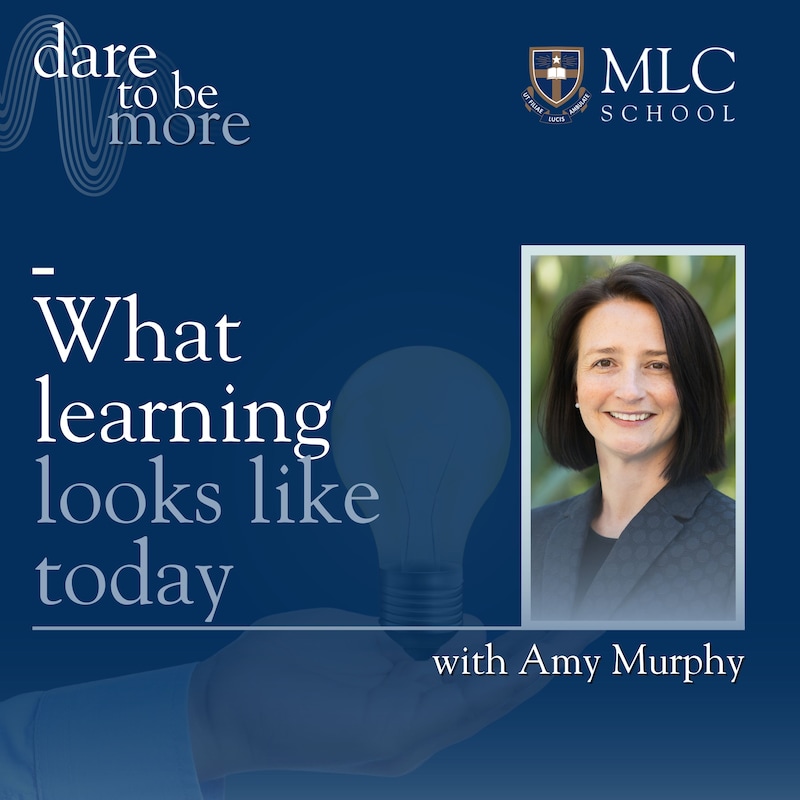
In this episode of 'Dare to Be More', host Anthony Perl speaks with Amy Murphy, Director of Professional Practice, about how learning has evolved and what contemporary education looks like at MLC School.
Amy, who recently joined MLC School after 17 years in the public system, shares her observations about the similarities and differences between educational contexts, emphasising that at the core, all educators want students to thrive and become agents of change in the world. She explains how her role supports both students and teachers, ensuring a clear vision for teaching and learning whilst providing responsive support for teacher wellbeing and professional growth.
The conversation explores how learning today differs from previous generations, with Amy highlighting the increased agency, voice, and choice that students now have in their learning. She discusses the focus on developing dispositions and soft skills - self-awareness, self-regulation, resilience, and collaboration - alongside content knowledge, preparing students to apply learning to any context in the world.
Amy addresses the role of technology and AI in modern classrooms, explaining how MLC School has chosen to embrace rather than ban AI, using it as a tool for feedback, idea generation, and efficiency whilst maintaining critical thinking as a priority. She discusses the complexities of assessment in an AI-enabled world and how teachers are adapting their approaches to ensure authentic student work.
The episode explores the critical intersection of wellbeing and learning, with Amy emphasising that psychological safety is essential for students to show up and learn effectively. She discusses trauma-informed pedagogy, neurodiversity, and how MLC School's relational approach - where teachers truly know, see, and value their students - creates the conditions for both academic success and personal growth.
Amy shares insights into how teachers are supported through the complexities of modern education, including professional learning that is relevant, meaningful, and practical. She discusses the importance of being kind to ourselves as learners in a rapidly changing world, and how Canvas as a learning management system provides transparency for parents whilst supporting teacher efficiency.
The conversation concludes with Amy's powerful interpretation of 'dare to be more', drawing on TS Eliot's "The Love Song of J. Alfred Prufrock" and the question "Do I dare disturb the universe?" She describes the inherent restlessness to keep growing, learning, pursuing, and making change as essential to both teaching and learning.
About MLC School: MLC School is a leading independent girls' school in Sydney, committed to empowering young women through academic excellence, character development, and innovative education. Our mission is to inspire girls to dare to be more.
Connect With Us:
- Website: mlcsyd.nsw.edu.au
- Instagram: @mlcsydney
- Facebook: @MLCSchoolSydney
- LinkedIn: MLC School
Co-host: Anthony Perl
Produced by: 'Podcasts Done for You'
Transcripts
What learning looks like today?
2
:Welcome to Dare to Be More, the podcast
from MLC School in Burwood, Sydney.
3
:Today we're exploring modern
education with Amy Murphy, the
4
:director of professional practice.
5
:For year seven to 12, discover how
learning has evolved from yesterday's
6
:traditional approaches to today's
student-centered classrooms where agency
7
:voice and choice empower girls to thrive.
8
:Learn about the intersection of wellbeing
and learning how technology and AI
9
:are being thoughtfully integrated
and why relationships remain at
10
:the heart of exceptional education.
11
:We'll explore how MLC School develops,
not just content knowledge, but the
12
:character and soft skills students
need to navigate our complex world.
13
:I'm your co-host, Anthony Pearl.
14
:Let's get into today's conversation.
15
:Well, hello everyone and welcome to
another episode of Dare to Be More, and
16
:I've got Amy with me today and we're gonna
be talking about all things relating to
17
:the junior and senior school and learning
and what that actually looks like today.
18
:It's quite a broad topic in many respects.
19
:So Amy, welcome to the program.
20
:Amy Murphy: Thank you for having me on.
21
:Anthony Perl: Well, I think we always
need to start off by allowing you
22
:to introduce yourself to everyone.
23
:Amy Murphy: Yeah, so hello everybody.
24
:My name is Amy Murphy and I am the
new director of professional practice
25
:for year seven to 12 at MLC School,
26
:Anthony Perl: you've got such a
broad area that you're covering.
27
:And you know, but I think we need
to start off with that kind of idea
28
:of what learning looks like today.
29
:I think in part we need to kind of
address what learning looked like
30
:yesterday in order to understand
what it looks like today, because
31
:there really is a significant shift.
32
:I think any parent would feel that
what the kids are doing in today's
33
:school is very different from what
they would've experienced in school.
34
:Amy Murphy: Yeah, absolutely.
35
:I think that's a really nice
question actually, because.
36
:I feel like kids today probably have
a little bit more agency and voice
37
:and choice in their learning, and I
think that's really powerful for their
38
:confidence and for their empowerment as
well to know that they can do things.
39
:They can do things really beautifully
as a 6-year-old, as a 14-year-old,
40
:and then we want them to go and do
wonderful things in the world too.
41
:So agency is key in our classrooms
today, which is definitely a difference
42
:even from when I went to high school.
43
:You know, having voice and choice
in how you learn and what type of
44
:learning suits you can be really
powerful for an individual too.
45
:Also, you know, there's a lot of
focus on what we call our soft
46
:skills or our dispositions today too.
47
:So we're not just growing
content in brains.
48
:Content is obviously very important,
but we're also trying to teach kids
49
:how we learn and the process of what
learning looks like so that they can then
50
:apply that to any context in the world.
51
:But you know, also, how do we grow
them in terms of their self-awareness,
52
:their ability to self-regulate the
resilience that is required to be
53
:part of such a complex world that
we've landed ourselves in right now.
54
:So all of those dispositions are
equally as important as to the content
55
:that we teach with our curriculum to
obviously a key difference in learning.
56
:At the moment is technology and ai.
57
:How will AI impact learning?
58
:How can we embrace AI as much
as possible to kind of leverage
59
:learning within our spaces?
60
:And our director of E-Learning, Mariana
is doing a beautiful amount of work
61
:with teachers in that space at the
moment, before we next roll out what
62
:that looks like to our students too.
63
:Here at MLC School, I think
what is the same though?
64
:Is that relationships are key to learning.
65
:So, you know, you hear the girls at MLC
speak all the time of how much they love
66
:their teachers, or you can see them in the
playground waving to their teachers or.
67
:Sharing jokes or stories, and I think
there's a really beautiful sense of
68
:relational pedagogy at MLC School, which
allows our girls to feel really safe.
69
:And that psychological safety now is so
important in order to allow kids to learn.
70
:Because if you're not
safe and you're not well.
71
:It's really difficult to be
able to show up and learn.
72
:So I think even our understanding of
how wellbeing intersects with learning
73
:has also come a long way from the past.
74
:And you know, there's so much research
into trauma informed pedagogy.
75
:You know, how do we really work
with kids who have really tough
76
:stories and complex lives?
77
:How do we work with neurodiversity
so that we best get the needs of that
78
:learner to their most success that
they could ever possibly see as well?
79
:So huge complexities just in the shifting
landscape of the world, as well as the
80
:shifting landscape of education too.
81
:Anthony Perl: And, and it's really
points to the fact that it's become
82
:much more personalized, hasn't it?
83
:I mean, if you think back, it
wasn't that long ago that everybody
84
:did exactly the same thing.
85
:You didn't have too many choices about it.
86
:And if you didn't keep up with
the Joneses as it were, then
87
:you were just left behind.
88
:But as you say, there's a whole lot of
different circumstances that for any
89
:individual that you need to cater for,
and they might be learning related,
90
:they might be cultural related, they
might be just psychologically related.
91
:There's a whole different elements
to consider, and I think that's an
92
:important aspect, isn't it, of the
school, that there are a lot of choices
93
:and there's a lot of opportunities.
94
:For personalized attention.
95
:Amy Murphy: Oh, absolutely.
96
:I mean, that's probably, you know, one
thing that has really blown me away is
97
:the amount of opportunities here for
the girls, but also, yeah, opportunities
98
:in classrooms to show up as they are.
99
:And the teachers do such a beautiful job
of meeting them exactly where they're at.
100
:So there's high expectations across
the school, which is obviously what
101
:we want, but those expectations
are different depending on.
102
:You know how girls come to our classrooms,
what their histories are, what they
103
:imagine their futures to be as well, and
I think that's the only way it can work
104
:is when we really actively listen and then
shape education up around individuals.
105
:Anthony Perl: Yeah, and I think
that's provides its challenges
106
:for teachers as well, doesn't it?
107
:To be able to cater for that
level of individual care.
108
:Amy Murphy: Absolutely.
109
:The complexities that teachers face today.
110
:Are huge in their classroom spaces,
you know, and they do such a phenomenal
111
:job to know kids really well.
112
:So I think it comes back to that
relational pedagogy, knowing your students
113
:in front of you, knowing how they learn,
having a whole toolbox of strategies
114
:that are supported by evidence to be able
to get kids to where they need to be.
115
:Anthony Perl: Talk to me a little
bit more about the technology
116
:and how that's coming into play.
117
:I mean, we talk about AI and I know
we've had some other discussions on
118
:other episodes of the podcast talking
specifically about some of those
119
:examples, but just at a high level, the
complexities of having to deal with that.
120
:Both from a teacher perspective
and a student perspective?
121
:Amy Murphy: Yeah, I think ultimately,
you know, AI can be a beautiful friend
122
:and a beautiful critical friend in a way
to get feedback on paragraphs that they
123
:might be writing in English ahead of.
124
:Learning and teaching today
gave a marker workshop.
125
:I meet the marker workshop for year
12 students who've just finished their
126
:trials and she said, you know, like,
use AI pop in the last few questions
127
:from the HSC Pop in the rubric.
128
:Figure out what we haven't
asked in the HSC and see what
129
:questions come out from that.
130
:So there's some really beautiful work
in relation to making it work for you.
131
:But at the end of the day, we
still want our girls to be critical
132
:thinkers, and so we still wanna
prioritize how we teach and learn with
133
:critical thinking in our classrooms.
134
:And then AI can be used just as a tool
for us either to help with efficiency.
135
:Again, like I said, with feedback,
moving things forward, next steps.
136
:There's definitely, you know, a whole
spectrum of how we can use AI in our
137
:classrooms from idea generation to
finding out and filtering research
138
:to popping in your bibliography.
139
:I think once you've got that skill
of a bibliography, you've ticked that
140
:one off and AI can super speed that
process right up for you as well.
141
:Yeah, so there's really big potential for
how it can be used as a tool to help you.
142
:Anthony Perl: But when you go away from
that in terms of helping you, you've then
143
:got the challenge of how do you assess.
144
:Yeah, based on all of that,
because that's becoming more com
145
:complicated as well, isn't it?
146
:I mean, it's not just about the simple
HSE score that you get at the end of it.
147
:There's a lot of things that go
along the way that are both catering
148
:for the individual and both also
combating that use of technology.
149
:Amy Murphy: Mm, yeah.
150
:No, I completely agree.
151
:And I mean, that's a much
bigger discussion as well.
152
:There is an AI task force that
Mariana leads to at MLC School.
153
:I know that they are, you know, really
talking about how do we actively
154
:assess, how do we let AI in as a tool,
but when do we need to put a stop to
155
:it so that we maintain our critical
thinking and we know that this is
156
:a student's own work completely.
157
:Because in the HSC we have to
sign off that this is definitely
158
:a student's work at the end of
their course for their major work.
159
:And they also complete in all my own work.
160
:You know, aspect and check in their year
10 to make sure that, you know, there is
161
:no plagiarism and things like that too.
162
:So there are things that are being
shaped up, I think, across the board with
163
:education around the world for how do
we tell, you know, how can we measure,
164
:how do we need to make sure we've got
active processes in class where we can
165
:see the development of student thinking
and student work before they might
166
:submit a final assessment task as well.
167
:Anthony Perl: Because there's something
also being said for the fact of.
168
:Understanding how to use the technology
because it's very easy to go and say
169
:into an AI and say, go write me this.
170
:But it's another thing to actually give
it very specific commands to give it
171
:the context and things that you want.
172
:So part of it is actually learning
how to utilize the technology.
173
:Amy Murphy: Yeah, absolutely.
174
:And I think Marianna has amazing
plans for how she will roll
175
:that out over the coming years.
176
:Because you're right, there's an
absolute technique to be able to make
177
:it work for you in a really clever
way, but ultimately, at the end of the
178
:day, like the human on the other end
has to have the skills to be able to
179
:manipulate what it is telling you to
shift things, to make it work for them,
180
:and to make it really personal as well.
181
:Anthony Perl: When we talk about the
changes that are happening in learning.
182
:Girls to some extent will be easier
to adapt because it's all new to them.
183
:So they're adapting very easily.
184
:Whereas you are looking at teachers
who may have been, you know, teaching
185
:for some period of time, and so they're
having to learn on the go almost about
186
:how to not only use the technology and not
just technology, but different learning
187
:styles and different programs and things.
188
:As well as then being able to teach them.
189
:So that must have its challenges as well.
190
:Amy Murphy: Certainly does.
191
:I think that's so why, that's part of my
role too, is that teachers, one of the
192
:reasons teachers sign up to be a teacher
is because they love learning as an
193
:inherent desire for them to know more.
194
:To be more, to grow more constantly.
195
:So I think for a lot of our teachers,
the learning that happens all the
196
:time in terms of wellbeing, in terms
of differentiation, in terms of the
197
:cognitive science, all of the neuroscience
and cognitive psychology work that
198
:is coming out and coming back round
in relation to cognitive load theory.
199
:Retrieval practice is really powerful and
exciting because it gives us additional
200
:strategies to use in our classrooms that
we know are totally evidence backed to.
201
:It's a lot though for teachers to
keep their head around that, and I
202
:guess it's really important from a
leadership and vision perspective that
203
:we have to be really careful with how.
204
:We engage with that knowledge,
how that knowledge rolls out to
205
:staff as well to make sure that
they are not at cognitive load.
206
:Because if they are at cognitive
load, just like kids, you know, no
207
:new information will go into that.
208
:So we are looking at reimagining, you
know, what can professional learning look
209
:like so that it is relevant, meaningful,
and practical, but really a part of.
210
:The day to day of teachers as
well in their classroom spaces.
211
:Anthony Perl: Yeah, there's
a lot for them to learn.
212
:I'm sure the days of just working on
a chalkboard are well and truly gone.
213
:Right.
214
:So, and just having to combat
with that, you know, all of the
215
:technology that you have to use
just to deliver the lessons Yeah.
216
:Is in of itself a, a steep
learning curve for some.
217
:Amy Murphy: Yeah, and I think,
you know, we operate on Canvas is
218
:our learning management system.
219
:Canvas is phenomenal.
220
:Mariana again has done a really
beautiful job with setting up canvas.
221
:But that obviously takes time to train
teachers to make sure they feel really
222
:safe and comfortable with using Canvas.
223
:So usually the best way is
a really phased approach.
224
:You know that by this point in
time we'd love you to be here.
225
:And really at the end of the day, the
tech tools like ai, we've got a full
226
:suite of Microsoft Co-pilot that we have
access to, and then Canvas in the end.
227
:Will usually help with the efficiency,
um, for them to manage everything that
228
:they have to in their role as a teacher,
but particularly in relation to their
229
:lesson planning and their learning design.
230
:Anthony Perl: What's the
lesson for parents as well?
231
:Because they're also sitting out
there and having had a very different
232
:experience in terms of learning to
what their children are undertaking.
233
:So how do they.
234
:Best work in between that because you
can't necessarily expect that they're
235
:always on top of the technology.
236
:Amy Murphy: No, that's absolutely right.
237
:I mean, I think the rule, you
know, the new rule that is being
238
:passed in parliament for 16 year
olds and social media will be
239
:really powerful for all parents.
240
:I think just make her cry for
help and a big celebration there.
241
:But it's really hard being a parent, I
think, in this world and this landscape.
242
:And you know, if you're a parent of
multiple kids, it's absolutely huge to be
243
:across everything that schools are doing.
244
:Um, I think, you know, parents need
to be kind to themselves in learning
245
:and relearning what a new world like.
246
:We're in a brand new world with
teenagers at the moment, and they,
247
:their world changes so quickly too.
248
:So asking questions, you know,
curious questions when you can,
249
:like, how does this work on Canvas?
250
:How do you submit an assessment?
251
:Show me your lesson from today.
252
:You know?
253
:And quite often our faculties will
communicate through the newsletter,
254
:so parents will be able to see and
read what they get up to as well.
255
:And you know, like parents are sent
notifications through Canvas if
256
:things are submitted or they aren't.
257
:So it's important to have
your notifications turned on.
258
:As a parent, but one of the
best things about Canvas is that
259
:there's complete transparency.
260
:You know, parents can actively go
into Canvas and see exactly what
261
:their child is learning and doing.
262
:Um, so yeah, I think be kind
and go slow, you know, like
263
:technology changes all the time.
264
:Um, but yeah, there are definitely, you
know, huge things that we need to explore
265
:and unpack in relation to AI as well.
266
:And when we do that, we will
absolutely always communicate home.
267
:Anthony Perl: Just in closing things
off a little bit, I wanted to ask
268
:about something you touched on
before, which is that balance between
269
:academic excellence and wellbeing.
270
:Yeah.
271
:That's become more and more important,
so how do you find that balance for.
272
:Individual girls.
273
:Amy Murphy: Yeah, I think
it comes back to a lot.
274
:One is your relationships with the
girls, knowing them, seeing them,
275
:valuing them in your classroom spaces.
276
:Two, how you design your
lessons and your learning.
277
:You know, making sure that there
is a space for inquiry, curiosity,
278
:and collaboration in your lessons.
279
:There's a really explicit
learning intention and success
280
:criteria so that girls know,
okay, by the end of this lesson.
281
:I need to know the following
things, or I should have learned
282
:or achieved the following things.
283
:That provides a really beautiful
layer of safety for them and
284
:direction for where they're going,
providing and working with a gradual
285
:release model, you know, so I do.
286
:We do together and then you do,
so they get the chance to transfer
287
:and apply their learning in
your spaces as much as possible.
288
:And then obviously focusing in on just
in time teaching is what we call it.
289
:And that's being super
responsive to the class.
290
:So if someone says, ah, miss, can you
just explain topic sentences again?
291
:You know, like, I think I've got
it, but I haven't fully got it.
292
:It's up to me as a teacher in that
space to think about, okay, like
293
:I need to rework a strategy here.
294
:There was something that didn't
quite land for this particular
295
:student, and that's okay.
296
:So I'll dig into my toolbox to kind of see
how I can best help them, because I need
297
:to come at this from a really different
angle, and then that allows them to feel.
298
:Really well, you know, within that space,
because I'm being really transparent.
299
:I'm working within their needs.
300
:I'm responding to them as best as
I possibly can, challenging them.
301
:You know, like sometimes learning
isn't actually, a lot of the
302
:time learning isn't easy.
303
:So I think reminding girls as well
that, you know, learning is hard and the
304
:struggle is usually where the learning is.
305
:That we'll get there.
306
:You know, we just need to get out of
the pit, the learning pit, we call it.
307
:A little bit, and we need additional
strategies, and that can come in the
308
:way of instruction, but it can also
come in the way of that wellbeing where
309
:we're trying to build resilience at
the same time as building understanding
310
:of a particular concept as well.
311
:So knowing them, hearing them,
seeing them, validating them,
312
:you know, having complete belief
that your students can achieve.
313
:Is obviously very important and something
that I have witnessed so beautifully.
314
:Anthony Perl: Just to wrap things up, as
we do in the podcast, I'm interested in
315
:what your response is going to be to this.
316
:We are asking everybody what dared
to be more means, particularly in the
317
:context of what we've been talking about,
318
:Amy Murphy: so it's probably one of
the things that really attracted me
319
:to applying for the job at MLC School,
and that's because I love, I'm an
320
:English and drama teacher and I love.
321
:The poetic suite of TS Elliot, and in his
poem, the Love song of j Alfred, proof
322
:Rock, the Persona, which is Proof rock.
323
:Questions, do I dare disturb the universe?
324
:And I love that question.
325
:I mean, he's in a state of paralysis
because of existential thinking.
326
:Urbanization, the modernist world.
327
:So he doesn't want to
disturb the universe.
328
:But that question always
makes me think, yes.
329
:Do disturb the universe.
330
:That's exactly what we want to happen.
331
:So when the motto of the school is
obviously dare to be more, for me it's
332
:always about for teachers and for students
having this inherent restlessness to
333
:keep growing and to keep learning, and to
keep pursuing, and to keep making change,
334
:Anthony Perl: that is a
wonderful way to bring.
335
:What is a very broad topic to a close,
but thank you so much for those insights
336
:and I love that reference to something
that's so personal for you as well
337
:and, and bringing that all together.
338
:So Amy, thank you so much for
being part of Dare to Be More.
339
:Amy Murphy: Oh, thanks
for having me on the show.
340
:Anthony Perl: Thank you for
joining us on Dare To Be More.
341
:If you enjoyed this episode, please
subscribe wherever you get your
342
:podcast so you never miss an episode.
343
:Your likes and comments also
help more families discover
344
:these valuable conversations.
345
:For more information about MLC School
and their approach to girls education,
346
:visit their website, MLC c.nsw.edu.au.
347
:Check out the show notes
for more information.
348
:The Dare To Be More Podcast is
produced by podcast Done for You.
349
:I'm your host, Anthony Pearl,
and we invite you to join us next
350
:time as we continue to explore
what it means to dare to be more.
