Shownotes
What happens when loss changes everything—not just emotionally, but structurally?
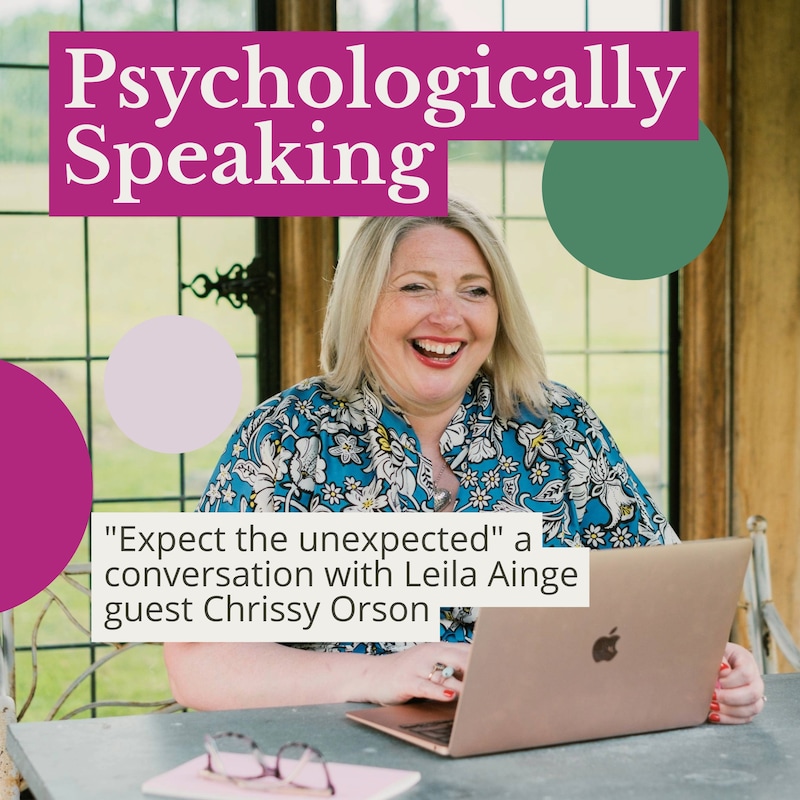
In this episode of Psychologically Speaking, Leila Ainge is joined by wellbeing consultant and psychotherapist Chrissy Orson to explore grief, identity shifts, and the moment your life no longer fits the way it used to.
After losing both her sister and father within weeks during lockdown, Chrissy shares how grief didn’t just affect her personally—it completely changed how she saw work, time, family, and what actually matters.
We talk about the psychology of grief, why many women “keep going” until they hit a wall, and how organisations often fail people at the moments they most need support.
This is a conversation about loss—but also about clarity, boundaries, and building a life that reflects what you now know to be true.
We cover:
- Grief, trauma, and identity shifts
- Why women keep going (even when they shouldn’t)
- The hidden admin and emotional labour of loss
- Psychological safety at work during life events
- Why flexible working often isn’t truly flexible
- Therapy vs coaching—and when you actually need each
Link to EMDR explainer https://www.youtube.com/watch?v=bIJZQAr9nQo
You can find Chrissy at:
Chrissy Orson MBACP (Accred) | She / Her | www.chrissyorson.co.uk
Transcripts
But everything had changed.
2
:Like it was like, like my whole kind of axis had shifted and it was like, actually this,
this, I don't want to be the center of my world.
3
:Anybody that ever met my sister, so Liz O'Donnell was her name, could attest that she was
just this absolutely fantastic person.
4
:She was my absolute go-to for all things advice.
5
:She was very present.
6
:Welcome to Psychologically Speaking with me, Leila Ainge.
7
:I'm a psychologist and researcher for Hire and also the facilitator of the reflection
room, a group coaching space.
8
:This season, our theme is Expect the Unexpected and we have already heard from some
wonderful women who have spoken to us about things that have happened to them that they
9
:never anticipated would happen.
10
:I can't wait to introduce you to our next guest.
11
:We've got Chrissie Orson joining us and Chrissie is a wellbeing consultant.
12
:She specialises in supporting organisations to look at psychological safety for employees
and increase their wellbeing and retention.
13
:If you've listened to my podcast for a while, you'll know that I'm a huge fan of
psychological safety.
14
:So I can't wait to get into that conversation.
15
:Chrissie is also a psychotherapist and coach.
16
:She supports clients who've experienced trauma to feel psychologically safe again
themselves.
17
:And one thing that I didn't know about Chrissy until I was stalking her on LinkedIn
earlier is that she's also a school governor we're going to talk about that because it's
18
:such a rewarding role and a lot of parents get thrust into it
19
:Chrissie, welcome to the Psychologically Speaking podcast and thank you so much for being
here.
20
:Thank you for having me
21
:I love your accent.
22
:whereabouts in the country you are from?
23
:So I live in Sadleworth, so it's part of Oldham, so kind of between Manchester and
Huddersfield.
24
:I lived in Manchester for over a decade so whenever I hear a lovely accent from either
Oldham or Berry or Bolton it always makes me feel like I'm at home
25
:Chrissie, What is it that prompted you to get in touch and to say I want to talk about
something unexpected that's happened to me?
26
:What can we expect to hear from you today?
27
:So for me, the unexpected for me was a significant period of loss in 2021.
28
:And that led to some really major changes for me, kind of career, life, ways of thinking,
ways of showing up in the world, all hit around the same time.
29
:So that's what I would like to talk about today.
30
:And so this would have been a period which was, were we coming out of lockdown
31
:We the children weren't back in school.
32
:Lockdown was very much alive and kicking and everything felt very isolated and very small,
which made things really interesting to deal with.
33
:Yeah, so obviously letting listeners know that we are going to talk about death and loss
and grief and bereavement today.
34
:You're a psychotherapist.
35
:I feel very comfortable having this conversation with you knowing that you're happy to
talk about this.
36
:But if anyone listening needs any support, I will put some details in the show notes of
places and spaces and organisations that you might want to reach out to.
37
:Chrissie, do you want to tell us a little bit about what happened, who your family member
was how that has changed things for you?
38
:So in 2018 I started a new job working for a local authority supporting education settings
to have a whole school approach to mental health.
39
:Everything was fairly settled, we'd moved house the year before, everything was fairly
kind of relaxed and then in the December of that year my older sister was diagnosed with a
40
:really rare form of cancer.
41
:cancer with a bile duct which apparently is supposed to be male
42
:Over 70, quite often associated with heavy drinking, smoking, obesity, things like that.
43
:And my sister would have been 46, And I'd run a half marathon two weeks before she was
diagnosed.
44
:Yeah, so as a family that absolutely floored us, she has four children.
45
:So there was kind of a lot kind of going on for us all.
46
:We were really lucky that in Manchester, one of the specialist surgeons is actually based.
47
:So she kind of had surgery and went into a period of remission, which was fantastic.
48
:We always knew that it was a type of cancer that doesn't really stay away.
49
:At some point it will reoccur.
50
:And at the end of 2020, that happened.
51
:So we entered kind of a bit of a funny stage where she was obviously kind of terminally
ill.
52
:They were still locked down, so there was some flexibility around caring.
53
:I was doing my best to support with her family and things along with her husband.
54
:But that meant that I was going backwards and forwards to support them, whereas my
children were not able to.
55
:Then in early 2021, they stopped all treatment and she passed away in February 2021.
56
:Anybody that ever met my sister, so Liz O'Donnell was her name, could attest that she was
just this absolutely fantastic person.
57
:She was my absolute go-to for all things advice.
58
:Since my mum died in 2009, her, well, me and my other sister largely turned to Liz for any
sort of advice.
59
:She was very present.
60
:She was kind of the first person, other than my husband, to hold both of our children.
61
:and was kind of very, very involved in our lives, kind of sister, auntie, friend.
62
:So she passed away in the February, which was horrendous.
63
:It was absolutely awful, even though we knew that it was going to happen and it was
expected.
64
:It was awful.
65
:And we were kind of waiting for it.
66
:So I kind of went into work one morning and then, well, when I say went into work.
67
:I walked downstairs into my kitchen and sat at my dining room table like everybody was
doing at that point for work.
68
:And at some point I got a phone call from my mother-in-law that said, like, you need to
come.
69
:So I kind of ended up putting an out of office on, which was really odd because I didn't
really know what I was putting an out of office on for.
70
:And I was very lucky in hindsight.
71
:I think I was very lucky that I was with her when she died.
72
:I was with her, my other sister, her husband and her children, we were able to be there.
73
:And it was kind of a proper defining moment.
74
:I'd had to some really difficult conversations with my children who would have only been
five, like four and six, I think maybe five and seven.
75
:had to kind of explain to them firstly that Antillis was going to die, which was a
horrendous conversation, had to really put a lot of, like all the learning that I have
76
:around how to explain that to a child, and then had to explain to them that she had died.
77
:Then it was her funeral a couple of weeks later, and the day before her funeral I got a
phone call from my dad.
78
:My dad had been like massively hit by her death.
79
:You know, I don't think any parent thinks that they're going to outlive their child, do
they?
80
:he was at the time fit and healthy.
81
:He was kind of.
82
:Walking most days, you know, doing all his own shopping, cooking, cleaning, things like
that.
83
:he said he'd had a fall, which never happened before.
84
:he kept saying he had this pain between his shoulder blades and the doctor kind of seemed
to think it was like grief, you know, kind of holding onto pain, things like that, which,
85
:you know, we didn't really have any reason to think otherwise.
86
:So the morning of my sister's funeral, my dad phoned my husband, which was really unusual.
87
:He never phoned my husband, he always phoned me.
88
:Keith was kind of a bit of a, kind of afterthought almost, as much as my dad loved him.
89
:So we phoned my husband and asked him to go down.
90
:And at this point, my dad couldn't move.
91
:We had to, he couldn't kind of, he couldn't get himself up on the sofa or anything.
92
:It was really, really difficult.
93
:And we had to kind of summon a little kind of team of friends to basically help get him to
the funeral.
94
:had to borrow a wheelchair.
95
:It was horrendous.
96
:By the following morning, my dad had lost all sensation in his legs and we had to ring an
ambulance.
97
:At this point, he wouldn't have any of it.
98
:My dad was pretty much what you would class as white coat syndrome.
99
:Didn't like doctors, didn't like hospitals, would avoid them at all costs.
100
:So I ended up going into hospital and we were told that his spine had collapsed from a
secondary tumour, from a cancer that he didn't know he had.
101
:He'd had no symptoms.
102
:So I was able to go into A &E to take him, kind of a bag.
103
:But after that, we weren't able to see him at all.
104
:He was taken into hospital and was admitted.
105
:We didn't really know what was going on.
106
:I was getting lots and lots of phone calls from him.
107
:various different specialists and was eventually kind of given a phone call, got a phone
call to say that they wanted to bring him home and that he'd signed a DNR in the hospital.
108
:was all very kind of traumatic and we're still very much in adrenaline mode to be honest.
109
:um My children's school were really, really helpful.
110
:Their teacher actually kind of phoned me and he said like, can I...
111
:can we take the children back into school early because it will help you?
112
:And I was like, no, no, no, no, it's fine.
113
:Actually, yeah, that would be really, really helpful.
114
:Because it's what we do as women, isn't it?
115
:We kind of go, no, no, no, it's fine.
116
:I can get on with this.
117
:It's fine.
118
:It's no problem.
119
:It was a problem.
120
:So.
121
:where schools were only partially open for children of maybe key workers?
122
:Yeah.
123
:And presumably then when you're saying we were allowed to go into A &E, but then the rest
of the hospital must have been quite closed off for you.
124
:They were making exceptions, weren't they, for people who were on palliative care and
stuff, I think by that point.
125
:yeah, it's trying to put ourselves back in that place, you know, which was...
126
:you know, such a strange place.
127
:it was so strange.
128
:And I mean, I went to see him.
129
:Well, I didn't even go to see him.
130
:We were allowed into the hospital for a meeting with a social worker.
131
:And we were allowed in to see my dad for a few minutes.
132
:But it was like full PPE, aprons, face masks, like face shields, everything.
133
:It was awful.
134
:And it was awful for me to visit for like half an hour.
135
:So kind of I can only imagine what it would have been like being there being so
frightened.
136
:So we eventually came home and we were told kind of it could be weeks, it could be months,
but about six weeks after my sister died, my dad passed away.
137
:So I'd had some kind of interesting moments, you know, kind of while we were getting ready
for him to come home and things, and I was talking to somebody who used to manage my
138
:manager.
139
:He rang me up and I was saying, like, you know, I'm going to look at carers leave and see
if I can go back to work part time and see what flexibility they have.
140
:And he told me.
141
:And I mean, it sounds really harsh when I say it to somebody else, but he's a very lovely
person.
142
:just said, you need to get a grip.
143
:He said, you are not replaceable to your family, but you are replaceable at work.
144
:You need to be with your family because you will regret not being with your family if
you're not there.
145
:And that kind of really stuck with me.
146
:because I had to some time off after my dad died and it kind of all blurred into one which
raised a whole load of questions around kind of bereavement leave and how often should you
147
:be allowed to have bereavement leave like I planned to lose relatives so closely together.
148
:And I mean, my manager was really, really supportive, but because I worked for a large
organization, it's numbers, isn't it, rather than individuals.
149
:So I went back into work.
150
:But everything had changed.
151
:Like it was like, like my whole kind of axis had shifted and it was like, actually this,
this, I don't want to be the center of my world.
152
:And I was going back into schools as they started to open and I was working with them and
I really, really enjoyed my jobs.
153
:I loved the relationships that I had with, you know, head teachers and mental health leads
and all the kind of schools and things that were supporting.
154
:but it wasn't lighting me up the same way.
155
:I felt like I could only kind of scratch the surface.
156
:And part of that was due to kind of budget cuts and things like that.
157
:But it was also because with budget cuts, gets thinner and thinner.
158
:I wanted more in terms of I wanted more to be able to have more time with my own family.
159
:I wanted to be able to look after my own health.
160
:because I had this realization that my sister never made it to 50 and my mum was only 61
when she died.
161
:What am I, am going to just work myself to the point where I'm not well?
162
:Or do I want to be able to enjoy things now and be able to create a life where I can
create moments of opportunity that I can have time off with my children, that I can take
163
:the afternoon off to go and watch a gymnastics performance and I can go on, take a day off
to go and take my son to the cinema because he's off school and my daughter isn't, you
164
:know, those sorts of opportunities.
165
:I wanted to be able to create those now.
166
:And it completely shifted what was important to me.
167
:I said to my husband, you know, if I've not found another job by the end of the financial
year, then I'm gonna jump and just go self-employed.
168
:Now what actually happened was I found a job.
169
:Ironically, I was offered the job on my sister's birthday.
170
:So I found a job and it was,
171
:go three days a week so that I could start building my own stuff.
172
:And I did that for, I stayed in that role for kind of about just over 12 months, probably
about 18 months, during which time I got from three days a week to two days a week and
173
:then I went fully self-employed.
174
:And well I mean anybody who tells you go self-employed is a really good way to give
yourself any free time, it's probably not, but that's probably not the moral of the story,
175
:it didn't give me any free time really but it does give me more flexibility.
176
:And it means that if I want to do my work after my kids are in bed, I can.
177
:If I want to schedule LinkedIn posts at six in the morning before on my way to the gym,
then I can do.
178
:And if I want to finish to take my daughter to gymnastics, can.
179
:Or I want to kind of take time off with them in the holidays.
180
:I can do those things and I'm not kind of constrained by other people.
181
:And it's meant that I can work in a way that works for me.
182
:So I still work with my individual clients and I love it.
183
:But it's allowed me to also take some of that, the learning from my time working kind of
whole school to different organisations and talk to them about things like policies and
184
:procedures.
185
:You know, it's not the sexy approach to staff wellbeing.
186
:You know, it's not going to look good on your Instagram, but it is the stuff that makes
the real big difference because, you know, if something happens, like, you know, you have
187
:an employee who has a family member who dies and they're told that they can have, you
know, 3.2 days because it's this relative.
188
:it doesn't go anything towards what your relationships are, then you lose that connection
with your staff.
189
:They don't feel safe, they don't feel supported, they don't feel wanted and then nobody's
getting their best out of their staff.
190
:you described your whole axis changed when you returned to work.
191
:And I think that's such an interesting metaphor to use.
192
:So if we think about where your axis was pre Liz and your dad dying and where it is now,
what has shifted most for you?
193
:Being able to do the stuff that I really enjoy and being able to create a life and way of
working that works for my family.
194
:Mm.
195
:Mm.
196
:because many organizations do things like flexi time, but it's not all that flexible.
197
:It's flexi time, but only between half past eight and half past five.
198
:And you can only earn up to one day.
199
:And if you earn more than one day, then no one's got time to take it.
200
:That never really kind of worked for me.
201
:And sometimes I might take a day off during the week and it might mean that I end up kind
of writing and training on a Saturday, but I do that at a time that works for me.
202
:And it means that
203
:can do it whilst kind of doing things at home after a football match or something like
that.
204
:And it means that I can kind of put my family first and I can put my health first as well
because I was really struggling when I was at the local authority just before COVID.
205
:I have two chronic health conditions and I had a really significant flare-up of one of
them that causes kind of chronic back pain.
206
:and like I'd myself on crutches and we had to go and have kind of injections into my
spine, about a week before lockdown, which was a really interesting experience, travelling
207
:to London at the point where nobody else was going and standing on a platform at Euston
Station in rush hour and there being six of us, it was really odd.
208
:But being able to kind of put things in place to be able to make my health kind of a
priority.
209
:rather than something that I was just kind of like shoving in along the way and hoping for
the best.
210
:Being able to kind of take the time off when I want to, being able to say kind of like, in
summer I'm hoping to take like three and a half weeks off work, which I've never done.
211
:I've never had three and a half weeks off since maternity leave.
212
:But actually it's like my opportunity to do something really amazing with my family
because, you know, my kids aren't going to be little forever.
213
:They're not going to want to go on holiday with me forever.
214
:I mean, I kind of hope they do, but you know, but you know, I would really like the
opportunity to make those memories whilst I've got time to do that.
215
:Do you think you would have moved into self-employment had your sister and dad not died
when they did?
216
:I'm not sure if I'm really honest about it because my dad was of a generation where kind
of you work for a local authority, it's a job for life, it's stable, it's secure, which
217
:it's not anymore.
218
:You know, there's been so many redundancies and things like that in kind of across Greater
Manchester.
219
:So I don't know whether I'd have had the same level of support, but also, I mean, I was
really lucky in a position that it allowed me just
220
:just enough kind of financial freedom that I could go, actually I can make this work.
221
:If I can't make it work, I've got kind of like six months that I can kind of get by for.
222
:So there was that.
223
:It also allowed me the opportunity to kind of create an office at home and things like
that, which has all helped in terms of, you my outgoings and things as well.
224
:I think I would probably have...
225
:done our level of self-employment, but I think I would probably have held on to an
employed role.
226
:It's my gut feeling.
227
:It's curious, isn't it?
228
:when I speak to women as part of the research I'm doing at the moment.
229
:many of the women that I speak to don't suddenly wake up one day with a passion to go self
employed.
230
:it happens because it's the alternative.
231
:It's the alternative to becoming burnt out or trying to manage procedurally everything
that's happening.
232
:There was something interesting as you were talking earlier when you were retelling what
had happened around your sister Liz and your dad.
233
:And it was
234
:that kind of procedural, is what happened and then this happened and then this happened.
235
:I was thinking, it sounds like you were somebody who was very much moving through it
holding stuff and moving everybody along what felt like an inevitable conveyor belt.
236
:But when you look back now with your training as a psychotherapist and I suppose with all
of your experience of trauma how do you think you coped then?
237
:Well, kind of thinking about it, was, I stayed at my job for two years after they died.
238
:And what happened was basically for the first year, I think I just kept going.
239
:I think if I'd have gone to me as a therapist and talked about it, I would probably have
talked about manic avoidance, which is the kind of let's just keep busy and let's keep
240
:going and it will be fine.
241
:Because that's really weird.
242
:There's like loads of admin associated with death that nobody really tells you about.
243
:And like we were trying to empty a house that my dad had lived in.
244
:It was our family home.
245
:So we'd lived there since I was four five.
246
:So by the time my dad died, I think we've been there 36 years, I think we decided.
247
:So trying to empty that level of house.
248
:And I don't think
249
:Other than getting rid of my mum's clothes, which like me and my sisters had sorted, I
don't think he'd really ever got rid of anything else.
250
:You know, we found things for him, but Adam was a plumber's merchant.
251
:I found 50 brass outside tacks.
252
:You know, like, what am going to do with these?
253
:We did find some really hilarious things.
254
:Four toilet seats!
255
:Like, the toilets that we didn't even have!
256
:I felt like I didn't really have any choice other than to just keep going.
257
:But as the house went, as the house sale went through, which was an absolute nightmare,
probate was ridiculous.
258
:It took absolutely ages.
259
:our bias, how sale fell through twice.
260
:But when it eventually went through, I literally, I hit a wall.
261
:and I remember going into work by what bits point the schools were open and I delivered
some training in a school.
262
:And I remember somebody telling me that the training was really, really good.
263
:And I'd done like two, two lots of training.
264
:I did kind of something in there, some staff wellbeing training afterwards.
265
:So was doing their inset and
266
:I came home and just as I was turning off the main road my boss ran me and she was like,
how did he go?
267
:And I said, yeah, it was great.
268
:And she said, are you all right?
269
:I just burst into tears.
270
:And I was like, I can't do this.
271
:I can't do this anymore.
272
:I can't keep going.
273
:don't know what I'm like.
274
:And I just absolutely went to pieces.
275
:And I mean, I think I'd literally hit the wall.
276
:Not even like metaphorically, like literally hit the wall.
277
:I didn't know what I was going to do with myself.
278
:And I was lucky at the time I was having some.
279
:supervision, reflective supervision from an organization near me, and it was kind of
through a project that I was managing, and I got quite kind of friendly with the.
280
:two people who ran the organisation and I rang one of them and I was like, I need some
extra sessions, I need some extra sessions that needs to be with her because basically I
281
:said, she already knows everything that's going on.
282
:I said, and if I have to go and find somebody and wait, I think I'll be able to pull it
back together and I won't actually be able to start kind of working on the stuff.
283
:And I said, you know, if I go and work with her and I try and tell her that I'm fine, I
think she will call bullshit and she will make me go there.
284
:that's what I need.
285
:So I was really lucky.
286
:we just pause there knowing when is the right time to do the work and to have therapy and
to sit and have those conversations is a bit of an art form in itself because you.
287
:Yeah.
288
:And, during COVID about similar time that you're talking about, I was, um, working in the
NHS at the time and I was helping to settle per trauma informed service.
289
:So I was in and around practitioners, clinical practitioners who did supervision.
290
:And our whole thing was trying to get people in for, psychological support at the right
time.
291
:And I don't think I'd ever appreciated how.
292
:challenging that is because there's that period where perhaps you have gone through loss
and we had women who'd gone through loss and it's too soon and I didn't think that there
293
:was a thing and then clearly there's the period where people have tried to just kind of
carry on and that's potentially where unhelpful behaviors and thoughts and intrusive
294
:thoughts come in.
295
:It gave me a
296
:you know, an understanding how do we, as women who are carrying and spitting plates and
juggling loads of things, how do we notice when we need to talk?
297
:think.
298
:So when you're talking about grief and things like that, a lot of organisations will talk
about, you know, need X number of months to pass before, you know, before you start
299
:accessing support.
300
:And I think that is the case in general, but I wouldn't say it's necessarily a blanket
thing.
301
:So I think the thing that we're looking at is that grief isn't a mental health issue.
302
:Grief is a natural process that everybody needs to learn how to go through.
303
:what the need is, people around them, they need support, they need people to help them be
resilient, because nobody can be resilient on their own.
304
:It's one of my absolute bug bears of the term.
305
:So they need that kind of practical support, somebody who can help them emotionally and
things like that.
306
:And quite often that is friends and family.
307
:Not everybody has that.
308
:So I think sometimes I've worked with clients where they've needed that support earlier
because they haven't got anybody.
309
:yes it is a process that we all need to learn how to go through but if you haven't got
anybody to support you on that process how do you learn?
310
:And I think it's also different if you've got things like traumatic grief so you know I
take clients from victim supports, homicide service, know I've worked with people who are
311
:bereaved by suicide, various other traumatic situations where you end up with kind of
grief needs you to remember somebody.
312
:It needs you to be able to think about them and to find a place in mind.
313
:But trauma, your body's natural response is to try and make you forget and to try and
ignore it.
314
:So if you're dealing with grief and trauma, then the trauma gets in the way of the grief.
315
:So you never get to get past it.
316
:So there's no point waiting three months or six months because actually the trauma is
still in the way.
317
:And what people need is to have support with that.
318
:But I think for me, I think
319
:We quite often, what I see kind of quite often with clients when they come is they, like I
did, and I will hold my hands up, I wasn't very good as a client.
320
:I wasn't working as a therapist at the time.
321
:I had taken a break.
322
:because it would not have been appropriate for me.
323
:But I think what people...
324
:People wait until they're absolutely desperate.
325
:They wait until they hit the wall and then they need support and then they want support.
326
:They need support like yesterday.
327
:And that can be really, really difficult because then if you find the right person, then
sometimes you might have to wait a few weeks and stuff and you're a bit like, oh, but
328
:actually I really wanted it to start now.
329
:So it's about how do we recognise that we're starting to wobble?
330
:And quite often it's how do we recognise that things are starting to get in the way?
331
:starting to get in the way of our actual lives.
332
:know, is it getting in the way of our relationship with our children?
333
:Is it getting in the way of our sleep?
334
:Is it getting in the way of our ability to concentrate and work?
335
:Is it getting in the way of us wanting to spend any time with anyone?
336
:You know, our relationship with our partners, anything like that.
337
:And I think that's one of the kind of things I always kind of think is a bit of a warning
sign is around, is it getting in the way of the stuff that I want to be doing?
338
:Mm.
339
:that can be stuff from like sleep and eat and self care up to, I just can't bring myself
to like go out and spend time with my friends anymore because I'm not getting any
340
:enjoyment out of it.
341
:And I think quite often we're afraid because people think, you know, therapy is for people
at crisis point.
342
:Actually therapy isn't for people at crisis point.
343
:When people are at crisis point, they need crisis support, not therapy.
344
:And it's how do we get people to come in?
345
:like just that step back.
346
:And I also think we miss that therapy can be a really supportive tool like coaching for
performance, for keeping ourselves well.
347
:You know what mean?
348
:I work with clients who I've worked with long-term who we have periods where we see each
other more often.
349
:If they're struggling, we have periods where we see each other less.
350
:If things are going well.
351
:One of my clients referred to me as kind of the equivalent of having a personal trainer.
352
:It's like what?
353
:Yeah, she was like, what would you say?
354
:I pay for personal trainer and it's like absolutely no bother.
355
:He said, why do I kind of why do I question whether it's OK to pay for a therapist?
356
:So we go through phases where it's more.
357
:We go through phases where it's more like coaching, we go through phases where it's more
more like therapy, but I don't think the therapeutic journey is a straight line because
358
:people will do some of the work and then they kind of go like, why do you pause and let
that settle?
359
:and go away and practice things.
360
:And it's really interesting, isn't it?
361
:Because that whole idea of, you know, we wouldn't think twice about an athlete hiring a
coach for high performance.
362
:And that's where I think the most interesting kind of psychological studies sit is in that
sports arena, because we really get what high performance means.
363
:We've got a very clear context of how to strip everything else out and what focus looks
like and what flourishing looks like.
364
:and what teamwork, et cetera, looks like in that area.
365
:And coaching, again, I think people now think more positively about coaching these days
than they did maybe 20 years ago when I started out in organizations.
366
:Coaching was still fairly new.
367
:not many people, I think you've got a coach if you were at a senior level.
368
:You didn't get coaches when you started an organization, whereas...
369
:Now we say it's great to start a coaching relationship earlier rather than later.
370
:And yet that therapeutic relationship, you know, time and time again, the psychological
effect of the therapeutic relationship is so powerful.
371
:We know that it's such a wonderful thing when it does happen, when you click with
somebody, when you've got that great safe space to talk and to work through things.
372
:But
373
:Like you say, I don't think we think of it as something we purchased for performance.
374
:We think we purchased it or buy it for fixing.
375
:Yeah, and I think it's funny because I think we've moved in terms of like coaching being
more acceptable and people kind of being happy with saying, you know, I've got a coach and
376
:things.
377
:But I mean, I've worked with clients who have asked me to invoice them for coaching when
we're doing therapy because their organisation has said that they will pay for coaching,
378
:but not therapy.
379
:therapy.
380
:Yeah.
381
:And sometimes where it's a stigma attached to it, whether it's like, actually somebody is
perfectly susceptible to go for coaching, but what people think if they know it's therapy?
382
:And I think that's still something really, really important to be done there because
you're not telling me that kind of people at the top of their game, kind of CEOs and
383
:people like that, C-suite people.
384
:don't have any issues with their wellbeing, don't struggle with their mental health, don't
sometimes feel out of touch in their relationships, don't sometimes feel like they're on a
385
:treadmill and they just can't get off.
386
:coaching can go there with some of those topics, but it isn't a replacement for therapy.
387
:No, no not at all.
388
:So your career then as a therapist, when did that start?
389
:When did you train originally?
390
:So I qualified in 2014.
391
:So yeah, I think my career has been a series of things that have changed.
392
:So I started training as a psychiatric nurse and then this chronic health condition came
to the fore and I wasn't able to restrain people.
393
:And I worked in a mental health hospital, in a forensic mental health hospital.
394
:And that's a bit problematic if you can't restrain people.
395
:which is kind of how I ended up coming into therapy.
396
:And that was another slight curve ball because I started my training and I finished my
training with a child and pregnant.
397
:So how to make your masters really difficult.
398
:it is such an intense kind of period of learning because a master's is, is you're
mastering a whole kind of academic subject and also the practitioner points of it as well.
399
:And it's over a short period of women who go back to university or do a master's in
midlife.
400
:I couldn't imagine doing it with morning sickness and being pregnant.
401
:yeah, so it was part time.
402
:So it was two years for the kind of qualification part, and then an additional year for
year kind of dissertation.
403
:But a counselling master's is, like counselling self therapy as a training is really hard
going because you've got placement, you've got personal therapy.
404
:Yeah, you've got placement hours, you've got personal therapy, you've got supervision.
405
:more placement hours you do, the more supervision you need.
406
:Yeah.
407
:obviously takes time.
408
:You've then got your kind of actual writing alongside that and your actual research and
everything.
409
:It was fun.
410
:But yeah, so 2014 I qualified and then I've kind of been in various different roles, which
I think has given me a really wide breadth of experience really, because like I've worked
411
:in the third sector, I've worked kind of in education, I've worked in a role where I was
412
:funded by the DFE, employed by a local authority, paid by the NHS.
413
:was, you know, sitting between different kind of organisations and things.
414
:Gives you a really kind of like that kind of breadth and kind of helps kind of see what
works well and where things haven't worked well and things like that, which is where kind
415
:of psychological safety came in for me, really started when I was in an education role.
416
:And I was working in a school and I was really proud of the work that I was doing with
these individual young people.
417
:And know, I'd set up a service from scratch.
418
:We'd got a way to kind of, you know, got a way to kind of...
419
:evaluate the service.
420
:You know, I'd kind of got all these things set up.
421
:I'd kind of worked out how to kind of do appointments so I wasn't taking young people out
of the same lessons every week.
422
:I'd argued that children couldn't only just miss PE and technology, that they had to kind
of go through other subjects because taking children who are failing everything except
423
:those subjects only out of those isn't good for their self-esteem.
424
:But the thing that kind of always frustrated me a little bit was
425
:I was working like with a really small group of children and there were some things that
we could do that if we could just make some small changes kind of in the wider school, it
426
:could make a massive difference.
427
:And it was like, no, no, no, no, no, you we just want you to do that.
428
:We want you to do that.
429
:And I was like, yeah, but actually we'd need fewer children who needed that if we could do
a bit of this and we could do some groups and we could look at some training for staff.
430
:No, no, no, no, no, you're doing a great job here.
431
:You stay here.
432
:And I kept thinking like...
433
:I'm working with some children who, you know, we've got this great sense of psychological
safety in this room, but as soon as they leave, it all falls apart and they can't hold it.
434
:And then they get in trouble in school or they're being told they're not resilient or
they're not engaging or they're being suspended.
435
:And it kind of really frustrated me and kind of things about like
436
:sharing bits of information, so obviously they're completely confidential, but being able
to share kind of little pieces of information that would keep a child safe, feeling safe,
437
:by which I don't mean kind of they're not safe in school because the doors aren't locked.
438
:I mean, feeling safe, feeling like I'm okay, I can function, I can think, I can learn.
439
:Being able to share those little snippets of information that would make a difference
would make so much more sense.
440
:you know, being able to do things like talking about mental health in the curriculum.
441
:And I could never really get out of that little room.
442
:So when the job came up at the local authority, which was around whole school approaches
to mental health, I was like, oh, that's where that's where it is, because there was a
443
:whole public health movement about it.
444
:Earlier on, you mentioned whole school approach and I had a stint being a chair of
governors at my child's school.
445
:I was a parent governor.
446
:And one of the things that I found so challenging was this idea that SEND provision was
seen as just...
447
:as additional for individuals.
448
:And yet most of the papers that I was reading and some of the really interesting studies
just showed how inclusive we could be if we made changes for everybody.
449
:And I think recently on the podcast, I was talking to somebody who said, you know, well,
everyone's getting diagnosed with ADHD.
450
:I said, well, you know, I actually feel really good about that.
451
:I think more people that are diagnosed or
452
:aware of ADHD, the better because whenever we make an adjustment or a change or support
for somebody with something, then it benefits everybody.
453
:And I feel the same way about whole school approaches.
454
:There's just so much stuff that we could do.
455
:Like little things like sometimes schools have weeks that are just so overwhelming.
456
:So much activity going on in one week, like towards the end of term.
457
:And you think actually there would be
458
:children in that school who wouldn't hit a diagnosis for autism or for ADHD, but they
might be sensitive to noise or they might be sensitive to something else.
459
:And you think if we could just have a whole school approach where we can have some
different ways of doing things, people can opt into what makes them feel safe and feel
460
:comfortable.
461
:And that's psychological safety.
462
:It's not about saying that Johnny needs this and Sarah needs that.
463
:It's about saying we have this and you can opt in if you want to or if you need to.
464
:Well, I mean, I'm actually a governor in two schools.
465
:So I'm a chair of a governor's at a special secondary school that's got a plus 16
provision.
466
:But I'm now a parent governor at my children's school as well.
467
:Well, one child's school now, at a primary school, and I'm the send governor.
468
:And one of the key things that kind of I always found, because I worked alongside the
educational psychologist at the local authority and things.
469
:everything comes back to the idea of what's good to the send is good for all.
470
:And it's that idea, I always think of it as what is vital for some is really useful for
everyone.
471
:You know, to me, you think about things like a visual timetable, anybody who doesn't know
what a visual timetable is, it's literally like, we'll write down everything that's going
472
:to happen that day, and we'll put it somewhere so that the children know what's going to
come now, what's going to come next, and what will come after that.
473
:is absolutely vital for some children who kind of need to know they need to be able to
regulate their nervous system you know for autism things like that but actually like
474
:everyone quite likes to know what's going to happen
475
:You know what, last week I was on a call with, I'm organizing a conference with colleagues
this week from the British Psychological Society.
476
:And we were on a call, there's loads of us, you we're all volunteering and we're trying to
work out what we're doing.
477
:we've done this conference every year for a decade or something, you know, it's a
well-oiled machine.
478
:Um, but we're all talking and I'm just sitting there and I'm thinking, God, I just need to
visualize this.
479
:So I pulled up a spreadsheet, shared my screen and started visualizing like the, the
timetable for everybody.
480
:Everybody, not one person went, no, this is, this isn't helpful.
481
:And it was like, this is really helpful to see it.
482
:know, visualizing stuff, you know, we've got all of these different sensors.
483
:Why aren't we using them all?
484
:Why?
485
:And the other thing that I don't know.
486
:how this has happened, but with childhood, I've only just realized how much children are
expected to keep knowledge in their head.
487
:So my child has so much information in his head that he holds onto.
488
:And then I think, my God, I couldn't possibly hold onto all of that.
489
:And I know I've got systems and as adults, we create systems for keeping information
separate and storing it elsewhere.
490
:I think we do forget how much children do have to hold in their heads and how much they're
expected to just learn and that they're learning every single day.
491
:You know, they're not, they don't reach a point of like kind of equilibrium, do they?
492
:At class, they're always being expected to improve their performance and reach the next
level.
493
:So it's never an easy place for children.
494
:It's just this constant kind of treadmill of
495
:Right, you've reached the top of that little hill, get to the next one!
496
:And I think the way we examine children is really awful, because you can learn to be good
at exams.
497
:That doesn't necessarily mean that you're good at everything else.
498
:And exams really fail.
499
:SEN children quite often, SEN children are kind of disapplied from exams and things like
that.
500
:But we've also got, we're asking them to learn things that like, I
501
:remember when one of mine learned to read and they were talking about split diagrams and
things like that and I'm like I've got an English degree and I am like excuse me can
502
:somebody tell me what a split diagram is and I was like
503
:my 10 year old now with his English homework.
504
:I just don't know it.
505
:And I've had to just sit there and say to him, know, learn it, pass the test.
506
:And there's just some stuff and I'm like, wow, OK.
507
:And the levels of things that we were expecting children to learn and know, but not stuff
that's useful to know.
508
:Because I kind of think the things that we're missing when I was at school, things like
financial education, anybody explain what APR is to anybody or like a mortgage or an
509
:interest rate or anything.
510
:No, that wasn't there then.
511
:It's still not there now.
512
:And it's like, surely we know better and we could probably do a bit more of that.
513
:And I think, you we've come some ways with things like mental health and around that being
kind of covered in the curriculum to an extent and talking about kind of mental illness
514
:and talking about coping strategies and things like that.
515
:But there is still so much more that we're not doing because we're out on so much through
things like play.
516
:Because when you look at kind of how a child's
517
:brain develops, I don't want to get kind of dead technical about it, but when you look at
how a child's brain develops, one of the things you have to learn how to do is exist
518
:alongside other people, because we're mammals, we're meant to live in community.
519
:So you've got to learn how to do things like take turns, share, um kind of have ideas in
play, but not be over controlling in place so that you can kind of develop a sense of self
520
:and that idea of I'll play your game if you'll play mine.
521
:you know, and then being able to get into education and being able to thrive in some
things, but maybe not others.
522
:But then how are we helping children who aren't academically able feel like they're
thriving in anything because otherwise they're ending up feeling like they've got no
523
:skills at like 11.
524
:And that's just not all right because everything doesn't come down to academic ability.
525
:You know, we need other things as well.
526
:And I think, you know, the way that kind of
527
:curriculum is run and that's always like a national problem it's not it's a government
level problem it's not the school's fault but I think that really kind of causes a lot of
528
:challenges with children around kind of their mental health their resilience levels
because they haven't got it and nobody teaches it and then they haven't got the capacity
529
:to provide it for each other either because there's just no time given.
530
:There is, I find it really challenging.
531
:think the more I learned about psychology, the closer I was getting to working in the NHS
in terms of sitting alongside clinical psychologists and understanding how people ended up
532
:coming into therapy and when was too late and also just how normal it is to need to talk.
533
:And then being a school governor and then seeing how we operate schools, it felt a little
bit like I was a drop in the ocean in terms of what I could effect or change.
534
:But I feel that by being a school governor that I have a better understanding possibly or
a better compassion.
535
:have more compassion now for teachers.
536
:around the difficulties in managing a whole school and trying to do a whole school
approach when you have basically, you know, hundreds of little minds that are all
537
:developing at different paces, spaces and time zones, you know, and then we just have
budget problems, you know, it's not cheap to educate children.
538
:So I think I've got more compassion, I think, as a role, a volunteer role.
539
:it was for me the most unexpectedly rewarding role that I've ever done.
540
:I couldn't do it for very long.
541
:I had to let that one go when I started doing my PhD, but I would encourage anybody if
they get the opportunity to at least be a governor, even just for a year, you know,
542
:anything that you can give helps.
543
:And most schools are crying out for governors,
544
:almost if you think you've got nothing to offer a score, I think you're probably exactly
the kind of person they want because what we don't want is rooms full of people who all
545
:look the same and think the same.
546
:We want people to ask difficult questions who say, like, can I just ask why we're doing
this?
547
:Because it doesn't really make any sense to me.
548
:And, you know, I think it makes such a massive difference.
549
:I feel quite honored when I get to do that.
550
:But I think one of the things that's really brought home to me is the need for, when I was
talking about supervision before, that supervision spaces for those people who are in
551
:really, really difficult roles like head teachers, SENCOS, safeguarding leads, social
workers.
552
:I social workers get case supervision, but...
553
:So when you can put down the really awful things that you hear at work, because, know,
safeguarding leads, for example, they're going and having to make decisions about, you
554
:think this child should stay with their family?
555
:And, you know, where do you put that down?
556
:You can't go home and like chat to your husband about that, you?
557
:You know, they're the things that kind of you hold and to be able to look after our own
mental health, we need those roles.
558
:And I think kind of education and HR.
559
:are the other roles that think kind of get given everything and then they support
everybody and then they have no way to put it and I think that's something that's really
560
:important.
561
:think there's, from what I can see, and certainly in LinkedIn circles, there seems to have
been more awareness now, in this past five years since COVID, that that important role
562
:that HR professionals play and how they haven't been supported to date, in, you know, that
organisational parenting that they do, which, you know, is quite a big role.
563
:Yeah.
564
:Organisational parenting is a thankless task, think, isn't it?
565
:So we've spoken obviously about your unexpected route into self-employment, how going
through, multiple losses and grief.
566
:has really taken you on this trajectory of where you are now.
567
:and do you have thoughts about post-traumatic growth as a professional?
568
:I I have seen times when it has happened and I think for me, I think I have definitely
lot as a person since kind of:
569
:experience after my mum died in 2009.
570
:But I also want to kind of err on the side of caution of the kind of toxic positivity of,
know, everything happens for a reason, something comes out of everything because
571
:At the time, it was absolutely awful.
572
:I didn't know how the hell I was going to get through it other than I had two small
children and I didn't really have much choice.
573
:I mean, I had a very supportive partner, but, you know, I wanted to carry on going and I
wanted to kind of make things work and make things look different for my family.
574
:But I think so it's that kind of balance really that I think for some people.
575
:Traumatic situations can be kind of give people a really massive sense of purpose, give
them kind of a real kind of change in their thought processes, what's important to them,
576
:all those sorts of things can kind of really lead to them kind of making really
significant changes in their lives.
577
:But I never want to kind of come across that I'm saying, but don't worry, know, something
good will come in the end.
578
:I'll be fine in the end because actually this still days where it's not.
579
:You know what I think?
580
:I think I have I think I have had kind of that post traumatic growth, but actually this I
would this I would swap swap it all to have so much to time.
581
:And.
582
:where the psychological research is landing on post traumatic growth.
583
:think I want to say that the research on this is probably a decade old or longer I think
broadly
584
:what I do remember finding really fascinating about it was, it was a construct
post-traumatic growth was something observed and academic psychologists said, right, we've
585
:observed this and we're going to create this construct of post-traumatic growth.
586
:We're describing what we're seeing and interpreting and that's absolutely fine.
587
:But then...
588
:The other side of that argument is that it is a construct and it's difficult to pin down
what it is or it isn't and how you measure it.
589
:So the measurement of post-traumatic growth is particularly problematic, I think, because
how do you possibly measure what growth looks like in terms of trauma?
590
:So I always found that quite interesting.
591
:I think back to things that I've experienced and yes, I can think, yeah, I've definitely
had personal growth.
592
:But who's to say that personal growth wouldn't have happened anyway, because we experience
things in our life trajectory anyway.
593
:The other thing around trauma that I thought would be useful to just kind of mention is
you're an EMDR Do you want to just explain very briefly what EMDR is and how it works?
594
:it's quite interesting, although there isn't kind of necessarily a single belief for how
it works.
595
:But it is not magic, because that's the other thing that people come up with is like, it's
magic.
596
:We don't know how it works.
597
:There are ways it works.
598
:so EMDL stands for eye movement desensitization and reprocessing.
599
:Ironically, it doesn't always have to include eye movements, which means that it's quite a
badly named type of therapy.
600
:But it is a type of therapy.
601
:um which supports you to reprocess events that have happened that haven't really been
stored well in your brains.
602
:They haven't been kind of stored and categorized as memories.
603
:So it's most commonly associated with PTSD and it's one of only two types of therapy in
the NICE guidelines for PTSD.
604
:But it can be used for lots of other things.
605
:So I use it quite often with
606
:traumatic bereavement, for example, I use it with chronic pain because there is quite
often an underpinning trauma with lots of different things.
607
:So I've worked with people where there's been chronic pain, for example, and there's been
like a history of domestic abuse within their relationships.
608
:And when you start working with the trauma, you can then start, you start working with the
trauma that they associate alongside the pain.
609
:you can start to help them be able to manage the pain better.
610
:So EMDR basically works, they call it alternating bilateral stimulation.
611
:So it's either eye movements going from side to side, hand taps, so being able to kind of
utilize kind of eye buzzes that buzz in each hand alternating, or sound, you could do
612
:sounds to each side.
613
:And...
614
:What that does is it kind of encourages your brain to kind of work across both hemispheres
basically.
615
:And in doing that, it allows you to make different associations to a memory.
616
:So your brain will access what they call adaptive information.
617
:So adaptive information is the idea that your brain probably has the answer somewhere in
there.
618
:And EMDR kind of creates the right conditions for it to access that information.
619
:And if you can't access that information, it creates a way for us to kind of feed in.
620
:information that helps you kind of reprocess that trauma because when we talk about a
traumatic memory it generally comes alongside a belief about yourself so this memory this
621
:experience makes me feel I'm not good enough or I'm broken or I'm too much or I'm not
enough and it allows us to kind of target those those feelings and kind of the body
622
:sensations as well.
623
:Mm.
624
:we talk about traumatic memory, it gets activated and I always think about it as being
that kind of sensation of like, my God, like it feels almost like I'm back there.
625
:I'm not back there, but it feels almost like that.
626
:Like I'm frightened again.
627
:And it helps you to be able to kind of target those different feelings in your body as
well as the thoughts.
628
:find it such a fascinating therapy.
629
:And certainly women I've spoken to who've had EMDR as part of postnatal kind of trauma or
postpartum trauma.
630
:That's where I know it from specifically.
631
:I will.
632
:I'll send you this link to a couple of videos that you could pop in the show notes from
the EMDR Association that they kind of give a little bit of an explanation of it.
633
:But I think it's that idea that it's known for PTSD.
634
:But actually trauma doesn't only exist in PTSD.
635
:It's, know, when we're talking about things like post-natal depression, when we're talking
about things like chronic pain or domestic abuse.
636
:you if think about it, not every person who experiences domestic abuse is diagnosed with
PTSD, but I don't think we're any good or anyone is going to argue that they've all
637
:experienced trauma.
638
:Yeah, yeah.
639
:And then one thing that I've always wondered, because I think with EMDR, and you mentioned
obviously the name of it is slightly misleading, because we think it's about eye movement.
640
:And eye movements have very recently psychologically been linked to how we use memory and
think.
641
:And the reason we know this is there's a condition called aphantasia, which is people who
were unable to
642
:uh see images in their mind's eye so they can't they they're visualize yeah so this is not
an on or off condition it's i think there's different levels
643
:Some people have got very vivid memories, some people haven't.
644
:And I always wondered how do we work therapeutically with memory for people who don't have
that vivid imagination and does that affect things like EMDR at all?
645
:Well, from a research perspective, couldn't tell you.
646
:m But EMDR, when we talk about the incident, and we always ask somebody to bring to mind
an incident, and if it was, if you were to run it as though it was happening, where would
647
:you press pause?
648
:What's the worst moment?
649
:But that might be an image, that might be a sound, that might be kind of a smell, for
example.
650
:So it's not just all about, it's not just about kind of the actual image.
651
:What the image gives us is a way for us to think about what that means about us.
652
:So what's the belief that we associate with that image?
653
:So like I'm not safe, for example.
654
:And then we talk about them, where do we feel that in our body?
655
:So we're actually working with not just the image, but the thoughts behind it and this
kind of the semantics, the feelings in our body as well.
656
:So I would imagine that if you were gonna work with aphantasia, you would be.
657
:looking more at kind of sounds and smells, but you can try to get down to that.
658
:What's the thought behind it and what's the feeling?
659
:I'm just always interested in those kind of like edge cases.
660
:And also, I think when the type of work I do as a coach will often say to people, imagine
or visualise and it's trying to be like that whole approach, which is trying to be more
661
:inclusive, which is not everybody's going to visualise or imagine it might be, what was
your sense there?
662
:Yeah, well, it's like, for example, when I work with somebody who's autistic, I might ask
them where they feel that in their body.
663
:I don't necessarily ask them what's the emotion you associate with that because.
664
:No, no, or they might tell me that each yellow.
665
:You know what mean?
666
:So it's like where do you feel that anybody?
667
:So it's kind of with EMDR.
668
:What we're doing is we kind of altering the standard protocol a little bit.
669
:of tweaking it a little bit almost like you would differentiate to teach to a different
child.
670
:We kind of tweaking that protocol a little bit for anything that we can't access.
671
:Yeah.
672
:The conversation today has just been fascinating.
673
:I mean, it's been so generous of you to share your experience of grief and loss.
674
:And I think it's such an important conversation to have and for people to hear.
675
:hopefully, if there's somebody out there who's listening, who's going through their own
grief, it will be a source of something where they can go, right, I've got a point to
676
:refer to in terms of I know.
677
:how other people do or don't process grief.
678
:There is no rule book, I don't think, for any of these things.
679
:It's been fascinating to talk to you about your beliefs and how you work with psych
safety.
680
:And the examples you've given, can honestly see how valuable your role is, you know, in
this self-employed freelance kind of world.
681
:and we need millions of people like you to go and fix the world and help and support us.
682
:Thank you.
683
:I've really enjoyed our conversation today.
684
:So thank you very much.
685
:Thank you so much for listening to Psychologically Speaking.
686
:You've been joined by myself, Leila Ainge and Chrissie Orson, who is a wellbeing
consultant specialising in supporting organisations and psychological safety.


