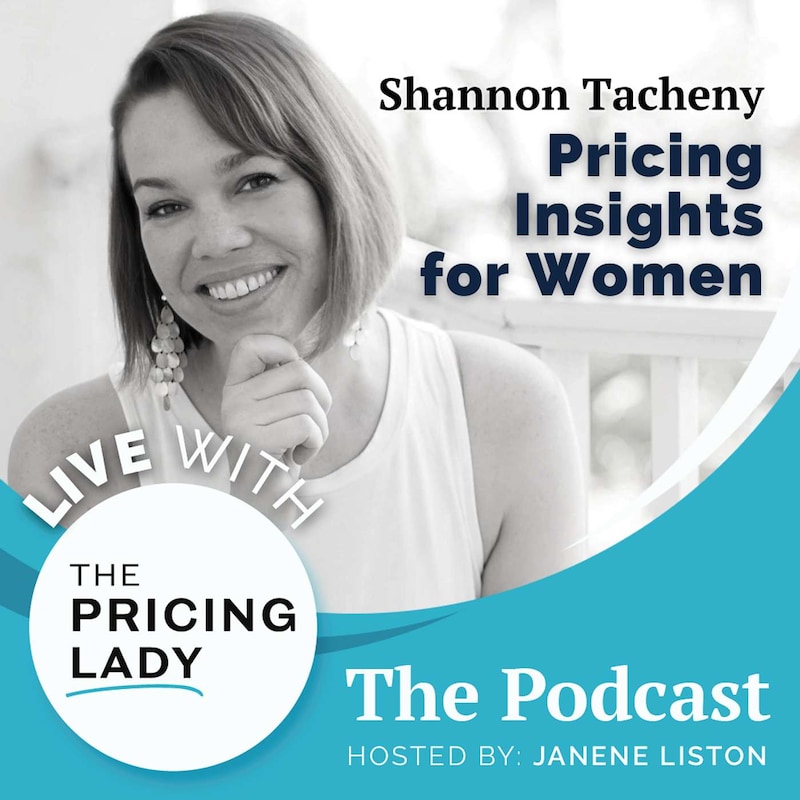
Artwork for podcast The Pricing Lady
Pricing insights for women-led businesses
Episode 113rd June 2024 • The Pricing Lady • Janene Liston
00:00:00 00:35:19

Share Episode

Transcripts

Speaker:

Welcome to Live With The Pricing Lady.

Speaker:

I'm Janene, your hostess.

Speaker:

This show is all about helping you build a sustainably profitable

Speaker:

business while making an unbelievable impact on your world.

Speaker:

Learn from my 20 years of experience and from my guests as we discuss their pricing

Speaker:

challenges, failures, and successes.

Speaker:

Pricing is a way of being or behaving in your business.

Speaker:

My mission is to help you confidently charge for the value you deliver.

Speaker:

Pricing is either hurting or helping your business.

Speaker:

Let's make sure it's helping you reach your dreams.

Speaker:

In this episode of Live with The Pricing Lady, I sit down with

Speaker:

Shannon Tacheny brand strategist and owner of feather blue studios.

Speaker:

Shannon has priced so many different things over her entrepreneurial career.

Speaker:

And she's sitting down to share with us her journey and what that

Speaker:

meant for her over the years.

Speaker:

I found this episode absolutely inspiring, and I hope you will too.

Speaker:

So sit back, relax and enjoy the episode.

Speaker:

Welcome to today's guest Shannon Tacheny.

Speaker:

Hi, Shannon.

Speaker:

Hi, Janene.

Speaker:

So happy to be here.

Speaker:

Thanks for having me.

Speaker:

I'm super excited to have this conversation with you.

Speaker:

Shannon, why don't we start with where you're joining us from today?

Speaker:

I'm in Minnesota in the United States.

Speaker:

Excellent.

Speaker:

I'm near Minneapolis, Saint Paul area.

Speaker:

What would you call your superpower?

Speaker:

You know I think that My superpower is taking what people have in

Speaker:

their business, like what women have to give and connecting it to

Speaker:

the person who needs to find them.

Speaker:

So I do that mostly through like, you know, brand strategy, messaging

Speaker:

design, but it's like this instant, what, what can I pull out from you

Speaker:

that can connect you to what the person needs to hear to find you?

Speaker:

And I just feel like it's a combination of empathy and communication skills.

Speaker:

That's kind of where I thrive.

Speaker:

Oh, that's really, that's so wonderful.

Speaker:

I can imagine that with your clients, that makes a huge difference to them because I

Speaker:

mean, quite frankly, that's what for most people who are starting businesses, you

Speaker:

know, that's sort of part of the element that they're missing is that connection.

Speaker:

Yeah.

Speaker:

And we all need an outside person I think to help us See what we

Speaker:

really have to bring to the table.

Speaker:

Yeah, it's hard to, you know, see the forest through the tree, so to speak.

Speaker:

So, you get a different perspective when somebody else is looking at it.

Speaker:

Yeah.

Speaker:

So Janene, what is one interesting thing that most people don't know about

Speaker:

you that you'd like to share with us?

Speaker:

Yeah.

Speaker:

I was telling you earlier that I lived in Paris for six weeks.

Speaker:

This was kind of like during college years.

Speaker:

And, I had been studying communications and graphic design and marketing.

Speaker:

I had always wanted to go to Paris and I found a way to take

Speaker:

a photography class there that I needed for my graphic design minor.

Speaker:

And so I signed up for this class and like, wonder upon wonder, somebody

Speaker:

from my school who, my boyfriend at the time knew was going to.

Speaker:

So it was this great experience.

Speaker:

We got to go to Paris and live there for six weeks.

Speaker:

The funny part is that we walked by the Eiffel Tower literally every

Speaker:

day on the way to our class, but we never ever went to the top.

Speaker:

So I just find it very ironic.

Speaker:

We went all the way to Paris.

Speaker:

We did a lot of amazing things, but here we are in this space and never

Speaker:

went to the top of the Eiffel Tower.

Speaker:

We'll go

Speaker:

back and do it.

Speaker:

But

Speaker:

we'll say, have you been back and did you do it?

Speaker:

Not yet!

Speaker:

Uh oh!

Speaker:

No, and my husband really wants to hit Italy, so I feel like if we go to Europe

Speaker:

again, we'll hit Italy, and maybe I can do a little side tour, you know, of France.

Speaker:

You can stop by and say hi to me, because I'm right in between the two!

Speaker:

That would be marvelous!

Speaker:

Cool, excellent.

Speaker:

So, yeah, so I guess there's definitely something on your to do list there.

Speaker:

Yeah.

Speaker:

Okay, Shannon, why don't you share with us about what you, what led you

Speaker:

to starting your own business and how that process was like for you?

Speaker:

Yeah, well, I mean, as somebody who's had sort of multiple businesses along a

Speaker:

journey, I think for me, quite honestly, starting as an entrepreneur, really

Speaker:

young, like right out of college.

Speaker:

It was just a gut instinct and a drive.

Speaker:

I mean, I don't think I recognized that, you know, at the time, you

Speaker:

know, you're in college and you're on the path to get the career role.

Speaker:

And, you know, here I was thinking I was going to go into advertising.

Speaker:

So I'm like, well, I need to work more on my portfolio before I can get a job and

Speaker:

learn some new programs and these things.

Speaker:

And so.

Speaker:

You know, you kind of, put the brake on the actual like full time job thing,

Speaker:

but really I think it's cause I just had my heart to do all these things.

Speaker:

Right.

Speaker:

So, I started designing handbags and jewelry was my very original

Speaker:

business that was kind of on my heart in college and that I just kind of

Speaker:

dove into and I was able to work.

Speaker:

for a part time, worked part time for a jewelry artist at the time

Speaker:

who had a really thriving business.

Speaker:

She still does.

Speaker:

And you know, was able to sell retail and wholesale.

Speaker:

And that helped me go like, Oh, this small business thing is like doable.

Speaker:

Like, and now I understand things like for instance, pricing, like

Speaker:

how the heck do you price anything?

Speaker:

How do you, you know, find wholesalers?

Speaker:

How do you find people to buy?

Speaker:

And I think that probably the combination of this natural drive,

Speaker:

which I mean, I had a store out of my bedroom when I was eight.

Speaker:

Okay.

Speaker:

All my summer plans involved around like garage sales and bike washes and

Speaker:

carnivals in the neighborhood so that we could, it was just in me, this spirit.

Speaker:

and so that's probably what really, drove me to start was just this initiative

Speaker:

that was inside me, but then being able to see somebody else demonstrate

Speaker:

that you can run a small business was probably what kept me on the path, right?

Speaker:

So I transitioned through the years after that, but I think

Speaker:

that was sort of the initial drop.

Speaker:

Did you come from a family of entrepreneurs?

Speaker:

You know, my mom, I have three sisters.

Speaker:

There's four of us girls.

Speaker:

My mom did run a business at home.

Speaker:

I think it was more out of necessity than drive.

Speaker:

You know, it was more like, this is the skill I learned.

Speaker:

I learned how to type so I can, you know, have this kind of.

Speaker:

Business at home.

Speaker:

But I think she had a little bit of an independent spirit too.

Speaker:

And

Speaker:

I do love how this does run in the family.

Speaker:

I look back to like my great grandpa who I just heard stories about.

Speaker:

He was always kind of like chasing the next idea and buying the next business

Speaker:

and moving the family to the next thing.

Speaker:

And even though I never met him, I always think, Oh, I get that spirit.

Speaker:

Like I have that entrepreneurial spirit in me.

Speaker:

Right, so you came out of the womb.

Speaker:

Sold!

Speaker:

I think so.

Speaker:

You know, I wish people would have recognized that in me

Speaker:

earlier and poured into me like, Hey, here's where you're gifted.

Speaker:

I can see this path being good for you.

Speaker:

A lot of times we just have to figure that out for ourselves.

Speaker:

I think that's normal.

Speaker:

But now I can look at like my children and be like, what do you have in you?

Speaker:

Let's help you pull it out so that you can get to live a life of joy along

Speaker:

the journey you were created to be on.

Speaker:

So

Speaker:

that's your superpower.

Speaker:

That's yeah.

Speaker:

Also helping a lot of people at a young age, love seeing

Speaker:

people's gifts and bringing, like elevating those gifts for them.

Speaker:

Shannon, when you started that first business doing the jewelry and handbags,

Speaker:

I think you said the first time you had to like set a price and tell people what

Speaker:

the price was, what was that like for you?

Speaker:

Yeah, I mean, I've been thinking about like how so many things

Speaker:

go into setting a price, right?

Speaker:

And especially when you first start and especially when something

Speaker:

is personal to you, a lot of it is just, I want to do this.

Speaker:

What will people pay for it?

Speaker:

If they won't pay this for it, then I'm being rejected in some way, shape or form.

Speaker:

Right.

Speaker:

I think That, that can be in the early cycle and also that can

Speaker:

like recycle through the journey of your business because it's

Speaker:

attached to our confidence a lot.

Speaker:

I will say, I think that going into that first business, because I actually set

Speaker:

my handbag prices fairly High end at the time, and I did take into account

Speaker:

definitely the products and the materials.

Speaker:

And I was thinking about the marketplace, like where do

Speaker:

these fall into the marketplace?

Speaker:

I think at that point in time, I wasn't taking into account as much of my time.

Speaker:

And that was probably a factor there.

Speaker:

But I did, I mean, I look back and I go, well, I had a little bit of guts to say

Speaker:

that these belonged at this price point.

Speaker:

And at that point was able to sell them like on a small level at boutiques

Speaker:

and at art fairs and things like that.

Speaker:

Custom work for like bridesmaids and stuff.

Speaker:

So I had some success at it.

Speaker:

I didn't really.

Speaker:

and I didn't do that business very long because we ended up moving and I had

Speaker:

gotten married young, we were moving and we were having a baby And so it

Speaker:

just kind of naturally dropped off.

Speaker:

but it's funny because then I look at other businesses or other focuses

Speaker:

down the line and think sometimes you go backwards in your pricing.

Speaker:

Sometimes you go backwards in your confidence and.

Speaker:

Yeah, there's just a lot of psychological elements that go along

Speaker:

with pricing, which you well know.

Speaker:

Yeah, absolutely.

Speaker:

There are.

Speaker:

So one of the things that we had spoken about is that you've

Speaker:

priced lots of different things.

Speaker:

So you, you left your jewelry and handbag business.

Speaker:

And then where did you go and how did that shift your, your thinking

Speaker:

or your approach to pricing?

Speaker:

Yeah.

Speaker:

So, lo and behold, since I had taken that one class in Paris, studying photography,

Speaker:

I had bought a camera at the time.

Speaker:

And even during that time I was doing handbags and jewelry.

Speaker:

I was doing like a tiny bit of freelance photography kind of for fun, right?

Speaker:

Like people knew.

Speaker:

You know, that you had a camera and you got referred to some random kids

Speaker:

and started experimenting, right?

Speaker:

So a few years down the line, you know, my family and I moved from Minneapolis

Speaker:

area to St. Louis area in Missouri.

Speaker:

My husband had got promoted there.

Speaker:

I had a baby there, did all sorts of really cool, creative things, mostly

Speaker:

volunteer, back a couple of years later.

Speaker:

And ironically into the same house because we had rented it and we had remodeled it.

Speaker:

And so we're moving back in and I said, Hey, here I am now with

Speaker:

like an almost two year old.

Speaker:

What do I want my career path to look like?

Speaker:

Like I had this drive still.

Speaker:

But I also knew that I loved being a mom.

Speaker:

I wanted to find this balance.

Speaker:

And so we continued to remodel the house and we put in a photography

Speaker:

studio in the basement of that home.

Speaker:

And then I went on to run a photography studio for about 10 years at that point.

Speaker:

So then it became a big pricing journey.

Speaker:

Pricing the

Speaker:

house

Speaker:

is very interesting because it's both a service and it's product, right?

Speaker:

You're selling prints or you're selling digital images.

Speaker:

Wow.

Speaker:

I mean, we were at the beginning of the digital images versus the print stage

Speaker:

and, the mental approach to how a digital image might not be as valuable as a print,

Speaker:

but really was more valuable because

Speaker:

it was

Speaker:

telling your negative to somebody, right?

Speaker:

Like all the potential that became a lot of what was being talked about in industry

Speaker:

and a lot of what I had to process.

Speaker:

So I think that I was lucky to start in that industry when

Speaker:

prints were still the standard.

Speaker:

Help me place the value on not just the session, but then you

Speaker:

choosing these images afterwards.

Speaker:

And so there was that, that was helpful going in at the same time.

Speaker:

I remember getting like my first, like somebody wrote me a check for

Speaker:

101 and 50 cents or something for her, order of her children's pictures.

Speaker:

And I thought, Oh my gosh, I'm making it like 100

Speaker:

to do what I love to do.

Speaker:

Like it's happening.

Speaker:

And.

Speaker:

Looking back, I very much did not account for time.

Speaker:

I think that's probably been one of my default

Speaker:

trends.

Speaker:

I can definitely price for product.

Speaker:

I can maybe even price for value and marketplace, but your time, because

Speaker:

you just want to do it and you underestimate how long it takes and,

Speaker:

you know, that can be okay, but if you're trying to make a living over

Speaker:

the course of a year and you only have so much hours to put into something,

Speaker:

you

Speaker:

have to factor in that element and then you have to factor in like.

Speaker:

Am I worthy as an artist, right?

Speaker:

This is the emotional end of it, to ask people to pay this much.

Speaker:

Do I have enough experience?

Speaker:

And so definitely I started underpricing in the photography industry.

Speaker:

Definitely priced, repriced probably every other year or

Speaker:

more, like rethinking the pricing.

Speaker:

I mean, it's like constantly very complex because you're pricing this service.

Speaker:

And then you're pricing these.

Speaker:

Do you buy these things separately?

Speaker:

Do you have a package?

Speaker:

Do you put it all in one big package?

Speaker:

I mean, there was so many decisions, complex decisions around photography

Speaker:

as an industry period, but it did force me to really think about how I do this.

Speaker:

And by the end really massively changed in my money mindset.

Speaker:

And even that's where like, now that I'm a brand strategist and a business mentor

Speaker:

for women, I can say, I also understand how I started out like I want to be for

Speaker:

everybody and got to the point where like, no, I need to have a singular brand

Speaker:

that draws exactly the right client I want who's willing to pay what I need

Speaker:

to get paid to just stay in business.

Speaker:

Right.

Speaker:

And so all of that really goes hand in hand.

Speaker:

Yeah.

Speaker:

Yeah.

Speaker:

I've worked with quite a few photographers and, I've seen one, the struggle that

Speaker:

they have with pricing, also the criticism that they get sometimes from people about

Speaker:

their pricing, which I find incredibly,

Speaker:

hmm, what's the right adjective?

Speaker:

, Mean at times.

Speaker:

Yeah,, the, the feedback that people get about their pricing structure,

Speaker:

especially when they try to adjust it, so that it's something that

Speaker:

they can make a business from.

Speaker:

I had a guest on the show a few years back, a Maria Ramanatha.

Speaker:

She's also in photography, or had part of her business was photography related.

Speaker:

She shared with us a story how it took her like three times to at least three

Speaker:

times of changing her prices until she was actually attracting the kind of customers

Speaker:

that she wanted to be working with.

Speaker:

And that, you know, being underpriced brought her customers

Speaker:

who didn't value her service, didn't value what she was offering.

Speaker:

And, and so she ended up, you know, with these low prices, she

Speaker:

just attracted the wrong people.

Speaker:

I think that's a really important, point.

Speaker:

for people to, to reflect upon.

Speaker:

Yeah.

Speaker:

I mean, really as a brand strategist, I can say that your pricing is part of your

Speaker:

brand because it is one of the elements you are giving off that's going to

Speaker:

attract or deter the right person for you.

Speaker:

So really knowing who you want to work with and where you want to fit

Speaker:

in the marketplace is super important for both your brand and your pricing.

Speaker:

I do want to just speak to that thing about like people's

Speaker:

perceptions of pricing though.

Speaker:

And I. I think you're right in the photography industry.

Speaker:

It's been extra hard to like prove that this is how much something is worth

Speaker:

because we live in a digital era, wherever we can take a snapshot on their camera.

Speaker:

And I think that initially it can feel very like hurtful as

Speaker:

you try to raise your prices.

Speaker:

And as you try to, see the value people have of something, and that's

Speaker:

probably true in other industries.

Speaker:

So what I want to share is that I think as a business owner, we can make the

Speaker:

mental shift to say, it's not their fault for being naive about pricing.

Speaker:

It's my fault.

Speaker:

Now, I don't want to induce guilt here, right?

Speaker:

But my responsibility to

Speaker:

educate why this has value and educating why something has value

Speaker:

is a really big part of marketing.

Speaker:

And so we can see that's just a regular piece of the marketing puzzle that I no

Speaker:

longer have to feel bad when somebody.

Speaker:

Perceive something as low value than it is.

Speaker:

I have to say, Oh, that is an eye opening conversation to help

Speaker:

me be a better CEO and marketer.

Speaker:

And now I know what to put into my messaging to help people come into

Speaker:

this conversation on pricing with the right perception right away.

Speaker:

So hopefully that like makes people feel better about it.

Speaker:

I know it has for me.

Speaker:

It's really important to establish the value.

Speaker:

And I go back to this example all the time.

Speaker:

It's one of my very favorite examples of, you know, putting

Speaker:

that value stake in the ground.

Speaker:

It was also a photographer and on his, I don't remember his name.

Speaker:

I'm sorry if you overhear this and you know who you are and

Speaker:

I don't remember your name,

Speaker:

but on his website, on his pricing page, it says, Yep.

Speaker:

It's going to cost you at least 2, 000 for me to photograph your wedding.

Speaker:

Are you okay with that?

Speaker:

And I said, yes.

Speaker:

It said, you know, book a call with me.

Speaker:

No, here's the link to Craigslist.

Speaker:

Which is like a really beautiful way to establish value and help people

Speaker:

understand, you know, how at least they perceive value and to steer people

Speaker:

who weren't willing or able to pay that, you know, in another direction.

Speaker:

So, I think that's a really important aspect.

Speaker:

So Shannon, I'd like to shift into the business that you have now and some of

Speaker:

the learnings that you've had in pricing, either your own experience or what you've

Speaker:

seen with clients and what you do now.

Speaker:

Yeah.

Speaker:

Well, so now as.

Speaker:

I mean, I started, I shifted from my photography studio to a full service

Speaker:

marketing firm, which felt very comfortable to me at the time because I

Speaker:

was still selling tangible things, right?

Speaker:

So I recognized that, you know, while I loved my photography business and my

Speaker:

clients, I wasn't using all of me, which is part of what I now like help people do.

Speaker:

Right.

Speaker:

I was really missing the marketing elements and the brand elements that,

Speaker:

and the writing that I was really loving in my photography business, and I'd kind

Speaker:

of mastered the photography part and it didn't feel like as much of a challenge.

Speaker:

And I thought, I need to just.

Speaker:

Go into the full me.

Speaker:

And that was

Speaker:

of course an identity shift too, not just like a brand shift, right?

Speaker:

Like I'm a photographer and now I'm suddenly saying I'm a brand

Speaker:

strategist, I'm a marketing strategist.

Speaker:

So we won't go into that.

Speaker:

But if anybody's in that, know that we feel you because You're giving yourself

Speaker:

a promotion or you're a new job and you have to be the one to identify it.

Speaker:

So I move in first to this marketing, you know, firm type model where I can

Speaker:

say, Hey, we will do this for you and you can pay this much for a package.

Speaker:

And by then I was much more adept at like going, okay, I can't do this unless.

Speaker:

I guess it's going to be worth my time.

Speaker:

There was still definitely some struggle around value.

Speaker:

Like am I definitely going to give them, I'm new to this thing, even

Speaker:

though I'm experienced and I've been doing stuff like this for years.

Speaker:

So there was some struggle in the value and I think then the biggest

Speaker:

though, thing I learned about pricing during that stage was, Every

Speaker:

project I was doing was individual.

Speaker:

So if you need, you know, a website and Facebook ads and a marketing funnel

Speaker:

and a logo, and you need, you know, social media graphics and whatnot, I'm

Speaker:

starting from scratch with each project.

Speaker:

And so, yes, I might be pricing at a level that is You know, reasonable

Speaker:

for my business, reasonable for you.

Speaker:

But the project management part was tricky because you're changing

Speaker:

mental hats every time you're making different contractors for each one.

Speaker:

And, and I realized that that didn't feel good and that if I was going to do it

Speaker:

that way, I definitely was going to have to price more to hire a project manager.

Speaker:

Right.

Speaker:

So then I went kind of from that, that stage, excuse me.

Speaker:

into a shift to I'm really seeing women have a lot of success when I

Speaker:

just coach them around how to do this.

Speaker:

And a lot of these women's struggles isn't that they need

Speaker:

a new logo or a new website.

Speaker:

It's that they need the confidence to, you know, step into whatever

Speaker:

is that next thing for them.

Speaker:

Then they need somebody to help them pull out the words to define it.

Speaker:

Then they need the online presence to bring that, right.

Speaker:

And so to back up and give them this freedom to like

Speaker:

strategize who you really are.

Speaker:

What you and your company bring to the table and how we need to communicate that.

Speaker:

Then I was leaning in towards like coaching and mentoring, and

Speaker:

that becomes a whole new pricing issue, because you're straight up

Speaker:

pricing for what the transformation you're bringing, not the hours.

Speaker:

I'm not right.

Speaker:

And so then I really had to establish, Hey, where do I

Speaker:

fit into the marketplace here?

Speaker:

And again, for people pivoting their business, the confidence

Speaker:

again, like, yes, I'm a quick to

Speaker:

do

Speaker:

this, but I just transitioned again.

Speaker:

I feel like a newbie in a marketplace.

Speaker:

Even though I have, you know, almost 20 years of experience

Speaker:

in the business place, right?

Speaker:

So, that all goes into it.

Speaker:

But I think for me, where I've gotten to now, like just straight up having been

Speaker:

in business for over 15 years, it has to be this balance of First of all, how much

Speaker:

money do I just straight up need to make?

Speaker:

Right?

Speaker:

I'm purpose driven.

Speaker:

I want to help people.

Speaker:

I want to see everybody get the transformation they want, but I

Speaker:

can't just run myself ragged, right?

Speaker:

Or I can't not be able to pay my bills.

Speaker:

So straight up at the end of the day, how much money do I need to make in a year?

Speaker:

How many hours do I actually have to give?

Speaker:

To a client, to clients, right.

Speaker:

Versus how many hours go to other things in my business, administration,

Speaker:

marketing, behind the scenes stuff, right.

Speaker:

How many hours do I want to work a week?

Speaker:

Let's just take my actual whole life picture into consideration here and then

Speaker:

go, okay, here's how much time I have to put into actual clients and here's

Speaker:

how much money I need to make, like minimum to like my high goal, right.

Speaker:

And then work backwards and say, what is the absolute minimum I can price a client

Speaker:

at to hit that, and then taking that number and going, here's the reality check

Speaker:

and then factoring in the other elements.

Speaker:

Like, okay, where do I want to be in the marketplace?

Speaker:

How do I want to be perceived?

Speaker:

What does my client have to pay?

Speaker:

Because somebody who is, for instance, starting a business is in a

Speaker:

different spot to invest in somebody.

Speaker:

You know, transitioning a business, even if the value you bring us the same.

Speaker:

And so it's okay if you price it.

Speaker:

Probably different in those two phases, right?

Speaker:

The value.

Speaker:

Yeah.

Speaker:

And that's totally okay.

Speaker:

Right.

Speaker:

You just have to decide who you really want to serve and then go, if this

Speaker:

is the person I really want to work with, where does this element of what

Speaker:

I need to get paid meet what, where they are expecting to pay something in

Speaker:

the marketplace, that's fair for them.

Speaker:

Right.

Speaker:

And then kind of maybe accounting for all the little extras that might kick

Speaker:

in above and beyond them too, right?

Speaker:

So a little, little wiggle room because it's very easy for us

Speaker:

to just inch our way up and not allow for the wiggle room as well.

Speaker:

And so I think some combination of that is now where I approach pricing.

Speaker:

And it's much more based on the transformation that I'm

Speaker:

going to get from somebody.

Speaker:

and the investment it is for them than it is on hours or expectations or things like

Speaker:

that.

Speaker:

I'm so glad you brought up the wiggle room.

Speaker:

And I mean, there's a lot of different contexts in which, which we can

Speaker:

talk about this, but actually having this conversation earlier today with

Speaker:

someone, you know, if you, let's say you, you offer, 500 whatever

Speaker:

us dollars, Franks, whatever, you know, doesn't matter for 500, right?

Speaker:

But then you decide you want to offer an early bird special, so then you're selling

Speaker:

it less than 500 and then, you know, some coaching organization approaches

Speaker:

you and say, Hey, we'd love to have this course on offer for our people.

Speaker:

Are you willing to offer it, you know for us at 30 percent discount because we can

Speaker:

bring you so many and then all of a sudden You know, it starts whittling away and

Speaker:

then if you take payments by Stripe, they take 3 percent And if you have the course

Speaker:

on a course platform, they may take, you know, 10 or 20 percent The wiggle room,

Speaker:

you know, depending on the strategy that you have and how you're, you know, Putting

Speaker:

that course or that program or whatever it is out there is a really important

Speaker:

part of where you set your prices.

Speaker:

Yes, I really, it's really good I think for you to emphasize

Speaker:

that and I'm sure you have more experience than anybody with that.

Speaker:

But it is definitely something we as entrepreneurs tend to not include

Speaker:

that margin, the margin in our time and the margin in our finances.

Speaker:

And I think that's where it gets most of us in trouble because we just

Speaker:

genuinely want to do what we love to do.

Speaker:

And so we just try to make it as accessible as possible.

Speaker:

And that we forget along the way that we are just wearing ourselves out by not

Speaker:

having this financial or time wiggle room.

Speaker:

And, and sometimes you just need somebody to speak that into you too, right?

Speaker:

Like, Hey, you have all this expertise.

Speaker:

You're allowed to have a little break in your day.

Speaker:

You're allowed to have a little vacation.

Speaker:

You're, you know, like we're all

Speaker:

allowed, you know, actually I would even all say more than allowed, but it's.

Speaker:

It's, it's right to have financial independence and security, right?

Speaker:

Wise.

Speaker:

It's wise to

Speaker:

have this wiggle room.

Speaker:

It's wise as well.

Speaker:

Yes,

Speaker:

certainly.

Speaker:

But it, you know, it's really, in my opinion, it's something

Speaker:

everybody in, you know, in a sense should be entitled to almost.

Speaker:

You know, because it's so important to just everything

Speaker:

else in, in your, in your life.

Speaker:

Okay, Shannon.

Speaker:

So.

Speaker:

I have two more questions before we start wrapping it up.

Speaker:

So as you've gone through and you've, you know, had all these sort of evolutions

Speaker:

in your own pricing journey, what's been the difficult, most difficult thing

Speaker:

that you faced in terms of pricing?

Speaker:

I think probably when we go back to that part where people undervalue you.

Speaker:

Before you get to the mindset and the confidence level that you

Speaker:

don't have to take that personally.

Speaker:

I think

Speaker:

when you're in that stage, that hits you very hard.

Speaker:

Right.

Speaker:

I will share one quick story.

Speaker:

It's kind of later on in my photography business and I'm sitting across from

Speaker:

the desk with a woman who's going to buy pictures for her children.

Speaker:

And you know, she's always talking about the budget at this point.

Speaker:

I mean, my photography was, you know, more towards the higher end part, not.

Speaker:

Maybe all the way, but I felt good about the prices, right?

Speaker:

And, but you're still feeling bad because the person's talking about, you know,

Speaker:

maybe they can't afford this and whatever.

Speaker:

And she'd been a client for a few years, so I knew her pretty well.

Speaker:

And, you know, I, I'm, I can't remember if I was either like about

Speaker:

to offer her an extra discount or we were kind of narrowing down what

Speaker:

she was going to buy to eliminate.

Speaker:

And then she starts talking about this designer handbag she just bought.

Speaker:

And it was this eye opening moment.

Speaker:

And I didn't feel bad and I didn't feel mad.

Speaker:

I thought this is my fault because she values that designer handbag more than

Speaker:

she values these pictures of her family.

Speaker:

And that means I have not done a good enough job marketing the value of this.

Speaker:

So I think in one hand, it was, it was good that I was a very healthy

Speaker:

mindset place to recognize that.

Speaker:

But definitely, you know, when we as solopreneurs, many of us, some

Speaker:

of us have small teams, right?

Speaker:

I felt like.

Speaker:

It's personal.

Speaker:

What you do is personal.

Speaker:

And to have to face what other people think about that, it can be hard.

Speaker:

So learning to let go of that partially, really stand firm and

Speaker:

know that in order for me to have the joy fueled, purpose driven business

Speaker:

I want to have, I need to work with people who value me and appreciate me.

Speaker:

And so do my clients, right?

Speaker:

But I think that since it is personal, that can be one of the biggest struggles.

Speaker:

I love that story.

Speaker:

So my story, similar story, was a vacation to Jamaica.

Speaker:

That was, that was what came up during the conversation.

Speaker:

You may be like, wait a minute here.

Speaker:

Yes, you have enough money for that vacation to Jamaica.

Speaker:

I think you can handle this.

Speaker:

But it's what people value, right?

Speaker:

And it is such a good reminder.

Speaker:

I mean, I think people need to hear this.

Speaker:

People want to buy things.

Speaker:

People want to buy things they care about.

Speaker:

People want to spend money.

Speaker:

You just have to give them a reason for your thing to be the thing they want to

Speaker:

spend the money on or save the money for.

Speaker:

You need to entice them and give them the time to build up because people

Speaker:

don't make a sale right away either.

Speaker:

They think about things, they dream about it, they reflect on it, and there's also

Speaker:

this sense too that if I get rejected right away, Oh no, my prices are too high.

Speaker:

Well, maybe that person just needs the time.

Speaker:

To like save up or dream big about it or recognize that it's now like the priority.

Speaker:

So I think it's good for people to hear that.

Speaker:

Yeah.

Speaker:

Yeah.

Speaker:

I think that's really important.

Speaker:

Thank you so much for sharing that.

Speaker:

So now we just talked about, you know, what was a big challenge.

Speaker:

I'm curious, what's something that you felt that was a real success when

Speaker:

it came to pricing in your business?

Speaker:

I think that anytime you price, whatever you have at your highest price that you

Speaker:

feel like is Too good to be true, and then somebody spends the money on it.

Speaker:

And then you go, oh, I guess I could go up again from here.

Speaker:

And you start to recognize that.

Speaker:

There aren't necessarily limits.

Speaker:

And I don't mean that meaning like we're always just trying to like raise

Speaker:

our prices and price the highest thing ever, but I think there's freedom

Speaker:

and recognizing that what I cannot imagine right now that somebody might

Speaker:

pay for a product or service, right.

Speaker:

Is something that I, my business could get to.

Speaker:

And you know, our imaginations can only imagine what they know is the truth.

Speaker:

Right.

Speaker:

And so to, to have that eye opening ability to go, Hey, I'm going to I

Speaker:

mean, I say I've priced things from, from 15 to like 9, 000 packages.

Speaker:

Right.

Speaker:

I've sold all those levels.

Speaker:

So, to go, Hey, somebody just paid me this much for something.

Speaker:

Oh, I guess maybe in the future.

Speaker:

Right.

Speaker:

It's something that has, and it's just really freeing.

Speaker:

And it doesn't like necessarily fix all your pricing and money problems

Speaker:

right away, but it does make you feel like you have some good mindset around

Speaker:

the area of pricing and opportunity and kind of like being a really

Speaker:

stepping into the visionary CEO role.

Speaker:

Where does my business fit in the market?

Speaker:

And what can I do for the world?

Speaker:

Right.

Speaker:

Oh, I love that.

Speaker:

I love that.

Speaker:

It brought to mind for me.

Speaker:

Oh, what was her name?

Speaker:

Marie Kondo and the Spark of Joy.

Speaker:

Oh, we have Spark of Joy moments for my clients.

Speaker:

That's a big deal.

Speaker:

Because I mean, business building is a journey.

Speaker:

You aren't just trying to hit a goal in the end.

Speaker:

I mean, yes, you think you are, but you're living your life along the way.

Speaker:

You need to celebrate and have Spark of Joy moments.

Speaker:

Enjoy the journey.

Speaker:

Like as you get to whatever it is that next goal, you're gonna

Speaker:

have another goal after that.

Speaker:

Yeah.

Speaker:

I think we found the hashtag for this episode.

Speaker:

Okay.

Speaker:

So why don't we start wrapping it up?

Speaker:

I'm curious if there's one thing that you want people to remember

Speaker:

from this episode or that you think it's important for them to remember.

Speaker:

What would that be?

Speaker:

Yeah.

Speaker:

I mean, it's really easy to say, don't worry about what people think,

Speaker:

because the truth is we all worry about people think whether that's

Speaker:

our brand or our pricing or whatever.

Speaker:

But I think to start your pricing and start your brand around,

Speaker:

what really do I want to create?

Speaker:

If I could have the perfect business that makes me feel the most freedom and joy,

Speaker:

and like I'm bringing the most purpose and impact to the world through what I

Speaker:

do, what would that look like on paper?

Speaker:

Like, what would it be priced at?

Speaker:

What would you do?

Speaker:

What would you not do?

Speaker:

Right?

Speaker:

What freedoms would you have?

Speaker:

What would you let go of?

Speaker:

Give yourself permission to just go all out.

Speaker:

Nobody has to see it.

Speaker:

I think we sometimes won't even go there because we're so busy worrying about what

Speaker:

people will think along with what we want.

Speaker:

And we're always kind of trying to cut the difference.

Speaker:

And it doesn't mean you don't think about the market or the people you do, but give

Speaker:

yourself permission to start with what would I love this to look like for me.

Speaker:

What would I love to do?

Speaker:

What would I like my brand elements to be?

Speaker:

How much do I want to show up online?

Speaker:

Where do I want to fit in the marketplace?

Speaker:

All those things.

Speaker:

And

Speaker:

then secondarily fit the other things in.

Speaker:

Just give yourself permission to dream really big.

Speaker:

No, I love that.

Speaker:

Thank you so much.

Speaker:

Okay.

Speaker:

Two more questions.

Speaker:

So is there a book, a tool, a podcast, something that you're

Speaker:

really excited about right now that you'd like to share with us?

Speaker:

And if so, what?

Speaker:

Oh yeah.

Speaker:

Okay.

Speaker:

So my favorite thing right now, I was thinking about, right now versus

Speaker:

like in the past, I read a lot.

Speaker:

I love to learn.

Speaker:

But right now I have been reading, 10X is easier than 2X is the name of the book.

Speaker:

It's kind of a combination of the guy who's run the business strategic

Speaker:

coach for like 30 or 40 years.

Speaker:

So he's a little bit older.

Speaker:

And then this other guy who has been a writer and like a psychology

Speaker:

and human expert has come in and kind of co written them with him.

Speaker:

but this concept that.

Speaker:

It's kind of that margin part.

Speaker:

Sometimes we think that just a little bit more up is going to be easier.

Speaker:

It's easier to get double my business.

Speaker:

It's easier to just get a little edge up when sometimes actually like going

Speaker:

way beyond what you think is easier, because in the process you create so much

Speaker:

more time, freedom, creative freedom.

Speaker:

The ability to.

Speaker:

to think and be visionary, to solve more problems well.

Speaker:

and I just, it's a very freeing book.

Speaker:

So I would encourage people to find that one.

Speaker:

Super.

Speaker:

So we'll put a link to that in the show notes as well for everyone.

Speaker:

Thank you.

Speaker:

My last question is if people would like to find out more about you,

Speaker:

connect with you or work with you, where should they reach out to do that?

Speaker:

Yeah.

Speaker:

So, I'm just basically everywhere at Feather Blue Studios, but you can find

Speaker:

me on Instagram at Feather Blue Studios.

Speaker:

Same thing for my website and Facebook.

Speaker:

So, yeah.

Speaker:

Great.

Speaker:

So we'll put all those links in the show notes as well.

Speaker:

So people can get to you easily or find you connect with you easily.

Speaker:

Let's put it that way.

Speaker:

Shannon, thank you so much for coming on the show today.

Speaker:

It's been such an inspiring conversation.

Speaker:

Thank you so much.

Speaker:

It's always a pleasure to talk to you.

Speaker:

And just what you do is important to the world.

Speaker:

You bring so much value, Janene.

Speaker:

So thank you for having me.

Speaker:

Thank you for listening to this episode of Live with The Pricing Lady, the podcast.

Speaker:

If you enjoyed the episode, rate, review, and subscribe to it, then share

Speaker:

it with your friends and colleagues.

Speaker:

I love hearing back from you listeners.

Speaker:

If you've got comments, questions, or topic ideas, go on over to thepricinglady.

Speaker:

com and contact me there.

Speaker:

Not sure where to start when it comes to improving pricing and profits?

Speaker:

At ThePricingLady.

Speaker:

com you can download a copy of my Self Assessment Pricing Scorecard.

Speaker:

Find out where it's going well and where you can begin improving.

Speaker:

Or just simply book a discovery call with me.

Speaker:

There we can discuss what's up with pricing in your business and

Speaker:

how I might be able to help you.

Speaker:

Thanks once again for joining.

Speaker:

Remember, pricing can hurt or help your business.

Speaker:

Let's make sure it's helping you reach your dreams.

Speaker:

See you next time and as always, enjoy pricing.

Follow

Links

Chapters

Video

More from YouTube