Transcripts
Welcome to Animal Posse, the podcast dedicated to the
2
:people and rescues making a
difference in the lives of animals.
3
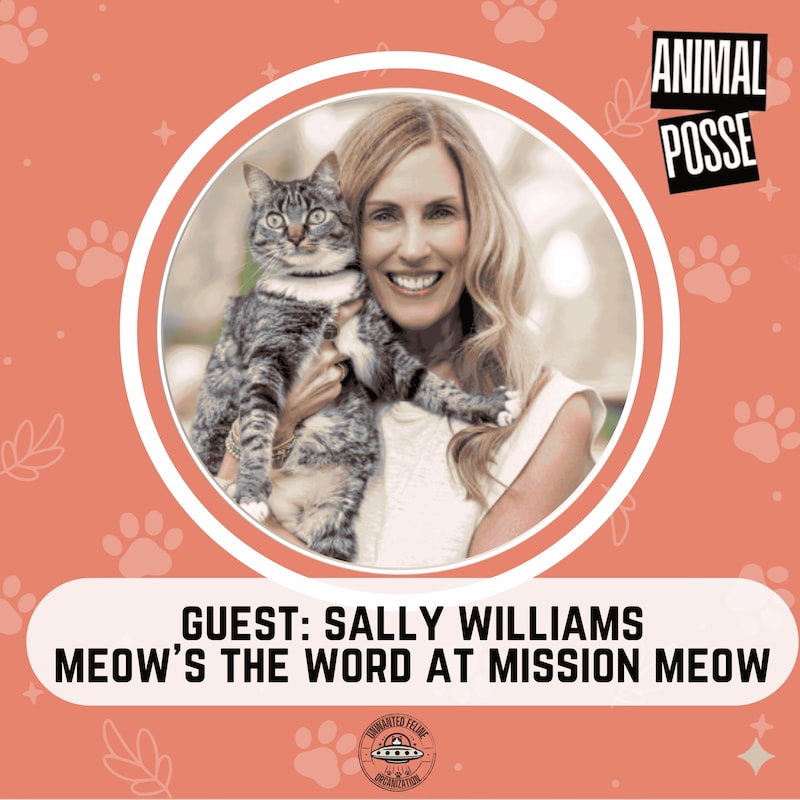
:Today's guest is Sally Williams.
4
:She spent years providing direct
assistance to families navigating
5
:pet cancer through the Brodie Fund,
but her journey led her to a new
6
:mission supporting the very people
who save cats through Mission Meow.
7
:And that's what we're gonna
be talking about today.
8
:So welcome to the show, Sally.
9
:Sally: Thank you so much for having me.
10
:Dixie: To start off, I'd love if you
could tell us a little bit about yourself.
11
:Sally: Sure.
12
:I am obviously a cat lover first and
foremost, and I always say that my journey
13
:started when my mom was pregnant with me
and our family cat slept , on her belly.
14
:And so I think from the very beginning,
cats were just always meant to be
15
:a big part of my life's journey.
16
:And, I grew up, always had a
cat as a part of my life, and
17
:then I started volunteering.
18
:I had some health issues in my early
forties and had to stop working.
19
:And I had an incredible doctor
who suggested I volunteer.
20
:And volunteering was,
what would you wanna do?
21
:And I said I'd wanna pet cats.
22
:So guess what I did?
23
:I went to a local shelter and I pet cats
and petting cats turned into falling in
24
:love with working with them led me to
studying behavior, becoming a behaviorist.
25
:And I had a business for quite
a while as a behaviorist.
26
:And when that was going on, I had
my first cat . I've had multiple
27
:cats diagnosed with cancer, which
is not uncommon for those of us who
28
:have multiple cats in our lives.
29
:But my very first one was my cat Brodie.
30
:And that started my journey
into the nonprofit world.
31
:When he was going through treatment
for the first time ever, I heard
32
:a term called economic euthanasia.
33
:And when I found out what that was,
I thought, if I can do anything to,
34
:change that in any way I want to.
35
:And so I learned about nonprofits.
36
:Obviously I'd been volunteering for
one, but then I started volunteering
37
:for another one that gave grants
which led me to asking them if I
38
:could start a fund within their fund.
39
:And did that for a while, but then decided
to take the Brodie Fund out onto its own.
40
:And for seven years I ran a pet
cancer fund and we fully funded.
41
:Cases for families, meaning we
didn't cap but we gave, if we had
42
:enough to give holy, we gave holy.
43
:If we didn't, we found another
organization to partner with.
44
:And it was an amazing experience.
45
:We saved a lot of lives.
46
:It was incredibly rewarding but
also incredibly heartbreaking
47
:because there's a lot of losses too.
48
:And within that time I had
another cat diagnosed with cancer,
49
:Marlin, who is my soul cat.
50
:And, eventually, after going through
it again and COVID and all these things
51
:we said goodbye to the Brodie Fund.
52
:We had a big party and we raised a lot
of money and we gave legacy grants.
53
:And then I took some time off.
54
:And in that time, after several
months, I realized how much I missed
55
:running a nonprofit and started
thinking about, okay, how can I help?
56
:Cats.
57
:I really just wanna
focus on cats this time.
58
:That's where my passion is.
59
:And an organization near me during COVID
had to give up their cafe space and pivot,
60
:and they were doing more TNR and they
opened up a much smaller adoption center.
61
:And I thought, wow, if they
struggled for a little bit, is
62
:this happening in other places?
63
:And I started Googling this and
cat rescue closing, cat rescue,
64
:pivoting , like all the different
ways I could think about Googling
65
:the struggles of small feline centric
nonprofits and saw it was epidemic.
66
:This was happening across the country.
67
:And that is how mission Meow started.
68
:And it's funny because fast forward
to now, my cat West, so we launched
69
:three years ago, October, so
we're just over three years old.
70
:And when I was trying to come
up with a name, I was in the
71
:backyard swinging in hammock.
72
:And I tell the story in a talk that I
do and just having a quiet moment and.
73
:Speaking out loud.
74
:Okay, what's my mission?
75
:What's my mission?
76
:And West had incredible timing
and he, meowed and , that was it.
77
:Mission Meow was born.
78
:And so we had the name,
we had our mission.
79
:We filed for nonprofit status, had it in,
I think five, six weeks, and we hit the
80
:ground running and we haven't looked back.
81
:Dixie: That's an amazing story.
82
:And I especially love
how you got your name.
83
:That is pretty cool.
84
:That's a sign for sure.
85
:Sally: It was definitely
a sign and was simple.
86
:It was super cute.
87
:I loved the inspiration of it,
that it came from one of my cats.
88
:And then obviously there was a lot more
that went into launching a nonprofit,
89
:but I'm amazed at how smoothly it went.
90
:It was just one of those things that
if you're spiritual at all and you
91
:feel like in life, you're in flow.
92
:That's what it felt like.
93
:Like it just happened and
everything just took off so quickly.
94
:I talked to a couple friends of
mine, told them what I wanted to do.
95
:They were on board right away so we knew
we wanted to help small feline centric
96
:nonprofits, and I knew I needed to do
it in a different way because starting a
97
:nonprofit, a grassroots organization, it
takes a long time to build a donor base.
98
:It's a slow and steady process
and it's worthy of doing, but I
99
:wanted to have money right away.
100
:And in the town next to me, there had
been a house fire and it was awful.
101
:Obviously tragic, nobody was hurt.
102
:But what I thought was remarkable was the
way the community came together, which
103
:often happens, people do fundraisers.
104
:But what was unique to me was the
businesses in the town all came
105
:together and did different events to
raise money and I got a little light
106
:bulb moment and I was like businesses
because I had a nonprofit and I had
107
:also been speaking at conventions.
108
:I had met quite a few business owners,
so I slowly started reaching out to
109
:them and telling them about Mission
Meow and what my thought was that the
110
:foundation of the organization would
be businesses who wanted to give back
111
:to a community that they cared about.
112
:So we launched with, I think it was
34 business partners who had signed
113
:on to give us money four times a year.
114
:So we were, and we still are
giving grants quarterly, and
115
:it just made sense that way.
116
:It wasn't a big ask from them.
117
:We weren't coming at a company and saying,
we want you to give every single month.
118
:And so it was just a really unique,
wonderful formula, and that's
119
:how we launched the organization.
120
:And then over time, as
we've grown, we have.
121
:A wonderful donor base as well.
122
:Very passionate supporters.
123
:Then the combination of the two
coming together is how we're
124
:able to give larger grants.
125
:Dixie: How is it that you came
to find all these businesses?
126
:Sally: It, a combination of
research then phone calls, emails,
127
:and getting out to conventions.
128
:It's a lot of different ways.
129
:I find personally, I like meeting
people in person, telling them
130
:about Mission Meow, because
I have such a passion for it.
131
:So I always think
face-to-face is the best way.
132
:But if there's a company that I
find out about that excites me,
133
:that I think will align with our
mission, then it's just reaching
134
:out, whether it's a call or an email.
135
:And I would say the thing
that's important for me is.
136
:It really is about a product
that I feel strongly about.
137
:Whether it's litter or food or
toys or, we have behaviorists.
138
:I find it works for me to feel
supportive of what they're doing
139
:because we want to promote them too.
140
:So when they sign on as a business
partner, we give back to them as well.
141
:We have different ways of promoting
them and so we want them to feel
142
:supportive of our mission just as much
as I wanna be able to be supportive
143
:of whatever it is that they are
either, whether they're retailers,
144
:wholesalers, or they have a company.
145
:I think it's important
that we align together.
146
:So if you look at the list of our
partners, they're all wonderful companies
147
:and we feel really good about that.
148
:Dixie: It's clear that
you are not a rescue.
149
:So what would you classify
your organization.
150
:Sally: We are a nonprofit
that helps other nonprofits.
151
:I think that's probably the simplest way.
152
:Our focus is giving grants to small
feline centric nonprofits to make
153
:meaningful and lasting change for them.
154
:So our organization helps other
nonprofits, and we strictly focus
155
:on small feline centric nonprofits.
156
:Pretty much their budgets range
between 50-250K and their volunteer
157
:maybe one or two organizations
might have had somebody part-time,
158
:but these are the ones that really
struggle with getting grants because
159
:they're so small, they get overlooked
often, and they're the reason why.
160
:A, a lot of the hard work gets
done, the TNR fostering challenging
161
:cats working with towns.
162
:As far as strays and ferals these
are these small orgs all across the
163
:country, and once you start finding out
about them and getting to know them.
164
:The work they do is incredible, especially
when we're talking about, the largest
165
:problem in the US is overpopulation.
166
:So TNR or TNVR is incredibly
important and we are huge supporters
167
:of organizations that are heavily
doing TNR across the country.
168
:But it's not just that, it's foster based
groups, it's ones that rescue specifically
169
:special needs or specifically kittens.
170
:We really try to have variety in who
we're giving our grants to because
171
:we want to be impacting all the
different areas of feline centric
172
:nonprofits in the CAT community.
173
:Dixie: Yeah, and I love the
term feline centric, by the way.
174
:That's
175
:Sally: great.
176
:The thing is some of the organizations
we help , they're feline centric, but
177
:because they're such amazing people.
178
:If somebody shows up with
a dog, they don't turn them
179
:away or say a pig or whatever.
180
:We have organizations that have
started out strictly feline and then
181
:have evolved over time just because
there is a need in the community.
182
:So we won't grant to programs that
aren't feline centric or feline
183
:focused, but the organizations
can be helping in other ways too.
184
:We would never say no to somebody
who rescues both, but say we help
185
:in the organization that has dogs
within but they're looking for
186
:cubbies for an adoption room.
187
:So the money can go there, but it
cannot in any way, shape or form.
188
:And not that we don't love
dogs, but our focus are cats.
189
:That's the area we chose to focus on.
190
:So the funds have to be
earmarked specifically for cats.
191
:Dixie: Aside from the financial
assistance, what other kind of services
192
:do you offer to help these nonprofits?
193
:Sally: So we also have a program
where every single month people
194
:can apply for mentorships and
shelter, foster behavior, and TNR.
195
:And so we have experts in the
field, and so people can apply
196
:monthly for a mentorship.
197
:We think it's really important to be
supporting them and helping their growth.
198
:And then we have something that kind
of evolved from giving the grant.
199
:So obviously the grant, the money, the
impact that has is first and foremost.
200
:But we also found that there was an
effect that happened after a small
201
:organization got a large grant and we
actually call it the Mission Meow Effect.
202
:And we didn't know this, I certainly
didn't know this going in that once.
203
:They're a part of our family because
, once we've given a grant, we don't
204
:just write the check and walk away.
205
:We have a Facebook group that they all
join and they network with each other.
206
:We co-hosted an event with a group.
207
:We can make connections for them
if they're looking for, we've been
208
:able to find low cost vaccines help
with food and litter and things
209
:like that we don't give grants for.
210
:So there's all these things that happen.
211
:But what also happens, because we
do things how people would look at
212
:it backwards, we choose our grant
recipient and then we take a whole
213
:month and we raise money for them.
214
:And within that month, that's
when our business partners donate.
215
:But that's also when anybody
can donate to Mission Meow.
216
:You might specifically
support TNR or maybe you love.
217
:Foster or you just like that we're gonna
be giving a van or something like that.
218
:So that's where we take a whole month
that allows us to give a really big grant.
219
:But in that month, we're promoting the
organizations that we're working with.
220
:We tell them about their missions,
we'll tell stories about a cat that
221
:they've, helped or something special
that they've done, a program or anything.
222
:So people get to know these
organizations and because we're
223
:talking about them so much, we've found
that they'll gain more volunteers.
224
:Some have gotten board members,
we've connected them to new donors.
225
:They now have a network of other
like-minded rescues, foster
226
:groups that they can network with.
227
:Because one of the things that we
focus on in reading and evaluating
228
:these organizations that we're
choosing for grants is they have
229
:to be collaborative in nature.
230
:That's something that's
super important for us.
231
:So once they all become part of the
Mission Meow family, now they're all
232
:networking and helping each other.
233
:So it became a lot bigger
than just giving the grants.
234
:All these other things happened.
235
:And then formally we have the Facebook
group and we're able to help them in
236
:other ways with other connections.
237
:I know a woman who's a
documentarian, her name is Mye
238
:Hong, and she's actually traveling.
239
:All last year, and she'll be back out
there this year traveling with her
240
:documentary 25 Cats from Qatar and.
241
:When she goes to a town, she
looks to support a rescue.
242
:So she'll show the documentary and
the ticket sales go to the rescue.
243
:So I've been able to connect her.
244
:I think this point it's six or seven.
245
:So it's things like that.
246
:We're always trying to think,
okay, how else can we be helping?
247
:Because the need is so great.
248
:Whether it's cat rescues I'm less familiar
with dog rescues, but it's really hard.
249
:I don't know if people understand how
challenging it is to run a small foster
250
:group rescue group, TNR group, because
most of these people have full-time
251
:jobs, so they're full-time doing
something else and running a rescue.
252
:And compassion fatigue is real.
253
:Burnout is real.
254
:All these things are real.
255
:So all these other areas that we're
helping them in are really so important
256
:above and beyond the financial.
257
:Dixie: I'd like to talk a little
bit about the compassion fatigue
258
:and how you work to help them
when they're suffering from this.
259
:Sally: Honestly the grants help
them tremendously and I can quickly
260
:tell you just , one example.
261
:So very early on, I think it was our third
grant cycle, so , we were still new and
262
:we were choosing grants based off what we
thought our fundraising abilities were.
263
:But if we raised more money,
we were recognizing we could
264
:surprise an organization,
which we have done regularly.
265
:So that particular month we had picked
a wonderful organization that was
266
:launching a foster program and our
money was funding 30 kitten kits.
267
:And the program was called
All You Need is Love.
268
:And this organization
gave them everything else.
269
:So all you needed was love,
but we got this application
270
:from an organization that just.
271
:Was sitting with me because
one of the things they needed
272
:was a fire alert system.
273
:And I have to tell you, I couldn't sleep
at night knowing there was a group out
274
:there that needed the fire alert system
and , I think something had happened
275
:and money was spent in other places.
276
:Organizations have to
do a lot of juggling.
277
:And the cats care first
and foremost is everything.
278
:So , what I mean by something
happened, they were also applying
279
:for ceiling tiles and lights.
280
:So something had happened
to their ceiling.
281
:So I knew that was important, but the Fire
Alert system was what really struck me.
282
:So I reached out to business partners
and several of our donors and
283
:said, we have another application.
284
:If we can't fully fund the entire
6,000, I want to at least raise the
285
:money to cover the Fire Alert System.
286
:It's just so important for me.
287
:And we did it, and we raised the
money and we raised the whole
288
:$6,000 and we were able to surprise
them and it was so wonderful.
289
:There were a lot of
tears of joy and relief.
290
:And what the interesting part
of this is the very next day the
291
:director of the organization called
me and she said, I had to call you.
292
:'cause I didn't wanna tell you, we were
celebrating, but she said we were planning
293
:on closing at the end of the year.
294
:And I said, why?
295
:I've seen your budget.
296
:I've seen the work you do like there's
no reason for you to be closing.
297
:And she said, we didn't
think that anybody cared.
298
:And we're so burned out because
we work and we work, but we don't
299
:think that anybody really cares.
300
:And that broke my heart.
301
:And that's a big part of the
compassion fatigue and burnout,
302
:is they don't feel recognized
for the work that they're doing.
303
:And it's invaluable work.
304
:It's important work, and they
need to be recognized for it.
305
:And it can be, it doesn't
have to be a huge grant.
306
:It could be somebody who sends a
thank you who adopted from that.
307
:You know what I mean?
308
:There's just so many different ways, but
we really need to be recognizing them.
309
:Also, because we have the Facebook
group, they talk to one another and
310
:they share stories and they support
one another and they're there for one
311
:another in a way that not everybody
can be, not everybody may understand
312
:the toll it takes to be doing TNR.
313
:That's really hard work.
314
:Especially during kitten season.
315
:Kittens are fragile, very fragile, and
these organizations suffer a lot of losses
316
:and that can lead to compassion fatigue.
317
:If you're a small organization,
it's hard to say no too.
318
:You get phone calls all the time
and people, can you please help?
319
:Can you please take in, and they stretch
themselves sometimes past where they
320
:should and so it's important for them
to be able to support one another.
321
:It's important for us to be there
for them and say, it's okay to
322
:say no, it's okay to take a break.
323
:It's okay to take care of yourself
because otherwise if you're burning
324
:out to the point where you're closing.
325
:We're losing organizations that
are doing valuable work, and
326
:that's what we really wanna stop.
327
:So the influx of cash, the support,
teaching them how to support one another
328
:too, that, you don't have to be isolated,
that you can support each other.
329
:I at one point started a
group called Rescuing the
330
:Rescuers, and it still exists.
331
:I'm just not running it anymore
because I don't have the bandwidth.
332
:But it's there to have, a safe place
for people to go and share their
333
:rescue stories and not feel judged
and just to get things off your chest.
334
:It's so important that these people
have a place to feel safe and talk.
335
:'cause this work is hard.
336
:I'm sure
337
:Dixie: yeah, definitely.
338
:And I love that you have the group too,
for people to support each other, but
339
:also to share ideas with each other too.
340
:Because I'm all about collaboration.
341
:'cause personally I find that
there's a lot of fighting going
342
:on between organizations and
competition between organizations
343
:that does not need to be there.
344
:My whole thing is it's about the animals.
345
:So if I work with you, if it might
not be one of my animals that gets
346
:adopted, but if I get your animal
adopted, then I have done my job.
347
:Sally: Yeah, I'm part of another
group called One United Paw.
348
:It's myself, Sterling Davis.
349
:He founded it.
350
:And Aaron Lighty.
351
:And we speak at conventions and the talk
is called Collaboration Over Competition.
352
:And we talk about all the different
ways that you can be a collaborative
353
:and maybe it's initially, so say you're
thinking you wanna start a nonprofit
354
:and you want to help and rescue, find
out in your community what the need is.
355
:If there's already six organizations
doing TNR, maybe foster,
356
:maybe, just do something else.
357
:That's a good way to get started.
358
:We encourage people volunteer before
, you launch your own organization, it's
359
:wonderful if in a community there's
all the different parts of rescue.
360
:So if , there's a lot of one thing
going on, move into a different area.
361
:We also talk about, don't have the
mindset of it's your way is the only way.
362
:There's more than one way to do things
and try to support one on another in that.
363
:Don't be judgmental of
another organization.
364
:Be curious, ask questions
if you're curious, why.
365
:Some organizations, lack
kittens, which sounds crazy.
366
:Communicate with other organizations in
the south, so in the northeast and north
367
:center of our country and northwest for
a large part of the year, there's not a
368
:lot of kittens, so do some networking.
369
:So you can have transports and
bring kittens in, but it's really
370
:all about the communication.
371
:I talk about founder syndrome and how
it's unhealthy in an organization and
372
:you need to have a succession plan.
373
:You need to be thinking about that.
374
:You need to be.
375
:Of the same mindset, collaborative
as a founder and president.
376
:Don't think that same thing.
377
:That your way is the only way.
378
:Collaborate with your board,
collaborate with your volunteers.
379
:That's just such a key.
380
:And the fighting is just not necessary.
381
:There's just so many assumptions made
and judgments made, and it's better to
382
:sit down and talk and ask questions and
find out why people do things the way, do
383
:things, and I see, and I hear about the
fighting all the time, and so we really
384
:encourage people, and I would be happy
to, if an organization, even if they
385
:weren't a grant recipient, reached out
and had questions, of course we're there.
386
:They can reach out to one United Paw,
there's an Instagram page, and people
387
:can reach out if they wanna learn more
and learn more about working together.
388
:And we're stronger together for sure.
389
:And there's that expression.
390
:The rising tide lifts all boats and it's.
391
:Certainly true in rescue.
392
:Dixie: What would you say to these
rescues that think that they're
393
:competing for the same limited resources?
394
:Sally: I am not finding that there's
so much truth to the scarcity
395
:mindset, and that's what I call it.
396
:It's a scarcity mindset.
397
:Think of it this way, when we are giving
a grant, we are sharing and talking
398
:about our organizations all the time.
399
:I never think I'm going to lose a donor.
400
:And if I lose a donor, I'm gonna
401
:Dixie: find another donor.
402
:Sally: I hope that our donors become
supporters of these other groups.
403
:And if then in turn they end
up I'm gonna choose them.
404
:So be it.
405
:And I just feel like then
somebody else is gonna come in.
406
:But I think if you approach everything,
having that scarcity mindset,
407
:it can become self-fulfilling.
408
:I just think of different ways, get
creative with how you fundraise.
409
:And again, back to if you're thinking
about starting an organization, look in
410
:your area and think of, maybe I'll go
a different route or think, reach out
411
:to the organization and say, okay, can
we collaborate on something together?
412
:Come together to do things.
413
:You can always also collaborate with
rescues that are in the dog world.
414
:I love when I see that, when
you see a fundraiser and it's
415
:to get dogs and cats adopted.
416
:I just think if you're open and you're
curious and you ask questions and you
417
:don't live in that scarcity mindset, I
think that there's a way around that.
418
:I really do believe that there's
enough out there for everyone.
419
:Last year I was a bit pessimistic.
420
:I know that a lot of people are
feeling that way right now because,
421
:the economy can be a little bit scary.
422
:And we had an exceptionally good
year last year and I think that
423
:there's a lot of mentality out there
that people are a little bit just,
424
:uneasy with the world right now.
425
:But one of the things they can do, and it
doesn't matter how much, if it's a dollar,
426
:$5, $20, it does feel good to give back.
427
:And so I would encourage people,
and I did hear that, I had people
428
:reach out who donated, they
said it's something I can do.
429
:There's not a lot of things I can
change, but this I can do or volunteer.
430
:Too, but I do think that there's more than
enough room out there for everybody, and I
431
:think that working together is a good way,
if you have an organization that you're
432
:curious about that's near you, reach out.
433
:Maybe there's ways you
can help one another.
434
:Maybe you're different enough that
you could do something together.
435
:Dixie: Yeah, I couldn't
agree more with that.
436
:I'm of the mindset that there's
enough out there for everybody.
437
:If you have to change your focus,
I do believe there is enough
438
:Sally: out there for
439
:Dixie: everybody.
440
:Creative.
441
:Yes.
442
:Sally: Do creative things.
443
:I remember during COVID when I was running
the Brodie Fund at the time, COVID was
444
:really a challenge for fundraising, right?
445
:One of our biggest annual fundraisers
for the Brodie Fund was something
446
:that we called Santa Paws.
447
:, Our big end of year.
448
:And we did it in a really fun
way , and however anybody wants
449
:to do it, there's no wrong way.
450
:I just loved what we did.
451
:So instead of just setting up
in a space and taking photos of
452
:people's and their dogs, cats,
bunnies, whatever they brought.
453
:We worked with different restaurants
and breweries, and it would be a whole
454
:afternoon event and you could bring
your dog obviously with exceptions,
455
:where we would clear out time at the
end where people needed to get, dogs
456
:that were reactive to other dogs, but
if your dog was good or your bunny was
457
:good, or whatever, come for the day.
458
:And so people came and they ate
and they drank, and we did raffle
459
:baskets and we made it really fun.
460
:And it was a very successful fundraiser.
461
:And all of a sudden COVID hits
and I'm like, oh boy that's a
462
:lot of money we're gonna lose.
463
:And somebody suggested doing a giving
tree, and I just looked at them.
464
:How's that helpful?
465
:Because in my experience, a
giving tree was something I saw
466
:either at a pet store or a bank.
467
:And you took something
off the tree, right?
468
:Like you would take an ornament or
something that had a piece of paper
469
:written on it and you were gonna pick
a child's toy or a dog's toy or food.
470
:But it was always where you were
taking something off the tree.
471
:So I thought, okay, how can we
do this and have it be something
472
:forgiving, not, giving to us.
473
:And in turn then I'm able to
pay it forward through grants.
474
:And I came up with this idea and
it was named after my cat, Marlin,
475
:who I lost to cancer, who is really
my inspiration for pretty much
476
:everything I do in the cat world.
477
:He was just an amazing cat.
478
:And so I came up with this idea where
people would donate a minimum of $10
479
:and we would write the name that they
wanted of their pet on the star Dog Cat.
480
:And then it turned into, in
honor of somebody in rescue or
481
:in honor of an organization.
482
:And so people were donating $10,
but then some people would donate
483
:20 or 50 or a hundred or even more.
484
:And so the first year, I don't
remember how many stars I hung on the
485
:tree, but we raised $5,000 hanging
stars on a tree in my living room.
486
:And each year with the Brodie
Fund, it increased a thousand.
487
:So we did it for, I think
we did it three years.
488
:So it's 5000 1st year,
6,000, the next 7,000.
489
:Then I brought it to Mission Meow.
490
:First year we did it with 6,000.
491
:Last year it was 7,000.
492
:This year we raised over $8,000.
493
:Me in my living room, writing names
on stars and hanging them on a tree.
494
:And I think there's just times
where you just have to get creative.
495
:I never imagined that.
496
:It would become an $8,000 fundraiser
and maybe in some bigger organizations,
497
:that doesn't seem like a lot of
money, but $8,000 in my living
498
:room I think is pretty awesome.
499
:And what's so cool about it and why
people really resonate with it and
500
:why it grows each year is that it's
not that, just them doing that.
501
:So I take the time, Monday
through Friday, I give myself
502
:weekends off so I don't burn out.
503
:I sit down, I punch holes in each star,
and I hand write each star, and then I
504
:make a video so that everybody on that
day who has donated stars gets to see me
505
:hold the star up in front of the camera,
read the name, and hang it on the tree.
506
:Especially for those people that
are doing it in memory, like
507
:the tree is in memory of Marlin.
508
:A lot of people do this in memory of
for their cats or for a friend and
509
:they say, Hey, watch the video tonight.
510
:You have to see this.
511
:And then I read the name
of their beloved cat dog.
512
:We've had horses, lizards, you name it.
513
:Read the name.
514
:We've had people who have passed
away that meant a lot to people
515
:in rescue who are involved.
516
:Their names go up on the tree.
517
:So it's become really this beautiful
tradition and it's gonna keep growing
518
:every year, but it came out of.
519
:Oh my gosh, what am I gonna do?
520
:We can't leave the house.
521
:We lost our fundraiser and
it ended up being one of my
522
:absolute favorite fundraisers.
523
:A favorite tradition of mine.
524
:I love reading names.
525
:I love when people fill out where
they're donating and they tell stories
526
:about, this is for my cat Oscar, who,
you know, only lived three years,
527
:but he impacted my, and I get to read
their stories and it's so beautiful.
528
:Dixie: Yeah, that is very beautiful.
529
:Sally: It's almost making me teary eyed.
530
:Dixie: So I think,
531
:Sally: yeah, so I think
there's always a creative way.
532
:Of doing something, you just, I'm a
big believer in getting out and getting
533
:fresh air and going for a walk when
you're feeling stuck, go for a hike.
534
:Or if you're in the city, just
put your, earbuds in, get out.
535
:Crazy enough, some of the best ideas, and
I know people get this, they happen when
536
:you're in the shower or you're taking a
bath, 'cause you're just quiet then, and
537
:your mind just opens up a little bit.
538
:, Or talking to people, I love good
brainstorming sessions, so I love getting
539
:on a phone call with a business partner
or the head of another organization
540
:and talking to them for say, an hour.
541
:You never know what comes of this.
542
:Some of the best ideas have
come from brainstorming sessions
543
:when you least expect it.
544
:And so I think sometimes if you're
feeling stuck, you just have to
545
:move forward a little bit, find a
way, whether it's picking up the
546
:phone or going for that hike or,
I just think there's always a way.
547
:Dixie: We've covered the
scarcity aspect of that.
548
:Now, another question that I have that
relates to the whole collaboration versus
549
:competition, or maybe you can just offer
some advice to this, is something else
550
:that I see frequently is like a lot of
people fight over volunteers and I'm more
551
:in the mindset that if somebody comes
and helps me as a volunteer and they go
552
:and help another group, that's great.
553
:They still came and helped me.
554
:So what would you have to say about that?
555
:I agree.
556
:Sally: I agree.
557
:I just, here's the thing.
558
:You can only do what you can do
as far as volunteers, it's really
559
:hard to find good volunteers.
560
:That's the first thing.
561
:So count your blessings for the
ones that you have, and if somebody
562
:comes and goes, be grateful for
the time that they gave you.
563
:But also, sometimes maybe it's good
to sit down and talk to other people
564
:in your organization say, are we doing
enough to appreciate our volunteers?
565
:'cause volunteers, they're
giving time that maybe they
566
:could be doing something else.
567
:So I think there's two things I think
that be grateful for the time that they
568
:gave, but also maybe be thinking, are we
doing enough to appreciate our volunteers?
569
:And it doesn't have to cost money, right?
570
:Facebook posts, Instagram posts.
571
:Emails, phone calls, a handwritten note.
572
:If you are lucky enough to have a
volunteer coordinator in a volunteer
573
:capacity, make sure they're doing
enough to let the volunteers know
574
:how much they're appreciated and also
be clear on what their roles are.
575
:I think a lot of times volunteers
really feel a bit lost.
576
:They don't really have good guidance
on what they should be doing.
577
:So I think that, appreciate them for when
they were there and try to think about
578
:how to keep them, what can we be doing to
make sure that our volunteers feel valued?
579
:And if you've done all those things and
they move on to another organization, I
580
:would say send them a thank you note and
say you so appreciated the time that.
581
:They gave.
582
:We have donors that come and go and we
don't always know why they stopped doing
583
:anything, but I think sometimes, donors
will stick with you for a year and then
584
:they move on to another, you don't know.
585
:I always send them a
thank you, doesn't matter.
586
:I thank them.
587
:Thank you so much for the time
that you spent with us and for
588
:being a part of our family and
for contributing to our mission.
589
:Always.
590
:I'm just grateful for whatever that
timeframe is, and it's, whether it's
591
:volunteers or donors, just I think showing
gratitude for it is a wonderful thing,
592
:and I think once you put that out in the
universe, the next one's gonna come along.
593
:Dixie: Great advice.
594
:Now to wrap things up, I'm going to
ask you just some questions that are
595
:gonna be focused on getting the next
generation of CAT Heroes involved.
596
:Sally: Okay.
597
:I'll do my best.
598
:Dixie: Okay.
599
:So for the aspiring advocate.
600
:What is the very first step someone should
take if they wanna help cats, but they
601
:don't wanna start a full-blown rescue.
602
:Sally: Think about what is
your passion really about?
603
:Like where do you see yourself and
find an organization that aligns
604
:with what you think the direction you
wanna take in and start volunteering,
605
:find a mentor reach out to people.
606
:The best way I'd say before
anybody jumps in and doing
607
:this, 'cause it's a lot of work.
608
:And you know what, I was a
jumper, iner, I went all in.
609
:, But I did spend a little bit of time with
an organization before, not maybe enough,
610
:but I just felt very strongly about it.
611
:But I think if you can find an
organization in your community, or it
612
:doesn't even need to be, that people
shouldn't be myopic in their focus of,
613
:it has to be, unless of course you want
to interact a hundred percent with the
614
:animals, but maybe you don't, maybe
your skillset is somewhere else, so
615
:widen your search and think we have
volunteers from all over the country.
616
:So find what you think you want to do,
what you're good at, what you feel like.
617
:I would feel really good about this.
618
:There'll be somebody out there.
619
:We have people who help with
social media, you know what I mean?
620
:So what's your skillset?
621
:And find an organization that you really
feel good about and if you don't have
622
:to be hands-on, it could be anywhere.
623
:So make sure you have your search.
624
:Be broad.
625
:Dixie: What about a sanity tip?
626
:What is one non-negotiable
boundary every new advocate
627
:should set to avoid burnout Early.
628
:Sally: Don't be afraid to say no.
629
:Just don't.
630
:Don't ever be afraid to say no.
631
:You have to have that ability because
if somebody calls you and asks you to do
632
:something, of course we wanna give, right?
633
:We're volunteering.
634
:But you have to be able to set
your boundaries right away.
635
:So I think one of the things you
have to be is practice saying no.
636
:Just practicing.
637
:No, and that's okay.
638
:It doesn't mean you're not a good
volunteer not everybody can, be
639
:there all the time and that's okay.
640
:Longevity is important.
641
:So to have that longevity,
it's okay to say no.
642
:Dixie: What is one common myth
about cat rescue that you wish new
643
:advocates would stop believing?
644
:Sally: Going back into what we
were just talking about you don't
645
:have to be hands on to volunteer.
646
:I think that a lot of
people think if I can't, be.
647
:Petting a cat or active there's
a place for everybody.
648
:And I feel like, you should know
that, there's also no minimum amount
649
:of time If you think you don't
like, maybe that's a myth where
650
:you won't have enough time to give.
651
:Trust me, as somebody who runs an
organization, it all makes a difference.
652
:So there's a place for you,
there's a time for you.
653
:I don't think that because you have
limited time or maybe you think your
654
:skillset is atypical or maybe you're super
shy there's definitely a place for you.
655
:. Dixie: And then lastly, what is the
biggest lesson that your cat, Marlin,
656
:taught you about the resilience
that every advocate needs to hear?
657
:Sally: Oh my gosh.
658
:Marlin taught me how to live
every day to the fullest.
659
:That's the biggest lesson
I learned from him.
660
:He was a kitty with cancer.
661
:But the thing is, and I always
joked, Marlin doesn't know he
662
:has cancer, so don't tell him
because cats it beautifully.
663
:They don't know, right?
664
:So they're very much in the moment and
they very much just live their best lives.
665
:And so that's my approach to
every day I wake up in gratitude.
666
:I try to find one thing to
be grateful for every day.
667
:And that's something that
he definitely taught me.
668
:Because they are just so different.
669
:We can get really wrapped
up in so many things.
670
:And I can see his face
perfectly right now.
671
:And always, I could just look at him and
just know gosh, things are just so simple
672
:in the sense of you truly live every
day to the fullest and you find so much
673
:joy in life and so much gratitude in.
674
:And I think about him
all the time in that.
675
:Dixie: Thank you so much
for joining me today, Sally.
676
:Sally: I'm so
677
:grateful.
678
:I'm so glad we were able to do this.
679
:And thank you for giving me an opportunity
to talk more about Mission Meow and about
680
:rescue and all the important things.
681
:And I would just love to say to everybody
out there and rescue, hang in there.
682
:Hang in there.
683
:We know it's hard.
684
:We see you.
685
:We see you, and we recognize
you for the work that you do.
686
:And thank you for it.
687
:Dixie: And just before we end
how can people find Mission?
688
:Meow?
689
:Sally: They can go to mission meow.org.
690
:That's our website.
691
:We are on TikTok, not that much,
so that's not my first go-to.
692
:But Facebook, Instagram but directly,
just go right to mission meow.org.
693
:I'll include some links
in the show notes too.
694
:Perfect.
695
:Dixie: All right.
696
:Thank you.
697
:Sally: Thank you so much.
698
:Dixie: That's it for today's episode.
699
:I wanna thank everybody for
listening and supporting us.
700
:If you wanna take that an extra
step, consider becoming a member.
701
:We just added this to our
website, animalposse.com,
702
:scroll down, look for the support tab.
703
:Our membership program is going to
help us directly support animals
704
:in need, whether that be through
vaccinations, food or spay neuter efforts.





