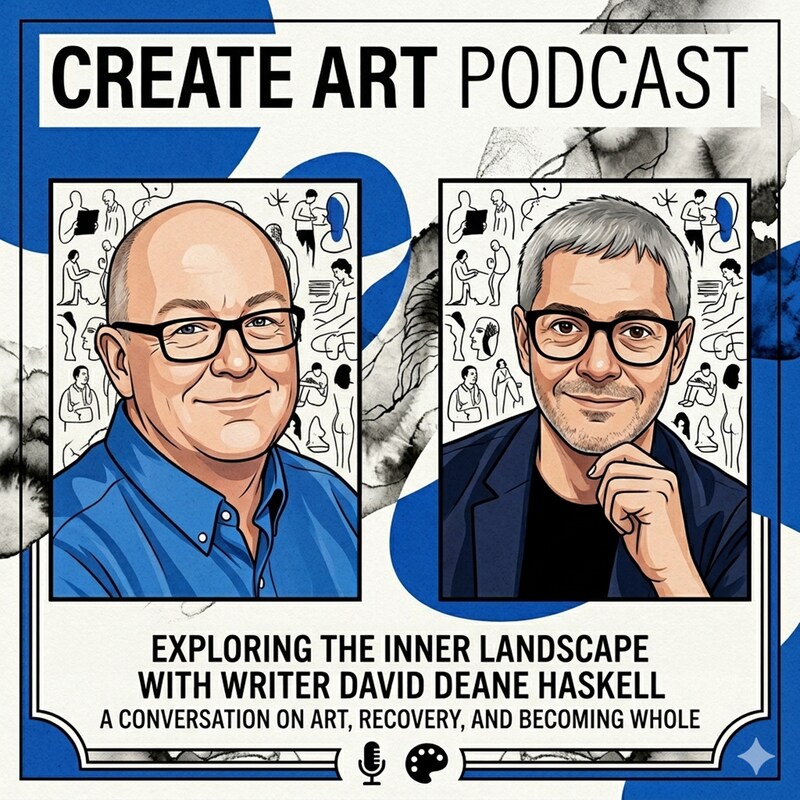
Shownotes
Get ready for a wild ride as we dive into a conversation with David Deane Haskell, a talented writer and drummer who's all about exploring the messy, beautiful process of creativity! We kick things off by chatting about his journey from penning speculative fiction to navigating the intricate waters of memoir and recovery writing. David's work is a heartfelt exploration of what it means to make sense of a chaotic world, and trust me, he’s got some profound insights on the struggle of being human. We also groove into how his drumming influences his writing, and how creativity can be both a physical and emotional release. So grab your headphones and let's get inspired together as we tackle the ups and downs of creating art, one beat at a time!
Summary:
In this episode, we sit down with author and mindfulness guide David Deane Haskell to explore the intersection of speculative fiction, memoir, and the lifelong process of becoming whole. David discusses how he navigates a world without instructions, using the power of storytelling to map his own journey from deep distress to spiritual awakening. Whether he is writing about the complexities of AI-reshaped societies or the raw, intimate reality of inner-child healing, David’s work serves as a powerful testament to the beauty of evolution under pressure.
What You’ll Learn:
- How David uses the "speculative reach" of fiction to explore themes of trauma and connection.
- The connection between his past as a hermit and his current focus on writing for "seekers and wounded people".
- Practical ways to balance emotional honesty with the structural demands of creative writing.
- Why the "reconstruction of the fractured self" is a recurring theme in both his memoirs and his science fiction worlds.
Bio
David Deane Haskell writes about what it means to make sense of a world that doesn't come with instructions—and that none of us make it through unscathed.
His work explores that reckoning—through failure, obsession, and the slow reconstruction of the fractured self. Across speculative fiction, memoir-driven essays, and recovery-centered writing, he returns to outsiders, seekers, and wounded people trying to become whole without abandoning the parts of themselves that helped them survive.
He is drawn to stories of evolution under pressure: societies reshaped by artificial intelligence, people unraveling within systems they don't understand, and the lonely, wrenching but ultimately beautiful work of learning to listen to the heart.
Blending emotional honesty with speculative reach, his writing moves through technology, spirituality, trauma, and imagination to explore shame, connection, creativity, and the lifelong process of becoming you.
Links
Website https://daviddeanehaskell.com/
Takeaways:
- David Deane Haskell dives deep into the idea of creativity as a healing journey, emphasizing the importance of vulnerability in both fiction and nonfiction.
- In our conversation, we explore how writing can be both a discovery process and a means to convey deeper truths about ourselves and our world.
- The interplay between drumming and writing is fascinating—while writing is cerebral, drumming serves as a physical and emotional release.
- Haskell's latest work reflects on technology's impact on society, tackling themes of AI and the human experience in a rapidly evolving world.
- We discuss the challenges of being a creative in today's fast-paced environment, particularly the pressure to stay relevant and innovative.
- Ultimately, Haskell aims to inspire readers to ponder 'what if' scenarios, fostering a sense of wonder and optimism about the future.
How do I get such great guests?
PodMatch I use Podmatch to get the best guests on the show. Check out PodMatch if you want to be a guest on other podcasts or if you have a podcast and need guests for your show. Guests from Podmatch
Want to be a guest on Create Art Podcast? Send Timothy Brien a message on PodMatch, here: https://www.podmatch.com/hostdetailpreview/createartpodcast
Make Sharing your podcast easier
Use Podcast Beacon for the best NFS products to share your podcast while out and about or at conferences.
Reach Out To The Podcast
To reach out to me, email [email protected] I would love to hear about your journey and what you are working on. If you would like to be on the show or have me discuss a topic that is giving you trouble write in and let's start that conversation.
- Email: [email protected]
- YouTube Channel: Create Art Podcast YT Channel
- IG: @createartpodcast
- Twitter: @createartpod
- Create Art Podcast Hotline (540) 300-1793
- SpeakPipe
Create Art Podcast Newsletter
Special Message
If you have found value in this podcast, please share it with a friend, as that is the best way to discover new podcasts. I want this to be a 5-star podcast in your eyes, so let me know what you would like to see.
Speaking about sharing with a friend, check out my other podcast Find A Podcast About where I help you outsmart the algorithm and find your next binge-worthy podcast. You can find that podcast at findapodcastabout.xyz.
For all of my projects, check out my portfolio website TKBPodcaststudio.com, where I help my clients through quiet professionalism lead through the noise.
This podcast uses the following third-party services for analysis:
OP3 - https://op3.dev/privacy
Transcripts
Create Art Podcast interview David Dean Haskell. Hello, friends.
This is Timothy Keem o', Brien, your head instigator for Create Art Podcast, where I bring my over 30 years of experience in the arts and education world to help you tame your inner critic and create more than you consume. So for this episode, I decided, hey, let's get somebody from not across the pond, but actually from on the other side of the world.
And so I'm proud to introduce you to David Dean Haskell. He actually wrote me an email and said, hey, I like what you're doing over here. I'd like to be on your show. I thought to myself, well, you know what?
I've always wanted to go to Japan,.
Tim:And this is probably as close as.
Tim:I'm going to get for the next few years, so let's go ahead and do that. Well, let me tell you a little bit about David Dean Haskell. Now. He's a writer and a drummer, and.
Tim:We do talk about both of those.
Tim:Things that he does in this conversation that we have. And he writes about what it means to make sense of a world that doesn't come with instructions and that none of us make it through unscathed.
His work explores that reckoning through failure, obsession, and the slow reconstruction of the fractured self across speculative fiction, memoir, driven essays, and recovery centered writing. He returns to outsiders, seekers, and wounded people trying to become whole without abandoning the parts of themselves that help them survive.
He is drawn to stories of evolution under pressure, societies reshaped by artificial intelligence, people unraveling within systems they can't understand, and the lonely, wrenching, but ultimately beautiful work of learning to listen to the heart.
Blending emotional honesty with speculative reach, his writing moves through technology, spirituality, trauma, and imagination to explore shame, connection, creativity, and the lifelong process of becoming you. So we have a long flight to get on over to Japan, so let's get this conversation rolling.
Tim:All right, thank you, everyone, for joining us here on Create Art Podcast. It's my personal privilege to reach across not only the pond, but across the world. And today I have with us David Dean Haskell.
ually, tomorrow, I guess it's: David:10:15 In the morning here, so that makes it yesterday for you. Yeah, it was a Simpsons episode. One time they said, welcome to Japan. The local time is tomorrow, right? So it's good. It's good.
been calling Japan home since:It's been a long ride. And I spent the last couple years traveling a lot through Southeast Asia, in Vietnam and Thailand and Indonesia. Had a great time in all those places.
But it's nice to be back where I call home. My friends are here, my daughter's here, and Japan's great.
Tim:Awesome, everybody. Now, you know somebody in Japan go visit. And like we were talking earlier, the Yen is in a really good place for. For folks in America to go visit.
I don't know about other countries, but as Americans, we need to go over to Japan and just hang out with David. All right, well, let's get jumping right into this. First, we're going to talk a little bit about writing here with you.
And when you're drafting a narrative, when you're drafting that novel, is the process of that novel making sense, something that you like to solve for the reader, or when you're making that draft, is it something that you're discovering as you're writing that draft?
David:I would say it's something that I'm discovering. And I'll tell you the I can think most clearly about my latest book, my latest fiction.
I write nonfiction and fiction, so when it comes to the nonfiction, it's. It's kind of easier in a way, because I'm just telling the truth as I see it.
So there's not any, you know, trying to figure out what plot makes sense or what twist would be cool. But my latest fiction book, the Solarian Deep, it started out as a serialized thing.
I was doing it on Royal Road at first, and then I moved it to substack, where I had an audience there. And. And I didn't have the ending when I started it.
And I was literally putting this out for readers, a small but mighty group of readers who were waiting for the next chapter. So it's like, okay, what can I do to make this good?
But also, it was evolving as I wrote, and that was really cool because a lot of the themes that I had ideas of it at the beginning, and I even on rereading and editing my own stuff, I was like, oh, that idea. I'm going to expand on that transformation.
These kinds of things, these themes of how did societies get along, which has been a big topic these days, too. That's pretty much where that was at. It was sort of a work in progress the whole way through until I had it done.
And still 10 chapters left to publish. But yeah, it's something that I'm discovering as I go. I'm more. I'm not a plotter kind of guy, so.
Tim:Yeah. More of a pantser than a plotter, would you say?
So when you're doing that first draft, something that you had brought up before we hit record here, that I definitely wanted to cover with you, is that you're a drummer as well. You do drumming all over the place where you're at.
David:And.
Tim:Are you.
When you're doing that draft, do you have some of that drumming going on in the back of your head, or do you have your drums there to kind of help you through a rough patch or those two worlds interact with each other whatsoever?
David:I would say more like, when I need a break from one, I go to the other. So I found. Especially when I was traveling last year, I was traveling and kind of lonely and I was writing a lot.
This year I'm doing more like the outreach and the podcast and pitching the books, and I'm trying to do more writing as well. But last year I was just doing tons and tons of writing, and occasionally I would just get. I would be done.
I'd feel like kind of burned out, whatever. And then I'd pick up my. My drumsticks and pad, which I always have with me, and sort of play drumming for me is. It goes way back.
I've been drumming since I was 12, 11, 12 years old, professional drummer. I played drums at Disney for a while. So it's more. It's not practicing or even playing music. It's just sort of meditative.
I'm just sort of jamming for 10 or 15, and then I would sort of beat myself up. It's like, you got to get back to the writing. What are you doing? Drumming. But, I mean, same kind of thing.
I was doing drum workshops in Indonesia, which was a lot of fun. It was great. I got to meet amazing people and I was on stage and doing that thing. But I'm kind of introvert.
So when that was all done, I'd go back to the hotel room and then after I decompressed, do some writing and quiet. Because for me, the writing is a quiet exercise, so.
Tim:Sure, sure. Are you listening to music while you're writing or not at all?
David:I can't. I want to. I. One thing. I can't listen anything with lyrics because I'll just focus in on it.
But even, you know, like, classical or jazz or something I can listen to. There's. I recommend this, too. On YouTube, you can Google up a ton of ADHD music, right? ADHD focus. And I'm ADHD all over the place, right?
So I've never diagnosed. I would bet a thousand dollars that I'm adhd. And so this focus music I can do. It's like very steady rhythm, and then you can just.
Okay, you're focused in regular music. I know some people do it, but I can't.
Tim:I. I recently joined up with this group called Shut up and Write. It's a national group, actually, but we have a little enclave here in Fredericksburg, Virginia. And you go to the.
Go to books a million in the little Cafe Cafe there. And I see everybody on their laptops sitting there with headphones in.
And it my first time going there, I was like, okay, so I threw my headphones in, and I'm a huge jazz guy. You can see my record collection right behind me here. I know the audience can't. But my first two things are strictly jazz.
Then I have some rock and other stuff there.
But I was sitting there writing a novel that I started three years ago that I needed to get back to, and I was listening to some jazz and no lyrics, nothing like that. And I experienced what you were talking about there. I got into the jazz and I just couldn't get any good writing.
Being quiet like that actually helps you out, though.
David:Yeah, it does. And the other thing is I have a little bit of a weird process that really works well for me. Recently I do drafts with. With voice to text.
So I speak my voice. I speak my voice. Of course I speak my voice. I speak my books. And like Wounded Angels, which is the nonfiction.
The inner child book I wrote that was literally like every word of it was voice to text. Because I was. It was nonfiction. I was just telling my story.
But even the fiction, I can get draft stuff done so much quicker if I just grab my phone and talk and just. And I'll do. I use GPT for this. And I know some people. I'm not going to get into the AI controversy, whatever.
But GPT is the best voice to text technology. And I use the prompt format this for paragraph breaks and punctuation only. Do not tamper with the text. Text as follows.
And then I just talk for two minutes and it gives me my draft. And then I just copy pasted in the word. And I can write a thousand or two thousand words. Like nothing that way. So that silence anyway.
Cause I'm talking, right? And then when I'm. When I'm doing the edits, that's when it's either adhd music, which I actually, that does work well for me.
Or silence, which after a while I'm like, what's too silent here?
Tim:So, yeah, I have the problem with. With silence. I have tinnitus from my days in the air force working on aircraft. So I have this ringing going on all the time.
Drives me nuts when it's absolutely silent. To bed. When I go to bed, I have to have some kind of noise going on, otherwise I will not sleep.
But I. I think I'm going to steal that trick from you with Chat GPT because we are AI friendly here at Creator Podcast. It's a tool much like a pen, paper, whatnot. I've used like voice notes and then thrown that into Chat GPT.
David:But voice to text technology is amazing there. It doesn't make mistakes as long as you're in a pretty quiet space. If you're walking down the streets in Tokyo, then it'll screw it all up.
But if you're in a reasonably quiet space, it's spot on. It's really great.
Tim:Although that might be a cool novel to write. I'm just. I have an excuse to come to Japan now. I have an excuse to come to Tokyo.
David:Writing on the streets of Tokyo.
Tim:Absolutely, Absolutely. And if something comes in, I don't have to write it. It's right there.
David:I'll tell you something about Tokyo. It's.
I didn't realize I've been living here forever, but I didn't realize until I went to Southeast Asia, which is the noisiest place in the world, Especially Vietnam. Vietnam is 24. 7 Noise, beeping, megaphones, like they. They're into it. They love making noise. Tokyo is the opposite.
It's the quietest city you could imagine. It's this mega city. And you walk down the street and you realize, wow, it's like completely silent. It's bizarre.
It was really almost disconcerting, but I liked it at the same time. Still, it's not quite quiet enough for to do voice stuff because even the traffic noise will mess it up.
Tim:I'm originally from Chicago, so I'm used to a lot of noise.
David:Yes, Vietnam is a level up from that, I'll tell you. But it messed with my nervous system, I'll tell you. I couldn't do it. I wish I liked Vietnam because it's super cheap.
I don't dislike it, but it's super cheap, very nice people, great food.
But my nervous system was on edge the whole time I was there because, like every minute there was like some kind of like loud Jarring noise, even four o' clock in the morning. So, yeah.
Tim:Oh, wow. Vietnam. I'm gonna have to. I'm just gonna make the grand world tour.
David:Yeah, some people love it. I've only been in Chicago. I went to Chicago three years ago with my daughter. We went to see a musical.
We actually were stopping on the way to Boston, which is my hometown, and it was 18 below. We landed on December 23rd. It was crazy. We were like waiting in line for a taxi and it was like being in a refrigerator. It was wild.
Tim:Oh, yeah.
David:And I'm from Boston, but man, Chicago cold is a whole different level.
Tim:It's insane how cold it gets into Chicago. And there's a reason why they call it the Windy City. So, yeah.
Getting on to a little bit more of your work here and, and all that now, like, like you said earlier, you do non fiction and fiction as well. And you had said a little bit earlier that fiction is a little bit. I'm sorry, non fiction is a little bit easier because you're speaking the truth.
Is the process the same for you with fiction versus non fiction? In terms of when you're writing that draft? I'm just thinking off the top of my head.
I would think it would be a little bit different because with non fiction, you kind of know how the story ends. With fiction, you may not, but can you talk about the differences?
And as a dad myself at Data Twins, I'm going to ask you which one you find the most satisfaction with. And I know I'm asking you to pick your favorite kid, but pick your favorite kid.
David:Okay, that's a. This is a huge question for me. I don't use a pen name. I've been going by my full name, David Dean Haskell. But there's a reason for that.
There is another writer named David Haskell who's a Pulitzer Prize winning biologist. He writes about forests or whatever. I can't compete with this guy on Google. You Google David Haskell, you're gonna find forests and trees.
So I go by my full name, David Dean Haskell. But I was encouraged, strongly encouraged, to do a pen name and to separate my fiction and get to websites and all this. But I just can't do it.
I'm me. And it's all truth for me because like I'm writing the heal, it's trauma and healing stuff is the fiction, the non fiction inner child.
And then like after I get healed, then I'm talking about the visionary, hopeful future that I hope because my stuff, my especially the stuff I'm Writing now is very optimistic. I've had enough of the dystopian. We're living enough of the dystopian now that we don't need that in the fiction. Right.
So for me, it's all like the same.
Tim:Exactly.
David:But. So maybe I'm getting myself in trouble because my website has both and some people want one or the other, but to me, yeah, it's.
It is choosing between two children. But I never wanted to write nonfiction. My first four books were fiction. Then I had a five year writer's block. That's part of my story as well.
That was when I was doing that trauma healing and all that stuff. Then I wrote the non fiction book and then Solarian Deep is my latest fiction book.
I only wanted to write fiction, but nonfiction kind of wrote itself. It maybe sounds lame, but it's like I was like, ah, really, I'm gonna write this. Seriously, I don't want to. What good is that?
But it came out and that's. It was easy to write, but hard to publish because it's very vulnerable stuff.
I mean, I'm talking about my own life and really deep moments in my life, talking about addiction and all kinds of stuff. So, yeah, publishing it, it's vulnerable in a different kind of way. But in terms of drafting, I think the editing is different.
The first draft, it's just. It's kind of like I just put it out there. Yeah.
Tim:With the, with the fiction. I'm sorry, with the nonfiction. And trust me, I know the difference between the two.
I've got 12 year olds, they tell me all the time, no, pops, nonfiction is the truth, fiction is not the truth.
But with that vulnerability aspect, I can really relate to that because I just recently started a podcast talking about my journey with Ms. And a lot of the stuff, it's a continuing journey of healing. But a lot of the stuff I have been able to, I don't want to say compartmentalize to deal with.
So that way I feel okay with sharing it with the public. For you when you're doing non fiction, when you're talking about your healing, and I know a lot of people do this.
Have you fully dealt with the healing aspect of it for yourself? And have you been able to grow from sharing it with the public?
David:I don't think we ever fully get there until we, until we're done with this lifetime. And I think that's. And I'm sorry to hear about the Ms. Diagnosis as well. I'm sure that's going to be a process for you.
As well, which is, you know, it'll come and go. This is all I talk about. This four different types of health. Physical, spiritual, mental, and emotional. And like, where. Where are we at?
And I did a lot of work on my emotional and spiritual health. And so this is a forever journey for me. I'm never going to be 100%. I'm always checking in on my health. Actually, this.
These past couple weeks, I've been dealing with physical because I hit my head a couple of weeks ago and I have a bit of back pain. So that's nothing permanent, but it's something that I'm.
So, yeah, the spiritual and the emotional healing, which was inner child stuff that I did after quitting drugs and alcohol and dealing with whatever codependency issues that I had is ongoing and took years. And I was doing that work for years before I started to write it. And as I. It just sort of started writing itself, like, this needs to be written.
And I don't know why I do think it's going to help people. It's just basically showing, okay, this is what worked for me.
And if I, you know, am courageous, I don't want to use the word courage too loosely, but courageous enough to be vulnerable and show this to you. I'm taking a chance because you could be like, oh, what a loser. I read your book. You're an idiot, pathetic, and I hate you.
And it's very easy to be targeted. But at the same time, you can also relate to people and you can also find some people that might benefit from reading it.
So, yes, I do think was cathartic in a way. It was done six months before I published it because that was like convincing the inner child that it was okay to publish with the fiction.
It's always been, when the book's done, I want to publish it. I want it behind me, I want it out. But this was the opposite. This was like, should I do? I really want to? And I did.
And so it was more that kind of vulnerability. When it's the fiction, it's just more like the vulnerability of like somebody giving you a one star and this guy's a hack.
The worst thing I've ever read. And then somebody else writes. It's the best thing I ever read. And I've come to a lot. I've come to terms with that creatively.
I mean, the idea for me is to find writers that vibe with what I write. Sorry, readers that vibe with what I write. And so not everybody's going to like it.
I don't like I don't like everybody's books and the people that dislike my writing or have a problem with the style or whatnot, that's not my reader. Ignoring the one star reviews is part of that process too. The nonfiction. I'm not that afraid of one star reviews in a sense, because I mean, can't.
It's my story. Like, maybe you could say I did a bad job with my life. Okay, I could have done better, right? But I'm just sharing where I'm at.
I'm doing better now at age 55 than I was when I was 35. And really, you know, circling hopefully that's a bit of an inspirational story for others. So different kind of vulnerability.
I think, as you know, any kind of creativity is vulnerable. If you're putting it out to the public, you're setting yourself up to be judged.
Tim:Amen to that. Amen to that. And I know a lot of people are afraid of showing that vulnerability to a public because you may get that one star review.
And I look at one star reviews as this, especially if they write a comment. If they just give me a one star review and go away, I'm like, eh, okay, whatever. But if they write like a thesis, they gave me a one star review.
I'm definitely reading that because I'm like, oh, there's. It could be some good nuggets in or something like that.
But I think we got to remember that they're not writing a one star review on our life, just something we created. And I think you said it beautifully. Hey, it's not for them. They're not my reader and we're okay with that.
So I'm a big fan of Seth Godin, and that's one of the things that he says is that, hey, I made this and if it's not for you, it's not for you. And that's okay.
David:Long ago I would read all the reviews and beat myself up for it. I don't think these days I would so much. It's always nice to get a nicer. But I'm not really looking for.
I'm sort of at a point where I'm just like, if you like it, if somebody points out an actual mistake, like this is a butthole or whatever, typo, whatever. Great, thank you. And I'll fix it in the second edition.
In fact, I did go back this year a couple months ago, and I did second editions on two of my oldest books just because I wanted to clean them up and I wanted to fix some of the stuff that at the time I wasn't adept enough to deal with. So I think if you're going to, if you're looking for that though, you want to look at the three star reviews.
Not the one stars, the three star review. They'll be honestly critiquing what you're. If you're looking for that, I don't really recommend it.
I'd say find a few people that you trust that like your writing and ask them.
Tim:You're reading my mind because I was going to say, do you have that group of people?
And so I think I'm going to take that question a little bit farther is how do you find that group of people that I remember when I first started writing and I joined a writers critique group, my first fear was they're going to steal my ideas. And then some of the people have nefarious reasons for being in writers workshops.
How do you go about finding the right people to give you that critique?
David:It's not easy. And again, for me it's different with the fiction and the non fiction. I have very few people that I trust to read my non fiction.
And I'm not really looking for point out something if it's awkward or difficult to read or confusing. But for the most part, I don't want you to tell me what's wrong with chapter eight because chapter eight was. It was what it was.
It involved lightsabers and Inner Child and A Bad Day or whatever nonfiction. I'm more open and I'm not. I don't really worry about people stealing my. I'm sort of. I mean, if it happens, I probably would not be happy about it.
But I make my. I don't lock up my books like in Amazon. You can put the tougher to steal or easier to steal.
I make it all easy to steal because as far as I'm concerned, if a few of my copies get pirated, maybe they'll tell a friend. And besides that, I don't want to make it difficult for you.
If you bought my book on a Kindle and it's hard for you to put it on a different device, I don't want that. Like, I don't want you to pay twice. And I just want to make it easy.
So I'm not saying please pirate my stuff, but at the same time, I think unless somebody literally plagiarized, steals it and publishes it before you, then I suppose I could get a lawyer and prove that I wrote it. Right? Because we have, we have all the documentation now on word, right? There's actually been cases like that.
I mean, if you really wanted to go down that rabbit hole, if my books were worth something, that kind of money, if somebody grabs my story and becomes a bestseller, then I'm going to go after them. But otherwise I'm not that worried about that. But yeah, trust, it's tough.
And a lot of people do beta reading groups and whatnot and they kind of go crazy trying to get early reviews and whatnot. I sort of tried to do that, didn't do a good job of it. And I don't have a lot of reviews. I'm a failure in that regard.
So you'll have to talk to somebody else. When it comes to that awesome algorithmic marketing stuff that so many people do so well that I just. Yeah, but you know.
Tim:Yeah, but I, I think because I found a lot of. I call them diamonds in the rough and I'm stealing that from somebody else that originated that term. But I find a lot of those to be way better.
It's probably because I am the type of reader that they're talking to. But I, you know all the stuff on the.
Not the Wall Street Journal, the New York Times bestseller list, I don't really read those that much with sci fi.
I'm a huge fan of Philip K. Dick and the only reason I got into him is because I saw Blade Runner, which is based off of Do Androids Dream of Like Sheep? And he's outside of the sci fi world. You not known. And I saw the book cover and I was like, oh, this looks pretty cool. The movie was pretty cool.
And I became a fan for life. But my wife never heard of them. And you can see my little small library here. She has rooms and rooms of books.
So she is a voracious reader and she'd never heard of them. And I was like, well, here, try it out. She's like, I understand you now. You're weird. That's why I married you.
David:Right? Exactly. Yeah, exactly. It's all a matter of taste.
Tim:All right, let's take a breath for just a moment.
Tim:Okay. Now if you're listening to this, you're probably in the middle of a project or more likely you're thinking about the one that you're about to start.
But maybe you're too scared now. Here at Create Art were all about creating anyways and embracing the ugly stage of the process. But I don't want this to be a one way conversation.
I want to hear about your mess. So I've opened up a couple of ways for you to Join me on the show.
Now, if you want to send me a high quality story or poem, you can head on over to my Contact Page page where you see I have a link to my Speak Pipe app that you can leave that message to.
-: -:Now these don't have to be perfect projects. They don't have to be done projects. They can be projects that you're just starting up.
Maybe you're just starting up and you're really scared about it. I don't care.
Tim:That's fine. Shoot me a message, let me know.
Tim:What you're doing and maybe somebody hears.
Tim:It and it's listening to the show and we can do something about that.
Tim: -:Looking forward to seeing what you all are doing out there and sharing it with the world. Now back to the show and you've.
David:Got me wanting to read. Okay, Dick, because I know I always meant to read When Android's Dream of Electric Sheep, because I love Blade Runner.
I might have read one or two of his other books. I'm not sure I'd have to look back. But when you were talking about that, the one that sprang to mind for me was Orson's card.
Because I got into those books and not a lot of people like him that much. They don't like his politics or whatnot. But like not even the end, the Ender's game stuff. It's funny, I wrote a short story called Gamer's End.
A little bit of a twist. It's Actually an addiction story. It's on my substack if anybody wants to read. It's free. But it was a bit of a tribute.
But there was some other books that he wrote, really obscure ones. I couldn't even find it on a search when I was trying to think of.
I was trying to come up with the name of it is his just really bizarre thought ideas that. That just really appealed to me, like, right from page one, page two. And so for me, that's what sparked my interest.
It's whatever some people like the slow burn, whatnot. So, yeah, it's just find what you like and there are no rules. Right.
Tim:That's the beauty of it. Because if you're creating it, you're creating the world and the rules yourself. So it's your rules.
That's one of the things I love about podcasting is it's. I hate saying it's relatively new, but it's newer than writing, that's for sure. And we have 7 million podcasts out in the world here.
And I do my thing.
Tim:Yeah.
Tim:I've got friends that do their thing. And. And it's okay because nobody is punching me in the face. And you're doing it wrong because I just do it my way.
David:Right, right, right. I'm sure there are some podcast critics out there somewhere, but you don't have to pay attention to them. Right.
Tim:If you're looking at your entire body of work that you have going, and let's stick with the fiction aspect of it. So all the stuff that you've written that is fiction based, is there a.
A single theme that you want to get across to people with that, or is each one of them its own unique universe?
David:I think there are definitely themes that run through a lot of my books. Techno thriller, near future, sci fi kind of guy. I haven't written any aliens yet. I've written what do you. What Will the Future Look Like?
lari and Deep, I published in:But when I went back and looked at it, and that's the one that's on my mailing list is for free. It's called Emergence. And I was like, I got a lot of that stuff right.
Like, it was like, it's been going on these last six, seven years, and now I'm Right, I'm writing a new one, and it's called the Vibrance V I B R A N T S. And it's.
I Mean, I titled it years ago, been working on the book for a long time, and now just this month or last month, they start talking about vibe coding and all that shit, right? And I'm like, oh, yeah. And they're gonna think I got the title from there, but I didn't. I came up with that years ago, you know?
So I think, yeah, I think the near future, what's it gonna look like? Are we gonna be okay? How does technology fit into all this? Cause I'm a tech geek guy. I like. I like the Internet.
I like playing with codecs and whatnot. Man, I did my own website. I've had the crappiest website on the planet for years. Hated it, embarrassed by it. Couldn't make it happen. I'm not an.
I'm not. I don't have an eye for heart, and I didn't have money to pay for somebody to do it.
But a month or two ago, I used the AI to make my website, and I switch. It's demonstrably better because I'm getting traffic, I'm getting subscriptions to my mailing list. I'm like, holy crap, I just did that.
Or the AI did it, but I guided it. It's like this kind of amazing technology, which is neither good nor bad, right? It's a tool. It's what we do with it is very interesting to me.
So that's a big theme in my writing. And then I think the little guy versus the big horrible corporation is a big part of what I write. My first book was about.
rote. I published that one in: worse than I thought back in:It's worse than I thought it would be. And I was imagining a pretty bleak future. Yeah, I think that. I think that. Yeah, I. The little guy versus the man is a big part of.
I always have a little guy shaking his fist, and that's usually my hero. Through that corporation, I'm going to win.
Tim:Well, we're going to help you win by that. So we're going to definitely all check out your website, which I have in the show notes.
And I got to say that, yes, his website, David's website, is better than my business website that I have that I'm just like. So I don't have any hair right now because I'm like, how do I do this? I will be tapping into our good friend AI and having them help.
David:We checked out Lovable.
Tim:I have not checked out.
David:Lovable is an AI app that makes website. That's what I did. I used Lovable.
Tim:Okay.
David:Took me like an hour.
Tim:So I think we all have an hour that we can use that tool to make our websites look.
David:Yeah. Just for the record, it's a little more complicated than that because I. If you want to pay, then you can just pay.
And it's easy enough, but if you don't want to pay, it's quite expensive. I used Lovable to create the website on the free version and then I hosted it on Cloudflare, which is also free. So it's also free.
The only thing I pay for is the domain. But that's the kind of thing where I'm willing to do like the maintenance and whatnot. So it's not as easy as that.
But you can certainly just do things that you couldn't do a year or two ago.
Tim:Like, nice. Hopefully you can get the banner ads coming back from the early days of the Internet. Or not. Or the pop up ad.
So some 14 year old is going to find a way to do the ad blocker and make billions of dollars and then they'll run the US government and there's our dystopian future right there. The stuff writes itself. The stuff writes itself.
David:My, my biggest fear with fiction now is whether it won't be fiction by the time I publish. Like, literally, like, I mean, what I'm writing right now. Yeah.
It's about AI Human creativity in the future and the Vibrance and it's like, is there going to be a headline next month? It's going to make my stuff look antiquated. Like I don't even know.
Tim:Well, and stuff is moving so quick too. It's just we're of a certain age. I'm 53, so we're of a certain age. We're very close. And I remember when stuff took time.
David:Oh yeah.
Tim:To like a movie would come out and you wouldn't get it on your VHS tapes, folks. We had VHS tapes out there. You wouldn't get that for like 12, 18 months after it left the theaters. You had to wait for it.
Now streaming services, it's out in the theaters and it's right there on the TV for you right then and there. It's crazy.
David:At the same time, era of diminishing attention spans, I think is where we're at. And I do it, too. Like, I'll end up scrolling those stupid YouTube shorts. And, like, makes me crazy.
I wish I could delete them, but they don't want you to delete them doing that. Right. But at the same time, I'm trying to learn how to use them, too, because, like, a lot of these.
I'm doing tons of podcast appearances these past couple of months. And those shorts are great because they make them automatically. The AI makes them.
And it's great because you can really get a summary of what we talked for a minute. You can see the short, and then you can come watch the hour if you're into what we have to say. That makes some sense to me. Yeah. Yeah.
Tim:No, I actually do that for a client of mine because I run my own podcasting consulting agency. And, yeah, he was like, tim, let's do all video. And I'm like, you don't have the budget for that? Tim, let's do these shorts.
I'm like, you have the budget for that? Yes. So kind of to close out everything here. What are you hoping that the reader feels when they shut that last page?
When they close it on the Kindle or whatever device they're using, or when they have it in their hands, they flip that last page. What do you want them to be feeling? Walking away with.
David:A sense of what if? Like, what if it was like that? I don't want to necessarily say optimism. I write some dark shit, too.
But, like, just the wonder of the future, like we used to have. And we're the same era, same generation, Star Wars, Star Trek, that kind of thing. We grew up with that.
I miss that in a lot of the stuff that I read and see these days. And so I'm sort of trying to. Not trying. I'm writing. I don't really have a choice. What I write, it's coming out the way it comes out.
But that's kind of where I'm aiming, is to go a little more for that optimistic future. Maybe things are going to be cool in 20 or 100 years. What if. Right. So that's what I want people to get out of my books. And. Yeah, for all of it.
So the fiction and the nonfiction. Because the nonfiction. What if I could heal? What if I could get better? Same thing.
Tim:I think that's a wonderful thing because we have the Blade Runners that are dystopian. We have Enders Game, we have the Hunger Games and all that kind of good stuff.
David:And.
Tim:Yeah, I mean, we just came out of A pandemic, which. The funny thing is, about six to eight months. Right before that happened, I was reading the Plague by Albert.
David:It. Yeah.
Tim:And I'm just sitting there going, well, I know how to survive this. Read the book.
It was crazy, but I think it's great to kind of go against the grain of everything that's out there right now and find that positivity, because we have to have it in order to keep on creating the things that we create. I mean, if we're down and depressed and really negative about the future, then what are we doing here?
I'd rather read something that's a little bit more uplifting now. Yeah. I am going to read my Deep Dark Evils for. For that. For the enjoyment of that.
But I'm also interested in reading stuff that is uplifting, that gives that hope. Like Star Wars. When it came out, it said I'm the only one in my household that actually saw it. When it came out in a theater,.
David:You're like three or four. Yeah. Do you remember it?
Tim:I do. I remember waiting in line for it. I remember it was such a big thing, so.
David:Me too. I remember waiting in line for it. I don't actually remember seeing the movie, but I do, clearly. I remember Empire Strikes Back because that was.
I went with my uncle and it was crazy because, like, people were hooting and hollering in the theater. Like, it was the first time I ever saw people make noise in the theater when it came on and tauntaun and all that. But I don't remember.
I do remember waiting in line for Star wars. And then I think I remember seeing it, but not the first time I saw it, like, whenever it came back up. But, yeah, that was our generation, man.
Tim:Yeah, that was. And my parents. And back in that time, you could go see a movie and you didn't have to mortgage your house.
But I remember for, like, a certain summer, my parents would just. They would give my older brother money and that would be my babysitter for the whole summer, is to just go and see that again and again every.
I think we saw it, like, three times in one day, back to back. So that's how parenting worked back then. And look where we're at now.
David:Yeah.
Tim:Doing okay. Well, I get to talk to awesome people like you, so, yeah, I gotta be doing something. Okay.
David:Doing something. Okay. Still standing, creating and moving forward.
Tim:Absolutely. As far I wanted to get back to your drumming, because this is a. Because I do a little bit of musical work myself. I'm not a drummer.
I Don't have the rhythm for it, the timing for it, which is weird because I used to play tuba and I played a little bit of keyboard, so you would think I would have the timing for it, but I just, I can't get my hands and feet to do that kind of stuff. How did you discover drumming as a creative outlet for yourself? And what does it do for you that maybe other forms of art don't do for you?
David:Yeah, well, drumming and music for me is more physical. And so, yeah, the writing, I would almost say, yeah, I was talking about the different types of health. Right.
For me, drumming is a physical release and emotional as well. Music is emotional. I think for me the writing is more like emotional and mental, especially when I'm talking.
And a bit of spirituality thrown in there too, the more I progress with myself. But there's nothing really physical about the writing to me. Maybe there will be someday.
But yeah, so the drumming, it's more an embodiment kind of thing. But for me, it came much, really early. I started. I started with the piano, which. And my stepmom was forcing me to practice a half hour a day.
I didn't want to. I was pretty talented at it, but I didn't want to do it.
But then I joined the local marching band and I saw the drummers and I was like, I want to do that, I have to do that. And my parents like, no, that's too noisy. We don't want you to do that. Play the piano. But I had to. And then I just couldn't stop practicing.
I was just playing day and night. And it was a release for me. It was therapy. It was a way to get away from the bad stuff. And it's been in my blood. I. Drumming has come and gone.
I wasn't doing it for a long time for like 10 years. But then last year I came back propped back up. I was doing coaching clinics in Indonesia. Just happened to happen.
It was like a serendipitous kind of thing. And it was great. It was just sharing another outlet, another creative outlet.
And when I teach beginner drummers, I'm the kind of teacher, I'm not tough on them. I'm just like, let's have fun. What can you do? Hit it really hard, see how you feel. Like that kind of thing. And of course I could.
High level people and then you get technical. But yeah, I. They're not exactly the same. As I say, writing and drumming is kind of separate.
And this conversation is great for me because I'm thinking about the differences. And yeah, I think for the writing is more. I want to be heard. Well, it's all. I want to be heard. Right.
Because drumming too, I want to be heard, but in a different way. I want. I want you to hear my heart when I'm playing drumming, but I want you to feel my soul when I'm writing nonfiction.
And when it comes to the fiction, I want you to join with me and intellectually, what. How do we feel about going forward? That's really the connection for me. So I don't know if that makes sense, but that's where I'm at.
Tim:Absolutely. You're a triple threat with that, with the drumming, the emotional and feeling that and then with the.
With the writing with more cerebral and then even branching it off with the non fiction and the fiction. Getting a couple of branches off of that. I really should do this in video because all these.
But I have a face for podcasting, so we'll leave it at that. Awesome. Well, David, I want to respect your time and I want to thank you so much for joining me here on Create Art podcast.
And I'm going to have show notes for everybody, so that way they can go ahead and have all the links there to get in contact with you to see what you're doing. See your awesome looking website, which I'm jealous of right now. I'm gonna. I'm gonna go and work on mine. You've challenged me.
And then I'm gonna also go work on my novel that started back three years ago that I need to get done. You've challenged me, which is why I love doing the show. So thank you again so much for this talk with me today, Tim.
David:It's been great. I really appreciate your time and I appreciate being here. I'm very grateful. And it's amazing that we can do this from half a world away.
Tim:It's amazing. Hey, you're giving me a reason to go to Japan and Vietnam all on the same trip. So we'll make it happen.
David:Great. Thank you so much.
Tim:All right. Thank you.
Tim:All right, that was my talk with David Dean Haskell. Lot of golden nuggets in this one for sure, folks. So make sure you check out those show notes.
I want to thank David so much for not only being generous with his time, but with being generous with all those nuggets that he gave us. Can't thank him enough. And yes, he has given me a reason to go ahead and go to Japan.
It is something that I actually had a orders for Yokota Japan when I was in the Air Force. Unfortunately, I couldn't go. But now I have a reason to go. Because I have a new friend, a new creative person in my life. So now it's up to you.
If you get something out of this, Please reach out Timothyartpodcast.com Love to know what you're doing. You can be like David. He wrote into me via email, said he wanted to be on the show. And after a couple emails back and forth, we made that happen.
And it's amazing in this creative world that we have built that we can connect with people all the way across the world. I'm amazed by it every time I do one of these conversations. So it's up to you now. Tame that inner critic.
Create more than you consume, and go out there, make some art for somebody you love. Yourself. I'll talk with you next time.
