Shownotes
Re-industrializing America sounds bold. Necessary. Inevitable.
But on factory floors across the country, automation keeps stalling before it ever delivers real value.
Robots sit unused. Projects drag on for years. Leaders know automation is essential, yet decisions stall, risks get avoided, and the same problems repeat. This episode goes straight to the heart of why.
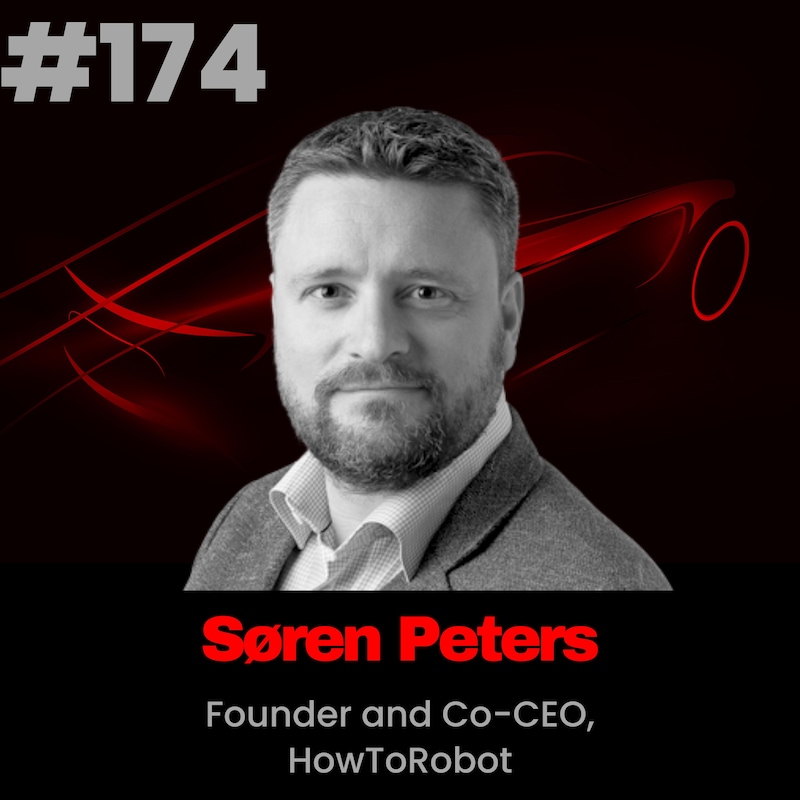
Jan Griffiths is joined by Søren Peters, CEO of HowToRobot, a global marketplace helping manufacturers source and implement robotics more effectively. Søren has spent decades leading digital transformation and operational change, giving him a front-row seat to why automation struggles inside real plants, not PowerPoint decks.
This conversation moves past hype. It tackles the real blockers: fear-based leadership, siloed decision-making, short-term contracts, poor education, and a complete lack of ownership once robots hit the shop floor. Automation doesn’t fail because the technology isn’t ready. It fails because organizations aren’t.
Søren challenges leaders to rethink how they assess risk, train their workforce, and take responsibility for change. Buying a robot isn’t a technology decision. It’s a leadership decision. And without courage, clarity, and accountability, even the smartest automation strategy will collapse.
If the automotive industry is serious about rebuilding manufacturing capacity, closing labor gaps, and preparing for an AI-enabled future, leaders must stop waiting for certainty and start owning the change.
Themes Discussed
- Why automation failures are leadership failures, not technology failures
- The risk-avoidance mindset is slowing manufacturing transformation
- How siloed decision-making kills automation on the shop floor
- Why education matters beyond engineers and integrators
- The hidden impact of short-term supplier contracts on ROI
- What successful automation leaders do differently
- Why ownership and courage matter more than tool
Watch the full video on YouTube - click here
This episode is sponsored by Lockton, click here to learn more
Featured Guest
Søren Peters is the CEO of HowToRobot, a global industrial robot marketplace that helps manufacturers find, evaluate, and implement automation solutions more effectively. He has spent over two decades leading companies through digital transformation, outsourcing, and large-scale operational change across Europe and the United States. Søren brings a pragmatic, leadership-first perspective to automation, grounded in what actually works inside manufacturing plants.
About Your Host – Jan Griffiths
Jan Griffiths is a champion for culture change and the host of the Automotive Leaders Podcast. A former automotive executive with a rebellious spirit, Jan is known for challenging outdated norms and inspiring leaders to ditch command and control. She is the author of AutoCulture 2.0 and the co-host of the Auto Supply Chain Prophets podcast. Jan brings honesty, energy, and courage to every conversation, proving that authentic, human-centered leadership is the future of the automotive industry.
Mentioned in this Episode
Episode Highlights
[02:55] Re-industrialization sounds great until automation decisions stall for years
[04:12] Why factories don’t need humanoids, they need basics that work
[06:35] The real reason companies delay buying robots for a decade
[09:10] Fear, risk, and leadership paralysis inside manufacturing
[12:58] Why training only engineers guarantees automation failure
[14:41] Robots are workers, and leaders must manage them as such
[18:04] Short-term contracts destroy long-term automation ROI
[19:52] Financing, trust, and the reality of buying unfamiliar technology
[21:21] What the DNA of a successful automation leader really looks like
Top Quotes
[11:20] Soren Peters: “I think it’s leadership. And I think those who want to be the one who takes the torch and says, I will take the risk. I will bear the burden.”
[14:52] Soren Peters: “A robot is a worker in a sense, and it comes with different ROIs, it comes with different behaviors.”
[15:15] Soren Peters: “And a robot also has a sick day. But we are also saying to everybody, a robot never gets sick — and it’s not, well, but it does.”
[25:48] Jan Griffiths: “The tech mindset is let’s get this technology and play with it. Let’s break it. Let’s break it. Let’s iterate it.”
If this episode resonated, share it with a fellow automotive leader and subscribe to The Automotive Leaders Podcast, where we’re shaping the future of authentic leadership in the automotive industry.
This podcast episode is also available on YouTube. Check out our YouTube channel at Jangriffithsautomotiveleaders
Send us your feedback or questions — email Jan at [email protected].
Transcripts
Welcome to the Automotive Leaders Podcast, where we help you
Jan Griffiths:prepare for the future by sharing stories, insights, and skills from leading voices
Jan Griffiths:in the automotive world with a mission to transform this industry together.
Jan Griffiths:I'm your host, Jan Griffiths.
Jan Griffiths:That passionate, rebellious farmer's daughter from Wales with over 35 years of
Jan Griffiths:experience in our beloved auto industry and a commitment to empowering fellow
Jan Griffiths:leaders to be their best authentic selves.
Jan Griffiths:Stay true to yourself, be you and lead with gravitas, the
Jan Griffiths:hallmark of authentic leadership.
Jan Griffiths:Let's dive in.
Jan Griffiths:This episode is brought to you by Lockton.
Jan Griffiths:Rising benefit costs aren't inevitable for you or your employees when
Jan Griffiths:you break through the status quo.
Jan Griffiths:Independence matters, it means Lockton can bring you creative,
Jan Griffiths:tailored solutions that truly serve your business and your people.
Jan Griffiths:At Lockton, clients, associates, and communities come first,
Jan Griffiths:not margins and not mediocrity.
Jan Griffiths:Meet the moment with Lockton.
Jan Griffiths:Re-industrialize America.
Jan Griffiths:Wow.
Jan Griffiths:That's a term that we're using a lot these days.
Jan Griffiths:Across the US factories are waking back up and companies want to bring production
Jan Griffiths:home, but they're hitting a wall.
Jan Griffiths:There's some problems: labor shortages, skill gaps, rising
Jan Griffiths:costs, tariffs, you name it and there's a growing need to automate.
Jan Griffiths:We're starting to pay a lot more attention to automation now, but even as the
Jan Griffiths:demand for robotics explodes, many plants still buy robots that don't get used.
Jan Griffiths:I've been in many plants in my lifetime where it, the advanced
Jan Griffiths:manufacturing group is all excited.
Jan Griffiths:They bring in the robot, they put it in a plant and a southern state where
Jan Griffiths:they can't get the skilled labor, and what happens, the plant manager gives
Jan Griffiths:up, throws a top over it and says, I'll just hire a couple of extra people.
Jan Griffiths:So, what are we gonna do about this?
Jan Griffiths:Today's episode tackles a critical question.
Jan Griffiths:If automation is essential to rebuilding American manufacturing, why are so
Jan Griffiths:many companies still failing at it?
Jan Griffiths:And what has to change before we move forward into a truly automated
Jan Griffiths:and then AI-enabled future.
Jan Griffiths:Well, to answer that question and a whole lot more, I am thrilled to
Jan Griffiths:bring on the show today, Soren Peters.
Jan Griffiths:He is the CEO of How to Robot, a global marketplace helping manufacturer source
Jan Griffiths:automation and robotics more easily.
Jan Griffiths:Soren has spent his career leading companies through digital
Jan Griffiths:transformation, technology adoption, and large-scale operational change.
Jan Griffiths:His vantage point puts him right at the center of one of the biggest
Jan Griffiths:shifts in modern manufacturing.
Jan Griffiths:The urgent need for automation as production moves back to the US.
Jan Griffiths:Soren, welcome to the show.
Soren Peters:Thank you.
Soren Peters:I'm glad you'd have me here.
Jan Griffiths:It is great to have you.
Jan Griffiths:I saw you on stage at a UHY conference and your message was so powerful, so real,
Jan Griffiths:and so needed in the world we're in today.
Jan Griffiths:So Soren set the stage for us.
Jan Griffiths:What's happening in the world of automation right now?
Soren Peters:That's a big question.
Soren Peters:I wish I could answer that.
Soren Peters:I think it comes in layers and I think we sometimes have the tendency of
Soren Peters:maybe only seeing the most exciting one, from a technology perspective
Soren Peters:sometimes, but it feels like some of the other layers might be the ones
Soren Peters:that are missing the most right now.
Soren Peters:And I think I've been saying that for the last many years.
Soren Peters:If you ask me, at least, I think we're all fascinated by AI and AI enabled
Soren Peters:robots and any kind that rhymes with AI or autonomous or whatever.
Soren Peters:And I am too, I think it's hard not to whether it's a dog or
Soren Peters:a humanoid or whatever it is.
Soren Peters:I think the more realistic or more broken part of it is maybe that if you go out
Soren Peters:and see a shop floor, they are maybe not so much in need of humanoids right now.
Soren Peters:Well, definitely in need of humans but it still feels like a
Soren Peters:conveyor or a palletizer is the more appropriate fit for a lot of
Soren Peters:these things to get things moving.
Soren Peters:I still feel it's the ongoing discussion of, is robots gonna take
Soren Peters:the workforce out and blah, blah, blah.
Soren Peters:But I think that we are still at, nope, it's not, the people aren't there, so
Soren Peters:it's not gonna take a job that isn't occupied right now, but maybe we can
Soren Peters:move some of these guys to a different position where they feel more valued
Soren Peters:and, as we've been saying for 30 years, that the robot can do the dirty
Soren Peters:jobs and all those kinds of things.
Soren Peters:And I still feel that the backbone of what we're still need to push is
Soren Peters:that while we're developing humanoids and other things but I do feel that,
Soren Peters:we always have a tendency to see that shining thing in front of us.
Soren Peters:I had a colleague once that his thing was Monday morning around 10.
Soren Peters:He always wrote an email to everybody saying, thank God it's it's weekend soon.
Soren Peters:And my point with that is he, let's look past the weekend right on to Sunday roast.
Soren Peters:Whereas the reality is we will have both Monday and Tuesday and Wednesday
Soren Peters:that we have to fight through.
Soren Peters:I think that's what we see.
Soren Peters:We're still at Tuesday.
Jan Griffiths:Yeah, that's a good point.
Jan Griffiths:We hear this number Sorin that there's 500,000 manufacturing
Jan Griffiths:jobs open in the US right now.
Jan Griffiths:That seems to be a number that people are using a lot these days.
Jan Griffiths:Then we've got this other news headline that says, oh my gosh, the robots
Jan Griffiths:are coming, the robots are coming it, and they're gonna take all our jobs.
Jan Griffiths:Well, both are true sort of, but automation is definitely part of a
Jan Griffiths:manufacturing plant's plan, whether it's to reduce labor cost or whether
Jan Griffiths:it's because they can't get the labor.
Jan Griffiths:But automation is part of their plan.
Jan Griffiths:But we're not very good at making that decision, are we?
Jan Griffiths:Why does it take companies so long to make a decision to buy
Jan Griffiths:automation, to buy a robot?
Soren Peters:I think I saw another podcast host, by the way,
Soren Peters:once post one of those, who are?
Soren Peters:Manufacturers?
Soren Peters:What are we gonna do?
Soren Peters:Buy robots.
Soren Peters:When do we want them?
Soren Peters:Tomorrow?
Soren Peters:Are they needed?
Soren Peters:Yes.
Soren Peters:When are we gonna issue the P.O?
Soren Peters:Probably sometimes in the next 10 years.
Soren Peters:And I think that's easier.
Soren Peters:I think that's the point in all its simplicity.
Soren Peters:This is a very US focused public podcast, but a very similar scenarios
Soren Peters:playing the UK for a second.
Soren Peters:How long have they known that Brexit was a thing?
Soren Peters:I mean, years.
Jan Griffiths:Yes.
Soren Peters:We are seeing, I'm not saying they haven't realized that the
Soren Peters:Brexit is happening, but we are now seeing a steady inflow of projects from the UK
Soren Peters:realizing that they are down in workforce.
Soren Peters:But that can't come as a surprise really?
Soren Peters:I'm sure it doesn't but it feels like the time it took to pull the trigger
Soren Peters:on realizing no, you're not gonna get temporary labors from out other places in
Soren Peters:Europe to, I don't know, pick your apples or your strawberries or whatever it is.
Soren Peters:It's not gonna happen.
Soren Peters:And they knew this three years ago.
Soren Peters:Of course they did.
Soren Peters:Why are they pulling the trigger now?
Soren Peters:And the same thing in the us That's not Brexit, but it's other things.
Soren Peters:There is an immigration policy saying that we are a little bit more restrictive at
Soren Peters:the border and a little bit is probably, differs but, so it will impact that.
Soren Peters:And it's been an agenda for years.
Soren Peters:I'm born in Europe as well, it's has been an agenda, the Arab Spring
Soren Peters:and everybody panted a little bit.
Soren Peters:What's that gonna mean for fugitives and so on.
Soren Peters:Long story short, we know that this is impacting us and still,
Soren Peters:we're still thinking about it.
Jan Griffiths:You know that there's issues with people buying
Jan Griffiths:robots and implementing robots.
Jan Griffiths:You formed an entire company around it to help people do it.
Soren Peters:Yes.
Jan Griffiths:But what's right at the core of why companies can't
Jan Griffiths:seem to get their head around this?
Soren Peters:But I think they can, if you divide it up for a second, I think
Soren Peters:when we started working with this in 1718 on the whole platform idea at that
Soren Peters:time was just, there was still a lot of like, why should we use automation like
Soren Peters:seminars, podcasts like this, would be all about why is robots a great idea?
Soren Peters:Let's be honest, that's hopefully not the agenda at any podcast anymore.
Soren Peters:But the why or actually, try to advertise how to robot and we are still stuck there.
Soren Peters:So a few examples.
Soren Peters:I think there's still a fear and a balance.
Soren Peters:The last five years been incredibly changing for a lot of things, and
Soren Peters:very omnidirectional in the sense that every arrow has pointed in every
Soren Peters:direction at any given point in time.
Soren Peters:And I think, if I were a decision maker and a large manufacturer in the last
Soren Peters:five years, there would've been times where I've probably thought that what's
Soren Peters:the old game where you just turn the bottle and it pointed at someone might
Soren Peters:be the right way to take a decision because what's gonna happen next?
Soren Peters:It's tariffs, for and against but there is tariffs.
Soren Peters:There's been a number of wars we hadn't foreseen.
Soren Peters:The former East has suddenly changed their views on a whole lot
Soren Peters:of things and so on and so forth.
Soren Peters:Political winds have changed a lot.
Soren Peters:And as you said, leading into this, there is suddenly an enormous, I don't
Soren Peters:wanna say deglobalization view, but something that is a little bit like
Soren Peters:that and put all those things together.
Soren Peters:How are you gonna navigate that?
Soren Peters:And then still coming out of COVID, people were realizing, we could
Soren Peters:have damned some of the effects of COVID if we had robot workers.
Soren Peters:But still, they didn't pull the trigger until 22, 23.
Soren Peters:I mean, we can see that from the sales.
Soren Peters:I think there is conservatism.
Soren Peters:I think it's difficult to calculate the outcome and let's say that you are a plant
Soren Peters:manager in a factory, in a country with a maybe a little bit shorter payback time
Soren Peters:on hours could be anywhere south of the US for example, and so the management,
Soren Peters:for example, in the US have given you very, very strict orders on what to
Soren Peters:produce, how to produce it and when.
Soren Peters:But at the same time, the management knows that it's also
Soren Peters:difficult to get workers there.
Soren Peters:So on one hand you're asking a guy whom you're fenced in pretty good
Soren Peters:on KPIs to think out of the box and change the way he produces things.
Soren Peters:Likewise, on the production floor, how do we get factory workers?
Soren Peters:Well, mostly it's the guy who's been there 10 years.
Soren Peters:He gets the new guy.
Soren Peters:The new guy learns from the guy who's been there 10 years.
Soren Peters:And you're expecting them to adopt robots, right there.
Soren Peters:I don't think that's gonna happen.
Soren Peters:So in all thing, it's leadership and I think who want to be the one that takes
Soren Peters:the torch and say, I will take the risk.
Soren Peters:I will bear the burden and I will let myself crucify if necessary,
Soren Peters:if this fails, and if I were brave enough to say that, then the next
Soren Peters:thing is, and who helps me with that?
Soren Peters:I think that's a very big part of it.
Soren Peters:And we might not say it that loud because then we will be one of the
Soren Peters:ones saying, yeah, I'm maybe not so fascinated about all these things.
Soren Peters:I actually just need things to work.
Soren Peters:And that is not as cool as being, an evangelist or saying human
Soren Peters:robot or humanoids or whatever, so.
Soren Peters:I think there's leadership, there's definitely leadership.
Soren Peters:There's risk and to dare.
Soren Peters:So you know why not?
Soren Peters:Well, I don't think they made it to many parts of the US
Soren Peters:yet that risk taking ability.
Jan Griffiths:Yeah, and I think a lot of it too goes back to the silo
Jan Griffiths:mentality and silo thinking that we have, particularly in the auto industry.
Jan Griffiths:So you see advanced manufacturing engineers or manufacturing
Jan Griffiths:engineering group that may be in a corporate office somewhere.
Jan Griffiths:They are working on the robot and they come up with a robot
Jan Griffiths:and they work with the supplier.
Jan Griffiths:And sometimes, and I've heard you talk about this, sometimes they can
Jan Griffiths:be talking different languages because maybe these are mechanical engineers.
Jan Griffiths:They don't exactly speak the same language as the robot manufacturer.
Jan Griffiths:So there's perhaps a little bit of a disconnect there.
Jan Griffiths:But then this thing arrives at the plant and maybe you got some purchasing
Jan Griffiths:person that decided to cut the training module out because they wanted to save
Jan Griffiths:some money, that can happen, but it arrives and then like you say, the
Jan Griffiths:poor guy in the plant is like, what?
Jan Griffiths:What?
Jan Griffiths:So give us some examples of where you've seen that play out and what people
Jan Griffiths:do to prevent that from happening.
Soren Peters:I think there's two levels of education here, or maybe even three.
Soren Peters:I think the most common layer is that if you're a robot vendor, as in other words
Soren Peters:an integrator or whatever you are, that are the ones that got the order are now
Soren Peters:installing the robot, I think it's in their genes and it's in their contracts.
Soren Peters:As a rarely we see a contract where it isn't in that they
Soren Peters:educate the present factory engineer in what they've installed.
Soren Peters:At least to the, so that he can get it moving again.
Soren Peters:What we see more rarely or more is that do they also educate the rest
Soren Peters:of the workforce because those of are gonna be the ones going near the thing
Soren Peters:and might also get the responsibility for that specific line where that
Soren Peters:creature from hell is now standing.
Soren Peters:And you know, be honest, we've hired advisors.
Soren Peters:Automation advisors even coming from the automotive industry.
Soren Peters:And when we sent them out to a plant that did whatever, food and
Soren Peters:beverage or something like that in the middle of nowhere, they
Soren Peters:literally called me and said, oh my God, I didn't know it was like this.
Soren Peters:And so I think there's the other part which is are we aligned on what
Soren Peters:the state of automation is really?
Soren Peters:Because that would also define the level of education that
Soren Peters:we have to bring to the table.
Soren Peters:So very often we actually see the vendor, the integrator, whatever, deliver one
Soren Peters:kind of education, but then actually the factory themselves or others take
Soren Peters:the more broad education into look what we've done and so on and so forth.
Soren Peters:And not only the technical education.
Soren Peters:And lastly, a robot is a worker in a sense, and it comes with different
Soren Peters:ROIs, it comes with different behaviors.
Soren Peters:And now you also need to train the management.
Soren Peters:What does that mean?
Soren Peters:You definitely hired a different kind of workforce that comes with other
Soren Peters:problems or other greatnesses than the guys we normally use that's they come
Soren Peters:with unions or they need the first sick day of a child or whatever it is.
Soren Peters:And a robot also have a sick day.
Soren Peters:But we are also saying to everybody, a robot never gets sick
Soren Peters:and it's not, well, but it does.
Soren Peters:It's a piece of machinery and so.
Soren Peters:Long story short, it's back to education on a few levels and
Soren Peters:not just the technical education.
Soren Peters:It's back to when we buy something, we don't buy it for the sake of
Soren Peters:technology, we buy it because it will change my ability to pack fish or
Soren Peters:whatever I'm packing from 2 to 5,000.
Soren Peters:And honestly, it could be a robot, but it could also be a giraffe technically,
Soren Peters:if that could solve the problem.
Soren Peters:And that was the same with IT, it took 20 years, 25 years before we went from,
Soren Peters:the greatness of technology to that the normal manager of a division in some
Soren Peters:kind of company actually knew how to set forth specific functional demands
Soren Peters:to whatever system he was buying because if he bought the system, some C-level
Soren Peters:dude will come and kick his behind if he didn't deliver on the purchase.
Soren Peters:So there is still that technology to functionality conversion in our purchases.
Soren Peters:Understanding and so on and so forth that we are seeing is still
Soren Peters:a roadblock or a challenging part that shows up later, which says
Soren Peters:no, but it, it does it packed fish?
Soren Peters:Yes, it does, but it only packs 2100 and we were so much hoping for 5,000.
Soren Peters:Oh, didn't we say that?
Soren Peters:Or I think we said that, but you didn't hear it, or it's so classic.
Soren Peters:And anyone can get us all.
Soren Peters:Of course we said that, or the Venus can say, of course, we heard that.
Soren Peters:Reality is that's what we see.
Jan Griffiths:This episode is sponsored by UHY.
Jan Griffiths:Did you know suppliers now spend 157 hours on an average RFQ and still face
Jan Griffiths:the same roadblocks as 20 years ago?
Jan Griffiths:UHY and the Center for Automotive Research, break it all down
Jan Griffiths:in their new white paper.
Jan Griffiths:Get the insights and see what's really changed in 2025.
Jan Griffiths:Download your copy.
Jan Griffiths:There's a link in the show notes.
Jan Griffiths:Listening to you talk, it takes me right back to my career and my time on the shop
Jan Griffiths:floor, and not specifically with robots, but I remember buying capital equipment
Jan Griffiths:and it's exactly like you described.
Jan Griffiths:The equipment manufacturer will spend most of the time educating one or two engineer.
Jan Griffiths:Maybe a set guy and a maintenance guy, and these guys then are the like
Jan Griffiths:the gods of that piece of equipment.
Soren Peters:Yes.
Jan Griffiths:Nobody else knows what to do with it.
Jan Griffiths:I mean, they might have gone through some operator training, some
Jan Griffiths:basic stuff, but very, very basic.
Jan Griffiths:But those two people are the only ones that really know how to use that
Jan Griffiths:machine, and that is a huge problem.
Jan Griffiths:You are exactly right, and I've seen it play out time and time again.
Jan Griffiths:So that's a huge area of opportunity.
Jan Griffiths:, Soren Peters: In any country, I guess, the majority of companies that need
Jan Griffiths:to adopt automation are not Ford size.
Jan Griffiths:They are 50 to 400 workers.
Jan Griffiths:But they're also the upstream suppliers, for example, to the automotive industry.
Jan Griffiths:Now, you're hoping that these guys will invest in environmental, environmentally
Jan Griffiths:great things, ESG and all that.
Jan Griffiths:You're hoping that they'll adapt future technologies such as AI and whatever.
Jan Griffiths:You're even hoping they have a year P system, and you're definitely hoping
Jan Griffiths:they'll bring on robots because that would give you, in many cases, a more robust
Jan Griffiths:production in terms of quality and so on.
Jan Griffiths:So we all know that, but the problem is the deal they can get with the guy
Jan Griffiths:they deliver to, is a year at a time.
Jan Griffiths:And then byebye ROI again, because if you can only invest a year or two it
Jan Griffiths:isn't very many solutions that will have a payback of a year and a half.
Jan Griffiths:There will be some, but then we are all with those ones, and then it becomes a
Jan Griffiths:little bit more strategic, and if your supply deal with whatever automotive
Jan Griffiths:major company is on a two year basis.
Jan Griffiths:Of course, we all know that your company had that deal the last
Jan Griffiths:31 years, and you're probably also gonna get it next year.
Jan Griffiths:But if I am a somewhat sane CEO or CFO, I will tell my board yes, it'll have
Jan Griffiths:a payback in three and a half years.
Jan Griffiths:Yes, it's strategic investment and no, our contract with whatever is only 18 months
Jan Griffiths:left under you know, on the clock there.
Jan Griffiths:And yes, you're right technically, and hopefully, we get it again, but as some
Jan Griffiths:would say, hope is for Sundays at 10.
Jan Griffiths:Yeah.
Soren Peters:Depending on where your church time is.
Soren Peters:So yet another roadblock.
Soren Peters:It's just you have to liquidity the situation.
Soren Peters:As you know, we've been lifting the financial as partners where
Soren Peters:we lift it that you can finance a robot so you don't pay until the
Soren Peters:thing is on the factory floor.
Soren Peters:A lot of companies are now looking to do that and so on.
Soren Peters:Why?
Soren Peters:Because that's the other thing.
Soren Peters:You're buying a robot with 80% down technically from a guy you made
Soren Peters:at a trade show three months ago.
Soren Peters:You're buying a thing you never bought before.
Soren Peters:A thing you don't really understand, but you're putting all your hopes in.
Soren Peters:But still, you're giving that guy $400,000 before you've even seen the thing.
Soren Peters:I mean, there's still so many basic factors.
Jan Griffiths:Yeah.
Soren Peters:And if you add them up, of course it's preventive.
Soren Peters:Of course it is.
Soren Peters:So yeah, I mean, am I fascinated by robots that can weed fields?
Soren Peters:Yes.
Soren Peters:Tremendously.
Soren Peters:Do I still say see a ton of hesitation in buying those things?
Soren Peters:Yes.
Soren Peters:They don't get it.
Soren Peters:I mean, they get the idea of it, but there's other roadblocks that I think.
Soren Peters:The robot industry see, but maybe not see clearly enough or maybe
Soren Peters:they do but don't know how to solve.
Soren Peters:So honestly, I think this goes in many levels.
Soren Peters:I think if you're an automotive superpower, whatever name that could be
Soren Peters:there, you have a task here to look at your contract and say, look, Jan, for the
Soren Peters:next four years, this contract is yours.
Soren Peters:The trade off is, that you promised me that you would automate your
Soren Peters:production to a certain degree because then you won't get the contract
Soren Peters:after the four years if you don't.
Jan Griffiths:I feel that automotive manufacturing companies supply
Jan Griffiths:base particularly, have got to get their arms around this in quickly.
Jan Griffiths:We've talked a lot about the problems.
Jan Griffiths:I want to switch you now to, go into the mindset of a leader who really
Jan Griffiths:gets it, understands it, and is likely to be successful, and in selecting,
Jan Griffiths:purchasing and implementing robots.
Jan Griffiths:What's the DNA of that leader look like?
Jan Griffiths:Tell me, I wanna know about their leadership style, how they make decisions.
Jan Griffiths:What's that look like?
Soren Peters:I think for some years, I think some of us thought
Soren Peters:that age was a big part of this.
Soren Peters:Like if you were older than X, then your likelihood of investing
Soren Peters:in newer technology would be less.
Soren Peters:It's funny enough, not always the case.
Soren Peters:I think there's a few factors here.
Soren Peters:I think one of the determined factors is.
Soren Peters:Can I find a way to experiment and not get crucified in the sense of, can I
Soren Peters:find a way or can I buy myself a way to set myself free enough to to at least
Soren Peters:change things and give myself a little leeway to both change, but then also fix.
Soren Peters:I mean, none of this can change lanes without a little bit of after
Soren Peters:polishing and so on and so forth.
Soren Peters:And so, if you're not able to buy yourself that leeway, you're highly
Soren Peters:likely gonna fail at one of the first attempts of trying this.
Soren Peters:So I think there is some shoulder width and an organization that are able to
Soren Peters:sustain that you're actually doing this.
Soren Peters:Give the guy the leeway.
Soren Peters:No, we are not talking about standing out in your backyard burning a hundred
Soren Peters:dollars bills, but we are talking about that there is a little bit of like
Soren Peters:the day he said he would fix this.
Soren Peters:Don't stand there and threaten him.
Soren Peters:Give him those extra 15%.
Jan Griffiths:Yeah, it's like a trial.
Jan Griffiths:You need to build in some time to play
Soren Peters:Yes,
Jan Griffiths:familiar
Soren Peters:But not endless.
Soren Peters:And that's the thing.
Soren Peters:We have this terrible idea of either we say, did you make it on time?
Soren Peters:Or it is like a total hippie we'll see and maybe ridden in the stars.
Soren Peters:There is a middle ground, and the middle ground might be
Soren Peters:give the guy the time plus 20%.
Soren Peters:And tell him that that's what he's getting and help him do that.
Soren Peters:We have seen many times that a big company have a division or a group
Soren Peters:that are very focused on changing automation team or whatever is
Soren Peters:advanced manufacturing team, whatever.
Soren Peters:But there is also a plant manager with responsibility day to day that has to
Soren Peters:go hand in hand, and they need to give him the leeway to adopt this but also
Soren Peters:help him like put on the new suit.
Soren Peters:And so leadership wise, I think there is daring.
Soren Peters:I think there's definitely daring and maybe also a little bit of,
Soren Peters:I'll ask for permission afterwards.
Soren Peters:Which is a cultural difficult thing for some.
Soren Peters:I think there is a certain kind of firmness decision
Soren Peters:wise that needs to be there.
Soren Peters:It's like, this is what we do and lagging up.
Soren Peters:And you know, where I come from, we say you have to point with the whole hand.
Soren Peters:So literally be firm about this direction we're taking.
Soren Peters:You are all on board.
Soren Peters:Because I think changing things like this is hard if you're also wobbly.
Soren Peters:So if you take the decision of introducing AGVs or Palletizers or
Soren Peters:whatever it is, it is a firm thing we do, and of course we're all gonna
Soren Peters:contribute to the this is gonna work.
Soren Peters:As they say in church, speak now or forever hold your peace.
Soren Peters:I think that's a very, very big factor.
Soren Peters:If you allow too much let's sit in a circle and play guitar and so on.
Soren Peters:I think it's okay for the 20% where we try to figure out how do we get
Soren Peters:the people to adopt this, you know, we're humans, but I think when you
Soren Peters:point and say, this is what we do, that's where you have to be super firm.
Jan Griffiths:You are right though, but it's a balance, right?
Jan Griffiths:Because so often we see companies that might decide to say, okay.
Jan Griffiths:We're gonna introduce robots for material handling for this new project.
Jan Griffiths:So now you've got a brand new project going into the plant, and you're going to
Jan Griffiths:introduce automation for the first time.
Jan Griffiths:And now you're on a timeline.
Jan Griffiths:And now your customer came in and shortened the timeline, right?
Jan Griffiths:So the chance of that succeeding is slim to none.
Jan Griffiths:New technology, new program launch, but yet we do it because we're driven.
Jan Griffiths:We're driven.
Jan Griffiths:We've got numbers, we've got KPIs, we've got financials that we have
Jan Griffiths:to meet, and that's how we operate.
Jan Griffiths:And that's very much automotive mindset.
Jan Griffiths:More of the tech mindset is let's get this technology and play with it.
Jan Griffiths:Let's break it.
Jan Griffiths:Let's break it.
Jan Griffiths:Let's iterate it.
Jan Griffiths:Let's work with it.
Jan Griffiths:Work with it in our process until we can figure out how to truly optimize it.
Soren Peters:Yeah.
Jan Griffiths:This that kind of playing in the sandbox with it mentality.
Jan Griffiths:What I hear you say is you need to allow room for that, but not forever.
Jan Griffiths:There's gotta be some kind of guardrail around that.
Soren Peters:I think if I were a plant manager or whatever, I would do two
Soren Peters:things that would make me sleep at night.
Soren Peters:I would, one, buy me a little leeway from my boss saying, we
Soren Peters:might have a 20% hiccup here.
Soren Peters:Don't worry I will ensure it is 20% and not 600.
Soren Peters:And so I will control this, but you need to allow me hiccup and
Soren Peters:then I'll tell my guys, under me, I would say, this has to work.
Soren Peters:And I probably would not tell them 20%.
Soren Peters:I would probably find the balance of giving myself a little leeway
Soren Peters:to navigate knowing that this is something I haven't tried before,
Soren Peters:but also looking firm on the outside.
Soren Peters:I've played in a band for many years and funny enough, I rarely get nervous talking
Soren Peters:on a stage or whatever, where it's only me, but it, I feel like I can control me.
Soren Peters:Now, rarely you'll find a factory where, where the only worker is me.
Soren Peters:So there is a band and funny enough, when we play out in concerts and whatever,
Soren Peters:I feel I'm much more nervous because there's a whole band dependent on me,
Soren Peters:and if I screw up, I drag everybody down.
Soren Peters:And we all look like idiots.
Soren Peters:So I actually feel a greater responsibility for them than I do
Soren Peters:for the audience, funny enough.
Soren Peters:So I think what I learned to conquer my insecurity was, and obviously
Soren Peters:I've never said this and I know we're recording this, but screw the audience.
Soren Peters:As long as I get leeway with my band members, as long as I know
Soren Peters:that if I screw up whatever, they're okay, they'll continue playing,
Soren Peters:and 'cause they'll screw up, five minutes later and I'll carry them.
Soren Peters:But outside we just plow on.
Soren Peters:We just play that.
Soren Peters:Yes, the bass player might be an idiot for the next 20 seconds 'cause
Soren Peters:he's fumbling, but the band keeps on.
Jan Griffiths:That's really good.
Jan Griffiths:'Cause the bass player is very much a supporting role, pulling it all together.
Soren Peters:It is a rhythm group, funny enough, right?
Soren Peters:Bass and drums.
Soren Peters:But, so it will be noticed if I fall.
Soren Peters:But it'll be definitely be noticed if the whole band stops and looks
Soren Peters:at me and think, what the hell, that will be noticed and that that's
Soren Peters:the situation I'm nervous about.
Soren Peters:So, but if the band carries on, we won't fall all at the same time.
Soren Peters:So if the band carries on, I can climb up using them and then they later fall
Soren Peters:and they can climb up and look in any concert anywhere I've ever played, we've
Soren Peters:screwed up any one of us, at a number of times 'cause this is not my full-time job.
Soren Peters:The good thing is at most parties, people are dumb ass drunk anyway.
Soren Peters:So they're not gonna notice.
Soren Peters:It's only if you record it and afterwards you think, oh my god.
Jan Griffiths:Yes.
Soren Peters:But that's the beauty of it.
Soren Peters:Whereas if the whole band stopped.
Soren Peters:It will be very, very visible.
Soren Peters:So my point is the factory has to move on that you need to promise your boss.
Jan Griffiths:Yeah.
Soren Peters:But I need leeway 'cause I am human and I'm now
Soren Peters:doing a thing that I don't do very often in this case, automation.
Soren Peters:So please bear with me just a little bit.
Soren Peters:I will still make sure the band plays on.
Jan Griffiths:Yeah.
Jan Griffiths:That's a great way to describe it.
Jan Griffiths:Now, Soren, in closing, I want you to talk to our listening audience.
Jan Griffiths:Give them one piece of advice, one step, maybe step one.
Jan Griffiths:Maybe they're starting to think about automation.
Jan Griffiths:They're just starting to think about it.
Jan Griffiths:Give them a couple of pointers.
Jan Griffiths:What do they need to do?
Soren Peters:Let's see if I can say this without advertising, but we build
Soren Peters:how robot with literally two focuses.
Soren Peters:'Cause we only meet two kind of clients.
Soren Peters:We meet the guy that know he has to do something, had no idea why or when.
Soren Peters:So not why, but when and how technically.
Soren Peters:And then we meet the guy that know why and he also know kind of where but not whom.
Soren Peters:And so, you know, if we built what we did to ensure that if you know
Soren Peters:where, like I need palletizing, this is where I'm bleeding out.
Soren Peters:You don't have to buy it tomorrow, but very quickly you sit with
Soren Peters:knowledge because that's what we need that the point is the knowledge
Soren Peters:part is where I feel more secure.
Soren Peters:I feel more, firm in my decisions.
Soren Peters:So if I very quickly get ideas of what this is gonna cost
Soren Peters:and a concept and all this.
Soren Peters:Again, get this very, very quickly so it doesn't drag out for nine months.
Soren Peters:I can be more firm in my decision saying that's what we're gonna do.
Jan Griffiths:Yeah.
Soren Peters:So that's for the guy who probably knows where,
Soren Peters:but just need to figure out how.
Jan Griffiths:Yep.
Soren Peters:And even if it's just a comparison to what he already knows,
Soren Peters:and maybe he'll pick his own, you know, local guy to do that, that's fine.
Soren Peters:But if the market says this is a $250,000 solution.
Soren Peters:Great, you know that now you can have a much more educated
Soren Peters:discussion with your local vendor.
Jan Griffiths:Yeah.
Soren Peters:The, the other guy is the guy, who had no idea what, and we
Soren Peters:try to solve some of it with what we call a feasibility assessment, which
Soren Peters:is technically a robot capable person that uses two days on the factory floor
Soren Peters:saying, look, you can do 20 things.
Soren Peters:But two of them is where I would start and let me tell you why,
Soren Peters:and then get it on the platform.
Soren Peters:Get some, some quotes, but the other thing we've seen is that
Soren Peters:if you enable people to get the knowledge that they're lacking fast.
Jan Griffiths:Yeah.
Soren Peters:So what has been highly successful SaaS?
Soren Peters:SaaS is extremely like software service is extremely successful because a dumb
Soren Peters:ass like me can think, oh, I wish we had some kind of solutions for all the
Soren Peters:receipts that my traveling sales guys have and on a Sunday, I can literally
Soren Peters:log in and get a $10 tryout of a system online that can screen those receipts
Jan Griffiths:Yep.
Soren Peters:And give me an no.
Soren Peters:Now, if you can do the same with robots and not make it a nine months engineering
Soren Peters:wise process, but literally allow them to like, within a week or two, get some
Soren Peters:indications of how difficult is this?
Jan Griffiths:Yeah.
Soren Peters:I think you'll start to see that suddenly you feel educated because
Soren Peters:neither you nor me have problems buying a car because your dad and your parents
Soren Peters:and them before them, knew how to do this.
Soren Peters:So we're okay with buying a car.
Soren Peters:We feel educated enough to do so, but a robot, not so much.
Soren Peters:So if we can raise the knowledge level, and I don't mean long webinars.
Soren Peters:I literally mean, oh, you're trying to pickle bee route.
Soren Peters:Great.
Soren Peters:Here's the six vendors that do that.
Soren Peters:It'll cost you between 200, $300,000.
Soren Peters:Okay, let me think about that for a couple of months and then I'll
Soren Peters:get back, but that makes sense.
Soren Peters:Let me look at my factory now and see how I can make that work.
Soren Peters:But the current solution is that you.
Soren Peters:Take one of your own engineers.
Soren Peters:He uses nine month looking at how this might be achievable,
Soren Peters:knowing that he's not the market and he's never done this before.
Soren Peters:Then he comes back and say, this might be a million dollars.
Jan Griffiths:Oh yeah,
Soren Peters:You see what I mean?
Jan Griffiths:yeah.
Soren Peters:And then it dies right there.
Jan Griffiths:Yeah.
Jan Griffiths:Fascinating, fascinating approach.
Soren Peters:What I mean?
Jan Griffiths:I do.
Jan Griffiths:Well, there's a lot to think about and automotive manufacturers are getting
Jan Griffiths:their heads around this right now.
Jan Griffiths:And the timeline, the clock is ticking.
Jan Griffiths:So, Soren, thank you so much for joining us today.
Jan Griffiths:We've learned a lot and hopefully our listeners have too.
Jan Griffiths:Thank you.
Soren Peters:Thank you.
Jan Griffiths:Thank you for listening to the Automotive Leaders Podcast.
Jan Griffiths:Click the listen link in the show notes to subscribe for free on your platform of
Jan Griffiths:choice, and don't forget to download the 21 Traits of Authentic Leadership PDF by
Jan Griffiths:clicking on the link below and remember.
Jan Griffiths:Stay true to yourself, be you, and lead with gravitas, the
Jan Griffiths:hallmark of authentic leadership.



