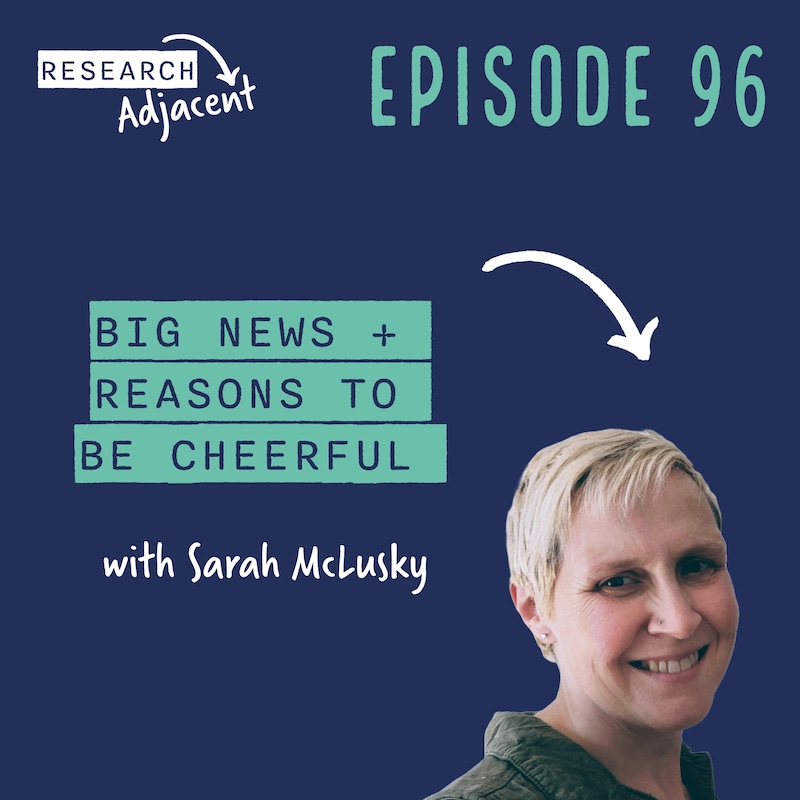
Shownotes
As we near 100 episodes, Sarah announces that it's time to step aside and let others take the lead in the research-adjacent careers space.
Sarah talks about
- Why episode 100 will be the last episode of Research Adjacent
- How the research-adjacent world has evolved over the time the podcast has been running
- What the future for research professionals might be like, even if things feel tricky right now
Would you like to share a comment which might be included in one of the final episodes? Record a voicenote here https://www.speakpipe.com/researchadjacent or send an email to [email protected]
Mentioned in this episode:
Helping you have conversations that move research forwards
When she's not hosting Research Adjacent, Sarah McLusky organises, facilitates and trains people to run events, workshops and meetings that get people talking about research. To find out more about working with Sarah and to book a free call go to https://sarahmclusky.com/
Transcripts
Hello there.
Speaker:I'm Sarah McLusky, and this is Research Adjacent.
Speaker:Each episode I talk to amazing research adjacent professionals about what
Speaker:they do and why it makes a difference.
Speaker:Keep listening to find out why we think the research adjacent space
Speaker:is where the real magic happens.
Speaker:Hello there.
Speaker:I am your host, Sarah McLusky, and welcome to episode 96 of Research Adjacent.
Speaker:Now, today's episode is just going to be a solo episode, and that is because
Speaker:I have got some big news to share.
Speaker:Now, that big news is that when the podcast reaches 100 episodes, I have
Speaker:decided that it is going to, in the technical term that they use in the
Speaker:podcast world, it is going to sunset.
Speaker:What that means is just that episode 100 is going to be the
Speaker:last episode of Research Adjacent.
Speaker:It's a little bit of a bittersweet announcement for me to make because it has
Speaker:been… In some ways, doing this podcast has genuinely been life-changing for me.
Speaker:It has been an incredible way to expand my network.
Speaker:I've met so many amazing people doing it, and I really do genuinely think that we
Speaker:have made a useful contribution to the conversation around research professionals
Speaker:and research professionals' careers.
Speaker:But I have also now been doing the podcast for over three and a half years, and
Speaker:like anything, things move on, people move on, times change, and it does
Speaker:feel like the conversation around this area has really moved on, and I think
Speaker:that is an absolutely incredible thing.
Speaker:It is no coincidence that I decided that last week's episode with the Research
Speaker:Professional Futures team was going to be the final episode where I would
Speaker:have guests on, and it's because I feel like I am handing over the baton
Speaker:now to that team, and it is for other people to take this fight forwards,
Speaker:and I will very much enjoy cheering from the sidelines as that does happen.
Speaker:And there is now so much more emphasis, when I first started the podcast,
Speaker:it was, oh, late 2002, I had the idea for it, and then I actually
Speaker:launched the podcast in January 2023.
Speaker:Did I say 2002?
Speaker:It was 2022 that I had the idea for the podcast and then launched in January 2023.
Speaker:And at the time when I was first looking at it, there was starting to be…
Speaker:There was a lot of talk about research culture, but there wasn't
Speaker:actually… It didn't actually feel like an awful lot was changing.
Speaker:It does now feel that some of those things have escalated and actually
Speaker:perhaps there is more change, or maybe just the conversation has
Speaker:become a bit more normalized now.
Speaker:And certainly I have also seen a huge shift in the ways that we are talking
Speaker:about research professional roles.
Speaker:And so I feel like the work that I originally got into this to do, to raise
Speaker:the profile of these roles and to help build a community around it, I feel to
Speaker:some degree my work, it's not to say this is done because this is something
Speaker:that is never gonna be done, but to some degree I feel that my work here is done.
Speaker:There's also the thing that I think might surprise you, I think it
Speaker:surprises quite a lot of people, is that I'm freelance and nobody pays me
Speaker:to do the Research Adjacent podcast, and it is incredibly time-consuming.
Speaker:It probably takes at least a full day, if not two days, of my time for each episode.
Speaker:Once you include… In fact, it will be two days once you include things
Speaker:like finding guests and recording the interviews, and then doing all
Speaker:the social media to go along with it.
Speaker:So it's probably taking about a day a week of my time.
Speaker:And as I say, initially when I started the podcast, it was incredible for
Speaker:growing my network, and so actually I was happy to spend that time.
Speaker:But as time's gone on it has just become an unsustainable workload.
Speaker:And maybe things would be different if somebody funded the podcast,
Speaker:sponsored it, something like that.
Speaker:But that isn't something that I have been able to make happen.
Speaker:And so for that reason, I need to focus my attention, my energy on the
Speaker:things that actually I get paid for.
Speaker:And yeah.
Speaker:And it's not to say this will be the last podcast.
Speaker:It has to be said this is already my third podcast.
Speaker:There may be another podcast in the works I'm thinking about possibly around what
Speaker:I actually do, which is like my day job, which is helping people to have better
Speaker:conversations around research, better meetings, better events, and finding
Speaker:ways to collaborate more effectively.
Speaker:You might have already seen some of the little videos I've done
Speaker:on LinkedIn around some of that.
Speaker:So there may be a germ of a podcast idea brewing there.
Speaker:But it is time to move on for me, from Research Adjacent.
Speaker:So what happens now?
Speaker:That 100-episode back catalogue is an incredible resource, and I am so amazingly
Speaker:proud of what I have created there.
Speaker:And so that archive will remain it is there as a resource.
Speaker:You can go back and go and catch up on episodes that you
Speaker:haven't listened to before.
Speaker:Share it with people who are maybe coming into this world for the first
Speaker:time and just, yeah, I encourage you to keep using that as a resource.
Speaker:That will remain for the indefinite future with the same podcast website
Speaker:address and things like that.
Speaker:As well as the back catalogue remaining, the Research Adjacent Freelancers
Speaker:community, which I also run which is another thing that came out of
Speaker:the podcast, which has been such an incredibly rich part of my life.
Speaker:And for those people who are not in the community, if you are freelance
Speaker:listening to this, come and- join us.
Speaker:It's an absolutely lovely bunch of people, and we're doing… We're just
Speaker:really helping each other out to, to navigate being freelance in this space.
Speaker:And that will continue.
Speaker:The directory, which is a listing of other freelancers, that will continue,
Speaker:but they may evolve, they may change a little bit as things move with the
Speaker:podcast And then thinking about what also happens now is we're not at episode
Speaker:100 yet, so you might be thinking I've already said this is going…
Speaker:That I haven't, I'm not gonna do any more guest interviews, so what happens now?
Speaker:There's this episode today.
Speaker:I have got, as well as this announcement about the podcast, I
Speaker:have got some little thoughts for you about where the sector is in general,
Speaker:that I'll come to in just a moment.
Speaker:Then I'm gonna do three episodes, which are gonna be compilation reflective
Speaker:episodes, looking back on the series.
Speaker:And if you would like to contribute to those at all, that would be fantastic.
Speaker:You can send a voice note to the podcast, and so you might actually find, hear your
Speaker:contributions on one of those episodes.
Speaker:And so if you want to do that, you'll find a link in the show notes, but
Speaker:it's speakpipe.com/researchadjacent,
Speaker:if I remember correctly.
Speaker:But go to the link in the show notes to be sure.
Speaker:And you can record up to a 90-second clip there, or feel free to just
Speaker:drop me an email as well, which is via [email protected].
Speaker:And if you do that, you can… I'd love to hear things like,
Speaker:what was your favorite episode?
Speaker:Are there any quotes or stories or things like that have really stayed with you?
Speaker:Just what generally has the podcast meant to you?
Speaker:And it would be fantastic to hear any thoughts that you might want to share,
Speaker:and I'll see if I can incorporate those into some of the other episodes.
Speaker:And then the final episode, the 100th episode, is going to be somebody
Speaker:interviewing me for a change.
Speaker:So I have got fellow podcaster and previous guest, Andy Tattersall,
Speaker:he is going to host the 100th episode and turn the tables so
Speaker:that I am the guest on that one.
Speaker:As I say, if there is anything that you would like to contribute, please
Speaker:do send a message, a voice message, or just an email and let me know,
Speaker:and that would be fantastic, and I'll see if I can incorporate them.
Speaker:So that's a little bit of an explanation of why I am going to end
Speaker:the podcast at 100 episodes, and also what you can expect going forwards.
Speaker:As I hinted at there, though, I think one of the reasons that I have chosen
Speaker:to end the podcast now is partly because there's quite a lot of change happening
Speaker:in this world that we're in at the moment.
Speaker:Definitely some of it is change that is making some people
Speaker:feel very uncomfortable, making people feel very concerned, and
Speaker:making this whole space feel a
Speaker:little bit less steady than I think perhaps it did three and a half
Speaker:years ago when I started the podcast.
Speaker:However, it is not really in my nature to dwell on the negative.
Speaker:And so I don't want to be in any way dismissive of the challenges that
Speaker:are facing the sector, challenges that are facing individuals.
Speaker:But I also want to give you perhaps a slight reframe on some of those
Speaker:topics, which is why I am calling this section Reasons to Be Cheerful.
Speaker:Because I think that one of the key things that has got me through 25 years,
Speaker:I've been doing this kind of work.
Speaker:I've been in this kind of space for 25 years, and I can tell you that
Speaker:things come and they go, and there are funding crises, and there's
Speaker:perhaps a funding crisis every 5 to 10 years, depending on where we're at.
Speaker:There are rounds of redundancies.
Speaker:There's restructuring.
Speaker:These things are happening all the time.
Speaker:A lot of the jobs, I know we've talked about this previously on the
Speaker:podcast, but a lot of the jobs now which people are doing in this space
Speaker:are jobs which when I started 25 years ago did not exist, and now they do.
Speaker:And so the fact that those are new jobs that are being created, it means
Speaker:there's other new jobs being created now.
Speaker:So in 10 years' time, it is, again, it's gonna look different,
Speaker:and that is just how life is.
Speaker:It's how things should be.
Speaker:Things should be moving on and progressing.
Speaker:That's entirely the point of research is to find ways to do things better, to be
Speaker:better people to have better workplaces.
Speaker:And I know that when you are in the midst of that change, it doesn't
Speaker:always feel like it is for the best.
Speaker:But as I say, part of the reason I've managed to work in this field for such a
Speaker:long time is, I think, just being open to opportunities, not getting bogged down in
Speaker:the negativity, and really just focusing on the things that I can control and
Speaker:the things that are not in my control.
Speaker:I'm also a yoga teacher.
Speaker:I do get a bit zen sometimes.
Speaker:But that's not to say I'm a totally chill person all the time, 'cause I'm
Speaker:really not, but I do think that yoga helps me cope at times like this.
Speaker:But yeah, I promised you some reasons to be cheerful.
Speaker:The first one is the Research Professional Futures programme, which
Speaker:were my guests in the previous episode.
Speaker:And so if you haven't listened to that, then do go back and listen
Speaker:to that episode of the podcast.
Speaker:And the Research Professional Futures programme, maybe it
Speaker:can't tackle the funding crisis.
Speaker:It can't tackle the job precarity.
Speaker:It can't necessarily tackle the fixed-term contracts, although I think they have
Speaker:got some of that in their sights, but there's obviously certain amount
Speaker:of things that they can't control.
Speaker:But what they are gonna tackle is three of the big topics that come
Speaker:up again and again as part of the conversations I've had both in this
Speaker:podcast and just with people in this community, and that is they're gonna
Speaker:be having a look at how research professionals are properly recognised and
Speaker:supported, and that in itself is huge.
Speaker:That is, it's like that is the gateway, I feel, to everything else because if you
Speaker:recognise the value of these roles, then you recognize that they need to be treated
Speaker:well and properly compensated, whether that's financially or otherwise, that
Speaker:they need to have promotion opportunities.
Speaker:And so yeah, that's some of the other things that they're gonna get into.
Speaker:They're gonna look at the career frameworks and what that might look like,
Speaker:and what progression opportunities might look like, and how to improve things.
Speaker:And then the third thing they're gonna look at, which comes up again
Speaker:and again, is what genuinely useful
Speaker:professional development would look like for people working in this world.
Speaker:And so I think that's one huge reason to be hopeful is because that's work that's
Speaker:funded by Research England, and it's a really big, complex project, but it shows
Speaker:that they're taking it seriously, and that this, these are people they recognise
Speaker:need support and haven't been supported.
Speaker:So I think that's my first reason to be cheerful.
Speaker:The other reason that I think there is to be cheerful is that there are always
Speaker:opportunities for people who are skilled.
Speaker:And I hope one thing that we have showcased in this podcast
Speaker:is that research professionals don't just work in universities.
Speaker:Research professionals also work in charities, they work in private companies,
Speaker:they work in places like the NHS, they work in places like the civil service.
Speaker:And so if you are feeling like the university sector is not the place
Speaker:that you want to be right now, that doesn't mean that there are
Speaker:no job opportunities out there.
Speaker:And some of the skills that are developed in some of these research-adjacent
Speaker:roles are incredibly valuable elsewhere.
Speaker:I talk to people all the time who say just finding people who are good at
Speaker:their job some places is quite rare.
Speaker:And so being able to… Here's just some of the things I think that
Speaker:research-adjacent professionals are really good at, which are transferable elsewhere.
Speaker:And that includes things like being adaptable, being good at solving problems,
Speaker:leadership skills, social influence, and we've had those previous podcast episodes
Speaker:where we've looked at influencing others.
Speaker:Maybe worth going back and having a look at them.
Speaker:Working effectively in a team, emotional intelligence.
Speaker:So again, that comes down to the whole influencing thing and how you persuade
Speaker:academics to get them to do what you want them to do with your mind control powers.
Speaker:So emotional intelligence, huge, project management skills, and
Speaker:just being lifelong learners.
Speaker:I know that one of the reasons a lot of you have ended up in the research world
Speaker:is just 'cause you're really curious, and you want to learn about stuff.
Speaker:That's one of the reasons I have loved my job over the past 25 years
Speaker:because I found when I did my PhD, I was becoming very expert in a very
Speaker:tiny niche little thing and I actually just wanted to know about everything.
Speaker:And so being in a research-adjacent role has been fantastic for
Speaker:me to just keep being curious.
Speaker:And I think people who are curious and who want to learn
Speaker:will always find opportunities.
Speaker:So I do think that there are opportunities out there if you are open to them,
Speaker:and if you recognise that your future, to some degree, is in your own hands,
Speaker:and you can decide what it looks like.
Speaker:So hopefully that is a little bit of a counterpoint to what
Speaker:sometimes even for me feels like relentlessly negative conversations.
Speaker:As I say, I hope that's not taken as gaslighting or pretending that things are
Speaker:not happening when I know that they are.
Speaker:But also, I know that the people who listen to this podcast are
Speaker:smart and resilient and curious, and that they can figure things out.
Speaker:Yeah, good luck if you are in a situation where you're facing redundancy or
Speaker:restructuring or things like that.
Speaker:Everybody is wishing you all the best if that is the case.
Speaker:And then, yeah.
Speaker:And so stay tuned for these last few episodes of the podcast.
Speaker:Hopefully, we might be able, in the next four episodes, to showcase just how far
Speaker:we have come in three and a half years.
Speaker:And yeah, it has been my privilege to be in your ears for… I don't know how
Speaker:many episodes you might have listened to now, but if you've listened to all
Speaker:of them, that's quite a lot of time that you've spent listening to my voice.
Speaker:Thank you for indulging me.
Speaker:And yeah, stay tuned for the next episode.
Speaker:I haven't decided exactly what the topic will be yet, but it will be the
Speaker:first of our compilation episodes.
Speaker:But for now, thank you.
Speaker:I'll see you next time
Speaker:Thanks for listening to Research Adjacent
Speaker:If you're listening in a podcast app, please check you're subscribed and then
Speaker:use the links in the episode description to find full show notes and to follow
Speaker:the podcast on LinkedIn or Instagram.
Speaker:You can also find all the links and other episodes at www.researchadjacent.com.
Speaker:Research Adjacent is presented and produced by Sarah McLusky,
Speaker:and the theme music is by Lemon Music Studios on Pixabay.
Speaker:And you, yes you, get a big gold star for listening right to the end.
Speaker:See you next time.
