Shownotes
Welcome to Day 3 of International Week of Yoga: Movement, Meditation, Spirit & the Divine Feminine.
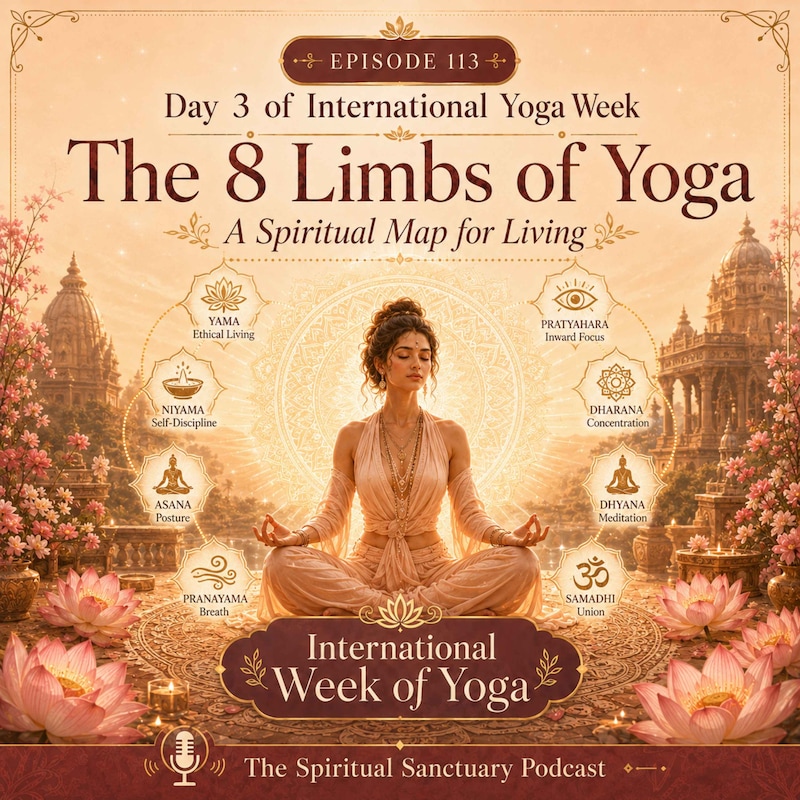
In this episode, we explore the 8 limbs of yoga from Patanjali’s Yoga Sutras and how they offer a spiritual map for daily living. Many people think of yoga as physical postures or stretching, but the 8 limbs remind us that yoga is a complete path involving ethics, personal practice, posture, breathwork, turning inward, concentration, meditation, and spiritual union.
This episode explains each limb in a simple and practical way so you can understand how yoga applies both on and off the mat.
We also explore the idea of an optional modern “9th limb,” which can be understood as living yoga, embodiment, or integration. This is the practice of taking yoga into your everyday life through compassion, service, devotion, presence, and spiritual awareness.
Yoga is not only something we do. It is something we live.
In This Episode, You’ll Explore
- What the 8 limbs of yoga are
- How the 8 limbs come from Patanjali’s Yoga Sutras
- Why yoga is more than physical poses
- Yama as ethical restraints and relationship with others
- Niyama as personal observances and spiritual self-care
- Asana as physical posture and preparation for meditation
- Pranayama as breathwork and life force energy
- Pratyahara as turning inward and withdrawing from distraction
- Dharana as concentration and training the mind
- Dhyana as meditation and deep inner awareness
- Samadhi as union, bliss, and spiritual connection
- How to practice the 8 limbs in everyday life
- The optional 9th limb of living yoga, embodiment, and integration
The 8 Limbs of Yoga
- Yama — Ethical Restraints
- How we live in relationship with others. Includes non-harming, truthfulness, non-stealing, moderation, and non-possessiveness.
- Niyama — Personal Observances
- How we care for ourselves spiritually. Includes cleanliness, contentment, discipline, self-study, and surrender to the Divine.
- Asana — Posture
- The physical practice of yoga, originally connected to preparing the body for meditation.
- Pranayama — Breathwork
- Working with life force energy through the breath.
- Pratyahara — Turning Inward
- Withdrawing from outer distractions and listening within.
- Dharana — Concentration
- Training the mind to focus.
- Dhyana — Meditation
- Deep meditative awareness and inner stillness.
- Samadhi — Union
- A state of spiritual connection, bliss, or oneness.
Optional 9th Limb: Living Yoga
A modern spiritual addition could be called living yoga, embodiment, or integration. This is the practice of taking yoga off the mat and into daily life through compassion, service, devotion, honesty, breath, boundaries, and presence.
Spiritual Reflection
The 8 limbs remind us that yoga is not something we only do. It is something we live.
Yoga is not only a posture or a practice session. It is how we breathe, speak, listen, relate, focus, serve, surrender, and return to presence.
Journal Prompt
Which limb of yoga do I already practice? Which one do I feel called to explore more deeply?
Use this prompt to notice where yoga is already present in your life and where it may be inviting you into deeper practice.
Closing Practice
Choose one limb of yoga to practice intentionally today.
You might choose:
- Ahimsa: speak kindly to yourself
- Satya: honor your truth
- Santosha: practice contentment
- Asana: move gently
- Pranayama: take three slow breaths
- Pratyahara: step away from outer noise
- Dharana: focus on a candle, mantra, or prayer
- Dhyana: sit in meditation
- Surrender: release what is not yours to carry
Repeat:
Today, I practice yoga with intention.
Today, I bring yoga into my life.
Today, I return to presence.
Links
Listen to the podcast:
https://www.bertena.org/en/podcast
View the full International Week of Yoga schedule:
https://bertena.ezycourse.com/en/international-week-of-yoga
Keywords
8 limbs of yoga, Patanjali Yoga Sutras, yama, niyama, asana, pranayama, pratyahara, dharana, dhyana, samadhi, yoga philosophy, yoga for beginners, yoga as spiritual practice, yoga beyond the poses, living yoga, yoga off the mat, spiritual map for living, International Day of Yoga, International Week of Yoga, yoga podcast, Divine Feminine yoga, priestess path, sacred embodiment, spiritual yoga podcast, Bertena, The Spiritual Sanctuary Podcast
🎧 Listen & Subscribe
Find Spiritual Sanctuary: Wisdom for the Divine Feminine on Spotify and all major podcast platforms.
👉 https://open.spotify.com/show/1pNkD0FKF4TpgzcRFQQrhA
Subscribe to my newsletter here
Help Support the Sanctuary here
🤍 Podcast Sponsor: Cosmic Connections Nashville
This episode is proudly sponsored by Cosmic Connections, a beloved metaphysical shop and spiritual community in Nashville.
🎁 Listener perks:
- Discounts on online purchases use bertenapodcast10 for 10% off
- Entry into a gift card drawing when you comment on the episode or share it on social media and tag @bertena11
Supporting Cosmic Connections helps sustain a heart-centered spiritual space for seekers, healers, and practitioners.
👉 Visit Cosmic Connections:
Transcripts
International Week of Yoga: Movement, Meditation, Spirit & the Divine Feminine
Day 3: The 8 Limbs of Yoga — A Spiritual Map for Living
Hello and welcome to The Spiritual Sanctuary: Wisdom for the Divine Feminine.
I’m Bertena, Priestess and Spiritual Coach, and I am so happy to welcome you to Day 3 of our special series, International Week of Yoga: Movement, Meditation, Spirit & the Divine Feminine.
In Day 1, we explored the deeper meaning of yoga. We talked about yoga as union, connection, sacred embodiment, and a practice of returning home to yourself.
In Day 2, we took a gentle journey through the history of yoga. We looked at yoga’s ancient roots in India, sacred texts like the Vedas, Upanishads, Bhagavad Gita, and Patanjali’s Yoga Sutras, and we talked about the importance of honoring yoga’s origins with respect and humility.
Today, we are going to explore one of the most well-known teachings in yoga philosophy:
The 8 limbs of yoga.
The 8 limbs of yoga come from Patanjali’s Yoga Sutras, and they offer a guide for spiritual living. They show us that yoga is not only something we do on a mat. Yoga is a way of living, breathing, relating, meditating, and moving through the world with awareness.
In many modern yoga spaces, we often focus mostly on the physical poses. And physical yoga can be beautiful. It can help us stretch, strengthen, breathe, release tension, and connect with the body.
But in the traditional 8-limb path, physical posture is only one limb.
Only one part of the practice.
That means yoga is much more than movement.
Yoga is also how we treat others.
How we care for ourselves.
How we breathe.
How we focus the mind.
How we turn inward.
How we meditate.
How we connect with the Divine.
How we live.
This is why today’s spiritual reflection is:
The 8 limbs remind us that yoga is not something we only do. It is something we live.
So let’s walk through the 8 limbs in a simple, practical, and heart-centered way.
________________________________________
Limb 1: Yama — Ethical Restraints
The first limb is Yama.
Yama refers to ethical restraints, or how we live in relationship with others and the world around us.
This is where yoga begins with relationship.
Before we even get to the poses, yoga asks us to look at how we are living. How are we speaking? How are we acting? How are we treating others? How are we treating the earth? How are we using our energy?
The yamas include five teachings:
Ahimsa, non-harming.
Satya, truthfulness.
Asteya, non-stealing.
Brahmacharya, moderation or wise use of energy.
Aparigraha, non-possessiveness or non-grasping.
Let’s make these very practical.
Ahimsa, or non-harming, invites us to practice compassion. Not only toward others, but toward ourselves. This means noticing harsh thoughts, judgment, comparison, and self-criticism. Sometimes the most powerful yoga practice is choosing not to speak to yourself in a cruel way.
Satya, truthfulness, asks us to live in alignment with truth. It invites honesty, authenticity, and integrity. It asks: Am I being truthful with myself? Am I honoring what I really feel? Am I speaking from clarity and kindness?
Asteya, non-stealing, is not only about taking physical things. It can also mean not stealing time, energy, credit, peace, or attention. It can mean honoring boundaries and living with respect.
Brahmacharya is often translated in different ways, but one helpful modern interpretation is moderation or wise use of energy. Where is my energy going? Am I giving too much away? Am I scattered? Am I using my energy in ways that support my soul?
Aparigraha, non-possessiveness, invites us to release grasping. It asks us to notice where we cling, control, compare, or hold too tightly. It teaches us that peace often comes when we loosen our grip.
The yamas remind us that yoga is relational. We cannot separate our spiritual practice from how we treat others and how we move through life.
________________________________________
Limb 2: Niyama — Personal Observances
The second limb is Niyama.
If yama is about how we live in relationship with others, niyama is about how we care for ourselves spiritually.
The niyamas are personal observances, practices, or inner disciplines that help us develop self-awareness and spiritual maturity.
The five niyamas are:
Saucha, cleanliness or purification.
Santosha, contentment.
Tapas, discipline or inner fire.
Svadhyaya, self-study.
Ishvara Pranidhana, surrender to the Divine.
Saucha can mean physical cleanliness, but it also points to energetic, mental, and spiritual cleansing. What are we taking into our minds? What environments are we sitting in? What thoughts are we feeding? What needs to be cleared so we can feel more present?
Santosha means contentment. This does not mean we stop growing or that we ignore pain. It means we practice finding peace in the present moment. It is the practice of saying, “I can be here now. I can breathe here now. I can find gratitude here now.”
Tapas is discipline, devotion, and inner fire. It is the sacred energy that helps us keep showing up. Not from punishment, but from commitment. It is the fire that helps us practice, heal, grow, and transform.
Svadhyaya means self-study. This is such an important part of spiritual practice. It asks us to observe ourselves. What patterns do I repeat? What stories do I believe? What is my soul trying to teach me? This can include journaling, studying sacred texts, meditation, therapy, spiritual reflection, or honest self-inquiry.
Ishvara Pranidhana means surrender to the Divine. It reminds us that we do not have to control everything. We can practice. We can show up. We can do our part. And then we can surrender what is not ours to carry.
The niyamas remind us that yoga is also an inner path. It is how we care for our own spirit.
________________________________________
Limb 3: Asana — Posture
The third limb is Asana.
This is the limb most people recognize because asana refers to posture, or the physical practice of yoga.
In many modern yoga classes, asana is the main focus. We move through poses, stretch the body, build strength, improve balance, and connect movement with breath.
But traditionally, asana was connected to preparing the body for meditation.
The body needed to be steady enough, comfortable enough, and open enough to sit in meditation. So posture was not about performance. It was not about looking impressive. It was not about twisting into the most advanced shape.
Asana was about creating steadiness, presence, and readiness.
This is such an important reminder.
Your yoga pose does not have to look like anyone else’s.
Your body does not have to fit into a perfect shape.
Your practice does not have to be intense to be meaningful.
Asana can be gentle.
Asana can be seated.
Asana can be practiced in a chair.
Asana can be done in bed.
Asana can be slow, soft, and accessible.
Asana can be one stretch and three deep breaths.
The purpose is not perfection.
The purpose is presence.
When we practice asana with awareness, the body becomes a doorway into the present moment.
________________________________________
Limb 4: Pranayama — Breathwork
The fourth limb is Pranayama.
Pranayama is breathwork, but it is more than simply breathing.
The word prana refers to life force energy. It is the vital energy that moves through us. Breath is one way we connect with that life force.
Pranayama teaches us to work with the breath consciously.
The breath is powerful because it connects the body and mind. When we are anxious, overwhelmed, or tense, the breath often becomes shallow or restricted. When we slow the breath, deepen the breath, or simply become aware of the breath, the nervous system can begin to soften.
Breath can bring us back to the present moment.
Breath can help us pause.
Breath can help us regulate.
Breath can become prayer.
Breath can become meditation.
Breath can become a bridge between the physical and the spiritual.
A simple pranayama practice might be taking a slow inhale through the nose and a long exhale through the mouth. Or breathing in for four counts and breathing out for six. Or simply placing a hand on the heart and belly and noticing the breath moving through the body.
Pranayama reminds us that our breath is sacred.
Every breath is a reminder that life is moving through us.
________________________________________
Limb 5: Pratyahara — Turning Inward
The fifth limb is Pratyahara.
Pratyahara is often described as withdrawal of the senses, but I like to explain it as turning inward.
This does not mean rejecting the world. It means learning how to step away from constant outer distraction so we can hear the wisdom within.
We live in a world filled with noise.
Phones.
Messages.
Social media.
News.
Responsibilities.
Opinions.
Expectations.
Other people’s energy.
Pratyahara invites us to pause the outer noise and listen inward.
This can happen in meditation.
It can happen in Yoga Nidra.
It can happen when we turn off the phone.
It can happen when we close our eyes.
It can happen when we sit quietly with a cup of tea.
It can happen when we choose not to immediately react.
Pratyahara is the practice of reclaiming your attention.
It teaches us that not everything outside of us needs access to our inner world.
On the Divine Feminine path, pratyahara is deeply connected to intuition. When we turn inward, we begin to hear the quiet voice beneath the noise.
The body speaks.
The soul speaks.
The Divine speaks.
But we have to create space to listen.
________________________________________
Limb 6: Dharana — Concentration
The sixth limb is Dharana.
Dharana means concentration or focused attention.
After we begin turning inward, we learn to focus the mind.
This is not always easy. The mind wanders. Thoughts arise. Plans, worries, memories, and distractions come in.
That does not mean you are bad at meditation.
That means you have a human mind.
Dharana is the practice of gently bringing the mind back.
Again and again.
You might focus on the breath.
A candle flame.
A mantra.
A goddess name.
A sacred image.
A prayer.
A word like peace, love, or surrender.
The practice is not about never getting distracted.
The practice is returning.
This is one of the most compassionate teachings of yoga. Every time the mind wanders and you return, you are practicing.
You are not failing.
You are training attention.
Dharana helps us become less scattered. It helps us gather our energy. It helps us become more present with what matters.
________________________________________
Limb 7: Dhyana — Meditation
The seventh limb is Dhyana.
Dhyana is meditation, deep meditative awareness, or a state of inner stillness.
If dharana is concentration, dhyana is what begins to unfold when concentration becomes more continuous.
It is the difference between repeatedly bringing the mind back and beginning to rest more fully in awareness.
Meditation does not always mean the mind is blank.
That is one of the biggest myths.
Meditation is not necessarily the absence of thought. It is the cultivation of awareness.
It is learning to witness.
To sit.
To breathe.
To observe.
To soften.
To become present.
For some people, meditation happens in stillness.
For others, meditation happens through movement.
For others, through chanting.
For others, through walking.
For others, through prayer.
For others, through Yoga Nidra or guided meditation.
Dhyana is the limb that invites us into deeper communion with the inner self and the Divine.
It is sacred listening.
It is the space where we remember that we are more than our thoughts.
________________________________________
Limb 8: Samadhi — Union
The eighth limb is Samadhi.
Samadhi is often described as union, bliss, spiritual absorption, or oneness.
It is the deepest state of yoga.
This is the experience of union beyond the separate self. It is the sense of being connected with the Divine, with all of life, with truth, with peace, with pure awareness.
For most of us, this may not be something we experience in a dramatic or permanent way. But we may have glimpses of it.
A moment of deep peace.
A moment in nature where everything feels connected.
A moment in meditation when the mind becomes quiet.
A moment of prayer where you feel held.
A moment of love where separation dissolves.
A moment when you feel fully present and whole.
Samadhi reminds us of the ultimate aim of yoga: union.
Not performance.
Not perfection.
Union.
Connection.
Wholeness.
Sacred presence.
________________________________________
Optional 9th Limb: Living Yoga
Now, traditionally, we speak of the 8 limbs of yoga.
But I also love to talk about what I call a modern spiritual “9th limb,” which could be called living yoga, embodiment, or integration.
This is not one of Patanjali’s traditional 8 limbs, but it is a helpful way to ask:
How do I take yoga off the mat?
How do I live these teachings in my daily life?
How do I practice compassion when I am frustrated?
How do I practice truthfulness when it is uncomfortable?
How do I practice breath when I am overwhelmed?
How do I practice surrender when I cannot control the outcome?
How do I practice contentment in ordinary moments?
How do I practice sacred presence in my relationships?
How do I practice devotion while washing dishes, caring for family, working, grieving, creating, resting, or serving?
This is where yoga becomes embodied.
It becomes how we live.
Yoga is not only the hour we spend in practice.
Yoga is how we return to ourselves throughout the day.
It is how we treat the cashier.
How we speak to our body.
How we hold boundaries.
How we listen to intuition.
How we respond instead of react.
How we honor the Divine in the ordinary.
How we bring compassion, service, devotion, and presence into real life.
That is living yoga.
________________________________________
Spiritual Reflection
So today’s spiritual reflection is:
The 8 limbs remind us that yoga is not something we only do. It is something we live.
Yoga is not only a pose.
It is a breath.
A choice.
A pause.
A relationship.
A prayer.
A way of listening.
A way of being.
The 8 limbs offer us a spiritual map. They teach us how to live with more awareness, integrity, compassion, discipline, breath, focus, meditation, and connection.
You do not need to master all 8 limbs today.
You simply begin with one.
One breath.
One act of kindness.
One moment of truth.
One pause before reacting.
One journal entry.
One prayer.
One moment of surrender.
One intentional practice.
That is enough.
________________________________________
Journal Prompt
Your journal prompt for today is:
Which limb of yoga do I already practice? Which one do I feel called to explore more deeply?
Maybe you already practice asana through movement.
Maybe you practice pranayama through breath.
Maybe you practice svadhyaya through journaling and self-study.
Maybe you practice bhakti through devotion.
Maybe you are being called into meditation, surrender, truthfulness, or turning inward.
Let this prompt help you notice where yoga already lives in your life and where it may be inviting you next.
________________________________________
Closing Practice
Before we close, I invite you to choose one limb of yoga to practice intentionally today.
Maybe you choose ahimsa, non-harming, and speak more gently to yourself.
Maybe you choose satya, truthfulness, and honor what you really feel.
Maybe you choose santosha, contentment, and pause to notice one thing you are grateful for.
Maybe you choose asana, and do one gentle stretch.
Maybe you choose pranayama, and take three slow breaths.
Maybe you choose pratyahara, and take a few quiet minutes away from your phone.
Maybe you choose dharana, and focus on a candle, mantra, or prayer.
Maybe you choose dhyana, and sit in meditation.
Maybe you choose surrender, and release what is not yours to carry.
Let this be simple.
Take a slow breath in.
And release.
Ask yourself:
Which limb will I practice today?
Listen for the answer.
Then softly say:
Today, I practice yoga with intention.
Today, I bring yoga into my life.
Today, I return to presence.
Take one more breath.
Thank you for joining me for Day 3 of International Week of Yoga: Movement, Meditation, Spirit & the Divine Feminine.
Tomorrow, we will explore the paths of yoga and the many doorways into the Divine, including devotion, wisdom, service, meditation, mantra, Kundalini, and sacred rest.
Until then, may you remember that yoga is not only something you do.
It is something you live.
With love,
I’m Bertena, and this is The Spiritual Sanctuary.







