Shownotes
There is a version of career progression that looks like success from the outside and feels like erosion from the inside: you get more senior, you sit in more meetings, you write less software, and eventually someone asks whether you'd like to become an architect. Most people in that position have already watched what happens to the ones who said yes.
Larisa Feldman joined Andrew, Andrea, and Kenny to tell a story that doesn't begin with a design problem — it begins with a decision she kept refusing to make. Over 18 years at National Australia Bank, she worked alongside integration, solution, domain, and enterprise architects, and she noticed a pattern: "they start very happy and they become quite sad." Their clear, well-reasoned visions kept getting stripped back by a mainframe that couldn't cope, an old system that wouldn't integrate, priorities that never arrived. As a senior and then principal engineer, Larisa was the one explaining how the systems actually worked before any design conversation could start — using a floppy disk as her analogy for why mobile isn't a website deployment. But she never wanted the title. As she put it, the sadness in the architects' eyes protected her.
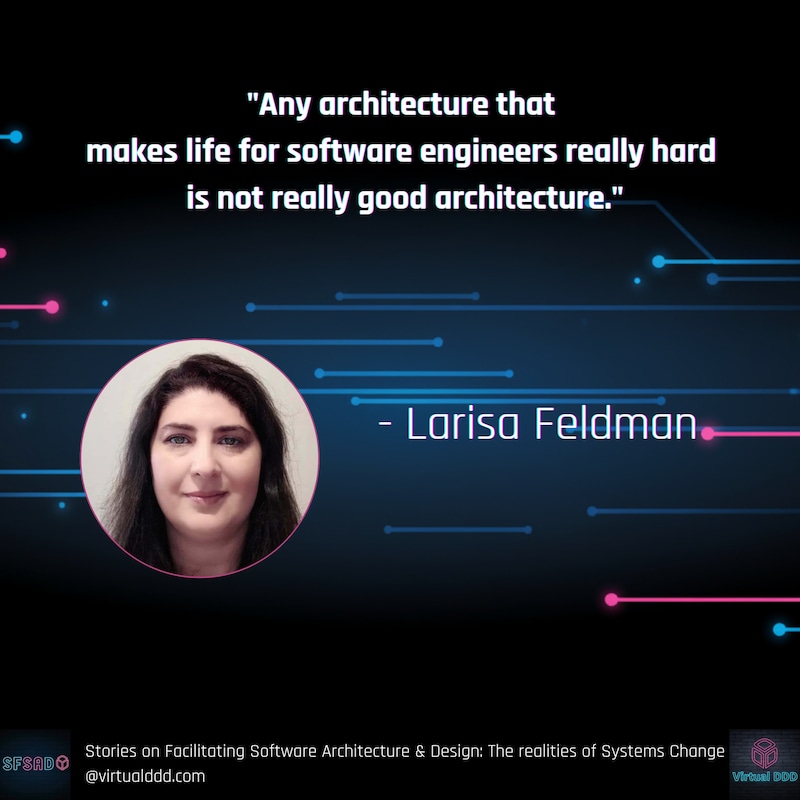
What eventually changed her mind wasn't ambition. After leaving financial services for REA Group — no change panels, no product/tech split, everything straight to production — she was offered an architecture role on a modernisation programme. The pull was specific: "an opportunity to actually do something the way I wanted it to, rather than do it as another architect suggests." She became an architect almost by accident, but not without reason — and now measures the role by a single test: is the architecture making engineers' lives better, or harder?
This conversation explores what the architect role actually is and who it's actually for. We dig into Gregor Hohpe's "do we want architects or do we want architecture?", the case for advisor roles over architect titles, Kenny's analogy of decisions made by someone from a distant village with authority but no context, and why writing things down turns out to be an architectural act in its own right.
Key Discussion Points
- [00:01] The Reluctant Architect: Larisa frames a story that isn't about designing a system, but about years of deliberately refusing the role
- [02:00] From Steel Plants to Software: an electro-mechanical degree in a collapsing Soviet economy and an accidental route into writing code
- [05:00] "Let Me Tell You How Mobile Works": translating system constraints to architects who arrived without context — and the floppy-disk analogy that stuck
- [08:00] The Sadness That Protected Her: why the bank's architects started happy and ended demoralised, and why that kept Larisa saying no
- [10:00] Architects or Architecture?: Kenny raises Gregor Hohpe's distinction; Larisa on why an architect who still wants to code is probably in the right job
- [13:00] Advisor, Not Architect: the slightly controversial idea that some senior engineers contribute more from an advisory seat than from a room full of stakeholders
- [19:00] Self-Fulfilling Roles and the Next Village: roles that stop enabling teams and start justifying themselves — authority without context
- [22:00] Learning Not to Be Blunt: influence across stakeholder levels, writing to crystallise what only she knew, and architecture as the glue between engineers and leadership
Guest: Larisa Feldman
Hosts: Andrew Harmel-Law, Kenny Schwegler, Andrea Magnorsky
Transcripts
Andrew Harmel-Law: Hello again
2
:Everybody.
3
:and welcome back to another episode of
Stories of Facilitating Software Design
4
:and Architecture with me, Andrew Hael Law,
and my co-conspirators, Andrea and Kenny.
5
:And today our guest that
we've got with us is Larissa.
6
:Do you wanna quickly introduce yourself?
7
:Lar.
8
:Larisa Feldman: Yes, sure.
9
:So, my name is Larissa Feldman and I'm an
architect at company called Array Group.
10
:our main software is, real Estate
Portal Marketplace, realestate.com
11
:un some other businesses.
12
:Andrea Magnorsky: Υπότιτλοι
13
:Larisa Feldman: I've been there
for four and a half years and I've
14
:been an architect for the last.
15
:Two and half, almost three years.
16
:Andrew Harmel-Law: That sounds exciting.
17
:Andrea Magnorsky: AUTHORWAVE
18
:Andrew Harmel-Law: story that
you've got for us and 'cause
19
:we're really excited to hear.
20
:Larisa Feldman: So, um, the
story is, a little bit unusual.
21
:I'm sort of, um, unusual in a sense.
22
:I'm probably not gonna talk about
how I designed anything or whatnot,
23
:or maybe we'll come to that.
24
:But I'm going to talk a little bit about
how I have become a reluctant architect.
25
:So, yeah, that's, that's
a topic for today.
26
:Andrew Harmel-Law: Just jump
into the story then, 'cause
27
:that sounds really interesting.
28
:So I think this happens to more than a
few people, I think, in our industry.
29
:So.
30
:Larisa Feldman: Yeah, I think so.
31
:so, I was born in, in Ukraine,
which was a former Soviet Union.
32
:And, the end of my education just
happened to be in the nineties where
33
:Soviet Union kind of all started collapse
and the industry started to collapse.
34
:And, as I was always very curious about
how things work, my education that I
35
:got was electro mechanical engineering.
36
:So.
37
:I spent five and a half years, you
know, learning about, big machines,
38
:you know, the, steel making plans,
things like those ones, and then
39
:suddenly there is no industry.
40
:So, so I found a job in a small accounting
companies and, that company had.
41
:A piece of software that
supported some scripting and
42
:then needed some customization.
43
:So that's how I started
getting into writing code.
44
:and couple of years later, my family
migrated to, to Australia and I sort
45
:of thought, okay, that's a new start.
46
:How about, Going into something different.
47
:And with my job experience, I decided
to do post-grad in software engineering.
48
:that was in 99, so that
was a advent of Java.
49
:So the first Java I tried
was like version 1.0,
50
:0.3,
51
:I think.
52
:and then my software
development career started.
53
:and, I, I was, doing, sort of
after, after that, that one year
54
:of postgrad I worked for some small
companies that was:
55
:Boom happened and there was a
lot of very interesting things
56
:happening in an industry.
57
:And then I spent a couple of years in
superannuation companies, so that's
58
:where all, you know, the pensions are
stored and calculated in Australia.
59
:And, my next big chunk of my career
I spend in National Australia Bank.
60
:so if you're not familiar with
it, in Australia, we've got
61
:what's called Big four banks.
62
:So those are like, you know, larger,
larger banks amongst the smaller ones.
63
:And I spent there whooping 18 years.
64
:And the, the large part of that,
career I spent trying not to become an
65
:architect, which was quite interesting.
66
:So, I spent, spent a lot of time with.
67
:Area, which is called digital.
68
:Like I, I really don't buy into
the term because like everything's
69
:digital nowadays, but that's how big
banks and big organizations, like
70
:all the organizations call those
areas digital, whatever that means.
71
:and I spend time in like internet
banking that's like, you know,
72
:start of internet banking.
73
:And we started with,
2,400 concurrent users.
74
:And by the time I left the team,
four or five years later, that was
75
:like over 40,000 concurrent users.
76
:And we are talking about, you know, just,
just Australia, which is population wise.
77
:Not huge, right?
78
:So that's like a big, big change
where, four years before we could
79
:find a quiet time in the middle
of the night to do change and
80
:suddenly there is no quiet time.
81
:You can't do change in a quiet time.
82
:You can't shut it down.
83
:So that was very, very interesting.
84
:and then I turned the, corporate internet
banking that's like quite different.
85
:That was, that was cool.
86
:And then, some smaller.
87
:Roles here and there, and over
time kind of been shifting into the
88
:role from the, software engineer
to senior software engineer.
89
:And, one of my last roles in there
I did, I was principal engineer
90
:for mobile internet banking.
91
:and that was one of the, another
reluctant things I did, in a career.
92
:I.
93
:I was never really
passionate about mobile.
94
:So when somebody tapped me on a shoulder
and said like, we need a, like, you
95
:know, really good principal engineer
to set up standards and delivery
96
:pipelines and all of those things
for mobile, I'm just like, mobile.
97
:I'm not spending a lot
of time on my mobile.
98
:I'm not like, very curious about that.
99
:But, um, but yeah, I took it on
and that was very interesting
100
:and, and very, very different.
101
:Um, but.
102
:How it relates to the talk is that as, as
you become more senior engineer in large
103
:organizations, You deal with a lot of
architects coming to your digital channels
104
:and saying, we want to, to do this thing,
or we want to implement that feature.
105
:And the architects, especially solution
architects, they, they don't have the
106
:context of the system or of how things
work or, some historical context, right.
107
:That, that you might have as, as a senior
engineer or as a principal engineer.
108
:And I found myself.
109
:Self, explaining a lot of, a lot of
things about a lot of different systems.
110
:mobile probably was one of those,
unusual ones where any new solution
111
:architect or domain architect comes in
and there's like, we are gonna do this.
112
:And I'm just like, Let me
tell you how mobile works.
113
:because it's so very different.
114
:It's not like you, deploy something and
it just appears on a website, right?
115
:it's a little bit like in desktop times.
116
:Like you, like given a floppy disk
to someone, they've installed it,
117
:and then you have no visibility to
anything that happens after, right?
118
:So that's the analogy I use.
119
:I've started documenting all of that.
120
:So instead of having those conversations,
I will say, this is pretty for you once
121
:you've done, come back and talk to me.
122
:And the more I became like a
principal engineer and working
123
:more with architects, I found that.
124
:I do less and less code and I
delegate more and more to, to
125
:senior engineers and that was tough.
126
:So, just before I joined mobile team,
I kind of decided that like really
127
:want to go back to coding and I did,
for about two and a half years and.
128
:Then it became sad.
129
:I kind of like, okay, so I'll
code yet another feature, I'll try
130
:another framework, kind of miss that,
larger picture, you know, things.
131
:And and when I went to be the principal
engineer in mobile, that's kind of
132
:opened up again, those opportunities
to work across different, different
133
:lines of business, different, you know,
134
:Different architects, there's like
payments, accounts, loans, like,
135
:you know, as an internet banking
app, you've got all of it, right?
136
:And it's so, but then again, it's one
of the reasons I never even entertained
137
:applying for the architectural role in at.
138
:National Australia Bank is
as a very large organization.
139
:I kind of observe the architects
who are never quite, quite happy
140
:bunch, because they can come up with
this brilliant idea, like how to
141
:implement a product and all of that.
142
:get stripped away by, you know, there
is this mainframe and it can't do this.
143
:Or there is this old
system, it can't do this.
144
:Or, you know, we don't
have priority to do that.
145
:And they kind of like, they start
very happy and they become quite sad.
146
:So, and I was, I was never tempted
to be honest, although I was
147
:prompted and prodded couple of times.
148
:But, the sadness in their eyes,
that eventual sadness kind
149
:of protected me from that.
150
:I loved working with them.
151
:They were all great, great guys and
girls, like, you know, I always had
152
:a really good relationship with them,
but I was never tempted to apply.
153
:four and a half years ago, I decided
to leave financial services behind
154
:and do something very different.
155
:Enjoyed the advertisement company, which
is, very different and very exciting.
156
:And although you can't say it's
like, a startup company or whatnot,
157
:it's a very, modern, like it's
30 old company, but it's set up.
158
:Quite modern way, of adopting Agile,
not having separate product and
159
:technology like we all work together.
160
:everything goes directly into production.
161
:it's very different.
162
:And there were quite a
few shocks there for me.
163
:like what do you mean, everything
deployed into production straight away?
164
:So there is no like change
panels and change reviews
165
:and all of those things, but.
166
:That was, that was really cool.
167
:And I joined as a role that was quite
similar to principal engineer role.
168
:And in, in first, year and a
half, I helped to, stand up.
169
:Big modernization program that, you
know, looks in transforming one of
170
:the oldest software in, onto the
new platform and new technology.
171
:And and I was offered
like, do you want to apply?
172
:As an architect for the
role for that program.
173
:And I thought, well, that's an opportunity
to actually do something the way I wanted
174
:it to, rather than do it as another
architect, you know, suggest, to do it.
175
:And, so yeah, that's, that's how I become
an architect a little bit accidentally.
176
:Kenny Schwegler: So a lot of
things hit, hit home for me.
177
:Architects not being happy because,
you know, don't know enough context.
178
:But one thing I want to focus on, and I
think that's an interesting observation,
179
:I always see only with the role architect,
but also business analysts or other
180
:roles, they're so rigidly defined.
181
:That, it becomes very binary, right?
182
:If, if you become an architect, you can
only do this, you cannot code anymore.
183
:And, it's what Gregor Hopi
says, do we want architects
184
:or do we want architecture?
185
:what happened with you
a little bit, right?
186
:Because I think having
you doing architecture is
187
:like the best
188
:thing you can ever imagine, right?
189
:We have a senior principal.
190
:In a team doing coding, knowing so much
191
:so much.
192
:about it, do letting that person do
architecture, great, but also make sure
193
:that they're not being overwhelmed.
194
:This is what I usually often
see in teams happening, and
195
:you had the same thing, right?
196
:You're we're organizing things in a team
and doing less and less coding, right?
197
:Larisa Feldman: Yeah.
198
:Yeah, I think so.
199
:You just sort of don't have
that, that much bandwidth.
200
:Um, but I, I found myself doing bits
and pieces of code in anyway, like,
201
:I think, you get drawn to it anyway.
202
:So even as an architect, if you need
to do some reporting on something, and
203
:I need to look at GitHub, my, my first
thought is like, how about I'll just
204
:write something that do it for me, right?
205
:Rather than, you know, exporting
it into spreadsheet or whatnot.
206
:And,
207
:Kenny Schwegler: Yeah.
208
:Larisa Feldman: I think it's quite
powerful now with having all the AI tools,
209
:you know, to actually not letting that go.
210
:And for me, software engineering is
something that I hold really dear.
211
:So for me, any architecture that makes
life for software engineers really
212
:hard, is not a really good architecture.
213
:To be honest, because they experience
and how well they can work is
214
:quite important for me as well.
215
:So I think you get less coding because
you just don't have less bandwidth.
216
:but I think if an architect
still have that, desire to code,
217
:it's probably, they're probably
in the right job, I think.
218
:Kenny Schwegler: I see that this
struggles a lot with engineers
219
:that, don't want to become that
full-time architect want to still, but
220
:they're the main person in the team.
221
:And then get overwhelmed by
all the meetings they're in.
222
:And it's sort of like, at some points
I feel that myself as now an architect
223
:enabler, if the knowledge is not
shared in a way, the person in the
224
:team gets overwhelmed with meetings.
225
:and, that's a struggle I see
a lot of engineers, struggling
226
:with because they want to do more
architecture, but they don't want
227
:to get overwhelmed with meetings.
228
:Larisa Feldman: maybe a bit controversial.
229
:I think, um, I think some senior
developers, that gets drawn into that
230
:sort of architecture discussions and
whatnot, they probably would be more
231
:useful and more happy, happier if, if
they are as a advisor role rather than
232
:being, you know, drawn into actually
doing an architecture and, you know,
233
:being drawn into those meetings.
234
:I think there is a lot of, well, once
you get into some of those, you know,
235
:really strong, Software engineers at
the staff level, you can find that
236
:they're really their happy places.
237
:Like just, just them and a computer
and maybe pair programming with
238
:someone, but in a larger audience.
239
:And like, you know, in the meetings,
it's not their happy place.
240
:So I think, I think it's okay.
241
:We need these people too.
242
:they excel at what they do.
243
:I think somebody may be less experienced
but more curious and could be a better.
244
:candidate to grow as an
architect, sometimes that sets
245
:my, I don't know, my 2 cents.
246
:Kenny Schwegler: I
tried to do that, right?
247
:I tried to facilitate these
people in teams and remove some
248
:of the burden the role gives.
249
:But then the danger I always see is
that a lot of knowledge towards me.
250
:So, you want to make sure that the
knowledge of this whole system.
251
:It's available for the teams to move on.
252
:Right?
253
:It's sort of like a, a, a symbiotic
relationship if you're not careful
254
:and you want to step out of it.
255
:But I think that's a good one, right?
256
:How can we make sure that these
people start advising instead of
257
:taking on the burden of, of with
all the politics or dealing with
258
:all the other things around them?
259
:Yeah.
260
:Andrea Magnorsky: If only
there was a thing about a bias
261
:and decision, "kuch" Andrew
262
:Andrew Harmel-Law: I know, I know.
263
:I completely relate to
that Larissa, right?
264
:'cause like.
265
:As soon as someone gets the word
architect in their job title,
266
:they end up being, they get, like
267
:like you said they have to go to meetings.
268
:They become blockers and, and that's, so
they can't, they don't get enough time to
269
:do any of the things that they need to do.
270
:But like Kenny said, advice is more
like, you can even do async, right?
271
:Like I.
272
:Lots of stuff I coach people on these
days is like, maybe you're not like, you
273
:don't like standing up in meetings and
having an opinion and then having your
274
:opinions challenged because that's not,
you need time to think, but if you can
275
:write stuff down, which might not be
one of your skills, but you can learn
276
:to write stuff down and then provide
like written advice and input and stuff.
277
:Larisa Feldman: Yeah.
278
:Andrew Harmel-Law: It's a big deal and
it can really transform things, right?
279
:Like then you can get these people
who might be more happy sitting
280
:down on their own or in a pair.
281
:can still have an impact, but they don't
have to turn up at meetings and stand in
282
:front of whiteboards and point at things
and yeah, I think it's super powerful.
283
:Andrew, you were gonna say
something though, I think, or, yeah.
284
:Andrea Magnorsky: It may or may not be
opportunistic, you upload something.
285
:As in the case of Larissa.
286
:It's like, I didn't really want to
be an architect, because they look
287
:tough and I didn't want to be tough.
288
:I think the question is about the general
scene, or the generalization of it.
289
:What does it mean…
290
:About the career How can you see in
the future, for example, we're here
291
:now, we all have the same careers now.
292
:What exists in our future and we
don't hope for, because we don't
293
:think we want to, but it's also hard
to know until you're on the road.
294
:For example, from Larissa, I know your
story that you really enjoy now, even if
295
:you didn't want to be an architect for
many years and that's because you're…
296
:Not just an architect, not the right role,
but the right role in the right place.
297
:And I think as we move our careers,
the roles become less clear, and we
298
:need to have that internal process
to see what we're going to do in the
299
:next one and try to figure it out,
rather than choosing it for ourselves.
300
:I don't know, that's how I was when
you made me in the positive photos.
301
:Larisa Feldman: Yeah, I think,
I think you, you nailed it.
302
:It's probably depends where as well.
303
:You know, it's not just, like
the role of architect is so
304
:different depending on the company.
305
:And, sometimes it's very rigid.
306
:You do just this, right?
307
:Like in a big bank you'll have your
integration architects or solution
308
:architects, domain architects,
enterprise architects, you know,
309
:and each role has got very specific
things where if you look at, like, we.
310
:We are just the group of architects
and whatever within architecture we do.
311
:Right?
312
:And uh, um, I find, some aspects
of the architect role very
313
:appealing and I like it very much.
314
:Some less so, but I think, A lot
of things that architects did,
315
:which I didn't see a value of,
started to became apparent, right?
316
:Because you get dragged into things
that you haven't been, you know,
317
:um, in some of the discussions
or in some of the, you know, um.
318
:In, in some of the initiatives
at a different level when they
319
:just start up or, you know,
like, it, it's very different,
320
:different way of looking at things.
321
:You look at, across organization,
you look at different initiatives,
322
:you're trying to draw the line.
323
:So your field of vision is quite wide.
324
:It's not, not very narrow.
325
:So certain activities that architects
do and I'm just like, oh, why would they
326
:do it, like mapping the capabilities
of systems or something like that.
327
:It's now kind of quite apparent why,
so I can, I might be enjoying it a bit
328
:more because now I see a reason why
or, you know, which is which is good.
329
:so yeah, I'm definitely enjoying it.
330
:sure.
331
:Kenny Schwegler: yeah, I often
see architects in that role, and
332
:not even architects, but everyone
in, in this leadership role.
333
:It starts well, right?
334
:You want to have engineers and
teams do engineering, and you
335
:say, oh, okay, there's all these
stuff that we need to think about
336
:holistically, so let's pull that out.
337
:Which is a good, maybe
a good thing, right?
338
:Let's pull that out to a role.
339
:I often see that role not reflecting.
340
:Are we still enabling the teams
to do their work better or
341
:are we just self-fulfilling?
342
:I see it with managers as well.
343
:Yeah.
344
:They, they're really looking
for us to make decisions.
345
:Right.
346
:And, and, and because
347
:Today he have the capacity to do it
or the cognitive load load to do it.
348
:That's usually along along
the lines, what I usually do.
349
:And the the architecture well,
teams know ity sure, correct.
350
:But.
351
:If you then say.
352
:That's why we are here.
353
:That's like a self prophecy.
354
:And and then you stop looking at
what do the teams actually need?
355
:the teams
356
:might need we guide them
understanding about, then they
357
:can make decisions themselves.
358
:that's the thing that I you
say with the story, right?
359
:The solution architect came, but they
don't know, understand the context of it.
360
:It reminds me me a little bit
of, of, actually in our village.
361
:We, want to get something done on your
house and someone from another village
362
:somewhere far away, will make a decision
if you are allowed to do that or not.
363
:If it's you are not not not allowed.
364
:to this and this rules.
365
:And I'm like, well, have
you seen my neighborhood?
366
:Other people do it right?
367
:And because they're not living
in the village, don't know
368
:the context of the village.
369
:So they make vary.
370
:mis weird decisions in a way.
371
:And then they have all this
form of control over it.
372
:I think that's what I hear you.
373
:And that's that's off-putting
to a lot of engineers, I guess.
374
:Right?
375
:You don't want to be in that role,
without context trying to make
376
:decisions that cannot be done anyway.
377
:Is that something that didn't
want to make you architect in that
378
:Larisa Feldman: Yeah,
379
:Kenny Schwegler: previous moment?
380
:Larisa Feldman: I think
that's one of the aspect.
381
:And another one is that,
like vision really, you know,
382
:transformed into what the.
383
:What they saw it to be because
of gazillions of different
384
:limitations and inability to make
decisions quickly, as in any large
385
:organization, an old organization.
386
:but like I think you are
quite right about like.
387
:Engineering community overall.
388
:in, in some organizations just
trying to ignore the architects and
389
:the, the function of architecture.
390
:Kind of like, like, like those
people in, like in the next village.
391
:So they just ignore what they say
and just do what I want in my house,
392
:you know, and my, as my neighbor did.
393
:I think at area we are a bit better
at, at least we do try, we try to
394
:listen to the community and there are
channels they can, you know, tell us
395
:Andrea Magnorsky: if
you are doing a good job
396
:Larisa Feldman: or need
to look at, at something.
397
:And we try to, to measure how well we
doing our job for, for the development
398
:community as well as for our stakeholders.
399
:So I think that's, That
is quite important.
400
:At least it's very important for me.
401
:because I think if you are not
there as a, as that glue between
402
:the development community and you
know, and leadership, then it's
403
:not quite clear why we are needed.
404
:Andrea Magnorsky: One of the
405
:last questions, did you find that
406
:You spend more time thinking
about influence Let's
407
:say, you are more opportunistic
in your cooperation and you happen
408
:to use more time than the previous
one and if this is the case, then
409
:how did you learn these plans Um,
410
:Larisa Feldman: definitely I, I do.
411
:And, um, at a different level
of, you know, stakeholders.
412
:So, uh, the,
413
:Andrea Magnorsky: the context
414
:Larisa Feldman: and tone of voice
and the right, you know, level
415
:of details is quite important.
416
:Started as being a really
blunt person, to be honest.
417
:And, I had to learn along the way to,
you know, to pick the words and, put
418
:things in the context and, you know,
I'm one of those unfortunate people
419
:that can have everything clear in my
mind, but sometimes struggle to explain.
420
:And because sometimes it's just based
on experience and you have a gut feel
421
:that this thing won't work or won't
work as well as you think it will,
422
:but it's very hard to articulate.
423
:So over the years I tried to learn
how to kind of extract it from
424
:my brain on, on paper or digital
media to kind of crystallize it.
425
:You kind of like learn it
through the, through your career.
426
:And I think if somebody has, has
an ambition to become an architect
427
:or principal engineer, they just
need to look for opportunities.
428
:And opportunities and in
my view, are always there.
429
:You know, like if you know something that
only you know, or have some historical
430
:context, you can always, you know, put it
on paper and share it as a blockbuster.
431
:Just something on, you know,
confluence so people would know.
432
:so I kind of did it through the
last, I dunno, maybe 15 years.
433
:So I found it relatively
easy join, like joining the
434
:architecture team from that aspect.
435
:One thing I found a little bit
challenging, easy kind of deal, visa,
436
:with executives and general managers
more, and that's like a different
437
:level of thinking about the business.
438
:As you are, like even
like head of product.
439
:So that kind of level of vision, even
though I kind of thought, okay, I have
440
:got that, that level of vision and for
the architecture and the systems, I had
441
:a very little understanding how business
and product people do it at that level.
442
:So that's quite fascinating
to even look at that as well.
443
:So that's an interesting, and
how they communicate is, is
444
:very, Very, very high standards.
445
:Let's put it this way.
446
:Andrew Harmel-Law: Yeah.
447
:Super interesting.
448
:Thanks Larissa.
449
:For, for that all the other stuff.
450
:There's a few things that you
said I'm gonna be thinking about.
451
:Like one, the thing that hit me most
was, It needs to make like the, the
452
:things you do as an architect need
to be, make the developer's lives
453
:better or need to, you know, be, and,
and beneficial to the developers.
454
:'cause otherwise it won't have any impact.
455
:And I think that's, a big deal.
456
:But I think we're out of time.
457
:So, thanks very much for sharing
your story and it was very different
458
:from lots of the other ones we hear.
459
:So thank you very much
for taking the time and,
460
:Larisa Feldman: Thank you.
461
:Andrew Harmel-Law: sharing
everything with us.
462
:Cheers everybody.
463
:Andrea Magnorsky: bye
464
:Larisa Feldman: Thank you.
465
:Bye.
