Shownotes
Episode 183 Frederick Dudek | Business Prosperity Advisor
Employee advocacy becomes a growth weapon when leaders stop managing from the sidelines and start building a people-first culture that wins like a championship team.
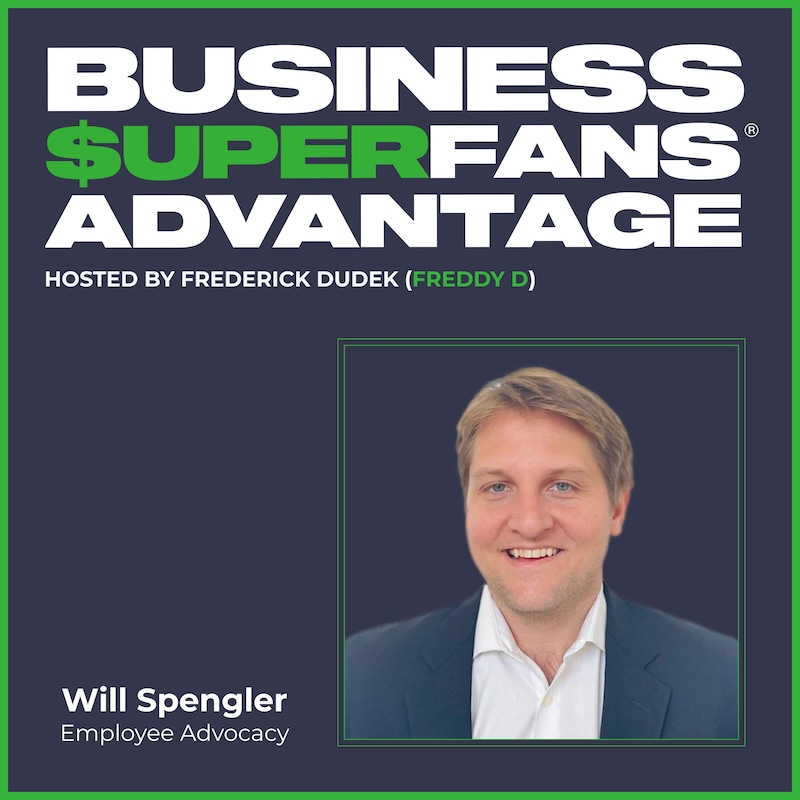
Employee advocacy is the foundation behind sustainable growth, and in this episode, Will Spengler, Founder of Frederick Fox, reveals how a people-first recruiting model helped scale the firm to nearly $10 million in revenue in just six years.
In a crowded staffing industry known for burnout, low loyalty, and command-and-control leadership, Will chose a different playbook—one built on transparency, partnership, and empowerment. By treating recruiters as internal customers and removing friction through a shared-services model, Frederick Fox created an environment where people stay because of who they work with, not just compensation.
Freddy D and Will break down how employee advocacy fuels client trust, collapses sales cycles, and turns relationships into long-term growth engines—just like a winning team that builds momentum play after play.
Discover more with our detailed show notes and exclusive content by visiting: https://linkly.link/2ZPOu
Key Takeaways
- Employee advocacy starts with leadership behavior: When leaders work with their teams—not over them—engagement and performance rise fast.
- People-first cultures scale faster: Frederick Fox proves that empowering recruiters creates leverage no software can replace.
- Shared services remove friction: Centralized operations allow top performers to focus on what wins games—placing talent and building relationships.
- Transparency builds trust and retention: Open financials and merit-based advancement eliminate politics and confusion.
- Founders must avoid becoming the bottleneck: Teams win championships when leaders coach, not block.
- Recruiting is relationship brokerage: Long-term success comes from aligning talent, culture, and vision—not just filling roles.
- Culture outperforms compensation alone: You may not outspend the giants—but you can out-align, out-care, and out-execute them.
Kindly Consider Supporting Our Show: Support Business Superfans® Advantage: Predictable Growth for Service Entrepreneurs
Guest Bio:
Will Spengler is the Founder of Frederick Fox, a professional recruiting firm specializing in accounting, finance, sales, operations, and technology leadership roles. Since launching in 2019, Will has grown the firm to nearly $10M in revenue, supporting 850+ clients through a people-first, shared-services model. Known for transparency, empowerment, and leading from the front lines, Will is redefining what employee advocacy looks like in modern service businesses.
Freddy D’s Take
This episode is a masterclass in people-first leadership.
Will Spengler didn’t scale Frederick Fox by stacking hierarchy—he scaled it by activating his internal team. Like a championship roster where every player knows the playbook and trusts the locker room, Will aligned vision, incentives, and culture so everyone rows in sync.
What stood out most was Will’s refusal to play small as a leader. No ivory tower. No micromanagement. No fear-based controls. Instead, he sells alongside his team, removes obstacles, and focuses on one question: How do I make it easier for my people to win?
This is exactly the type of ecosystem-first strategy I help leaders implement through my SUPERFANS Framework™ inside Prosperity Pathway coaching within the Superfans Growth Hub—where employee advocacy fuels client loyalty, referrals, and long-term momentum.
Winning businesses aren’t built by control.
They’re built by teams that believe.
The Action:
The Action: Strengthen internal employee advocacy
Who: Founders & leadership teams
Why: Your team is your frontline brand—misalignment kills momentum.
How:
- Identify one friction point slowing your team down
- Clarify vision, expectations, and upside
- Remove one unnecessary approval or control
- Ask: “What would make your job easier this week?”
- Act on the answer immediately
Guest Contact
Connect with Will Spengler:
- Website: https://www.frederickfox.com
- LinkedIn: Will Spengler
Resources & Tools
Frederick Fox – Executive & professional recruiting firm
Employee Advocacy Models – Internal team activation strategies
This podcast is hosted by Captivate, try it yourself for free.
Copyright 2026 Prosperous Ventures, LLC
Transcripts
A company is really just people that are choosing to work together on the same team to reach a vision or objective and are all working towards that.
Intro:But I am the world's biggest super fan. You're like a super fan. Welcome to the Business Superfans Podcast.
We will discuss how establishing business superfans from customers, employees and business partners can elevate your success exponentially. Gain insightful knowledge from the experts who create applications to help you create passionate super fans.
This is the Business Super Fans Podcast with your host Freddy D. Ready?
Will Spengler:Ready.
Freddy D:Hey super fans.
Freddy D. Here in this episode 183 we're joined by Will Spingler, Founder and principal of Frederick Fox, a fast growing recruiting firm that's reimagined how top tier finance and accounting talent is hired.
Since launching in:He's led Frederick Fox with a focus on speed, accountability and and a human first approach, helping finance leaders make smart hires with confidence.
A math nerd turned entrepreneur, Will is also a guitar playing, hot yoga loving father of three who brings real world insight and zero fluff to everyday conversations.
Freddy D:Welcome Will to this is Superfans, the Service Providers Edge podcast. Great conversation that we had before we started recording. You're down in Delray Beach, Florida. I'm here in Arizona.
My mother in law lives in Delray so we spent a lot of time there. Welcome to the show.
Will Spengler:Do you try to avoid Del Rey because since your mother in law's there or do you come down often or.
Freddy D:No, we come down often. She was just down there recently because she works for a company that's based in Coral Gables and so she works remotely.
She'll be with the company eight years in April and every year they have a company meeting and they bring all their team from the United States for business meetings and then team building and fun stuff. She's been one of her top performers. She's in sales and so she ends up always getting the prize to hang out with the owner of the company.
Last year she ended up doing deep sea fishing. Not her favorite thing but she got to hang out on the boat with the guy. So that was for her one on one time for several hours.
Will Spengler:Very nice. Yeah, I appreciate you having me on the show Freddie D. And yeah, it's nice meeting you as well.
I lived in Arizona from: Freddy D:Yeah, we're looking, we're deciding whether we want to stay here. I've been here since 96, so I saw the whole thing kind of explode. But I told her that I'm ready for some water. Desert's great.
We've got some man made lakes, but I'm ready for some sand and some islands. We're looking at some of the Caribbean islands. Last year we went on a cruise from Hawaii all the way down to Australia.
And so we hit Tahiti and New Zealand and stuff like that. And so I was like, could hang here. This doesn't suck. Well, we'll see, we'll see where it goes.
But so let's go back to the beginning and how did you get started with Frederick Fox?
Will Spengler: Frederick Fox was started in:And I always say I think I was just young enough and just dumb enough to start a company. I started it at 31 and been at it now six years. I always say I was dumb enough because I didn't really fully know what I was getting into.
So it was maybe a good thing I didn't know that six years later we're coming up on 10 million in revenues. We have 55 agency recruiters, five back office.
Then we have over 850 customers that we provide professional staffing services to, mainly in accounting and finance, sales and operations and technology.
Freddy D:That's really good for from 19 to 25. That's a massive growth.
Will Spengler:Yeah, somehow I stayed married just barely. I have a 8, 6 and a 2 year old. And so I think the first four or five years I worked seven days a week.
I'd get up at 5am and I'd work till 11 at night. I so badly wanted to make this work and grow it, but I think I didn't put my family and my priorities in the right place.
So the last few years I've slowed down and gone back to 40 hours a week. But the business is growing. I think anyone that's been in business a while will tell you businesses take 10, 15, 20 years to build.
I was young and immature and was trying to make it happen overnight.
Freddy D:It did a pretty darn good job for six years in grossing 10 million. That doesn't suck. Thank you. So what makes you guys unique?
Because it's a crowded space and I'm familiar with the industry because I started in A tech space decades ago and I'm still friends with the recruiter that I worked with back there because he strategically placed me around multitude different companies, always in a better position. I'm still friends with him decades later. But he was a one man band and he was very good at what he did.
But you scaled to significantly, much larger organization than what he's done.
Will Spengler:I was a single shingle for two years before I scaled up and so I used to think of myself as like a lone assassin but then I really realized that I perform better working with other people and a team. I thought I was a lone wolf and then I realized I actually do better and my mental health is better when I'm working within teams.
And so as far as what makes us different, I don't think we have a differentiator to the end client with cutting edge teeth on the bone. Of course we position ourselves as an executive search firm that only hires veteran agency recruiters with at least seven years of agency experience.
But I think our real differentiator is our internal model to the recruiters that work for us.
and:But we found first of all we pay our recruiters 80% commissions, which our competitors pay typically 30 to 40% commissions. So we've doubled that. So we're a very thin margin business.
But I think the idea was to pay out as much as possible and to have a really innovative shared service center that could handle the scale. And we've pulled that off so long answer your question.
But I think the differentiator is how we treat our people that work for Frederick Fox, how we pay them and the opportunity we've given the people that sell for us. That's our differentiator, not so much the differentiator to the end client.
Freddy D:Sure. Yeah. And one of the things that you know, I'm going to re highlight here is the fact that your team, it all starts internally.
And that's one of the things I've always talked about is that's your front line, your team is your front line. You have a combination of people that actually work work with you. And I use the term with because it just changes the dynamics.
hat are on your team that are:So by elevating them and treating them as your team, core team, that's the differentiator you guys have is the team is the nucleus of the business.
Freddy D:Let's take a quick pause to thank our sponsor. This episode is brought to you by our friends at Ninja Prospecting, the outreach team that makes cold connections feel warm. Here's the deal.
Most service business owners are drowning in spammy DMs and cookie cutter LinkedIn messages that never get a response. Sound familiar? Ninja Prospecting flips that script. They craft human first outreach that actually sounds like you and more importantly gets results.
No bots, no fluff, just real conversations that open doors.
If you want to stop wasting time on dead end messages and start filling your pipeline with qualified leads, talk to my friend Adam Packard and his team.
Head over to ninja prospecting.com to schedule chat today and be sure to mention you heard about it right here on the business super fans, the service provider's edge. And hey, if you're the kind of person who likes to get started right away, you can join their free community at school.
S K-O-O-L.com ninja prospecting. It's packed with tips to maximize your connections and start making the right new ones. All right, let's get back to our conversation.
Will Spengler:We have a flyer when we try to hire a new sales rep that it literally says are you tired of working for and ready to work with. The fact that you say that as well, that's one of our main things is working for seems to command and control.
I think people are tired of that, to be honest. We view the business as how do we add more value to our salespeople?
And we view the salespeople as our internal customer and how can we add as much value to them and make their life as easy as possible so that they then go out to the customer and are an advocate of our company, right?
Freddy D:Yeah, they're super fans.
You want to transform your internal team into superfans as the organization because once that happens, that's contagious because you've got somebody that's fired up. I remember back in the early 80s when I got in the tech space, we had a group of us that started roughly around the same time.
This was in the beginning of the software world in the computer aided design. Computer aided manufacturing we were a team for seven years together and I'm still friends with the guy that I started on the same day.
We didn't know anybody, so we figured we'd hang out together and decades later we're still friends. That was contagious. Whenever we would do presentations, we would go to customers and prospective customers.
Everything else we had a bounce in our step because the way the company treated us, we were appreciated, we were recognized.
beer into the office at about: Will Spengler:I completely agree. In a services business, I think people are your greatest asset in staffing the very low barrier to entry company.
In other businesses there might be a million dollar manufacturing plant. We don't have a heavy asset that is making salespeople stick.
So we have to innovate as a company to empower them and set up a culture where we're continuously learning. We're taking feedback on how we could add more value to them.
I've had people say, why do you do all the development to make their jobs easier when your margin's only 20%?
I never even thought of it that way because I always thought of it as how do I constantly innovate, develop process automation so that I can make the job easier for them. I also don't believe in non competes and non solicits. I don't believe in that type of command and control.
I know people would argue otherwise, but I think just taking that off the table and taking more of a how do I add so much value to you that you don't want to leave right then?
Freddy D:That's what a good leader does. A good leader helps empower their team and elevate their team and then gets the heck out of the way and lets them do what they need to do.
And you're really a facilitator to helping them be successful at what they want to accomplish. And once you've got a team that's empowered and believes in your organization, it's like watching a Super bowl team.
And you can tell who's going to win the game by the fact of who's agile, who's having fun on the field, and the guys that are loose having fun, high fiving, chest bumping, all that stuff, they've got a momentum going and you can't break. Once you get that momentum rolling, it's unstoppable and it's contagious and it gets Everybody fired up.
Will Spengler:100%. I'm 37, but been in a leadership role for 10, about 10 or 11 years. And I've started this business about six years ago.
But one of the things I've learned as the founder of the business is that if you make yourself the bottleneck and every decision has to come to you, you, you're actually holding back your company from growing.
So if you're empowering the people and you're creating a culture that gets them excited, you do really just need to get out of the way because your business outgrows you as the founder and you don't want to be a founder that blocks the business.
It's like you have to let people run with projects and own them and not get in the way otherwise and allowing them to be creative because next thing you've got people pushing your business and you're just essentially in a coaching function just trying to see how can I add more value to you. The business outgrows even what you thought it would be when you first started.
Freddy D:So let's talk a little bit about how do you guys source people and how do you guys place people? Because it really, at the end of the day, that's what you are.
You're helping businesses find talent so that they can grow their business and you're the facilitator of all that. So let's talk a little bit about that, Will.
Will Spengler:Yeah, sure.
So as far as where to start with this is that we first try to find companies that have open positions typically at the senior to executive level, 100 to 300k range. And we are approaching them. And as a service provider, we charge a one time fee for placing the candidate.
Companies don't typically like to pay recruiting fees and I don't blame them. We're almost like attorneys at times. Nobody wants to pay an attorney.
The difference is a lot of companies will advertise, they'll work their network, they'll use indeed ZipRecruiter Monster Career Builder. I think where we really make sense because I've had companies say can't we just use our internal recruiter and post an ad?
Please go ahead and do that. What we really do is we're like research people. We research all your competitors within the market.
We talk to you is about exactly what you're trying to accomplish in the hire and the type of profile that works for your company. And we really just do sometimes 20, 30 hours of research and map everybody that could make sense based off the criteria our customers give us.
And it becomes a sales job of calling people that aren't looking for a job, pitching our customers value proposition and trying to convince them to move over to our client. There's a lot of things recruiters do to de risk hiring on behalf of our customers as well to make sure that's a quality hire.
But that's our service offering. We're like real estate brokers, but we're brokering hiring and people movement.
Freddy D:Yeah. And so you got to really look at the individual as their skill set. Will they fit into the culture of the company?
So you guys are doing a lot of different things to really qualify that individual that says okay, I'm interested in this opportunity. Because at the end of the day they've got to walk in and be almost hit the streets running into that organization.
I think that's your biggest differentiator is you're getting people that can do that.
They can start day one and they're ready to rock and roll and they don't need a big ramp up time because they've got the skill set that the company is looking for and they assimilate into the organization very quickly.
Will Spengler:Absolutely, yeah.
What a recruiter does is they first need to understand the complexity of our end customers environment, what stage of development that company's in, what technologies they use, what problems they're trying to solve.
And so I think recruiters first need to understand the customer and what exactly they need and their value proposition and then really interview for very specifically to that fit and then also do references and background checks to ensure that somebody is who they really are. And in the people business, anything can happen with people. It's a kind of a two way sell. But we do a really good job.
We have about a 95, 96% actually excuse me, more like 98 or 99% success rate on the first pass.
There are those instances where people start a job and their significant other passes away or some kind of life event occurs that's outside our control. But we have a hundred percent success rate of finding somebody else. But we de risk it as much as possible. It's very rare where that does happen. Yeah.
Freddy D:Because you're really looking at what the objectives of the companies are that you're working with to find a proper teammate that's going to come in as is be part of the team. And that takes a unique skill set because you got to really vet the person comprehensively.
I remember when I was working with my recruiter and he would Helped me understand the companies I was going to be talking to and everything else. The way I would come in prepared, I would have a 90 day plan put together for the position.
So when I went into the interview, I had the mindset, it was my job and here's how I'm going to tackle the job right off the bat.
Because of the preparedness that I had and the fact I had a 90 day plan and we would end up tweaking the plan and the job was already mine because of the fact that I went in with the mindset because Mike was the recruiter, he helped me get prepared properly for the opportunity.
Will Spengler:Yeah, it sounds like Mike is a really good recruiter and that's exactly what we try to do as well.
Freddy D:Yeah, because that's what you're doing is you're really, you're creating a marriage in a sense, for lack of a better way of wording it. But you're taking a highly skilled individual that's potentially looking for an opportunity.
May not be initially, but all of a sudden that opportunity says, huh, maybe I should really think about this. And then you're solving the need of a company so that they can get to the next level. I'd say different than a real estate broker.
You're really brokering relationships so that businesses can scale to the level they need to with the right proper talent as part of their organization.
Will Spengler:Yeah, I think we help save companies time. I don't think recruiting is rocket science per se.
When I first got into recruiting and I interviewed with a recruiter, I thought it seemed like a scam. But after 14 years in the business and just doing it and I've made thousands of placements, it is a lot of actual work.
It's a lot of interviewing, prepping, debriefing, recruiting is one of those time intensive things.
If you're trying to fill a chief financial officer job, you might get 600 applications, but you actually have to read through Those, call them CFOs, love to talk for 45 minutes.
And you have to really dig in so that when you present, let's say five profiles to your customer, our goal is to save that customer time with really accurate candidates. And that's part of our service, is that we've done all that front end.
And so your time spent interviewing like we are valuing that by putting the best people up in front of you that we possibly can, you fit the.
Freddy D:Right individual into that company, they become super fans of your organization. Because now you've got somebody that's a rock Star helping them get to the next level.
Everybody knows everybody, so they're telling their complimentary business partners and CEOs, they all hang out together, more or less. And that's how you get that momentum going for your organization. That's why you've guys been able to scale so quickly in six years.
Will Spengler:100%. Let's say we place the CFO at the job. They oftentimes might become the CEO in five years.
And if you've treated that person well and kept a relationship and then now they're a person in a hiring position or a strategic planning position, they're going to want to come back to you because they had a good experience. I've seen that Even in my 14 year career, I'll place somebody as an individual contributor.
Turn around seven years later, they're now in the C suite and they loved working with me and they come back. So it's so hard to acquire new customers because it's such a saturated space.
But so like most of every relationship is it's more of a account management or a strategic relationship approach. That is far better avenue for better business than always going cold.
Freddy D:Yeah, you've got your internal team. You need to have them super fans of the leadership, which is you and whoever else is in the leadership roles in the organization.
They've got to be super fans of the leadership team in your company that transcends to who they're dealing with and they want to turn those people into what I call super fans. And that's your growth engine because you've got that momentum. It goes back to the sports team analogy.
You got the superfans with the jerseys, the faces painted and everything else, they're promoting their favorite team to everybody.
And that's what happens in business is that if you get that momentum going where your customers are now being your sales force and talking to other businesses and says, oh man, you need to talk to my buddy Will. And that's the conversation. It's not, oh, I know a recruiter. No, you got to talk to my buddy Will.
And then that collapses that whole sales cycle because that guy's going to say, oh, all right, I'll just call Will and say, hey, John told me to call and boom. And you're already in the conversation. Your sales cycle just collapsed dramatically.
Will Spengler:Absolutely. I think you said this earlier. You were talking about what is a company other than people.
And I totally agree with that sentiment of a company is really just people that are choosing to work together on the same team to reach a vision or Objective and are all working towards that. Because money is a artificial thing. So it really is. A company is people that are on the same team working together towards a common vision or a goal.
Because I've thought, even when I started this business, I said, when is it a real company? Or at what point are we a real company? Is a $10 million business a real company? 50, 60 people, real company?
And I've come back to that same point you made. It's a team that works together, so you have to treat them well so that they care about the vision.
And then if they'll treat your customers, that will care about the vision of your company and refer more businesses out to you.
Freddy D:Yeah, your customers is everybody in the equation, really, because you're the. The individual that you're placing, that's a customer. The agency that you're working with is that you're placing them into as a customer.
Your team, internal team is your customer. So if you create that experience to where it's a positive one, that just transcends everybody.
And now you've got a collaborative, synergized organization that builds friendships. People go out together. I'm still friends with some of the people that I worked with decades ago because we had a camaraderie.
We still call each other every now and then. It's 20 years I was thinking about you, and we catch up what's going on in life.
But you're making memories at the end of the day, because at the end of the ball game here, that's the only thing we take with us. You can have quadzillions of dollars and the only thing you take is your memories.
Will Spengler:You know, that's good. You know, I did a survey. We do surveys to everyone in our company.
And one of the things that kept popping up was that they stay working for us because of the whole. And that is really important is that who they do life with is what's important to them. And I heard that from some of our top folks.
That's what's really sticking them to us, is that they want to be. It's about who you're doing it with. And that's been resonating with me. Recruiting.
Such a low barrier to entry business, but a high barrier to success. We're forced to try to create as much value and to make sure the people that choose to work for us are having the best time doing it.
And our goal is to make sure they make as much money as possible doing it.
Freddy D:So I'm going to use an analogy that I'VE used in the past. And it's. You're like the coxswan of a racing rowing team. You've got to get everybody, everybody has.
You get the whole team aligned with what your vision is and then getting them rowing in synchronization because again, it's all individual to individual people. He's got to write this side and that side.
And if they're not in sync to the vision, to the goals of the company and the goals of the people that they're working with, that boat's going no place. It's not even going in a circle because again, it's individual oars. It's just wobbling like this and in place.
And that's why you're scaling so quickly is everybody's aligned with the vision, the mission, the objectives and that transcends to the whole ecosystem.
Will Spengler:Yeah, I agree. I think one of like our number one core value is transparency and we're completely transparent about all financial.
So we disclose everything as a small private company to everyone in the business. When it comes to being promoted internally, it's all merit based and we have clear objectives and milestones to be promoted.
I think that you build trust when you're consistent and you have a merit based program and you stay true to the vision and you're very clear with your direction there. I said this the other day, we're a small company. We can't outpay really large firms or add all these extra benefits and perks.
We're never going to outspend a billion dollar competitor. But I think where we can win is with clear vision and teamwork and culture.
And so we win with as a smaller company with clear vision and why and a clear path of an upside versus sometimes these large mega companies. In our space, it's very old school command and control. It can get political. We're really the antithesis of that.
It's more of like a flat organization.
Freddy D:Yeah. Because what you're doing also, and I want to emphasize that Will, is that everybody knows what the mission is.
And because you're being transparent, people feel that they're part of it, they're contributing, they're helping it grow. They're part of something. And that's really the magic. A lot of times it's not necessarily cash that becomes the factor.
It's really the environment that they're in because they're happy to be where they're at. Building the camaraderie with fellow team members. That in itself speaks volumes. The core of us that had started in the tech space.
We stayed together for seven years, which was unheard of. We would go camping together. We would go boating together. We would go to sports games together. We ended up creating a poker thing.
Some of us would go in each other's houses and play poker. We had a team that was like family in a sense.
Will Spengler:That's how I feel. My wife's always like, why don't you have more personal friends? And I'm like, I'm friends with the people I work with. They're my best friends.
And she's. That doesn't count. You need to have, like, guy friends. Look. And I'm like, they are my guy friends. She's. But that's who you work with. I really blur.
Blur those lines. A lot of people in the firm now I've known for 10, 12 years or we've worked at other agencies before. So I view it as.
I feel blessed that they work for Frederick Fox. And a lot of us have shared experiences in the past. And what we're trying to create an environment that we wish existed before.
And so we share in trying to create a really great environment. And we're pulling it off.
Freddy D:Yeah. Because Sir Richard Branson says it the best. There's no difference between work and personal time. It's called life. Hello.
And so at the end of the day, it's life you guys are living. And that's what the companies that get that are the ones that are having fun, the ones that are scaling rapidly because they realize this is life.
There's no difference. This. I'm living it. And they treat it as such. Where versus you got the things your job is.
You need to be here from 8 to 5, and you gotta get my permission to go to the bathroom. It's just ridiculous.
Will Spengler:And I do know some people like highly structured and they perform better with managers. I was never one of those people. I then felt like I had this obligation to my employer or I was never good enough for my employer.
And I just don't believe in that. I was. That type of environment when I was an employee before made me feel anxious, made me feel like I wasn't good enough, made me insecure.
Now that I've been blessed to be in the position I'm in.
And I'm not saying I do a perfect job at it, but I don't want anyone to feel the way I used to feel working for a large, publicly traded staffing company.
Freddy D:You're really creating superfans internally. And that's the difference.
And that's why you've scaled so quickly to 10 million in six years in gross revenue is because of the fact that everybody goes back to the rowboat, everybody's in sync, everybody knows what the mission is, and everybody's rolling and doing their part to get there. And they're happy to do it because they love what they're doing and they love who they're doing it with. And that's the other key.
Will Spengler:Exactly. Being younger, starting a company, I always wanted to lead by example because there's people that have more experience than me in our company.
One of the things I've prided myself on is I actually continue to sell, even though I don't have to. I believe in just being in the weeds.
I know at some point in a company that's not a scalable concept or best use of my time, but I think that's been part of the magic too, is that I don't sit on an ivory tower. I've always tried to lead on the front lines.
Freddy D:And that makes you part of the team. You're in there with the team and that makes a great leader because leaders are running with their team.
Will Spengler:Yep. That's the way I view it.
Freddy D:Yeah.
Will Spengler:Yep.
Freddy D:As we wrap up here, Will, great conversation. How can people find your agency?
Will Spengler:Www.frederickfox.com and you can always reach out to me on LinkedIn. I'm under Will Spengler. If you message me at 11 o' clock at night, I'll probably respond.
Freddy D:We'll make sure that's in the show notes. Great conversation. Very much appreciate your time today and definitely would love to have you on the show down the road again.
Will Spengler:Thanks Freddy. Appreciate it.
Freddy D:All right, thank you.
Freddy D:What a great conversation with Will from Frederick Fox. The big takeaway from today's episode is this real growth in a service based business starts on the inside.
Will showed us that when you treat your team like true partners, when you work with people instead of over them, you don't just build a company, you build momentum for service providers. This matters because your people are the product.
When your internal team becomes super fans of the mission, that energy carries straight through to your clients, your referrals and ultimately your revenue. Wolf story is a masterclass in leadership, transparency and creating a culture where people actually want to stay, grow and win together.
If you enjoyed today's conversation, make sure to hit subscribe so you don't miss future episodes.
Join the Entrepreneur Prosperity Hub on School it's free to join and get your free service Provider Prosperity Playbook at school S K-O-O L.com Eprosperity Hub inside are tools, weekly growth plays and live virtual networking events that help you connect, collaborate, and build a business that runs smoothly, predictably and profitably.
Freddy D:Thanks for tuning in today.
Freddy D:I'm grateful you're part of the Business Superfans movement. Every listen and every action brings you closer to building your own superfans. Be sure to subscribe to the show.
We've got another great guest coming up focused on what really moves the needle for service based entrepreneurs. I'll talk to you in the next episode. Remember, one action, one stakeholder, one superfan closer to Lasting prosperity.
Intro:We hope you took away some useful knowledge from today's episode of the Business Superfans Podcast. Join us on the next episode as we continue guiding you on your journey to achieve flourishing success in business.






