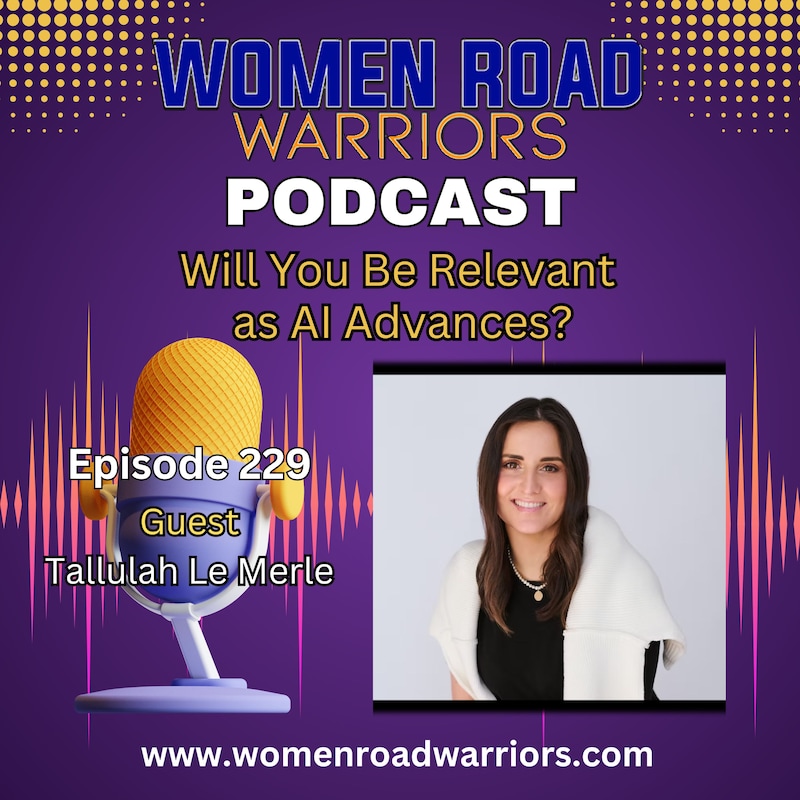
Shownotes
Artificial Intelligence (AI) is transforming the future of work, and many are asking the same question: Will my career still matter in an AI-driven world?
In this episode of Women Road Warriors, Shelley Johnson and Kathy Tuccaro sit down with AI strategist and investor Tallulah Le Merle to explore how women can stay relevant, competitive, and thrive as AI reshapes industries. The good news is women have strong abilities to shine in this new era.
Tallulah leads AI investment strategy for firms connected to more than 1,500 startups and over 80 unicorns, including Coinbase and OpenSea giving her a front-row seat to where technology, business, and careers are heading.
As an AI advisor and fractional COO, she helps companies scale while preserving culture and well-being. With a background from Oxford and MIT Sloan, and experience speaking at the UK House of Commons, she brings powerful insight into navigating change with confidence. She is known for her keynote “The Case for Hope in the Age of AI.”
In this conversation, you’ll learn:
- How AI is changing jobs and career paths
- The skills women need to stay relevant in the future of work
- How to adapt, grow, and stand out in an AI-driven economy
- Why opportunity—not obsolescence—is the real story
If you’re thinking about your next move, your career growth, or your place in a rapidly changing world—this episode is essential listening.
🎧 Learn how to stay relevant and thrive in the age of AI. Tune into this episode.
https://www.tallulahlemerle.com/
https://womenroadwarriors.com/
#ArtificialIntelligence
#FutureOfWork
#AI
#WomenInTech
#CareerGrowth
#WomenEmpowerment
#DigitalTransformation
#TallulahLeMerle
#ShelleyJohnson
#KathyTuccaro
#WomenRoadWarriors
Transcripts
This is Women Road warriors with Shelly Johnson and Kathy Tucaro.
Speaker A:From the corporate office to the cab of a truck, they're here to inspire and empower women in all professions.
Speaker A:So gear down, sit back and enjoy.
Speaker B:Welcome.
Speaker B:We're an award winning show dedicated to empowering women in every profession through inspiring stories and expert insights.
Speaker B:No topics off limits.
Speaker B:On our show, we power women on the road to success with expert and celebrity interviews and information you need.
Speaker B:I'm Shelley.
Speaker C:And I'm Kathy.
Speaker B:Where will our jobs be as artificial intelligence becomes more commonplace?
Speaker B:It's here and a lot of people are worried they're going to become obsolete.
Speaker B:Today, we're tackling an even bigger question.
Speaker B:How can women stay relevant and thrive in a future shaped by age?
Speaker B:AI.
Speaker B:We've got the perfect guest to guide us.
Speaker B:Tallulah Lamurle is a leader at the crossroads of technology, business and human potential.
Speaker B:She heads AI investment strategy for 5th Era and blockchain Company Investors, a firm with more than 1,500 startups in its portfolio, including over 80 unicorns like Coinbase, Kraken and OpenSea.
Speaker B:She sees exactly where the future of work is headed.
Speaker B:Tallulah is also an AI advisor and fractional COO who helps companies scale without sacrificing culture or well being.
Speaker B:She's an Oxford graduate with additional study at MIT Sloan and she's spoken at prestigious venues including the UK House of Commons and is known for her keynote, the Case for Hope in the Age of AI.
Speaker B:I think we're all looking for that.
Speaker B:Kathy and I are honored to have her on the show to learn how we can adapt and be indispensable with AI on the horizon.
Speaker B:Welcome, Tallulah.
Speaker B:Thank you for being with us.
Speaker D:Thank you guys so much for having me.
Speaker D:I'm so looking forward to this discussion.
Speaker C:Oh, gosh, so are we.
Speaker C:We're delighted to have you.
Speaker B:Absolutely.
Speaker B:Tallulah, your credentials and experience are impeccable.
Speaker B:Can you give us a brief background on yourself before we discuss how AI is going to change our workplaces?
Speaker D:Yeah, I mean, and thank you for the intro.
Speaker D:You covered much of it there, but I.
Speaker D:So let's see what color I can add.
Speaker D:I grew up in California in the west coast, but out of a family that is mostly British with some French.
Speaker D:So actually the.
Speaker D:The majority of my adult life has been spent in UK and Europe before moving back here just about a year ago for many of the reasons you cited when you gave the overview about the work I do in the world of AI, which still very much has its.
Speaker D:You Know one of the big hubs for that is out on the west coast.
Speaker D:But I, I spent a long time as a consultant and advisor for large corporates helping them navigate technology and you know, digital and data transformation.
Speaker D:How do they reach and interact with their customers in a world in, in a, in the digital era.
Speaker D:And there was a lot of AI strategy in there back before it was the buzzword soup du jour term of the day and it was more about machine learning and big data.
Speaker D:And at some point though I said, you know, I, this is such, I really want to be part of the cutting edge of this space and to do so I want to be at the heart of the ecosystem.
Speaker D:So I left the firm I was working for and started independently advising the really fast growing startups in the space as they were navigating their growth journeys.
Speaker D:Did that for a number of years and now I found myself on the invest side of the equation.
Speaker D:As you mentioned my role at 5th era we invest in frontier technology areas and I lead our AI strategy.
Speaker D:So I'm kind of in the world of early stage venture now.
Speaker D:But I have to say that my true platform and passion is at the intersection of AI and topics.
Speaker D:We hear a lot about the technology and less about the implications for us and on our life.
Speaker D:And when we do hear about it at the moment it's pretty, pretty fear based which is completely understandable because there's a lot of uncertainties and unknowns and very valid risks of the current moment.
Speaker D:But I see huge opportunity and I've always considered myself a humanist.
Speaker D:That's, you know, the other thing I'd say is the red thread aside from my career which we so identify with and I was like my intro has been all about my career but alongside that I'm just such a passionate investigator of the human condition and our behavior.
Speaker D:Human psychology.
Speaker D:I, when I took a sabbatical year after leaving the firm, I really immersed myself in the world of well being, consciousness, wisdom.
Speaker D:I was a student of every topic under the sun.
Speaker D:I did the science of happiness course at Yale, I worked with Stanford professors informally looking at human centered AI and other related topics.
Speaker D:And I just am so passionate about us as you know, how we interact, behave our patterns, our conditioning and I feel really hopeful from a pretty grounded place of understanding both sides of the equation.
Speaker D:And one more, just one more.
Speaker D:I have four brothers.
Speaker D:I grew up in a very male dominated but fun household and I love now to speak to women, gather women, find and create the tribe.
Speaker D:You know, that's really lighting me up in my life right now.
Speaker B:So it sounds like you're pretty optimistic about how we're going to interact with AI.
Speaker B: rticle in Forbes that said by: Speaker B: Forum's Future of Jobs Report: Speaker B:But at the same time, they're saying 170 million new jobs will be created.
Speaker B:Yeah.
Speaker B:So do you think people are just fearful because it's new and they're just wary and they have misinformation and fear that's unfounded?
Speaker D:I love that you started with that stat, because it's the first place I start in a.
Speaker D:When I have these discussions too, is jobs.
Speaker D:Because it's so near term, it's very close to people's hearts.
Speaker D:You know, it's like my livelihood, my job.
Speaker D:And.
Speaker D:But, but what you pointed out there is that what, you know, most of the messaging gets stuck on the 90 million jobs displaced and replaced.
Speaker D:And it's.
Speaker D:I don't want to diminish it.
Speaker D:Like, that's a.
Speaker D:It's a huge shift.
Speaker D:It's going to be a massive evolution that impacts every industry, some more than others and some types of roles and work more than others.
Speaker D:But the fact of the matter is that similar to the Internet, you know, that these technologies create entirely new industries that we can't really fathom at the outset.
Speaker D:Like the Internet brought in social media, brought in the possibility that we're doing this podcast now from remote locations via something called Zoom.
Speaker D:Right.
Speaker D:We couldn't have fathomed that or the size and scale of E commerce, for example.
Speaker D:So new industries arise and new career ladders where you have hybrid human AI, in this case, roles, but in that case, just Internet now underpins absolutely everything we do.
Speaker D:Well, most of what we do in the information era.
Speaker D:Right.
Speaker D:So it's a evolution.
Speaker D:And I think you said, is it unfounded?
Speaker D:I don't think fear is ever unfounded.
Speaker D:It's very natural human response to change.
Speaker D:It's just our amygdala is designed to keep us safe from things we don't, where we can't fathom, where we can't clearly see what's going to arise.
Speaker D:The difference of the moment we're in is that we have social media and all these ways in which we can share our concerns, fears, et cetera.
Speaker D:And so my real worry is that we just get lost in that type of messaging and we don't look at the very valid facts that point towards hope and opportunity as well.
Speaker B:Any Change.
Speaker B:You're right.
Speaker B:People don't like it.
Speaker B:I mean, obviously when the automobile came around, people who had horse and buggies didn't like it.
Speaker B:And of course, there were all of these crazy thoughts that, gee, if you go over 45 miles an hour, it's going to be bad, especially to women and their internal organs and their reproductive organs and all of this.
Speaker B:They'd be compromised.
Speaker B:That's what they actually thought.
Speaker B:People didn't want to have the change.
Speaker B:People don't like change.
Speaker B:And I think a lot of times when people think of AI they're afraid of it taking over.
Speaker B: You remember the movie: Speaker B:Hell, you know, is that all unfounded?
Speaker B:I mean, there's so many benefits to AI but obviously it needs to be handled correctly too.
Speaker D:Of course.
Speaker D:Yeah.
Speaker D:So here's the framing I put on it.
Speaker D:If I just zoom out from any one.
Speaker D:One individual fear, and I'll point to actually a few of them that are commonly cited.
Speaker D:So, of course, this technology, like any other, and actually more so than any other because of the pace of development and so on, will be deeply disruptive, but I believe deeply beneficial for humanity.
Speaker D:And that is because as a species, you know, we've evolved through countless eras of evolution.
Speaker D:We were hunter gatherers.
Speaker D:We were then agrarians, where 90% of us were farmers.
Speaker D:We spent all our time tilling the land.
Speaker D:We were industrialists in factories.
Speaker D:And now we're in this digital age, and there's progress with each of those.
Speaker D:But I think that we forget that with innovation also comes this distancing from the kind of fabric and essence of what makes us human.
Speaker D:We've lost a lot of our connection to self, to our physical bodies, our somatic intelligence, to other people.
Speaker D:You know, we don't have the same sense of community we used to wear.
Speaker D:We.
Speaker D:Much of our work is done in this isolated way on screens.
Speaker D:I mean, we spend a lot of time sedentary.
Speaker D:We.
Speaker D:We're disconnected from the natural world.
Speaker D:We're indoors for almost all that we do.
Speaker D:We don't have that ecological intelligence of living off the land that we once had.
Speaker D:And so in that framing.
Speaker D:And then I can ground it and, you know, that sounds very lofty, but in that framing, AI is this massive disruptor.
Speaker D:But also, I always ask, like, disruptive to what?
Speaker D:You know, if it's disrupting that, it can also be this potential catalyst for a real, you know, deepening or return to human flourishing.
Speaker D:And to help us remember a lot of these forgotten forms of intelligence that we've gotten out of touch with.
Speaker D:So I would just say, you know, you cited this macro fear, AI will overpower humanity.
Speaker D:That's a big, you know, runaway AI.
Speaker D:And alignment is definitely something that we need to address in terms of the models themselves and bias and inference and decision making.
Speaker D:But I think for every fear, there's a corresponding hope that you can cite.
Speaker D:And that's what, you know, I speak about this topic all the time and the books coming out soon, which I'm so happy I've just had the opportunity to flesh out this thinking more broadly.
Speaker D:But it's like we talked about the jobs 1.
Speaker D:Does it take jobs or does it free us from kind of drudgery and a modern definition of work that doesn't really dignify the human experience?
Speaker D:It's bad for the environment.
Speaker D:That's another one.
Speaker D:You know, the energy demand is cited a lot.
Speaker D:And that's true in terms of where we are right now with new capability.
Speaker D:But AI is also, it's the greatest tool for efficiency we've ever created, and that's efficiency of everything we do as a species.
Speaker D:And I actually, you know, my degree at Oxford was largely around environmental geography, and I see AI as one of the greatest allies in the climate crisis that, that, that we have access to and so on and so forth.
Speaker D:You know, it will do.
Speaker D:You know, people think it'll make us less intelligent.
Speaker D:Well, was true intelligence ever only really cognitive?
Speaker D:Again, I'm a little bit simplifying now for the purposes of just framing it here, and I don't want to lose nuance or risk involved, but I think it's important to frame these on a certain level.
Speaker A:Stay tuned for more of Women Road warriors coming up.
Speaker B:Industry movement Trucking Moves America Forward is telling the story of the industry.
Speaker B:Our safety champions, the women of trucking, independent contractors, the next generation of truckers, and more help us promote the best of our industry.
Speaker B:Share your story and what you love about trucking.
Speaker B:Share images of a moment you're proud of and join us on social media.
Speaker B:Learn more at truckingmovesamerica.com.
Speaker A:Welcome back to Women Road warriors with Shelly Johnson and Kathy Tucaro.
Speaker B:If you're enjoying this informative episode of Women Road Warriors, I wanted to mention Kathy and I explore all kinds of topics that will power you on the road to success.
Speaker B:We feature a lot of expert interviews, plus we feature celebrities and women who've been trailblazers.
Speaker B:Please check out our [email protected] and click on our episodes page.
Speaker B:We're also available wherever you listen to podcasts on all the major podcast channels like Spotify, Apple, YouTube, Amazon Music, Audible, you name it.
Speaker B:Check us out and bookmark our podcast.
Speaker B:Also, don't forget to follow us on social media.
Speaker B:We're on Twitter, Facebook, Instagram, Pinterest, LinkedIn, YouTube and other sites and tell others about us.
Speaker B:We want to help as many women as possible.
Speaker B:We're talking about one of the biggest questions facing all of us right now, how to stay relevant as AI reshapes the future of work.
Speaker B:And we have the perfect guide for this conversation.
Speaker B: firms connected to more than: Speaker B:She's not guessing where things are going.
Speaker B:She's seeing it unfold in real time.
Speaker B:While some jobs may become obsolete, new careers will be created.
Speaker B:This technology, because of the pace of development will be deeply disruptive but also beneficial to humanity.
Speaker B:We just need to stay mindful and informed.
Speaker B:Let's get back to the discussion.
Speaker B:Tallulah, what jobs do you see maybe becoming obsolete?
Speaker B:How should people retrain and pivot?
Speaker B:I think that that's where a lot of concern is.
Speaker B:I've been hearing some things where people are coming out of college right now and they're wondering is their job going to be relevant in the next 10 years or even 20?
Speaker B:Are there specific areas where people can train or retrain so that they can really take advantage of the positive aspects of AI?
Speaker D:Yeah.
Speaker D:So in terms of work, if we're returning to this point, definitely.
Speaker D:You know, I think the IMF said about 40% of global employment's exposed to AI and will face some sort of disruption and 6 to 7% of the US workforce could be replaced in the next decade.
Speaker D:Again, it's thought that it will be relatively gradual.
Speaker D:The Goldman Sachs says 0.5 points is the estimated peak unemployment effect which translates to pretty gradual.
Speaker D: and the economic recession of: Speaker B:Right.
Speaker D:So the jobs it will it impacts is is obvious is those that are kind of manual data entry processes and workflows within corporate settings.
Speaker D:That's in the, that's in the immediate term.
Speaker D:It's already happening as corporates are adopting this at scale enterPR AI is absolutely booming and it's also the you know man, I wouldn't say manual but there's a lot of use case of AI in kind of warehouses and in supply chain and to replace some of the oversight that humans would have done in those contexts.
Speaker D:So those are some of the ones I believe reabsorption will be pretty high.
Speaker D:So as people, as those sorts of jobs are impacted, they.
Speaker D:There's this opportunity that they could be absorbed into other areas or sectors.
Speaker D:And you know, it's an unequal effect on these kind of like white collar roles that I mentioned in undeveloped economies which the only benefit of that is that people are skilled and trained in those roles.
Speaker D:Right.
Speaker D:So there is an opportunity for reskilling and that they, and that there's capabilities up.
Speaker D:Not even, you know, it could just be okay, you were doing this previous role, now that role is augmented by AI.
Speaker D:So how do you learn how to work with that tool in a similar context to what you were doing before?
Speaker D:And that just means we're going to need to have really good programs, whether it's within a corporate context or whether it's government led or.
Speaker D:But to reskill to help help people navigate this transition.
Speaker B:Yeah, it's a huge transition when you think about it.
Speaker D:It's massive.
Speaker D:And that's not even getting to the entirely new industries I was mentioning that will arise that we can't even fathom yet.
Speaker D:Right.
Speaker D:So for that it's almost hard to say for people what we don't know, what we don't know.
Speaker C:You know, even here at work we have.
Speaker C:I've been working, operating for, I work for ExxonMobil up in Northern Canada and we have been using autonomous trucks for the last five years, I think.
Speaker C:And we're the first, we're the only mine in North America to have an all autonomous truck.
Speaker C:So we lost 81 drivers of those trucks that got laid off when we went full on autonomous.
Speaker C:They started just by one truck, two trucks to try it out.
Speaker C:And now we have 81 autonomous trucks.
Speaker C:And I gotta say it has been really a difficult transition, but it's also been really sad to see people lose their jobs and now to work with these robots on a daily basis.
Speaker D:It's awful.
Speaker C:You know, just, just the little things like missing waving at people, you know, or, or like it's just they're cold, they're unforgiving, they're.
Speaker C:There's, they.
Speaker D:It's.
Speaker C:I don't know, I'm.
Speaker C:I'm not, I'm not enjoying it at all.
Speaker C:But I mean it does pay the robots.
Speaker C:Yeah, it's very difficult to.
Speaker C:In the mining section anyway.
Speaker D:So.
Speaker D:Yeah.
Speaker D:And I think that brings up this other important point which is that as a species we're so social and we're by nature and.
Speaker D:And so people worry like that certain things will swing completely in one direction and we'll lose the kind of human touch, human centricity to a lot of the work that we do.
Speaker D:And in the short term, there may be a little bit of a swing, but then I think that we'll readjust because, as you say, like, there's already this reaction in response to things that don't feel in line with our nature.
Speaker B:Right.
Speaker D:They don't give us the same touch and tonality and experience as we desire.
Speaker D:But I don't.
Speaker D:I agree with you.
Speaker D:Like, I don't want to.
Speaker D:There's no downplaying just how painful part of this transition will be and uncomfortable and strange and teething problems.
Speaker D:Right.
Speaker D:There's that curve people talk about when you're in the trough of disillusionment when it comes to new innovation, where you have all these transitional pains, you have change fatigue.
Speaker D:People are sick of.
Speaker D:Sick of hearing about it.
Speaker D:There is this very painful period where, yeah, there's, you know, a lot of teething problems, transitional pain, change fatigue.
Speaker D:People are sick of hearing about it.
Speaker D:The early use cases are kind of more experimental in their nature and they're less than ideal.
Speaker D:There's a lot to navigate in the coming years.
Speaker D:And I do think there's also a whole discussion about unequal benefits of,.
Speaker B:You.
Speaker D:Know, the fact that certain.
Speaker D:There's a concern that there'll be imbalanced distribution of the economic benefits from AI and therefore an increasing need for measures to kind of mitigate against that.
Speaker D:That's where you get this whole discussion about ubi Universal Basic Income.
Speaker D:You've heard.
Speaker D:Have you heard about any of the discussion around that?
Speaker D:Or there.
Speaker B:There's a lot of debate that it's good, that it's bad.
Speaker B:There's a lot like it or don't.
Speaker D:Yeah, I will.
Speaker D:I'll personally put a flag in the ground to say that I think it in theory is a wonderful thing, but the real question is about how you would really fund it at scale.
Speaker D:So the concept is that basically you.
Speaker D:You provide, you know, a stipend, whether it's on a monthly basis or whatever it may be to.
Speaker D:To individuals, whether or not they're, you know, it's just a universal basic income stipend that.
Speaker D:That gets provided.
Speaker D:And they've done many trials about this in Finland and California.
Speaker D:They did one more recently, I think, in the last five years, where they give.
Speaker D:Gave people $500 a month.
Speaker D:And the findings from it always is that your well, you know, people's well being improves, they have less stress, they have better mental health, they feel more secure and that they're this, this big fear is like, oh well then no one will have work incentives.
Speaker D:They're not going to work.
Speaker D:They're what are we going to do?
Speaker D:Just like lay back and play, you know, be in nature all day or dance or create art.
Speaker D:And first of all, I'm like okay, well what would be so wrong with that?
Speaker D:But second of all, they actually found that that's not the case.
Speaker D:People are almost double as likely to move from part to full time work when they have a stipend that covers their basic needs because they don't have that survival stress and they can go out and find something properly for themselves to do and get job interviews and their transport and childcare, et cetera is covered.
Speaker D:And so it really creates upward mobility.
Speaker D:Now the issue is all those pilots are very targeted and very, you know, they're pilots, they're small scale, so universal.
Speaker D:UBI would require much larger funding source and there's kind of this open question about how that would be done.
Speaker D:But it transitions us from this like again, pretty modern mode of work that we've been in, which is this the 9 to 540 in model except now we all do it on screens.
Speaker D:Like the hunter gatherers would be shuddering considering that that's how we ended up spending all of our time, however many centuries later.
Speaker D:Right.
Speaker D:So I don't know, it's human work has always evolved and where we derive our definition of purpose and meaningful effort has changed massively over lifetime of humanity and it's going to shift again.
Speaker D:And I think we're in that shift now.
Speaker B:I think you're right.
Speaker A:Stay tuned for more of Women Road Warrior coming up.
Speaker B:Industry movement Trucking moves America Forward is telling the story of the industry.
Speaker B:Our safety champions, the women of trucking, independent contractors, the next generation of truckers and more.
Speaker B:Help us promote the best of our industry.
Speaker B:Share your story and what you love about trucking.
Speaker B:Share images of a moment you're proud of and join us on the social media.
Speaker B:Learn more at truckingmovesamerica.com.
Speaker A:Welcome back to Women Road warriors with Shelly Johnson and Kathy Tucaro.
Speaker B:If you're feeling uncertain about where you fit into an AI driven future, this conversation's for you.
Speaker B:Tallulah Lamural is known for her message of hope in the age of AI, but it's grounded in real world experience.
Speaker B:She works directly with emerging companies, studies what's working and helps leaders adapt without getting left behind.
Speaker B:Human work has always evolved, it's just a matter of evolving with it.
Speaker B:This is, in theory, it's strategy that you can use.
Speaker B:Let's return to the conversation, Tallulah.
Speaker B:We're miles away from how people worked even 50 years ago.
Speaker B:We can work remotely and never even step into the office in many cases.
Speaker B:And it is quite the transition.
Speaker B:Having face to face, being able to be in front of someone versus on a screen.
Speaker B:I do think that the technology has impacted our communication skills.
Speaker B:Definitely.
Speaker B:And to be able to work with AI so that it augments us versus makes us less likely to communicate, I think would be a good thing.
Speaker B:Human beings adapt, but not as quickly as technology.
Speaker B:And of course a lot of that goes into how AI is trained.
Speaker B:Correct.
Speaker B:I mean, it's the machine learning.
Speaker D:Yeah, exactly.
Speaker D:So let's talk about this because there's this getting kind of to another point about why AI in its current form is not, is bad for kind of our collective well being, interaction, et cetera.
Speaker D:Not least because we're offloading cognitive, you know, cognitive decision making and problem solving.
Speaker D:So that's that fear, like, oh, it's making us less intelligent.
Speaker D:But also because what you mentioned, you know, it makes us disconnected.
Speaker D:We spend more time in, you know, in virtual engagement rather than something that feels more real, quote, unquote, this sycophantic issue, like, oh, it's only going to tell us what we want to hear.
Speaker D:So it's going to reinforce our existing beliefs and, and, and, and this misuse.
Speaker D:You know, there was a story about AI manipulating someone into taking their own life because there weren't the proper guardrails and they're like awful stories.
Speaker D:I mean, truly.
Speaker D:Right.
Speaker D:Like, and I'm not denying any of that.
Speaker D:I think there's some real issues in terms of where the models are that need to be absolutely worked on.
Speaker D:But there are, you know, I would say again, and I don't, I never want to understate the validity of those risks, but I would say early use cases of technology tend to be less than ideal.
Speaker D:Right.
Speaker D:Like I, I again, I'll say talk about the Internet.
Speaker D:The early Internet was all dark web porn, spam pop ups.
Speaker D:Like it was not safe or secure.
Speaker D: l panic about it in the early: Speaker D:Right.
Speaker B:It's just actually what I'd heard was that porn was what kind of grew the Internet.
Speaker B:It was kind of the backbone of revenue in the early stages.
Speaker B:In the 90s on it was like, wow.
Speaker B:Yeah, yeah.
Speaker D:So, and now The Internet's the backbone of everything we do today and it's still not safe and it's still not fully secure or ideal.
Speaker D:But it's mostly, you know, okay, we interact with it day to day.
Speaker D:So.
Speaker D:So I would say that on each of the points we mentioned there's absolutely things being done to address bias and misuse and to ensure the proper guardrails.
Speaker D:And that's happening.
Speaker D:There's even, there's more and more pressure on the foundation model players themselves because of regulation and safety catching up with innovation, which always tends to lag a bit behind.
Speaker D:But it's coming, but also on a unified, almost global cooperation to address some of these things.
Speaker D:And then I would say there are, you know, this technology is just as powerful of a tool for positive outcomes when it's used in the right ways.
Speaker D:For example, when ChatGPT 5 came out there was a kind of, there was quite a few people up in arms.
Speaker D:No, I wouldn't.
Speaker D:Up in arms is a bit strong.
Speaker D:But there was a reaction because it didn't feel like it had the same quality of relating to people as prior models had.
Speaker D:And there was this almost wake up which since has spawned this whole conversation about empathetic AI and emotional use cases of AI that people felt deeply validated by this technology.
Speaker D:They felt seen and heard in this virtual context of course, but like then to become familiar with what that feels like and what good looks like to seek it out in person and it's getting poo pooed in some dialogues as like sycophantic AI.
Speaker D:But I think there's really something there that's a powerful reaction to be stirring in humans.
Speaker D:And there's opportunities as well to improve empathy, you know, improve peer to peer empathy.
Speaker D:There's tools and startups working on, you know, use cases of AI where they're monitoring and training individuals on how to have person to person dialogues and they, you know, they'll rate the level of trust in that conversation or how much, you know, is there bias or prejudice in what they're saying is there and then give them feedback accordingly.
Speaker D:There's an opportunity that this tool can improve our openness because you know, we can use it for bias reduction training.
Speaker D:We can, it can provide examples that are kind of counter stereotypical or help challenge our assumptions.
Speaker D:It's like a mirror, you know, we've created this tool that can be a mirror.
Speaker D:It can improve our self inquiry, it can improve our reflection, it can if you, you know, integrate it with wearables and things we put on our bodies, it can help with emotional regulation, it can give us biofeedback, it can give us real time detection of our own stress and intervene accordingly.
Speaker D:And so there's this, like, amazing.
Speaker D:There's potential there too.
Speaker B:Right.
Speaker D:But it's, it's lost in the sea of the concerns that exist right now, which I also understand.
Speaker B:Sure.
Speaker B:Well, I think people are afraid of how it's influencing maybe younger people who think it's a friend or use AI as a substitute friend.
Speaker B:Rather than interacting with people on a face to face basis.
Speaker B:A lot of people are doing it virtually.
Speaker B:So these are some of the transitions.
Speaker B:And of course, I do feel that we're social animals.
Speaker B:We need to be face to face.
Speaker B:And if you, you have to, that's where parents need to be probably involved, limit their children's screen time and that kind of thing so that they have a combination of.
Speaker B:Because we can't lose our skills as social animals either.
Speaker D:No, and I would.
Speaker D:I mean, I think there's opportunity to enhance them, like I was saying.
Speaker D:But I get it.
Speaker D:Like, we've just lived through the social media age, which completely, I feel, has scarred us pretty deeply because social media, like the promise was that it would connect us all in these new ways.
Speaker D:And for sure there's been benefits of it in terms of creating some sense of community and like we can peer into people's lives across the globe from us and see new perspectives and.
Speaker D:But also those platforms ended up being designed in a pretty nefarious way to exploit psychology.
Speaker D:Like it's all about the dopamine hit and staying on, you know, keeping us retained on the platform and constantly refreshing and caring about the likes and comparing ourselves and feeling anxious and it's been a disaster, to be honest, on so many fronts.
Speaker D:But what I would say is I almost feel there's a benefit to the fact that we've lived through that wave, that now we have such a strong collective will to design technology more consciously.
Speaker D:And actually we have this like, back, this huge backlash now to AI if we see even just a tiny inkling that it could be bad for us in the same way that AI or sorry, that social media was.
Speaker D:And so now you have wonderful, wonderfully intentional, conscious people demanding that we design this, this technology now with ethics and integrity at the core.
Speaker B:There's more accountability.
Speaker B:That.
Speaker B:That's good.
Speaker D:Oh, massively.
Speaker D:I mean, like, you hear it like the backlash and the outrage even from the public and the fear.
Speaker D:It serves a good purpose.
Speaker D:Right.
Speaker D:It's putting a ton of scrutiny and strain on the People building in this space to get it right in ways that social media failed us.
Speaker D:And so I don't think it's, I think it's, it's a good thing.
Speaker D:It's a good thing.
Speaker B:It's kind of like maybe that they're going back to Isaac Asimov, who had the three laws of robotics.
Speaker B:A robot may not injure a human being or allow a human to come to harm.
Speaker B:That's one of them.
Speaker B:Must obey orders by humans and must protect its own existence as long as it does not conflict with the first two laws.
Speaker B:So in other words, humanity is always at the forefront of importance.
Speaker D:And that's, you know, you mentioned this like Mac, will AI overpower us?
Speaker D:The AI overlord kind of scenario, which as you said, has been around for a decade in literature and, you know, popular film, you know, representations in film and things like this.
Speaker D:The one thing I see that's really hopeful here and I go in much more detail and in book and other places, but humans, we've always created an other and a self.
Speaker D:It goes back to our tribal nature, right?
Speaker D:Like we needed to establish boundaries in terms of what the tribe was versus others because we had a limited amount of resources.
Speaker D:So it's in our nature to other.
Speaker D:And we've done it across all sorts of, you know, we do it on religion, we do it on gender, we do it on so on.
Speaker D:Now we've almost created an other that is not human.
Speaker D:You know, the AI is the other.
Speaker D:And when we've created this, this, this non human other, humanity becomes the self.
Speaker D:And so when it comes to macro risks of AI and AI in the hands of bad actors or in, in war, use of AI and warfare and weaponry to scale the impacts of war and these sorts of concerns, we then create this invitation to like establish and stand behind what is, you know, humanity as a self and a shared set of human values.
Speaker D:Which is another big conversation happening right now.
Speaker D:It's like, how do you even start to define what human values are given?
Speaker D:That's such a diverse, you know, where do you begin to then be able to encode that into the technology we're building?
Speaker D:But that conversation's happening and you get unprecedented global cooperation to try to start to answer that question.
Speaker B:Interesting.
Speaker B:So maybe this could unify humanity.
Speaker D:We'll get out of the tribal is going with it.
Speaker D:Yeah, I mean there's an opportunity in nothing that I'm saying, am I saying for sure this is what's going to happen?
Speaker D:I'm just saying for every fear there's a mirror hope and any trajectory is really possible at the moment.
Speaker D:But I truly believe wherever we focus that's where our energy will flow.
Speaker D:So if we are constantly imagining and spending all our time and energy and attention envisioning those worst case scenarios, we're just much more likely to end up there and build for them.
Speaker D:I'm just trying to balance the dialogue so people can choose more intentionally where they want to focus and just see that there's another side to to the equation here.
Speaker B:Always that's important.
Speaker A:Stay tuned for more of Women Road warriors coming up.
Speaker B:Industry Movement Trucking Moves America Forward is telling the story of the industry, Our safety champions, the women of trucking, independent contractors, the next generation of truckers and more help us promote the best of our industry.
Speaker B:Share your story and what you love about trucking.
Speaker B:Share images of a moment you're proud of and join us on social media.
Speaker B:Learn more at truckingmovesamerica.com.
Speaker A:Welcome back to Women Road warriors with Shelly Johnson and Kathy Tucaro.
Speaker C:Foreign.
Speaker B:We're talking about one of the biggest questions facing all of us right now, how to stay relevant as AI reshapes the future of work.
Speaker B:And we have the perfect guide for this conversation.
Speaker B: firms connected to more than: Speaker B:She's not gonna guessing where things are going.
Speaker B:She's seeing it unfold in real time.
Speaker B:While some jobs may become obsolete, new careers will be created.
Speaker B:This technology because of the pace of development will be deeply disruptive but also beneficial to humanity.
Speaker B:We just need to stay mindful and informed.
Speaker B:Let's get back to the discussion.
Speaker B:Tallulah, would you say regarding AI with hope versus fear is a better way to look at things?
Speaker D:Hope is not something we're sold very often anymore, right?
Speaker D:It's all like because of the way our social media digital era kind of works.
Speaker D:It is all about sharing and clicks and engagement.
Speaker D:A lot of the messaging has gone towards fear and anger and just kind of inciting in us those emotions that really move us to action and so you don't have as much hope filled messaging.
Speaker D:We always think about Obama with his like yes we can and just how powerful of a rallying cry.
Speaker D:That was always a choice.
Speaker D:It's just always there as a choice and as an option.
Speaker D:And I actually think you need people on every side of the equation.
Speaker D:You need people who are very skeptical and who worry wisely because they make us sharper and they make us more responsible and they force us to really scrutinize what we're building and how we're building it.
Speaker D:But you also need hopeful, you know, humanists flag bearing into this new era and painting a picture of the problems of the world we live in today that could be solved by taking a bet on really cutting edge technology.
Speaker D:Because how else are we going to solve some of these things like the climate crisis.
Speaker D:We're like this sticky situation we've gotten ourselves into, I don't believe can be solved with the same brains that created it.
Speaker D:And there's a lot of issues like that.
Speaker D:And I see AI, as I said, a real ally in addressing some of these things.
Speaker D:Inequality, health, access to health care, access to education, globalizing and democratizing some of these things, making us more efficient and therefore less energy consuming in everything that we do.
Speaker D:Partnering with Earth observation satellite data to spot methane leaks and changes to icebergs and illegal logging operations in the Amazon.
Speaker D:Much faster and so much potential.
Speaker B:Well, aren't they using AI to detect meteors and that sort of thing?
Speaker B:Because they've been concerned about that too, that something could come from outer space and just kind of like the big bang.
Speaker B:We don't need that.
Speaker B:Aren't you using that same technology to do forecasting or to see what's happening before we can actually figure it out as humans?
Speaker D:Yeah, absolutely.
Speaker D:I mean AI because of its kind of you, you when you, when you use even ChatGPT, you see that it's one thing it does is just process, analyze, churn out results, possibilities, scenarios in a fraction of a second of the time it would take us to do it.
Speaker D:So you apply that to just about any issue in the world and you're just turbocharging our ability to spot, detect, hypothesize, stimulate or sorry, not simulate possible outcomes and then plan accordingly.
Speaker D:So yeah, there's like you said, I mean digital twins at earth level and city level and in every industry and for example, like the one you mentioned, they're just, they abound.
Speaker B:Well, I know that AI is playing a huge role in medical diagnostics basically that could really, that would help with human longevity and prevention and catching things earlier before you have to have invasive surgery.
Speaker B:I mean the potential is huge and I'm sure that there are certain industries that are going to benefit more quickly as they transition.
Speaker B:What industries and what companies do you see being in demand as we make the transition to AI?
Speaker D:Well, healthcare is a great one to mention.
Speaker D:I get really excited about a lot of the use cases of AI in healthcare again because it has the possibility to deeply personalize care and to democratize access to healthcare in a way that we don't currently have.
Speaker D:And I think what's important there is that always a human doctor should be making the final call.
Speaker D:But there's so much that AI can do.
Speaker D:I mean, in pathology, their AI microscopes now can scan tissue samples and identify cancer cells with a speed and with a consistency that far surpasses the human ability to it, which then frees up those doctors, the pathologists, to actually focus on a.
Speaker D:The most complex cases are on the treatment and the care itself rather than on the identification.
Speaker D:Same thing goes, I mean in any other, like dermatology or, or when you're analyzing scans.
Speaker D:So like in Cardiology, looking at EKGs, it can detect like faintest signals that human, that the human eye, that even be invisible to the human eye.
Speaker D:So if you have an impending heart attack, but it's just really subtle signals that will pick up things like that.
Speaker D:So it's all about like the human still handles all the nuance and the context and the final decision making.
Speaker D:But there's this opportunity of AI to support with pattern recognition and speed up the time to diagnosis and catch things early and then, and then to look at the full person and consider all of their data and inputs and information to deeply personalize what whatever course of treatment there then led to.
Speaker D:And, and I just.
Speaker D:That one's so.
Speaker D:It's so.
Speaker D:It's this fascinating, wonderful space that so AI and healthcare is an amazing one.
Speaker D:There's so many others I could mention.
Speaker D:I don't know how deep we want to go into it.
Speaker D:I mean, like, it's interesting in the world of education, in the world of financial services and open.
Speaker D:Opening up new, new pathways to financial inclusion and access.
Speaker D:And in creative arts, it's fascinating.
Speaker D:People are really worried about AI.
Speaker D:Take, you know, AI generated contents like destroying human content and all these sorts of fears.
Speaker D:But there's actually a lot of potential there too.
Speaker D:So we could go down any avenue.
Speaker D:But.
Speaker B:Yeah, well, certainly a lot of the performers are very worried that they are not going to be needed.
Speaker B:They'll be making movies with AI, no humans needed.
Speaker B:Is that true?
Speaker B:Or how does someone mitigate against that sort of thing?
Speaker D:Yeah, I mean, I would always say, as with anything like, the anxiety about disruption in these industries is definitely not misplaced.
Speaker D:It's very legitimate.
Speaker D:Things are changing very quickly.
Speaker D:Art and creative arts, like in their purest form to me are just such a natural expression of human condition that you can't replace Creativity ever.
Speaker D:It's just like an innate human trait.
Speaker D:That's the first thing I'd say.
Speaker D:The second I would say is that this has always been a concern in, in, in creative fields, right?
Speaker D:Like, we thought that the radio would replace, you know, would mean that live artists and musicians would be completely.
Speaker D:There'd be no market for them and instead it actually like democratized access to their craft and they reached entire new audiences.
Speaker D:Or we thought CGI and film would destroy the actual craft work within, you know, within making movies.
Speaker D:But instead it created entirely new genres and so on and so forth.
Speaker D:There's other examples of that.
Speaker D:And I think that really it's.
Speaker D:They're kind of.
Speaker D:It's being referred to as Korea Korea tech industry that it's like this again, hybrid human AI Art outputs content that creates entirely new possibilities and expands the boundaries of what our imagination can create.
Speaker B:Working in tandem perhaps is a better approach with AI because it could expand our potential much more than we ever thought possible in so many areas, obviously.
Speaker B:Are there specific areas you see where people going into business, women going into business, or people who want to retrain.
Speaker B:Where are some of the hottest areas right now for AI so that people can pivot and make this transition a much smoother one and profitable for themselves?
Speaker D:That is like the exam question.
Speaker D:And again, it's a little bit, to an extent, there's this point of we can't fathom what we can't fathom.
Speaker D:Like I was reading this paper at the dawn of the Internet where we guessed some of the use cases we might use it for and others we had no clue.
Speaker D:Again, like social media, no clue.
Speaker D:You know, being on video chats miles away for like worlds away from each other, no clue.
Speaker D:So I, I mean, I always, when I talk to students, I say whatever you're passionate about, whatever area, whatever industry, just learn about how AI is impacting, influencing that industry and get savvy about it and start from there.
Speaker D:That's one.
Speaker D:And then I zoom out even further.
Speaker D:Here's my.
Speaker D:So this is like a personal opinion, right?
Speaker D:Because we can't really know.
Speaker D:But my hypoth, in a future where so much can be automated, so much of the problem solving and the kind of rigorous, analytical, cognitive work that we've done, I asked myself, like, what remains uniquely human?
Speaker D:Like, what is it that can't be replaced?
Speaker D:And for me, it's some of the things we touched on earlier.
Speaker D:The fact we're social creatures, we want to connect, we want to come together, we want to gather, we want to Commune that will never go away, that we have physical bodies, a somatic experience of the world around us that's like, you know, then these physical bodies contain a lot of their own wisdom and into, you know, woman in a, in a coma could still create life and come, you know, bear a full term pregnancy whether or not her brain was online for any of that.
Speaker D:So our bodies carry all this incredible wisdom.
Speaker D:And I think the wellbeing industry has massively grown as people get more and more in touch with their physical body.
Speaker D:So there's that.
Speaker D:And so I see and then again our creativity, our imagination, like these innate human traits that aren't at risk of like extinction by this, you know, tool that we've created.
Speaker D:And so in that future, I think any work that really has that as its core becomes deeply valuable.
Speaker D:It comes at a premium, almost like social capital, creative capital, connection as currency, conversation as currency.
Speaker D:These sorts of spaces, experiences, events, gathering and things that restore us to lost intelligences that are, you know, to do with our broader human nature outside of our ability to have a sharp brain that's constantly innovating.
Speaker B:Right.
Speaker D:Like these sorts of things.
Speaker D:So I don't know even what that looks like in terms of industries or spaces, but I'm excited you ask about women.
Speaker D:It's like we are wonderful at so many of those things.
Speaker D:They, they are innate within our toolkit.
Speaker D:Empathy, inclusion, openness, generosity, collaboration, adaptability, being adaptable in a kind of uncertain future, being visionary, these things.
Speaker D:So I feel optimistic without really having a concrete answer to your question.
Speaker B:Yeah, it's hard to predict the future, but it's good to know that women have the characteristics that they can adapt and really, really thrive in this new frontier, if you will.
Speaker B:Tallulah, where do people reach out to you?
Speaker B:I see you do a lot of speaking and you said you have some books that are going to be coming out as well.
Speaker D:Yeah, I.
Speaker D:The easiest place is, is LinkedIn, which is obviously just my full name.
Speaker D:My website is www.tallulahlamerle.com which has more information on everything I do across obviously my investor day hat, but also this kind of hope in humanity in the age of AI focus.
Speaker D:And indeed my book which is just a culmination of my how passionately I feel about the opportunity and potential here.
Speaker D:I'm actually took myself out into the countryside to force myself to finish editing and it's called the Case for Hope in the Age of AI with my wonderful co author Andre Liskoff, who's spent most of his career in this space as well and tackles it from also the tech, the technologist lens.
Speaker D:So it's a good pairing.
Speaker B:Excellent.
Speaker B:Well, we've just kind of scratched the surface, but you've really given us some food for thought.
Speaker B:And basically, I guess it's a matter for listeners to educate themselves and just stay aware as we go through these changes because we don't have a crystal ball.
Speaker B:We can't predict exactly how all of this is going to shake out, but it's got a lot of potential and possibility.
Speaker C:So just one last thing.
Speaker C:I find that if you don't follow the ways of the world and the way of technology, you're going to be left behind.
Speaker C:And even as, you know, like the aging generation, like I'm 56 and I struggle with technology, but I have to push myself and force myself to keep up with AI and the way the world is.
Speaker C:So.
Speaker D:Yeah, exactly.
Speaker D:I just hope again, we need the full spectrum from worry to.
Speaker D:And fear to hope.
Speaker D:But I just encourage people to really be intentional in choosing where they fall.
Speaker D:And I think the biggest risk is that we sway too far in either direction, which would be bad for, you know, different reasons.
Speaker D:But for me, that's the biggest risk is, is we just lose ourselves to fear mongering and then we create the doomsday scenarios that we're so worried about.
Speaker D:So I think a balance is needed.
Speaker B:Tallulah, this has been very insightful.
Speaker B:Thank you so much for being on the show.
Speaker D:Thank you guys so much.
Speaker D:Yeah, thank you.
Speaker B:We hope you've enjoyed this latest episode.
Speaker B:And if you want to hear more episodes of Women Road warriors or learn more about our show, be sure to check out womenroadwarriors.com and please follow us on social media.
Speaker B:And don't forget to subscribe to our podcast on our website.
Speaker B:We also have a selection of podcasts just for women.
Speaker B:They're a series of podcasts from different podcasters.
Speaker B:So if you're in the mood for women's podcasts, just click the Power network tab on womenroadwarriors.com youm'll have a variety of shows to listen to anytime you want to.
Speaker B:Podcasts Made for Women Women Road warriors is on all the major podcast channels like Apple, Spotify, Amazon, Audible, YouTube and others.
Speaker B:Check us out and please follow us wherever you listen to podcasts.
Speaker B:Thanks for listening.
Speaker A:You've been listening to welcome to Women Road warriors with Shelly Johnson and Kathy Takaro.
Speaker A:If you want to be a guest on the show or have a topic or feedback, email [email protected].




