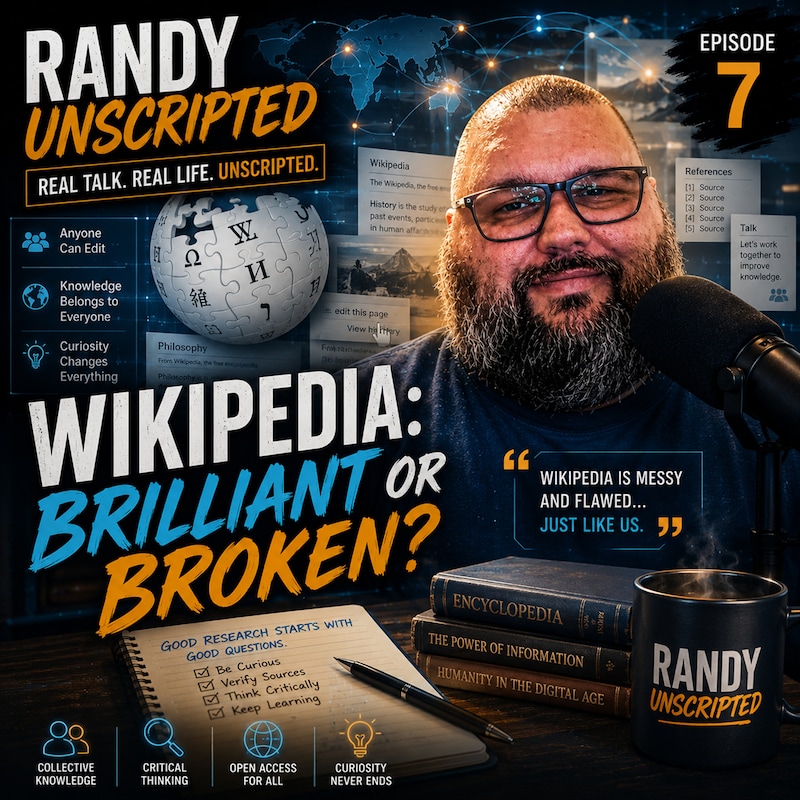
In this episode of Randy Unscripted, Randy takes a closer look at Wikipedia and the enormous impact it has had on the way people access and share information online. As part of the NAPODPOMO 2025 challenge, he explores the history and mission of Wikipedia, the collaborative model that allows volunteers around the world to contribute knowledge, and why the platform has become one of the most widely used resources on the internet.
The conversation also examines the strengths and weaknesses of open-source information, including concerns about accuracy, bias, misinformation, and editorial reliability. Randy reflects on the importance of critical thinking, digital literacy, and responsible research habits while recognizing the value Wikipedia provides as a freely accessible educational resource for millions of people worldwide.
Transcripts
:
Wikipedia is the best thing ever.
:
Anyone in the world can write anything they want about any subject.
:
So you know you are getting the best possible information.
:
Hey everybody, welcome back to Randy Unscripted.
:
This month I'm taking part in NAPOD POMO, the national podcast post month,
:
where podcasters around the world take on the challenge of creating and releasing an episode
:
every day for the entire month of November. It's a great way to stretch your creativity,
:
explore your ideas, and just talk about things that make you think. Today's episode is one that
:
hits close to home for anyone who's ever gone down an internet rabbit hole,
:
and I know I'm guilty of that plenty of times. We're talking about Wikipedia, what it really is,
:
the good and the bad of it, and how it's shaped the way we live and we learn today.
:
When you think about it, Wikipedia is kind of amazing.
:
It's not a company, and it's not a news outlet, and it's not really a traditional encyclopedia
:
either.
:
It's this massive living collection of human knowledge, written, edited, and maintained
:
by everyday people all over the world.
:
If you've ever looked up a movie or a scientific concept
:
or even a small-town historical event,
:
chances are you ended up there.
:
Wikipedia has become the world's reference desk.
:
But what makes it so fascinating is its mission.
:
The Wikimedia Foundation, the nonprofit behind Wikipedia,
:
has this vision statement.
:
Imagine a world in which every single human being can freely share in the sum of all knowledge.
:
That is a bold statement.
:
It's not about selling ads or subscriptions.
:
It's about access, about openness, and most importantly, it's about collaboration.
:
At its best, Wikipedia represents the Internet's original dream.
:
Free information for everyone.
:
but like a lot of streams reality tends to get a little bit messy
:
so let's start with the positives because there is a lot to appreciate about wikipedia
:
wikipedia has broken down barriers that used to keep knowledge locked behind library doors or
:
behind paywalls it's free it's global and it's available in more than 300 languages
:
It doesn't matter if you're a college student or a teacher or just someone curious about how black holes work.
:
You have instant access to a massive pool of information.
:
It's also collaborative in a way that never really existed before.
:
Anyone can edit it.
:
If you spot an error or you have a better source, you can jump in and you can fix it.
:
That means Wikipedia can grow.
:
It can evolve.
:
It can update itself faster than almost any traditional source of information.
:
And for educators, like me in a previous position, it's become an unexpected ally at times.
:
For years, teachers have been telling students, don't use Wikipedia, and some still do.
:
But the conversation has started to shift.
:
Now we're saying, use it, but use it wisely.
:
It's an amazing starting point for research, and it teaches critical thinking, like how to check citations, how to compare sources, and how to understand context.
:
In many ways, Wikipedia has democratized knowledge.
:
It's not perfect, but it's accessible, and that is very powerful.
:
Of course, the same openness that makes Wikipedia great can also make it unreliable.
:
Since anyone can edit, that means anyone can introduce mistakes, sometimes accidentally,
:
sometimes intentionally.
:
There have been plenty of cases where misinformation sat on pages for days,
:
even weeks before someone caught it and corrected it.
:
And then there are what some people call the quote-unquote edit wars.
:
That's when contributors can't agree on what's true.
:
In controversial topics, that can get messy very fast.
:
Wikipedia tries to enforce a neutral point of view.
:
But neutrality is tricky when real-world issues are full of nuances and of bias.
:
There's also the issue of who's writing.
:
Studies have shown that a small percentage of users make most of the edits to Wikipedia,
:
and that group tends to be less diverse than the world it's writing about.
:
That can lead to uneven coverage.
:
You know, like some topics get deep, detailed pages, while others,
:
a lot of times I hate to say it, especially about women and non-Western countries or
:
minority communities, are barely represented.
:
As an educator, I've seen how students sometimes treat Wikipedia as the final source instead of the first.
:
And it's easy to forget that even a well-written article might be missing context, or it may be relying on outdated information.
:
So while Wikipedia gives us incredible access, it also asks us to be responsible users.
:
It's a reminder that open doesn't always mean accurate.
:
When we step back, the impact of Wikipedia goes far beyond just having an easy place to look things up.
:
It's actually changed how we think about knowledge itself.
:
Before Wikipedia, information was something we consumed.
:
It was written by experts, published by institutions.
:
It was distributed through official channels.
:
Now, it's something we co-create.
:
We add to it.
:
We question it.
:
And we update it in real time.
:
That is revolutionary.
:
It's influenced education, journalism, and even technology.
:
Journalists rely on it as a quick reference.
:
Sometimes too much.
:
But they do.
:
Artificial intelligence systems, including the ones that we interact with every single day,
:
often use Wikipedia data as a foundation that they begin to build off of.
:
That does have the chance to create a feedback loop.
:
Like, for example, if Wikipedia gets something wrong,
:
that misinformation can spread, and it can spread easily,
:
and can spread in some surprising ways.
:
But there's also something deeply human about it.
:
Wikipedia is like a mirror of the world.
:
It's showing what we care about, what we argue about,
:
and what we think is worth recording.
:
It's not just a collection of facts.
:
It's a reflection of our collective priorities
:
and our blind spots.
:
At the end of the day, Wikipedia isn't perfect.
:
But maybe it was never meant to be.
:
It's messy.
:
It's flawed.
:
It's constantly changing.
:
Just like us.
:
And that might be what makes it so remarkable.
:
It proves that knowledge doesn't have to be locked away in a textbook
:
or controlled by only a few experts.
:
It can be open, evolving, and shared as long as we approach it with curiosity
:
and a little bit of skepticism.
:
So the next time you're on Wikipedia at, you know, two in the morning,
:
reading about the history of coffee or the physics of time travel,
:
remember this.
:
you're not just learning from the internet you're participating in one of humanity's
:
biggest experiments in collective knowledge
:
thank you for joining me for another episode of randy unscripted this episode is part of my
:
napod pomo challenge 30 episodes in 30 days exploring ideas both big and small
:
until next time remember to stay curious keep learning and always keep asking questions
:
randy black randy black randy black randy black randy black randy black randy black randy black