Shownotes
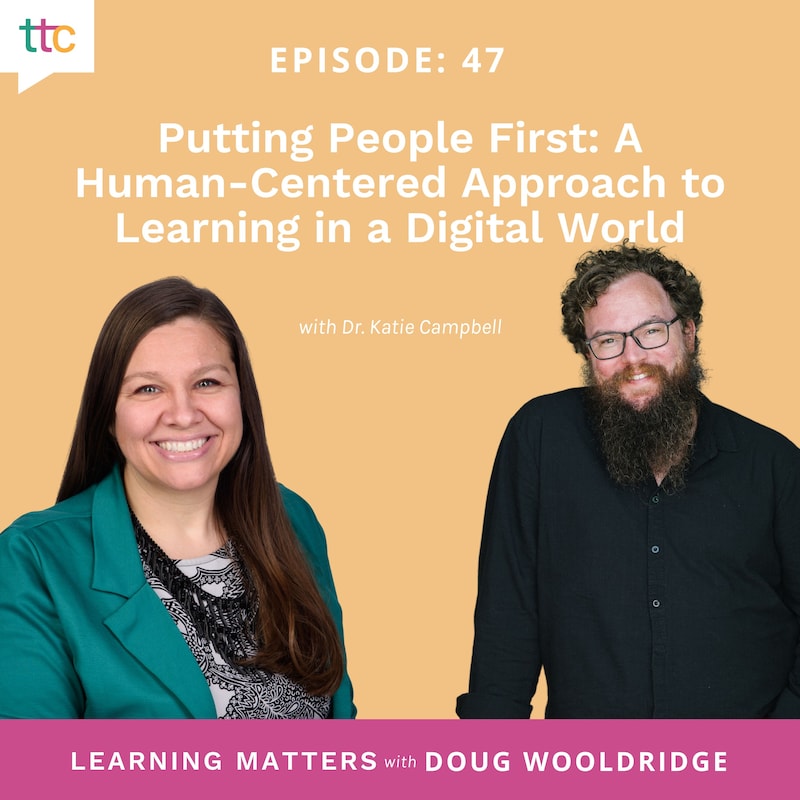
In this episode of Learning Matters, host Doug Wooldridge sits down with Dr. Katie Campbell, Senior Director of Learning and Talent Management at a Fortune 1000 data and financial services company.
Dr. Campbell shares how she’s reimagining leadership development—moving beyond the traditional Nine Box model to create a values-driven, data-informed approach that actually builds stronger leaders.
From embracing AI with a human touch to designing learning experiences that truly align with business goals, Katie offers practical strategies for anyone shaping the future of work and learning.
You’ll hear about:
✅ Rethinking succession planning and leadership pipelines
✅ How to make learning programs more human-centered
✅ Practical ways to drive AI adoption in the workplace
✅ Why values-based assessment beats one-size-fits-all models
✅ Katie’s personal journey—and the advice she’d give her younger self
Whether you’re a learning leader, HR professional, or simply passionate about talent development, this conversation will inspire you to think differently about the role of learning in a rapidly changing world.
🔗 Connect with Dr. Katie Campbell on LinkedIn: https://www.linkedin.com/in/drkatiecampbell/
At ttcInnovations, we help businesses create lasting change with immersive learning experiences. Through instructional strategy, design, and content development we empower employee confidence, performance, and results.
💡 Looking for custom learning experiences without licensing fees? Contact us for a free consultation! https://bit.ly/4aOhPKq
🤝 Need extra hands fast? Try staff augmentation! Click here to get matched with experts in 48 hours - no job posting needed. https://bit.ly/3RiEfLT
🚀 Simplify outsourcing with our subscription plans - predictable pricing and limitless innovation. Book a meeting for your free first week! https://bit.ly/3RiEfLT
🎯 Boost results with serious games for optimal retention and results. Contact our Sales team to learn more: https://bit.ly/3RiEfLT
Transcripts
I think there's a lot of great opportunity. tend to be pretty optimistic, so I want to at least start with that part. And I am really excited about the emphasis and focus on learning and development. I think one of the greatest opportunities facing us is
There's so much technology coming at people in so many ways. And not that the company I work for is the same as everybody I've heard, know, varying degrees of how this is manifesting, but in particular, when you think about AI, the pace of change and the number of things coming at people is massive.
Welcome back to Learning Matters. I'm Doug Wooldridge, your host, and I'm very excited to be talking with our guest today. She drives growth at the intersection of people and profit, coaching leaders and building programs that scale businesses. She's known for pioneering new programs and leading change in fast-paced, complex environments, turning strategy into results. She's led global transformations and created award-winning learning initiatives that boost retention and prepare teams for the future.
alent management at a fortune:Such an exciting intro. Thank you. I feel very formal now.
(:Awesome. Well, as always, we'll be discussing the world of learning and development today. And I'd like to start off with this, Katie. What strategy matters most in learning and development?
I will answer actually with two if that's okay. Okay, the first one I feel like is kind of a given. Any, I work for a club.
Let's do it.
(:publicly traded company and any publicly traded company, course, is supposed to be generating shareholder wealth as not cool as that sounds, right? So from like a board of directors and business impact perspective, I think many of those individuals would say that succession and making sure that we have a great leadership pipeline is one of the utmost important things that we can do in talent management, HR, any of those sorts of functions. So that's a big one. And then I would also kind of add as a corollary.
to that human capital planning and that takes different flavors in different places. So for me, what I mean about that is, you know, thinking about the strategy playbook for that business, thinking about what skills we have versus what skills we need, and then finding ways to close those gaps so that we can make sure our business is prepared for where it needs to go.
And when we were talking earlier, you mentioned the Nine Box and how it might be a little outdated. And you mentioned there's gotta be a better way. And can you kind of share some of the first steps of getting away from that? I'm here for all the salt.
salty right away. Let's do
So talent management is a big focus of my job.
(:And I have spent a long time and, you know, here as a part of academics, any of those things looking at what does that look like? And for most places and most people, it is the nine box. I don't mean to disparage the nine box. do appreciate it and I recognize its value and I do think it's a good display of data. And when you think about the nine box versus what results you're trying to accomplish and, you know, really affecting development and succession.
and it's part of a bigger whole. And I am anticipating that people will say that in response to what I'm saying and they're right. So I'm not disagreeing with that, but at the end of the day, what should it be?
Right? What should it be and what should we be doing? And I ask that question a lot of a lot of people and love that I get to ask this of this audience because I feel like there has to be more. And we've started exploring that in our small part of the world. And I'm always excited to hear from people what they're doing and how they're doing it because I feel like some incredible innovator out there is going to have an amazing answer for that question that can help all of us to do a better job there.
Talking about being a people-centric focus approach, how do you come to this mindset? Is this just something that you've kind of grown accustomed to working towards, or have you kind of had a come to Jesus moment in the past to get here?
That's a very loaded question. I'm not sure that there's a simple answer for that question. I would imagine it's probably an amalgamation of a lot of things, but just as a human, think we're all.
(:people first and then employees second. And so if you think about the implications of that, at least for me and in my experience, most people are not working because we're independently wealthy. Most of us are working to provide a better life for ourselves, our family, and the people we love. And so if you think about a lot of what we experience, anytime we can prioritize, thinking about the person is great. As I just mentioned, I work for a publicly traded company. And so obviously there's times where those two things
aren't the same and part of you know maybe what our role as leaders is is to try to find ways to make that a higher priority as often as we can especially in the age of AI.
How do you make it a priority? What is it in your organization that you guys focus on with the learners to really engage them, keep them interested and try to get them to retain as much, also just understand that this is an investment from the company into them as an employee.
So I think they're.
a lot of what the end result ends up is affected by how well we assess and troubleshoot at the beginning. And one of the other things we talked about, and I think one of the other identifying things that we all have as a community and learning is that learning isn't always the right intervention, right? So planning upfront and really doing a quality needs assessment and understanding the problem and what we're trying to solve, I think makes everything better
(:for everybody in the end, not only to be human-centric, but also to meet the needs that you're trying to meet and making sure that you're solving the right problem and all of those things. So I am a firm believer that planning and also caring for what it is that you're trying to solve from the beginning correctly. And of course, making sure that you have alignment throughout the process is really a good way to help make all of those things better towards the end.
And speaking of solving problems, what do you find is the biggest issue currently that we're facing as a learning community?
I think there's a lot of great opportunity. tend to be pretty optimistic, so I want to at least start with that part. And I am really excited about the emphasis and focus on learning and development. I think one of the greatest opportunities facing us is there's so much technology coming at people in so many ways. And not that.
The company I work for is the same as everybody I've heard, you know, varying degrees of how this is manifesting. But in particular, when you think about AI, the pace of change and the number of things coming at people is massive and not everybody feels great about it, right? Going back to how we feel about it. And so when you think about, you know, trying to get everybody on board and not only that, but also just keeping up with the number of tools that are coming at us and in the pace that they're coming at us and, making sure.
if you're a decision maker that you're picking the right tool that will actually, again, meet the needs that you're trying to solve for. It's a big challenge right now and really trying to get adoption and to get people excited about AI, I think is a great opportunity for all of us. But then making sure that we're...
(:thinking about it through the lens of the company and also shepherding the behaviors that we want if it's coming through a business environment. There are some risks and other things that we have to care for as well. to me, that's a great opportunity and a thing that we need to care for as well in the community. then certainly measurement is another big one that we all probably hear about and identify with as well. So I would say those would be my top two.
Did your organization drive adoption for AI or are there any tools that you guys are using in your day to day life that's been a big help?
So I work at a Google shop. Not everybody has that as a part of their daily life. And that can be interesting in some cases, because a lot of platforms really are built for their competitor in that marketplace. But one of the cool things about that is that I feel like
Google has done a whole lot in terms of emphasizing widely available AI tools for everybody, which is cool. And especially for us, that's a great opportunity, right? Because just by being a Google shop, you get a lot of great tools that come with that. So really excited about that. I think, you know, to your point again, going back to that human centric.
helping people understand what it is and getting them to want to use it. That culture aspect is a big part of what I think we're focusing on. My boss, for example, did a really great thing the other day that I loved, which was a fun and funny photo. Like in our team chat, everybody for the whole department of HR, we all were sharing some fun photos. And what she also asked for that I thought was brilliant was the prompt that you used.
(:to get the results so that those spectacular photos, people could see the prompts and learn from those and start putting together. And I went to a Gartner conference and they also did an image and it was like a quiz in between sessions up on the screen where it said, you know, choose the prompt A, B, C or D that got you this picture. And so there's these cool, fun ways to get people thinking about it and also helping kind of sharpen those skills.
that I love and I've started to see a lot of, I am trying to pick up as well, just because I think in learning, we do a lot of sharing of those tactics. So I love hearing about different ways that people are bringing it to life. But I think even before that, back to our earlier discussion point around planning, we have some utilization data, which has been awesome and helpful to help us understand what groups are firing on all cylinders, what groups maybe aren't as excited. And then looking across the different groups, what
a kind of standard user might need as opposed to what one of our data and analytics colleagues or maybe our tech colleagues need is very, very different. And so then thinking about not only the breadth and depth of the needs and what all they might need to care for, but in addition to that, how can we make people feel good about it and actually want to do it and see places in their life where this can really help them and then allow them to focus on.
the really meat and potatoes parts of their jobs that they haven't been able to because of some busy stuff that's been distracting them.
Do you and your team have any exciting projects or initiatives coming up this year that you're most excited about?
(:Yes, thankfully. Otherwise that might be a problem, right? One of the ones that I'm excited about, kind of touched on a little bit. I am sort of thinking about it like a differentiated development process. Whereas just instead of only a nine bucks, we introduced values based assessment for the company that we have our values. You if you think about it, most
processes care for, what are the person's goals, and then some proponent of like how are they as a human and how are they functioning as a human, so that what plus the how. And the what is very different from person to person, but when we think across our layer four leaders, which is like our vice presidents and the people who are on a lot of those succession plans, the behaviors are pretty well defined and also relatively consistent from person to person.
So what we are doing this year is having our leaders assess their whole teams and then creating kind of a heat map across that layer four so that we can think about how we raise that water level for all the boats. Cause that's our critical leadership level. And that's where a lot of our, you know, succession bench strengths will come for our, you know, direct report to the president roles. And so of course that's a huge focus for us and something we need to report on, but it gives us to something outside of just,
you know, a person's assessment leader, I am in no way again undervaluing the leader's assessment. They see that layer four leader living and breathing every day, their life, their job, how they work. So I don't mean to again devalue that, but I also think, you know, in the longer term, especially from a succession lens, that leader, if they win the lottery, isn't gonna have a whole lot of say about what's gonna happen, right? So how can we make it a little bit more assessment-based and database as opposed to
you know, putting somebody in a box. And so we've been able to come up with a way to assess based on the values points and give people a score. And at least from year year, we can also not only see for that layer what they need to work on, but then also, hey, how is this person developing? Right? Because at the end of the day, I am excited to share that we also have goals from our leaders around, you know, helping make more successors ready.
(:things like that. So it's really important that they do live and breathe it, which I love. And of course, for my job is really incredible. But we also need to be able to look year over year at what are we doing and how are we doing it. And I'm excited about the prospects. I think next year's iteration will have more of a 360 so that other leaders will also get to assess that leader. But to start, we wanted to just at least let people assess their own teams and get used to the new process. And if anybody has any other
you know, great ideas or ways of doing that that they're excited about. I would love to hear about those.
Off the top of your head, what's one of the biggest challenges that you and your team have had to overcome in recent time?
I think the pace of change and all of the things coming at us, you know, we are really excited about AI and the possibilities. And I also appreciate that we want to make sure that we're thinking about change management and bringing people along and not having it feel like something that's being thrust upon all of us that we're not excited about, right? So I love the idea of being thoughtful and deliberate about how we're doing those things.
and also helping people see people like them doing the thing and understanding its impact to their life as opposed to just here's some AI learning, everybody take this, you know, and you're gonna like it and good luck. So I think that's been interesting. And then certainly like a lot of learning and development teams, we are small and mighty and we get to also have a PMO as a part of our team. And so that's cool. And we're very connected then with the projects that are going on.
(:Ha ha ha!
(:We shifted this year to being an agile HR shop, which has been exciting. And so my team also has been front and center in helping our group adopt that new process and help foster that change across the board. Cause of course, HR tends to be one of the catalyst groups, right? So by us having a great attitude and some expertise in that space, we're able to help our leaders also feel as excited and hopefully successfully adopt those changes too.
like to get into some more personal side of things if we could. Tell me about you, Katie. Take me back to the younger days. What led you into the world of HR and learning and development? How did you become a senior director of learning and talent management?
Origin story alert, right? It was, would, a colleague of mine used the term career jungle gym. And I love that so much. I've heard career lattice and things like that. And that's a little more realistic for what, at least what I've seen for most people. And, you the people that I've mentored and coached, there seems to be this perception that a lot of people have a...
clear view and a fully defined roadmap of sorts in their mind for what they're going to do and how they're going to do it. And then at least for me, I'm kind of a perfectionist. And so when I got to the real world part where I needed to figure out what that actually was, I didn't know. And, you know, I was in school and taking school, but I really didn't have a full vision of what I wanted for myself. When I was younger, I shadowed teaching and I had always thought I wanted to be a teacher.
and I shadowed kindergarten and I walked away from it. At the time I might've had some profanity going in my mind, because I do have a little bit of a potty mouth, but I thought there's no way in heck I could do that as a job. That would make me bonkers and kind of let it go. And then went into school, not really knowing what I wanted to do. I...
(:got a business degree and I was fortunate to have a opportunity to go through a graduate assistantship for a master's degree, which I accepted and was excited about. And then I graduated and kind of didn't really know what I wanted. So I worked as a compliance auditor, believe it or not, as my first real job out of college. And then met at a wedding, a lady who worked in corporate learning.
And she was like, I have this job and I think you'd be perfect for it. You should come talk to me about it next week. And I am grateful to the universe and whatever forces made that happen because I've been in learning and development ever since. feel like I found my calling, you know, my thing, my people. it was, it was not, yeah, it was not as intentional as a lot of people have, and it wasn't a neat package, but.
Once I got there, I was like, this is awesome. I love this. I wish I would have known this was a thing, you know?
Definitely. And if you could go back in time, let's say just coming out of college and give yourself a piece of advice. What might that advice be?
Where you can, try to find places that you can stress less and enjoy and appreciate what's going on around you more because you never get to redo any of those experiences or, you know, when you think about like family and all those things, I wish I would have had a greater appreciation for all of, you know, those things as a younger person and had prioritized those more because life is so short.
(:and you don't realize it until you're a little bit older. And then you go back and you say, man, I, especially in some of my professional pursuits made choices where I sacrificed family. And if there was one thing I could go back and change, it would be that I had always prioritized my family instead, because that is who is gonna be there when things are bad. And that is who's gonna pick me up. And that's who loves me and cares about me. As much as we want our company to...
to be that and to do that. Not all, but very few companies are actually that caring about their employees, but your family are the ones who are there when the rubber meets the road. So not really professional per se, but human advice, I would say.
Yes, I love humid advice. Well, lastly, before I get you out of here today, where can people connect with you?
I'm on LinkedIn. Dr. Katie Campbell, think is the short link there. can't remember. should have had that already. Okay, perfect. was like, hopefully if there is the next time and I love, I'm in a lot of different groups about learning development, HR communities. I was not always in HR. I have actually a lot of operations experience, which I think makes me a little bit better at my job. Cause I also understand the business and what they've experienced.
That's OK. We'll have it in the show description.
(:So I'm in a lot of operations forums and those sorts of things and would be happy to connect, email, learn from. I am a lifelong learner just as a human and always want to be better and know more and learn from people who are doing great things. So if you're a person who mentors and you feel like you have things that you could teach me, I would love to learn them. So any of those things are always exciting. I'm a crazy dog lady. I also love dogs.
We don't have human children. We have free four-legged babies and we're outdoor people. Like I like to be outside. I like good food. I like any of those things. So those would all be things that I would love to connect with anybody about. you know, just anything else that might be awesome that I don't know that I should know.
Well, that's wonderful. And thank you so much for joining us today, Katie. It's been a real pleasure.
Same, thank you so much. Have a great rest of your day.
Thanks. If you learned something new or had a laugh, share the show with someone you know. And this has been another episode of learning matters. As always, like and subscribe wherever you get your podcast and don't hesitate to reach out to us here at TTC innovations for all of your learning needs. See you next time.


