Shownotes
Welcome to the Epilogue...this time I'm talking to award-winning and best selling author Gail Carriger! We discuss her Parasol Protectorate and Finishing School series, the archaeology of writing, writing connected series, and most especially, the Heroine's Journey--what it is, the structure, and viewing as an alternative to the Hero's Journey.
Chapters:
- 00:00 Intro
- 02:19 The Parasol Protectorate
- 13:28 The Archaeologist Role of the Author
- 22:58 Alien and Normal in Science Fiction
- 35:11 The Heroine's Journey
- 45:09 The Hero's Journey vs. The Heroine's Journey
- 56:41 Genre and Audience Alignment
- 01:01:54 Finding Your Role as an Author
Gail's Information:
Gail Carriger writes books that are hugs, mostly comedies of manners mixed with steampunk, urban fantasy, and sci-fi (plus cozy queer joy as G. L. Carriger). These include the Parasol Protectorate, Custard Protocol, Tinkered Stars, and San Andreas Shifter series for adults, and the Finishing School and Tinkered Starsong series for young adults. Also nonfiction: The Heroine’s Journey. She is published in many languages, has over two million books in print, over a dozen New York Times and USA Today bestsellers, and starred reviews in Publishers Weekly, Booklist, Kirkus, and Romantic Times.
Her first book, Soulless, made Audible’s Best list, was a Publishers Weekly Best Book, an IndieBound Notable, and a Locus Recommended Read. She has received the American Library Association’s Alex Award, the Prix Julia Verlanger, the Elbakin Award, the Steampunk Chronicle‘s Reader’s Choice Award, and a Starburner Award. She was once an archaeologist and is fond of shoes, cephalopods, and tea. Get early access, specials, and exclusives via her website gailcarriger.com.
Gail's Books Mentioned:
The Heroine's Journey - or audiobook version
Soulless (Parasol Protectorate Book 1) or audiobook version
Prudence (Custard Protocol Book 1) or audiobook
Etiquette & Espionage (Finishing School Book 1) or audiobook
Crudrat (Tinkered Stars Book 1) or audiobook
Divinity 36 (Tinkered Starsong Book 1)
The Sumage Solution (San Andreas Shifters Book 1) [High Heat]
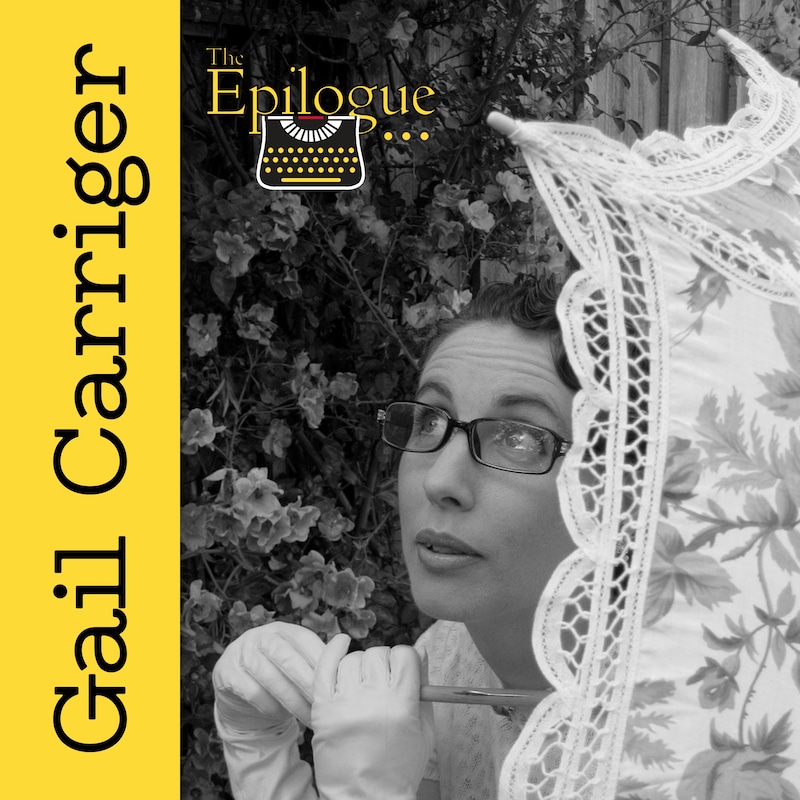
Gail Carriger photo credit: Vanessa Applegate.
Visit theepilogue.net to view our interviews, sign up for our newsletter, and watch for upcoming member bonuses such as extended interviews and full video.
Transcripts
In a world of epic sagas and legendary quests where every tale tells the same story, one hero must rise alone to defeat all opposition. One journey, one story. But what if there is another way?
It is a way of exploration and allies where victory lies not in defeating evil, but forging new alliances. And the end is not solitude, but finding peace. What if your story needs not a hero, but a heroine?
Welcome to the epilogue where everything makes sense in regards to retrospect, hopefully. I am joined today by Gail Carrier, New York Times and USA Today best selling author.
She's written several series of books, perhaps most known for the Parasol Protectorate series, also the Custard Protocol and the Tinkered Stars series. She has also the San Andreas Shifter series for adults as well as the Finishing School Tinkered Star Song series for young adults.
She has also written the Heroine's Journey, which I'm sure isn't as generally popular as her other books, but I think is very valuable and it's a great different look at structure for writers.
She's received the American Library Association's Alex Award, the Pre Julia Verlanger, the Albican Award, the Steampunk Chronicles Readers Choice Awards, a Star Burner Award. She also provides tea drinking advice and is a snappy dresser.
Gail:So, ah, very, very flattering. Thank you.
Michael:So welcome to the show. Thank you very much for, for, for showing up here.
Gail:Thank you so much for having me. I'm, I'm delighted to be here, ready to talk books and things.
Michael:So I think it makes sense to start with the Parasol Protectorate series. It is a supernatural comedy of manners series taking place in Victorian London. That's correct. Steampunk. It's.
I've heard it described as urban fantasy. Yeah, but it's historical.
Gail:Yeah, yeah.
Michael:Would you like to describe it better than, than me?
Gail:No, that's it. Everybody struggles with this one.
Michael:Yeah.
Gail:I think one of the early pitches was Buffy the Vampire Slayer meets Jane Austen. I might say Buffy the Vampire Slayer meets Bridgerton at this juncture. But yeah, it's kind of a mashup.
I'm very heavily influenced by writers like P.G. wodehouse or Jerome K. Jerome. So there's quite a bit of sort of absurdist comedy as well.
And yeah, I always like to say, you know, things explode, everybody runs around and then they drink tea and talk about it. So, you know, that's kind of what I write.
Michael:Melodrama.
Gail:Yeah. Yeah.
Michael:There's a lot of, yeah, a lot of tongue in cheek humor.
Gail:Yes. I have a lot of fun. Nothing is taken Seriously. And yeah, they're quite silly. And I don't mind being thought of as quite silly. So it works for me.
Michael:It's great.
Gail:Yeah. And nobody knew where to shelve them.
I was like, I thought it would never sell to a publisher because I was like, who knows what category these crazy books are in? But the publisher picked up solas and I was like, well, we don't actually know what to do with this.
Like, we don't know what kind of COVID to put on it and all this sorts of thing. And then it went out into the world and went out to bookstores and they were similarly confused.
And so it got like accidentally end capped and people would have stacks like near the till because they were like, we don't know where to put this, but we like it, so we want to like hand sell it to people. So it was this sort of slow burn success despite itself.
You know, it got put in like the romance section and then in the sci fi section and then the YA section. And so I ended up getting readers from all of these different genres. And it was, yeah, it was a. It was a. A crazy time back then and.
And it was a crazy book to be successful because it just doesn't sit comfortably in any particular niche.
Michael:I think that's a great tip maybe for writers who are looking to get their future work end kept. Just make it impossible to categorize. It'll just kind of work its way to the middle.
Gail:Yeah, I don't know that you can do that anymore. I think the algorithms in general and those few remaining bookstores, you know, force books into a genre now. But.
But yeah, back in the early days, for me, it was. It was a. It was a surprise, Surprise success. Success.
Michael:That actually speaks a lot to the narrative voice here because you are. It is a comedy of manners. Exactly like you think, except that there's like vampires and werewolves and dirigibles and weird.
You have the steampunk elements.
Gail:Yes. Yeah.
Michael:You have the etiquette rules around vampire blood drinking and you know, the single women need to be escorted because if not, then you know, that's. It's perfectly okay.
Gail:Yes. There could be a vampire. Yes. You have to wear a dress with a high collar. Protect your neck. Exactly.
Michael:And there's something about that with the historical elements that you're rethinking there that I would like to touch on. But like the narrative voice first, there's a. You. You're having fun with this, but there's very much a control of language and intentionality.
Here you're using the narrative style of the. What would have been the contemporary literature from Victorian times as much as you can. And it's authentic to the story.
It doesn't read like an outright parody like, say, Pride and Prejudice and Zombies is. How do you. How did you find that balance and how. How to write the flow?
Gail:That's a very interesting question, because I did want it, and I still do want it when I write this, this. This in this particular time period or adjacent to it, to be accessible specifically to American readers, but to English language readers in general.
So I don't want to be too sort of precious about vocabulary or too. To Dickensian or in my case, it was sort of Elizabeth Gaskell, who was sort of leaning into. But. But definitely influenced by.
By Austen and Dickens and Gaskell. Admittedly, they're all sort of different time periods, but essentially that style.
And also sort of Jerome K. Jerome and Woodhouse, who are later, you know, closer to turn the century and just after. But that sort of absurdist humor. In a way, it's parody, but it's like. It's a parody of the Victorian era, not of. Of a. Of another writer or.
Or of the authors of that era, but of the era itself.
And, yeah, I want it to feel, for lack of a better way of putting it, as a sort of gentle humor where I'm kind of like, we're not gonna punch up or punch down.
We're just gonna like, like, kind of collectively mock, but also seat characters very comfortably in this absurdist universe and have them be naturally absurd as part of that arrangement. Especially in my case, vampires. Always. I've always found vampires a bit silly, so I just.
I make them sort of very caricature, larger than life, sort of Oscar Wilde or Scarlet Pimpernel esque. So, yeah, I think it was definitely intentional. I was definitely thinking about it.
I definitely wanted a historical flavor to come across, but for it not to be abrasive or difficult because of that. And humor is one tool for that.
It does help if you're a little familiar with the works of that time period or perhaps have immersed yourself in BBC costume dramas or something like that. I think it is a little bit more comfortable if you have some kind of background in it, and the voice has to do with a lot of that.
And so the way I write this period is a little bit more kind of casual and breezy than you would write it if you were trying to do a straight up parody of the works of the time period. So, yeah, I mean, I will go into flowery language and describe fashion and stuff like that.
But generally speaking, I'll pay it out at the very end of that description with something very funny or a rule of three being activated or very silly piece of clothing that's being worn. So that I'm kind of rewarding your patience for having waded through what amounts to kind of an Austen's description of a ball.
So I think also if you get into the sing song nature of my kind of vocabulary when I'm writing these books, you also get used to being rewarded for being patient with something that's perhaps a little bit more historical than you're accustomed to, which is important.
Michael:That's part of the time period, like compared to now. It's really refreshing to see nowadays.
And I think there is a little bit of, I don't want to say a trend, but there is more commonly books coming out that are kind of anti Hemingway in a way. You get a little bit more of like the people who are reading this like words. So let's give them words. Which I really appreciate.
Gail:Yeah. I'm not gonna. I don't sugarcoat. I like long juicy words and vocabulary and descriptors and I am gonna use the right words word.
Like if I'm talking about a fish, you. I'm going to call it a fishu.
And you know, you can go Google what that means or you can infer from context that it's a kind of a drape that's going around the neck of that the ladies are wearing and move on with your life.
So it's sort of that kind of thing as well is I try to write in such a way that you will understand the plot and enjoy the characters and the dialogue and what's happening in these books even if you maybe don't entirely understand some of the actual objects of the world around these characters. And I'll do that with made up words too.
So I'll make up a piece of technology for the steampunk universe that is part of the plot of the book and I'll sort of explain what it does. But it's not vital that you know mathematically and structurally exactly how it works. Right.
Michael:I like those too. They have a.
Gail:They.
Michael:They sound really appropriate to the 19th century.
Gail:Precisely. Yeah.
Michael:Scientific sort of. Let's, let's. I don't even know what to call this. Wurless.
Gail:Yeah. Yes, exactly. Exactly, exactly. A theoregraphic chamber or something. Right. And that's part of it too.
And I try to again to sort of not Break the suspension of disbelief for the. For the readers. I want to make sure that the. The objects and the things fit with the time linguistically.
So, and that includes, like, the names that my characters have.
But, you know, often I will, like, pick a piece of clothing or an object in a room that maybe did exist in the Victorian era, but I'll specifically choose to put it in that scene because its name is so juicy Victorian, you know, And. Yeah, and that's very intentional.
And then if I do want to break the suspension of disbelief, like naming a character Bob or something, it's also very intentional, like, I'm making that a jarring moment because I want my readers to pay attention to that character or I want them to laugh about what a silly name that character has or something like that. So, yeah, language is very much a sort of toy for me in this context.
Michael:Yeah. Which is. Which is great. And people are reading it for fun, so it should be written for fun.
Gail:Yes, I say that a lot. I always say when I'm teaching or when I'm. Or when I'm just, you know, talking to newer writers.
I personally have the, I guess, motto that I am an entertainer and I am meant to entertain.
And because I write genre, commercial genre fiction, essentially, people are hopefully reading me for pleasure, and I don't want it to be an obligation. And I always say, also, if you're not enjoying it, stop, don't, don't keep reading. It's okay. You don't ever have to finish it.
But I want primarily to entertain and in my case, bring comfort. That's part of. Part of my. My motto as well, I guess. And. Yeah, and so I try to stick with that stance. I get.
I would say it's not a particularly, like, noble stance, but I'm like, I want to entertain. So I do that. Like in my newsletter, I do that when I'm on social media.
Like, I am a fiction writer, which means entertainment is the place I fall on the wheel of what's my purpose? And I want people to enjoy the interaction as much as possible.
Michael:So related to that question, though, which I kind of put a pin in this earlier, is historical. We'll call it authenticity, because. So first of all, you have a background in archeology.
Gail:I do.
Michael:You had. You had a few degrees.
Gail:Yes.
Michael:Two masters in two different countries.
Gail:Wow. You did your research. Yes.
Michael:On this.
Gail:Yes.
Michael:Here's the thing. My wife just got her degree in archaeology, so that's why a little bit of this is. Is bleed over.
I find it fascinating and I think it's really helpful for writers, just as, you know, information. I guess I'll throw that to you. How does that play into your writing?
Because even though you're not rating what we would call straight historical fiction necessarily, so far as I know, there could be a big cover up about the vampires and werewolves in Victorian London. The time, the feeling of the time is coming through, I think.
Gail:I mean, the reason, I always say one of the reasons I wanted to become an archaeologist is the closest you get to touching history, like to actually being in history. And I have done that.
Like I have in fact handled a piece of pottery and put my fingers in the same places that we had the fingerprint imprints from, say, a medieval potter or something. And it's just, it's such a cool thing to be able to do.
So that's, that's definitely why I'm attracted to historical settings in particular, I think, I think it's also why I was very attracted to steampunk is I'm very object driven.
And that's where the archaeologist comes in rather than the cultural anthropologist or the, or the umbrella of anthropology in general is this, this like a lot of my characters have like icon objects, like objects that represent them, like Alexia and her parasol and Sophronia and her fan. And so that is also part of it.
Again, fashion and the manipulation of perception through appearances and objects and possessions is also very interesting to me as well.
So I do objects as characterization as to characterize inanimate objects a lot objects, often houses and things, often have personality the way I write them. I was very influenced by a nonfiction author called Gerald Durrell, who does that all the time.
And so, yeah, that's a part of my lexicon, I would say as well. So I think it was a natural sort of home for me. The archaeology is also very young science and its origin is in the Victorian era.
And so we have to study it as part of the degrees. When you get archaeological degrees, you need to know where you come from and how you're. Your field began, so to speak. So that's part of it as well.
So I was sort of familiar with some of the scientific theories from the time period and it was sort of easily accessible to me.
So that's also why I take my characters at different books and different times to places that I have traveled, often places that I traveled in order to excavate or places where I had an association with the field. So, yeah, it's definitely there and it's definitely something I think, think about and that probably informs my work more than I realize.
Michael:I can see that in the way that we touched on. Like you will, you're thinking like an archaeologist backwards about like the history, the fashion, the objects that like this had this purpose.
We know because we have it written down. But if I was to like, think about why would this high collar be important if there's vampires around? Why would you know that? Sort of.
There's a branch called experimental archaeology, which.
Gail:I also work with. Yeah, yeah.
Michael:Yes.
Gail:Yeah. And it's a very. It's a fun way to train. So I always say I don't write alternate history, I write re explained history.
So the idea being every time I write in this universe and I've gone further back in time and forward in time, it's still pretty much recognizable. So, like the fashion and the history and the. Has all evolved along the same time frame that we are familiar with.
time. Parasol books are like:So they're during the time of what was euphemistically called the Queen Victoria's Little Wars. So we've gone.
We've gone just to the beginning of the Victorian Empire for this latest book, which is a whole different set of circumstances, but it's still my universe and still what is going on. The.
The mainstay battle still happened, as opposed to the original concept of alt history, which was to take a battle and then make it go differently in the. In the theory of parallel universes, obviously. So this is not a parallel universe. It's kind of the same universe. It's just re explained a little bit.
And so every time I encounter something, and it is a very archaeological thing to ignore the written record, like, ignore the history, what history says, and be like, yeah, but if I was looking at this without the history, how would I explain all of these things?
Objects, occurrences, happenstances, arrangements of governments, social structures, cultural interactions with the presence of something else, a different kind of technology, this sort of dirigible, etheric scientific explanation that everybody's working under.
And these supernatural creatures, which, as we learned through the course of my rather complicated world of 30 odd books, now there are more and different kinds of supernatural creatures. Every time you leave the country, you encounter some other culture's version of a flesh eater.
Or a bloodsucker and a shapeshifter because almost every culture in the world has those two mythological creatures at least. So.
Yeah, so it's really, it's really fun as a, from an archaeological perspective, it's really fun to write because you can re examine culture conflict through the lens of sort of supernatural creatures and you can re examine nationalism and imperialism and occupation and all of these other things.
But I'm, I'm testing its, I'm testing its measure by injecting immortals and supernatural creatures into it who by their nature have a different kind of perspective from sort of the human mayflies that they're interacting with. And that allows me to bring a certain amount of a modern perspective to the table.
Michael:And all of this is still very fun. It's still very, it still has the same absurdist approach to it. So.
Gail:Yes, well, comedy's a serious business.
Michael:It is serious. You have to take it seriously if you want it, your characters to be authentic and your humor to be authentic.
Gail:They have to move through the world taking it seriously and themselves seriously. Or, or, or that immersion that I talk about, that suspension of disbelief, it's not going to work for the readers. It will feel disingenuous.
Michael:But you see why this could be. And talking to the listeners here, you can see why this sort of thinking could be very helpful for writers.
Gail:Yes. World building, absolutely. Another an example I always use is, let's say you're writing a world in which there's, there are no.
A fantasy world where there's no guns or gun power. Right. We're still in a classic, classic, quote unquote fantasy setting where there are swords and that sort of a thing.
But if you have wizards who have fireballs and like pyrotechnic capacity, then you are going to build buildings that are star shaped and etc. Etc. Like your, your environment is going to react to the presence of a projectile weapon.
It's just that it's a different, it's a magical projectile weapon, but you're still going to have the construction and things being built in order to cope with that. Right. If you have dragons breathing fire from the air, then you have an air force situation, right?
Like you, you need to build a defensive capacity to protect against something being weaponized from above, which throughout most of the course of human history we don't really think about in our structures, except for perhaps hail. But you know, it's, it's so it's that kind of thing. Like, just like the, the moment, especially in the science fiction and Fantasy genres.
The moment you're considering how your magical system works, the physical environment around is going to be informed and changed by the presence or absence of. Of whatever you have changed within the world.
I think one of the reasons I moved into science fiction is a lot of sort of the early pulp's hard sci fi authors were very good at thinking about and hypothesizing how technology might change or advance in the future and very, very poor at imagining how social structures might change or advance in the future or even how aliens alien could be. Right. How, how if you.
If you evolve on a planet completely devoid of everything that we expect out of everyday life, you are an entirely alien creature. And so I eventually felt compelled to write science fiction because I was like. Because I wanted to write cultures that were profoundly alien feeling.
Michael:I've really appreciated how there have been several breakthrough science fiction stories lately that have taken less of a guys in makeup approach to building their alien creatures. You know, with just lumpy foreheads. Yeah, we've had some.
Gail:Several good ones that are very simple premise. There's a.
There's an awesome romance author who has a sci fi series and the simple premise is that the monkeys are actually the rarest evolutionary strain and it's actually the invertebrates that made good. So it's all squids and octopi or whatever that actually, actually managed to evolve capacity on most planets.
And so when humans eventually do make it out into space, it's populated by mostly squids or variants of squids. Right.
Michael:And that could be our future here.
Gail:And. And they're. And. And creatures with bones are sort of given a sort of. Really. That doesn't. That doesn't seem to.
That doesn't seem to be very safe or logical. You're so easily breakable. You don't bend or squish. And it's sort of a charming like very into.
This is set like these adorable little romance stories. Earth Fathers are Weird, incidentally is the first one that I highly recommend to everybody out there. Earth Fathers Are Weird. Anyway, it's just.
But it's just I love that kind of thing where you have this like juicy little nugget of a thought and then you're like and how. And how does that change the world or the universe that you're then going to write in?
Michael:I was going to talk about your extended universe.
Like you had started with a core series and you have five books, you have connected series and you also have novellas and short stories that maybe standalone.
Gail:Yep.
Michael:Some of this kind of feeds into one of my questions about writing romance series. Ah, how can you keep the. Do they. Don't they going?
Gail:So that's interesting. So if you, I think you know, speaking to my fellow authors out there, the readers I think know this whether they articulate it or not.
But if you, if you promote and and title something a romance, it usually needs to end happily within the course of that one book.
Since my series is in the sense of the sci fi fantasy word series by which I mean the same main character or characters through the course of several books in a row, then such standards are a little bit more relaxed. So you don't necessarily have to have the have them get together every book you can have.
You can break them up again and get them back together or whatever. If it's a romance reader they will expect to get a satisfying romance each book generally speaking with some exceptions in some. Some sub genres.
And so when I self title a novella a romance novella then everybody reading it expects the main romance thread to be satisfied by the end of that book. And I do that. If I don't call it a romance then it's not gonna happen. So like the reason sci fi series that I wrote, I called it a sci fi series.
I did not call it romance in any way. Although there's a romantic thread in it. There's romance in almost everything I write. But that meant that the readers did not expect it.
They knew that it was going to be a continuing arc three books and that it would be it's me so it would have a satisfying ending because that's one of my kind of contractual author guarantees with all of my readers. But that that it might not. They might not necessarily be together until that end. Right. So. So it's.
It comes down to marketing in a way and making sure that you're on point with managing your readers expectations about what you are doing within that book. And I've. I've gotten pretty good at it after 40. 40 books or so. So yeah so sometimes I might romance novellas.
Sometimes I write just little short story like novellas that are not romances that tie into this universe.
And then sometimes I write series is within the universe and those series are either like series sci fi fantasy series or occasionally they're like little romance series.
And by romance series is it means it's kind of fun following a group of characters where each book is going to be two of the two or more of those characters getting together in a romance and then the next one will be a different set of main characters but it will still be within the context of that group.
And because I tend to write kind of ensemble pieces, you know, so it'll be everybody in an airship together or everybody in a pack house together with a bunch of werewolves.
You know, that that sort of lends itself very easily to that style of writing and it allows me to sort of jump to a new set of main characters every time I pick. I go to write a novella or a novel.
So yeah, so I have like three main series, I would call it in this universe, which are essentially same main character. Ish. The last one got a little pear shaped, but that has contract reasons behind it.
And then I have little novella lines that kind of tie into those series, one of which is pretty much concluded. Now that's the fan service one. And then the delightfully deadly one.
And those are side characters from those previous main series who I'm giving their happily ever after. So they may not have gotten that happily ever after in that original series.
And so I'm making sure to make sure that all of my readers are happy and they got their. Got their happy ever after. It just. Sometimes it just takes them a little while.
So like sometimes it takes them, you know, 20 years and in other cases they have to escape being imprisoned in the potting shed by some vampires. So you know, it's. Yeah, but they. But it'll all be all right.
Michael:Every romance has its challenge.
Gail:Yeah. So that's what I do.
So basically it's a gray, big old sandbox where I have essentially arranged it so I can write whatever I want to write what I feel like writing it, for lack of a better word.
Michael:That's really good.
But even for non romance books that have a romance element in them, if you go on and say have like a Robert Jordan sized, you know, run of books in a single story, people get tired of waiting for that.
Gail:It's a big buyer. Yeah.
Michael:Yeah. You've gotten several tools there, like having the different character to shift through so you can have these two are together, that's fine.
But now these two, you can do that. And you also are breaking those up into different stories also those breakout stories, those novellas to.
Gail:Yeah, and that's a. It's very intentional.
Accidentally intentional, I guess I would say is that because I have so many characters and they can cross over and they dip in and out of each other's books that you can enter into my universe with any of the standalones, like say how to Marry a Werewolf is one of my most, my most beloved standalones and you enter into that story, how to Marry is Channing's book. And Channing. Channing is kind of a villainous character in the other. So this is his redemption art.
And he, he's very unpopular, shall we say, and so he could only ever possibly marry an American. So I have to send an American to London to have a season in London and. And hijinks ensue. Right.
And it's all based on like how to marry an English lord or some sort of the Rockefeller kind of nouveau riche Americans who would start sending their, their daughters to London society to catch a duke. Right, yeah, the Buccaneers. But Walton is a very famous version of this historical version of this anyway, so. But it's me playing games with that.
She has to marry a werewolf because she's been ruined in the eyes of society. And so the werewolves are the only ones acceptable to try to marry. So. Yeah, but you can read that.
And in that you're introduced to all of these other characters, some of which may get romances in the future or may get their own story arcs or whatever, all of which have probably had adventures with each other in the past and some of whom have long running adventures.
So a main character from one of my like five or four book series may like come in stage right, say something crafty at a ball and then leave again and. And a careful reader might be very intrigued by that character.
And then you're like, well, guess what, there's a whole series for you to read about that character. Right. So it's a very kind of enmeshed, netted way to grab new readers into what is getting a larger and larger universe.
Fuller, fuller and fuller of books. But there was always something, of course, from a writerly perspective, I can always be caught out as well. It's a lot to keep track of.
I have a open source world bible so that I have a bunch of fans that help me keep track of things.
And then I have some very, very good beta readers at this juncture are all pulled from the fan base because, man, you know, I mentioned that character five books ago and they had brown eyes and suddenly they have hazel eyes and I'm like, oh, shoot. And so I need, I need a lot of help keeping track of things at this point.
Michael:Interesting that you're mentioning the standalones as being crafted as entry points rather than a lot of times I think they get created as fan service rewards. Go deeper into this story if you're already here, rather than here's the side door to get you and your friends in.
Gail:Side door is A wonderful way of putting it.
It's like a big elaborate secret garden and there's a big main entrance, overarch of flowers, but there's also little back doors, little side doors, and you can come in and it's always intriguing to me when somebody has entered via one of the side doors. Since my, my first series is the is remains the most popular and remains the biggest entry point, which is fine. It's. It is the entry point.
It's the way I entered. Surprisingly enough, the second series is also a major entry point because that's the YA series. But. Yeah, but, but there are still.
There are definitely people who find the. The whole world via some of these standalones. I personally really enjoy standalones.
Like as somebody who's likely to enter into a world, I enjoy reading the standalone verse. So like Carowind by the sword for Mercedes Lackey's Valdemir was my first Valdemir book and it's a standalone.
And after that I went and read some of the series in the universe. But I really enjoy a very tight story and arc so that it all is very satisfying in one reading.
You know, I'm quite a fast reader, so to be able to like sort of enter into a universe and finish a story arc in the space of a day is very exciting to me. And so I like to sort of hand that out. On the flip side, sometimes as a writer, there are concepts or very juicy things.
Like specifically for me, this is.
Well, this is sci fi, where in order to unpack everything that's going on with that alien race and with that concept, I'm going to need more than one book. And so then I'll be driven to write a series. But I enjoy them both. I enjoy both shorter pieces and longer ones and I feel.
Feel like they serve different purposes. But I do feel like from a writer perspective, you're. You. You're wise to build entry points into an elaborate universe.
When you write in elaborate universes, like, like many of us do, that is.
Michael:An interesting take that I will bookmark for myself.
Gail:Good. Glad I could be helpful speaking of.
Michael:Different takes, because I have my notes here. In my next topic, I was going to talk about the heroine's journey.
Gail:Ah. Which.
Michael:Yes, we have a segue. Look at this. This is a dialogue segue. This is how you do it. This is how you stack it. Yeah.
So most of your writing is based on the heroine's journey, including the book that you wrote about the heroine's journey for writers. So writers who are listening to this, I have to say this one is very helpful because it is underrepresented information in writing instruction.
Thank you. This will improve your writing. Like being able to put Star wars aside and all the hyper masculineated Hollywood.
Gail:Adventure time, shall we say? Yes, yes, yes.
Michael:There is, there is a type of story that has a certain structure that a lot of people are familiar with.
Gail:Which is love and a lot of readers enjoy.
Michael:It's great. Yeah, like you, you, you love Indiana Jones, you love Star wars and that's great.
But the heroine's journey, you can actually describe it as the expert, but it is, it is used. You read, you see it all the time.
You might not realize it, but as a writer you might feel pressured to try and squeeze this story into this box over here that it doesn't fit.
Gail:Yeah, that was it. So I, like we said, we have a background in archaeology.
For those who may not be in the United States, where this discipline falls into different categories than here. Here it tends. It's an interdisciplinary discipline if you're studying it as an undergraduate.
So which essentially means in most US Universities, if you're taking an archaeology BA you have to take courses in lots of different departments. So we tend to have to do like seds, obviously in the geology department, sedimentary geology will need to do.
If you're a science focused like I was, you'll need to take some other sort of materials scientists classes. So like crystalline structures, that sort of lithographics, that sort of a thing.
And then of course architecture or structural, if you're going to be working in that sort. So there's lots of different courses you end up taking. And art history of course. So. And then anthropology or the study of culture.
Human culture and human interaction. So. So in the course of that I focused on classical archaeology, which is the archaeology of the Mediterranean area.
And which meant I was taking a lot of classical courses as well as everything else. Archaeology majors tend to pick up a lot of minors.
Just that I had seven minors because I was so busy taking stuff in other departments and then I get very excited and interested in something so I just take more of that as electives. And classical. The classics department really interested me. I felt very akin. The classics and I were quite close.
Like most young kids, I had a huge Greek mythology phase and a huge Egyptology phase and I still. And my focus is ceramics.
And so especially if you're studying Greek pottery, you really need to know the myths because they're a predominantly decorated red and black figure is predominantly decorated with images from Greek mythology. So you have to have them all as a lexicon.
So you know what you're looking at when you're looking at a place of pottery or frescoes or what, or statuary or whatever. Right. Archaeology. So and then I tunneled into specifically gender in classical mythology. And as a part of that, we learned about the hero's journey.
And at the same time we also learned about the heroine's journey. And I thought everybody else did this too.
So when I transitioned sort of out of archaeology and into being a full time author, and I was doing a lot of conventions and sitting on a lot of panels and stuff, like somebody would mention like the beats of the hero's journey. And I would be like, and the heroes journey. And someone in the audience would be like, what is this?
And I was like, I am not equipped to give you an entire course on the heroine's journey when you haven't done the basic reading of, say, the Demeter myth or the American Demeter. And I was like, so talk to me later. Like, I'll talk to you at the bar. We'll have a whole conversation.
And this happened so frequently, for so long, for a decade, actually, that I was just like, well, I guess, I mean, I can't keep pointing people like Murdoch, as good as she is, her approach is very Jungian.
And I was like, what authors really need is a basic breakdown of how this narrative works, how it's different from the hero's journey, how that it might be what you're writing, whether you know it or not.
Because a lot of people sort of ingest these, these essential beats of narrative and then start spitting them back out again when they're writing, writing prose. And you might not even realize that this is what you gravitate to reading and therefore gravitate to writing.
And if you try to apply the premises of the hero's journey in order to make your heroine's journey work, when that's what you're writing, it's not. It's not going to work. You're going to encounter like writer's block and things like that.
So if all you're learning is, say, Romancing the Beat or Save the Cat or the Hero, hero's Journey, and it's really not working for you, there's a possibility that what you're writing is the heroine's journey and you just need a toolkit that's going to help you out. So a very simple example of this is if you have a hero on a hero's journey, then generally what he needs is stressors. He needs an opponent.
He needs a goal, he needs a mission, and he needs to be set off, often by himself, to defeat insurmountable odds. So the old adage is you can make something explode, do, do, do, do, do. And like just put him into motion, isolate him as much as possible.
He's gonna have to try to figure out how to do everything on his known. Violence is usually the answer. He's gonna be, you know, have a particular set of skills, so on and so forth.
And so your instinct, if you're writing that is to apply those kinds of stresses. And generally speaking, that's going to be, that'll work for you, you'll be able to keep writing that particular narrative.
But if you try to do that and what you're actually writing is a heroine's journey, your heroine character, whether male or female, will begin to suffer from inertia. Because what a heroine character needs is a connective moment.
So a heroine character tends to need a new character to come in stage right with important information and then the two of them to talk about it and try and figure it out and then go off together in pursuit of the next stage of the quest or the plot or whatever it is.
And if you don't know that you keep isolating your heroine, she's going to like sort of freeze up on you and not know what to do because the journey itself is like, don't know, she needs some more connection, she needs to delegate a new task or she needs to, you know, spy on something and learn more information and then go and find somebody else and share that information.
So, so if you just like kind of know, the basic differences between the two can actually just be really, really helpful because a lot of us are writing heroines journeys and a lot of them are quite commercially successful as well.
And, and if you don't kind of have that instinct to know it for some anyway, it can be really, really helpful to, to just read a little bit about like the basics of it.
Because again, this is one of those sort of core myths that's sort of injected into our brains through art and oral history and tradition and the past in the Western mythos. And so having access to basically an explanation of how it works.
So essentially I was like, somebody needs to write this book for about six years and nobody did. I was like, great, I guess I have to write this book.
And essentially I did three myths, I did an analysis, a breakdown, beat analysis essentially of three well known classical myths.
So I did the Demeter myth, the Homeric hymn to Demeter I did Nagy's translation of that, and then I did Budge's Isis or the Osiris myth, which is really the Isis journey. And then Inanna or Ishtar, which is an Assyrian. And that is a myth that we know about because of archaeologists in particular. So I did those three.
And then I cobbled together what essentially is a kind of breakdown of the beat, the circle, much as you have as Campbell drew a hero's crossing of the threshold, etc. I did the same kind of thing, but for a heroine and how she evaluates success and victory and. Yeah.
And what is a satisfying conclusion for readers who like this myth or prefer this style? And then I broke down some popular commercially successful pieces of ip and I did that without.
Without any judgment on how I personally feel about that IP or the authors of that ip. I just did chose them because they were commercially successful. And I wanted to show that this narrative is commercially successful or can be.
Yeah, I just wrote the book and I wrote it in. And I, because I am an author, I tried to write it in like a kind, digestible way rather than in a very dry, academic way. And hopefully. Yeah.
And generally speaking, people have responded pretty positively to it. And it's. And it's nice to now say on panels, when somebody says, wait, what's this heroine's journey?
I could just be like, guess what, there's a book.
Michael:There you go. You got it. You got. You got about 200 pages.
Gail:Yeah.
Michael:Pages of answer there.
Gail:So, yes, although I will say you don't have to read a cover to my cover. It is.
It's very much a textbook of the kind that I, as a scientist and a social scientist, I'm accustomed to, which is, you should be able to jump to the chapter that interests you and that appeals the most. You do, you don't. You don't have to read it cover to cover.
Michael:That begets the question, why the hero's journey? Why does the hero's journey saturate our. It's recent.
It's like for people who are writers who are coming to this, the storytellers in ancient times did not sit down and say, well, this is a heroine's journey that we are going to. This is a description, it's a categorization of certain story patterns that we crafted after the fact.
Gail:Yeah. It's post hochst. Campbell identified. Yeah. Absolute. Yeah.
Michael:So why is it that the hero's journey. And obviously there's pop culture reasons for it, but why do you feel like the hero's journey Even without, say, Star Wars.
But the basic story structure was more commercially pushed in our culture.
Gail:Well, I mean, there's a long story. I do go into the history of it here. There's a whole chapter that's why is it so specifically critically disenfranchised the heroine's journey?
And that has a lot to do with.
We're right back to the Victorian era again, but for, for Western and for English language in particular, it kind of has to do with the Industrial Revolution to a certain extent. So what, what was going on? I mean, again, this is an entire lesson. Sec.
But essentially what's going on is during the Industrial Revolution you have many things. The rise of the middle class, the rise of leisure activities, the invention of the printing press and the education of women.
And so the side effect of all of that is that you end up with women reading quite a bit more than they ever did previous.
And also women writing and what women were primarily writing, and it's not entirely gender split in any way, but what women were primarily writing were heroine's journeys.
They were writing romances and friendship sagas and stories of groups of people banding together to solve problems together and stories of people ending up married and happy, rather than the sort of pathos ending that you often see for the hero's journey.
And most of the critics of those works were men who had come out of a tradition of the hero's journey where that was the narrative that was particularly admired for being stoic and self efficient and, you know, victorious and, you know, masculine and powerful and all of these things. And so these critic, these stories written by these women were critically disenfranchised, essentially.
They were dismissed often as quote unquote, sadly popular, with the idea being that like, if women enjoyed reading them and writing them, then obviously they couldn't possibly be good quality literature.
Which should sound awfully familiar to you if you are at all tangential to the romance genre, because that is exactly the kind of description that has always been cast on the romance genre.
And like, for lack of a better way of putting it, it's because there tends to be written and consumed by women and women's opinions generally has been given less worth throughout the years. Which is not to say that you cannot have a male main character as a heroine. And it's not to say that it is not written by men pretty regularly.
It's just that because of the initial birth of its consumption as a commercial activity, the heroine's journey, by and large got associated most intimately with romance in the nascent birth of the romance drama, but also, quite frankly, with things like sci fi and fantasy, which were also easily dismissed for long periods of time as being puerile or too popular or unserious. Right. You know, looked down upon. And a lot of that has to do with this association with it being also. They tend to be more positive narratives.
They tend to be happier narratives. They tend to be narratives about connection and peace and community building and networking and conversation and information. And that is just. It's.
If it's not exciting or dark or gritty, it is often looked down upon. I encounter this as a comedy writer as well.
And yeah, so there are many reasons for this and those are just some of them, particularly in the British, English, Canadian, Australian and American consumer base. And it's still a battle that is being fought. Right. It's still a difficult. You know, comedy movies are less made and less.
Even though some of them are wildly popular, you know, the rom com is still frowned upon, so on and so forth. Right? Yeah.
Michael:Right. Yeah. There's reflections of that in like the genre stigma and also like the advice that you get when you're writing a story.
This is another reason that I think this tool set is helpful. When you are writing a story that you know, works and you are given advice that's based on that person.
Read Save the Cat and believes that everything has to. Everybody has to save a cat and everything has to be exactly the same story structure or everything's a hero's journey or whatever that they learned.
It's unfortunately something that I would. If you have the tool in your pocket to say, no, that's a different story structure. This is why this works and this is why I can defend my story.
When you're taking advice, it's important to really understand does it work for you? What does and does not apply to your story. Because sometimes you don't want to be dismissive just because you think somebody doesn't get your work.
Being able to understand why it does or doesn't fit. Important.
Gail:Yeah. The sort of trusting your own voice and your own instinct and.
And being able to sort of back it up with, you know, a thousand years of history is pretty, pretty helpful. But also understanding that like everybody, authors and readers, we have our own taste and we have things that we gravitate to and we like.
I mean, one of the things I always say is when you're looking for beta readers, I mean, early on, when you're looking for critique partners and workshopping, then your fellow authors are helpful, but also you kind of want fellow authors that either understand your genre very, very well, preferably who read it themselves, if not write it themselves. But also, you know, are not going to judge from your perspective.
Like, I don't want a suspense writer, you know, like I don't want, I know the Jack Reacher author or whatever reading and critiquing my books. Like he's not going to bring anything to the table that going to help me or my audience.
And similarly, you as a newer author, do not want a critique partner who cannot, you know, understand your books much in the way that you probably cannot understand their books. That is definitely part of it. But also when you get to the stage where you're looking for beta readers, you really want beta readers for your genre.
Like you really want beta readers who read and enjoy the kind of books that you write. And the heroine's journey is a good base level understanding of the kind of readers that you want.
So you want readers that if you're writing a heroine journey, you want readers that enjoy a heroine's journey. So you know stories about connection and found family and all of these sorts of things.
And so there's, there's some, you can get a beta, like if you have a strong romance thread, you could get a beta reader who's a romance reader, even if you're, what you're writing is essentially a fantasy. But you should probably have some fantasy readers as well, right? Like you kind of want, and that's part of it is you.
They need to understand instinctively what their preference is. And you being able to articulate that is, it can often be kind of helpful to the whole situation.
Because like you said, one thing is to be able to know to dismiss the critic, the other, the, the outer critics opinion.
So, and you're going to need that skill and that confidence in your own voice and in your own preference of narrative style in order to stand your ground your whole career. You're gonna need it, you're gonna be able to, you're gonna need it to go up against agents, editors and reviewers.
I mean, my first review of my first book was a one star review on Goodreads. And I tell this all the time.
I could not have asked for a better review, quite frankly, because what that reviewer said is, I got this book for free because it was given out as an arc at bea. It's not the kind of book that I enjoy. I tried it and I didn't like it. And I was like, that's the best one star review to ever get, right?
Because clearly this book was not for you. I in fact have a whole blog post where I basically say, learn to love your one star reviews.
Because what they're doing more than anything is they're reviewing themselves as a bad reader of your work. Right. You're like, great, please don't ever bring. Yeah. And that's.
And because that kind of critical voice is not a critical voice that you ever need to pay attention to. If you're not writing for those people, then it doesn't matter what they think. Right.
The critical voice you need to think about and pay attention to is the people who do read your genre, who do.
Who have read your books before and enjoyed them, who have, you know, those are the critical, the critics that you're actually looking for because they're going to have something useful to say when you are making a mistake that does betray some of the core principles of your own voice. So, yeah, there's my little rant about criticism.
Michael:We've all heard the quote, like, you know, if you tell me something is wrong, you know, you're right. If you tell me something why it's wrong, it's, you know.
Gail:Yes, exactly. Just for all the new authors out there, editors, exactly the same.
An editor is usually pretty good at telling you that there's something wrong in a scene. But if you try to pin them down over what's wrong, they're notoriously incorrect about it.
Because at least most editors, not writers, that's just an existence.
Michael:It's hard from the outside though, to try and figure out what the writer is trying to do exactly. If something is getting in the way of them doing that.
Gail:Exactly. Yeah, exactly.
It's so funny, with my beta readers and my editors, these occasionally they'll just get hung up on a, like a principle or a sentence or something I said. And I'll just be like, I'll just delete it. And then they'll just harp on about it for the whole rest of the book. And I'll be like, it's gone.
I deleted it. Stop worrying about it.
But it's just, I mean, I think this is my idea in bringing the heroine's journey out into the world was merely to just be like, look, here's an alternative option that you maybe didn't know was an option. That might be what you're doing already. And hopefully this can help you out if that's what you're doing. Right. And if it's not, there's a lot.
Michael:Of opposite steps and.
Gail:Yeah, yeah, yeah.
Michael:I should probably, in order to be fair to you, and also the battery and my earbuds. Probably start winding this towards the end here. We're circling. I'm going to go back to a question that's probably of interest to many writers.
You have several series. You have science fiction and you have fantasy.
Now you also have young adult and you have what we'll call mainline, and then you have what we'll call adulter.
Gail:Yes, I have High heat, as the romance authors would say. Yep.
Michael:You do separate out the adulter books.
Gail:Yes.
Michael:With your pen name.
Gail:And that is not really.
And that's because I wrote YA under Gail Carragher and then I wrote my main adult series, the Parasol Verse, the steampunk stuff under Gail Carragher. And so I didn't want very young readers to sort of stumble into another Gale Carragher world. That was very high heat.
Although I think I write high heat well. And it's an education, if that's what you want, but, you know, you should know. And so I wrote Those ones under G.L. carragher just.
Just to give a little extra filter of distinction. And the covers make it very clear as well. So I just want to make it very clear. So, yeah, that's why I chose a pen name. But it's what's.
It's a wedded pen name or a married pen name.
Michael:And it's all on your website. It's not like you. You have like.
Gail:It's not a secret identity.
Michael:Yeah. You're. You're. Oh my gosh, that GL character. Just very, very. So close.
Gail:So close. Yeah, I have a very clear voice. Even if I'm not writing historical stuff, if I'm writing sci fi or even if I'm writing like.
I think you could probably figure out it's me if you have read enough of my stuff. So there's no point in trying to obfuscate it.
Michael:And I think just to wrap this all together, you have your Parasol Protectorate related books, your comedy of Manners series, the Tinkered Stars universe. You've hi Fi. You have a. A sci fi cozy mystery in the.
Gail:That was actually a GL book written in that universe. And then I have a couple Gale books written on it.
So that will tell you that that's a High heat sci fi romance mystery mashup, which is just me having a grand old time. It's actually one of my favorite books. And. And then there's a YA book written in the universe.
And then there's the Tinkered Star Song, which is a series written in that sci FI universe. And that is, I would call it new adult. So it's ya, but aged up a little bit. But yeah, that's my, that's my chewy concept.
One that I got very excited about. Yeah. And so, and then I have the gl. The GL books that are set in contemporary but urban fantasy essentially in the area.
Michael:And even your Higher Heat books, you have described some of the cozy queer joy on some of your. The word cozy comes up a lot.
And I know there's something with the heroine's journey to be spoken to here, but you have obviously made an intentional choice to kind of embrace a certain kind of job for yourself as an author.
Gail:Yes, you're right. Yes. And the way I described it, I can't remember who I was talking to recently. Some sort of author gathering or whatever is.
I do feel compelled and I think it is because I am old, but I feel compelled to write into existence the possibility of happiness that growing up in the 80s during the AIDS epidemic in particular, I didn't think was. I didn't feel like was possible.
And so I'm sort of been driven since childhood to write stories where, you know, and early on I might package it as sort of strong world building stories with strong romantic elements because I want people to get the happy ending. Now often I will give my characters a found family happy ending that's almost more important than the romance.
Although the romance is also very important.
Like for example, the Tinkered Star Song series is about a refugee character essentially building a band, a group, a group of artists putting a group of artists together for himself and, and that. Those, that trilogy, I actually used romance beats to put the band together. So I'm being quite tricksy and clever that way. But yeah.
So to sort of make long story short as much as possible. Yes.
I'm not, I don't know that I would tout it as like a message per se, but I would say it's a compulsion that I need to depict diverse characters, particularly in the queer realm of diversity, who are given like whole cloth lives that are satisfying and happy and sure, sometimes it takes a little work and it's a bit of strife to get there.
But yeah, I really want people to have the possibility of seeing themselves in my books and to see themselves joyful in those, in those pages and to see that there's a possibility for that. And perhaps it's a little utopian, but. But I think we have enough like negativity and toughness to deal with in reality.
So I take the brief as like entertainment and fantastical very literally so that fantasy elementary all parts of my pages, including making sure that like people see themselves in a fantastical possibility that includes family and friendship and love in its many forms.
And again, as a writer, I know I'm writing primarily for a lot of other introverts and I think introverts need to be encouraged to find their people in whatever form those people take.
Michael:I think there's something to be said about considering that the audience for Written Word may be changing and going back to what it was versus yeah, the.
Gail:Escapism of the book is always front and center no matter what happens to the industry itself.
Michael:Okay, so somebody listening here wants to find you, wants to find your work. Where do you want them to go?
Gail:Gailcarragher.com, my my my website is where everything is.
So it's P A I L Carragher, C A R R I G E R. But generally if you make an attempt, make a stab at it and put the word author at the end on Google and I'll come up. I'm pretty good on my SEO. Yeah. And that website will allow you to do anything you would like. You can drop me a calling card, AKA send me an email.
You can sign up for my newsletter, which is again similar brief. I try to make it happy and fun and light and entertaining and full of connection and deliciousness. Occasionally there's a recipe tea.
Michael:Tips, writing tips.
Gail:Exactly. Yeah. But you can also find any social media platforms that I'm on. Stuff like that is all. It's all on the website, so just go there.
There's also for writers, there's also a whole references and resources section. So one of the tabs at the drop down of my website is. Is all resources and there's a whole section for newer authors and.
And then another section for more established authors. And that's not just me, in fact primarily isn't me. It's other authors, other articles, YouTube videos.
Just stuff that I think is particularly helpful and useful if you're at the beginning of your career or even if you're more established trying to make a pivot, things like that. There's also a whole. Again, I'm an academic, so I believe heartily in this part.
But there's a whole resources page for the heroine's journey as well, which has lots of links to interesting articles as well as all of the references that I use that are available as online resources and some schematics of the journey and stuff like that that are all downloadable.
Michael:That's great. We love that. And I will of course be including your website in the show notes as well as the books that we've talked about. You have 40.
You have a lot of books. We're not going to get them all in the show notes, but we will put the ones that we've.
Gail:Yeah, whenever I do like conventions or whatever, I was like, just get the first in the series. There's no need for anything, just the first series. But yeah, yeah, if you want to. And again, that's also all on my website.
There's a big all books page where you can get lost in the sea of covers.
Michael:I want to thank you again for joining us, Gail, so much. Thank you and wonderful advice. It was a wonderful conversation.
Gail:I hope it's really helpful to people out there and I hope it helps you all to know you're not alone and that there are options. And if you're hitting up on writer's block, it might not be your fault.
Michael:It's very true. It's always somebody else's problem.
Gail:Exactly.
Michael:Every story is not the same. Every character is not a hero. You don't have to be on your writing journey alone and neither does your main character. Find the path.
Find the shape that fits your story, whether that is for a hero or a heroine or another path. A very big thank you once more to Gail Carragher for just joining us on our show.
If you'd like to read more of her work, visit gailcarragher.com or visit the links in the show notes. You will find links to the heroine's journey and Gail's fiction as well as other works we talked about in the show notes.
She has a lot of books, so like she said in the episode just the series starters, the shared links go to bookshop.com in order to help support independent bookstores. Clicking the links may also help to support this show in a small way.
If you prefer audiobooks, you can also find links to audiobooks from Libro FM again to support independent bookstores. If you enjoyed this interview, you can subscribe or follow this podcast in your favorite podcast player.
You can also visit theepilogue.net and sign up for the newsletter so you don't miss future interviews with other fantastic authors. Thank you.
Gail:Sam.






