Shownotes
Audio • Season 2 • 7 • Series 2 Episode 7 - From Refugees to Millenary and the New King.
© 20 26 The Rise of the Protestants., Author, Shaughan Holt.
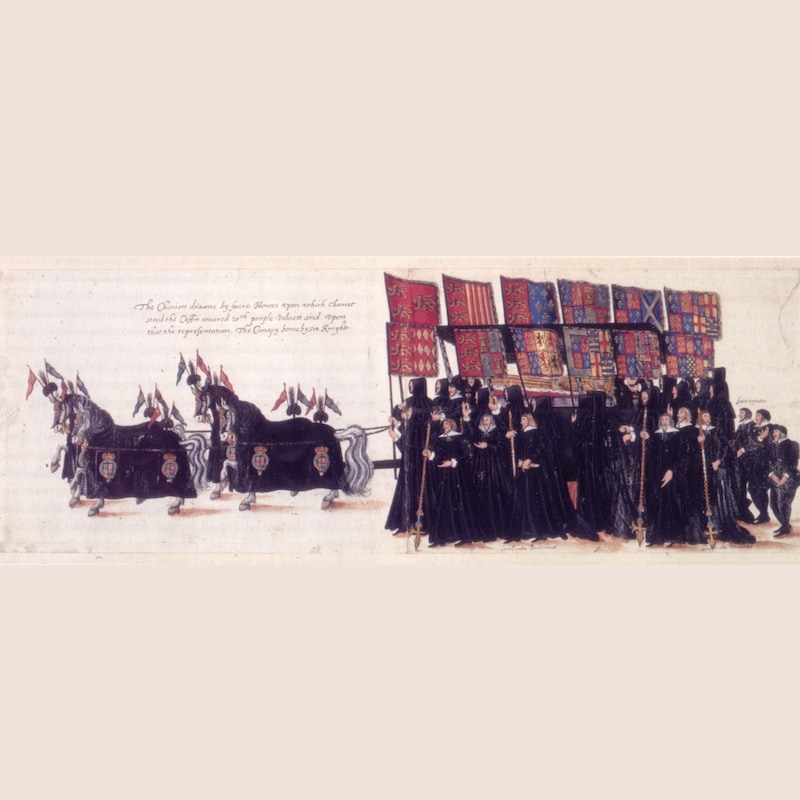
Artwork • Funeral of Queen Elizabeth I - April 28, 1603.
Published by janetwertman
Music • Drop, drop, slow tears. Sung by the Cambridge Chorale, in Ely Cathedral.
From a Poem by Phineas Fletcher (1582-1650), Composer is Orlando Gibbons 1583—1625).
Drop, drop, Slow tears, is a devotional reflection sung at Passiontide, but not specific to that season. Orlando Gibbons, joined text by the Jacobean poet and clergyman Phineas Fletcher to a hymn tune, Song 46, which was published in 1623.
Interestingly, the poet and composer are linked by their connection with King’s College Cambridge, where Gibbons was a chorister and Fletcher a student.
By the 1610s, Gibbons was the leading composer and organist in England.
His career was cut short when he died , aged 41, in 1625, which is thought to have been caused by the Plague.
Passiontide, in the Christian liturgical year, is a name for the last two weeks of Lent,
beginning on the Fifth Sunday of Lent, long celebrated as Passion Sunday, and continuing
through Lazarus Saturday.
It commemorates the suffering of Christ , Latin "passio" meaning is “suffering”.
Music 2 • Prevent Us, O Lord - Sung by Recordare Chamber Choir.
Composer William Byrd. c. 1540-1623
Manuscript: 1580 in Dow Partbooks, no. 58. The Dow Partbooks is a collection of five partbooks in Oxford around 1580. The collection includes choral and also instrumental pieces. Robert Dow was a trained calligrapher and the books are unusually easy to read among Tudor manuscripts.
© 20 26 The Rise of the Protestants., Author, Shaughan Holt.
"All rights reserved. No part of this podcast may be reproduced, translated, distributed, or transmitted in any form or by any means, including photocopying, recording, or other electronic or mechanical methods, without the prior written permission of the copyright holder, except in the case of brief quotations embodied in critical reviews and certain other non-commercial uses permitted by copyright law".
Requests regarding translation, licensing, or republication should be directed to: [email protected]
Your feedback matters,send me an email at [email protected], with any comments, suggestions, or criticisms. I read every message
Transcripts
© 20 26 The Rise of the Protestants., Author, Shaughan Holt.
"All rights reserved. No part of this podcast may be reproduced, translated, distributed, or transmitted in any form or by any means, including photocopying, recording, or other electronic or mechanical methods, without the prior written permission of the copyright holder, except in the case of brief quotations embodied in critical reviews and certain other non-commercial uses permitted by copyright law".
Requests regarding translation, licensing, or republication should be directed to: [email protected]
Your feedback matters, send me an email at [email protected], with any comments, suggestions, or criticisms. I read every message
Series 2.
Episode 7.
From Refugees to Millenary, and the new King.
The Seventeen Provinces of the Low Countries, particularly the Westkwartier area in Flanders, were economically significant, due to their production of the New Draperies, known as Says, in the early seventeenth century.
These lightweight woollen fabrics became popular among the gentry and burghers, seeking fashionable attire.
During the sixteenth century, this region was under the Habsburg's rule, but an economic crisis, made the textile workers, susceptible to the propaganda of Anabaptists and Calvinists, who were advocating for change.
The Dutch-speaking Flemish in the north, and the French-speaking Walloons in the south, felt exploited by their clergy, which in turn, led to a growing discontent with the Catholic Church, as they sought to improve their circumstances.
In the mid-16th century, many French-speaking Protestants, from the Walloon region, and Dutch-speaking Flemings, fled to England to escape warfare and religious persecution, by the Catholic Inquisition.
They settled, in large numbers, in places such as London and the south-eastern towns of Sandwich Maidstone Southampton, Dover, and Canterbury.
After Queen Elizabeth restored Protestantism, the Dutch refugee community in London grew significantly.
William Cecil, quickly recognised, the economic benefits, these skilled textile workers, brought to their host communities.
However, concerns about overcrowding in London, due to an influx of refugees, prompted the government to relocate some, including at least 150, to the Cinque Port of Sandwich between 15 61 and 15 66.
Among the refugees, were Reformed and Calvinist militants, who would go on to establish independent churches.
Sandwich, an ancient English port on the south-east coast, was a busy hub, with strong ties to the European Continent, especially the Low Countries.
The town was attractive to the Westkwartier refugees, due to its local yarn, markets, and the supportive local magistrates, who were focused on its economic improvement.
The Cinque Ports are an historic confederation of coastal towns, comprising Sandwich, Dover, Hythe, New Romney, and Hastings.
The name, which comes from Old French, simply means "Five Harbours”.
By 15 62, Sandwich had experienced a significant influx of Flemish refugees, as well as French and Walloon-speaking Calvinists, fleeing the increasing persecution against Protestants in Flanders.
This surge of newcomers, locally known as “Strangers”, raised concerns among the Sandwich Council, as the small port town had never encountered such a situation before.
And so, in 15 64, Sandwich's town governors, allowed St. Peter's Church on Market Street, to serve its Flemish and Dutch congregations.
By 16 05, Flemish and Dutch people, comprised about 20% of Sandwich's population, alongside British-born individuals of Dutch descent.
Second and third-generation Dutch descendants, began to influence the town's religious views, inspiring the Sandwich Separatists, to seek an independent community, free from the English Church.
St Peter’s is now a redundant Anglican church in Sandwich Kent designated as a Grade one, listed building.
A Norman church was established on the site around 11 00, but was likely destroyed during the French attack in 12 16.
The Carmelite friars rebuilt it in the 13th century, expanding the north aisle, and adding a Chantry chapel in the 14th century.
In 15 75, to help with the overcrowding problem in Sandwich, the Lord Warden of the Cinque Ports allowed a group of people known as the Walloons to move to Canterbury.
At that time, there were many empty houses in Canterbury because fewer people were visiting as pilgrims.
The Walloons were permitted to hold their church services at St. Alphege's Church, which is situated right across from the Archbishop's Palace.
They organised themselves into a group called a Consistory, to come together and take care of the needs of their community.
St. Alphege, Archbishop of Canterbury in the 11th century, was captured by Danish invaders in Ten Eleven, and after refusing to pay ransom, he was executed in Greenwich.
Initially buried at St. Paul's, his remains were moved to Canterbury Cathedral in 10 23.
The church is believed to have been founded around 10 30, and underwent significant renovations, following the Norman Conquest, around 10 70, when the tower and chancel were added.
Additional changes took place during the 13th and 15th centuries, further shaping the Cathedral's architectural character.
In the early 17th century, Robert Cushman, who helped secure the Mayflower, for the Leiden Separatists, was married there.
The separatists sailed in 16 20, and Cushman, later travelled to Plymouth Colony on the Fortune, with his son.
St. Alphege, ceased functioning as a church in 19 82, and is now home to the Canterbury Environmental Centre, serving as part of King's School, with restricted public access.
The refugees, arriving into England, mainly came from areas near Lille, Valenciennes, Tournai, and the Lys River valley.
The region, was well known for its strong Reformist tradition, and has a history, of intricate cloth manufacturing.
In Canterbury, the Walloon immigrants were quickly integrated into the city's weaving industry, creating job opportunities for local women and children, who spun, yarn, - while the cloth was woven in their homes.
They used high-quality wool, from Romney Marsh, along with silk and linen threads, to craft their high quality draperies.
The finished cloth, was then sent to London, or exported, leading to wealth for merchants, and master weavers.
After their arrival in Canterbury, the newcomers came to an agreement with the city authorities, that they would care for their own orphans, widows, the elderly, and the sick, knowing, the English Poor Laws would not provide assistance to them.
They also took responsibility, for their ministers' salaries, and the upkeep of the cathedral crypt.
Elders and deacons, collected donations and distributed communion tokens, clothing, and financial support.
As a result, many refugees passed through Canterbury, often receiving financial assistance to travel to London, or return home, to reconnect with family and check on their properties.
The Walloon church, sometimes known as the Consistory, included a minister, typically ten elders from the cloth trade, and eight deacons, assigned to the four, city quarters.
Antoine Lescaillet served as their first minister until he fell ill, and was replaced by Samuelle Le Chevalier, from London.
In 15 95, the plague returned to Cambridge, severely affecting the Walloons, who suffered a 10 percent population decline, resulting in the loss of many children.
Notable Walloon conformists, are memorialised in the cathedral, including Canon Richard Colfe and Archdeacon Hadrian à Saravia, the latter being a translator, for the King James Version of the Bible, and a co-author of the "Confessio Belgica”.
This confession, created in 15 61, aimed to clarify the Reformed faith, during the upheaval of the Spanish Inquisition in the Low Countries.
At that time, many Huguenots, the Protestant refugees from northern France, had joined the Walloons, to escape the wars of religion and persecution.
By the century's end, their community in Canterbury, had grown from just 25 families to over 2,500 members, within a population no larger than 9,000.
The congregation's size would continue to fluctuate, due to factors like assimilation and death, as well as the effects of the waves of repression and conflict, happening in France and the Low Countries.
Hadrian à Saravia, was born in 15 32 in Hesdin Flanders, to Protestant, Flemish and Spanish parents.
He joined the Franciscan Order in Saint-Omer, but left after converting to Protestantism in 15 57.
In 15 77, after spending time back in Flanders, he accepted a professorship at Leiden University.
On 9 June 15 85, Saravia wrote to William Cecil, urging Queen Elizabeth, to assume the protectorate of the Low Countries.
However, in 15 87, his support for the English Governor-General Robert Dudley, led to his dismissal from Leiden, causing him to relocate to England.
Dudley, a supporter of the Protestant movement, had angered Queen Elizabeth, by accepting the Dutch Governor-General position, which had resulted in his recall.
Soon after arriving in England, Saravia was appointed master, at a grammar school in Southampton, where he published treatises defending Episcopacy against Presbyterianism.
In 15 90, he authored a book, titled, "De diversis gradibus, ministerium Evangelii", which translates to, "On the Different Degrees of the Ministry of the Gospel".
In his book, Saravia advocated for Episcopacy, a position that sparked a controversy with Theodore Beza.
He was subsequently recognised, as a Doctor of Divinity at Oxford, on 9 June 15 90, and on 22 October 15 91, he received a prebend at Gloucester.
Doctors of Divinity, hold the highest academic standing at Oxford, while prebendaries historically received a fixed regular income, from land and are now, simply honoured clergy in the Church of England.
On 6 December 15 95, Saravia was appointed to a canonry at Canterbury, and later became vicar in Lewisham Kent, were he formed a close bond, with the theologian Richard Hooker.
He was present, to offer Hooker absolution, on his deathbed in November 16 00.
Between 16 04 and early 16 05, Saravia presented his Latin treatise on the Eucharist, to King James I of England.
However, his manuscript, remained unpublished in the Royal Library until 18 85, when Archdeacon G. A. Denison, finally brought it to light, complete with a translation and introduction.
In 16 07, he became a translator for the King James Version of the Bible, contributing from Genesis to the Second Book of Kings, and was notably the only non-English member of the team.
He passed away at 80, on 15 January 16 12, in Canterbury, and was buried in the cathedral, where his second wife, Margaret Wiits, erected a memorial for him.
The year is 16 00.
James Chilton, born around 15 56 in Canterbury, was the son of Lyonel Chilton and had deep historical roots, with records of his ancestor Robert Chilton in Parliament dating back to 13 39.
In 15 83, James became a freeman in Canterbury, working as a tailor.
A Leiden Separatist, he was the oldest passenger on the Mayflower in 16 20, and was a signatory to the Mayflower Compact.
James and his wife, Susanna, had seven children baptised in Canterbury between 15 87 and 15 99, later relocating to Sandwich, where they had three more children.
In Sandwich, Chilton met Moses Fletcher, and other Separatists who would later join the Leiden congregation in Holland.
Sandwich became a meeting point for the Kent Separatists, which would include future members of John Robinson's church.
Moses Fletcher, born around 15 64 in Kent, was a blacksmith, who married Mary Evans in 15 89 at Saint Peter's Church, where their ten children were baptised.
He journeyed to America alone, on the Mayflower in 16 20, and signed the Mayflower Compact.
On 27 September 16 00, John Smyth was appointed as the new city preacher of Lincoln, winning a narrow vote of eight to seven.
Replacing the incumbent, Thomas Luddington, he would also serve, as a private chaplain to a minor noble.
While he had the opportunity, to manage a much larger parish, he opted against it, mindful of the scrutiny it would invite.
The Corporation of Lincoln provided him with an annual stipend of £40, paid quarterly, and a housing allowance, along with permission to keep three cattle on common land.
As a dedicated Puritan, Smyth viewed himself as a pastor rather than a priest, emphasising Scripture's authority, while prioritising conversions in his ministry, which would often lead, to clashes with other councillors.
In 16 02, Puritans continued to criticise Elizabethan society, particularly the theatre, believing that secular entertainment, distracted from worship, and deeming boy actors in female roles, immoral.
Playwrights therefore would often mock them, with Shakespeare's Malvolio, in "Twelfth Night", being a notable example.
Dressed in all black, Malvolio is portrayed as a hypocritical character, at odds with the irresponsible Sir Toby Belch, and Sir Andrew Aguecheek, showcasing his desire to end their revelry.
Shakespeare, masterfully presents the Puritan viewpoint, while critiquing, what he perceives as their excessive zeal.
In 16 02, at about twelve years old, William Bradford, influenced by scripture readings, faced pressure from his uncles to work on their farm.
He suffered, from what he called a "long sickness," which allowed him time, to read the Bible and classic literature.
His interest grew, after learning about Reverend Richard Clyfton, a preacher in Babworth known for his impactful sermons.
Despite facing community disapproval, he felt compelled to attend Clyfton's services.
His journey from Austerfield to Clyfton's church would have taken him past William Brewster's house in Scrooby, where Brewster, the postmaster and bailiff, likely knew Bradford's family.
William met the older Brewster when he was about twelve or thirteen, and Brewster, then in his late thirties, took him in, teaching him Latin, Greek, and religious studies.
They would travel to Babworth together, to attend Richard Clyfton's sermons.
His teachings, emphasised, that everyone has the right to discuss the Bible, parishioners should actively engage in services, and individuals can communicate with God, outside of the official Book of Common Prayer.
Amid the religious turmoil in England, the young orphan, William Bradford, grew increasingly engaged with the Separatists.
The Church of All Saints in Babworth, where he and William Brewster attended services, still stands today.
Richard Clyfton preached there, and although the church is part of the Church of England now, with many decorative features, Puritans like Clyfton disapproved of them.
Bradford, a devoted Puritan, would separate from the Church of England in 16 06, spending, over a decade in Holland, before sailing to North America on the Mayflower in 16 20.
For more than 30 years, Bradford served as the governor of Plymouth Colony, chronicling his experiences, in a journal, that has become the definitive narrative, of the Pilgrims and their settlement.
In Lincoln, Smyth's blunt preaching style continued to face growing opposition, particularly from Luddington, a former city preacher with many loyal supporters.
This political tension put Smyth's position at risk, especially after he was accused of disrespecting the city fathers in a sermon.
On 2 September 16 02, Smyth's friends attempted to secure his position.
However, it was revealed, that he not only lacked a preaching license, but had also previously been barred from any ministry, by the bishop.
Consequently, the city council dismissed him and revoked his stipend, electing Luddington as City Preacher.
Feeling threatened, Smyth considered legal action, but the Corporation, were able to provide evidence that the Bishop, also disapproved of his teachings.
Lincoln Corporation reran the election, resulting in Mr. Dalby being elected as City Preacher over Luddington by twelve votes.
John Smyth, dissatisfied with the outcome, escalated the dispute to Lord Sheffield, who ultimately resolved the matter to everyone's satisfaction.
Smyth stayed in Lincoln, to decide his future path, and began supporting his family by practising medicine, as obtaining a licence, was not required at that time.
Lincoln Cathedral, constructed in the Norman style and consecrated in 10 92 by Remigius, a bishop associated with William the Conqueror, symbolised, Norman authority in England.
After experiencing damage from a fire in 11 41 and a local earthquake in 11 85, extensive rebuilding took place.
This major renovation marked the beginning of the beautiful Gothic style that the cathedral is famous for today.
Bishop Hugh of Avalon, oversaw the reconstruction, which introduced a new choir and eastern transept, along with the iconic, Lincoln Imp,—a hidden grotesque figure, carved around the same time as the Angel Choir, built between 12 50 and 12 80.
Although its spire was removed in the 16th century, due to structural concerns, Lincoln Cathedral remains a remarkable and dominant feature of the landscape.
The cathedral has also played a significant role in the history of England.
It was one of the original sites for the Magna Carta, a charter, established in the thirteenth century, to safeguard the rights and properties of barons, against a tyrannical ruler.
Notably, one of the four surviving original copies of the Magna Carta is preserved in the nearby Lincoln Castle.
For nearly a thousand years, Lincoln Cathedral has been a centre for Christian worship, and continues to serve, as the home of the Bishop of Lincoln.
The year is 16 03.
Queen Elizabeth's health, had started to decline in autumn 16 02, following the deaths of some close friends, especially Catherine Carey and Lady Knollys, which led her into a profound depression.
By March 16 03, she grew increasingly ill and motionless, finally passing away, on 24 March at Richmond Palace.
Shortly afterwards, Sir Robert Cecil and the council, now set their plans in motion, proclaiming James VI of Scotland as the new King of England.
Elizabeth's coffin was secretly transported to Whitehall, in readiness for her funeral procession to Westminster Abbey on 28 April, which was carried by a hearse, draped in black velvet.
Although a Protestant, Elizabeth retained some Catholic symbols, and pragmatically balanced religious policies, seeking to appease both Catholics and English Protestants, while resisting the extreme changes proposed by Puritans.
After Elizabeth's death on 24 March 16 03, James VI of Scotland, ascended to the English throne, marking the, "Union of the Crowns".
He had become King of Scotland, at just thirteen months old on 29 July 15 67, and was crowned, alongside his wife, Anne of Denmark, on 25 July 16 03 at Westminster Abbey, the first coronation, held in English rather than Latin.
The Coronation Music featured "O Lord, Grant the King a Long Life," inspired by Psalm 61.
This anthem, attributed to Thomas Weelkes or Thomas Tomkins, was included in the 16 62 Book of Common Prayer, and was recently performed, at King Charles III's coronation on 6 May 20 23.
A plague outbreak in London, delayed the Royal couple's entry into the city until 15 March 16 04.
This epidemic was the first of the 17th century, and marked the transition, from the Tudor to the Stuart period, as Elizabeth was the last monarch of the Tudor dynasty.
Despite being King of England and Scotland, James faced challenges in unifying the governments.
While popular in Scotland, he struggled with the English Parliament's resistance, to his, absolutist ambitions.
Ongoing issues, such as poor financial management, and unpopular favouritism, further complicated his reign.
However his reign did see a flourishing of the arts and sciences, reminiscent of the Elizabethan Age.
As a scholar, he played a crucial role in creating the King James Bible, the authorised version for the Anglican Church.
On 5 April 16 03, James had left Edinburgh, intending to travel to London for his coronation as King James I of England.
The Puritans were hopeful, when James VI of Scotland was named King of England, as he was raised in a Protestant environment, despite having a Catholic mother, Mary Queen of Scots.
Protestantism heavily influenced his upbringing, as Scotland had adopted this faith under the leadership of John Knox.
The more moderate Puritans were hopeful that James would continue the reforms, that they were unable to implement during Elizabeth's reign, creating excitement about his upcoming rule.
The Millenary Tract Petition - April 16 03.
In 16 03, anticipating the new Protestant king, Puritan ministers had gathered signatures, for the Millenary Petition, named for the nearly 1,000 clergy members who allegedly signed it.
This advance delivery was presented privately to King James in Leicester, to prevent prior discussion, and interference from the Bishops.
The petition, called for reforms, to eliminate rituals perceived as Catholic, while being careful to avoid challenging Royal Supremacy, within the Church of England.
Key proposals included, appointing a preaching minister for each parish, instead of just reading from the Book of Common Prayer, and to allow ministers to subscribe, only to the Thirty-Nine Articles, and no more.
It opposed Archbishop John Whitgift's policies, and suggested replacing Episcopacy, with a Presbyterian governance model.
In response, James agreed to hold a conference in London, for debate on the proposed reforms.
When he finally arrived in London on 7 May 16 03, just nine days after Elizabeth's funeral, James was taken aback, by the wealth and size of his new kingdom.
Francis Johnson and Henry Ainsworth who were leaders of the Ancient Church, a Brownist congregation based in Amsterdam, made their way to London, independently of the English Puritans, aiming to gain a private audience with the new king.
They intended to present a justification, for their congregation's views, on the need for Church of England reform, and to seek permission to return to England, where they hoped to worship freely, according to their beliefs.
After some meetings with lower officials, and after submitting a summary of their views for discussion, Johnson and Ainsworth accomplished nothing, and had to return to Amsterdam.
Back home, they revised their petition twice, publishing it under the title, of, "An Apology, or Defence of True Christians, Commonly and Unjustly Called Brownists".
Before Queen Elizabeth's death, Edwin Sandys had visited King James VI of Scotland, to pay his respects.
When James took the English throne in 16 03, he knighted Sandys, showing his trust and appreciation for his loyalty.
Edwin Sandys was born on 9 December 15 61 in Worcestershire, the second son of Archbishop Edwin Sandys.
He attended Merchant Taylors' School, and later Corpus Christi College Oxford.
Sir Edwin Sandys served in the House of Commons from 15 89 to 16 26, and was a founder of the Virginia Company of London, which established the first permanent English settlement in Jamestown Virginia, in 16 06.
